R E S E A R C H
Open Access
On a generalized Gerber-Shiu function in a
compound Poisson model perturbed by
diffusion
Chaolin Liu
*and Zhimin Zhang
*Correspondence: [email protected]
College of Mathematics and Statistics, Chongqing University, Chongqing, China
Abstract
In the spirit of a publication by Cheung in 2013 we study generalized Gerber-Shiu functions in the compound Poisson risk model perturbed by diffusion. These generalized Gerber-Shiu functions can be used to analyze the moments of the total discounted claim costs until ruin. Integral equations for the generalized Gerber-Shiu functions are derived and a solution procedure is also provided. Some explicit results are given when the claim size density is a combination of exponentials, and some numerical results are also given.
Keywords: Generalized Gerber-Shiu function; integral equations; Laplace transform; combination of exponentials
1 Introduction
In this paper, we describe the surplus process of an insurance company by the following compound Poisson risk model perturbed by diffusion:
U(t) =u+ct– N(t)
i=
Xi+σB(t), (.)
whereu≥ is the initial surplus,c> is the incoming premium rate per unit time. The counting process
N(t) =max{n:V+· · ·+Vn≤t}
is a homogeneous Poisson process with intensityλ> , whereVis the time until the first claim arrival, and fori≥,Viis the inter-claim time between the (i– )th claim and the
ith claim. Fork≥, letTk=
k
i=Vibe thekth claim arrival time. The claim sizes{Xi}∞i= are positive continuous random variables which form an i.i.d. sequence distributed like a generic variableXwith density functionfXand Laplace transformfX(s) =
∞
e
–sxf X(x)dx. In addition,σ> is the diffusion coefficient and{B(t)}t≥is a standard Brownian motion. Finally, we assume that{N(t)},{Xi}, and{B(t)}are mutually independent.
The perturbed compound Poisson risk model, first proposed by Gerber [], is an exten-sion of the classical risk model by adding diffuexten-sion process to denote small volatility in
the surplus process. Since then, a lot of contributions have been made to this model and its extension. Seee.g.Tsai and Willmot [] for the compound Poisson risk model, Li and Garrido [] for a Sparre Andersen risk model with Erlang inter-claim times, Zhang and Yang [] for a perturbed compound Poisson model with dependence between inter-claim times and claim sizes, and Zhanget al.[] for a Sparre Andersen risk model with time dependent claim sizes.
In ruin theory, one of the effective tools to study ruin related problems is the expected discounted penalty function (also known as Gerber-Shiu function) proposed by Gerber and Shiu []. It provides a unified approach to study the time to ruin, the surplus before ruin and the deficit at ruin. Recently, some generalized Gerber-Shiu functions are pro-posed by some researchers to study other ruin related quantities. For example, Caiet al.
[] propose a generalized discounted penalty function that can be used to study the total discounted operating costs up to ruin; Cheung [] considers a generalized Gerber-Shiu type function that can be used to analyze the moments of the total discounted costs up to ruin in a Sparre Andersen risk model with general inter-claim times; Cheung and Woo [] study the discounted aggregate claim costs in a class of dependent Sparre Andersen risk models.
For risk model (.), we define the ruin time by
τ=inft≥ :U(t)≤,
whereτ =∞ifU(t) > for allt≥. In this paper, we study the following generalized Gerber-Shiu type function proposed by Cheung []:
φn(u) =E
e–ατ
N(τ)
k=
e–δTkθ(X k)
n
wU(τ)I(τ<∞)U() =u
, (.)
whereα,δ≥ are the forces of interest; nis a nonnegative integer; wis a nonnegative penalty function that depends only on the deficit at ruin;I(A) is the indicator function of eventA. The random variablek=N(τ)e–δTkθ(X
k) can be interpreted as the total discounted
claim costs until ruin, whereθ(·) is the ’cost’ function of a given claim size. We remark that the expected total discounted claim costs have been studied by Caiet al.[] in the com-pound Poisson model. For higher order moments (n> ), we refer the interested readers to Cheung []. To the best of our knowledge, there has been no contribution to this gen-eralized Gerber-Shiu function in the diffusion perturbed risk model.
Due to the existence of Brownian motion, ruin can be caused by claims or diffusion oscillation. Hence, we decomposeφn(u) as follows:
φn,w(u) =E
e–ατ
N(τ)
k=
e–δTkθ(X k)
n
wU(τ)Iτ <∞,U(τ) < U() =u
,
φn,d(u) =w()E
e–ατ
N(τ)
k=
e–δTkθ(X k)
n
Iτ<∞,U(τ) = U() =u
It follows thatφn,w(u) is the generalized Gerber-Shiu function when ruin is due to a claim. In particular, whenn= ,
φ,w(u) =E
e–ατwU(τ)Iτ<∞,U(τ) < |U() =u
is the traditional discounted penalty function of the deficit at ruin when ruin is caused by a claim, which has been studied extensively in ruin theory. In the remainder of this paper, whenever we talk aboutφn,d(u), we suppose thatw() = , and for the casen= , we mean
φ,d(u) =E
e–ατIτ<∞,U(τ) = |U() =u,
which is the Laplace transform of the ruin time when ruin is caused by oscillation. For applications of the above general discounted penalty functions, we refer the interested readers to Cheung [].
The paper is organized as follows. In Section , we derive integral equations forφn,w(u) andφn,d(u), and propose a recursive approach to solve the integral equations. In Section , we derive some explicit expressions when the claim size density is a combination of expo-nentials. Some numerical examples are illustrated in Section .
2 Integral equations and the solutions
In order to derive integral equations forφn,w(u) andφn,d(u), we need to condition on the surplus level immediately before the first claim arrival time. To this end, for q≥ we introduce the followingq-potential measure:
R(q)(u,dx) =
∞
e–qtPru+ct+σB(t)∈dx,t<τ–dt,
whereτ–
=inf{t≥ :u+ct+σB(t)≤}. Let
s,q=
–c+c+ σq
σ , s,q=
–c–c+ σq
σ
be the roots of the quadratic equation (ins)
σ
s+cs–q= .
It follows from Theorem . and Corollary . in Kyprianou [] thatR(q)(u,dx) admits a density which is such thatR(q)(u,dx) =r(q)(u,x)dxand is given by
r(q)(u,x) =e–s,qxW(q)(u) –W(q)(u–x),
whereW(q)is aq-scale function defined asW(q)(x) = forx< and
W(q)(x) = e
s,qx–es,qx
σ
forx≥. More explicitly, we have
Now we are ready to derive integral equations for the generalized Gerber-Shiu func-tions. First, we considerφn,w(u). Conditioning on the time of the first claim arrival and distinguishing whether or not ruin occurs due to the first claim, by binomial expansion we obtain
Similarly, we have
We use Laplace transform method to solve integral equations (.) and (.). In the re-mainder of this paper, we denote the Laplace transform of a function by adding a hat on the corresponding letter. For example,
For notational convenience, we set
s,n=s,λ+α+nδ, s,n=s,λ+α+nδ.
ForRe(s) > , multiplying both sides of (.) bye–suand then performing integration from to∞gives
It follows from (.) that
∞
Hence, by changing the order of integrals we can obtain
Substituting (.) and (.) back into (.) we find that
Rearranging terms in the above equation gives rise to
Similarly, we can obtain from (.)
To make the following analysis more transparent, we introduce the Dickson-Hipp oper-atorTs(seee.g.Dickson and Hipp []), which for any integrable functionf on (,∞) and any complex numberswithRe(s)≥ is defined as
The following commutative property will be used in the sequel:
TsTrf(y) =TrTsf(y) =Tsf(y) –Trf(y)
r–s , y≥,
for complex numberss=r.
By Gerber and Landry [] we know that the following generalized Lundberg equation:
σ
s+cs– (λ+α+nδ) +λf
X(s) = (.)
has a unique nonnegative root, sayρα+nδ. By subtraction we have
Settings=ρα+nδin (.) gives
Applying some arrangements to the above two equations results in
and
Inverting the Laplace transforms in (.) and (.) we obtain the following result.
Proposition The generalized Gerber-Shiu functionsφn,w(u)andφn,d(u)satisfy the
fol-lowing integral equations:
φn,w(u) =
The integral equations (.) and (.) are defective renewal equations since
∞ By renewal theory, we can express the solutions to (.) and (.) as follows:
and
φn,d(u) = n–
j=
n
j
u
p,n,j(u–x)Tρα+nδφj,d(x) +p,n,j(u–x)φj,d(x)
dx, (.)
where
pn(u) =ζn(u) +
u
Sn(u–y)ζn(y)dy,
pi,n,j(u) =χi,n,j(u) +
u
Sn(u–y)χi,n,j(y)dy, i= , .
It follows from (.) and (.) that we can computeφn,w(u) andφn,d(u) recursively with the starting pointsφ,w(u) andφ,d(u). Forφ,w(u), settingn= in (.) gives
φ,w(u) =p(u) =ζ(u) +
u
S(u–y)ζ(y)dy. (.)
Forφ,d(u), it follows from Tsai and Willmot [] that the following defective renewal equa-tion holds:
φ,d(u) =
u
φ,d(u–x)g(x)dx+e –(ρα+c
σ)u. (.)
Hence,
φ,d(u) =e–(
ρα+c
σ)u+
u
S(u–x)e–(
ρα+c
σ)xdx. (.)
3 Explicit results
In this section, we assume that the individual claim size is distributed as a combination of exponentials with density
fX(x) = m
i=
ηiμie–μix, x> , (.)
whereμ, . . . ,μm> ,η, . . . ,ηmare distinct constants such thatmi=ηi= . It is well known that the class of combinations of exponentials can be used to approximate any absolutely continuous distribution on (,∞) (seee.g.Dufresne []). We assume that the cost func-tion is a linear funcfunc-tion with the following form:
θ(x) =θ+θx, (.)
where θ,θ≥, andθ+θ> . Hence, each claim cost comprises a fixed costθand a proportional part with coefficientθ. It follows from (.) and (.) that we need to determine the functionspn(u),p,n,j(u),p,n,j(u) as well as the starting valuesφ,w(u) and
3.1 Determination ofpn(u)
By Laplace transform we have
pn(s) =
is a polynomial with degreem– . By partial fraction we have
where
By Laplace inversion we obtain the following result.
Proposition Suppose that–Rn,, . . . , –Rn,m+are distinct.Ifθ= andθ= ,then
Next, we consider the caseθ= . By binomial expansion we have
By (.) and (.) we have
Inverting the Laplace transforms in (.) yields the following result.
Proposition Suppose that–Rn,, . . . , –Rn,m+are distinct.Ifθ= ,then
where the last step follows from (.). By partial fraction we have
where
Kn,j,i=
σγn–j(ρα+nδ) m
k=(μk–Rn,i)
m+
k=,k=i(Rn,k–Rn,i)
, i= , , . . . ,m+ .
Then Laplace inversion gives the following result.
Proposition Suppose that–Rn,, . . . , –Rn,m+are distinct.Then
p,n,j(u) = m+
i=
Kn,j,ie–Rn,iu. (.)
Now we considerp,n,j(u), which has the Laplace transform
p,n,j(s) =
+Sn(s)
χ,n,j(s) =
χ,n,j(s) –gn(s)
. (.)
First, for the caseθ= andθ= , we have
χ,n,j(s) =
σ
s+ρα+nδ+σc
TsTρα+nδγn–j()
= λ σθ
n–j
s+ρα+nδ+σc
fX(s) –fX(ρα+nδ) ρα+nδ–s
= λ σθ
n–j
s+ρα+nδ+σc
m
i=
ηiμi (s+μi)(ρα+nδ+μi)
.
Hence, by (.) and (.) we have
p,n,j(s) =
Wn,j(s)
m+
i= (s+Rn,i) ,
where
Wn,j(s) =
s+ρα+nδ+
c σ
χ,n,j(s)
m
i= (s+μi)
is a polynomial with degreem– . By partial fraction we can obtain
p,n,j(s) = m+
i=
Wn,j,i
s+Rn,i ,
where
Wn,j,i=
Wn,j(–Rn,i)
m+
j=,j=i(Rn,j–Rn,i)
, i= , , . . . ,m+ .
Proposition Suppose that–Rn,, . . . , –Rn,m+are distinct.Ifθ= andθ= ,then
which has the Laplace transform
which has Laplace transform
By (.) and (.) we have
Finally, Laplace inversion gives the following result.
Hence, Laplace inversion gives
φ,d(u) = m+
i=
Ad,ie–R,iu. (.)
4 Numerical illustrations
In this section, we present some numerical examples. First, we compute the expected number of claims until ruin. We setc= .,λ= ,δ=α= ,σ= .,w≡,θ
= , and
θ= . We consider the exponential claim size densityfX(x) =e–x. In Figure (a), we depict
the curves of
Meann,d(u) :=EN(τ)Iτ<∞,U(τ) = |U() =u, Meann,w(u) :=EN(τ)Iτ<∞,U(τ) < |U() =u, Meann(u) =Meann,d(u) +Meann,w(u).
We observe that Meann,d(u), Meann,w(u) and Meann(u) start from zero, then increase w.r.t.u, and finally decrease to zero asu→ ∞. This is due to the fact that ruin occurs immediately for zero initial surplus, and ruin is unlikely to occur for large initial surplus. Instead, if we consider the condition means
CMeann,d(u) :=E
N(τ)IU(τ) = |τ<∞,U() =u, CMeann,w(u) :=E
N(τ)IU(τ) < |τ <∞,U() =u, CMeann(u) =Meann,d(u) +Meann,w(u),
it follows from Figure (b) that they are increasing functions ofuand almost linear func-tions for large enoughu.
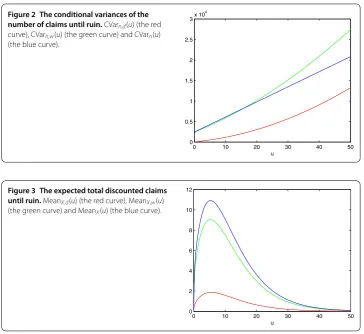
Figure 2 The conditional variances of the number of claims until ruin.CVarn,d(u) (the red curve), CVarn,w(u) (the green curve) and CVarn(u) (the blue curve).
Figure 3 The expected total discounted claims until ruin.MeanX,d(u) (the red curve), MeanX,w(u) (the green curve) and MeanX(u) (the blue curve).
We also study variances of the number of claims until ruin conditional on ruin occurring, which are defined as
CVarn,d(u) =Var
N(τ)IU(τ) = |τ<∞,U() =u, CVarn,w(u) =VarN(τ)IU(τ) < |τ<∞,U() =u, CVarn(u) =Var
N(τ)|τ<∞,U() =u.
We plot the conditional variances in Figure . It follows that the conditional variances CVarn,d(u) andCVarn,w(u) behave like quadratic functions ofuas the initial surplus
be-comes large, while the total conditional varianceCVarn(u) behaves like a linear function ofufor large initial surplus.
Next, we consider the expected total discounted claims until ruin. With the other set-tings as above, we setδ= .,θ= , andθ= . For the following functions:
MeanX,d(u) =E
N(τ)
k=
e–δTkX kI
τ<∞,U(τ) = U() =u
,
MeanX,w(u) =E
N(τ)
k=
e–δTkX kI
τ<∞,U(τ) < U() =u
,
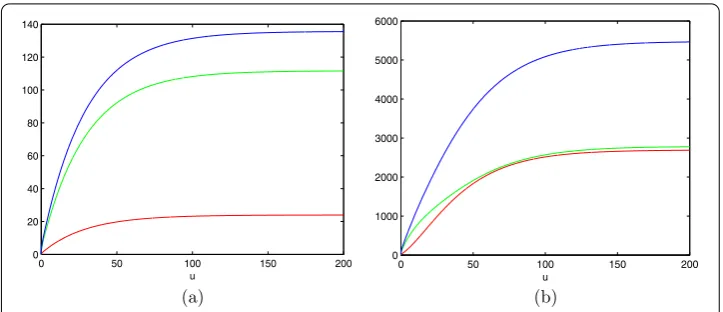
Figure 4 The mean and variance of total discounted claims until ruin conditional ruin occurring. (a)CMeanX,d(u) (the red curve), CMeanX,w(u) (the green curve), CMeanX(u) (the blue curve);(b)CVarX,d(u) (the red curve), CVarX,w(u) (the green curve), CVarX(u) (the blue curve).
it follows from Figure that they have the same behavior as the expected number of claims until ruin, which can be explained as above. Furthermore, we study the mean and variance conditional on ruin occurring, which are defined as
CMeanX,d(u) =E
N(τ)
k=
e–δTkX kI
U(τ) = τ<∞,U() =u
,
CMeanX,w(u) =E
N(τ)
k=
e–δTkX kI
U(τ) < τ<∞,U() =u
,
CMeanX(u) =CMeanX,d(u) +CMeanX,w(u),
CVarX,d(u) =Var
N(τ)
k=
e–δTkX kI
U(τ) = τ<∞,U() =u
,
CVarX,w(u) =Var
N(τ)
k=
e–δTkX kI
U(τ) < τ<∞,U() =u
,
CVarX(u) =Var
N(τ)
k=
e–δTkX k
τ<∞,U() =u
.
We find from Figure that the conditional means and variances are increasing functions ofuand converge to some finite constants asu→ ∞. The finite limit behavior has also been found by Cheung [].
Finally, we consider the case whenfXis a combination of exponentials with the following setting:
fX(x) = .e–x+ .e–.x.
Furthermore, we setc= .,λ= ,σ= .,δ= .,α= , and the cost functionθ(x) =
x+ ..
CMeanθ,d(u) =E
N(τ)
k=
e–δTkθ(X k)I
U(τ) = τ <∞,U() =u
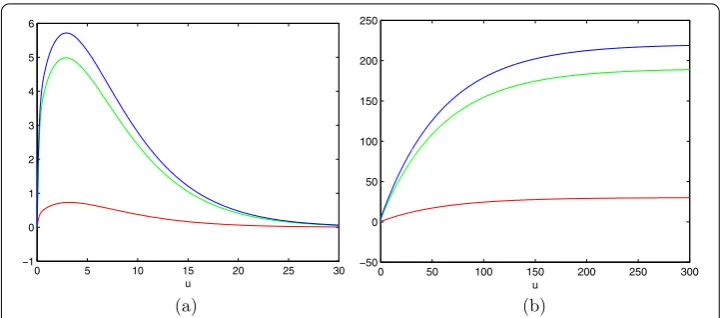
Figure 5 The mean and conditional mean of total discounted claim costs until ruin conditional ruin occurring. (a)φ1,d(u) (the red curve),φ1,w(u) (the green curve),φ1,d(u) +φ1,w(u) (the blue curve);
(b)CMeanθ,d(u) (the red curve), CMeanθ,w(u) (the green curve), CMeanθ(u) (the blue curve).
CMeanθ,w(u) =E
N(τ)
k=
e–δTkθ(X k)I
U(τ) < τ<∞,U() =u
,
CMeanθ(u) =CMeanθ,d(u) +CMeanθ,w(u).
In Figure , we plot the means and conditional means of the total discounted claim costs until ruin. Again, we observe that the means start from zero, then increase, and finally decrease to zero, however, the conditional means increase to some finite constants.
Competing interests
The authors declare that they have no competing interests.
Authors’ contributions
All authors contributed equally and significantly in writing this article. All authors read and approved the final manuscript.
Acknowledgements
The authors would like to thank two anonymous referees for their helpful comments and suggestions, which improved an earlier version of the paper. This work is supported by the National Natural Science Foundation of China (11101451, 11471058) and the Natural Science Foundation Project of CQ CSTC of China (cstc2014jcyjA00007).
Received: 23 October 2014 Accepted: 16 January 2015 References
1. Gerber, HU: An extension of the renewal equation and its application in the collective theory of risk. Skand. Aktuarietidskr.1970, 205-210 (1970)
2. Tsai, CCL, Willmot, GE: A generalized defective renewal equation for the surplus process perturbed by diffusion. Insur. Math. Econ.30, 51-66 (2002)
3. Li, S, Garrido, J: The Gerber-Shiu function in a Sparre Andersen risk process perturbed by diffusion. Scand. Actuar. J.
2005, 161-186 (2005)
4. Zhang, Z, Yang, H: Gerber-Shiu analysis in a perturbed risk model with dependence between claim sizes and interclaim times. J. Comput. Appl. Math.235, 1189-1204 (2011)
5. Zhang, Z, Yang, H, Yang, H: On a Sparre Andersen risk model with time-dependent claim sizes and jump-diffusion perturbation. Methodol. Comput. Appl. Probab.14, 973-995 (2012)
6. Gerber, HU, Shiu, ESW: On the time value of ruin. N. Am. Actuar. J.2, 48-72 (1998)
7. Cai, J, Feng, R, Willmot, GE: On the total discounted operating costs up to default and its applications. Adv. Appl. Probab.41, 495-522 (2009)
8. Cheung, ECK: Moments of discounted aggregate claim costs until ruin in a Sparre Andersen risk model with general interclaim times. Insur. Math. Econ.53, 343-354 (2013)
9. Cheung, ECK, Woo, JK: On the discounted aggregate claim costs until ruin in dependent Sparre Andersen risk processes. Scand. Actuar. J. (2014, in press).
http://www.tandfonline.com/doi/abs/10.1080/03461238.2014.900519#.VMjdztKl8oE
12. Gerber, HU, Landry, B: On the discounted penalty at ruin in a jump-diffusion and the perpetual put option. Insur. Math. Econ.1998, 263-276 (1998)