Effect of Type of Substrate, Ions and Aeration
on Photo-catalytic Oxidation of Phenol
Prof.Jayant M Modak1, Yogiraj K Shetty1, Sarangraj Balakrishnan2
Department of Chemical Engineering, Indian Institute of Science, Bengaluru, India1
Panasonic India Pvt Ltd, Bengaluru, India 2
ABSTRACT: The effect of different parameters on photo-catalytic oxidation of phenol was studied. Photo-catalytic oxidation of phenol in various substrates - groundwater, miliq water &evian water was studied. Rate of the reaction in various experimented substrate was found to be in the following order: Milliq> Evian Water> Groundwater, presence of ions in the substrate decided the rate of the reaction. Effect of various ions- calcium, magnesium, carbonate, chloride and bi-carbonate, which were abundantly found in water, was studied. Cations – magnesium and calcium had no effect on the rate of reaction, whereas anions had detrimental effect on the rate of reaction. Aeration of solution had positive effect on the rate of reaction.
KEYWORDS: Photo-catalytic oxidation, Phenol, Ions, Aeration, Milliq water (de-ionised water), Groundwater, Rate Constant.
I. INTRODUCTION
Phenol compounds have turned out to be a major pollutant in water bodies because of their extensive usage in daily life and industries. Phenol is stable hence remain in environment for longer period of time [1] . Moreover, high toxic nature of phenol makes them dangerous causing various health problems. Hence there is an alarming need for an economic method for the removal of phenol from water [2]. Lot of research is being carried out on photo-catalytic treatment of phenol in waste water, as it has shown some promising results ([3]; [4]; [5]).
A photo-catalyst is a substance capable of accelerating reaction, wherein it is being activated by adsorbing photon. Photo-catalysts are mainly semiconductors which has enormous potential to treat organic contaminants. This process is known as advanced oxidation process (AOP) [6]. Photo-catalytic degradation is an AOP which involves generation of oxidising species like hydroxyl radicals that takes part in reaction accelerated by the presence of catalyst.
Various semiconductors can act as photo-catalyst but TiO2 was found to be the most effective one which can carry out
complete mineralization of phenol in water ([6]; [7]; [8]; [9]). Salient features of TiO2 which makes it a widely chosen
photo-catalyst is its non-toxicity, insolubility in water and inexpensive ([10], [11]). Though TiO2 is an effective
photo-catalyst but its fast charge carrier recombination and recycling difficulties is a major concern. Hence, usage of supporting materials like carbon, clay and zeolite is a cogent solution. Of these supporting materials, Zeolite is the best because of its standalone properties such as high surface area, good thermal stability and high absorption towards organic compounds [12]. Hence, for this study TiO2/ Zeolite was used as a catalyst.
II. EXPERIMENTAL
A. Materials:
B. Instruments:
Max 303 (ASAHI SPECTRA) Compact Xe Light Source with UV radiation of wavelength 350nm with an intensity of 1 mW/cm2, HPLC Unit 1220 Infinity LC (Agilent Technologies), Stirrer -IKA RO 10 magnetic stirrer RO10 magnetic stirrer.
C. Degradation Experiment:
The photo-catalytic experiments were carried out on 1ppm phenol solution prepared in separate 100ml solution. In all experiments conducted, 0.1g of catalyst (0.025g of TiO2 and 0.075g of Zeolite) was added to the bottle containing
phenol solution. This was followed by sonication for about 5min in a sonicator and then a subsequent stirring on a magnetic stirrer for about 2hr. 2ml of the sample was filtered and collected at the 0min sample. 5ml of the sample was transferred to a 5ml PFA vessel and subjected to UV light for a time period of 1min. After exposure to radiation for the stipulated time, 2ml of sample was pipetted from the 5ml vessel, filtered and collected separately. The same procedure was followed for the time period of 2, 4, 6, 8, 10 and 12 min. The samples were then analysed using HPLC equipment. A set of experiments were carried out with MilliQ, groundwater and evian water. The degradation rate of phenol in each of these solutions was compared with each other. With an objective to analyse the individual effect of different ions on the rate of degradation of phenol experienced in J.N Tata groundwater, different solutions were prepared with the concentration of various ions ( Ca, Mg, Cl, CO3, HCO3) equivalent to that found in groundwater and finally an
artificial groundwater was prepared and the degradation experiments were executed. Chemicals used to get the concentration of a particular ion for the study was chosen such that the neighbouring ion of the corresponding chemical has least effect on the rate of reaction [10]. Given below in Table 1 is the list of chemicals used for the preparation of corresponding ion concentration.
Table 1. Chemicals used for preparation of solution of corresponding ions
With an objective to understand the effect of aeration on rate of reaction, groundwater and milliq water were aerated for two hours before carrying out the degradation experiments.
III.RESULT AND DISCUSSION
A. Effect of Substrate
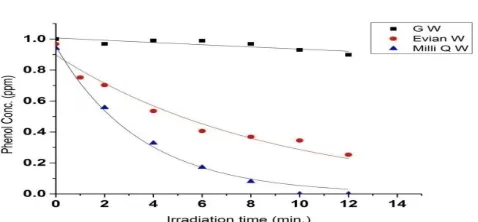
Figure 1. Degradation of phenol in (a) milliQ water (b) Groundwater (c) Evian water Sl. No Ion Chemical Used
Figure 1, which is the plot of concentration of phenol against time, shows that the rate of reaction in different substrates is in the following order: milliQ water >evian water > groundwater. That is, the rate of photo-catalytic oxidation of phenol is highest in milliq water and least in groundwater.
Table 2. Rate Constant for photo-catalytic oxidation of phenol in different substrate
The rate constant (slope of the curve for following reactions) for the reactions in various substrates are given in Table 2 which are in the following order: milliQ water >evian water > groundwater.
Presence of ions in the substrate is the decisive factor affecting the rate of reaction. Groundwater comparatively has lot of ions, whereas milliq is de-ionized water ([13]; [14]). Lot of studies have been carried out with an objective to find the effect of inorganic ions on the photo-catalytic degradation of organic contaminants ([15]; [16]; [17]; [18]; [19]; [13]; [20]). Various mechanisms for the fouling of catalyst by inorganic ions have been proposed. According to one of the mechanism displacement of hydroxide ions from the surface of TiO2 by inorganic anions thereby further reducing the generation of radicals results in decrease of rate of reaction ([10]; [21]).Hence, rate of photo-catalytic oxidation of phenol is least in groundwater and maximum in milliq water.
B. Effect of Ions
As discussed earlier, the reason for low rate of degradation of phenol in groundwater is the presence of inorganic ions. With an objective to determine the individual effect of each ion on the final rate of degradation of phenol in groundwater, different solutions were prepared with the concentration of various ions equivalent to that found in groundwater.
Table 3. Concentration of different ions in groundwater.
Concentration of different ions in groundwater was found out of which concentration of carbonate, chloride, bi-carbonate, calcium and magnesium were dominant. Abundantly found ions were considered for analysis and the concentration of these ions in groundwater is given in Table 3.
Type of Substrate Rate Constant (min^-1)
Milliq Water 0.310
Groundwater 0.009
Evian Water 0.114
Ion Concentration (ppm)
Calcium 73
Magnesium 32
Chloride 153
Carbonate 340
Figure 2. Degradation of phenol in (a) milliq water (b) groundwater (c) in presence of only calcium (d) in presence of only magnesium (e) in presence of only carbonate (6) in presence of only bicarbonate (f) in presence
of only chloride (g) artificial groundwater (all mixed).
Figure 2, which is the plot of concentration of phenol against time, shows the degradation of phenol in solution containing different ions whose concentration is equivalent to that of ion concentration found in groundwater.
It can be inferred from Figure 2 that the effect of cations (calcium and magnesium) on the rate of degradation is almost negligible as the slope of the curvefor the degradation reaction whose substrate contains calcium and magnesium is almost equal to that ofMilliQ water. Cations that are Calcium and magnesium had no effect on the rate of reaction because they are at their maximum oxidation states resulting in their inability to inhibit the photo-catalysis reaction. Moreover, it can be seen that anions- chloride, carbonate and bi-carbonate have detrimental effect on the rate of photo-catalytic oxidation of phenol as the slope of curve for the degradation reactionwhose substrate contains these anions is lower compared to that of MilliQ water. Scavenging effect of various ions in the groundwater is in the following order: Bicarbonate> Carbonate> Chloride.
The rate of photo-catalytic oxidation of phenol in artificial groundwater (‘All Mixed’ in the plot), containing all the abundantly found ions, was compared against natural groundwater. It is found that the rate of degradation is better in artificial groundwater than that in natural groundwater. The reason could be the absence of some of the scarcely found ions in artificial groundwater ions whichcould have had a notable aggregate effect on the rate of reaction in natural groundwater.
Table 3. Rate Constant for photo-catalytic oxidation of phenol in different solutions.
Rate constants (slope of the curve for following reactions) for the reactionsshown in Figure 2 has been given in Table.3 which supports the explanation given for the Figure 2.
Type of Water Rate Constant (min^-1)
Milliq Water 0.310
Groundwater 0.009
Calcium 0.308
Magnesium 0.301
Chloride 0.050
Carbonate 0.042
Bicarbonate 0.036
C. Effect of Aeration
Figure 3. (a) Aerated groundwater (BGW) against normal groundwater (GW) (b) Aerated milliq (BMQ) water against normal milliq (MQ)
Figure 3, which is the plot of concentration of phenol against time, shows the photo-catalytic oxidation of phenol in groundwater and millliq water in comparison to that of aerated groundwater water and milliq water.
The slope of the curve for the degradation reaction in bubbled groundwater is higher compared to that of normal groundwater which shows that DO has significant effect on the rate of reaction. Dissolved oxygen (DO) plays an important role in TiO2 photo-catalysis reaction to assure sufficient oxygen is present to trap the excited
conduction-band electron. Moreover, with the increase in DO the concentration of oxidants like super-oxides increases thereby increasing the rate of degradation [22].
Herein, the presence of ions in normal groundwater had affected the rate of degradation by scavenging the oxidants. So when the groundwater is aerated, the extra oxygen provided reacts with the excited TiO2 electrons thereby preventing recombination of electrons, at the same-time overcoming oxidant deficit issue. Hence, the rate of degradation in aerated groundwater showed far better result.
Unlike groundwater, degradation in aerated and normal milliq water remainedalmost same that is slope of the curves for the degradation reaction in aerated MilliQ water and normal MilliQ water almost equal. This is mainly because milliq has no ion contamination for scavenging of oxidants to take place. Hence, there is not much difference in the results.
Table 4. Rate Constants for photo-catalytic oxidation of phenol in different solutions.
Rate constants (slope of the curve for following reactions) for the reactions shown in Figure 3 has been given in Table.4 which supports the explanation given for Figure 3.
Type of Water Rate Constant (min-1)
Milliq Water (MQ) 0.310
Aerated Milliq Water (BMQ) 0.313
Groundwater (GW) 0.009
IV.CONCLUSION
Rate of degradation of phenol depends on the type of substrate, as the ions present in them is a deciding factor. Rate of degradation of phenol was found to be in following order for different substrate: Milliq> Evian Water> Groundwater, i.e substrate with least ions showed better result. Effect of individual ions (abundantly found) on the rate of degradation of phenol in groundwater was determined. Cations : Magnesium, calcium had almost no effect whereas anions: chloride, carbonate and bi-carbonate had detrimental effect on the rate of degradation. Furthermore, experiments determining the effect of aeration on the rate of degradation of phenol showed that aeration improved rate of degradation.
REFERENCES
[1] F. Akbal, A.N. Onar, Photocatalytic degradation of phenol, Environmental monitoring and assessment, 83 (2003) 295-302.
[2] K.-H. Wang, Y.-H. Hsieh, M.-Y. Chou, C.-Y. Chang, Photocatalytic degradation of 2-chloro and 2-nitrophenol by titanium dioxide suspensions in aqueous solution, Applied Catalysis B: Environmental, 21 (1999) 1-8.
[3] S. Bekkouche, M. Bouhelassa, N.H. Salah, F. Meghlaoui, Study of adsorption of phenol on titanium oxide (TiO 2), Desalination, 166 (2004) 355-362.
[4] J. Theurich, M. Lindner, D. Bahnemann, Photocatalytic degradation of 4-chlorophenol in aerated aqueous titanium dioxide suspensions: a kinetic and mechanistic study, Langmuir, 12 (1996) 6368-6376.
[5] Y. Ohko, I. Ando, C. Niwa, T. Tatsuma, T. Yamamura, T. Nakashima, Y. Kubota, A. Fujishima, Degradation of bisphenol A in water by TiO2 photocatalyst, Environmental science & technology, 35 (2001) 2365-2368.
[6] A. Fujishima, T.N. Rao, D.A. Tryk, Titanium dioxide photocatalysis, Journal of Photochemistry and Photobiology C: Photochemistry Reviews, 1 (2000) 1-21.
[7] J. Kumar, A. Bansal, Photocatalysis by nanoparticles of titanium dioxide for drinking water purification: a conceptual and state-of-art review, in: Materials Science Forum, Trans Tech Publ, 2013, pp. 130-150.
[8] C. Tilakaratne, I. Kottegoda, K. Tennakone, Photocatalytic degradation of organic contaminants in water with TiO2 supported on polythene films, (1995).
[9] D. Robert, S. Malato, Solar photocatalysis: a clean process for water detoxification, Science of the Total Environment, 291 (2002) 85-97. [10] M.N. Chong, B. Jin, C.W. Chow, C. Saint, Recent developments in photocatalytic water treatment technology: a review, Water research, 44 (2010) 2997-3027.
[11] A. Vidal, A. Dıaz, A. El Hraiki, M. Romero, I. Muguruza, F. Senhaji, J. González, Solar photocatalysis for detoxification and disinfection of contaminated water: pilot plant studies, Catalysis Today, 54 (1999) 283-290.
[12] A.H. Alwash, A.Z. Abdullah, N. Ismail, TiO^ sub 2^-Zeolite Y Catalyst Prepared Using Impregnation and Ion-Exchange Method for Sonocatalytic Degradation of Amaranth Dye in Aqueous Solution, in: Proceedings of World Academy of Science, Engineering and Technology, World Academy of Science, Engineering and Technology (WASET), 2013, pp. 764.
[13] C. Hu, C.Y. Jimmy, Z. Hao, P. Wong, Effects of acidity and inorganic ions on the photocatalytic degradation of different azo dyes, Applied Catalysis B: Environmental, 46 (2003) 35-47.
[14] Y. Shi-ying, C. Ying-xu, L. Li-ping, W. Xiao-na, Involvement of chloride anion in photocatalytic process, Journal of Environmental Sciences, 17 (2005) 761-765.
[15] C. Guillard, H. Lachheb, A. Houas, M. Ksibi, E. Elaloui, J.-M. Herrmann, Influence of chemical structure of dyes, of pH and of inorganic salts on their photocatalytic degradation by TiO 2 comparison of the efficiency of powder and supported TiO 2, Journal of Photochemistry and Photobiology A: Chemistry, 158 (2003) 27-36.
[16] M.H. Habibi, A. Hassanzadeh, S. Mahdavi, The effect of operational parameters on the photocatalytic degradation of three textile azo dyes in aqueous TiO 2 suspensions, Journal of Photochemistry and Photobiology A: Chemistry, 172 (2005) 89-96.
[17] A. Özkan, M.H. Özkan, R. Gürkan, M. Akcay, M. Sökmen, Photocatalytic degradation of a textile azo dye, Sirius Gelb GC on TiO 2 or Ag-TiO 2 particles in the absence and presence of UV irradiation: the effects of some inorganic anions on the photocatalysis, Journal of Photochemistry and Photobiology A: Chemistry, 163 (2004) 29-35.
[18] A. Riga, K. Soutsas, K. Ntampegliotis, V. Karayannis, G. Papapolymerou, Effect of system parameters and of inorganic salts on the decolorization and degradation of Procion H-exl dyes. Comparison of H 2 O 2/UV, Fenton, UV/Fenton, TiO 2/UV and TiO 2/UV/H 2 O 2 processes, Desalination, 211 (2007) 72-86.
[19] A.-G. Rincon, C. Pulgarin, Effect of pH, inorganic ions, organic matter and H 2 O 2 on E. coli K12 photocatalytic inactivation by TiO 2: implications in solar water disinfection, Applied Catalysis B: Environmental, 51 (2004) 283-302.
[20] K. Wang, J. Zhang, L. Lou, S. Yang, Y. Chen, UV or visible light induced photodegradation of AO7 on TiO 2 particles: the influence of inorganic anions, Journal of Photochemistry and Photobiology A: Chemistry, 165 (2004) 201-207.
[21] U. Diebold, The surface science of titanium dioxide, Surface science reports, 48 (2003) 53-229.