Division into Array of Solar Panels Kept in
Mirrored System Increases the Ability to
Generate High Electricity
Ajay B Devkatte1, Nitesh H Chavan2
U.G. Students, Department of Electronics Engineering, ACE, Malad, Mumbai, Maharashtra, India12
Founders of TECHPIRATES, Mumbai, Maharashtra, India12
ABSTRACT: The main focus of this paper is increase the efficiency of solar panel. "Renewable energy: Any energy resource that is naturally regenerated over a short time scale and derived directly from the sun such as thermal etc, indirectly from the sun such as wind, hydropower etc, or from other natural movements and mechanisms of the environment such as geothermal and tidal energy”. Solar energy is the most readily available source of energy. The solar energy is converted into electrical energy using solar panel. The solar energy is generated using solar panels from sun. Currently available solar panel does not absorb more sunlight from sun hence efficiency of solar panel is less.
KEYWORDS: Solar Panel, Energy Conservation and Mirror.
I. INTRODUCTION
Today’s world goes faster with their fast developing technology. Whole world is depend upon their technology. The main base of technology is depend on availability energy resources. There are many renewable energy resources present in nature like most important is SUN and AIR etc. Solar energy is depend on sun and Wind energy is depend on air. According to market economy, the increasing worldwide demand for energy, forces a continuous rise on the price of fossil combustibles. In fact, it is expected in the near future, that the demand for energy will grow faster than the finding out of new available fossil resources [1].Sustainable energy development requires three major changes [1] [2]: Energy savings at consumer level, [3] efficiency in production and [4] replacement of non-renewable by renewable energy resources. The cost is very important factor. The dependency of any technology on energy sources mainly depends on the following [5]:
• Availability of energy resources • Environmental Implications • Cost effectiveness
II. REVIEWOFSOLARENERGY
Solar energy is the most readily available source of energy. It is also the most important ofthe non-conventional sources of energy because it is non-polluting and, therefore, helps inlessening the greenhouse effect [6].The global formula to estimate the electricity generated in output of a photovoltaic system is[7]:
E = A * r * H * PR Where
• E = Energy (kWh)
• A = Total solar panel Area (m²) • r = solar panel yield (%)
• H = Annual average solar radiation on tilted panels (shadings not included)
Fig.1 Solar Panel
Government of India (GOI) has initiated many programs to achieve ambitious targets of producing over 1900 billion units of solar power annually, which is enough to meet theprojected demand of entire country in 2030 [8]. Ministry of New and Renewable Energies(MNRE) of GOI is working effective energy conservation and transformation processes since1981.
Fig.2 Total Energy Consumption
III.SYSTEMDESCRIPTION
A)CURRENTLY PRESENT OVERALL SYSTEM
In figure the mirror is horizontal to solar panel due to this mirror increase the efficiency ofsolar panel but in summer days the mirror reflects more light and damage the solar panel [9]. The costof solar panel is high. The main focus of this paper is to overcome to this problem.
Fig.4 Current System B) OVERCOME TO THE PROBLEM
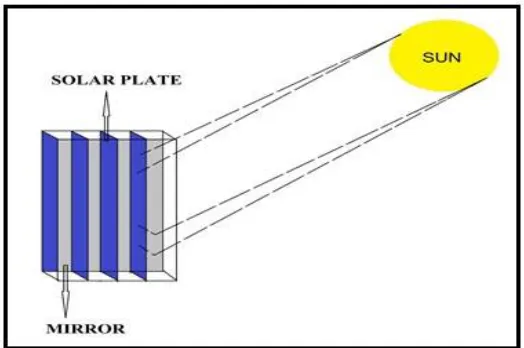
The system consist same things as compare to Fig3.1 but the different is this system does not consist whole solar panel. It consists of array of small solar panel with glass. Due to the damage problem the system consists of array of small solar plates. In above system the mirror generates heat but does not damage the solar plate because the mirror ability to damage is minimized. Division of system into array of Solar Panels kept in mirrored system increases the ability to generate high electricity.These system shows how to protect the solar panel from damage.
IV.EXPERIMENTAL RESULTS
The main focus of this paper is increase the efficiency of solar panel.Currently available solar panel does not absorb more sunlight from sun hence efficiency of solar panel is less.Due to the damage problem the system consists of array of small solar plates. Assume current solar panel absorb efficiency is 2% and when solar panel with glass then efficiency increases and it is 3% and when the division of system into array of solar panel is with glass then efficiency goes increasing to 4%.
Fig.6 Result
V. CONCLUSION
Renewable energy technologies could reduce carbon dioxide emissions by replacing fossil fuels in the power generation transportation sector and Industry. Today electricity is very important we should not waste even a small resource of power. The second figure increases the efficiency of solar panel it generates more electrical energy. It absorb more sunlight compare to current solar panel system. This system is more efficient as compared to existing system. It is important to use this renewable energy sources to develop the technology which can be used in future.
REFERENCES
[1] K. Blok, “Enhanced policies for the improvement of electricity efficiencies”’ energy policy, 33 (13) (2005), pp. 1635-1641.
[2] H. Lund, “Implementation of energy conservation policies: the case of electric heating conversion in Denmark” Appl energy, 64 (1-4) (1999), pp. 117-127.
[3] N. Lior, “Advanced energy conversion to power”, energy converse manage, 38 (10-13) (1997), pp. 941-955.
[4] N. Lior, “Thoughts about future power generation systems and the role of energy analysisin their developments”, energy converse manage, 43 (9-12) (2002), pp. 1187-1198.
[8] SubhabrateBaug, ArnabBaug, PoulomiMitra, Snehasis Chatterjee, “Role ofGovernment in Promoting Resources in India”, IJETAE, Vol. 3, Issue 3, Feb, 2013.
[9] http://geo-dome.co.uk/article.asp?uname=solar_mirror
[10] Mr. Ajay B Devkatte, Mr. Nitesh H Chavan, “RENEWABLE POWER HARVESTING MECHANISM : SURVEY”, International Journal of International Journal of Science, Environment ISSN 2278-3687 (O) and Technology, Vol. 5, No 4, 2016, 2368 – 2376 2277-663X (P) [11] Swami Prakash Shrivastava and Surat Prakash Shrivastava, “Solar Energy and its FutureRole in Indian Economy”, IJESDM, Vol. 4, No. 4,
2013.