HE, GUOZHEN. Microstructure Evolution and Mechanical Properties of a Heterogeneous Structured Al-5083 Alloy (Under the direction of Dr. Yuntian Zhu).
It has been a long researching goal to overcome the strength-ductility tradeoff for metals. Metals and alloys are either strong or ductile, but seldom maintain both characters for the same time. Attempts have been done by many researchers to achieve both high strength and ductility via heterogeneous structures. Here we report a heterogeneous lamella structure in 5083
aluminum alloy which is consisted of hard fine-grained domains and soft coarse-grained domains. The heterogeneous lamella structure is achieved by room-temperature rolling and partial recrystallisation.
Alloy
by Guozhen He
A thesis submitted to the Graduate Faculty of North Carolina State University
in partial fulfillment of the requirements for the degree of
Master of Science
Materials Science and Engineering
Raleigh, North Carolina 2018
APPROVED BY:
_______________________________ _______________________________ Dr. Yuntian Zhu Dr. Ronald Scattergood
Committee Chair
ii BIOGRAPHY
Guozhen He was born on October 30th, 1993 in Nanjing, China. Born as a professor’s child and grown up in a researchers’ community in Nanjing, the influence of his family and the community has great impact on him to value modesty and diligence. Since his childhood, Guozhen has been interested in science and music. At high school, Guozhen joined a robot team and won a national prize which excited his passion in becoming a researcher and an
entrepreneur.
In 2012, Guozhen attended Beihang University (Aka Beijing University of Aeronautics and Astronautics) where he found his new interest in materials science. He joined Dr. Ruixing Li’s group and spent one year working on infrared shielding materials. In June 2016, Guozhen finished bachelor’s degree in Materials Science and Engineering. From his research experience, Guozhen determined to pursue further study in Materials Science for future career.
iii ACKNOWLEDGMENTS
I would like to express my gratitude to my advisor Prof. Zhu, for his support and guidance throughout the research in the past two years. I would also like to thank Prof. Scattergood and Prof. Murty and for their precise time and patience to serve as my committee, review my thesis and presentation.
I am thankful to thank Xiaotian Fang, Ruocun Wang who helped me a lot revising the thesis, practicing presentations, and preparing for the oral exam. I would also like to thank Haotian Deng and Xinkai Ma for their advices. A thank you to all the group members for their friendship and help.
iv TABLE OF CONTENTS
LIST OF TABLES ... v
LIST OF FIGURES ... vi
1. Introduction ... 1
1.1 Statement of Purpose ... 1
1.2 Basics of Heterogeneous Structure ... 1
1.2.1 Gradient Structure ... 3
1.2.2 Bimodal Structure ... 4
1.2.3 Harmonic Structure ... 6
1.2.4 Nanodomained Structure ... 7
1.2.5 Heterogeneous Lamella Structure and Laminate Structure ... 8
1.3 Basics of Aluminum 5083 Alloy ... 11
1.4 Strengthening Mechanisms in Al-5083 Alloy ... 12
1.4.1 Heterogeneous Structure and Back Stress Strengthening ... 12
1.4.2 Grain Boundary Strengthening ... 14
1.4.3 Solid Solution Strengthening ... 16
1.4.4 Precipitation Hardening ... 17
1.5 Severe cold rolling of Aluminum and Aluminum Alloys ... 19
2. Experimental Techniques and Methods ... 21
2.1 Experimental Procedures ... 21
2.2 Back Stress Measurement ... 22
3. Experimental Results ... 24
3.1 Microstructure Characterization of Heterogeneous-Structured Al-5083 ... 24
3.2 Mechanical Properties of Heterogenous-structured Al-5083 ... 30
4. Discussion... 35
4.1 Microstructure Evolution ... 35
4.2 Strengthening Mechanisms and Back Stress Strengthening in Al-5083 ... 36
5. Conclusion ... 39
v LIST OF TABLES
vi LIST OF FIGURES
Figure 1 Gradient structured metal with grain sizes around 20 nm at the surface
layer and coarse grains in the core [8] ... 3 Figure 2 Ideal schematics of bimodal grain size distributions in polycrystalline
metals [28] ... 4 Figure 3 Schematic of a harmonic-structured material [29] ... 6 Figure 4 Schematic of a nanodomained Ni fabricated by electrodeposition ... 7 Figure 5 Schematics of an ideal lamella structure with elongated coarse grains
embedded in an ultrafine-grained matrix [6] ... 9 Figure 6 Schematics of a typical laminate-structured material [12] ... 10 Figure 7 (A) Schematics of the piling up of GNDs at the interlamellar interface.
(B) Plastic strain and strain gradient as the function of distance from the interface. (C) Stress as the function of function of distance from the interface [6]. (D) TEM image showing pileing-up of dislocations
in a recrystallized coarse grain at tensile strain of 2% [22] ... 13 Figure 8 Generation of successive closed loops of dislocation line from a
Frank-Read source [37] ... 14 Figure 9 Schematics of piling-up of dislocations from the dislocation source
S1 in grain 1 under a resolved shear stress τ. S2 is a dislocation
source in grain 2 [39] ... 15 Figure 10 Different types of serrations in a stress-strain curve ... 17 Figure 11 Schematics illustrating Orowan bypassing mechanism. (A) The dislocation
line bows between two particles. (B) The line moves forward. [39] ... 18 Figure 12 Schematics showing (A) an ideal unloading-reloading stress-strain
curve, (B) a real unloading-reloading cycle ... 22 Figure 13 TEM images of (A) equaxial grains; (B) elongated grains and isolated
subgrains; (C)cell blocks and dislocation tangled zones in al-5083 with
80% rolling reduction ... 24 Figure 14 TEM images of (A) oval shape precipitates; (B) subgrain structures
(C) elongated grains; and diffraction pattern of (D) oval shape precipitates
vii Figure 15 EBSD image of 80% rolled 5083 samples with annealing at 230°C for 10 mins .... 27 Figure 16 Misorientation angles of 80% rolled 5083 samples with annealing at
230°C for 10 mins ... 28 Figure 17 The effects of annealing temperature on al-5083 alloy with 80% thickness
reduction and annealed for 5 mins ... 31 Figure 18 Yield strength and uniform elongation al-5083 in this work and other data for
comparison ... 32 Figure 19 Unloading-reloading stress-strain curve of as-rolled samples with 230°C 10min
annealing ... 34 Figure 20 Back stress versus applied strain of as-rolled samples with
1 1. Introduction
1.1 Statement of Purpose
The purpose of this research is to find an efficient way to overcome the strength-ductility trade-off in a commercial aluminum 5083 alloy. One of the most efficient approach is to fabricate heterogeneous structures which exhibits a good combination of strength and ductility. In this research, we evaluated advantages and disadvantages of all the heterogeneous structures reported so far. Heterogeneous lamella structure is considered as the most ideal structure because of its high interlamellar interface density and completely constrained soft domains. Commercial aluminum 5083 (Al-5083) alloy is selected as the experimental material because of its ease of fabrication and important applications in ships and vehicle bodies. Room temperature rolling and annealing are selected to fabricate heterogeneous lamella structure. This thesis will start with introducing basic information of heterogeneous structure and features of commercial al-5083, then explain the back stress strengthening in heterogenous structures and potential methods to fabricate such structures, and finally explore the microstructure evolution and mechanical properties of heterogeneous structured al-5083.
1.2 Basics of Heterogeneous Structure
Throughout history, the progress of human society is always accompanied by a huge leap forward in materials. Metals and alloys have been playing an important role in our society for their significant mechanical properties, light weight, high conductivity, corrosion resistances, easy fabrication, and so on. Although composite materials have replaced metals in some
2 conditions. It has always been a long researching goal to fabricate metallic materials with
superior mechanical properties and light weight, however, strength and ductility turned out to be mutually exclusive for researches in many decades.
For the past few decades, nanostructured and ultrafined metals have raised interests of many researchers and have achieved extraordinary high yield strength, however, the ductility drops dramatically as grain size decreases to nanometer level [2–5]. With the increase in yield strength, ductility usually decreases, and vice versa. The phenomenon that ductility decreases with yield strength increase, known as strength and ductility trade-off, gradually becomes the main problem for researchers. Through decades of studies, researchers find that uniform nano- or ultrafined- structure is not able to solve this problem, thus a new strategy, which abandons the uniform structure and fabricates a heterogeneous structure for materials, becomes a promising solution to strength and ductility trade-off. Many attempts have been made to overcome the shortage of low ductile nanostructured metals and to balance the trade-off between strength and ductility. Some researches proposed a new strategy inspired by these attempts to maintain both aspects for metals at the same time. It is considered a genre of heterogeneous materials. Heterogeneous materials are defined as materials presenting huge microstructural heterogeneities in size, geometry, and strength between different domains. [6]. A heterogeneous material can be in the form of gradient structure[7–9], bimodal structure [10,11], laminate structure [12–14], harmonic structure [15,16], nanodomained structure [17], dual-phase alloys [18,19], nanotwinned grains [20,21] , and
3 1.2.1 Gradient Structure
Figure 1: A typical gradient structured metal with grain sizes around 20 nm on the surface and gradually coarse grains in the core [8].
In gradient structured materials, grain sizes increase from nanoscale at the surface to micron-scale in the core [8]. The gradient structure is consisted of, in sequence, nanograins (grain size around 100nm), ultrafine grains (several hundred nm to μm), deformed coarse grains, and central coarse grain core. Nanograins at the surface can be fabricated by coating and
4 diameters around a few microns to the sample surface under different applied speeds and
duration. Generally, a surface layer with grain size at nanoscale will be formed and core is still coarse-grained after SMAT. Up-to-date, SMAT has been researched to improve strength-ductility combination and fatigue behavior in different kinds of metals and alloys, such as IF steel [23], 304 Steel [24], various of aluminum alloys [25], copper [26]. In most of these works, the strength of the gradient structured materials surplus the calculation predicted by the rule of mixture (ROM) based on thicknesses of different layers [25,27].
1.2.2 Bimodal Structure
Figure 2. Ideal schematics of bimodal grain size distributions in polycrystalline metals [28].
6 1.2.3 Harmonic Structure
Figure 3: Schematic of a harmonic-structured material [29].
The harmonic structure was first proposed by Ameyama and co-authors[15,30]. It is a special case of the bimodal structure. Unlike a conventional bimodal structure, coarse grains around tens of microns sit as the cores in shells consisted of ultrafine grains. Harmonic structure is usually produced by mechanical milling followed by sintering [15]. The fabrication of
7 contaminate pure metal powders during mechanical milling and sintering. What’s more, the mechanical properties of harmonic structures reported so far are not superior than other
structures discussed previously [15]. Taken the example of harmonic structured pure Cu, when considering the ultrafine grain framework as hard domains, the spacing between hard domain interfaces are ranging from 50 μm to 100 μm which is several times larger than the optical interface spacing [15].
1.2.4 Nanodomained Structure
Figure 4: Schematic of a nanodomained Ni fabricated by electrodeposition.
8 nm. Their nanodomained nickel samples exhibited a yield strength almost 1.3 GPa and 30% uniform elongation while their electrodeposited ultrafine nickel samples (grain size around 200 nm) only exhibited 600 MPa yield strength and 12% uniform elongation. Unlike other
heterogeneous structure, authors believed that dislocations were pinned by these nanodomains during deformation, which is similar to the scenario of the Orowan bypassing mechanism. Despite from their superb tensile test results, sample geometry (10 mm × 2.5 mm × 150 μm) in their tensile test is far from ASTM standard, which may affect their uniaxial tensile results [17]. Dual-phase alloys are another genre of heterogeneous structured materials. The heterogeneity comes from different phases in the alloys which maintain distinct elastic properties. Researches have been done with dual-phase steel, transformation induced plasticity (TRIP) steel and nanotwinned materials [9,19,20].
1.2.5 Heterogeneous Lamella Structure and Laminate Structure
Although the structures mentioned above have their unique advantages, their shortages are still obvious. In gradient materials, there are two dynamically migrating interfaces which allows dislocation density accumulation over the whole sample volume to generate large back stress. On the other hand, the effected layer of gradient materials is usually several hundred micrometers. Thus, it is hard to be utilized in thick plates, and the yield strength improvement sometimes is not sufficient. Low interface density limits the capability of back stress work hardening. It is difficult to obtain the ideal distribution of grain size in bimodal materials, causing a problematic repetition of the mechanical properties. In laminate structured materials, domain interfaces are easy to locate, which make laminate structure a good system to study interface associated properties during
deformation. The disadvantage of laminate structure is that both soft domains and hard domains are subjected
9 Therefore, to discover a simple-fabricated HL structure and introduce more intrinsic
heterogeneity inside materials become important in making heterogeneous materials. Heterogeneous lamella structure is a new and promising structure for the extraordinary combination of strength and ductility.
Figure 5: Schematics of an ideal lamella structure with elongated coarse grains embedded in an ultrafine-grained matrix [6].
Heterogeneous lamella (HL) structure was first reported by X.Wu and co-workers in 2015 [22]. In their work, a titanium alloy was asymmetrically rolled with 87.5% reduction, then followed by annealing at 475 °C for 5 min. According to their report, both hard domains and soft domains were formed after partial recrystallization. Hard domains were defined as areas
10 samples while yield strength increased 600 MPa. Soft domains deformed much more than hard domains which produced strain gradient across interlamellar interfaces. As a result, the strain gradient generated geometrically necessary dislocations which produced long-range back stress near the interfaces [22]. The authors proposed that HL structure was superior to previous bimodal structure because of its lamellar nature which gives high interlamellar interface density and completely constrained soft domains by hard domains.
Figure 6: Schematics of a typical laminate-structured material [12].
Another method to make lamellar structure is accumulated rolling bonding (ARB) two different metals, forming a laminate structure. The laminate structure is a perfect system to study the role of the interface under deformation using either in situ or ex situ techniques. Unlike gradient heterogenous lamella structure, interfaces between soft domains and hard domains in the laminate structure are more accessible to locate because of parallel separation between different layers. C.X. Huang and coworkers researched interfaces affected zone in copper/bronze laminates [12]. They developed an in situ high-resolution digital image correlation (DIC)
11 structures. What’s more, Cu and bronze share similar elastic constant but different
recrystallization temperatures and stacking fault energies. These features make it easy to produce grain size heterogeneity and strain gradient. Upon deformation, geometrically necessary
dislocations are always first generated in the Cu layers. These features make investigations on dislocation sources in laminates easier than in heterogenous lamella structure.
1.3 Basics of Aluminum 5083 Alloy
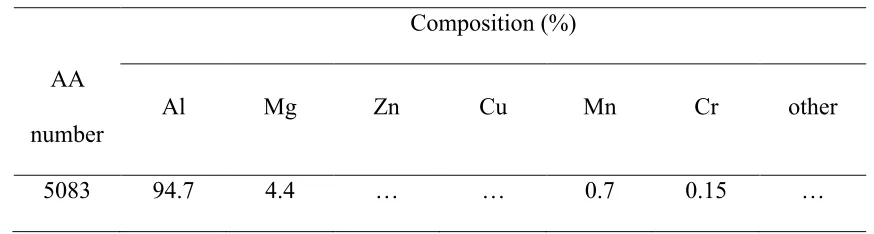
Magnesium is the principal alloying element in aluminum 5083 alloys with composition around 4.4 percent [32]. Aluminum 5083 is a widely used commercial alloy for ships, bridges, cars, and even missiles components. It shows good corrosion resistances and work hardening. Since global warming, air pollution, and energy shortage are becoming more and more serious issues, it’s meaningful to increase yield strength and ductility simultaneously for energy efficiency purpose in all these applicationsthe . As such a popular commercial alloy, al-5083 alloy has been well studied by the material community, however, there are few reports on
processing heterogeneous structures in 5083. Conventionally, possible hardening mechanisms in 5083 are as followed: solid solution strengthening, precipitation strengthening, grain boundary strengthening, and dislocation forest. It’s essential to distinguish the effects of different
12 Table 1: Nominal composition of common commercial aluminum alloy
Composition (%) AA
number Al Mg Zn Cu Mn Cr other
5083 94.7 4.4 … … 0.7 0.15 …
1.4 Strengthening Mechanisms in Al-5083 Alloy
1.4.1 Heterogeneous Structure and Back Stress Strengthening
Researchers proposed that back stress strengthening plays the most crucial role in the synergic improvement of strength and ductility for the heterogeneous structure [6,22,33]. In metals and alloys, shear flow stress is usually calculated as [34,35]
𝜏 = 𝛼𝐺𝑏√𝜌𝑆+ 𝜌𝐺,
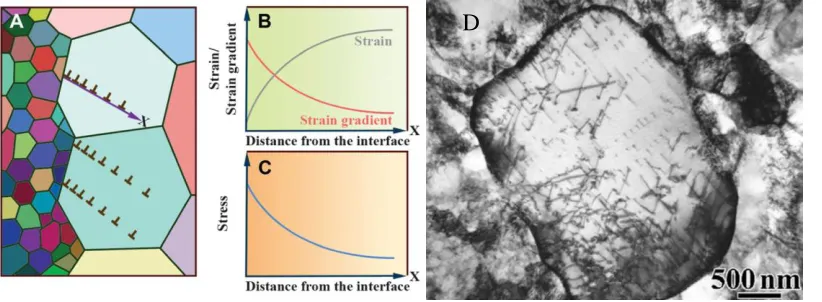
13 Figure 7: (A) Schematics of the piling up of GNDs at the interlamellar interface. (B) Plastic strain and strain gradient as the function of distance from the interface. (C) Stress as the function of function of distance from the interface. [6] (D) TEM image showing pileing-up of dislocations
in a recrystallized coarse grain at tensile strain of 2% [22].
In heterogeneous structured materials, geometrically necessary dislocations also play an important role in strengthening. Geometrically necessary dislocations are largely generated due to effective strain gradient, when plastic strain is not homogeneous throughout the material [35]. At the same applied stress, deformation of soft domains is larger than the deformation of hard domains. When geometrically necessary dislocations are emitted from a dislocation source inside a soft domain and pile up at the interface between hard and soft domain, a long-range stress called back stress is generated [22]. In this scenario, the effective stress at the dislocation source equals to the difference between the applied stress and the back stress. It required higher applied stress to pile up more dislocations at the interface. In another scenario, the same back stress will be produced if geometrically necessary dislocations are emitted from ledge sources on the domain boundaries or the grain boundaries [12,36].
14 1.4.2 Grain Boundary Strengthening
Grain boundaries can act as obstacles to dislocation motions across the grains. At grain boundaries, lattices are mismatched. As a result, misfit dislocations are generated at grain boundaries to accommodate lattice misfit. Slip planes are not aligned across different grains. Dislocations cannot travel across grain boundaries upon deformation. If dislocations are
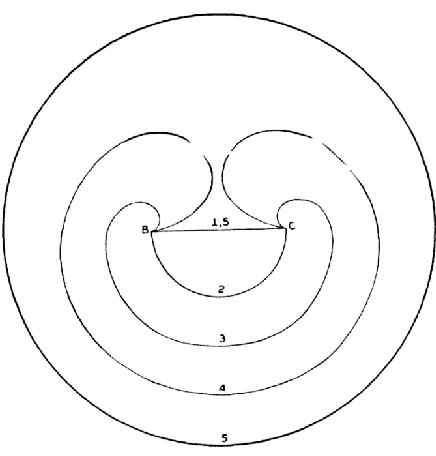
generated from a Frank-Read source, they will be stopped by the grain boundary and eventually pile up with increasing plastic strain.
Figure 8: Generation of successive closed loops of dislocation line from a Frank-Read source [37].
15
σy = σ0+ky
√d,
where σy is the yield stress or flow stress, σ0 is the resistance stress or back stress due to lattice friction, ky is Petch parameter, also unknown as unpinning constant, d is the average grain diameter. Hall-Petch equation predicts that the yield stress is a function of grain size.
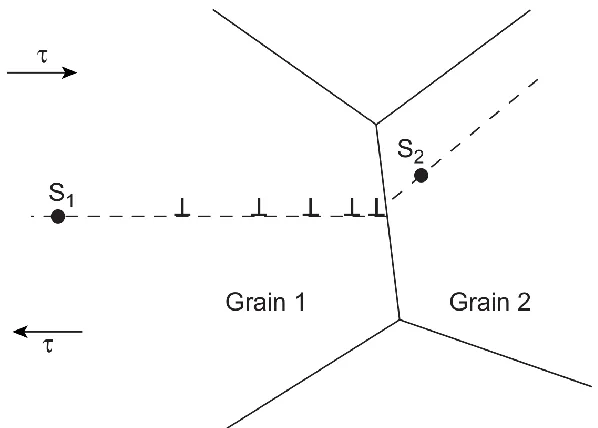
Figure 9: Schematics of piling-up of dislocations from the dislocation source S1 in grain 1 under a resolved shear stress 𝜏. S2 is a dislocation source in grain 2. [39]
Predicted by Hall-Petch equation, the smaller grain size is, the larger the yield stress will be. With the Hall-Petch equation, the strengthening contribution which comes from grain size effects can be estimated. Hall-Petch equation remains valid until grain size decreases down to around 50 nm[40]. Smaller grain size leads to larger grain boundary density and smaller distance between two boundaries. When grain size reaches below 50 nm, grain size softening or reverse Hall-Petch effect will occur. The yield stress will decrease with the decrease of grain size. Many
16 such small grain size, dislocations are not allowed to pile up inside grains, which results in grain boundary sliding and grain rotation.
1.4.3 Solid Solution Strengthening
17 Figure 10: Different types of serrations in a stress-strain curve.
1.4.4 Precipitation Hardening
There are different kinds of magnesium precipitate in al-5083. It has been reported that Guinier-Preston (GP) zone first growthgrow from the supersaturated Mg solid solution which is often called α phase [45]. Precipitates are formed from GP zone with increasing annealing time at the different annealing temperature. GP zone gradually grows into β′′ phase, β′ phase, and β
phase [45]. The stoichiometric composition of GP zone in 5083 is Al3Mg [3]. β′′ phase is also known as ordered GP zone. It has the same stoichiometric composition with GP zone which is Al3Mg [45]. Some researchers suggested that β′′ possibly has an L12 structure [4]. β′ phase has a stoichiometric composition of Al3Mg2 and is a semi-coherent hexagonal intermediate phase which is reported to the main hardening phase in al-5083 [46]. The β phase is also known as Samson phase which is an equilibrium phase called with an FCC structure [46]. The
18 Figure 11: Schematics illustrating Orowan bypassing mechanism. (A) The dislocation line bows
between two particles. (B) The line moves forward. [39]
Al-5083 is not classified as a precipitate hardening alloy. There are two types of well-found models describing dislocations – precipitates interactions, which are dislocation cutting through particles and dislocations bowing around particles. For coherent and semi-coherent precipitate particles, dislocations can cut through precipitate particles upon deformation because of the alignment between slip planes in precipitate particles and aluminum matrix. After cutting
through by dislocations, particles will be sheared in the direction of dislocation moment. Cutting through effect is not as useful in semi-coherent particles as in coherent ones. Dislocations
generated around the surface of semi-coherent particles will decrease volume misfit strain, making particle shearing less effective. For incoherent particles, slip planes are not aligned in particles and aluminum matrix. As a result, incoherent precipitate particles cannot be sheared by dislocations. When dislocations interact with incoherent particles, dislocations are likely to bypass these particles, ultimately forming dislocation loops. This mechanism is also called
A
19 Orowan bypassing or looping. The strengthening caused by Orowan looping. Orowan derived the very first equation describing dislocation bypassing a square distribution of particles [39],
τ ≈μb
l ,
where τ is the shear stress, μ is the shear modulus, b is the magnitude of the burger vector, l is the average spacing between two neighboring particles. The strengthening effects contributed by precipitates can be estimated using this equation from Orowan bypassing mechanism.
1.5 Severe Cold Rolling of Aluminum and Aluminum Alloys
Several models have been proposed to explain grain refinement and the formation of subgrain structures in high SPE metals deformed by severe rolling at ambient temperature. Different models have been built to demonstrate the microstructural evolution by large strain deformation in polycrystalline materials for years, including Taylor’s full constraint model which is best fit for describing homogeneous deformation in equiaxial grains [48]. According to
Taylor’s model, the uniform slip is achieved by activation of at least five slip systems in
20 dislocations in different cell blocks interact with each other at the cell block boundaries.
21 2. Experimental Techniques and Methods
2.1Experimental Procedures
A commercial Al-5083 alloy was studied in this research. Al-5083 alloy was received in plate form with a thickness of 10 mm. As-received commercial al-5083 alloy plates were first annealed at 500 °C for 5 h to reach a homogeneous supersaturate solid solution state. These Al-5083 plates were deformed by room temperature rolling with 10% thickness reduction each pass, until a total of 80% reduction in thickness was reached. No cracks were observed on the surface of these plates.
22 2.2 Back stress measurement
Samples used in loading-unloading tests shared the same sample geometry with uniaxial tensile samples. Back stress calculations were done based on methods developed by M.Yang and co-workers in their previous work [33]. Back stress was calculated by
𝜎𝑏 =𝜎𝑟+𝜎𝑢
2 ,
where σb is the back stress, σr is the reloading yield stress, σu is the unloading yield stress. Two important assumptions were made in this work in order to derive the relationship between back stress, unloading yield stress, and reloading yield stress [33]. Firstly, the frictional stress stays constant in both unloading range and reloading range. Secondly, during unloading process, back stress is assumed to be constant before the unloading yield point.
Figure 12: Schematics showing (A) an ideal unloading-reloading stress-strain curve, (B) a real unloading-reloading cycle.
The back stress equation was derived from the stress relations at both unloading yield point and reloading yield point. At unloading yield point, the back stress begins to overcome the
23 friction stress and the applied stress. Piled-up dislocations start to glide back, in the opposite direction of the applied stress. This leads to
σb = σu+ σf,
where σf is the frictional stress. Similarly, at reloading yield point, dislocations start to pile up again, because the applied stress starts to overcome the back stress and the friction stress, which is
σr = σb+ σf.
24 3. Experimental Results
3.1 Microstructure Characterization of Heterogeneous-Structured Al-5083
Figure 13 TEM images of (A) equaxial grains; (B) elongated grains and isolated subgrains; (C)cell blocks and dislocation tangled zones in al-5083 with 80% rolling reduction
As-received commercial al-5083 alloy plates were first annealed at 500 °C for 5 h to reach a homogeneous supersaturate solid solution state. Then, al-5083 plates were rolled at room
temperature until 80% thickness reduction was reached. Fig 13(A), (B) and (C) are TEM images of as-rolled Al-5083 plates. The grain size ranges from 1μm to a few micrometers. Subgrain structures are also observed with size smaller than 1 μm. After rolling with 80% thickness reduction, initial coarse grain samples were severely deformed, generating dislocation-tangle zones well spread across the sample. Fig 13(A) shows large density of dislocation walls and dislocation tangled zones. Small grains separated by dense dislocation walls are possibly evolved from cell blocks. Within these grains, subgrain structures are observed, which are possibly originated from dislocation cells inside cell blocks. In each newly formed fine grain (around a few microns), the number of subgrains per grain ranges from 2 to 3. Three kinds of dislocation walls are observed, which are dense dislocation walls [50], uncondensed dislocation walls [54], and clustered-small-cell walls [53]. Clustered-small-cell walls are consisted of equiaxed,
25 divided dislocation cells [53]. In fig 13(B), an elongated grain longer than 8 μm is observed, surrounded by uncondensed dislocation walls and clustered-small-cell-wall [53]. Isolated subgrains are observed near the boundary of the elongated grain. These subgrains have sizes smaller than 1 μm. Intensities from most areas differ slightly, indicating small misorientation across the area. Fig 13(C) shows a large area of dislocation-tangle zones accompanied by cell blocks and clustered-small-cell walls. Dislocation-tangle zones appear as continuous dark areas in TEM images.
Figure 14: TEM images of (A) oval shape precipitates; (B) subgrain structures (C) elongated grains; and diffraction pattern of (D) oval shape precipitates (E) al-5083 matrix in 80% rolled
5083 with annealing at 230°C for 10 mins.
A B C
26 After annealing at 230 °C for 10 mins, precipitations are observed. From the literature, precipitation sequence in an Al-Mg alloy is usually as supersaturated solid solution α phase – GP zone - β′′ phase - β′ phase - β phase [45]. Guinier–Preston Zones (GP zones) has a stochiometric composition of Al3Mg, which is short-range ordered. β′′ phase possibly has an L12 structure, and its composition is suggested to be Al3Mg[47]. β′ phase is a semi-coherent hexagonal
intermediate phase with a composition of Al3Mg2 (a=1.002 nm, c=1.636 nm)[46]. The β phase is an equilibrium phase called Samson phase and is of an FCC structure with the composition of Al3Mg2 [47]. Fig 14(A) shows oral-shaped precipitates and rod-like precipitates. The oral-shaped precipitate is almost 2 μm and overlapped on the al-5083 matrix in the TEM image. Selected area electron diffraction (SAED) pattern indicates that the oral-shaped precipitate is the closest to the intermediate β′ phase [211] zone axis. The rod-like precipitation is possibly to be an Mn-rich precipitate [47]. Fringes around the oval-shaped precipitation could be some other kinds of precipitations. Precipitates are not evenly spread throughout the as-annealed samples.
27 Figure 15: EBSD image of 80% rolled 5083 samples with annealing at 230°C for 10 mins.
Two kinds of domains are clearly shown in the EBSD picture. Large domains consist of grains in [101] orientation, separated by domains of fine grains. In previous studies, large domains in the same orientation are considered as soft domains. The soft domains are possibly originated from the same grain after rolling and annealing. The misorientation between them is so small that they all appear in the same color in the EBSD image. Surrounding areas consisted of fine grains are considered as hard domains. The hard domain consists of small grains in different orientations. The thickness of the hard domains measured from the EBSD image is ranging from 25 to 40 μm. The distance between two different hard domains is around 70 to 75
28 Figure 16: Misorientation angles of 80% rolled 5083 samples with annealing at 230°C
for 10 mins.
29 Table 2: Grain size distribution of as-rolled al-5083
with different annealing parameters. Grain size distribution
Annealing 1-10 (μm) 10-20 (μm) 20-30 (μm) 30-40 (μm) 40-50 (μm)
230°C5M 417 20 4 0 0
230°C10M 1756 16 3 0 1
30 3.2 Mechanical Properties of Heterogenous-structured Al-5083
31 Figure 18: (A) The effects of annealing time; (B) tensile stress-strain curve of al-5083 alloy with
80% thickness reduction and annealed at 230°C.
Figure 18: Yield strength and uniform elongation al-5083 in this work and other data for comparison.
(MPa
)
A B
(MPa
32 Fig. 17 and 18 shows the result of the uniaxial tensile test results for different samples. Each condition is tested 4 times for accuracy. To investigate the effects of partial recrystallization on mechanical properties, as-rolled al-5083 samples were annealed under different temperature for 5 mins. Results were summarized in fig. 17. The leftmost data belongs to as-rolled al-5083 with 80% thickness reduction for comparison. Upper yield point and lower point were observed in curves taken from 300 °C samples and coarse grain samples. Annealed at 220 °C,the uniaxial
33 Figure 19: Unloading-reloading stress-strain curve of as-rolled samples with
34 Figure 20: Back stress versus applied strain of as-rolled samples with 230°C 10min annealing.
Table 3: Back stress of annealed al-5083 and coarse grain samples. R80+230°C 10M Coarse grain
Back stress (MPa) 271 121
35 4. Discussion
4.1 Microstructures evolution
Detailed microstructural features are investigated by TEM. Observed from TEM images in fig.13, the grain size of as-rolled samples is in the range of 1 to 10 μm. Most equiaxed grains range from 1 to 2 μm. Elongated grains are observed to be 8 μm long and 2 μm wide. Isolated subgrains are observed in the elongated grains. Rolling was performed with 10% thickness reduction per pass, until a total of 80% reduction was reached. A modified Taylor’s model was the best approach to describe microstructure evolution during severe rolling at ambient
temperature [48]. At the early stage of rolling, slip systems were activated in each coarse grain to accommodate the plastic strain introduced by shear forces. Dislocation walls and dislocation tangled zones started to form, which divided grains into volume elements called cell blocks. With increasing strain, the misorientation angles between different cell blocks increased. Eventually, new grains formed at the place of cell blocks. Al-5083 plates were not deformed homogeneously by cold rolling at ambient temperature. Elongated grains and equiaxial grains were observed in as-rolled samples and annealed samples.
After partial recrystallization, two kinds of different domains were formed in EBSD images, soft domains and hard domains. The alternate arrangement of hard domains and soft domains formed a heterogeneous lamellar structure in annealed al-5803 samples.
36 subgrain structure partly remained in equiaxed cells and dislocation tangled zones while others were severely elongated into the plate-like structure. As shown in fig. 14(C), plate-like structure remained after annealing at 230°C for 10 minutes.
Another domain consisted of small grains in many different orientations. The domain of large grains offered larger dislocation pile-up ability than the adjacent domains of small grains. At the early stage of deformation, large grains would start to deform first. Until the strain in large grains reached a critical value, domains of small grains would start to deform. In this way, the large grains areas were considered as soft domains. On the contrary, small grains areas were considered as hard domains. The continuous hard domain would act as a constraint to the deformation of soft domains.
4.2 Strengthening Mechanisms and Back Stress Strengthening in Al-5083
Al-5083 samples presented in this research (80% thickness reduction and annealing) were as good as cryo-rolling 5083 (85% reduction and annealing) in mechanical properties [55]. Summarized in fig 16(B), cryo-rolling 5083 exhibited higher yield stress (522 MPa) than room temperature rolling with similar thickness reduction, however, mechanical properties were almost the same after annealing. It was the result of heterogeneous lamella structure in our 5083 samples. During cryo-rolling, dynamic recovery was suppressed by the low temperature,
37 Strengthening mechanisms which are possibly involved in al-5083 are back stress
strengthening, solute strengthening, precipitate strengthening, grain boundary strengthening, and dislocation wall strengthening. The contribution from each mechanism will be discussed
according.
Back stress is primary responsible for the improvement of yield stress and ductility. Annealed at 230°C from 5 mins to 10 mins, yield stress decreased 2.8%, which was 9 MPa, however, uniform elongation increased from 9% to 12%. Average grain sizes were almost the same, except few grains were found larger than 40 μm in 10 mins samples. The back stress of 10 mins annealed samples was 175 MPa larger than the coarse grain ones. The sample consisted of soft domains and hard domains, which laid next to each other in a lamellar shape. Two hard domains were separated by a soft domain with grains in [101] orientation. The average distance between two hard domains was around 70 μm. Upon deformation, the soft domain would
undergo plastic deform before the hard counterparts started to deform. The strain in soft domains was much larger than in hard domians. The strain partition caused geometrically necessary dislocations to pile up at the interface on the soft domain side, which generated back stress, which was in the opposite direction to the applied stress. The effective stress equaled to the difference between applied stress and back stress. Effective stress needed to surplus a critical value so that more dislocation would be operated and pile up. As a result, a larger applied stress would be needed to pile up more and more dislocations.
38 great barriers to dislocation motion. With larger areas of grain boundaries and larger density of dislocation forest, more dislocation could be stored during deformation.
Solute strengthening and precipitate strengthening show little difference between different samples. There was no difference in composition elements between each sample. The principal solution elements in Al-5083 samples are magnesium and manganese. Precipitates were found Under TEM, for example, Al-Mg β′ phase precipitates which were reported to be a hardening phase in Al-Mg alloys. Precipitate strengthening mechanism could be explained by Orowan looping,
τ ≈μb
l .
39 5. Conclusion
1. In this work, a heterogenous lamella structure was reported in aluminum alloy 5083 for the first time.
2. Reported al-5083 samples showed mechanical properties as good as cryo-rolling and annealing 5083 samples. Our process is more environmentally friendly and economical for mass production.
3. Microstructure evolution was examined by TEM and EBSD, confirming the formation of a heterogeneous lamella structure.
40 REFERENCES
[1] D. Gay, S.V. Hoa, S.W. Tsai, Composite materials design and applications, CRC Press, Boca Raton, FL, 2003.
[2] Y.T. Zhu, X. Liao, Retaining ductility: Nanostructured metals, Nat. Mater. 3 (2004) 351–352. doi:10.1038/nmat1141.
[3] Y.-H. Zhao, J.F. Bingert, X.-Z. Liao, B.-Z. Cui, K. Han, A.V. Sergueeva, A.K. Mukherjee, R.Z. Valiev, T.G. Langdon, Y.T. Zhu, Simultaneously Increasing the Ductility and Strength of Ultra-Fine-Grained Pure Copper, Adv. Mater. 18 (2006) 2949–2953.
doi:10.1002/adma.200601472.
[4] Y. Zhao, Y. Zhu, E.J. Lavernia, Strategies for Improving Tensile Ductility of Bulk Nanostructured Materials, Adv. Eng. Mater. 12 (2010) 769–778.
doi:10.1002/adem.200900335.
[5] Y.H. Zhao, X.Z. Liao, Z. Horita, T.G. Langdon, Y.T. Zhu, Determining the optimal stacking fault energy for achieving high ductility in ultrafine-grained Cu–Zn alloys, Mater. Sci. Eng. A. 493 (2008) 123–129. doi:10.1016/j.msea.2007.11.074.
[6] X. Wu, Y. Zhu, Heterogeneous materials: a new class of materials with unprecedented mechanical properties, Mater. Res. Lett. 5 (2017) 527–532.
doi:10.1080/21663831.2017.1343208.
[7] K. Lu, J. Lu, Nanostructured surface layer on metallic materials induced by surface mechanical attrition treatment, Mater. Sci. Eng. A. 375–377 (2004) 38–45.
doi:10.1016/j.msea.2003.10.261.
41 [9] X.L. Wu, M.X. Yang, F.P. Yuan, L. Chen, Y.T. Zhu, Combining gradient structure and TRIP
effect to produce austenite stainless steel with high strength and ductility, Acta Mater. 112 (2016) 337–346. doi:10.1016/j.actamat.2016.04.045.
[10] Y. Wang, M. Chen, F. Zhou, E. Ma, High tensile ductility in a nanostructured metal, 419 (2002) 4.
[11] B.O. Han, E.J. Lavernia, Z. Lee, S. Nutt, D. Witkin, Deformation behavior of bimodal nanostructured 5083 Al alloys, Metall. Mater. Trans. A. 36 (2005) 957–965.
doi:10.1007/s11661-005-0289-7.
[12] C.X. Huang, Y.F. Wang, X.L. Ma, S. Yin, H.W. Höppel, M. Göken, X.L. Wu, H.J. Gao, Y.T. Zhu, Interface affected zone for optimal strength and ductility in heterogeneous laminate, Mater. Today. (2018). doi:10.1016/j.mattod.2018.03.006.
[13] X. Ma, C. Huang, J. Moering, M. Ruppert, H.W. Höppel, M. Göken, J. Narayan, Y. Zhu, Mechanical properties of copper/bronze laminates: Role of interfaces, Acta Mater. 116 (2016) 43–52. doi:10.1016/j.actamat.2016.06.023.
[14] X.L. Ma, C.X. Huang, W.Z. Xu, H. Zhou, X.L. Wu, Y.T. Zhu, Strain hardening and ductility in a coarse-grain/nanostructure laminate material, Scr. Mater. 103 (2015) 57–60.
doi:10.1016/j.scriptamat.2015.03.006.
[15] C. Sawangrat, S. Kato, D. Orlov, K. Ameyama, Harmonic-structured copper: performance and proof of fabrication concept based on severe plastic deformation of powders, J. Mater. Sci. 49 (2014) 6579–6585. doi:10.1007/s10853-014-8258-4.
42 doi:10.1007/s11661-014-2649-7.
[17] X. Wu, F. Yuan, M. Yang, P. Jiang, C. Zhang, L. Chen, Y. Wei, E. Ma, Nanodomained Nickel Unite Nanocrystal Strength with Coarse-Grain Ductility, Sci. Rep. 5 (2015). doi:10.1038/srep11728.
[18] M. Calcagnotto, Y. Adachi, D. Ponge, D. Raabe, Deformation and fracture mechanisms in fine- and ultrafine-grained ferrite/martensite dual-phase steels and the effect of aging, Acta Mater. 59 (2011) 658–670. doi:10.1016/j.actamat.2010.10.002.
[19] Z. Li, K.G. Pradeep, Y. Deng, D. Raabe, C.C. Tasan, Metastable high-entropy dual-phase alloys overcome the strength–ductility trade-off, Nature. 534 (2016) 227–230.
doi:10.1038/nature17981.
[20] K. Lu, F.K. Yan, H.T. Wang, N.R. Tao, Strengthening austenitic steels by using nanotwinned austenitic grains, Scr. Mater. 66 (2012) 878–883. doi:10.1016/j.scriptamat.2011.12.044. [21] L. Lu, X. Chen, X. Huang, K. Lu, Revealing the Maximum Strength in Nanotwinned
Copper, Science. 323 (2009) 607–610. doi:10.1126/science.1167641.
[22] X. Wu, M. Yang, F. Yuan, G. Wu, Y. Wei, X. Huang, Y. Zhu, Heterogeneous lamella
structure unites ultrafine-grain strength with coarse-grain ductility, Proc. Natl. Acad. Sci. 112 (2015) 14501–14505. doi:10.1073/pnas.1517193112.
[23] X. Wu, P. Jiang, L. Chen, F. Yuan, Y.T. Zhu, Extraordinary strain hardening by gradient structure, Proc. Natl. Acad. Sci. 111 (2014) 7197–7201. doi:10.1073/pnas.1324069111. [24]Z. Ma, J. Liu, G. Wang, H. Wang, Y. Wei, H. Gao, Strength gradient enhances fatigue
resistance of steels, Sci. Rep. 6 (2016). doi:10.1038/srep22156.
43 109. doi:10.1016/j.scriptamat.2016.05.006.
[26] Y.S. Zhang, Z. Han, K. Wang, K. Lu, Friction and wear behaviors of nanocrystalline surface layer of pure copper, Wear. 260 (2006) 942–948. doi:10.1016/j.wear.2005.06.010.
[27] X.L. Wu, P. Jiang, L. Chen, J.F. Zhang, F.P. Yuan, Y.T. Zhu, Synergetic Strengthening by Gradient Structure, Mater. Res. Lett. 2 (2014) 185–191. doi:10.1080/21663831.2014.935821. [28] L. Zhu, S. Shi, K. Lu, J. Lu, A statistical model for predicting the mechanical properties of
nanostructured metals with bimodal grain size distribution, Acta Mater. 60 (2012) 5762– 5772. doi:10.1016/j.actamat.2012.06.059.
[29] Z. Zhang, S.K. Vajpai, D. Orlov, K. Ameyama, Improvement of mechanical properties in SUS304L steel through the control of bimodal microstructure characteristics, Mater. Sci. Eng. A. 598 (2014) 106–113. doi:10.1016/j.msea.2014.01.023.
[30] T. Sekiguchi, K. Ono, H. Fujiwara, K. Ameyama, New Microstructure Design for Commercially Pure Titanium with Outstanding Mechanical Properties by Mechanical Milling and Hot Roll Sintering, Mater. Trans. 51 (2010) 39–45.
doi:10.2320/matertrans.MB200913.
[31] H. Fujiwara, T. Kawabata, H. Miyamoto, K. Ameyama, Mechanical Properties of Harmonic Structured Composite with Pure Titanium and Ti–48 at%Al Alloy by MM/SPS Process, Mater. Trans. 54 (2013) 1619–1623. doi:10.2320/matertrans.MH201317.
[32] J.R. Davis, ed., Alloying: understanding the basics, ASM International, Materials Park, OH, 2001.
[33] M. Yang, Y. Pan, F. Yuan, Y. Zhu, X. Wu, Back stress strengthening and strain hardening in gradient structure, Mater. Res. Lett. 4 (2016) 145–151.
44 [34] H. Gao, Y. Huang, Geometrically necessary dislocation and size-dependent plasticity, Scr.
Mater. 48 (2003) 113–118. doi:10.1016/S1359-6462(02)00329-9.
[35] H. Gao, Mechanism-based strain gradient plasticity? I. Theory, J. Mech. Phys. Solids. 47 (1999) 1239–1263. doi:10.1016/S0022-5096(98)00103-3.
[36] L.E. Murr, Dislocation Ledge Sources: Dispelling the Myth of Frank–Read Source
Importance, Metall. Mater. Trans. A. 47 (2016) 5811–5826. doi:10.1007/s11661-015-3286-5. [37] F.C. Frank, W.T. Read, Multiplication Processes for Slow Moving Dislocations, Phys. Rev.
79 (1950) 722–723. doi:10.1103/PhysRev.79.722.
[38] N. Hansen, Hall–Petch relation and boundary strengthening, Scr. Mater. 51 (2004) 801–806. doi:10.1016/j.scriptamat.2004.06.002.
[39] D. Hull, D.J. Bacon, Introduction to dislocations, 5. ed, Elsevier/Butterworth-Heinemann, Amsterdam, 2011.
[40] H. Conrad, J. Narayan, On the grain size softening in nanocrystalline materials, Scr. Mater. 42 (2000) 1025–1030. doi:10.1016/S1359-6462(00)00320-1.
[41] H. Halim, D. Wilkinson, M. Niewczas, The Portevin–Le Chatelier (PLC) effect and shear band formation in an AA5754 alloy, Acta Mater. 55 (2007) 4151–4160.
doi:10.1016/j.actamat.2007.03.007.
[42] A.H. Cottrell, LXXXVI. A note on the Portevin-Le Chatelier effect, Lond. Edinb. Dublin Philos. Mag. J. Sci. 44 (1953) 829–832. doi:10.1080/14786440808520347.
[43]P. Rodriguez, Serrated plastic flow, Bull. Mater. Sci. 6 (1984) 653–663. doi:10.1007/BF02743993.
45 [45] K. Osamura, T. Ogura, Metastable phases in the early stage of precipitation in Al-Mg alloys,
Metall. Trans. A. 15 (1984) 835–842. doi:10.1007/BF02644557.
[46] J. Yan, A.M. Hodge, Study of β precipitation and layer structure formation in Al 5083: The role of dispersoids and grain boundaries, J. Alloys Compd. 703 (2017) 242–250.
doi:10.1016/j.jallcom.2017.01.360.
[47] R. Goswami, G. Spanos, P.S. Pao, R.L. Holtz, Precipitation behavior of the ß phase in Al-5083, Mater. Sci. Eng. A. 527 (2010) 1089–1095. doi:10.1016/j.msea.2009.10.007.
[48] H.-R. Wenk, P.V. Houtte, Texture and anisotropy, Rep. Prog. Phys. 67 (2004) 1367–1428. doi:10.1088/0034-4885/67/8/R02.
[49] F.J. Humphreys, P.B. Prangnell, J.R. Bowen, A. Gholinia, C. Harris, Developing stable fine-grain microstructures by large strain deformation, Philos. Trans. R. Soc. Math. Phys. Eng. Sci. 357 (1999) 1663–1681. doi:10.1098/rsta.1999.0395.
[50] B. Bay, N. Hansen, D.A. Hughes, D. Kuhlmann-Wilsdorf, Overview no. 96 evolution of f.c.c. deformation structures in polyslip, Acta Metall. Mater. 40 (1992) 205–219.
doi:10.1016/0956-7151(92)90296-Q.
[51] D. Kuhlmann-Wilsdorf, N. Hansen, Geometrically necessary, incidental and subgrain boundaries, Scr. Metall. Mater. 25 (1991) 1557–1562. doi:10.1016/0956-716X(91)90451-6. [52] D.. Hughes, N. Hansen, D.. Bammann, Geometrically necessary boundaries, incidental
dislocation boundaries and geometrically necessary dislocations, Scr. Mater. 48 (2003) 147– 153. doi:10.1016/S1359-6462(02)00358-5.
46 [54] C.D. Liu, M.N. Bassim, D.X. You, Dislocation structures in fatigued polycrystalline copper,
Acta Metall. Mater. 42 (1994) 3695–3704. doi:10.1016/0956-7151(94)90435-9. [55] Y.B. Lee, D.H. Shin, K.-T. Park, W.J. Nam, Effect of annealing temperature on
![Figure 2. Ideal schematics of bimodal grain size distributions in polycrystalline metals [28]](https://thumb-us.123doks.com/thumbv2/123dok_us/1575591.1193835/13.612.187.454.318.520/figure-ideal-schematics-bimodal-grain-distributions-polycrystalline-metals.webp)
![Figure 3: Schematic of a harmonic-structured material [29].](https://thumb-us.123doks.com/thumbv2/123dok_us/1575591.1193835/15.612.183.453.96.337/figure-schematic-harmonic-structured-material.webp)


![Figure 6: Schematics of a typical laminate-structured material [12].](https://thumb-us.123doks.com/thumbv2/123dok_us/1575591.1193835/19.612.202.436.264.444/figure-schematics-typical-laminate-structured-material.webp)