Ergonomic Analysis of Postures of Building
Construction Workers Using RII & PATH
Method
Vikram S. Kulkarni1, R.V. Devalkar2
P.G. Student, Department of Civil Engineering, NDMVPS’s KBTCOE, Nashik, Maharashtra, India1 Assistant Professor, Department of Civil Engineering, NDMVPS’s KBTCOE, Nashik, Maharashtra, India2
ABSTRACT: Ergonomics deals with the study of internal and external stresses acting on human body. Use of Ergonomic principles reduces fatigue experienced by the human body in various tasks. This study is related to various tasks on building construction. Most of the injuries, stresses and strains occur due to over-exertion and repetitive work actions. The aim of this study is to assess and understand the level of ergonomics in various tasks in construction industry. Another aim of the study is to find the level of MSD’s and suggest corrective measures for every task having high risk factor. The study is conducted by using RII & PATH method to assess the posture of the workers in various construction tasks.
KEYWORDS:Building Construction, Ergonomics, PATH, RII, Workers.
I. INTRODUCTION
Different construction tasks leads to ergonomic risk and serious injures such as strains, sprains and work related musculoskeletal disorders (WRMSD’s) that caused by carrying heavy loads, repetitive movement, awkward postures and contact stress vibration. Hence, it is necessary to achieve safety of the construction workers during work at different conditions on construction sites. Most of the time, the workers are compelled to perform the same activities repetitively that are most of the activities are repetitive; due to this workers may experience fatigue, Cumulative Trauma Disorders (CTD’s) or Repetitive Strain Injuries (RSI’s). To reduce the fatigue experienced by the workers and to reduce their unnecessary efforts Ergonomics comes into picture. The PATH method helps as a tool to asses and quantifies the fatigue involved in existing work methods which otherwise (fatigue) is a subjective variable [1]. The RII method helps for ranking the factors and makes them easy to find their relative importance [2]. The methods include direct observation or assessment through video recordings which can be done in confined workspaces without disrupting work. This paper reports Fatigue analysis using RII and PATH method.
II. THEORETICALFRAMEWORK
According to Bryan Buchholz, The posture codes in PATH method are based on Ovako Work Posture Analyzing System (OWAS), with other codes included for describing worker activity, tool use, loads handled and grasp type. This study shows a pilot study of 6 workers on 4 different road construction operations suggests that labours spend large proportions of time in non-neutral trunk postures & spend approximately 20% of their time performing their manual material handling tasks [1].
frequency. It is hoped that the findings of the paper will help the stakeholders to act on critical causes and further try to reduce delay of their projects [2].
According to Mamata Rajgor, the relative importance index, RII, was computed for each cause to identify the most significant causes. The causes were ranked based on RII values. From the ranking assigned to each cause of delays, it was possible to identify the most important factors or causes of delays in Indian construction industry [3].
The L. Muhwezi described the causes of delay under four main groups of consultant related, contractor related, client related and external related and then assessed their impacts on delay using relative importance index (RII) as a basis for analysis. The RII for all delay factors and group of categories was computed so as to rank the factors. The most significant factors of construction delays were identified as: (1) delay in assessing changes in the scope of work by the consultant; (2) financial indiscipline/dishonesty by the contractor; (3) inadequate contractor’s experience; (4) design errors made by designers; (5) inadequate site investigation by the consultant [4].
According to M. Arip Wahyudi, Most of the material handlings activities are being done manually by the workers, although some of them are semi automatically done with the usage of tools or machines. Material handling activity done repetitively in a long span of time would cause musculoskeletal disorder risk. One of methods to identify and analyse work posture to ensure safety and comfort in work is the Ovako Work Posture Analysis System (OWAS). OWAS is a simple method to verify safety level which related to work posture, and to evaluate risk level which leads to corrective action (Caputo et al., 2006). OWAS method can define the movement of all parts of the body and can recommends suggestion to safer and comforter feeling while working. Moreover, OWAS method will be more suitable to examine manual material handling [5].
The author Ndukeabasi Inyang showed in his article the state-of-the-art ergonomic techniques, Canadian ergonomic legislation, and work-related musculoskeletal disorder (WRMSD) lost-time claims (LTC) statistics to show the resultant economic (cash and productivity) losses and adverse social (occupational health and safety) impact of WRMSDs resulting from current practice and legislation. The potential short- and long-term productivity and cost merits of incorporating ergonomic assessments for construction tasks are presented [6].
PATH method (Posture, Activity, Tools & Handling)
The basis of the method is work sampling (Observing by “snapshots”) to get frequency distribution of observed items. Classification of postures is based on OWAS. Before observations the data collection template will be customized for relevant work activities, tools & handlings [1]. This method was developed in USA to characterize the ergonomic hazards of construction and other non repetitive work.
Postures codes in PATH are based on OWAS, with other codes included for describing worker activity, tool used, loads handled & grasp type.
Action tools & weights to be handled are determined with interviews, observations & measurements before customizing the data collection sheet.
To analyse any activity the photos and videos of that activity should be taken for postural analysis purpose and a questionnaire should be prepared to gather & study remaining data.
Actual process of PATH method is as follows: 1) Make site contact/visit
2) Perform site walk trough
Determine stages & operations underway
Describe operations
Describe tasks & trades involve in each 3) Meet a crew of workers
Interview workers
Get informed consent 4) Pilot PATH data collection
Identify activities & tools
Customize data collection sheets
Check inter-observer agreement 5) Perform PATH sampling
Randomize sampling order
6) Videotape and photograph important aspects
Documentation
More detailed analysis
Steps 3 to 6 can be repeated for each combination of trade and operation that is studied on a given construction site.
RII method
The overall ranking of most important factors, causes, effects and procedures of change orders control on construction projects was determined by the evaluation of mean score and relative important index.
The mean score for each factor was calculated by the following formula:
MS =∑ ×
Where,
S=score given to each factor by the respondents,
(ranging from 1 to 5 where 1 is Strongly disagree and 5 is Strongly agree); F=frequency of responses to each rating 1to5 for each factor; and
N is total number of respondents for that factor.
The relative important index was calculated using the following equation. This equation was used to calculate importance of variation factors according to survey responses.
RII = ×
Where
RII= Relative Important Index
N = Total number of respondents for that factor
Table 1: the level of importance and evaluation for Average Index Analysis
Physical discomfort scale Rate of physical discomfort 1 No pain / Discomfort
2 Just noticeable Pain/ Discomfort 3 Average pain / Discomfort 4 Moderate pain / Discomfort 5 Intolerable pain / Discomfort
III.WORKDETAILS,DATACOLLECTION&ANALYSIS
Based on above activities analysis was carried out step by step:
Experienced workers were selected randomly,
Equipments required like video recorder, etc. for performing the operations were gathered,
The domain experts were consulted and the process was carried out under their supervision,
Photos & videos of each task were taken,
Remaining data were gathered from questionnaire survey.
Work was carried out at S.V. Kulkarni (Builders & Contractors), Nashik, Maharashtra, which is a medium scale construction firm in western India. For this study activities were chosen randomly. The work was carried out on Excavation, Centering, Tiles work, Furniture work and marble polishing. Data for these activities were gathered by questionnaire survey (Annexure), visual observations, photos & videos.
A. EXCAVATION
In this activity, the excavation tool having breaker at the end was handled by the worker. The job was to excavate the given area throughout the day. There was only one helper to complete the job. The worker was supposed to complete the excavation of 8m3, but completed only 4.646m3. Hence the productivity was only (4.646/8)*100 = 58.08%. PATH analysis:
Figure 1: Worker doing excavation in awkward body posture.
B. CENTERING
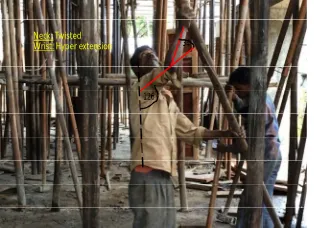
In this activity, props, hammer, nails & Centering plates were handled by the worker. The job was to dismantle the Centering after casting of slab. Total work completed in 8 working hours was 110m2 and work requirement was of 78m2 in whole day. Hence, the productivity was only (78/110)*100 = 70.91%. PATH analysis:
Neck: Twisted Wrist: Hyper extension
126 34
Figure 2: Worker removing Centering plates in awkward body posture.
C. TILES WORK
Ankle: Dorsiflexion
Figure 3: Worker doing tiling work in awkward body posture.
D. FURNITURE WORK
In this activity, hammer, nails, glue, measuring tape, pencil, cutter, etc. were handled by the worker. The job was to complete the application of veneer on furniture within 8 working hours of around 25m2. The worker was only able to complete 14.86m2 of application of veneer on furniture. The productivity was observed as: (14.86/25)*100 = 59.44% only. PATH analysis:
Neck: Side bending Ankle: Dosiflexion Trunk: Twisted
Figure 4: Worker applying veneer in awkward body posture.
E. MARBLE POLISHING
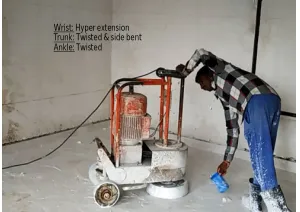
In this activity, water bucket, polishing machine, etc. were handled by the worker. The job was to polish the Italian marble. The task was to polish the Italian marble of approx. quantity of 28m2. Out of that only 15.036m2 were polished, hence the productivity was (15.036/28)*100 = 53.70% only. PATH analysis:
Wrist: Hyper extension Trunk: Twisted & side bent Ankle: Twisted
Figure 5: Worker polishing the marble in awkward body posture.
RII analysis:
Table 2: RII analysis of all activities Sr.
No.
Effects to the body Parts
Workers’ View
5 4 3 2 1 MS RII R
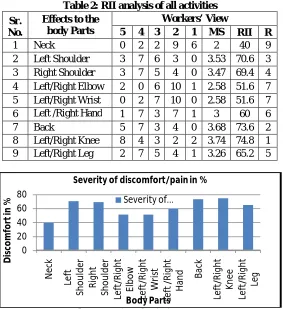
1 Neck 0 2 2 9 6 2 40 9 2 Left Shoulder 3 7 6 3 0 3.53 70.6 3 3 Right Shoulder 3 7 5 4 0 3.47 69.4 4 4 Left/Right Elbow 2 0 6 10 1 2.58 51.6 7 5 Left/Right Wrist 0 2 7 10 0 2.58 51.6 7 6 Left /Right Hand 1 7 3 7 1 3 60 6 7 Back 5 7 3 4 0 3.68 73.6 2 8 Left/Right Knee 8 4 3 2 2 3.74 74.8 1 9 Left/Right Leg 2 7 5 4 1 3.26 65.2 5
Graph 1: Severity of pain in percentage
Data collection & analysis by questionnaire survey:
Graph 2: Experience of workers in years
0 20 40 60 80 N ec k Le ft Sh o u ld er R ig h t Sh o u ld er Le ft /R ig h t El b o w Le ft /R ig h t W ri st Le ft / R ig h t H an
d Bac
k Le ft /R ig h t K n ee Le ft /R ig h t Le g D is co m fo rt in % Body Parts
Severity of discomfort/pain in %
Severity of …
0 5 10 15 20 25 C en te ri n g Ex ca va ti o n Ti le swo rk Fu rn it u re wo rk P o lis h in g Ex p e ri e n ce in Y rs Activities
Experience of Workers in Years
Following pie charts shows the data collected for various surveys:
Pie Chart 1: Percentage of body movements in all activities
Pie Chart 2: Body part which feel most discomfort
Pie Chart 3: Does worker perform same task for more than 1 hr.?
Pie Chart 4: Changes made to job/task
27%
22% 18%
33%
Percentage of Body Movements
Lifting
Pushing
Climbing
Bending
5%
40%
20% 30%
5%
Body parts which feel most discomfort
Elbow
Lower Back
Knees
Upper arm
Lower arm
74% 26%
Does worker perform same task for more than 1 hr.?
Yes
No
26%
74%
Changes made to job/task
Yes
IV.DISCUSSIONS
The PATH and RII both identified that the shoulders, knees, legs and back were at a high risk for developing CTD’s due to the abducted lower body postures, the repeated actions, and the flexion and extension of the wrists involved when the workers perform task. The outcomes of both the PATH and RII assessments indicate that there was a high risk of developing Cumulative Trauma Disorders (CTD’s) and musculoskeletal disorders (MSD’s). The process needs to be investigated further, and changes must be implemented to protect the workers and improve the productivity. PATH assessments show that each method identified awkward postures and high repetitions in the arm, wrist, and elbow locations which contributed to the reported injuries.
V. CONCLUSION&RECOMMENDATIONS
The above results were compared for each activity and it is found that all the selected activities were at high risk and further investigation and changes are needed. By applying PATH and RII assessment and consultation with domain experts the suggestions given were:
Activity redesigning is required.
Elevated platforms should be provided to reduce unnecessary movements like bending, etc.
Work should be done at proper heights to reduce unnecessary upper limb movements.
All materials should be kept in reach.
For conveyance of the materials trolleys or conveyor belts should be used.
For the activities like marble polishing, use of small diameter pipe to supply water at polishing area is must to avoid bending action.
For tiles work, activity should be performed at suitable height to avoid problematic sitting posture.
Use of excavating tools and trolleys is must.
ACKNOWLEDGEMENT
The authors share a note of deep gratitude for the valuable guidance and permission to conduct of this study on site received from Mr. S.V. Kulkarni (Proprietor, S.V. Kulkarni; Builders & Contractors, Nashik, Maharashtra, India).
REFERENCES
[1] Buchholz B., Paquet V., Punnett L., Lee D., Moir S., “PATH: A work sampling based approach to ergonomic job analysis for construction and other non repetitive work”, Applied Ergonomics, Vol. 27, No. 3, pp. 177-187, 1996.
[2] Desai M., Bhatt R., “A Methodology for Ranking of Causes of Delay for Residential Construction Projects in Indian Context”, International Journal of Emerging Technology and Advanced Engineering, Vol. 3, Issue 3, pp. 396-404, 2013.
[3] Rajgor M., Chauhan P., Patel D., Panchal C., Bhavsar D., “RII & IMPI: Effective Techniques for Finding Delay In Construction Project”, International Research Journal of Engineering and Technology, Volume- 3, Issue- 1, pp. 1173-1177, 2016.
[4] Muhwezi L., Acai J., Otim G., “An Assessment of the Factors Causing Delays on Building Construction Projects in Uganda”, International Journal of Construction Engineering and Management, Vol. 3, Issue- 1, pp. 13-23, 2014.
[5] Wahyudi M.A., Dania W.A.P., Rizky L.R. S., “Work Posture Analysis of Manual Material Handling Using OWAS Method”, Agriculture and Agricultural Science Procedia, Vol. 3, pp. 195 – 199, 2015.
[6] Inyang N., Al-Hussein M., ASCE M.P.E., El-Rich M. and Al-Jibouri S., “Ergonomic Analysis and the Need for Its Integration for Planning and Assessing Construction Tasks”, Journal of Construction Engineering Management, 138(12), pp. 1370-1376, 2012.
[7] Mattila M., “Computer-aided ergonomics and safety – A challenge for integrated ergonomics”, IJIE, Vol. 17, pp. 309 – 314, 1996.
[8] Ray P.K., Parida R., Sarkar S., “Ergonomic analysis of construction jobs in India: A biomechanical modeling approach”. Procedia Manufacturing, Vol. 3, pp. 4606 - 4612, 2015.
[9] Lee TH & Han CH. “Analysis of Working Postures at a Construction Site Using the OWAS Method”. IJOSE, Vol. 19, pp. 245–250, 2013. [10] Abdul-Tharim AH, Jaffar N, Lop NS, Mohd-Kamar IF, “Ergonomic Risk Controls in Construction Industry- A Literature Review”. Proc., the 2nd International Building Control Conference, Vol. 20, pp. 80 – 88, 2011.
[11] Gilad I, “A methodology for functional ergonomics in repetitive work”, IJIE, Vol. 15, pp. 91-101, 1995.