Without Set Backs
Dr.G V V Satyanarayana 1A Maheswar Reddy2
Professor, Dept. of Civil Engineering, Gokaraju Rangaraju Institute of Engineering and Technology, Hyderabad,
Telangana, India1
Post Graduate Student, Dept. of Civil Engineering, Gokaraju Rangaraju Institute of Engineering and Technology,
Hyderabad, Telangana, India 2
ABSTRACT: Generally irregularities in buildings are plan and elevation irregularities. Geometrical irregularity in building structures by the reduction of the lateral size of the building at specific levels of the elevation is known as setback building. A setback, sometimes called step-back, is a step-like recession in building walls. Setbacks were used
by ancient builders to increase the height of masonry structures by distributing gravity loads produced by the building
material such as clay, stone, or brick. This was achieved by regularly reducing the footprint of each level located successively farther from the ground. Setbacks also allowed the natural erosion to occur without compromising the structural integrity of the building. In heavily developed places, setbacks also help get more daylight and fresh air to the
street level. In this project a multi storied building with 15 to 25 floors are taken and seismic analysis is carried to that
building with different set back ratios according to the dimensions of the building. Results like nodal displacements, member deflections, drift ratios and story shear are compared among models of different setback ratios and the model with more resistant to seismic activity is figured out.
KEYWORDS: Staad Pro V8i, Set Backs Building Regulations, RCC Designs.
I. INTRODUCTION
1. INTRODUCTION
Earthquakes are the most unpredictable and devastating of all natural disasters, which are very difficult to save over engineering properties and life, against it.
1.2 SEISMIC MAPS
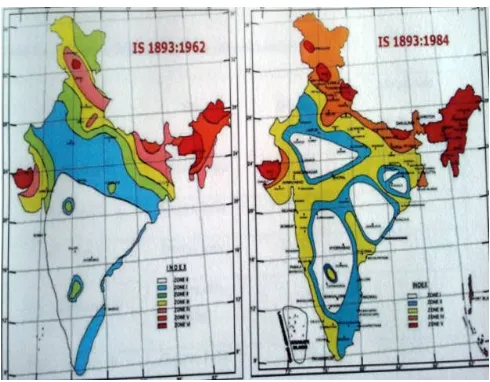
Seismicity trend of India classifies it as a highly varied country in terms of seismic activities. Fig 1.1 shows the seismicity map of India, it can be seen that the Deccan plateau region being prone to less seismicity.
Figure 1.2 Seismic Zoning maps of India from (1962 – 2002) 1.3 GLOBAL DEFICIENCIES
Global deficiencies can broadly be classified as plan irregularities and vertical irregularities, as per the Code. Some of the observed irregularities are as follows:
Plan Irregularities:
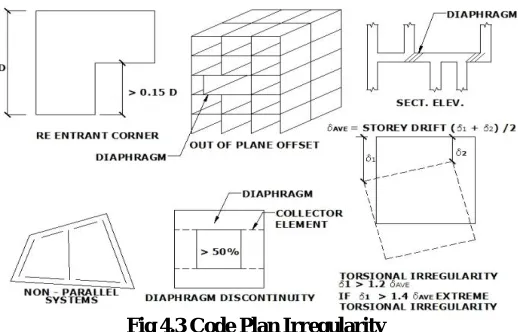
This Torsional irregularity due to plan symmetry and eccentric mass from water tankand frequent re-entrant corners. Diaphragm discontinuity due to large openings or staggered floors, along with the absence of collector elements. Out-of-plane offset for columns along perimeter. The Nonparallel lateral loads are resisting systems not observed in the building studied. VerticalIrregularitiesand Stiffness irregularity of a soft storey due to open ground storey. Mass irregularity not observed in the building studied. In-plane discontinuity for columns along the perimeter of the buildingthe weak storey due to open ground storey. In architectural design it is usual to choose irregularly shaped plans as an answer to the various factors, such as functional, spatial, environmental, conceptual, formal, etc., which are part of the conception of a building. However, in engineering the use of such plans is criticized due to their inappropriate seismic behaviour.
II.RELATEDWORK 2.1 OBJECTIVES OF THE STUDY
a) Creation of 3D building model for both linear and non-linear dynamic method of analyses. b) Understanding the seismic behaviour of Setback buildings.
c) Co-relating the seismic behaviour of the Setback building with that of a building without Setback.
d) Comparing the seismic behaviour of building with setback at every two levels to that of building with setback at each floor level. Study the influence of vertical irregularity in the building when subjected to earthquakes.
2.2. SCOPE OF THE PRESENT WORK
resulting in torsion in structural systems. Vertical irregularities are characterized by vertical discontinuities in the distribution of mass, stiffness and strength. Very few research studies have been carried out to evaluate the effects of discontinuities in each one of these quantities independently, and majority of the studies have focused on the elastic response.
OBJECTIVE OF STUDY
a) Creation of 3D building model for both linear and non-linear dynamic method of analyses. b) Understanding the seismic behaviour of Setback buildings.
c) Co-relating the seismic behaviour of the Setback building with that of a building without Setback.
d) Comparing the seismic behaviour of building with setback at every two levels to that of building with setback at each floor level. Study the influence of vertical irregularity in the building when subjected to earthquakes.
IV. IRREGULARITIES IN STRUCTURES 3.1 GENERAL
The building configuration has been described as regular or irregular in terms of size and shape of the building, arrangement of structural elements and mass. Regular building configurations are almost symmetrical in plan and elevation about the axis and have uniform distribution of the lateral force-resisting structure such that, it provides a continuous load path for both gravity and lateral loads. A building that lacks symmetry and has discontinuity in geometry, mass, or load resisting elements is called “irregular”. These irregularities may cause interruption of force flow and stress concentrations. Asymmetrical arrangements of mass and stiffness of elements may cause a large torsional force where thecentre of mass does not coincide with the centre of rigidity.
3.2 Architect, constructor and initial building design
The initial building is usually proposed by an architect who should harmonize the needs of investor with his own ideas and concepts, as well as with static and other technologies requirements. It is also useful to adapt the working of the building, to define the major dimensions of the structure and to propose the arrangement of the rooms in the way that correspond best to the given location, as well as to the needs of the investor and user.
3.2.1 Reasons for irregularities in buildings
a)Construction in Hilly areas
b) Modern/new trends in commercial complexes c) Thickly populated areas
CLASSIFICATION OF IRREGULARITIES
The structural irregularities are categorized in three types as: a) Plan Irregularities
b) Vertical Irregularities c) Other Irregularities
Plan Irregularities
Fig 4.2 Plan Irregularity
If, a walls is placed on one side of a building while the other side has open frames, the eccentricity between the centeroid of the mass and resistance causes the torsional vibration during an earthquake resistance structures larger damage has develops in members away from the center of resistance. The structural wall is decreases lateral deformation and resisting the large horizontal forces.
Fig 4.3 Code Plan Irregularity 4.3.2 Vertical Irregularities
Vertical Irregularities refer to sudden change of strength, stiffness, geometry and mass results in irregular distribution of forces and/or deformation over the height of building.
When the stiffness is reduced in a storey along the height, earthquake-induced deformations tend to concentrate at the flexible and weak storey. The concentration of damage in a storey leads to large deformations and excessive deformation in vertical members often leads to failure of the storey.
V.NUMERICAL STUDIES
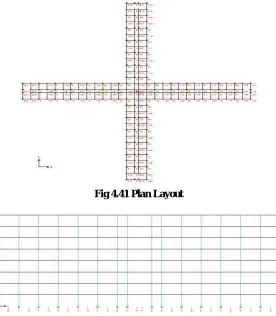
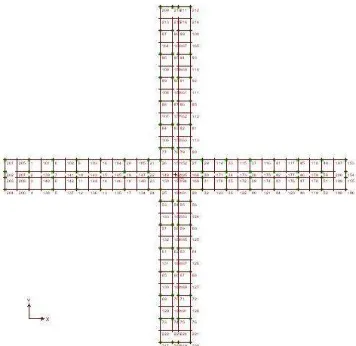
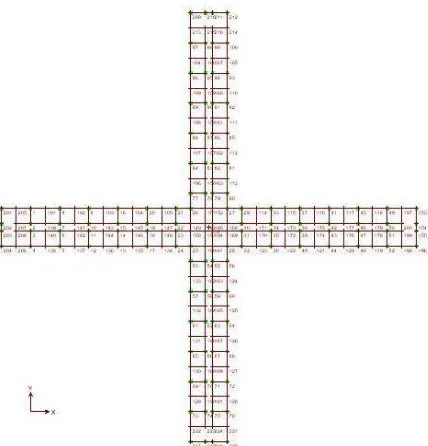
The plan layouts for the building modals with and without Setbacks are shown in figures.
Symmetric Building Models
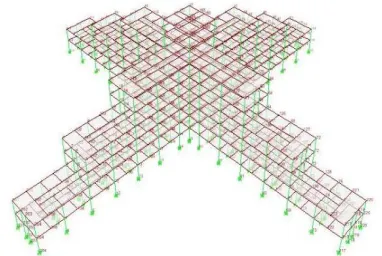
Model 1: Building modelled with Re-entrant corner and without Setback.
Model 2: Building modeled with Re-entrant corner and Setback at every two levels.
Model 3: Building modeled with Re-entrant corner at Setback at each level.
Plan Layout Model 1:
Fig 4.41 Plan Layout
Fig 4.6 View of Building without Setback (Model 1) Model 2:
Fig 4.9 Plan Layout for 5th and 6th Floors, 7th and 8th Floors
Fig 5.0 Elevation of Building with Setback (Model 2)
Model 3:
Fig 5.2 Plan Layout for 1st Floor VI. RESULTS AND DISCUSSIONS
1. The fundamental time periods of all the 90 selected setback buildings were calculated using different methods available in literature including code based empirical formulas.
2.These buildings were also calculated using modal analysis. Modal analysis procedure is explained.
3.Computed as per different code empirical equations such as IS 1893:2002, Rayleigh Method, and period obtained from modal analysis.
VII.CONCLUSIONS
Buildings with the setback irregularity have not received much attention in previous researches, and in the formulation of seismic design methodologies. In the present study, a detailed analytical study has been carried out to overcome these shortcomings. The main conclusions were as follows:
1. To quantify the setback irregularity a parameter called ‘irregularity index’, is proposed. The proposed irregularity index accounts for mass and stiffness changes due to the presence of setbacks along the building height.
2. The proposed parameter is based on dynamic response of the building, and is found to be quite simple.
3. This study could not conclude on the appropriate parameter defining the irregularity in three-dimensional multi-storied setback buildings.
and Building Materials 20 (2006) 34–45.