DOI: 10.1534/genetics.107.083907
Experimental Support for
Multiple-Locus
Complementary Sex Determination
in the Parasitoid
Cotesia vestalis
Jetske G. de Boer,*
,1Paul J. Ode,
†Aaron K. Rendahl,
‡Louise E. M. Vet,
§,**
James B. Whitfield
††and George E. Heimpel*
*Department of Entomology, University of Minnesota, St. Paul, Minnesota 55108,†Department of Entomology, North Dakota State University, Fargo, North Dakota 58105,‡School of Statistics, University of Minnesota, Minneapolis, Minnesota 55455,§Netherlands Institute of
Ecology, 3631 AC Nieuwersluis, The Netherlands,**Laboratory of Entomology, Wageningen University, 6709 PD Wageningen, The Netherlands and††Department of Entomology, University of Illinois, Urbana, Illinois 61801
Manuscript received October 29, 2007 Accepted for publication August 22, 2008
ABSTRACT
Despite its fundamental role in development, sex determination is highly diverse among animals. Approximately 20% of all animals are haplodiploid, with haploid males and diploid females. Haplodiploid species exhibit diverse but poorly understood mechanisms of sex determination. Some hymenopteran insect species exhibit single-locus complementary sex determination (sl-CSD), where heterozygosity at a poly-morphic sex locus initiates female development. Diploid males are homozygous at the sex locus and represent a genetic load because they are inviable or sterile. Inbreeding depression associated with CSD is therefore expected to select for other modes of sex determination resulting in fewer or no diploid males. Here, we investigate an alternative, heretofore hypothetical, mode of sex determination:multiple-locusCSD (ml-CSD). Underml-CSD, diploid males are predicted to develop only from zygotes that are homozygous at all sex loci. We show that inbreeding for eight generations in the parasitoid waspCotesia vestalisleads to increasing proportions of diploid males, a pattern that is consistent withml-CSD but notsl-CSD. The proportion of diploid males (0.2760.036) produced in the first generation of inbreeding (mother–son cross) suggests that two loci are likely involved. We also modeled diploid male production under CSD with three linked loci. Our data visually resemble CSD with linked loci because diploid male production in the second generation was lower than that in the first. To our knowledge, our data provide the first experimental support forml-CSD.
D
IFFERENTIATION between males and females is a fundamental aspect of life for sexually reproduc-ing animals. The underlyreproduc-ing principle of sexual differ-entiation is similar in most animals: a primary signal that differs in males and females leads to differential expression of a key gene. This key gene directs ex-pression of sex-differentiating genes, resulting in the sexual phenotype. Evolution has led to an astonishing diversity of primary signals of sex determination, in-cluding environmental, social, or genetic signals that can vary between closely related species and even within species (Bull1983; Marin and Baker1998; Schu¨ ttand No¨ thiger2000).
All sexually reproducing members of the insect order Hymenoptera are haplodiploid, with haploid males developing from unfertilized eggs and diploid females from fertilized eggs. This precludes a role for hetero-morphic sex chromosomes as primary signals of sex determination. Instead, many hymenopterans exhibit
complementary sex determination (CSD) (Whiting
1943; Beye et al. 2003; van Wilgenburg et al. 2006;
Heimpel and de Boer 2008). Under single-locus (sl
)-CSD, female development is initiated by heterozygosity at a single, highly polymorphic, sex locus. Homozygotes at the sex locus develop into inviable or sterile diploid males (Whiting1943; Cook1993b; Cookand Crozier
1995; Hollowayet al.1999;deBoeret al.2007b), with
the exception of the vespid waspEuodynerus foraminatus, in which diploid males have near normal fertility (Cowan and Stahlhut 2004). The production of
diploid males increases dramatically under conditions of inbreeding or low genetic diversity and represents a severe genetic load. The production of diploid males can reduce population growth rates (Stouthameret al.
1992) and effective population size (Zayed2004), and it
can increase extinction risk (Zayedand Packer2005).
Because inbreeding levels are presumed to be high in many hymenopteran species, it is expected that the genetic load associated with CSD should select for modes of sex determination that do not result in the costly production of diploid males. Indeed, not all hymenopterans exhibit CSD, but sex determination in
1Corresponding author:Evolutionary Genetics, Centre for Ecological and Evolutionary Studies, University of Groningen, P.O. Box 14, NL-9750 AA Haren, The Netherlands. E-mail: [email protected]
species without CSD is largely unknown. An alternative model, involving a maternal effect and genomic im-printing, has been proposed for the parasitoid wasp
Nasonia vitripennis (Beukeboom et al. 2007; Kamping
et al.2007).
An extension of thesl-CSD model ismultiple-locus(ml )-CSD (Snell1935; Crozier1971), where diploid males
develop only from fertilized eggs that are homozygous at all of two or more independent sex loci. Compared tosl -CSD,ml-CSD should lead to significantly fewer diploid males, and the same genetic load should be reached at higher levels of inbreeding. To date, no evidence has been reported that conclusively supports this genetic model (van Wilgenburg et al. 2006), and very few
studies have attempted to find evidence. We have argued elsewhere that evidence for ml-CSD may have been missed in previous studies due toml-CSD collapsing to
de facto sl-CSD under inbreeding (HeimpelanddeBoer
2008). Cookfirst raised this issue in his experimental
analysis of CSD in the bethylid parasitoid Goniozus nephantidis(Cook1993a). Underml-CSD, the
propor-tion of diploid males among the fertilized offspring depends on the number ofheterozygoussex loci (h) of the mother and is 1/2h
for a cross between parents that share a sex allele at each putative locus. When only one sex locus is heterozygous (h¼1),ml-CSD collapses tosl-CSD. If studies on CSD are done using material that has been previously inbred or has a narrow genetic basis, a collapse fromml-CSD tosl-CSD may lead to an underestimation of the number of sex loci.
Here, we report results from a multiple-generation inbreeding experiment in which we maximized the chance of starting the experimental crosses with females that are heterozygous at each putative sex locus. We used the braconid wasp Cotesia vestalis [¼ C. plutellae
(Shaw 2003)], a solitary endoparasitoid of
diamond-back moth larvae, for which we recently showed CSD based on the occurrence of diploid males in inbred but not in outbred crosses. We specifically test theml-CSD model for this species because diploid male frequencies were lower than those expected undersl-CSD (deBoer
et al. 2007a). An alternative multilocus model of sex determination was proposed by Battaglia for a co-pepod but was considered unlikely for Hymenoptera by Crozier (1975), and currently there are no other
testable models that include development of diploid males under inbreeding.
We also modified the original ml-CSD model to predict the effect of linkage between putative sex loci on the proportion of diploid males produced under inbreeding. If additional sex loci arose through dupli-cation, they may be linked to the original sex locus. For example, in Drosophila, 70% of recent gene duplica-tions were found in tandem with the original gene (Clement et al. 2006). Similarly, many gene families
occur in groups. We compare our data to the predic-tions of this new model.
METHODS
Experimental crosses: We used two strains of C. vestalis: one started with material from a commercial supplier (Biofac Crop Care, Mathis, TX) and one started with wasps from a wild population in Benin (deBoer
et al. 2007a). Ten experimental lines were started by outcrossing a haploid male from one strain with a female from the other strain to minimize the chance of fixed sex loci in the female offspring (Figure 1). Four lines were initiated with a male of the Biofac strain and a female of the strain from Benin; the other 6 lines were made in the other direction. One to four daughters from each of these lines were exposed to hosts as virgins to produce haploid sons. Approximately 2 weeks later, each of the 19 surviving females was crossed with one of her own sons. Subsequently, we established brother–sister crosses for seven generations. One to 4 replicates were done per original mother–son mating for a total of 22–26 repli-cates in each generation. We ensured using haploid males in each cross by allowing virgin females to oviposit in 10–15 second and third instar diamondback moth larvae before mating and using these male offspring in brother–sister matings of the next generation (deBoer
et al.2007b). To allow mating, pairs were kept together for 24 hr in a plastic vial (2.5 cm diameter, 6.5 cm high) with a piece of host-damaged cabbage leaf and a droplet of honey. After mating, females were exposed two times to30 hosts on a piece of cabbage leaf for 24 hr in the same type of plastic vials with a droplet of honey. Three sets of hosts were offered in the mother–son generation because we anticipated lower parasitism and fertilization rates due to the age of females and keeping them at low temperatures for12 days. Parasitized hosts were sub-sequently fed on cabbage for 2 days and then reared individually on artificial diet (modified from Shelton
et al.1991) in 1-oz. clear cups until cocoon formation, diamondback moth pupa formation, or death. Cocoons were transferred individually to microcentrifuge tubes with a small droplet of honey. Emerging wasps were sexed and then frozen at30°for analyses of ploidy (see below). Mating and oviposition were done at 23°61°, 30–50% relative humidity (rh), and 16 hr light (L):8 hr dark (D) in a climate-controlled room, and larval de-velopment was followed at 25° 6 1°, 30–50% rh, and 16 hr L:8 hr D in a growth chamber in the quarantine facility at the University of Minnesota. Data recorded in each generation were proportion of hosts that devel-oped into C. vestalis cocoons or diamondback moth pupae, proportion of hosts that died, and secondary sex ratio (proportion of males).
Flow cytometry:Ploidy of male offspring of replicates that produced at least one female was identified with flow cytometry, following methods described bydeBoer
et al.(2007b). In short, the head of an individual wasp was pulverized in Galbraith buffer (Galbraith et al.
DNA content of 2500 nuclei was determined on a FACSCalibur flow cytometer (Becton Dickinson Immu-nocytometry Systems, San Jose, CA). Males were classi-fied as haploid (h), diploid (d), or unknown by comparing their DNA histograms to those of known haploid males and diploid females. In total, ploidy of 186 of 2453 analyzed males remained unknown (7.6%). The number of haploid males (HM) and diploid males (DM) in each replicate was then estimated as HM ¼
[total males3h/(d1h)] and DM¼[total males3d/ (d1h)], respectively. Using these data, we determined the proportion of diploid males [DM/(DM1females)] and the fertilization rate [(DM1females)/total adult offspring] per replicate family.
Model predictions:Previous work onml-CSD assumed that the sex loci were independent (Cook 1993a),
following the model proposed by Crozier(1971). Here,
we designed a new model to predict the fraction of diploid males under three-locus CSD with varying degrees of linkage between these loci. The model works as follows: The sex loci are indicated with A1, A2, A3 and B1, B2, B3, where 1–3 are the three sex loci, and A and B indicate (sets of) homologous chromosomes. Recombi-nation between loci 1 and 2 occurs at rate ‘‘a,’’ and recombination between loci 2 and 3 at rate ‘‘b.’’ Because of the mother–son mating structure in the first gener-ation of our experiment (Figure 1), only two different alleles at each locus are possible in the model (indicated by ‘‘1’’ and ‘‘2’’). This leads to a maximum of eight different haploid gametes under three-locus CSD (i.e., 111, 112, 122, 121, 212, 211, 221, 222). Haploid males have a single allele at each sex locus, and thus there are eight different haploid male genotypes. Under three-locus CSD, there are 36uniquediploid genotypes. The 28 diploid genotypes with at least one heterozygous locus (i.e., A16¼B1 or A26¼B2 or A36¼B3) are females, while the 8 genotypes with only homozygous loci (A1¼B1 and A2¼B2 and A3¼B3) are diploid males.
We first modeled the frequencies of each type of gamete produced by each of the 28 female genotypes. Parental gametes (no crossover) are produced at rate (1a)3(1b)/2, gametes in which a single crossover occurred between loci 1 and 2 at ratea 3 (1 b)/2, gametes in which a single crossover occurred between loci 2 and 3 at rateb3(1a)/2, and gametes in which a double crossover occurred at ratea3b/2. Diploid males do not produce any gametes because they were not used in the experiment. No recombination occurs in haploid males.
Each female can potentially be paired with each of the 8 haploid male genotypes. The frequency at which each haploid male genotype occurs depends on the mother’s
Figure1.—Experimental design followed. As an example, genotypes for aml-CSD model with two independent sex loci are shown (A indicates locus 1, with allelesi,j, andl; B indi-cates locus 2, with allelesk,m, andn). For all matings, haploid males are obtained via oviposition by virgin females. Geno-types in boldface type are homozygous at both sex loci and thus diploid males. In each mating, sex alleles that are shared by the female and her mate are underlined. Step 1 is an out-cross between a female from one population and a haploid male from the other population. Within each population, one or more sex loci may be fixed for a single allele but assum-ing the populations carry different alleles at the same sex lo-cus, all resulting diploid offspring will be heterozygous. In step 2, females from the outcross first produce haploid sons as virgins (A) and are then mated to one of their own sons (B), which reduces the number of possible alleles per sex lo-cus to two. A mother and her own son always share an allele at each sex locus and, under two-locus CSD, result in 25% of the fertilized offspring developing as DM. In step 3, full-sib mat-ings are established between the haploid males and diploid females resulting from step 2B. In this example of two-locus CSD, three different types of sibling matings can occur after a mother–son mating. In type A, one of the female’s sex loci is fixed and her mate shares a sex allele at only one of the sex loci, which leads to all fertilized offspring being female. When the female is heterozygous for both loci and her mate shares sex alleles at each of these loci (type B), 25% of the fertilized offspring becomes DM. In type C, the female is heterozygous for one locus and her mate shares sex alleles at both loci, re-sulting in 50% of the fertilized offspring developing as DM. Type C matings represent a two-locus CSD system that has
genotype and is equal to the frequency of gametes she produces. There are thus 28 possible sets of haploid males, with different frequencies of genotypes for each set. Using these sets of haploid males, we modeled the
frequencies of diploid genotypes (36) produced by each combination of female genotype (28) and a set of haploid males produced by a certain mother (28). In our inbreeding experiment, the first generation was a mother–son mating, so in the model, females were paired only with the set of haploid males produced by their own genotype. In subsequent generations of the experiment, females were crossed with their brothers, so in the model they were allowed to mate with the set of males produced by their mother’s genotype (irrespec-tive of which genotype their own father was). Per generation, we calculated the proportion of DM among all diploid genotypes and the sums of relative frequen-cies of each female genotype per mother’s genotype, irrespective of the father’s genotype. These frequencies were used as starting frequencies of mother–father combinations in the next generation. The model was written in R (R DevelopmentCoreTeam2007) and is
available from the authors upon request.
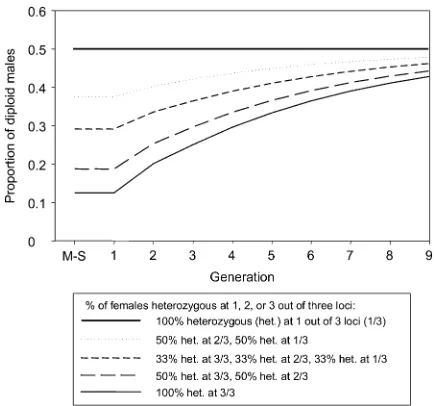
Assumptions in the model are that DM survival is equal to that of females and that iso-female lines were started with a female that was heterozygous at each sex locus. The latter assumption can be varied in our model and affects the level of DM production (Figure 2 shows the results for varying proportions of females being heterozygous at one, two, or three sex loci). To predict sex ratio under each CSD model for the sib-mating generations, the proportion of males was calculated as (1f1f3dmp), where dmp is the proportion of DM among the diploid offspring, andfis the proportion of eggs that is fertilized. We used the average fertilization rate across all generations in our experiment (0.57).
Statistical analyses:Statistical analyses were done on replicates with at least seven diploid offspring (DM1
females) because when a mother produces fewer than
Figure2.—Effect of female genotypes at the beginning of an inbreeding experiment (mother–son mating followed by sib matings) on the predicted proportions of diploid males among fertilized offspring under CSD with three indepen-dent loci. All females are heterozygous at all three sex loci (bottom, solid line), which is the assumption made in our other predictions, or various fractions of the females used to start experiments are heterozygous at one or two of the three sex loci and homozygous at their other locus or loci (fe-males must always be heterozygous at least at one locus be-cause homozygosity at all three loci results in diploid male development). When 100% of females are heterozygous only at one of three sex loci, predictions are identical to those un-dersl-CSD (top, thick solid line).
TABLE 1
Parameter values (mean6SE) for the mother–son mating and seven subsequent sib-mating generations
Generation
Parameter Mother–son 1 2 3 4 5 6 7
No. of replicates 19 26 24 21 25 25 22 24
No. of replicates with$1 daughter
17 24 18 12 15 16 14 18
No. of replicates with
$7 diploid offspring
13 19 12 10 12 10 12 16
No. of hosts reared 66.562.2 55. 962.7 49.761.9 55.662.1 59.461.1 61.562.4 59.661.0 58.761.4 No. dead 12.562.3 10.861.1 11.861.6 7.060.8 5.960.9 13.561.9 16.062.0 13.162.4 No. of moth pupae 4.1 61.3 2.160.5 1.760.7 4.561.4 5.461.6 5.061.7 5.861.7 6.961.3 No. of cocoons 49.963.1 43.062.9 36.362.2 44.162.6 48.162.3 43.062.7 37.862.6 38.762.8 No. of haploid males 17.362.9 10.661.0 11.061.4 14.561.4 13.962.3 13.361.3 12.361.7 13.361.7 No. of females 13.261.5 14.861.5 10.361.3 9.361.2 8.661.1 10.961.2 9.761.4 10.161.8 No. of diploid males 5.4 61.1 3.460.9 2.660.7 7.361.0 6.461.2 6.961.5 6.461.1 10.762.0 No. not emerged 14.162.4 14.161.9 12.461.1 13.062.5 19.261.9 11.960.8 9.561.8 4.661.0
seven diploid offspring we cannot accurately estimate the proportion of diploid males (Table 1).
We compared our data on DM production by C. vestalisto the predictions ofsl-CSD andml-CSD with two independent loci, using a likelihood-ratio test. Under
sl-CSD, the probability of producing DM is constant for all replicates over all generations of inbreeding because we started our experiment with a mother–son mating. Therefore, for each replicate, the distribution of the number of DM (x) is binomial with probabilityp, andnis equal to the number of offspring for that replicate, and
f0ðxÞ ¼ n
x p
xð1pÞnx:
Under two-locus CSD, the distribution of the number of DM (x) for a particular replicate is a mixture of three binomial distributions, with probabilitiespj(j¼1, 2, 3),
where the mixing parameters akj depend on the generationkfollowing from our model (see Figures 1 and 3B),
f1ðxÞ ¼ X3
j¼1
akj n
x p
x
jð1pjÞnx:
We compared the two models using a likelihood-ratio test (Berry and Lindgren 1996), where the null
hy-pothesis was thatsl-CSD is true and the alternative hy-pothesis was that two-locus CSD is true. The negative log-likelihood ratio,
XN
i
ðlogf1ðxiÞ logf0ðxiÞÞ;
where N is the total number of replicates over all generations, was computed using the observed data. The significance of this ratio was obtained by comparing it to the distribution of the negative log-likelihood ratio, assuming the null hypothesis was correct. This distribu-tion was estimated using R (R Development Core
Team2007) to simulate 1000 data sets fromsl-CSD and
computing the negative log-likelihood ratio for each. Simulated data sets were equal to the observed data set in terms of the number of replicates in each generation and the number of offspring per replicate.
We supplemented this analysis with a number of other tests ofml-CSD predictions. First, we tested for effects of the inbreeding level over the seven generations of brother–sister crosses on the following parameters using linear regression: the number of diploid males, the number of females, and the number of haploid males. The prediction from these analyses forml-CSD is that the number of diploid males produced increases with in-breeding, the number of females decreases, and haploid males are unaffected by inbreeding. As a related test that corrects for family size, we analyzed the effect of in-breeding level on the ratio between DM and females,
using logistic regression (underml-CSD, this ratio should increase). To assess whether variation in this ratio could be caused by developmental mortality of DM or females or general developmental mortality, we determined Pearson’s correlation coefficient for the ratio of DM to females and (1) total number of DM and females and (2) proportion of dead hosts. We also analyzed the effect of inbreeding on the fertilization rate ([diploid males 1
females]/all adults), using logistic regression (no effect is expected underml-CSD).
The initial mother–son mating also affords an oppor-tunity to compare the results to hypotheses related to different numbers of loci withinml-CSD. Assuming het-erozygosity at all loci in the mother, expected propor-tions of diploids that are male are 0.5, 0.25, and 0.125 for
sl-CSD, two-locusCSD, and three-locusCSD, respectively. We compared our diploid male data to all of these predictions, usingt-tests ( JMP 2007).
diploid males]/all adults) across brother–sister gener-ations, treating sex ratio as a binary response variable using PROC LOGISTIC in SAS/STAT 2006. Here, the expectation underml-CSD is an increase in the sex ratio (proportion of males) over generations of inbreeding. For all of the analyses that incorporate multiple gen-erations of inbreeding, we used the inbreeding co-efficient,F, as opposed to generations of inbreeding as the independent variable. The inbreeding coefficients are 0.5, 0.75, 0.875, 0.938, 0.969, 0.984, 0.992, and 0.996 for the mother–son mating and seven generations of sib mating, respectively (Crow1986).
RESULTS
Diploid males: We previously found that C. vestalis
produces diploid males after inbreeding but not after outcrossing, thus demonstrating that it has CSD (de
Boeret al.2007a). Here, we inbredC. vestaliswasps for
eight generations (a mother–son mating followed by seven generations of sib mating) to disentangle the effects of (1) the number of sex loci and (2) diploid male survivorship. When proportions of DM are low after one or a few generations of inbreeding, this may reflectsl -CSD with low DM survivorship orml-CSD with high DM survivorship. Continued inbreeding is thus needed to distinguish between these two scenarios: under the first scenario, proportions of DM should remain low, while under the second they should increase, assuming that inbreeding has no effect on developmental survivorship itself (see below). Mother–son matings reduce the potential number of alleles per putative sex locus to two. Therefore, undersl-CSD, 50% of fertilized eggs will result in diploid males in every subsequent sibling generation but under ml-CSD, the proportion of DM will increase gradually with inbreeding (Cook 1993a;
HeimpelanddeBoer2008). Our results show that DM
production increased with inbreeding level (Figure 3A), a phenotypic pattern that is consistent with the predic-tions of ml-CSD. We used a likelihood-ratio test to statistically compare how well the predictions ofsl-CSD andtwo-locusCSD fit our data. In this analysis, thesl-CSD scenario was designated as the null model and the two-locus case as the alternative model. The null model was rejected, indicating that thetwo-locusCSD model fits our data significantly better than does the sl-CSD model (observed negative log-likelihood ratio of 166.0, P ,
0.001; the estimated distribution of the negative log-likelihood ratio is approximately normal with mean
63.4 and standard deviation 9.3).
sl-CSD andml-CSD also differ clearly in the expected fraction of replicates per generation that produced at least one diploid male (Figure 3B). Undersl-CSD, each replicate female in every generation should produce DM. Underml-CSD, however, each mother–son mating should result in the production of DM, but not every
subsequent sibling cross results in the production of DM because some combinations of brothers and sisters are not matched in terms of sex alleles. Under two-locus
CSD, three types of sib matings are possible, resulting in DM proportions of 0, 0.25, or 0.50 (Figure 1). Under CSD with three or more (linked) loci, an even wider range of mating types is possible. Our data show that all of the mother–son matings produced DM, but that in sibling generations 1 and 2,60% of replicates pro-duced DM, while.90% of replicates produced DM in sibling generations 3–8. This is consistent with expect-ations ofml-CSD but not with expectations ofsl-CSD.
In addition, the proportion of DM in the mother–son generation can be used to estimate the number of loci involved in CSD because all females in this generation should produce the same proportion of DM, assuming that all of them are heterozygous for all putative sex loci. Given this, the expectation for the proportion of diploids that are male is 0.5 forsl-CSD, 0.25 fortwo-locus
CSD, and 0.125 forthree-locusCSD. In our experiment, 0.2760.036 (SEM) of diploids were male with a normal distribution (Shapiro–Wilks W ¼0.92, P . 0.3). This mean differs significantly from expectations under sl -CSD (t-test;t12¼ 6.5; one-tailedP,0.0001) or3
locus-CSD (t-test,t12¼4.1, one-tailedP,0.001) but not from
expectations oftwo-locusCSD (t-test;t12¼0.6, one-tailed
P.0.25).
Diploid male survival: We define diploid male sur-vival as the developmental survivorship of DM relative to that of females. Here we explore the possibility that the results in Figure 3A reflect an effect of inbreeding on developmental survivorship of DM or females rather thanml-CSD. An increase in the proportion of DM with inbreeding could still be consistent withsl-CSD either if developmental survival of females decreases with in-breeding or if developmental survival of DM increases with inbreeding. This should be reflected in an effect of inbreeding on the per-family proportion of diploid offspring. This proportion, which is the same as the fertilization rate, was 0.5760.02 averaged over all gen-erations and was not affected by the level of inbreeding (logistic regression, Wald’sx2¼1.23,P¼0.27; see also
Table 1). A related prediction is that underml-CSD, the number of diploid males should increase with inbreed-ing, the number of females should decrease with in-breeding, and the number of haploid males should not be affected by inbreeding. This is in contrast to pre-dictions undersl-CSD, where all of these values should remain unchanged with increased inbreeding following a mother–son mating. Our data are consistent with the predictions for ml-CSD (linear regressions, haploid males, P . 0.05; diploid males, P , 0.001,r2¼ 0.14,
diploid males¼ 13.6121.6F; females,P,0.01,r2¼
underml-CSD rather than from changing developmen-tal survivorship of females or DM.
As a related test that corrects for family size, we analyzed the effect of inbreeding level on the ratio between DM and females. This ratio significantly in-creased with inbreeding (logistic regression, Wald’sx2¼
28.9,P,0.001; see Figure 3A), inconsistent withsl-CSD but consistent withml-CSD. Variation in this ratio could still be consistent with sl-CSD if inbreeding affects developmental mortality of DM or females differentially or inbreeding affects general developmental mortality. However, we found no significant relationship between the total number of diploid offspring and the ratio of DM to females (Pearson’s correlation, r ¼ 0.14, P ¼
0.07) or between the proportion of hosts that died and the ratio of DM to females (Pearson’s correlation,r¼ 0.02,P¼0.80).
On the basis of the ratio of DM to females in sibling generations 3–7, where the DM to female ratio was quite stable and .90% of replicates produced at least one diploid male (Figure 3 and Table 1), we estimate DM survivorship to be 0.92 6 0.08. This validates our model assumption and confirms our previous findings (deBoeret al.2007a).
Linkage between the sex loci:Snell’s and Crozier’sml -CSD models assumed that the sex loci were independent (Snell1935; Crozier1971). Here, we investigated the
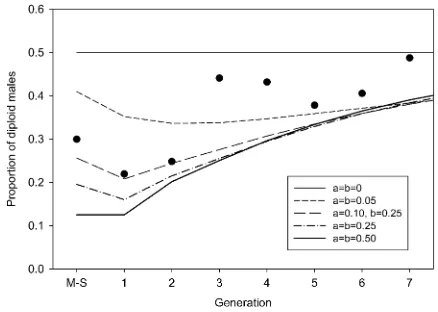
effect of linkage between three putative complementary sex loci on the production of DM in our inbreeding experiment (Figure 4) (for the effects of linkage in a single generation of matched mating see Heimpeland de Boer 2008). Our model predictions show that
linkage between the sex loci (dashed lines in Figure 4) is predicted to result in a higher proportion of DM in the mother–son mating compared to independent loci (thick
solid line in Figure 4). When loci are independent, crossover gametes are produced as often as parental, noncrossover, gametes. When loci are linked, more parental gametes than crossover gametes are produced, with the extreme of only parental gametes when loci are fully linked and act as a single locus (top solid line in Figure 4). Since DM develop from zygotes formed by two identical gametes, the proportion of DM is higher when more parental gametes and fewer crossover gametes are produced.
In subsequent sib matings, all daughter genotypes produced by a single mother can potentially pair with the same set of haploid brothers, produced by the same mother. Because each of these daughter genotypes pro-duces its own type of parental and crossover gametes, the initial bias toward a certain genotype of parental gam-etes is partially averaged out, leading to a lower fraction of DM in the first sib-mating generation than in the mother–son generation. Linkage also leads to a slightly slower approach of the asymptote of DM production than independent loci.
Our data show a reduction in the proportion of DM in the first sib-mating generation compared to the mother–son generation, which might indicate linkage between the putative sex loci inC. vestalis. The marked increase in the proportion of DM in the third sibling generation is not expected under CSD with linked loci. Perhaps this could be explained by differences in sex-determining strength between the sex loci (Crozier
1971). We did not statistically compare how well our data fit ml-CSD with linked loci compared to ml-CSD with independent loci because the variation in propor-tions of DM within generapropor-tions in our data compromises the power of such a test.
Sex ratio: The presence of CSD is often detected or suspected on the basis of male-biased sex ratios that appear under conditions of inbreeding (Heimpeland
Lundgren2000) and we present sex ratio in Figure 5 to
allow comparisons with other studies. The secondary sex ratio (proportion of males among adult progeny) is a result of the proportion of DM, the fertilization rate, and the relative survival of haploid males, diploid males, and females. AlthoughC. vestaliscan presumably manipulate sex ratio by preferentially withholding or allocating stored sperm, our results show no change in the fer-tilization rate over the course of eight generations of inbreeding (see above). Thus, the secondary sex ratio is directly related to the proportion of DM and is expected to become increasingly male biased over more than one generation of inbreeding underml-CSD but notsl-CSD when generations of sib mating follow a mother–son mating. Indeed, the secondary sex ratio of C. vestalis
follows a very similar pattern to DM production over eight generations of inbreeding (Figure 5). Sex ratio increased significantly with the level of inbreeding (logistic regression, Wald’s x2 ¼ 17.79, P , 0.001),
consistent withml-CSD but notsl-CSD.
DISCUSSION
Multiple locus-CSD was first proposed in 1935 but until now convincing experimental support was lacking. Several studies suggested their results might be better explained by ml-CSD rather than sl-CSD (Garofolo
1973; Kerr1974; Naitoet al.2000), while others found
no support for ml-CSD in a range of other species (Skinner and Werren 1980; Cook 1993a; Periquet
et al.1993; Butcheret al.2000; Niyibigiraet al.2004a;
Schrempfet al.2006). Here, we show that inbreeding
the braconid waspC. vestalisfor eight generations results in increasing proportions of DM and an increasingly male-biased sex ratio (Figures 3 and 4). This phenotype is consistent with predictions ofml-CSD but not with those ofsl-CSD. However, an increase in the proportion of DM among diploid offspring might in principle also be explained by decreased survivorship of females with inbreeding or increased survivorship of DM with in-breeding. This should lead to a significant effect of inbreeding on the proportion of diploids among all offspring. Because we failed to find such a relationship, the pattern of DM increase with inbreeding is best explained by ml-CSD. Our data from the mother–son crosses allowed for a direct test of the number of loci involved and that suggests that two loci are more likely than more loci. To confirm that multiple complemen-tary sex loci form the basis of sex determination inC. vestalis, genetic mapping studies are underway. Discov-ery of theml-CSD phenotype leads to questions about the potential regulatory pathways and evolution of such a mechanism of sex determination. We discuss these questions here in light of our new data and the predictions of our revisedml-CSD model, which includes linkage between the putative loci.
How might multiple complementary sex loci result in the initiation of female and male development? In
Crozier’s original model, females would develop from zygotes that have at least one heterozygous sex locus, irrespective of which sex locus this is (Crozier1971).
Males develop from haploid zygotes and from diploid zygotes that are homozygous at each of the sex loci. When Crozier proposed ml-CSD, sl-CSD was not yet understood at the molecular level. Cloning and se-quencing of thecomplementary sex determinergene (csd) in honeybees provided a major breakthrough in this respect (Beye et al. 2003). Allelic variants incsd were
detected (Hasselmann and Beye 2004) and on the
basis of this information Beye developed three models that could explain how csd determines sex within the context of haplodiploidy (Beye 2004). All models are
based upon the assumption of a single sex locus. In the first model, products of the two divergent sex alleles in females combine to form a heterodimer that activates the female-producing pathway while no dimer is formed in males. In the second model, homodimers are formed in both males and females, but the fact that females have two distinct types of homodimers initiates the female pathway. In the third model, the transcripts from the divergent alleles in females complement each other’s activity to initiate female development. Beye’s models are hypothetical and designed to be consistent with two observations: (i) haploid individuals are always male, and (ii) interference with thecsdtranscript (by RNAi) turns genetic females into males, but interference with
csd transcripts in haploid males does not lead to the production of females (Beyeet al.2003; Beye2004). But
how do these models stand up toml-CSD? If additional sex loci arose via duplication of the first locus (see below), and products of alleles from the first locus can interact with products of alleles from additional sex loci in a similar way to products of two different alleles at a single locus, then all three of Beye’s models would predict the production of haploid females and no diploid males under ml-CSD. Haploid females have recently been found in N. vitripennis, but this species does not exhibitsl-CSD orml-CSD, and haploid females were attributed to a failure in maternal imprinting of an unknown sex determination gene (Beukeboomet al.
2007; Kampinget al.2007). Interaction between
prod-ucts of different sex loci similar to interaction between products of a single sex locus seems very unlikely because the female pathway would be activated in haploid individuals and males would be entirely absent. We therefore expect no interaction between the prod-ucts of multiple complementary sex loci. To summarize this section, we currently have no clear explanation of howml-CSD might function. More insight into the sex determination pathway in species withsl-CSD, especially the honeybee, could provide a basis upon which we can build hypotheses forml-CSD.
How mightml-CSD have evolved?sl-CSD is generally thought to be ancestral within the Hymenoptera (Cook
1993b;vanWilgenburget al.2006).ml-CSD might have Figure5.—Secondary sex ratio (binomial 95% confidence
evolved fromsl-CSD by one or more duplications of the sex locus. Duplications of genes occur quite frequently, through tandem duplication of the entire gene, seg-mental duplication of part of a gene, chromosome duplication, or global duplication of the entire genome (Graur and Li 1999). For example, a survey of the
Drosophila melanogaster genome revealed the presence of 106 recently duplicated genes (Clementet al.2006).
Many duplicate genes become dysfunctional (pseudo-genes) but genes can be retained by changes in the protein-coding domain, or by changes in regulatory elements, leading to different spatial or temporal gene expression (Force et al. 1999; Prince and Pickett
2002). For example, theSex lethal gene in Drosophila probably arose by duplication and acquired its function in sex determination, while the ancestral gene (CG3056) continued to serve yet-unknown functions (Trautet al.
2006). In the honeybee Apis mellifera two sex deter-mination genes have been identified,csdandfem, with
csd alleles showing signatures of balancing selection (Hasselmannand Beye2004). The genefem(previously
designated as ‘‘type II csd alelles’’) appears to be the progenitor of csd, so that csd may represent a dupli-cation event from fem (Hasselmann et al. 2008a).
However,femshows low variability and no signature of balancing selection (Hasselmannand Beye2004, 2006;
Hasselmann et al. 2008a,b) and does therefore not
appear to function as a secondcsdlocus as envisioned underml-CSD.
In the case of duplication of the sex locus in species with sl-CSD, selection on retention of the duplicated gene is expected to be strong because a second func-tional locus should significantly reduce the genetic load under inbreeding. How strong this selection is depends on the level of linkage between the original gene and its duplicate (see below, Figure 4). Theoretically,ml-CSD may also evolve from sl-CSD if an unrelated locus acquires a function in the sex determination pathway in such a way that heterozygosity of the second locus is important in initiating female development. Interest-ingly, QTL analysis showed that several minor loci may be involved in sex determination in the parasitoid
Habrobraconsp. near hebetor, a species with a clearsl-CSD phenotype (Hollowayet al.2000).
We investigated the effect of linkage between the putative sex loci on predicted DM production. Snell
(1935) and later Crozier (1971) proposed
indepen-dent sex loci underml-CSD (Snell1935; Crozier1971)
but this may be unlikely if additional loci arose through duplication(s). Compared to independent loci, linkage leads to higher predicted DM proportions in the mother–son mating and a drop in the subsequent sib-mating generation (Figure 4). Visually, our data follow this pattern, which may indicate that linkage between the putative sex loci indeed plays a role, but we did not statistically compare the fit of a linkage model to our data. An alternative explanation for the relatively high
DM proportion in the mother–son mating may be that the females were kept at 10°for12 days while their sons developed. Sex determination inN. vitripennisappears to be influenced by the age of the mother and by temperature (Beukeboomand Kamping2006; Kamping
et al.2007), and some studies have suggested a temper-ature effect on DM production under CSD (Whiting
and Anderson1932; but see Weiseret al.2004).
Our model also shows that three rather tightly linked sex loci result in a significant reduction in DM pro-duction, compared to fully linked loci acting as a single locus (Figure 4). Recombination rates around the sex locus in honeybees are much higher than the average recombination rate in the honeybee genome (Beyeet al.
1999; Hasselmannand Beye 2006). This could be an
important advantage if the sex locus were duplicated because it reduces the chance of the two genes inherit-ing as a sinherit-ingle locus, defeatinherit-ing an advantage over a sinherit-ingle
csdgene. However, whether recombination rates around the sex locus are also high in other species with CSD is not known.
On the practical side, linkage between the sex loci makes distinguishingml-CSD fromsl-CSD more difficult because of the continuum of predicted DM levels for a single generation of inbreeding (HeimpelanddeBoer
2008). We therefore stress the importance of employing multiple generations of inbreeding and of initiating experiments with genetically diverse material.
To conclude, we have confirmed that the pattern of DM production inC. vestalisis consistent with ml-CSD but not with sl-CSD. Further, our results are most con-sistent withtwo-locusCSD. This in itself does not prove the existence ofml-CSD, but it is a strong indication, with important implications for research on sex determina-tion in the Hymenoptera. In particular, studying species that potentially possess ml-CSD might provide more insight into the mechanisms of CSD, and comparative studies on species with different modes of sex determi-nation will provide insight into the evolution of this im-portant trait in the Hymenoptera. The braconid genus Cotesia could provide a valuable system for comparative studies because it comprises species with presumedsl -CSD (C. glomerata),ml-CSD (C. vestalis), and no CSD (C. sesamiae, C. flavipes) (Gu and Dorn2003; Niyibigira
et al.2004a,b; Zhouet al.2006;deBoeret al.2007a,b). A
similar diversity of sex determining systems can be found more broadly in the Braconidae as well (Beukeboom
et al.2000; Wuet al.2005;vanWilgenburget al.2006).
Another interesting group is the ant family, Formicidae, because many species are believed to havesl-CSD (van
Wilgenburget al.2006), but it appears to be absent in
the inbreeding antCardiocondyla batesii(Schrempfet al.
2006). Also, a number of socially parasitic ants engage in inbreeding, bringing into question whether they have
sl-CSD (Crozierand Pamilo1996). Sex determination
conse-quences of CSD are potentially severe (Zayed and
Packer2005). Fundamental knowledge on sex
deter-mination could be used to improve the effectiveness with which hymenopterans are used as biological control agents of pest insects and as pollinators (Stouthamer
et al.1992; Heimpelet al.1999; Heimpeland Lundgren
2000; Antolin et al. 2003; Ode and Hardy 2008).
In addition, knowledge of the genetics of sex deter-mination could be used in conservation management of natural populations of pollinating hymenopterans, many of which are declining (Zayedand Packer2005;
Biesmeijeret al.2006).
We thank Dominique Bordat for supplyingC. vestalisfrom Benin; Lynn Knutson, Laura Stone, Dan Barta, Virginia Howick, and Beth Sandager for rearing assistance; Remco van Poecke for his help in modifying theml-CSD model; Greg Veltri of the Flow Cytometry Core Lab at the University of Minnesota Cancer Center for his help in the flow cytometry analyses; Zhishan Wu for letting us use facilities at the University of Minnesota/Minnesota Department of Agriculture Quar-antine Facility; and Leo Beukeboom for comments on a previous version of the manuscript. This study was supported by the National Science Foundation and the University of Minnesota Agricultural Experiment Station.
LITERATURE CITED
Antolin, M. F., P. J. Ode, G. E. Heimpel, R. B. O’Haraand M. R.
Strand, 2003 Population structure, mating system, and sex
de-termining allele diversity of the parasitoid waspHabrobracon hebe-tor.Heredity91:373–381.
Berry, D. A., and B. W. Lindgren, 1996 Statistics: Theory and
Meth-ods.Duxbury Press, Belmont, CA.
Beukeboom, L. W., and A. Kamping, 2006 No patrigenes required
for femaleness in the haplodiploid waspNasonia vitripennis. Ge-netics172:981–989.
Beukeboom, L. W., J. Ellersand J. J. M.vanAlphen, 2000 Absence
of single-locus complementary sex determination in the braconid waspsAsobara tabidaandAlysia manducator.Heredity84:29–36. Beukeboom, L. W., A. Kampingand L.van deZande, 2007 Sex
de-termination in the haplodiploid waspNasonia vitripennis (Hyme-noptera: Chalcidoidea): a critical consideration of models and evidence. Semin. Cell Dev. Biol.18:371–378.
Beye, M., 2004 The dice of fate: thecsdgene and how its allelic
com-position regulates sexual development in the honey bee,Apis mel-lifera.BioEssays26:1131–1139.
Beye, M., G. J. Hunt, R. E. Page, M. K. Fondrk, L. Grohmannet al.,
1999 Unusually high recombination rate detected in the sex lo-cus region of the honey bee (Apis mellifera). Genetics153:1701– 1708.
Beye, M., M. Hasselmann, M. K. Fondrk, R. E. Pageand S. W.
Omholt, 2003 The gene csdis the primary signal for sexual
development in the honeybee and encodes an SR-type protein. Cell114:419–429.
Biesmeijer, J. C., S. P. M. Roberts, M. Reemer, R. Ohlemuller, M.
Edwardset al., 2006 Parallel declines in pollinators and
insect-pollinated plants in Britain and the Netherlands. Science313: 351–354.
Bull, J. J., 1983 Evolution of Sex Determining Mechanisms.Benjamin/
Cummings Publishing, Menlo Park, CA.
Butcher, R. D. J., W. G. F. Whitfield and S. F. Hubbard,
2000 Complementary sex determination in the genusDiadegma (Hymenoptera: Ichneumonidae). J. Evol. Biol.13:593–606. Clement, Y., R. Tavaresand G. A. B. Marais, 2006 Does lack of
re-combination enhance asymmetric evolution among duplicate genes? Insights from theDrosophila melanogastergenome. Gene 385:89–95.
Cook, J. M., 1993a Experimental tests of sex determination in
Gonio-zus nephantidis(Hymenoptera: Bethylidae). Heredity71:130–137.
Cook, J. M., 1993b Sex determination in the Hymenoptera: a review
of models and evidence. Heredity71:421–435.
Cook, J. M., and R. H. Crozier, 1995 Sex determination and
pop-ulation biology in the Hymenoptera. Trends Ecol. Evol.10:281– 286.
Cowan, D. P., and J. K. Stahlhut, 2004 Functionally reproductive
diploid and haploid males in an inbreeding hymenopteran with complementary sex determination. Proc. Natl. Acad. Sci. USA 101:10374–10379.
Crow, J. F., 1986 Basic Concepts in Population, Quantitative, and
Evo-lutionary Genetics.W. H. Freeman, New York.
Crozier, R. H., 1971 Heterozygosity and sex determination in
haplo-diploidy. Am. Nat.105:399–412.
Crozier, R. H., 1975 Animal Cytogenetics 3. Insecta (7) Hymenoptera.
Gebruder Borntraeger, Berlin/Stuttgart, Germany.
Crozier, R. H., and P. Pamilo, 1996 Evolution of Social Insect Colonies:
Sex Allocation and Kin Selection.Oxford University Press, Oxford.
de Boer, J. G., P. J. Ode, L. E. M. Vet, J. Whitfield and G. E.
Heimpel, 2007a Complementary sex determination in the
parasitoid wasp Cotesia vestalis(C. plutellae). J. Evol. Biol. 20: 340–348.
deBoer, J. G., P. J. Ode, L. E. M. Vet, J. B. Whitfieldand G. E.
Heimpel, 2007b Diploid males sire triploid daughters and sons
in the parasitoidCotesia vestalis.Heredity99:288–294. Force, A., M. Lynch, F. B. Pickett, A. Amores, Y. L. Yanet al.,
1999 Preservation of duplicate genes by complementary, de-generative mutations. Genetics151:1531–1545.
Galbraith, D. W., K. R. Harkins, J. M. Maddox, N. M. Ayres, D. P.
Sharmaet al., 1983 Rapid flow cytometric analysis of the cell
cycle in intact plant tissues. Science220:1049–1051.
Garofolo, C. A., 1973 Occurrence of diploid drones in a
neotrop-ical bumblebee. Experientia29:726–727.
Graur, D., and W. H. Li, 1999 Fundamentals of Molecular Evolution.
Sinauer Associates, Sunderland, MA.
Gu, H. N., and S. Dorn, 2003 Mating system and sex allocation in
the gregarious parasitoidCotesia glomerata.Anim. Behav.66:259– 264.
Hamilton, W. D., 1967 Extraordinary sex ratios. Science156:477–
488.
Hasselmann, M., and M. Beye, 2004 Signatures of selection among
sex-determining alleles of the honey bee. Proc. Natl. Acad. Sci. USA101:4888–4893.
Hasselmann, M., and M. Beye, 2006 Pronounced differences of
re-combination activity at the sex determination locus of the hon-eybee, a locus under strong balancing selection. Genetics174: 1469–1480.
Hasselmann, M., T. Gempe, M. Schiott, C. G. Nunes-Silva, M.
Otteet al., 2008a Evidence for the evolutionary nascence of
a novel sex determination pathway in honeybees. Nature454: 519–523.
Hasselmann, M., X. Vekemans, J. Pflugfelder, N. Koeniger, G.
Koenigeret al., 2008b Evidence for convergent nucleotide
evo-lution and high allelic turnover rates at thecomplemetary sex deter-minergene of western and Asian honeybees. Mol. Biol. Evol.25: 696–708.
Heimpel, G. E., and J. G.deBoer, 2008 Sex determination in the
Hymenoptera. Annu. Rev. Entomol.53:209–230.
Heimpel, G. E., and J. G. Lundgren, 2000 Sex ratios of
commer-cially reared biological control agents. Biol. Control19:77–93. Heimpel, G. E., M. F. Antolinand M. R. Strand, 1999 Diversity of
sex-determining alleles inBracon hebetor.Heredity82:282–291. Holloway, A. K., G. E. Heimpel, M. R. Strandand M. F. Antolin,
1999 Survival of diploid males inBraconsp. nearhebetor (Hyme-noptera: Braconidae). Ann. Entomol. Soc. Am.92:110–116. Holloway, A. K., M. R. Strand, W. C. Blackand M. F. Antolin,
2000 Linkage analysis of sex determination inBraconsp near hebetor(Hymenoptera: Braconidae). Genetics154:205–212. JMP, 2007 JMP 2007.SAS Institute, Cary, NC.
Kamping, A., V. Katju, L. W. Beukeboom and J. H. Werren,
2007 Inheritance of gynandromorphism in the parasitic wasp Nasonia vitripennis.Genetics175:1321–1333.
Kerr, W. E., 1974 Advances in cytology and genetics of bees. Annu.
Rev. Entomol.19:253–268.
Marin, I., and B. S. Baker, 1998 The evolutionary dynamics of sex
Naito, T., M. Ishikawaand Y. Nishimoto, 2000 Two-locus
multi-ple-allele sex determination in the rose sawflyArge nigrinodosa. Third International Hymenopteran Congress, Canberra, Australia.
Niyibigira, E. I., W. A. Overholt and P. Stouthamer,
2004a Cotesia flavipes Cameron (Hymenoptera: Braconidae) does not exhibit complementary sex determination (ii): evidence from laboratory experiments. Appl. Entomol. Zool.39:717–725.
Niyibigira, E. I., W. A. Overholt and R. Stouthamer,
2004b Cotesia flavipesCameron andCotesia sesamiae(Cameron) (Hymenoptera: Braconidae) do not exhibit complementary sex determination: evidence from field populations. Appl. Entomol. Zool.39:705–715.
Ode, P. J., and I. C. W. Hardy, 2008 Parasitoid sex ratios and
bio-logical control, pp. 253–291 inBehavioral Ecology of Insect Parasi-toids, edited by E. Wajnberg, C. Bernstein and J. J. M.van
Alpen. Blackwell Publishing, Oxford.
Periquet, G., M. P. Hedderwick, M. Elagoze and M. Poirie,
1993 Sex determination in the hymenopteranDiadromus pul-chellus(Ichneumonidae): validation of the one-locus multi-allele model. Heredity70:420–427.
Prince, V. E., and F. B. Pickett, 2002 Splitting pairs: the diverging
fates of duplicated genes. Nat. Rev. Genet.3:827–837. R DevelopmentCoreTeam, 2007 R: A Language and Environment for
Statistical Computing. R Foundation for Statistical Computing, Vienna.
Schrempf, A., S. Aronand J. Heinze, 2006 Sex determination and
inbreeding depression in an ant with regular sib-mating. Hered-ity97:75–80.
Schu¨ tt, C., and R. No¨ thiger, 2000 Structure, function and
evolu-tion of sex-determining systems in Dipteran insects. Develop-ment127:667–677.
Shaw, M. R., 2003 Revised synonymy in the genusCotesia
(Hyme-noptera: Braconidae: Microgastrinae): the identity ofMicrogaster vestalisHaliday, 1834, as a senior synonym ofApanteles plutellae Kurdjumov, 1912. Entomol. Gazette54:187–189.
Shelton, A. M., R. J. Cooley, M. K. Kroening, M. T. Wilseyand S. D.
Eigenbrode, 1991 Comparative analysis of two rearing
proce-dures for diamondback moth. J. Entomol. Sci.26:17–26.
Skinner, S. W., and J. H. Werren, 1980 The genetics of sex
deter-mination in Nasonia vitripennis(Hymenoptera, Pteromalidae). Genetics94:s98.
Snell, G. D., 1935 The determination of sex inHabrobracon.Proc.
Natl. Acad. Sci. USA21:446–453.
Stouthamer, R., R. F. Luckand J. H. Werren, 1992 Genetics of sex
determination and the improvement of biological control using parasitoids. Environ. Entomol.21:427–435.
Traut, W., T. Mimi, K. Ikeoand K. Sahara, 2006 Phylogeny of the
sex-determining gene Sex-lethal in insects. Genome 49: 254– 262.
vanWilgenburg, E., G. Driessenand L. W. Beukeboom, 2006 Single
locus complementary sex determination in Hymenoptera: an ‘‘un-intelligent’’ design? Front. Zool.3:1–15.
Weiser, L., M. F. Antolin, Z. Wuand G. E. Heimpel, 2004 Does
temperature affect diploid male production inHabrobracon hebe-tor (Say) (Hymenoptera: Braconidae)? J. Hymenopt. Res.13: 309–315.
Whiting, P. W., 1943 Multiple alleles in complementary sex
deter-mination ofHabrobracon.Genetics28:365–382.
Whiting, P. W., and R. L. Anderson, 1932 Temperature and other
factors concerned in male biparentalism inHabrobracon.Am. Nat. 56:420–432.
Wu, Z., K. R. Hopper, P. J. Ode, R. Fuester, M. Tuda et al.,
2005 Single-locus complementary sex determination absent inHeterospilus prosopidis(Hymenoptera: Braconidae). Heredity 95:228–234.
Zayed, A., 2004 Effective population size in Hymenoptera with
com-plementary sex determination. Heredity93:627–630.
Zayed, A., and L. Packer, 2005 Complementary sex determination
substantially increases extinction proneness of haplodiploid pop-ulations. Proc. Natl. Acad. Sci. USA102:10742–10746. Zhou, Y., H. Guand S. Dorn, 2006 Single-locus sex determination
in the parasitoid waspCotesia glomerata(Hymenoptera: Braconi-dae). Heredity96:487–492.