ISSN(Online): 2319-8753 ISSN (Print): 2347-6710
International Journal of Innovative Research in Science,
Engineering and Technology
(An ISO 3297: 2007 Certified Organization)
Website: www.ijirset.com
Vol. 6, Issue 8, August 2017
The Effect of Ti Addition on the Properties of
AA6061-B
4
C Interface -A Microstructural
Study
H. R. Manohara 1, Bhujanga D.P2, Basava T3
Professor, Department of Mechanical Engineering, S.J.M Institute of Technology, Chitradurga, India1
Assistant Professor, Department of Mechanical Engineering, S.D.M. Institute of Technology, Ujire, India2
Professor, Department of Mechanical Engineering, S.D.M. Institute of Technology, Ujire, India3
ABSTRACT: In this present work, focus is on producing Al-B4C composites by liquid metallurgical route and to
overcome the wetting problem between liquid aluminium metal. The microstructure of the composites, evaluated by scanning electron microscope (SEM), shows the effect of addition of Ti added composites. EDS analysis is done to characterize the reaction layer on the prepared composites. It is observed from the scanning electron micrograph of fabricated AMCs that wetting issue was solved by the formation of very thin reaction layers of Titanium carbide (Ti-C) and Titanium di-boride (Ti-B).
KEYWORDS:AA6061, B4C, EDS, Microstructure, SEM, Ti.
I. INTRODUCTION
Aluminium Metal matrix composites (AMMCs) belong to a range of advanced materials providing properties which are not achieved by conventional materials [1-3]. These materials range from ordinary materials (e.g., copper, cast iron, brass), which have been available for several hundred years, to the more recently developed, advanced materials (e.g., composites, modern ceramics, and high-performance steels) [4]. AMMCs compared to unreinforced materials are greater strength, improved stiffness, reduced weight, improved high temperature properties, controlled thermal expansion coefficient, thermal/heat management, enhanced and tailored electrical performance, improved abrasion and wear resistance as well as improved damping capabilities [5]. Properties of AMMCs can be tailored by varying the type, size of constituents and percentage of reinforcement. Particulate Reinforced Aluminium Metal Matrix Composites are much less expensive to fabricate than continuously reinforced composites. Consequently, performance enhancement of the matrix comes at lower additional costs in comparison to composites with aligned reinforcements [6,7]. Silicon carbide, alumina, boron carbide, and graphite are common reinforcements for aluminium matrices. Boron carbide is the third hardest material after diamond and cubic boron nitride, which possesses low density (2.51 g/cm3), high specific strength, high degree of chemical inertness, high temperature stability, excellent thermoelectric properties, high Elastic modulus, high refractoriness, higher bending strength, high shock resistance, high wear and impact resistance, high toughness, has a relatively low fracture toughness, low specific weight and low specific gravity [8].
ISSN(Online): 2319-8753 ISSN (Print): 2347-6710
International Journal of Innovative Research in Science,
Engineering and Technology
(An ISO 3297: 2007 Certified Organization)
Website: www.ijirset.com
Vol. 6, Issue 8, August 2017
liquid phase. In order to improve the incorporation of hard ceramic material into the molten melt and to enhance wettability of hard ceramic particles, often they are coated or heat treated. Also it is important to control interphases occurring at the interface of Al-B4C composites, as it is reported there are nine phases in Al-B-C ternary system.
Titanium is one of the highly reactive metal that can be used to increase the wettability in Al-B4C composites [10].
In this present study Al-B4C composites were produced through liquid metallurgical route by adding flux K2TiF6 which
forms a reaction layer which contains Titanium carbide (Ti-C) and Titanium di-boride (Ti-B), which helps in strengthening the interface bonding and wettability.
II. EXPERIMENTALPROCEDURE
The proposed AMCs was produced by the liquid metallurgy routeTable 1, shows the nominal chemical composition of AA6061, and Table 2, shows the properties of B4C. Boron carbide (B4C) of particle size 220 mesh size is chosen as
reinforcement material.
Table 1Chemical composition of AA6061
Elements Mg Si Fe Cu Mn Cr Zn Ti Al
Wt. % 0.95 0.54 0.22 0.17 0.13 0.09 0.08 0.01 Bal.
Table 2 Properties of B4C
Density Hardness Melting Point Young’s Modulus Stiffness
2.52 g/cm3 30 GPa 2880 °C 540 GPa 445 GPa
To improve wettability between B4C with Al matrix K2TiF6 halide salt (Potassium titanium fluoride) is added as a flux
to the melt. At an appropriate Ti level, the titanium rich reaction layer covers the B4C particulates and thus these
particles are wetted by Al melt. The titanium rich layer consists of particle clusters of titanium carbide and titanium di-boride formed on the B4C surface. K2TiF6 incorporate B4C particulates in the melt.Also magnesium present inAA6061
(Aluminium Alloy 6061) alloy is also found to increase the wettability of the particulates by reducing the surface tension of the melt.
2.1 Preparation of cast composites
A batch of 250g of AA6061 was melted at 760 °C in a graphite crucible using an electric resistance furnace. The melt was agitated with the help of a zirconia coated steel rod to form a fine vortex. 3g of degassing tablet (C2Cl6-Solid
hexachloro ethane) was added to the vortex and slag was removed from the molten metal. Degasser remove all the absorbed gases in the melt. Once the temperature reaches 810 °C the preheated mixture of B4C (200 °C for 1 hour) with
an equivalent amount of K2TiF6 halide salt (with 0.05 Ti/ B4C ratio) were added at a constant feed rate of 0.5-1.0 g/s
into the vortex with mechanical stirring at 300 rpm for 5 min. Before pouring the molten metal to the mould, 2g of cover flux (45%NaCl + 45%KCl + 10%NaF) was added to the molten melt to reduce atmospheric contamination. Cover flux helps in decreased contact angle and surface tension forces. The molten metal at a temperature of 860 °C was then poured into the permanent CI mould preheated to 300 °C after holding the melt for an interval of 1-2 minutes and allowed to solidify. The AMCs having particle size of 220 mesh with varying weight percentage of 0%, 1%, 2%,
3%, 4% wt% of B4C were fabricated by the same procedure.
III.MICROSTRUCTUREANDTESTING
ISSN(Online): 2319-8753 ISSN (Print): 2347-6710
International Journal of Innovative Research in Science,
Engineering and Technology
(An ISO 3297: 2007 Certified Organization)
Website: www.ijirset.com
Vol. 6, Issue 8, August 2017
IV. RESULTS & DISCUSSIONS
4.1 Evaluation of microstructure
Themain objective of incorporating Ti into the molten metal is to form a reaction layer on the interface that contains Titanium carbide (Ti-C) and Titanium di-boride (Ti-B), at an appropriate Ti level, the Titanium rich reaction layer covers the B4C particulates and thus these particles are wetted by Al melt. The titanium rich layer consists of particle
clusters of Titanium carbide and Titanium di-boride formed on the B4C surface. Potassium (K) and floride (F) helps in
removing the oxide film from molten Al surface. K2TiF6 incorporate B4C particulates in the melt and improves
wettability of B4C particle with molten aluminium. This reaction is exothermic in nature and heat evolved in the
vicinity of B4C particle-melt interface. The local increase in temperature enhance the incorporation of particles in to
the melt and bonding with the matrix. Also magnesium present in AA6061 alloy is also found to increase the wettability of the particulates by reducing the surface tension of the melt.
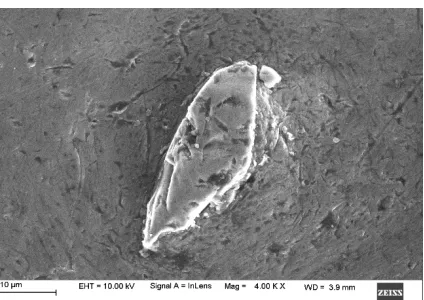
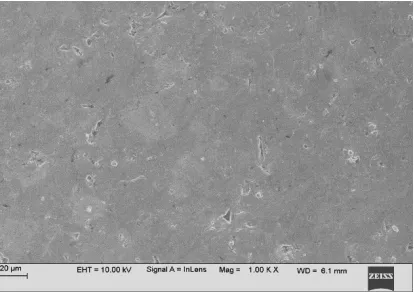
Figure. 1, 2, 3 & 4 shows the SEM micrographs of 4%, 3%, 2% , 1% B4C particulate reinforced AA6061 composite,
where formation of reaction layer can be seen on Ti element.
Fig. 1 SEM image of 4 % B4C particulate reinforced AA6061 composite.
ISSN(Online): 2319-8753 ISSN (Print): 2347-6710
International Journal of Innovative Research in Science,
Engineering and Technology
(An ISO 3297: 2007 Certified Organization)
Website: www.ijirset.com
Vol. 6, Issue 8, August 2017
Fig. 3 SEM image of 2 % B4C particulate reinforced AA6061 composite.
Fig. 4 SEM image of 1 % B4C particulate reinforced AA6061 composite.
The SEM images reveal that around B4C particle there is the presence of white layer of Ti compound. However in
some region the weak Ti compound layer is observed. The presence of weak Ti compound is also evident from the analysis and is depicted respectively. During solidification of composites the aluminium dendrites solidify first and the particles are rejected by the solid-liquid interface.
The layer consists of titanium carbide and titanium boride having spherical shape, square shape, and pyramid shaped morphology is uniformly distributed and grow over B4C particle. The reaction layer also acts as a reaction barrier on
the surface of the B4C particulates and limits the interfacial reaction between the hard ceramic particle and molten
aluminium, which in turn prevents the interphases. This layer gives excellent wettability and interfacial bonding between matrix and reinforcement.It is observed from the Fig. 2, 3 and 4 that Ti compound layer around the B4C
particles which tends to react as a reaction barrier and prevents the interfacial reactions between aluminium matrix and B4C.
4.2 EDS analysis of AMCs
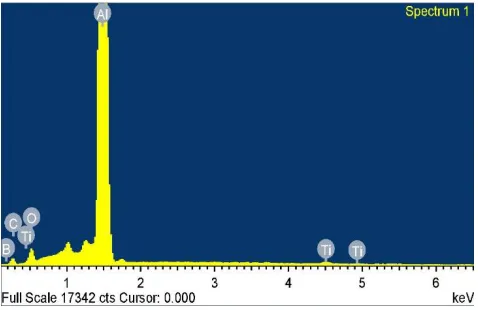
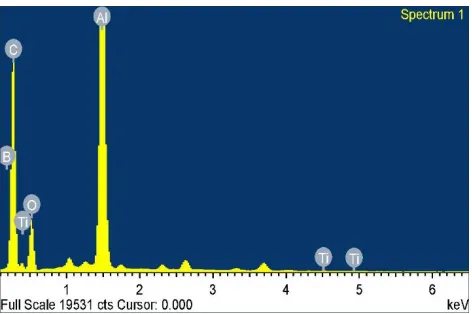
Energy dispersive spectroscopy (EDS) analysis as seen in Fig. 5, 6, 7, 8 confirms the presence of B4C reinforcement
ISSN(Online): 2319-8753 ISSN (Print): 2347-6710
International Journal of Innovative Research in Science,
Engineering and Technology
(An ISO 3297: 2007 Certified Organization)
Website: www.ijirset.com
Vol. 6, Issue 8, August 2017
Fig. 5 EDS analysis of AA6061-4%B4C particulate.
Fig. 6 EDS analysis of AA6061-3%B4C particulate.
ISSN(Online): 2319-8753 ISSN (Print): 2347-6710
International Journal of Innovative Research in Science,
Engineering and Technology
(An ISO 3297: 2007 Certified Organization)
Website: www.ijirset.com
Vol. 6, Issue 8, August 2017
Fig. 8 EDS analysis of AA6061-1%B4C particulate.
IV.CONCLUSIONS
The Al-B4C composites were produced by liquid metallurgical route, by incorporating K2TiF6 flux. The K2TiF6 flux
has improved the wettability of B4C particle with molten aluminium. The incorporation of B4C particle in the Al
matrix is facilitated by the flux and bonding with the matrix. Poor wetting was effectively solved by the addition of K2TiF6 resulting in the formation of very thin Titanium carbide (Ti-C) and Titanium di-boride (Ti-B) reaction layers.
ACKNOWLEDGEMENT
The authors acknowledge the R&D Centre, Mechanical Engineering Department., SJM Institute of Technology, Chitradurga, Vision Group on Science and Technology, Government of Karnataka (K-FIST Level -1 Grant) and Visvesvaraya Technological University (Research Grant) to provide the experimental facilities to carry out the research work. The authors are greatly thankful to Mr. Mahaboob Basha, R & D department for their technical support offered to execute the research work.
REFERENCES
[1] Lopez, V.H., Scholes A, Kennedy, A.R., “The thermal stability of TiC particles in an Al7wt. %Si alloy”, Material scienceand engineering, 427,
2006, pp. 76-82.
[2] N. Sahib, T. Laoui, A. R. Daud, M. Harun, S. Radiman and R. Yahaya, “Influence of Ti addition on wear properties ofAl- Si eutectic alloys”,
Wear, 249, 2001, pp. 656-662.
[3] J Y Fortin, J Sheehy, C Jean, P Brisson, U Harnisch, D A Doutre, X G Chen, “Aluminum alloy Boron carbide compositematerial”, U S Patent,
2009.
[4] J. A. Marcantonio and L. F. Mondolfo, “Grain refinement of aluminium alloyed with titanium and boron”, Metall. Trans,1971, Vol.2, pp.
465-471.
[5] Keri, “Production of TiC reinforced-aluminium composites with addition of elemental carbon”, Mater. Lett.59 (2005),pp. 3795-3800.
[6] T. Sritharan, H. Li, “Influence of Titanium to Boron ratio on the ability to grain refine Al-Si alloys”, J. Mater proc Tech.63,1997, pp. 585-589.
[7] A. J. Cornish, “Influence of boron on the mechanism of grain refinement in dilute aluminium-titanium alloys”, Met. Sci.,1975, Vol.9, pp.
477-482.
[8] I. G. Davies, J. M. Dennis & A. Hellawell, “The nucleation of aluminium grains in alloys of Al with titanium & boron, Metall”. Trans, 1, 1970,
pp. 275-280.
[9] A. J. Cornish, “Influence of boron on the mechanism of grain refinement in dilute aluminium-titanium alloys”, MaterialScience, 9, 1975, pp.