ISSN(Online): 2319-8753 ISSN (Print): 2347-6710
I
nternational
J
ournal of
I
nnovative
R
esearch in
S
cience,
E
ngineering and
T
echnology
(A High Impact Factor & UGC Approved Journal) Website: www.ijirset.com
Vol. 6, Issue 9, September 2017
Reducing PAPR of the OFDM Signal Using
Iterative Exponential Companding Transform
Yenni Priyanka, Sri.k.Durga Ganga Rao
M.Tech, Dept. of Electronics and Communication Engineering, JNTU, Kakinada, India
Assistant Professor, JNTU Kakinada, India
ABSTRACT: In Wireless Communication we widely used Orthogonal Frequency Division Multiplexing (OFDM) signal because spectral efficiency is very high and also having high inherent error resistance. But OFDM suffer with one main drawback is peak to average power ratio (PAPR). In this paper we mainly concentrate on reducing PAPR of the OFDM signal using iterative exponential companding transform and filtering (IECTF), where exponential companding transform is a non-linear companding which maintains both high and low signal with constant power level. This method is compared with the iterative companding transform and filtering (ICTF) where there are linear symmetrical transform(LST) and Two-Piece wise companding transform(TPWC) both are linear companding transform while using IECTF we can reduce PAPR of the signal with same number of iterations than used in two linear companding techniques used in ICTF.
KEYWORDS: orthogonal frequency division multiplexing, peak-to-average power ratio, iterative companding transform and filtering, iterative exponential companding transform and filtering.
I. INTRODUCTION
Now a Days all we are using wireless communication with multi carrier modulation to increase the high rates but before this we use single carrier modulation the main advantage of this modulation is simplicity and accuracy and also saving power because by using this technique because there is no need to use guard bands between them. The main drawback in this technique is having low data rates. Now increasing the more number of users we required the high date rates. All the services mainly voice and video communication and high speed internet access uses mainly third and fourth generation mobile networks because it provide users with high date rate. Increasing the amount of spectrum allocated to the service will get the high data rates.
For the high speed communications OFDM is a form of multicarrier modulation (MCM) technique. This OFDM is very famous because having spectral efficiency is very high and also less effect to multipath. In the OFDM system we use multicarrier to separate each one we add guard bands to them. Due to its high data rates having many advantages like digital audio broadcasting (DAB),mobile multimedia access communication (MMAC), IEEE 802.11a,etc.,.
In OFDM system we convert high data rate steams to low data rate streams which convert’s bandwidth of W to W/n which is lower than channel bandwidth so that represents OFDM signal having efficient bandwidth.
In OFDM system modulated the each subcarrier where this modulation is changing the frequency, phase, amplitude this modulated signals allotted for different users within the given bandwidth which is called multiplexing from this we can say that OFDM is done with both modulation and multiplexing technique. Because of amplifier nonlinear effects OFDM signal having high PAPR this is the main drawback in the OFDM system. The efficiency of the output power amplifier (PA) is reduce of this high PAPR. By using Inverse Fast Fourier Transform (IFFT) and Fast Fourier Transform (FFT) we can implement OFDM efficiently.
ISSN(Online): 2319-8753 ISSN (Print): 2347-6710
I
nternational
J
ournal of
I
nnovative
R
esearch in
S
cience,
E
ngineering and
T
echnology
(A High Impact Factor & UGC Approved Journal) Website: www.ijirset.com
Vol. 6, Issue 9, September 2017
band interference [5]. The iterative clipping and filtering can achieve the less PAPR but with more number of iterations. In this paper we use the IECTF technique we achieve the significant PAPR.
This paper is organized as follows: section I explain about the OFDM system later in section II explain the PAPR of the OFDM signal and the section III explains about the complementary cumulative distribution function (CCDF) section IV about the different PAPR reduction techniques and in the section V it explains about the proposed techniques that is the IECTF technique and their advantages over the other techniques and finally simulation results which are explained in the section VI.
II.OFDM SYSTEM
Fig1. Represent the block diagram of OFDM system. By using FFT transform and the IFFT transform we convert the simple analog OFDM implementation into the digital domain. The high data rate is split into lower data rates and each segment is transmitted through a different carrier signals and we all know that each sub-carrier is orthogonal to other. These are then modulated by using QPSK or QAM modulation techniques. The input bits are grouped and mapped to complex source symbols in digitally implemented system.
These are modulated by using different subcarriers.These complex frequency domain source symbol is given to IFFT block producing OFDM samples. The samples are again converted to signal by using parallel to serial block. Then added cyclic prefix (CP) we added CP because it reduces OFDM signal the inter symbol interference (ISI) this signal transmitted through the channel this is the entire block diagram of transmitter. And the reverse procedure is applied at the receiver.
Fig1.block diagram of OFDM system
III.PAPR OF THE OFDM SIGNAL
In OFDM by using the inverse fast Fourier transform (IFFT) the L complex symbols are transformed into time domain. This results in the following signal:
XK=
√ ∑ , 0≤k≤L-1
ISSN(Online): 2319-8753 ISSN (Print): 2347-6710
I
nternational
J
ournal of
I
nnovative
R
esearch in
S
cience,
E
ngineering and
T
echnology
(A High Impact Factor & UGC Approved Journal) Website: www.ijirset.com
Vol. 6, Issue 9, September 2017
The PAPR of the OFDM signal is the ratio of the maximum power of the signal to the mean power of the signal.
PAPR= [| | ]
[| | ]
IV. COMPLEMENTARY CUMULATIVE DISTRIBUTION FUNCTION (CCDF)
The probability by which the PAPR is greater than the threshold value of given PAPR0 is defined as CCDF. CCDF= PROB {PAPR>PAPR0}
The CCDF of the OFDM signal is
CCDF≈1−(1− )
IV. PAPR TECHNIQUES
To reduce the PAPR of the OFDM signal we have several techniques some of the techniques are clipping and filtering (CF), partial transmit sequence (PTS), companding transform (CT).
1. Clipping and Filtering (CF):
The easiest method for reducing the PAPR of the OFDM signal is CF. In this method before sending into the power amplifier(PA) high peaks present in the OFDM signal are eliminated by setting a clipping level(CL) this is called clipping. This method have both in-band distortion and out-of-band distortion because clipping method is a non-linear process. We can’t reduce the in-band distortion by using filtering by using but with taking longer IFFT can reduce the in-band distortion. By using filtering process we can reduce the out-of-band distortion. By this we can preserve the spectral efficiency and BER can be improved.
2. Partial Transmit Sequence (PTS):
This is also the one of the technique for reducing the PAPR of the OFDM signal. Basic idea in this method is first diving the entire OFDM signal into sub-data all these sub-data is send through the different sub-blocks then there are multiplied with the weighting factor choosing the optimum rotation factor until we get the low PAPR value.
3. Companding Transform (CT):
Companding transform is very simple and effective method to reduce the PAPR of the OFDM signal compared to the other techniques. Due to its low complexity and number of sub-carriers in OFDM signal this method is very attractive technique.
This companding transform operation is applied at the transmitter and to recover the original signal at the receiver we have to apply the reverse operation what we applied at the transmitter.
The basic principle in the companding transform is we compress the signal at the high peaks and enlarge the signal at the low peaks of amplitude of the OFDM signal.
One of the main advantage of the companding transform is for the companding function if we use a proper constant values we can achieve the constant average power of the signal.
In companding transform there are several linear and nonlinear companding transforms. We can use any method depends on the parameter we choose particular method.
V. PROPOSED TECHNIQUE
A. Companding function:
In this paper we use iterative exponential companding transform and filtering (IECTF) in this we compare with another companding transform they are LST and TPWC.
1. Exponential Companding Transform:
ISSN(Online): 2319-8753 ISSN (Print): 2347-6710
I
nternational
J
ournal of
I
nnovative
R
esearch in
S
cience,
E
ngineering and
T
echnology
(A High Impact Factor & UGC Approved Journal) Website: www.ijirset.com
Vol. 6, Issue 9, September 2017
In this companding transform we convert the OFDM signal statistics of the amplitude into the uniform distribution it also maintains the constant average power level. Maintain constant average power level can improve the amplifier efficiency. In high power amplifier linearity requirement can be reduced.
The companded signal of the OFDM signal is
h(x) = sgn(x) [1−exp( )]
Where = ( [| | ]
[ [ (| | )]
) /
h(x) is the companded signal and the is the average power of the OFDM signal and the sgn(x) is the sign function.
2. Linear Symmetrical Transform:
Linear Symmetrical Transform (LST) is the simplest CT profile, whose companding function is defined as f(x)=(k.|x|+b).sgn(x)
Where sgn(.) is a sign function, and two parameters 0<k<1 and b>0 are used to specify the companding profile. In order to maintain an unchanged average power after CT, it yields k2+√ . . +b2/ 2=1.
Thus once k was selected, b can also be determined and vice versa. The corresponding de-companding function is given by
f-1(x)=| | .sgn(x) another method used in this companding transform is TPWC.
3. Two-Piecewise Companding Transform Besides, Two- Piecewise Companding (TPWC) is an modification to LNST to reduce the 'unexpected bounce' issue, and its companding function is given as
f(x)= |x|. sgn(x), |x|≤v
( | | + ). ( ), | | >
Where u1>1, 0<u2<1, s=(u1-u2)v>0, and 0≤v≤V is the cutoff point with v=max {|xn|} for 0≤n≤JN-1. The de-companding function of TPWC is given by
f-1(x)=
|x|. sgn(x), |x|≤ v
(| |− ) . ( ), | | >
The relation between the three independent parameters is given as 2
(1-exp(-λ2))+ 2
(1-exp(-λ2))=1, where λ≥1.2 and v=λσ.
ISSN(Online): 2319-8753 ISSN (Print): 2347-6710
I
nternational
J
ournal of
I
nnovative
R
esearch in
S
cience,
E
ngineering and
T
echnology
(A High Impact Factor & UGC Approved Journal) Website: www.ijirset.com
Vol. 6, Issue 9, September 2017
Fig.2. Transform profiles of the different companded system.
B. Companding and Filtering the IECTF Technique:
ISSN(Online): 2319-8753 ISSN (Print): 2347-6710
I
nternational
J
ournal of
I
nnovative
R
esearch in
S
cience,
E
ngineering and
T
echnology
(A High Impact Factor & UGC Approved Journal) Website: www.ijirset.com
Vol. 6, Issue 9, September 2017
The proposed IECTF procedure is summarized as follows.
Step1. Set PAPRdes, SAFthod and the M which is a maximum number of iterations required. Select companding parameter’s exists in the companding technique used.
Step2. Then apply IFFT which convert frequency-domain into time-domain OFDM symbol.
Step3. Then the signal is companded
Step4. Convert the companded signal into the frequency domain using FFT.
Step5. Perform the filtering operation here we use the Hrect is a rectangular window filtering Hrect=
1, 1≤ ≤ −1
0 , ≤ ≤ −1
Step6. Convert this frequency-domain into time-domain by using IFFT
Step7. Then calculate the PAPR if it is less than the PAPRdes. Then return to step 2 and repeat the procedure until we get the desired PAPR.
VI. SIMULATION RESULTS
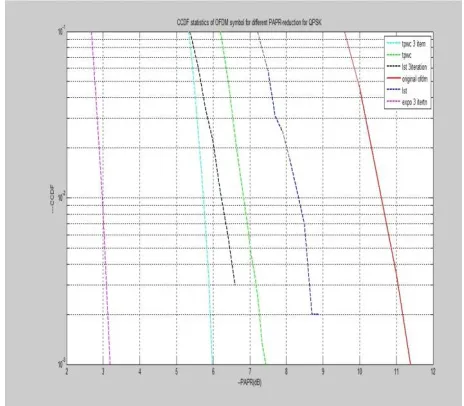
In this section the CCDF statistics for proposed IECTF technique are calculated and plotted and compared with the classic CT they are TPWC and LST with their iterations. Initialization parameters assume that the number of sub-carriers N=1024, using Quaternary Phase Shift Keying (QPSK). For comparison here we used two companded techniques LST (k=0.9), TPWC (λ=1.6 and u2=0.13),and also compared with iterations of the TPWC[8] and LST[8].In IECTF set the initial parameters as SATthod is 0.985 for LST and SAFthod is 0.978 for TPWC and there is no de-companding operation at the receiver.
Firstly we plot graph for the original OFDM signal
The relation between CCDF and PAPR of the original OFDM signal
CCDF≈1−(1− )
With N=1024
In the figure 2 plot the graph of the PAPR of OFDM signal from the above graph it can be observe that PAPR of the OFDM signal is 12.1dB which is having very high PAPR to reduce these we use the given companding transforms.
ISSN(Online): 2319-8753 ISSN (Print): 2347-6710
I
nternational
J
ournal of
I
nnovative
R
esearch in
S
cience,
E
ngineering and
T
echnology
(A High Impact Factor & UGC Approved Journal) Website: www.ijirset.com
Vol. 6, Issue 9, September 2017
Fig 3 CCDF statistics for different companded functions. (N=1024, QPSK).
From the above fig3 we can observe that the nonlinear exponential companding transform results the high PAPR compare to the other techniques given CCDF=10-2 LST companded function achieve the 8.3 dB with no iteration but with 3 iterations we achieve the PAPR of 6.2 dB and coming to the TPWC technique with PAPR of the 6.8dB and the TPWC with 3 iterations results in 5.7dB and now coming to the proposed method here we achieved the 3dB which is very less PAPR compared to all the companded techniques.
CONCLUSION
The main aim of this paper is to reduce the PAPR of the OFDM signal using IECTF. We reduce the PAPR significantly by using the non-linear companding transforms, used in the iterative procedure which is obtaining specified PAPR using more number of iterations. This iterative procedure consists of both companding and filtering. By using IECTF not only reducing PAPR but also number of iterations this reduces the complexity. Both the comprehensive theoretical study is derived, and analytically regarding the reducing of PAPR. This method is also can be extended to the other companding transforms.
REFERENCES
[1]L. Wang and C.Tellambura, “A simplified clipping and filtering technique for PAR reduction in OFDM Systems,” IEEE Signal Process. Lett., vol. 12, no. 6, pp. 453–456, Jun. 2005.
[2]P. Varahram and B. M. Ali, “Partial Transmit Sequence Scheme with New Phase Sequence for PAPR Reduction in OFDM Systems,” IEEE Trans. on Consumer Electron., vol. 57, no. 2, pp. 366–371, May.2011.
[3]J. Yang, L. Chen, Q. Liu, and D. Chen, “A modified selected mapping technique to reduce the peak-to-average power ratio of OFDM signals,” IEEE Trans. Consumer Electron., vol. 53, no. 3, pp. 846–851, Aug.2007.
[4]X. B.Wang, T. T. Tjhung, and C. S. Ng, “Reduction of peak-to-average power ratio of OFDM system using a companding technique,” IEEE Trans. Broadcast., vol. 45, no. 3, pp. 303–307, Sep. 1999.
[5]T. Hwang, C. Yang, G. Wu, S. Li, and G. Y. Lee, “OFDM and its wireless application: A survey,” IEEE Trans. Veh. Technol., vol. 58, no. 4, pp. 1673–1694, May. 2009
[6]P. Yang, A. Hu, “Two-piecewise companding transform for PAPR reduction of OFDM signals,” in Proc. IEEE International Conference on Wireless Communications and Mobile Computing, Istanbul, Turkey, pp. 619–623, Jul. 2011. [7]T. Jiang, Y. Yang, and Y.
Song, “Exponential companding transform for PAPR reduction in OFDM systems,” IEEE Trans. Broadcast., vol. 51, no. 2, pp. 244–248, Jun. 2005. [8]Yong Wang; Chao Yang; Bo Ai, “Iterative companding transform and filtering for reducing PAPR of OFDM signal,” IEEE transaction on