Effect of Light Glare in Eye and Camera
Detection
Nazım Imal1, Ufuk Ozyurek2, Zeynep Kaya3, Eralp Sener4
Master Student, Department of Energy Systems Engineering, Bilecik Seyh Edebali University, Bilecik, Turkey2
PhD Students, Department of Electrical and Electronics Engineering, Bilecik Seyh Edebali University,
Bilecik, Turkey1,3,4
ABSTRACT: Light and light sources have important role in image perception of eyes and cameras. If the light is inadequate in the enlightenment, sufficient vision and perception conditions can not occur. However, when the light is too high, it affects the vision and perception negatively. The objects, which is exposed to the light, are defined by the rays they reflect to the eye or camera due to their brightness. They also benefit from the contrast of their color differences in their backgrounds. If the light is too high, the perception of contrast between the objects and their backgrounds decreases, so the image quality decreases. This perception degradation, which is due to the increase in indirect light level in the direct area perceived by the eye and the camera, is defined as excessive light glare or excessive brightness. In this study, we mention the light glare effect briefly using numerical experimental results of the image quality perceived by the eye and the camera.
KEYWORDS: Light glare, Enlightenment, Perception
I. INTRODUCTION
Sufficient light and light sources size and quality for providing proper image play an important role in terms of image perception of eyes and cameras. The inadequacy of the level of light prevents sufficient vision and perception. The light reflected by objects exposed to the light is perceived on the camera, depending on their level of brightness. When performing this perception, the camera uses the reflected light from objects, as well as from the contrast provided by the color differences in their backgrounds.
In contrast to benefits of seeing and perceiving light, if it is too much, it indirectly affects vision and perception indirectly due to direct or excessive reflection. Because, if the light is excessive, the perception of contrast between objects and backgrounds decreases, so the perceived image quality decreases as a result of this negativity.
This perception degradation, which is defined as excessive brightness or light glare, is significant for the selection of lamps and luminaires as it creates negative visual conditions for the eye and the camera. For this reason, the concepts of light, vision and contrast are considered and the effect of light glare is emphasized in order to optimize the image quality perceived by the eye and the camera.
II. LIGHT AND VISION
In order for an image to occur on the camera and eye, the light energy which has a wavelength between 400 nm and 700 nm must be present. In vision and perception, the light, which is the basic physical factors, create this visual and perceptual effect with its level and colors. For this reason, it is necessary to consider the light as a physical quantity with its these components.
1. LIGHT AND COLOR
Physically, energy is defined as the effects that physically bring about an action, process and movement. For this reason, radio waves, sound, magnetic waves, etc., which physically propagate in a wave-like manner. These energy fluctuations with spreading in different wave lengths have the ability to transform into different physical effects in different objects. For example, while radio waves can be converted into electrical currents in antennas, infrared radiation can be converted to heat energy.
Similarly, the energy fluctuations that can be perceived by the eyes and the cameras create the visible light. The visible light fluctuations, which have 400 nm to 7000 nm wavelength, are shown in Figure 1.
Fig.1.Energy dissipation and visible light at different wavelengths [1]
2. BRIGHTNESS AND VISION
Fig.2.The effect of shine on the objects [2]
3. CONTRAST
There is no detailed visualization of the physical effects of an object with its wavelength-dependent color brightness and the physical effects it creates with its eye-level perceptors, unless compared with the physical effects of colors with different wavelengths in the near-field. The more different the wavelength of the rays reflected from the background of the object to be perceived, the different from the object being viewed, the clearer the perception will be. The antagonistic effect encountered in the perception is shown in Fig. 3.
Fig. 3. Contrast effect [3]
III.LIGHT GLARE EFFECT IN VISION AND PERCEPTION
The effect of light (I: cd) per unit surface (S: m2) is exploited when determining the perceivable determinants of light glare (L: cd / m2).
L = (1)
of the brightness values difference to the brightness of the focused object is defined as the relative brightness ratio (% ΔL).
∆L = L −L (2)
%∆L = (3)
1. EXCESSIVE BRIGHTNESS IN VISION AND PERCEPTION:LIGHT GLARE
When the amount of light used is increased as the amount of physical energy, the measured lighting levels will be higher. Depending on this increase in the amount of light, the amount of light perceived by the eyes and the camera will also increase.
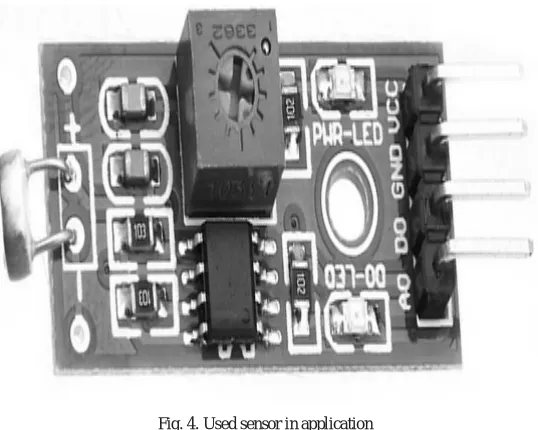
Here, between 0 V and 3.6 V is obtained by using a photo sensor for simulating eye and camera detection. The ability of the sensor data to be perceived by the eye and the camera depending on the increase in the light and illumination level is defined here as "Perceptual Ratio" and is classified as 0 to 4, as seen in table 1.
Fig. 4. Used sensor in application
Table 1: Detection rates determined by photosensor voltage
Photosensor Voltage
Perceptual Ratio Definition
0,9 V 0 Insentience
1,3 V 1 Weak perception
1,8 V 2 Normal perception
2,7 V 3 Good perception
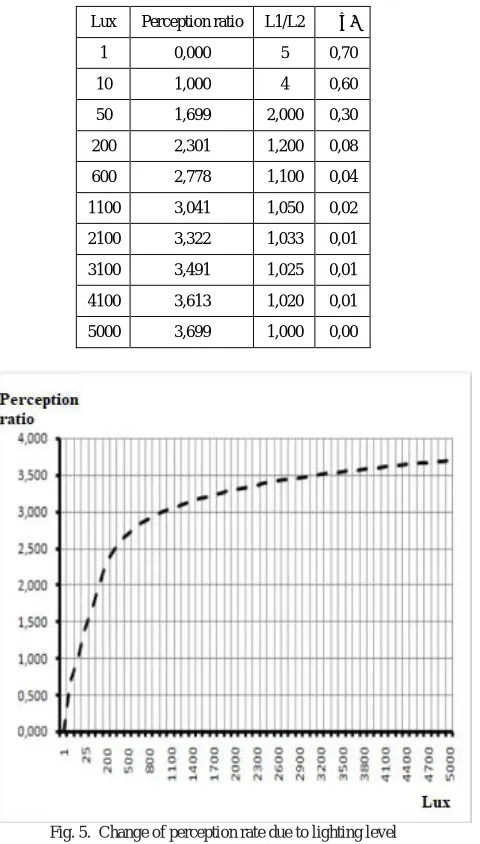
Although the linear increase of the photosensor voltage obtained by the increase of the light and illumination levels is the value realized, it is seen that the linearity is deteriorated especially on the 500 lux. In the lighting levels above 1000 Lux and 2000 Lux, this linear deterioration is defined as increasing the curve tilting, reaching saturation in the perceptual proportion of the light. The obtained brightness level, perceptual ratio, brightness ratio and relative brightness values are shown in Table 2, and perceptual ratio variation due to lighting level is shown in Figure 5.
Table 2: Obtained brightness, perceptual ratio, brightness ratio and relative brightness values in the study
Lux Perception ratio L1/L2 %ΔL
1 0,000 5 0,70
10 1,000 4 0,60
50 1,699 2,000 0,30
200 2,301 1,200 0,08
600 2,778 1,100 0,04
1100 3,041 1,050 0,02
2100 3,322 1,033 0,01
3100 3,491 1,025 0,01
4100 3,613 1,020 0,01
5000 3,699 1,000 0,00
Fig. 5. Change of perception rate due to lighting level
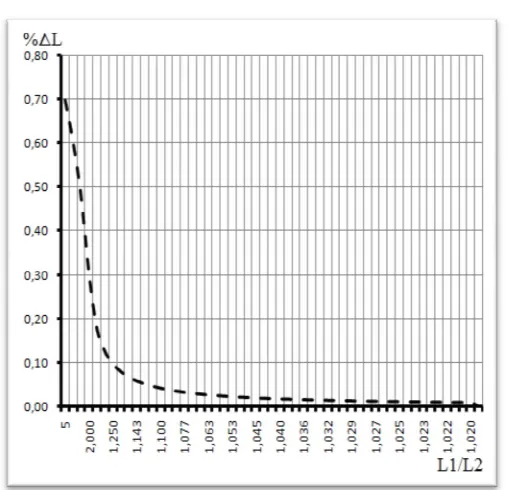
Fig. 6. For two adjacent objects, the relative brightness change due to brightness differences
In the obtained numerical data, it is seen that when the maximum brightness difference is taken as 5, the relative brightness ratio can be increased up to 70% and in this case the highest class is reached as the contrast detection. If the energetic magnitude of the light rays is increased and the higher luminosity levels are reached, then the brightness rate can be reduced to 1, which is shown in the same graph and it is seen that the lowest limit of zero is reached as the perception of the contrast. In other words, in this case, despite the fact that the vision is realized, the result is that the objects can not be selected because of the absence of excessive glossiness.
IV. CONCLUSION
In order for healthy vision and camera perception to occur, the color quality and energy dimensional amplitude of the light rays that make up the illumination levels are important. In this work, for the lighting conditions where the color qualities are sufficient, depending on the increase in the energy amplitude of the light, glare effect is considered. Depending on the increase in light and illumination level, based on data obtained using the photosensor, the ability of the light to be perceived by the eyes and the cameras is classified as "Perceptual Ratio" from 0 to 4. Due to the increase in the energy amplitude of the light, although there is an increase in the lighting level, it is graphically shown that there is no increase in the perceptual rate. Despite the increase in lighting levels, this deterioration in visual and camera perception is defined as reaching saturation in the perceptual proportion of the light.
REFERENCES
[1] N. İmal, H. ÇINAR, “Fotovoltaik Hücrelere Uygulanan Işınım Yapısının Enerji Dönüşümüne Etkileri” VIII. Yenilenebilir Enerji Kaynakları
Sempozyumu, Adana, 2015
[2] http://www.luxrender.net/wiki/images/8/8b/Glare.jpg
[3] https://jishytheobserver.files.wordpress.com/2012/04/contrast-wallpaper.jpg
[4] Michael G. Kent, Sergio Altomonte, Robin Wilson, Peter R. Tregenza, “Temporal Effects on Glare Response From Daylight, Building and Environment, 2017
[5] Ching-Cherng Sun, Chong-Jhih Jıang, Yi-Chun Chen, and Tsung-Hsun Yang, “Glare Effect for Three Types of Street Lamps Based on White Leds”, Optical Review, 2014
[6] N Davoudian, P Raynham, E Barrett, “Disability Glare: A Study in Simulated Road Lighting Conditions”, Lighting Res. Technol., 2014 [7] K Sweater-Hickcox, N Narendran, JD Bullough and JP Freyssinier “Effect of Different Coloured Luminous Surrounds on LED Discomfort
Glare Perception”, Lighting Res. Technol., 2013
[8] Brad Lehman, Arnold J. Wilkins, “Designing to Mitigate the Effects of Flicker in LED Lighting”, IEEE Power Electronics Magazine, 2014 [9] Saadi Mohamed Yacinea, Zemmouri Noureddinea, Barbara E. A. Piga, Eugenio Morello, Daich Safa, “Developing Neural Networks to
İnvestigate Relationships Between Lighting Quality and Lighting Glare Indices”, CISBAT International Conference, 2017
[10] Saadi Mohamed Yacinea, Zemmouri Noureddinea, Barbara E. A. Piga, Eugenio Morello, Daich Safa, “Towards a New Model of Light Quality Assessment Based on Occupant Satisfaction and Lighting Glare Indices, CISBAT International Conference, 2017
[11] Clotilde Piersona,*, Jan Wienoldb , Magali Bodarta, “Discomfort Glare Perception in Daylighting: Influencing Factors”, CISBAT International Conference, 2017
[12] Roberto German Rodriguez, Julieta A. Yamin Garreton, Andrea E. Pattini, “An Epidemiological Approach to Daylight Discomfort Glare”, Building and Environment, 2017
[13] A. Mangkuto, Kinanti Aprilia Kurnia, Dovi Nurdiana Azizah, R. Triyogo Atmodipoero, F.X. Nugroho Soelami, “Determination of Discomfort Glare Criteria for Daylit Space in Indonesia Rizki”, Solar Energy, 2017
[14] L.M. Geerdinck, J.R. Van Gheluwe, M.C.J.M. Vissenberg, “Discomfort Glare Perception of Non-Uniform Light Sources in an Office Setting” Journal of Environmental Psychology, 2014
![Fig.2.The effect of shine on the objects [2]](https://thumb-us.123doks.com/thumbv2/123dok_us/1583387.1195034/3.595.170.425.494.671/fig-effect-shine-objects.webp)