Finite Element Analysis of Protective Helmets
using Different Material Parameters
Saurabh Singh 1, Hrishabh Singh 2
P.G. Student, Department of Mechanical Engineering, GD Rungta College of Engineering and Technology, Bhilai,
Chhattisgarh, India1
Assistant Professor, Department of Mechanical Engineering, GD Rungta College of Engineering and Technology,
Bhilai, Chhattisgarh, India2
ABSTRACT: Numbers of road accidents are increasing as the number of vehicles are increasing in the roads. About
30% of the total road accidents accounts for the motorcycle accidents. Total deaths of such motorcycle riders are mostly due to inappropriate safety measures adopted by the riders and one of which is not using helmets or using faulty helmets. As per a statement by helmet manufacturer about 90% of total helmets in India use faulty helmets. This paper deals with the critical review of helmets that are available in the market and how are they performing to the standards of different testing scenarios. A comparative analysis has also been done taking four different materials and analysing how they perform on a similar loading condition. The main purpose of this paper is to give an insight on how the materials perform on given conditions and which will be a comparatively better option to be chosen.
KEYWORDS: Helmet, Crash Test, Motorcycle Accident, FEM, Ansys, PEEK, Polycarbonate, Polyester, PPA.
I. INTRODUCTION
Helmet is a protective gear used to wear on head when doing some hazardous work. Helmets are used while riding motorcycles, industry works, construction works etc. a helmet generally consists of a shell of a very hard and tough material which is covered by certain padding for shock absorption and comfort. In order to understand basic structure of helmets we must know some of the basic definitions and terminologies used in helmets.
1. Two Wheeler-A two wheeler can be defined as a two wheeled motor vehicle with or without detachable side car. General term used for this is Motorcycle.
2. Protective Helmet-A helmet primarily intended to protect the wearer's head against impact. A helmet is a type of safety measures used in various sections of the dangerous segments of use. A helmet is used in different sectors such as road safety as a safety gear while two wheeler driving, industrial work etc.
3. Shell-It is the most rigid part of the helmet which gives its general shape. A hard part of the helmet, which provides the strength and toughness, to the whole of a helmet structure.
4. Protective Padding-Protective padding is a soft material placed to absorb the impact shocks and its energy. As the name suggests it protects the head of the person who is wearing the helmet through shock reduction through its soft padding.
5. Comfort Padding-The material is similar in nature to the protective padding; this type of padding is provided to provide comfort to the person who is wearing it. To provide comfort is the whole sole purpose of this type of padding.
Peak-Peak is an extension of the shell which is covered throughout the helmet.
Lower Face Cover-It is an integral, detachable and movable part of the helmet which covers the lower part of
the face.
Protective Lower Face Cover-It is an integral, detachable and movable part of the helmet which covers the lower part of the face which is intended to protect the chin of the rider from impact.
Non Protective Lower Face Cover-It is an integral, detachable and movable part of the helmet which covers the lower part of the face and it does not protect the chin of the rider from impact.
7. Visor-Visor is that transparent part of the helmet through which a rider is able to see. It is a protective screen for the eyes.
Fig.1 Construction of a Helmet
II. REVIEWOFHELMETSUSEDACROSSTHEWORLD
There are several organisations which do test the helmets using different criteria, few of the global leaders of the helmet testing lab are DOT,SNELL, ECE, SHARP, crash etc. In this review we are using the data from CRASH testing lab.
RANK HELMET MATERIAL WEIGHT
1 Shark Explore-R Shark Composite Material 1.783 kg
4 SparX S-07 Acrylonitrile Butadiene Styrene (ABS) 1.644 kg
5 LS2FF323 Arrow Fibreglass 1.668 kg
6 HJC FG-17 Fibreglass + polyester resin 1.618 kg
7 Shark Evoline Composite Material 1.807 kg
8 Shark Vision R NA 1.695 kg
9 HJC IS-16 Polycarbonate Composite 1.703 kg
10 Zeus ZS-2100B Acrylonitrile Butadiene Styrene (ABS) 1.737 kg
Table 1. Rankings of Helmets by CRASH testing lab
From the above table it is clear that this data shows that composites are widely used and is very responsive as the needed quality of helmet is concerned. This is followed by some polyester resins and then fibreglass, Acrylonitrile Butadiene Styrene and Polycarbonate is somewhere in between the line.
III.DESIGNINGANDMATERIALPROPERTIES
Designing of the model has been done in CATIA with a shell thickness of 1mm and head diameter of 170mm.the actual idea of this design is to check the performance of different materials under same loading conditions and design. This will provide us a comparative idea of the materials and their suitability.
PROPERTY PEEK POLYCARBONATE POLYESTER PPA
Density(kg/m3) 1310 1200 1400 1100 Young’s Modulus (Pa) 3.6 e+009 2.4 e+009 4.41 e+009 2.2 e+009
Poisson’s Ratio 0.3779 0.37 0.33 0.4 Bulk Modulus (Pa) 4.914 e+009 3.0769 e+009 4.3235 e+009 3.6667 e+009 Shear Modulus (Pa) 1.3063 e+009 8.75 e+008 1.6579 e+009 7.8571 e+008 Tensile Yield Strength 1.1032 e+008 6.55 e+007 5.5861 e+007 6.9 e+007 Compressive Yield Strength (Pa) 1.379 e+008 8.27 e+007 2.588 e+009 0
Tensile Ultimate Strength (Pa) 3.4474 e+009 2.2063 e+009 1 e+008 2.0684 e+005 Compressive Ultimate Strength (Pa) 3.4474 e+009 1.6547 e+009 3.0002 e+0010 0
Table 2. Properties of PEEK, Polycarbonate, Polyester and PPA material
Fig.2. Different views of the model
IV.EXPERIMENTAL RESULTS
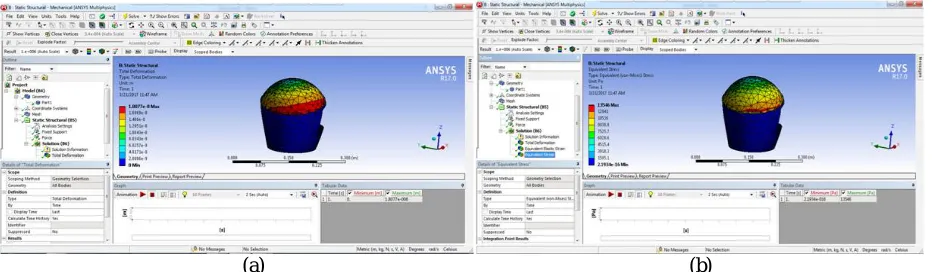
After analysing the model of our helmet we need to study the results that have been observed through the analysis. The analysis was done on ANSYS 17 for deformation and stress for four different types of material which are Polyether ether ketone (PEEK), Polycarbonate, polyester, and Polypthalamide (PPA).This analysis will give a comparative aspect on the performance of the four materials.
(a) (b)
Fig.3. Stress and Deformation report of PEEK material
Then after doing the analysis for PEEK material we changed the material parameters as of Polycarbonate material. The maximum and minimum stress observed was 13634 Pa and 0 Pa respectively which is given in fig. 4(a). The deformation result was 1.5943 e-8 m for maximum value and 0 mm for the minimum value, fig. 4(b) shows the result for deformation.
(a) (b)
(b) Fig.4. Stress and Deformation report of Polycarbonate material
(a) (b)
(b) Fig.5. Stress and Deformation report of Polyester material
The last material that we analysed was PPA.The maximum stress observed was 13546 Pa and the minimum was 2.1924 e-16 Pa, for the deformation the maximum value was 1.0877 e-8 m and minimum value was 0 m as described in fig.6 (a) and (b).
(a) (b)
Fig.6. Stress and Deformation report of PPA material
The compilation of all the above results has been tabulated below and has been discussed in the conclusion section of this paper.
MATERIAL STRESS (Pa) DEFORMATION (m)
PEEK 14314 1.0747 e-8
POLYCARBONATE 13634 1.5943 e-8 POLYESTER 13547 0.8668 e-8
V. CONCLUSION
In this paper we reviewed and analysed about different type of materials and models for deformation and stress test in order to get results for better performance characteristics. The analysis we did for 4 different materials, the highest stress observed was for PEEK material (Polyether ether ketone) and the lowest was for PPA (Polypthalamide) and the deformation that we observed was highest in PPA (Polypthalamide) and lowest in polyester. From the above condition we can state that the materials which were imparted to a minor load of 200N was to just check on to the performance of the materials and their deformation, the important aspect for a helmet is its deformation against the applied load. The minimum deformation observed was of the polyester material amongst the tested four materials and implies to be a better suitability for the use as helmets.
REFERENCES
[1] V. Kostopoulos, Y.P. Markopoulos, G. Giannopoulos, D.E. Vlachos, “Finite element analysis of impact damage response of composite motorcycle safety helmets,” Composite B vol-33, pp-99-107, 2012.
[2] V. C. Sathish Gandhi, R. Kumaravelan, S. Ramesh, M. Venkatesan, “M. R. Ponraj, Performance Analysis of Motor Cycle Helmet under Static
and Dynamic Loading”, Mechanics and Mechanical Engineering Vol. 18, No. 2, pp.85-96, May 2014
.
[3] Rajasekar.K, Ashokkumar.K, Narayanan.L, “Design and Analysis of Industrial Safety Helmet using Natural Fibers”, International Journal of Innovations in Engineering and Technology (IJIET), Vol.5 Issue 3, pp. 31-37, June 2015.
[4] S. Irfan Sadaq, Md. Abdul Raheem Junaidi, V. Suvarna Kumar, Joseph George. Konnully, Syed Sirajuddin Qadiri, “Impact Test on Motor Cycle Helmet for Different Impact angles using FEA”, International journal Of Engineering Trends and Technology, Vol. 12 No.6, pp.278-281, Jun 2014.
[5] Khushi Ram, Pramendra Kumar Rajput,”FEM analysis of Glass/Epoxy composite based industrial safety Helmets” International Conference on Advanced Material Technologies (ICAMT), Vol-1, 2016.
[6] K Naresh, Y Ramdas, Sk.Habibul Rehaman, M Dushyanth,”Design of Helmet and Fracture Analysis to identify the Crack Formation”,International Journal of Innovations in Engineering andTechnology, vol-6, Issue no-4, pp- 27-30, 2016.
[7] S. K. Mithun1 S. Umesh, Ramjan Pathan,” Conceptual Design Of Motor Cycle Helmet To Meet The Requirement Of Thermal Comfort, Ergonomics And Safety”, SASTECH Journal, vol-12, Issue-1, pp-65-71, 2013.
[8] Kingsbury, H. B. and Rohr, P. R.: Structure Characteristics of Motorcycle Helmets, Society of Automotive Engineers, Inc, No. 810372, 1981.
[9] Gilchrist, A. and Mills, N. J.: Impact Deformation of ABS and GRP Motorcycle Helmet Shells, Plastics and Rubber Processing and Applications, vol-21,issue- 3, pp-141–150, 1994
[10] Rueda, M. A. F. and Gilchrist, M. D.: Computational analysis and design of components of protective helmets, Proceedings of the Institution of Mechanical Engineers, Part P: Journal of Sports Engineering and Technology, vol-226, issue-3(4), pp-208–219, 2012.
[11] Praveen, K., Pinniji, P. K., Bourdet, N., Mahajan, P. and Willinger, R. New motorcycle helmets with metal foam shell, IRCOBI Conference proceedings, Bern, (Switzerland), pp-449–452, 2008.
[12] Mills, N.J., Wilkes, S., Derler, S. and Flisch, A.: FEA of oblique impact tests on a motorcycle helmet, International Journal of Impact Engineering, vol-36, pp-913–925, 2009.
[13] Pinnoji, P. K. and Mahajan, P.: Impact analysis of helmets for improved ventilation with deformable head model, IRCOBI Conference – Madrid (Spain), pp-159–170, 2006.