The Comparison of Neighbourhood Set and
Degrees of an Interval Graph G Using an
Algorithm
Dr.A.Sudhakaraiah,1 K.Narayana2
Assistant Professor, Department of Mathematics, S.V. University, Andhra Pradesh, India1
Research Scholar, Department of Mathematics, S.V. University, Andhra Pradesh, India2 ABSTRACT: In general, any mathematical object involving points and connections among them can be called a graph or an interval graph or hyper graphs. For a great diversity of problems such networks and pictorial representations may lead to a solution. In this domination is a rapidly developing area of research in graph theory, and its various applications to ad,hoc networks, distributed computing, social networks and web graphs partly explain the increased interest. In this paper focuses on neighbourhood sets and the main aim of the comparison of neighbourhood set and degrees of an interval graph G using an algorithm.
KEYWORDS: Interval family, Interval graph, Neighbourhood Number, Degrees.
I. INTRODUCTION
Graphs are very convenient tools for representing the relationships among objects, which are represented by vertices. In their turn, relationships among vertices are represented by connections. Examples of such applications include databases, physical networks, organic molecules, map colorings signal flow graphs etc. At present graph theory is a dynamic field in both theory and applications. In this section, the concept of domination, minimum neighbourhood set of an interval graphs[4]. Let G (V, E) be a graph. The neighborhood set of a vertex V in G[2,7,8] is defined as the set of vertices adjacent with V (including V) and is denoted by nbd[V]. A set S of vertices in G is called a neighborhood set of G if G=
S V
v
nbd
G
]],
[
[
where G [ ] is the vertex induced sub graph of G. Theneighbourhood number of G is defined as the minimum cardinality of a neighbourhood set S of G[1]. The degree of a vertex V in an interval graph G is the number of edges of G incident with V and it is denoted by degree of V that is deg(v). The maximum or the minimum degree among the vertices of G is denoted by ∆( ) or ( ). In this connection we will consider the maximum degree of vertices v from G corresponding to I
In this paper we discuss an algorithm for finding a minimum neighbourhood set, maximum degree of an interval graph corresponding to an interval family[3,6,9,11,12]. In this chapter we discuss the comparison of minimum neighbourhood set and maximum vertex degree. In this chapter we propose an algorithm for the comparison of minimum neighbourhood set and maximum degree of an interval graph corresponding to an interval family I[10].
II.PRELIMINARIES
G(V,E)is called an interval graph if there is a one to one correspondence between V and I such that two vertices of G are joined by an edge in E if and only if there corresponding intervals in I intersect that is if i= [ , ] and j=
, , then i and j intersect means either or [5].
Next we assume that the labels of the intervals satisfy such an ordering of n intervals. We proceed in the following manner to find a minimum neighbourhood set and maximum degree of an interval graph towards an algorithm. Let min (i) and max (i) denote the largest interval in nbd[i]. Let next[i] = j iff and there do not exist k such that . If there is no such j, then define next (i) = null. We start S= {max(1)} LI denotes the largest interval in S.
Theorem: For any interval graph G of order N corresponding to an interval family I, Then
∆≤ ≤ − ∆.
Proof: In this theorem it will arise the following cases.
1. To find the vertex degree of G of order n corresponding to an interval family I. 2. To find neighbourhood set of S corresponding to I.
3. To find the minimum neighbourhood set of G corresponding to an interval family I,
Case(i) :To find vertex degree:
Let I={ , , … … . . , } be an interval family and let G be an interval graph corresponding to an interval family I. We will find the maximum degree of vertex from an interval graph G correspondingto I. The degree of a vertex V is an interval graph G is the number of edges of G incident with V and it is denoted by degree of V i.e., deg (V). The maximum or minimum degree among the vertices of G is denoted by ∆( ) ( ). in this connection we will consider the maximum degree of vertex V from G corresponding to I. Generally we call that a vertex is called odd or even depending on whether degree is odd or even.
If deg (V) =0, then V is called an isolated vertex of G. If deg (V) =1, then V is called an end vertex or a pendent vertex of G and an edge incident with an end vertex is called an end edge or a pendent edge. The degree of an edge u, v is defined to be degree u+ degree of v-2. The maximum or, minimum degree among the edges of G denoted by
∆( ) ( ). an edge is called an isolated edge if deg (uv)=0. Then the graph must be disconnected but we consider only connected graph G corresponding to I.
Case(ii) :To find neighbourhood set of S corresponding to I:
Again we will find the minimum neighbourhood set of an interval graph G corresponding to an interval family I the neighbourhood of a vertex V in G is defined as the set of vertices adjacent with V including V and is denoted by nbd(V). A set S of vertices in G is called a neighbourhood set of G if G ==
S V
v
nbd
G
]],
[
[
, where [ ] isthe vertex induced sub graph of G. The neighbourhood number of G is defined as the minimum cardinality of neighbourhood set S(G). We have to find the minimum neighbourhood set towards an algorithm of an interval graph corresponding to an interval family I. Let S= {I1,I2,...Ik} where I1=max(1), Ik=max(min(next(Ik-1))) where k≥2 be
the set constructed by the algorithm.
Let the intervals be i and j are any two interval I such that i<j<max(i) then j intersects max(i), all the intervals from 1 to max(1) belonging to neighbourhood of max(1) and also the subset {j,....k(I) is contained in nbd(j)∪nbd(k)} i.e., any interval between j and k is covered by either j or k. i.e., all the interval j such that is<j<is+1 are contained in
nbd(is)∪nbd(is+1), for all 1≤s≤ −1.
Where is+1=max (min (next (is))). By the algorithm next (ik) =null. Therefore the intervals from to n belong to nbd
(ik). So all the intervals in I belong to nbd [i1] ∪ nbd [i2] ∪ ... ∪ nbd [ik]. And
I= nbd(i1) ∪ nbd(i2) ∪... ∪ nbd(ik).further an induced sub graph of G on { ,...,is+1} is contained in
G[nbd[is]]UG[nbd[is+1]].Hence
s i s I i i s s s s s
i
nbd
G
i
i
G
]].
[
[
}
,..,
{
} ,.., { 1 1But clearly G⊆
{
...,
}
.
Case(iii): To find the minimum neighbourhood set of G corresponding to an interval family I :
Let I = {i,j,...} be an interval family and G is an interval graph corresponding to an interval family I. Where I1 = max (1), Ik=max (min (next (ik-1))) where k ≥2. the right end points of intervals in S are ordered such that <
<... . Let j and k be two intervals in I such that k= max (min (next (j))). We consider if x is any interval such that bx> , than it does not intersect min (next (is)).this implies that the edge [min (next (is)), next
(is)] nbd(t). Since NS is a neighbourhood set of I, there exists an interval u∈ such that
and the Edge[min(next( )),next( )]∈ [ ( ).that there exists an interval u∈ such that ≤
and the Edge[min(next( )),next(is)]∈ [ ( )].that is there exists an interval u∈ such that < ≤ and
the Edge[min(next( )),next( )]∈G[nbd(u)].thus inbetween any two consecutive intervals in s, we get an interval u∈ ,such that < < ,where 1≤ ≤ −1 therefore besides , there are atleast m-1 subintervals in NS. Hence | |≥ = | |.
III. TO FIND MINIMUM NEIGHBOURHOOD SET OF AN INTERVAL GRAPH USING AN ALGORITHM
Input: interval family I= {1,2,...,n}
Output: Minimum neighbhourhood set of the interval graph G (I) Step1: set S= {max (1)}.
Step 2: LI=the largest interval in S. Step 3: compute next (LI).
Step 4: if next (LI) = null, then go to step 7. Step 5: find max (min (next (LI))).
Step 6: S=SU max (min(next(LI))),Go to step2. Step 7: END
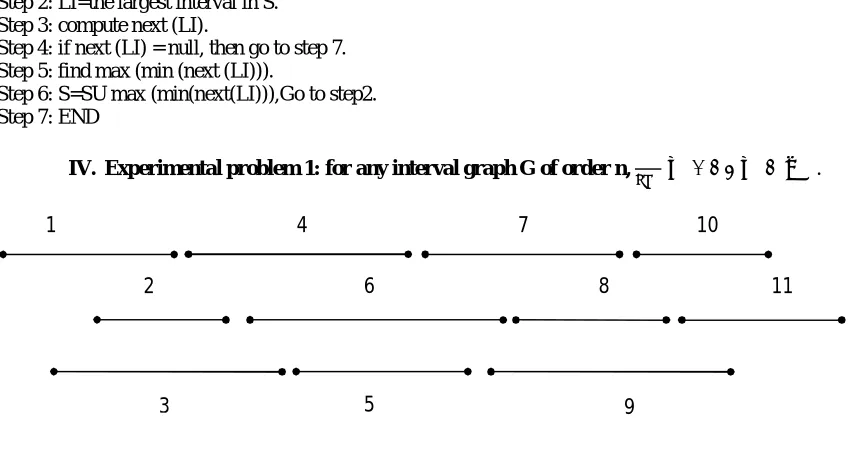
IV. Experimental problem 1: for any interval graph G of order n,
∆≤ ≤ − ∆.
Fig 1: Interval Family I 1
2
3
4
5 6
7
8
9
10
V. DEGREE OF VERTICES
deg (1) = 2, deg (2) = 3, deg (3) = 4, deg (4) = 4 deg (5) = 3, deg (6) = 5, deg (7) = 4, deg (8)= 3 deg (9) = 5, deg (10) = 3, deg (11) = 2
Since ∆= deg(6)= deg(9)= 5
Here n=11,∆= 5, δ = 2, MNS = {3,6,9}=3
Therefore the result is
∆≤ ≤ − ∆
6
3
8
.
1
6
3
6
11
The result is true.
Therefore we consider the maximum degree of g is either deg(6) or deg(9) is 5.
VI. TO FIND MINIMUM NEIGHBOURHOOD SET (MNS) OF AN INTERVAL GRAPH CORRESPONDING TO AN N INTERVAL FAMILY I
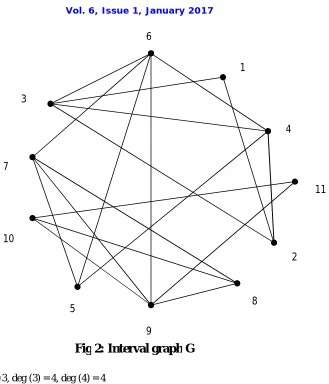
nbd(1)= {1,2,3}, min(1)= 1, max(1)= 3& next(1)= 4 nbd(2)= {1,2,3,4}, min(2)= 1, max(2)= 4& next(2)= 5 nbd(3)= {1,2,3,4,6}, min(3)= 1, max(3)= 6& next(3)= 5 nbd(4)= {2,3,4,5,6}, min(4)= 2 , max(4)= 6& next(4)= 7
Fig 2: Interval graph G
8
2 11 4
1 6
9 5
10 7
nbd(5)= {4,5,6,7}, min(5)= 4 , max(5)= 7& next(5)= 8 nbd(6)= {3,4,5,6,7,9 }, min(6)=3, max(6)= 9& next(6)= 8 nbd(7)= {5,6,7,8,9}, min(7)= 5, max(7)= 9& next(7)= 10 nbd(8)= {7,8,9,10}, min(8)= 7, max(8)= 10& next(8)= 11 nbd(9)= {6,7,8,9,10,11}, min(9)=6, max(9)= 11& next(9)= null nbd(10)= {8,9,10,11}, min(10)= 8, max(10)= 11& next(10)= null nbd(11)= {9,10,11}, min(11)= 9, max(11)=11& next(11)= null
VII.PROCEDURE FOR FINDING A MINIMUM NEIGHBOURHOOD SET(MNS) OF AN INTERVAL GRAPH USING AN ALGORITHM
INPUT: INTERVAL FAMILY I= {1,2,3…,11} STEP1: S= {max (1)} = {3}
STEP2: LI= the largest interval in S= 3 STEP3: Next (LI) = Next (3) = 5
Step5:max(min(next(LI)))= max(min(next(3)))= max(min(5))= max(4)= 6 STEP6: S= S∪{6} = {3,6}, go to step2
STEP2: LI= the largest interval in S= 6 STEP3: Next (LI)= Next(6)= 8
Step5:max(min(next(LI)))= max(min(next(6)))= max(min(8))= max(7)= 9 STEP6: S= S∪{9} = {3,6,9}, go to step2
STEP2: LI= the largest interval in S= 9
STEP3: Next (LI) = Next (9) = null, go to step7 STEP7: End.
OUTPUT: S= {3, 6, 9} is the minimum neighbourhood set of the interval graph G.
VIII. EXPERIMENTAL PROBLEM 2 FOR ANY INTERVAL GRAPH ‘G’ OF ORDER ‘N’ CORRESPONDING TO AN INTERFAMILY, MNS≤ ( + )−( − )∆
Fig 3: Interval family I
1 2
3
5
7 4
8
10
12
11
IX. DEGREE OF VERTICES
deg(1)= 2, deg(2)= 3, deg(3)= 4, deg(4)= 4, deg(5)= 4, deg(6)= 3, deg(7)= 5, deg(8)= 4, deg(9)= 4, deg(10)= 4, deg(11)= 3, deg(12)= 2 Here ∆= 5,δ = 2, n = 12, MNS = {3,7,10}=3
Therefore the result is MNS≤ ( + )−( − )∆
3
5
.
25
Therefore the result is true. Since ∆= deg(7) = 5
X. NEIGHBOURHOOD SET OF VERTICES
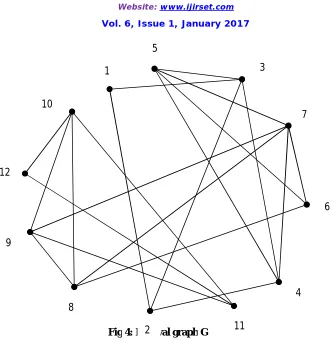
nbd(1)= {1,2,3}, min(1)= 1, max(1)= 3& next(1)= 4 nbd(2)= {1,2,3,4}, min(2)= 1, max(2)= 4& next(2)= 5 nbd(3)= {1,2,3,4,5}, min(3)= 1, max(3)=5& next(3)= 6 nbd(4)= {2,3,4,5,7}, min(4)= 2 , max(4)= 7& next(4)= 6 nbd(5)= {3,4,5,6,7}, min(5)= 3, max(5)= 7& next(5)= 8 nbd(6)= {5,6,7,8}, min(6)= 5, max(6)= 8& next(6)= 9 nbd(7)= {4,5,6,7,8,9}, min(7)= 4, max(7)= 9& next(7)= 10 nbd(8)= {6,7,8,9,10}, min(8)= 6, max(8)= 10& next(8)= 11 nbd(9)= {7,8,9,10,11}, min(9)= 7, max(9)= 11& next(9)= 12 nbd(10)= {8,9,10,11,12}, min(10)= 8, max(10)= 12& next(10)= null
Fig 4: Interval graph G
6 1
2
3
4 5
7
8 9
10
nbd(11)= {9,10,11,12}, min(11)= 9, max(11)=12& next(11)= null nbd(12)= {10,11,12}, min(12)= 10, max(12)=12& next(12)= null
XI. PROCEDURE FOR FINDING A MINIMUM NEIGHBOURHOOD SET(MNS) OF AN INTERVAL GRAPH G USING AN ALGORITHM
INPUT: INTERVAL FAMILY I= {1,2,…,12} STEP1: S= {max (1)} = {3}
STEP2: LI= the largest interval in S = 3 STEP3: Next (LI) = Next (3) = 6
Step5: max(min(next(LI))) = max(min(next(3))) = max(min(6)) = max(5)= 7 STEP6: S= S∪{7} = {3,7}, go to step2
STEP2: LI= the largest interval in S= 7 STEP3: Next (LI) = Next (7) = 10
Step5:max(min(next(LI)))= max(min(next(7)))= max(min(10))= max(8)= 10 STEP6: S= S∪{9} = {3,7,10}, go to step2
STEP2: LI= the largest interval in S= 10 STEP3: Next (LI) = Next (10)= null, go to step7 STEP7: End.
OUTPUT: S= {3, 7, 10} is the minimum neighbourhood set of the interval graph G.
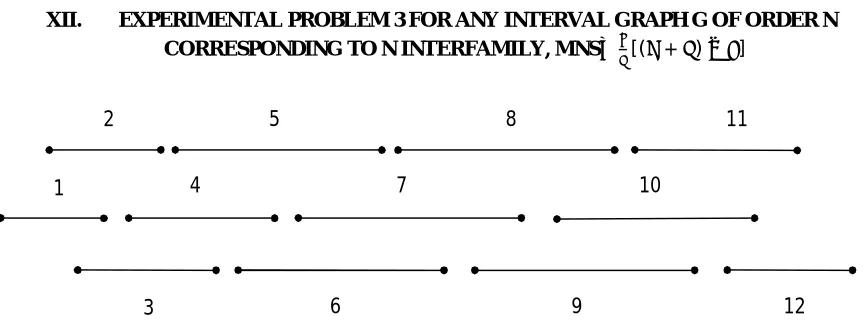
XII. EXPERIMENTAL PROBLEM 3 FOR ANY INTERVAL GRAPH G OF ORDER N CORRESPONDING TO N INTERFAMILY, MNS≤ [( + )− ]
Fig 5: Interval FamilyI 1
2
3
5
6 4
8
10
11
12 7
XIII.DEGREE POF VERTICES
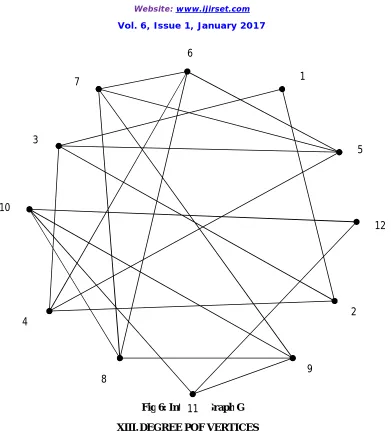
deg(1)= 2, deg(2)= 3, deg(3)= 4, deg(4)= 4 deg(5)= 4, deg(6)= 4, deg(7)= 4, deg(8)= 4 deg(9)= 4, deg(10)= 4, deg(11)= 3, deg(12)= 2 Here ∆= 4,δ = 2, n = 12, MNS = {3,6,9,12}=4
Therefore the result is MNS ≤ [( + )− ]
4
6
Therefore the result is true.
Since ∆= deg(3)or deg (4) or deg (5) or deg (6) or deg (7) or deg (8) or deg (9) or deg (10) = 4
XIV. NEIGHBOURHOOD OF VERTICES FROM G
nbd(1)= {1,2,3}, min(1)= 1, max(1)= 3& next(1)= 4 nbd(2)= {1,2,3,4}, min(2)= 1, max(2)= 4& next(2)= 5 nbd(3)= {1,2,3,4,5}, min(3)= 1, max(3)= 5& next(3)= 6
Fig 6: Interval Graph G 6
1
2 3
4
5 7
8 9
10
11
nbd(4)= {2,3,4,5,6}, min(4)= 2, max(4)= 6& next(4)= 7 nbd(5)= {3,4,5,6,7}, min(5)= 3, max(5)= 7& next(5)= 8 nbd(6)= {4,5,6,7,8}, min(6)= 4, max(6)= 8& next(6)= 9 nbd(7)= {5,6,7,8,9}, min(7)= 5, max(7)= 9& next(7)= 10 nbd(8)= {6,7,8,9,10}, min(8)= 6, max(8)= 10& next(8)= 11 nbd(9)= {7,8,9,10,11}, min(9)= 7, max(9)= 11& next(9)= 12 nbd(10)= {8,9,10,11,12}, min(10)= 8, max(10)= 12& next(10)= null nbd(11)= {9,10,11,12}, min(11)= 9, max(11)=12& next(11)= null nbd(12)= {10,11,12}, min(12)= 10, max(12)=12& next(12)= null
XV. PROCEDURE FOR FINDING A MINIMUM NEIGHBOURHOOD SET(MNS) OF AN INTERVAL GRAPH USING
AN ALGORITHM
INPUT: INTERVAL FAMILY I = {1,2,……,12}. STEP1: S= {max (1)} = {3}
STEP2: LI= the largest interval in S= 3 STEP3: Next (LI) = Next (3) = 6
Step5:max(min(next(LI)))= max(min(next(3)))= max(min(6))= max(4)= 6 STEP6: S= S∪{6} = {3,6}, go to step2
STEP2: LI= the largest interval in S= 6 STEP3: Next (LI) = Next (6) = 9
Step5:max(min(next(LI)))= max(min(next(6)))= max(min(9))= max(7)= 9 STEP6: S= S∪{9} = {3,6,9}, go to step2
STEP2: LI= the largest interval in S= 9 STEP3: Next (LI) = Next (9) = 12
Step5:max(min(next(LI)))= max(min(next(9)))= max(min(12))= max(10)= 12 STEP6: S= S∪{9} = {3,6,9,12}, go to step2
STEP2: LI= the largest interval in S= 12 STEP3: Next (LI) = Next (12) = null STEP7: End.
OUTPUT: S= {3, 6, 9, 12} is the minimum neighbourhood set of the interval graph G.
XVI.CONCLUSION
In this paper focuses on neighbourhood sets and the main aim of the comparison of neighbourhood set and degrees of an interval graph G corresponding to an interval family I using an algorithm. In future efforts in the paper eventually open up many an avenue in the field of research on interval graphs.
REFERENCES
[1] E. Sampath Kumar, P.S. Neeralagi, The neighbour of graph, Indian J. Pure.Appl.Math., 16,1985, 126-132.
[2] Kulli, V.R., Sigarkanti, S.K., Further results on a neighbourhood number of a graph, Indian, J. Pure. Appl. Math., 23,1992,575-577. [3] Even, S., Graph Algorithms, Computer Science Press, Rockville, MD, 1980.
[4] E.J.Cockayne, S.T.Hedetniemi, Towards a theory of domination in graphs, Networks, Vol.7(1977), 247-261. [5] Bertossi, A.A., Total domination in Interval graphs, Inform. Process., Lett.,23,1986,131-134.
[6] E. Horowitz and S. Sahani; Fundamentals of computer algorithms. Galgotia Publications, New Delhi(1998)
[7] B. Maheswari, Y. Lakshmi naidu, L. Nagamuni reddy and A. Sudhakaraiah, Minimum Global dominating set of an interval graph, International J. of Math. Sci. & Appls., Vol. 5, No. IV( July, 2011), pp. 265-269.
[8] B. Maheswari, Y. Lakshmi naidu, L. Nagamuni reddy and A. Sudhakaraiah, A polynomial time algorithm for finding a minimum independent neighborhood set of an interval graph, Graph theory notes of newyork XLVI,
9-12(2004) New York academy Sciences.
[9] Gupta, U.I., Lee, D.T. Leung, J.Y.T. Efficient algorithms for interval graphs and circular-arc graphs, Networks, 12, 1982, 459-467. [10]Keil,J.M., Total domination in interval graphs, Inform. Process. Lett., 22, 1986, 171-174.