ISSN(Online): 2319-8753 ISSN (Print): 2347-6710
I
nternational
J
ournal of
I
nnovative
R
esearch in
S
cience,
E
ngineering and
T
echnology
(A High Impact Factor & UGC Approved Journal) Website: www.ijirset.com
Vol. 6, Issue 9, September 2017
Automatic Warning System for Eyes Using
Ultrasonic Sensor
Vedansh Dubey1 , Shwetabh Priyadarshi2, Shubham Dubey3, Shreyansh Soni4
UG Student [BE], Dept. of ECE, Medicaps Institute of Technology and Management, Indore, Madhya Pradesh, India1
UG Student [BE], Dept. of ECE, Medicaps Institute of Technology and Management, Indore, Madhya Pradesh, India2
UG Student [BE], Dept. of ECE, Medicaps Institute of Technology and Management, Indore, Madhya Pradesh, India3
UG Student [BE], Dept. of ECE, Medicaps Institute of Technology and Management, Indore, Madhya Pradesh, India4
ABSTRACT: According to the recent study on the viewing distance of mobiles and computers it is concluded that the favourable distance between the eyes and screen should be close to 40cm (15.7 inches), but by the particular survey it was resulted that this was closer than the typical near working distance of 36 centimetres (14.2 inches) when reading printed text. The average working distance when viewing a web page on a smart phone was even shorter: 32 centimetres (12.6 inches) hence the above discussion itself conclude that it is required to have a device that will automatically detect the distance of the user and screen and warn them to adjust the screen to the favourable distance.
KEYWORDS: Ultra Sonic Sensor, Arduino Nano Board, LED.
I. INTRODUCTION
Arduino is an open-source electronics prototyping platform based on flexible, easy-to-use hardware and software. It's intended for artists, designers, hobbyists, and anyone interested in creating interactive objects or environments.As per the above discussion we have made an arduino nano based ultrasonic sensor distance detector system which tells the user to maintain a particular distance from the screen during usage of television laptops or mobiles. The distance that a particular person wants vary according to person’s requirement this facility is also given in this system to change the range for the ultrasonic sensor.Arduino Nano is a surface mount breadboard embedded version with integrated USB. It is a smallest, complete, and breadboard friendly. The Arduino Nano can be powered via the mini-B USB connection, 6-20V unregulated external power supply (pin 30), or 5V regulated external power supply (pin 27). The power source is automatically selected to the highest voltage source. Specifications of it, Microcontroller: Atmel ATmega168 or ATmega328,Operating Voltage(logic level): 5 V ,Input Voltage(recommended): 7-12 V ,Input Voltage(limits): 6-20 V, Digital I/O Pins: 14 (of which 6 provide PWM output), Analog Input Pins: 8DC Current per I/O Pin: 40 mA, Flash Memory: 16 KB (ATmega168) or 32 KB (ATmega328) of which 2 KB used by boot loader, SRAM: 1 KB (ATmega168) or 2 KB (ATmega328)EEPROM: 512 bytes (ATmega168) or 1 KB (ATmega328)Clock Speed: 16 MHz. An Ultrasonic sensor is a device that can measure the distance to an object by using sound waves. It measures distance by sending out a sound wave at a specific frequency and listening for that sound wave to bounce back.The Ultrasonic Sensor sends out a high-frequency sound pulse and then times how long it takes for the echo of the sound to reflect back. The sensor has 2 openings on its front. One opening transmits ultrasonic waves, (like a tiny speaker), the other receives them, (like a tiny microphone).The speed of sound is approximately 341 meters (1100 feet) per second in air. The ultrasonic sensor uses this information along with the time difference between sending and receiving the sound pulse to determine the distance to an object. It uses the following mathematical equation:
Distance =(Time x Speed of Sound)/ 2
ISSN(Online): 2319-8753 ISSN (Print): 2347-6710
I
nternational
J
ournal of
I
nnovative
R
esearch in
S
cience,
E
ngineering and
T
echnology
(A High Impact Factor & UGC Approved Journal) Website: www.ijirset.com
Vol. 6, Issue 9, September 2017
II. RELATED WORK
One of the most important function of engineering science is measurement of distance. There are many type of distance measurement systems we use in our environment from normal rulers interferometers. In applications,basic concept of electronic distance measure system is adopted in many areas like navigation, aviation and many more. In aviation, direct feedback is required for linear motion and positioning control application. GPS in navigation system using satellite is one of the good example of distance measurement system. So there is a lot of advantage of distance measurement technology in our environment.
Automatic ultrasonic distance detector work on the principle similar to radar or sonar which evaluates the attribution of a target by interpreting the echoes with radio or sound waves respectively.
III. PROPOSED WORK
The system works on the principle that whenever the user come in front of the sensor for more than specified time say 2 minutes at the particular distance say 23 m then the led blinks showing the user is too close to the screen.
(a)
(b)
Code:-
#define trigPin 3 #define echoPin 2 #define led 13 void setup() {
pinMode(trigPin, OUTPUT);
pinMode(echoPin, INPUT);
pinMode(led, OUTPUT);
}void loop() {
ISSN(Online): 2319-8753 ISSN (Print): 2347-6710
I
nternational
J
ournal of
I
nnovative
R
esearch in
S
cience,
E
ngineering and
T
echnology
(A High Impact Factor & UGC Approved Journal) Website: www.ijirset.com
Vol. 6, Issue 9, September 2017
digitalWrite(trigPin, LOW);
delayMicroseconds(1);
digitalWrite(trigPin, HIGH);
delay(5000); // for time delay
digitalWrite(trigPin, LOW);
duration = pulseIn(echoPin, HIGH);
distance = (duration/2) / 29.1;
if (distance < 28) //distance
{ // This is where the LED On/Off happens
digitalWrite(led,HIGH);
}
else
{
digitalWrite(led,LOW);
}
delay(50); }
The above code is used to program the system.
In future modification to this project can be done that will cause automatic change in brightness of the screen with distance of the user and also some other modification to this idea can be done that would be helpful in new innovations for the welfare of the human beings.
IV. EXPERIMENTAL RESULTS
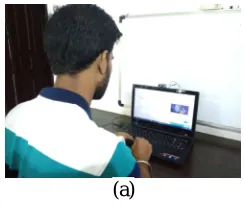
Figure shows the application of this device.
If the person using the device(say laptop, TV or mobile) maintain a proper distance from it then the LED is in OFF condition as shown in figure (a).
(a)
And simultaneously if the person comes in the range of ultrasonic sensor for more then describe time then the LED turns ON which is a warning sign.
ISSN(Online): 2319-8753 ISSN (Print): 2347-6710
I
nternational
J
ournal of
I
nnovative
R
esearch in
S
cience,
E
ngineering and
T
echnology
(A High Impact Factor & UGC Approved Journal) Website: www.ijirset.com
Vol. 6, Issue 9, September 2017
V. CONCLUSION
The above discussion and explanation leads to the conclusion that this system have a vast application in many devices which not only enhance the working capability but also have scope of further improvement and advancement like inbuilt system that automatically change the brightness or automatic on/off system for eyes safety etc. Hence this system have a variety of applications that are very useful for society and may lead to revolutionary changes.
REFERENCES
1. www.arduinouno.com.
2. P. Singh, A. Verma, and A. K. Shrivastava , “Design and development of robotic sewer inspection equipment controlled by embedded systems,” Proceedings of the First IEEE International Conference on Emerging Trends in Engineering and Technology, Jul. 2008, Nagpur, India, pp. 1317-1320.
3. SA. K. Shrivastava, A. Verma, and S. P. Singh, “Partial automation of the current sewer cleaning system,” Invertis Journal of Science and Technology, Vol. 1, No. 4, 2008, pp. 261-265.
4. O. Duran, K. Althoefer, and L. Seneviratene, “State of the art in sensor technologies for sewer inspection,” IEEE Sensors Journal, Apr. 2002, Vol. 2, No. 2, pp. 73-81.
5. Y. Jang, S. Shin, J. W. Lee, and S. Kim, “A preliminary study for portable walking distance measurement system using ultrasonic sensors,” Proceedings of the 29th Annual IEEE International Conference of the EMBS, France, Aug. 2007, pp. 5290-5293.
6. C. C. Chang, C. Y. Chang, and Y. T. Cheng, “Distance measurement technology development at remotely teleoperated robotic manipulator system for underwater constructions,” IEEE International Symposium on Underwater Technology, Apr. 2004, pp. 333-338.
7. H. He, and J. Liu, “The design of ultrasonic distance measurement system based on S3C2410,” Proceedings of the IEEE International Conference on Intelligent Computation Technology and Automation, Oct. 2008.
8. Ultrasonic ranging module HC -SR04 datasheet [Online] http://users.ece.utexas.edu/~valvano/Datasheets/HCSR04b.pdf 9. “Microcontrollers and Applications”, Satish Shah, Oxford Publications.
10. Muhammad Ali Mazidi, The AVR Microcontroller and Embedded Systems, 1st ed., Pearson, 2012. 11. “ATmega16a data sheet,” Atmel Corporation, U.S.
12. “Atmel AVR Microcontroller Primer”, Morgan and Claypool Publishers. 13. “Embedded C Programming and the Atmel AVR”, Richard H. Barnett.
14. "Narrowband Ultrasonic Detection With High Range Resolution: Separating Echoes via Compressed Sensing and Singular Value Decomposition", Guangming Shi, Senior Member, IEEE, Chongyu Chen, Jie Lin, XuemeiXie, and XuyangChen,IEEE Transactions on Ultrasonics, Ferroelectrics, and Frequency Control , vol. 59, no. 10, 2237-2253, October 2012..
15.
BIOGRAPHY
Vedansh Dubey was born in Khandwa, Madhya Pradesh, India,18 august 1997.He has completed his schooling from kendriya vidyalaya no.1 indore and he is pursuing bachelor of engineering from medicaps institute of technology and management indore in electronics and communication branch.He is a writer of number of magazines ,a co-author and has published two books.
ISSN(Online): 2319-8753 ISSN (Print): 2347-6710
I
nternational
J
ournal of
I
nnovative
R
esearch in
S
cience,
E
ngineering and
T
echnology
(A High Impact Factor & UGC Approved Journal) Website: www.ijirset.com
Vol. 6, Issue 9, September 2017
Shubham Dubey was born in Seoni ,Madhya Pradesh ,India,4 December 1996. He has completed his schooling from modern higher secondary school Seoni (m.p). He is pursuing bachelor of engineering from medicaps institute of technology and management Indore in electronics and communication branch.