Design and Comparison of Unsigned 16-Bit
Multiplier Based On Booth-Encoder and
Wallace-Tree Modifications
Pooja Chandgude1, Dr.A.M.Sapkal2, Prof. Ruchika Singh 3
M. E Student, Department of Electronics and Telecommunication, G.S.Moze College of Engineering Pune, India. 1
Professor, Department of Electronics and Telecommunication, College of Engineering, Pune, India. 2
Assistant Professor, Department of Electronics and Telecommunication, G.S.Moze College of Engineering Pune, India3
ABSTRACT: The deferral of the multiplier assumes a basic part in some fast executions and processors, for example,
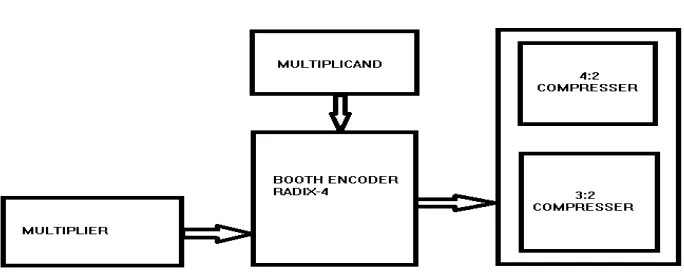
RISC, DSP, and picture handling centers, and so forth. In this paper, an outline of unsigned 16-bit multiplier is proposed, expecting to accomplish the best planning execution with a fitting zone. The proposed design comprises of a changed Radix-4 Booth encoder, an altered Wallace Tree adder, and a Carry Look Ahead adder.
KEYWORDS: Modified Booth Encoding multiplier, Baugh-Wooley multiplier, array multiplier, CSA, CLA Partial
product, Signed-unsigned.
I.INTRODUCTION
II.OBJECTIVE
1. Multiplications are most broadly and all the more frequently utilized number juggling calculation executed as a part of all advanced signal processing applications. Expansion is the essential operation for some computerized applications.
2. The point is to create region effective, fast and low power gadgets. Precise operation of an advanced framework is for the most part impacted by the execution of the adders. Multipliers are additionally imperative part in computerized frameworks.
3. In this an elite and low power 16 bit unsigned multiplier is proposed utilizing Wallace tree adders.
4. Advantage of Wallace calculation is it create the two columns toward the end of few line expansion however every line expansion is minimal complex. The fundamental target is examination of execution investigation of the area, power and speed of Radix-4 Booth multiplier and Radix-4 stall wallace multiplier.
III.LITERATURE SURVEY
The postponement of the multiplier assumes a basic part in some rapid usage and processors, for example, RISC, DSP, and picture preparing centers, and so on. In [1] an outline of unsigned 32-bit multiplier is proposed, planning to accomplish the best planning execution with a fitting territory. The proposed design comprises of an altered Radix-4 Booth encoder, a changed Wallace Tree snake, and a Carry Look Ahead viper.
[2] presents the strategies required to actualize a rapid and elite parallel complex number multiplier. The plans are organized utilizing Radix-4 Modified Booth Algorithm and Wallace tree. These two methods are utilized to accelerate the duplication procedure as their capacity to decrease fractional items era and pack incomplete item term by a proportion of 3:2. Notwithstanding that, convey spare adders (CSA) is utilized to upgrade the pace of expansion procedure for the framework.
Fast and low power MAC unit is most extreme prerequisite of today's VLSI frameworks and advanced sign handling applications like FFT, Finite motivation reaction channels, convolutionand so on. In [3], creators have examined diverse sorts of multipliers like stall multiplier, combinational multiplier, Wallace tree multiplier, cluster multiplier and consecutive multiplier. Every multiplier has its own particular points of interest and impediments. Distinctive sorts of strategies are exhibited for enhancing the rate and low power utilization like pipelined corner augmentation strategy in which pipelining is utilized as a part of stall multiplier to decrease the postponement of every stage.
[4] depicts usage of radix-4 Modified Booth Multiplier and this execution is contrasted and Radix-2 Booth Multiplier. Adjusted Booth's calculation utilizes both expansion and subtraction furthermore treats positive and negative operands consistently. No unique activities are required for negative numbers. [4] Investigates the technique for executing the Parallel MAC with the littlest conceivable postponement.
1 Booth Encoder
Booth encoding is a technique that allows for smaller, faster multiplication circuits, by recoding the numbers that are multiplied. It is the standard technique used in chip design, and provides significant improvements over the "long multiplication" technique.
Booth multiplication algorithm gives a procedure for multiplying binary integers in signed -2’s complement representation.
Following steps are used for implementing the booth algorithm:-Let X and Y are two binary numbers and having m and n numbers of bits (m and n are equal) respectively.
Step 1 Making booth table: In booth table we will take four columns one column for multiplier second for previous
first LSB of multiplier and other two (U and V) for partial product accumulator (P)[3]. 1. From two numbers, choose multiplier (X) and multiplicand (Y).
2. Take 2’s complement of multiplicand (Y). 3. Load X value in the table.
4. Load 0 for X-1 value.
5. Load 0 in U and V which will have product of X & Y at the end of the operation. 6. Make n rows for each cycle because we are multiplying m and n bits numbers.
Step2 Booth algorithm: Booth algorithm requires examination of the multiplier bits, and shifting of the partial product
(P). Prior to the shifting, the multiplicand may be added to P, subtracted from the P, or left unchanged according to the following rules:
1. Xi Xi-1
0 0 Shift only 1 1 Shift only
0 1 Add Y to U and shift 1 0 Minus Y from U and shift
2. Take U & V together and shift arithmetic right shift which preserves the sign bit of 2’s complement number. So,
positive numbers and negative numbers remain positive and negative respectively.
3. Circularly right shift X because this will prevent us from using two registers for the X value.
Repeat the same steps until n no. of cycles are completed. In the end we get the product of X and Y.
2 Wallace Tree
A Wallacetree is an efficienthardware implementation of a digital circuit that multiplies two integers, devised by Australian Computer Scientist Chris Wallace in 1964. Wallace tree reduces the no. of partial products and use carry select adder for the addition of partial products. Wallace tree has three steps:-
1. Multiply each bit of multiplier with same bit position of multiplicand. Depending on the position of the multiplier
bits generated partial products have different weights.
2. Reduce the number of partial products to two by using layers of full and half adders.
3. After second step we get two rows of sum and carry, add these rows with conventional adders.
Explanation of second step:-
As long as there are three or more rows with the same weight add a following layer:
1. Take any three rows with the same weights and input them into a full adder. The result will be an output row of the same weight i.e sum and an output row with a higher weight for each three input wires i.e carry.
2. If there are two rows of the same weight left, input them into a half adder. 3. If there is just one row left, connect it to the next layer.
V. METHODOLOGY USED
the number of partial products is high, which increase significant delay in the second step. Thus, the main objective in first step is to reduce the amount of partial products.
• Radix-4 recoding of the multiplier implies a reduction in the number of digits to 7:
• To multiply X by Y using the modified Booth algorithm starts from grouping Y by three bits and encoding
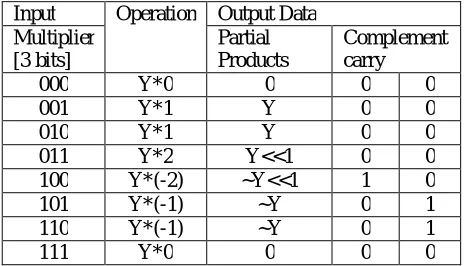
into one of {-2, -1, 0, 1, 2}. Table 1 shows the rules to generate the encoded signals by MBE scheme
Second Step: a tree adder is deployed to sum all the partial products. There are two common approaches with various advancements; they are Wallace Tree Adder (WTA) approach and Dadda Tree Adder (DTA) approach. The WTA-based methods are developed WTA-based on optimizing the compressor units such as 4-2 compressors and/or 5- 2 compressors while the DTA based approaches use 3-2 compressors as its basic elements. A strong advantage of WTA algorithm is that it can generate the final two rows with only few row additions. However, the complexity of each row addition is high, which leads to a high cost of timing and resources for each row-addition process. On the other hand, although each row-addition in DTA algorithm is simpler, DTA based designs have more row additions than those of the WTA based architectures.
Input Operation Output Data
Multiplier [3 bits]
Partial Products
Complement carry
000 Y*0 0 0 0
001 Y*1 Y 0 0
010 Y*1 Y 0 0
011 Y*2 Y<<1 0 0
100 Y*(-2) ~Y<<1 1 0
101 Y*(-1) ~Y 0 1
110 Y*(-1) ~Y 0 1
111 Y*0 0 0 0
Table 1: Truth table of MBE scheme
Fig 2:Bit grouping for radix-4 Booth Encoder
Modified Wallace Tree Adder:
Fig 3: Wallace tree adder
Third step: In the final step, two last rows are added together to compute the final multiplier result. Many different kinds of high-speed adder have been presented such as Carry-save Adder, Carry Look Ahead Adder (CLA) , etc. However, it can be proven that there is a part of the final multiplier result can be computed at the end of each row addition processing in step 2. Therefore, the typical final step can be done during the processing of its previous step, thereby giving rises to an improvement in processing time.
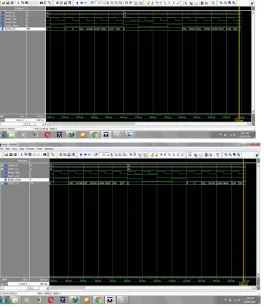
VI.EXPERIMENTAL RESULTS
VII.PERFORMANCE ANALYSIS 1. Area
VIII. CONCLUSION
REFERENCES
[1] Xuan-VyLuu, Trong-Thuc Hoang, and Trong-Tu Bui, Anh-Vu Dinh-Duc," A High-speed Unsigned 32-bit Multiplier Based on Booth-encoder and Wallace-tree Modifications", The 2014 International Conference on Advanced Technologies for Communications (ATC'14) ©2014 IEEE. [2] S. ShafiullaBasha, Syed. Jahangir Badashah,"Design and Implementation of Radix-4 Based High Speed Multiplier For ALU's Using Minimal Partial Products", International Journal of Advances in Engineering and Technology, July 2012, Vol. 4, Issue 1, pp. 314-325
[3] Soniya, Suresh Kumar," A Review of Different Type of Multipliers and Multiplier-Accumulator Unit", International Journal of Emerging Trends and Technology in Computer Science (IJETTCS), Volume 2, Issue 4, July – August 2013
[4] Sukhmeet Kaur1, Suman and ManpreetSignh Manna," Implementation of Modified Booth Algorithm (Radix 4) and its Comparison with Booth Algorithm (Radix-2)", Advance in Electronic and Electric Engineering,ISSN 2231-1297, Volume 3, Number 6 (2013), pp. 683-690.
[5] Chepurisatish, PanemcharanArur, G.Kishore Kumar and G.Mamatha," An Efficient High Speed Wallace Tree Multiplier", International Journal of Emerging Trends in Electrical and Electronics (IJETEE – ISSN: 2320-9569) Vol. 10, Issue. 4, May. 2014.
[6] UmerNisarMisgar, Wasim Ahmad Khan, and Najeeb-ud-clamor," Design of a Floating Point Fast Multiplier with Mode Enabled ", IMECS 2009, March 18 - 20, 2009.
[7] Shubham Gupta and Divyam Gupta," Pipelined structure of Modified Booth's Multiplier", International Journal of Current Engineering and Technology, Vol.5, No.5 (Oct 2015).