Throughput Maximization using Spatial
Reusability in Multi-Hop Wireless Networks
Snehal C Pise1, Prof D . P. Salapurkar2
M. E Student, Department of Computer Engineering, SCOE, Pune, MH, India 1 Assistant Professor, Department of Computer Engineering, SCOE, Pune, MH, India2
ABSTRACT: The main issue of routing in multi-hop wireless networks is to get high end-to-end throughput. So it is hard to find the optimal path from the source node to the destination node. There are number of routing protocols have been implemented to find the path with least transmission time for sending a single packet. Such transmission time reduces protocols cannot be ensured to get high end-to-end throughput. Spatial reusability aware single-path routes and any path routing protocols consider the both condition to achieve high end to end throughput and to find the path with least transmission time. And also compare them with existing single-path routing and any path routing protocols respectively. The evaluation results show that both protocols significantly increase the end-to-end throughput compared with existing protocols.
KEYWORDS: Multi-hop Wireless Networks, Single-Path Routing, Load Balancing, Dijkstra Algorithm.
I. INTRODUCTION
Large number of wireless routing matrices is finished in ancient wireless device network. In wireless communication network it's necessary to fastidiously realize the high utility route in multi-hop wireless networks. An outsized range of routing protocols is planned for multi hop wireless networks. Though, an straightforward downside with existing wireless routing protocols is that minimizing the general range of transmissions to deliver one packet from a supply node to a destination node. This protocol doesn't essentially maximize the end-to-end outturn. Thus two sorts of routing protocols, as well as single-path routing and any path routing square measure thought-about.
The task of this routing protocol is to pick out a value minimizing path, on that the packets square measure delivered from the supply node to the destination node. In abstraction reusability of wireless signals fade throughout propagation, 2 links square measure freed from interference if they're secluded enough, and therefore will transmit at identical time on identical channel. To the simplest of our data, most of the present routing protocols don't take abstraction reusability of the wireless communication. Thus thought of abstraction reusability of wireless device network routing is taken by victimisation single path routing and any path routing media under consideration.
II. LITERATURESURVEY
PAPER NAME, AUTHOR AND JOURNAL NAME ALGORITHM/ METHODS/ TECHNIQUES ADVANTAGES/ DISADVANTAGES REFERRED POINT “A Multi-Radio
Unification Protocol for IEEE 802.11Wireless Networks”,
AtulAdya, ParamvirBahl, JitendraPadhye, Alec Wolman, Lidong Zhou Microsoft Research,
1)Striping algorithm 2)Round Robin Algorithm
Adv: Multiple radios is to assign a flow to a particular channel based on the load across all channels and to maintain this assignment for the duration of the flow.
Dis: If a wireless node chooses a channel that is
Proc. 1st Int. Conf. Broadband Netw.,2004, pp. 344–354.
orthogonal to the channel chosen by its neighbors, then these neighboring nodes are not able to communicate with each other.
“Highly dynamic destination sequenced distance-vector routing (DSDV) for mobile computers,” C. E. Perkins and P. Bhagwat,Proc. 4th Annu. ACM/IEEE Int. Conf. Mobile Comput. Netw., 1998, pp. 85–97.
1) shortest-path algorithm 2) Distributed Bellman-Ford
(DBF) algorithm 3) dist ante-vector routing algorithm
The problems arising with large populations of mobile hosts, which can cause route updates to be receivedin an order delaying thebest metrics until afterpoorer metric routes arereceived, we have separatedthe route tables into twodistinct structures.
1)Ad-hoc networks 2)Mac layer
“A performance
comparison of multi-hop wireless ad hoc network routing protocols,” J. Broch, D. A. Maltz, D. B. Johnson, Y.-C. Hu, and J. G. Jetcheva, In Proc. 4th Annu. ACM/IEEE Int. Conf. Mobile Comput. Netw., 1998, pp. 85–97.
1)Temporally Ordered Routing Algorithm
Adv:The key advantage of DSDV over traditional distance vector protocols is that it guarantees
loopfreedom.
Dis: These missing pieces Greatlysimplify the problem facedby the routing protocol, as propagation delay, capture effects.
1)Wireless network 2)Ad-hoc network 3)OSI Model
“Trading structure for randomness in wireless opportunistic routing,” S. Chachulski, M. Jennings, S. Katti, and D. Katabi,in Proc. SIGCOMM Conf. Appl., Technol., Archit. Protocols Comput. Commun., 2007, pp. 169– 180.
1) Computing the number of transmissions each node makes to deliver
a packet from source to destination, zi’s
2) Dijkstra’s shortest path algorithm
Adv: Field tests on a 20- node wireless testbedshow that MORE provides both unicast and multicast traffic with significantly higher throughput than both traditional routing and prior work on opportunistic routing.
Dis:Can’tforwarding maximum packet this system.
1)Network Coding 2)Wireless Networks
“Routing in multi-radio, multihop wireless mesh networks,”
R. Draves, J. Padhye, and B. Zill,in Proc. 10th Annu. Int. Conf. Mobile Comput. Netw., 2004, pp. 114– 128.
1) shortestpath algorithm
Adv: First, higher layersofware runs
unmodified over the ad-hoc Network.
1)Mesh network
2) Expected Transmission Time (ETT)
III.EXISTING SYSTEM
In an ad hoc network wireless sensor nodes enthusiastically establishing a network without the use of whichever existing network organization management, which limit transmission range of wireless network strategies, multiple networks ”hops” may be needed for one node to interchange data with alternative across the network. Hence existing work scheme, a multiplicity of new routing protocols targeted precisely at this environment have been developed, but little performance info on each protocol and no realistic performance comparison between them is accessible.
In modern years, large amounts of routing protocols have been proposed for multi-hop wireless networks. Though, a essential problematic with existing wireless routing protocols is that minimizing the whole number (or time) of transmissions to deliver a single packet from a source node to a destination node does not necessarily maximize the end-to-end throughput.
2.1 Disadvantages of Existing System
1. Energy consumption was bigger challenge to wireless sensor network.
2. In multi-hop communication secure data transmission with less cost is ignored.
3. Existing infrastructure is expensive or inconvenient to use, wireless mobile users may still be able to communicate through the formation of an ad hoc network
IV.PROPOSEDSYSTEM
Routing protocols are usually enforced supported transmission value minimizing routing metrics; they can't guarantee most end-to-end turnout once spatial reusability got to be thought of. They have centralized management to appreciate MAC-layer planning, and to eliminate transmission rivalry. The algorithms planned during this work don't need any planning, and also the SASR algorithms may be enforced during a distributed manner. Our approach may be extended to adapt to multiple transmission rates, as long because the conflict graph of links may be calculated. Proposed system motivates to easily choose the trail that minimizes the general transmission counts or for delivering a packet. The aim is to exploiting spatial reusability. Specifically, we have a tendency to think of the trade-off between spatial recycle and rate, and planned a localised power and rate.
In reusability aware routing system novel approach is scheduled using the spectrum spatial reusability in single path routing and then for any path routing, and propose algorithm for participating node selection, cost calculation, and forwarding list determination. SASR algorithms and SAAR algorithm with different data rates in network simulator. The evaluation results show our algorithms works improvement to end-to-end throughput compared with existing ones. Specifically, for single-path routing, a throughput gain approximately 5:3 using a median greater than 60 percent is achieved when it comes to single-flow, with an average gain of more than twenty percent is achieved with multiple flows. For any path routing, an average gain of 13:2 percent along with the maximum gain approximately 71:six percent can be realized. Proposed work is definitely the outcomes of reveal packet level simulation comparing four multi-hop wirelesses ad hoc network routing protocols for an array.
4.1 Advantage Proposed System
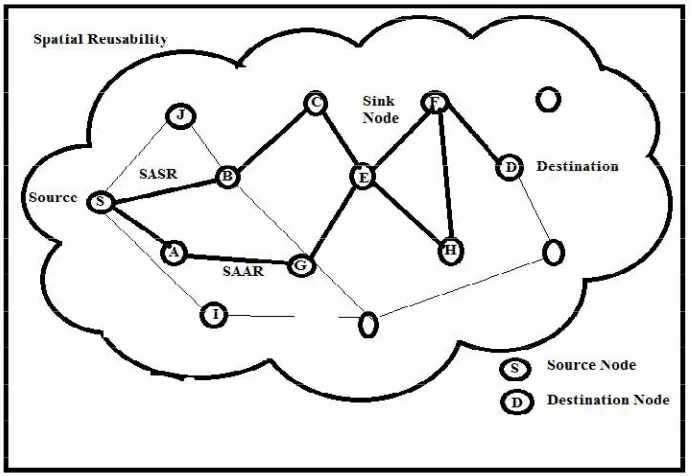
Reduced energy consumption in WSN. Secure node to node communication. Reduce packet drop attack with trust based active source routing. In spatial reusability aware routing Scheme novel approach is defined with the spectrum spatial reusability in single path routing and any path routing. Propose algorithm for participating node selection, cost calculation, and forwarding list determination, increasing throughput. There are two types of spatial reusability routing protocols. Spatial aware single path routing Protocol (SASR) and Sptial aware any path routing (SAAR) Protocol. SASR Protocol is divided into two types.
1. SASR-MIN 2. SAAR-FF
2. SASR-FF: - It is for achieving good performance in most of the cases. SAAR Algorithm which restricts the packets to be forwarded through a predetermined path from the source to the destination. Any path routing enables any intermediate node who overhears the packet to participate in packet forwarding.
3. SAAR Algorithm which restricts the packets to be forwarded through a predetermined path from the source to the destination. Any path routing enables any intermediate node who overhears the packet to participate in Packet forwarding.
Figure 1. System Architecture of Proposed System
V. ALGORITHMS USED
1. SASR-Min Algorithm:
This algorithm used for finding minimal path. C=Path delivery time
Q=Covered link
∗= Maximal non-interfering sets
I=non-interfering sets P=Path
1. C ← 0 Initially cost mean delivery time is zero. 2. Q ← Covered Set initially empty
3. while Q ≠ P In this Step loop for Q is not equal to select path then it executed. Enter in loop 4. foreach I ∗do In above step for loop executed up to I is an element of set ∗.
5. I ← I \ Q In that Store link in I when set that contains all those link of I that are not in Q. 6.if I ≠ &&c(I) / |I|< Threshold then
In that if I is not equals to Empty and also we check value of cost of I up to threshold i.e. particular link. 7. ∝ ← c(I) / |I| Store the value of cost in ∝.
9. End //End if loop 10. End //End Foreach loop
11. C← C+ c(Temp) Store total cost in C.
12. I ←I ∪ {Temp} Store the non-interfering link in I . 13. Q ← Q ∪ {Temp} Stored covered link in Q 14. End // End while loop
2. SASR-FF Algorithm
This algorithm used for minimal cost of path selection from set of paths. P=Path
C=cost of path
I= non-interfering sets
1. Sort the links in P by cost in non-increasing order L
2. Initially we give one variable K ← 0
3. Cost of path initially zero and I is empty C ← 0; I← ∅
4. Execute the for loop for all links are sorted in L and (i, j) are the values are particular node
foreach (i, j) L do
5. fused← FALSE; In this step fused is false then go to for loop 6. for l ← 1 to k doIn this step variable l is equals to one up to k 7. reusable ← TRUE; If route will be reusable then it assign to TRUE 8. foreach ( , ) do
9. if [ (i, j) , ( , ) ] E then
10. reusable ← FALSE; If route is not reusable then assign to FALSE i.e. if node not sending more packet for different route .
11. break;
12. end // end if loop 13. end // end foreach loop
14. if reusable then If reusable is TRUEThen find max cost of path add to non-interfering set 15. ← ∪ {(i, j) }; ← max{( , ) };
16. fused ← TRUE;
17. end
18. end
19. if not fused then
20. k ← k+1
21. I ← I ∪ {{(i, j) }}; ←
22. end
23. end
24. forl ← 1 to k do
25. C ← C+ 26. end
27. return C and I
SAAR
1 foreachi€N do
2 Ci←;Fi←Ø;Ώ(i,i);←1;
4 Cdst←0;q←Dst;Q{Dst};I←Dst}}; 5 whileq≠Srcdo
6 foreach(i;q)€E^i≠Qdo 7 Fi←FiU{q};Ώi←Ώ; 8 foreachj€Qdo 9 Ώ(i,j)←0;
10 foreachk€Fi^Ck<Cjdo 11 Ώi(i,j)←Ώ(i,j)+Wik*Ώi(k,j)
VI. EXPERIMENTAL SETUP
We use the set dest tool in NS-2 to uniformly distribute 80 nodes in a 2,000 meter * 2,000meter area, and considered two data rates of 802:11, including 11 and 54 Mbps. We usedCBR to generate 1500-byte packets at high enough rates.
VI.PROPOSEDRESULT
We have demonstrated that we can significantly improve the end-to-end throughput in multi-hop wireless networks, by carefully considering spatial reusability of the wireless communication media. We have presented two protocols, SASR and SAAR, for spatial reusability-aware single-path routing and anypath routing, respectively.
We have implemented our protocols, and compared them with existing routing protocolswith the data rates of 11 and 54 Mbps. Evaluation results show that SASR and SAAR algorithms can achieve more significant end-to-end throughput gains under higher data rates, shows the cumulative distributions of throughputs achieved by routing algorithms. They all achieve a median throughput gain of around 40 percent under 11 Mbps, and more than 60 percent under 54 Mbps. Under both data rates, the three SASR algorithms realize a throughput gain of 10 percent in the worst case. Therefore, the performance of SASR algorithms is better under higher data rate, because a higher data rate needs a shorter transmission time, which results in more opportunities of spatial reuse between links. The SASR algorithms will induce a larger extra transmission cost than in the single- flow case, load balancing throughout the network can be applied to improve the performance of SASR with multiple flows.
B. Nodes vs Packet drop ratio
C. Nodes vs overheads
D.Nodes vs Jitter
As throughput increases, it helps to minimize the jitter.
VIII.CONCLUSION FUTURE WORK
Spatial reusability aware routing can efficiently help the source to destination communication with high end throughput in multi-hop wireless networks, by carefully considering spatial reusability from the wireless communication media. This is accomplished by the protocols, SASR and SAAR, for spatial reusability aware single path routing and then any path routing, respectively. To contribute more for better energy efficiency system implement opportunistic routing to reduce energy consumption.
Future Work
As for the future work, one direction is to further explore opportunities to improvethe performance of our routing algorithms by analysing special underperformingcases identified in the evaluation. Another direction is to investigate inter-flow spatialreusability, and to optimize system wide performance.
REFERNCES
[1] Tong Meng, Student Member, IEEE, FanWu, and Zheng Yang,, “Spatial Reusability-Aware Routing in Multi-Hop Wireless Networkss,”IEEE transactions on COMPUTERS,VOL. 65, NO. 1, JANUARY 2016.
[2] A. Adya, P. Bahl, J. Padhye, A. Wolman, and L. Zhou,, “A multiradio unificationprotocol for IEEE 802.11 wireless networks”in Proc. 1st Int. Conf. Broadband Netw.,2004, pp. 344354.
[4] N. M. Jones, B. Shrader, and E. Modiano, “Optimal routing and scheduling for asimple network coding scheme,”in Proc. INFOCOM, 2012, pp. 352360.
[5] C. E. Perkins and P. Bhagwat, “Highly dynamic destination sequenced distancevectorrouting (DSDV) for mobile computers,”Proc. 4th Annu. ACM/IEEE Int. Conf. MobileComput. Netw., 1998, pp. 8597.
[6] T.-S. Kim, J. C. Hou, and H. Lim, “Improving spatial reuse through tuning transmitpower, carrier sense threshold, and data rate in multihop wireless networks,”in Proc.12th Annu. Int. Conf. Mobile Comput. Netw., 2006, pp. 366377.
[7] S. Chachulski, M. Jennings, S. Katti, and D. Katabi, “Trading structure for randomnessin wireless opportunistic routing,”in Proc. SIGCOMM Conf. Appl., Technol.,Archit. Protocols Comput. Commun., 2007, pp. 169180.
[8] R. Draves, J. Padhye, and B. Zill, “Routing in multi-radio, multihop wireless meshnetworks,”in Proc. 10th Annu. Int. Conf. Mobile Comput. Netw., 2004, pp. 114128.