Copyright 0 1982 by the Genetics Society
IDENTIFICATION OF A GENE REGULATING THE TISSUE
EXPRESSION OF A PHOSPHOGLUCOMUTASE LOCUS IN
RAINBOW TROUT
FRED W. ALLENDORF,’ KATHY L. KNUDSEN AND STEVAN R. PHELPS
Deportment of Zoology, University of Montono, Missoulo, Montono 59812
Manuscript received March 2, 1982 Rcvised copy accepted June 21, 1982
ABSTRACT
Nine percent of the rainbow trout (Solmo goirdneri) from a hatchery source have a greater than 100-fold increase in expression of a phosphoglucomutase (PGM) locus, Pgml, in the liver but have normal expression of this locus in other tissues. The results of genetic crosses are consistent with a single regula- tory gene with additive inheritance being responsible for the differences in the amount of PGM activity i n the liver.---The allele responsible for the expression of Pgml in the liver is apparently a recent mutation. This is supported b y its restricted distribution in rainbow trout and the absence of liver Pgml expression in closely related species. This genetic system is valuable for future analysis of the control of gene expression and in determining the relative evolutionary importance of genetic variation at structural and regulatory genes.
IFFERENCES in gene regulation are a potentially important basis for
D
evolutionary change in morphology and metabolism. A number of authors have suggested that changes in the regulation of enzyme loci may be of more evolutionary importance than structural differences in the enzymes coded by these loci (e.g., WALLACE 1963; WILSON 1976; AYALA and MCDONALD 1981). The genetic and epigenetic bases for differences in expression of enzyme loci have only begun to be explored. Evidence of intraspecific allelic variation at regula- tory genes in eukaryotes is sparse. Nevertheless, data from several organisms (e.g., maize, Drosophila and mice) show that-there are genes that control the timing and tissue-specificity of enzyme loci in eukaryotes (reviewed in PAIGEN 1979). The exact molecular and cellular bases for these differences in enzyme activity are not generally known (PAIGEN 1979; DAVIDSON and BRITTEN 1979). A series of molecular events results in the time of appearance and the tissue- specific amounts of functional enzymes; this process represents the ‘regulation’ of gene expression in its broadest sense.Recent studies clearly show the existence of putative regulatory genes that are responsible for the tissue-specific expression of enzyme loci (PAIGEN 1979; MCCARRON et al. 1979; POWELL and LICHTENFELS 1979; DICKINSON 1980; WOOD-
MAN and FREELING 1981). Some of these regulatory genes control only the structural gene that they are linked to, “cis” regulation. Other regulatory genes appear to produce diffusible effector molecules that result in “trans” regulation. Improved insight into the processes and effects of differences in tissue-specific expression of enzyme loci is crucial to our understanding of developmental and evolutionary mechanisms.
260 F. W. ALLENDORF. K. L. K N U D S E N A N D S . R. PHELPS
We have initiated a search for intraspecific variation of the tissue-specific expression of enzyme loci in the rainbow trout ( S a l m o gairdneri). We have discovered a presumed regulatory gene responsible for differences in the tissue- specific expression of a phosphoglucomutase (PGM, E.C. 2.7.5.1) locus (ALLEN-
DORF 1980). We propose here that the observed difference is caused by a
regulatory polymorphism for the tissue-specific expression of the Pgml locus.
METHODS
Tissue samples and mature fish for the experimental matings werc ohtained from the Arlee strain of rainbow trout held at the Jocko River State Trout Hatchery of the Montana Department of Fish, Wildlife, and Parks (MDFWP). The matings were performed as dcscribcd in ALLENDORF and UTTER (1973). Samples of rainbow trout from the Badger Lakc and Premier Lake strains were obtained from the Kootenay Trout Hatchery, Wardncr, British Columbia. Samples of the Soap Lake, New Zealand, and Winthrop strains of rainbow trout held at the National Fisheries Center-Leetown of the United States Fish and Wildlife Service werc: analyzed by Stevc Phelps while he was a n employee there. Samples of the Post Creek strain wcrc obtained from the Harriman Trout Company, St. Ignatius, Montana.
Sample preparation and electrophoresis in starch gels followed previously described methods (UTTER et al. 1974), using the stains described by ALLENDORF et al. (1977) and their buffer systems.
The nomenclature is adapted from ALLEN~ORF and UTTER (1979) and PAIGEN (1979). Multiple structural enzyme loci in salmonids have been named with a sequential numerical designation, beginning with the least anodal form, Pgml. The enzyme produccd by this locus is referred to a s PGM1. Alleles producing electrophoretically detectable allozymes are identified according to their relative electrophoretic mobilies. The genetic site responsible for differences in tissue expression of the PGMl enzyme is designated a temporal regulatory locus, Pgml-t. Alleles at this locus are assigned different alphabetical designations, Pgml-t(u) and Pgml-t(b). Genotypes at this locus are represented by the appropriate alleles separated by a diagonal, P g m l - t ( u / a ) .
PGM activity was measured using the assay of DAWSON and MITCHELL (1969), except that glucose- 6-phosphate dehydrogenase was at a concentration of 1 unit/ml of assay mixture. One enzyme unit (U) of PGM catalyzed the reduction of 1 pmol of NADP/min at 25". Specific activity is expressed as U/mg protein as determined by the method of LOWRY et al. (1951).
RESULTS
Rainbow trout PGM
Three major electrophoretic zones of PGM activity are found in rainbow trout (ROBERTS et al. 1969). Staining for PGM activity with and without the coenzyme glucose-1,6-diphosphate revealed that all three of these zones are dependent upon the presence of this coenzyme for activity. The most anodal zone of PGM activity is variable, but weak activity makes interpretation somewhat difficult, Results from controlled matings show that this zone of PGM activity is controlled by two loci, Pgm-3,4 (R. F. LEARY and F. W. ALLENDORF, unpublished results). The middle zone of PGM activity in rainbow trout is produced by a single locus, Pgm2, having two reported electrophoreti- cally detectable alleles (ROBERTS et al. 1969; UTTER and HODGINS 1972). Pgmz is clearly expressed in all tissues examined.
EXPRESSION OF P C M ~ I N RAINBOW TROUT 261
+
-0
Pgml
1 2 3 4 5 6
FIGURE 1.-PGM in skeletal muscle of rainbow trout from the Kootenay Hatchery showing electrophoretic variation at Pgml: (100/100) 1 and 5: (100/130) 2, 4 and 6 (130/130) 3. The upper bands are products of Pgm2.
allozymes in heterozygotes have equal activity in all tissues. The homozygote Pgml(130/130) has only the allozyme of the (130) allele in all tissues examined. There is, therefore, no indication of a second locus having a common allele that comigrates with Pgm1(100), as has been found for many salmonid isozyme loci
(BAILEY et al. 1970; ALLENDORF et al. 1975). The genotypes did not differ from expected Hardy-Weinberg proportions in either strain.
We have also detected a null allele at Pgml. Fifteen out of 40 rainbow trout from a New Zealand strain possessed no PGMl activity in any tissue. These fish were apparently homozygous for an allele producing no active enzyme (i.e., null). The estimated frequency of this null allele in this strain is 0.61. We have not seen this allele in any other strain of rainbow trout. This allele could either be structural or regulatory; we have tentatively designated this null allele as Pg m 1 (n).
Tissue-specific expression differences
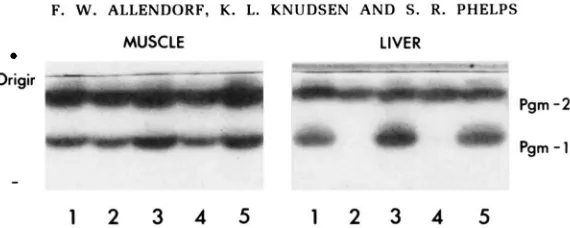
Although most rainbow trout have no detectable PGMl activity in liver tissue, others have a large amount of activity (Figure 2). This difference is consistent in fish from the earliest age that we can remove livers (approximately 60 days when the fish are 20-25 mm long) until sexual maturity at 2-4 years of age. There are no apparent differences between these types in the expression of Pgml in other tissues (skeletal muscle, eye, heart, brain, stomach and pyloric cecum). The phenotype showing expression of Pgml in the liver was present in 39 out of 432 fish (0.090) examined from the Arlee strain of rainbow trout.
The serial dilution technique of KLEBE (1975) was used with ten individuals of
each phenotype to determine how much more PGMl activity is present in the variant phenotype. No PGMl activity was detected in the livers of individuals having the common phenotype. PGMl enzyme activity disappeared in the variant phenotypes on the seventh or eighth one-half dilution. Thus, there is at least 100 times more PGMl enzyme activity in the liver of individuals having the uncommon phenotype.
262
Origir
F. W. ALLENDORF, K. L. KNUDSEN AND S . R. PHELPS
MUSCLE LIVER
-
L
Pgm - 2Pgm - 1
1 2 3 4 5 1 2 3 4 5
FIGURE 2.-PCM in skeletal muscle and liver showing differential tissue expression of Pgml in five parents from Table 1. Two phenotypes can be seen: Pgml-t(a/a) 2 and 4: Pgml-t(a/b) 1. 3 and
5.
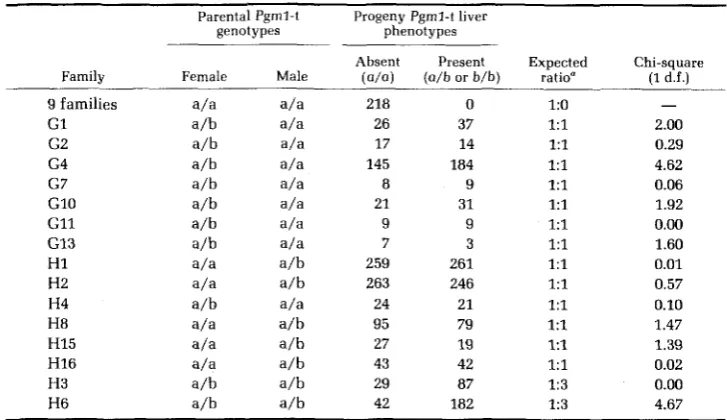
is inherited as a simple Mendelian dominant trait (Table 1). Two of the families
(G4 and H6) show an excess of progeny having PGMl activity in the liver. However, the magnitude of the excess in either family is not statistically significant when correction is made for the 15 independent chi-square tests that we have performed (COOPER 1968). We have designated the allele associated with PGMl activity in the liver as Pgml-t(b), and the common allele as Pgml- t(a).
The parents having PGMl enzyme activity in the liver are apparently all Pgml-t(a/b) heterozygotes on the basis of the observed 1:l segregation ratios. The estimated frequency of the t(b) allele, assuming binomial genotypic pro- portions, is 1 minus the square root of the frequency of the recessive t(a/a) genotype. The frequency of the t(b) allele in this hatchery stock is estimated to be 0.046. The expected frequency of the t(a/b) and t(b/b) genotypes are 0.088
and 0.002, respectively. Thus, we expect only 1 out of every 41 fish having
PGMl activity in the liver to be homozygous t(b/b) in this strain.
The families (H3 and H6) produced by mating two heterozygotes ‘make it
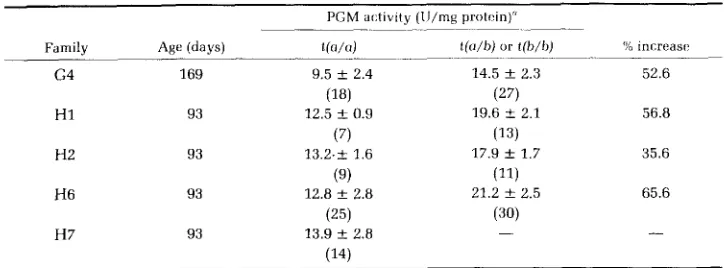
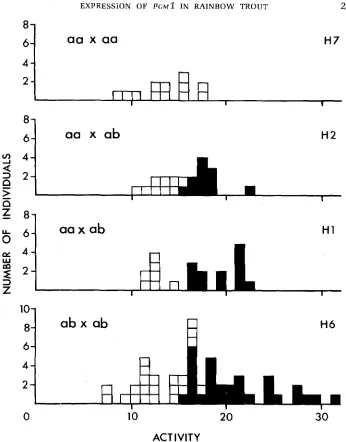
possible to test whether the amounts of PGMl enzyme in the liver show additive or dominant inheritance. We tested these alternatives by measuring the total amounts of specific activity for PGM in the liver of progeny from five different families (Table 2 and Figure 3). These measurements also included the activity of PGM produced by the other three PGM loci. Three families ( H l , H2, and G4)
were segregating 1:l [t(a/a):t(a/b)] for the presence of PGMl in the liver. Progeny having PGMl activity in the liver [t(a/b)] had an average of 48%
increase in total liver PGM activity. The dominant model predicts that fish having PGMl activity in the liver [t(a/b) and t(b/b)] from a family segregating
3:l should show the same increase. The additive model, however, predicts that the average increase in activity should be 33% greater than this because of the presence of the additional genotypic class [t(b/b)] consisting of one-third of the fish having twice the average increase in activity.
These results fit the additive prediction. Fish having liver PGMl activity in family H6 show a n average increase in activity of 66%; this enhanced increase results from a group of fish [putative t(b/b) homozygotes] showing a much higher increase in activity than seen in the families segregating 1:l (Figure 3).
The ten highest specific activities among the 54 t(b) fish in families H1, H2 and
EXPRESSION OF P C M ~ IN RAINBOW TROUT
TABLE 1
Inheritance of differences in Pgml expression in the liver of rainbow trout
263
Parental Pgml-t Progeny Pgml-t liver genotypes phenotypes
Absent Present Expected Chi-square Family Female Male (a/a) (a/b or b/b) ratio" (1 d.f.l 9 families
G1 G2 G4 G7 G10 G11 G13 H1 H2 H4 H8 H15 H16 H3 H6 218 26 17 145 8 21 9 7 259 263 24 95 27 43 29 42 0 37 14 184 9 31 9 3 261 246 21 79 19 42 a7 182 l:o
1 : l 1 : l 1:l 1 : l 1:l 1:l 1 : l 1:l 1 : l 1:l 1 : l
1:l
1: 1 1:3 1:3 2.00 0.29 4.62 0.06 1.92 0.00 1.60 0.01 0.57 0.10 1.47 1.39 0.02 0.00 4.67 " Assuming the t(b) allele is dominant resulting in the presence of P G M l activity in the liver.
The observed intermediate expression in heterozygotes is consistent with cis- regulation resulting in two independently regulated chromosomes. trans-Acting regulatory elements in prokaryotes are either recessive or dominant (PAIGEN 1979). However, trans-acting eukaryotic genes resulting in intermediate enzyme levels in heterozygotes have been identified (PAIGEN 1979). We have not yet been able to perform an unambiguous cis-trans test.
cis-Regulation would suggest close linkage between the regulatory and struc- tural regions. We cannot test this until we can examine the progeny of a heterozygote at both the structural and regulatory genes, Pgml(l~/l30)-t(a/b). Because both the structural and regulatory variation are rare, we have not yet found a population containing both variants. We are thus making efforts to produce double heterozygotes by crossing two different strains to test for cis- trans regulation. When the hybrid fish are sexually mature, several years later, we will be able to test for linkage.
Population distribution of Pgml-t(b)
The Pgml-t(b) allele is apparently a recent mutation. All other species closely related to rainbow trout that we have examined do not show expression of Pgml in liver tissue: coastal cutthroat trout, Salmo clarki clarki; westslope cutthroat trout, S. c. lewisi; coho salmon, Oncorhynchus kisutch; chinook salmon, 0. tshawytscha; and chum salmon, 0. keta. The absence of liver Pgml expression is thus most likely the primitive condition.
264 F. W. ALLENDORF. K. L. K N U D S E N A N D S . R. PHELPS
TABLE 2
PGM specific activity in livers of progeny without, t(a/a), and with, t(a/h or b/b), Pgml expression in the liver
PGM activity (IJ/mg protcin)"
Family Age (days) W d t(ci/h) or t(b/b) '% increasr
______ ~ ~ . ~ . . . _ _ _ _
G4 169 9.5 3z 2.4 14.5 f 2.3 52.6
H1 93 12.5 f 0.9 19.6 k 2.1 56.8
H2 93 13.2.k 1.6 17.9 3z 1.7 35.6
H6 93 12.8 f 2.8 21.2 f 2.5 65.6 H7 93 13.9 f 2.8
(18) (27)
( 7 ) (13)
(9) (11)
(30)
- -
(25)
(14)
Values represent the mean and standard deviatjon and the number of individuals tested.
(KINCAID 1981). It appears, however, that all strains of rainbow trout found to have the Pgml-t(b) allele have possibly shared a common source. The Post Creek strain was apparently derived from the A r k strain some 30 years ago and is similar to the Arlee strain at seven other polymorphic loci (unpublished data). Both the Winthrop and Pennsylvania strains that contain the Pgml-t(b) allele were at least partially derived from eggs from the Ennis National Fish Hatchery, Ennis, Montana approximately 10 years ago (KINCAID 1981; J. E.
WRIGHT, personal communication). The Ennis hatchery received eggs from the Arlee strain before that time. The Pgml-t(b) allele is apparently a recent mutation, possibly occurring in the Arlee strain, or a recent ancestral stock.
DISCUSSION
An important question is whether this difference in tissue-specific expression results from genetic variation at a distinct regulatory locus. It is conceivable that a mutation in the Pgml structural gene could produce the phenotypic differences detected. For example, the phenotype with Pgml expression in the liver could possibly result from a n enzyme having increased stability in the liver. We have not been able to detect any structural allelic differences in PGMl enzymes using heat inactivation or a variety of electrophoretic conditions. In addition, we mixed homogenized muscle and liver extracts together to see if the PGMl enzyme in t(a/a) fish was degraded at a faster rate. There were no detectable differences in stability of the PGMl enzymes under these in vitro conditions. These results, when considered along with the large difference in liver PGMl activity between segregating phenotypes, support the conclusion that the observed difference in tissue-specific expression of Pgml reflects a n increase in the number of PGMl molecules produced. Further support comes from studies that show differences in tissue expression of enzyme loci are caused by differential rates of protein synthesis (LEBHERZ 1975; NADAL-GINARD 1978; PAIGEN et al. 1979; DICKINSON 1980; BROWN 1981; RABINOW and DICKINSON 1981; KENNEY and LEE 1982).
EXPRESSION O F P C M Z IN RAINBOW TROUT 265
H 7
I I
aa
x ab
H 26 -
a a x a b
H15
2
2 -e 4 - 7
L u
-
3
Z I I
ab x ab
El
H 60
1020
30
ACT IVlTY
FIGURE 3.-Distrik)ution of PGM activities (U/mg protein) in liver extracts from four fami!ies. Open squares indicade phenotypes lacking liver Pgml; solid squares indicate phenotypes having liver Pgml activity.
candidate for having such variation. Fishes of the family Salmonidae (trout, salmon, char, whitefish, and grayling) underwent a tetraploid event a n estimated 100 million years ago (OHNO 1974; LIM and BAILEY 1977). Multilocus isozyme loci in the salmonids and the catostomids, another member of the ancient tetraploid family of' fish (FERRIS and WHITT 1979), show considerable regulator) divergence betweeri the duplicated loci produced by polyploidy.
Some duplicated isozyme loci in salmonids show no structural or regulator) divergence, and apy)arently have still not established complete disomic inherit- ance (WRIGHT et al. 1980; MAY, WRIGHT and JOHNSON 1982), a prerequisite fo!
266 F. W. ALLENDORF, K . L. KNUDSEN AND S. R. PHELPS
TABLE 3
Distribution of Pgml-t(b) ollele in populations of rainbow trout
~ ~ ~~~
Liver Pgml phenotype
f’gmI-t(b) d l l e l ~ c
f r e q u ~ n i ya _ _ _ _ _ _ _ _ _ _ Strain Absent Prewnt
Arlee 393 39 0.090
Post Creek 25 15 0 209
Soap Lake 35 5 0 065
Winthrop 37 3 0 038
~~~
We have not detected any PGMl activity in the livers of trout from approximately 30 other
a Estimated by taking the square-root of the recessive phenotype.
strains that we have examined.
establishing disomic inheritance in salmonids provide many pairs of loci at different stages of divergence. We therefore expect that some pairs of duplicated loci are polymorphic for the type of tissue-specific regulatory differences that are eventually established between duplicated genes. The relatively large amount of structural variation at isozyme loci (ALLENDORF and UTTER 1979) and widespread culture in hatcheries make the rainbow trout the preferred salmonid species to search for regulatory polymorphisms.
The Pgml system is promising for study of the molecular basis and evolu- tionary significance of a regulatory difference. The tremendous elevation of PGMl activity is a clear qualitative difference that is easier to study than the more subtle differences in enzyme levels characteristic of the temporal gene differences described previously. In addition, previous studies of temporal genes have made use of differences between inbred lines or species. The Pgml variation is intraspecific and exists as a polymorphism within a population of rainbow trout. Thus, study of Pgml is not hindered by a n y reproductive barriers between species. Possible effects on fitness can also be explored without the large amounts of linkage disequilibrium generated by crossing strains or species. Intraspecific regulatory variants are needed to test the relative evolutionary significance of genetic variation at structural and regulatory genes. It seems likely that large differences in enzyme amounts produced by regulatory genes may have a greater effect on the fitness of a n organism than small differences in the physical and chemical properties of those enzymes. Preliminary data reveal that fish having PGMl activity in the liver grow at a faster rate during one period of their development. The further analysis of this regulatory poly- morphism should elucidate mechanisms important to both developmental and evolutionary genetics.
This work was supported by National Science Foundation Grants DEB4004681 and ISP-8011499. We thank GREGORY WHITT and HENRY PARKER for their help with the PGM activity measures (supported by National Science Foundation Grant PCM-7608383); EMILE ZTJCKERKANIIL and GARY THORCAARD for their helpful comments on this manuscript; and J I M CREPEAU, JACK BOYCE, EMMETT COLLEY and GEORGE HOLTON of the Montana Departmcnt of Fish, Wildlife, a n d Parks for thcir excellent and gcnercius help in thc inheritance study. W O are especially grateful to G. WHITT for his continued interest and helpful suggestions o n this work and the manuscript.
LITERATURE CITED
EXPRESSION OF P G M ~ IN RAINBOW TROUT 267 ALLENDORF, F. W., N. J . MITCHELL, N. RYMAN and G. STAHL, 1977 Isozyme loci in brown trout
(Salmo trutta): detection and interpretation from population data. Hereditas 86: 179.
ALLENDORF, F. W. and F. M. UTTER, 1973 Gene duplication within the family Salmonidae: disomic inheritance of two loci reported to be tetrasomic in rainbow trout. Genetics 74: 647-654. ALLENDORF, F. W., F. M. UTTER and B. P. MAY, 1975 Gene duplication in the family Salmonidae:
11. Detection and determination of the genetic control of populations. pp. 415-432. In: Isozymes: IV. Genetics and Evolution, Edited by C. L. MARKERT. Academic Press, New York.
ALLENDORF, F. W. and F. M. UTTER, 1979 Population genetics of fish. pp. 407-454. In: Fish Physiology, Vol. VIII, Edited by W. S . HOAR, D. J. RANDAL and J. R. BRETT. Academic Press, New York.
Role of regulatory genes in adaptive evolution. Proceedings of the XIVth International Congress on Genetics, Vol. 11, Book One, pp. 118-136.
Multiple forms of supernatant malate dehydrogenase in salmonid fishes: biochemical, immunological and genetic studies. J, Biol. Chem. 245: 5927-5940.
AYALA, F. J. and J. F. MCDONALD, 1981
BAILEY, G. S., A. C. WILSON, J. E. HALVER and C. L. JOHNSON, 1970
BROWN, D. D., 1981
COOPER, D. W., 1968
Gene expression in eukaryotes. Science 211: 667-674.
The significance level in multiple tests made simultaneously. Heredity 23:
DAVIDSON, E. H. and R. J. BRITTEN, 1979 Regulation of gene expression: possible role of repetitive
DAWSON, D. M. and R. MITCHELL, 1969 The isoenzymes of phosphoglucomutase. Biochemistry 8:
DICKINSON, W. J., 1980 Tissue specificity of enzyme expression regulated by diffusable factors:
FERRIS, S . D. and G. S. WHITT, 1979 Evolution of the differential regulation of duplicate series
Turnover of gene products in the control of gene expression.
KLEBE, R. 1.. 1975 A simple method for the quantification of isozyme patterns. Biochem. Genet.
KINCAID, H. L., 1981
LEBHERZ, H. G., 1975 Evidence for lack of subunit exchange between aldolase tetramers in vivo.
LIM, S . T. and G. S. BAILEY, 1977 Gene duplication in salmonid fishes: evidence for duplicated but
Protein measurement with 614-617.
sequences. Science 204: 1052-1059.
609-614.
evidence in Drosophila hybrids. Science 207 995-997.
after polyploidization. J. Mol. Evol. 12: 267-317.
KENNEY, F. T. and K-L. LEE, 1982 Bioscience 32: 181-184.
12: 805-812.
Trout strain registry. U S . Fish, and Wildlife Report FWS/NFC-L/81-1.
J. Biol. Chem. 250 7388-7391.
catalytically equivalent A4 lactate dehydrogenases. Biochem. Genet. 15: 707-721.
the Folin reagent. J. Biol. Chem. 193: 265-275.
LOWRY, 0. H., N. J. ROSEBROUGH, A. L. FARR and R. J. RANDALL, 1951
MARKERT, C. L., J. B. SHAKLEE and G. S. WHITT, 1975
MAY, B., J. E. WRIGHT and K. R. JOHNSON, 1982
Evolution of a gene. Science 189 102-114.
Joint segregation of biochemical loci in Salmonidae 111. Linkage associations in Salmonidae including data from rainbow trout (Salmo gairdneri). Biochem. Genet. 20: 29-40.
MCCARRON, M., J. O'DONNEL, A. CHOVNICK, B. S . BHULLAR, J. HEWITT and E. P. M. CANDIDO, 1979 Organization of the rosy locus in Drosophila melonogaster: Further evidence in support of a cis-acting control element adjacent to the xanthine dehydrogenase structural element. Genetics
Regulation of lactate dehydrogenase levels in the mouse. J. Biol. Chem. 91: 275-293.
NADAL-GINARD, B., 1978 253: 170-177.
OHNO, S., 1974
PAIGEN, K., 1979
Protochordata, Cyclostomats, and Pisces. Gebruder-Borntraeger, Stuttgart.
268 F. W . ALLENDORF, K. L. KNUDSEN AND S. R. P H E L P S
PAIGEN, K., C. LABARCA and G. WATSON, 1979 A regulatory locus for mouse P-glucuronidase induction, Gur, controls messenger RNA activity. Science 203: 554-556.
control of tissue specific expression in D. pseudoobscura. Genetics 92: 603-612.
Drosophila is expressed at the RNA level. Mol. Gen. Genet. 183: 264-269.
rainbow trout, Sulmo gairdneri. Experientia 25: 1109-1110. POWELL, J. R. and 1. M. LICHTENFELS, 1979
RABINOW, L. and W. 1. DICKINSON, 1981
ROBERTS, F. L., J. F. WOHNUS and S. OH N O , 1969
Population genetics of Drosophila amylase. 1. Genetic
A cis-acting regulator of enzyme tissue specificity in
Phosphoglucomutase polymorphism in the
UTTER, F. M. and H. 0 . HODGINS, 1972 Biochemical genetic variation at six loci in four stocks of
Biochemical genetics studies of fishes: potentialities and limitations. pp. 213-238. In: Biochemical and Biophysical Perspectives in Marine Biology, Edited by D. C. MALINS and J. R. SARGENT. Academic Press, New York.
The annual invitation lecture. Genetic diversity, genetic uniformity, and rainbow trout. Trans. Am. Fish. Soc. 101: 494-502.
UTTER, F. M., H. 0. HoDclNs and F. W. ALLENDORF, 1974
WALLACE, B., 1963
heterosis. Can. J. Genet. Cytol. 5: 239-253.
WILSON, A. C., 1976 Gene regulation in evolution. pp. 225-236. In: Molecular Evolution, Edited by F. J. AYALA. Sinauer Associates, Massachusetts.
specific expression of Adh-1 in maize. Genetics 9 8 357-378.
WOODMAN, J. C. and M. FREELING, 1981 Identification of a genetic element that controls the organ-
WRIGHT, 1. E., B. MAY, M. STONEKING and G. M. LEE, 1980 Pseudolinkage of the duplicate loci for supernatant aspartate aminotransferase in brook trout Salvelinus fontinalis. J. Hered. 71: 223- 228.