Copyright 0 1983 by the Genetics Society of America
THE INTERACTION OF
cos
WITH CHI IS SEPARABLE FROM
DNA PACKAGING IN recA- recBC-MEDIATED RECOMBINATION
OF BACTERIOPHAGE LAMBDA
ICHIZO KOBAYASHI, MARY M. STAHL, DAVID LEACH’ A N D FRANKLIN W. STAHL Institute of Moleculor Biology, University of Oregon, Eugene, Oregon 97403
Manuscript rcceivcd March 18, 1983 Accepted April 22, 1983
ABSTRACT
Chi (5’-GCTGGTGG) is a recombinator in RecA- RecBC-mediated recombi- nation in Escherichia coli. In bacteriophage X vegetative recombination, Chi is fully active only when it is correctly oriented with respect to cos, the site that defines the ends of the packaged chromosome. Here we demonstrate that packaging from cos is not necessary for this cos-Chi interaction. Our evidence suggests that correctly oriented cos is a n activator of Chi. cos, as a n activator, is (1) dominant over cos-, (2) active opposite a n extensive heterology, (3) able to interact with Chi only when on the same (cis) chromosome, and (4) able to interact with Chi at distances as far as P 20 kb. Thus, cos and Chi form a two- component recombinator system for general recombination. cos may serve a s an asymmetric entry site for a recombination enzyme that recognizes Chi in an asymmetric way.
ENERAL genetic recombination can take place at any point between two
G
homologous DNA sequences, but the distribution of crossovers is not
uniform along the DNA molecule. Special sites (“recombinators”) that influence
recombination in their neighborhood were inferred by genetic analyses in fungi
(LISSOUBA
and RIZET
1960; LISSOUBA
et al. 1962; MURRAY
1963; for review see
STAHL
1979a,b) and later substantiated by the discovery and characterization of
Chi
(x)
in Escherichia coli (STAHL,
CRASEMANN
and STAHL
1975; for review see
STAHL
1979b). Chi, the DNA sequence S’GCTGGTGG
(SMITH
et
al. 1981b) is a
recombinator in recA- recBC-mediated recombination (STAHL
and STAHL
1977;
GILLEN
and CLARK
1974). It influences recombination in P1 transduction and in
conjugation (DOWER
and STAHL
1981) a s well a s in bacteriophage
X
lytic
infections, where it has been studied in detail.
Figure l a helps us to review the lytic cycle of
A. A phage particle contains a
double-stranded DNA molecule with complementary single-stranded “cohesive
ends.” After entry into the cell, the ends are covalently closed forming a cos
(cohesive end site) sequence. The resulting circle with a single cos is not a good
substrate for packaging into a phage particle. Unit X
DNA bounded o n each end
by a separate cos sequence is packaged efficiently. The packaging machinery
’
Present address: Department of Molecular Biology, University of Edinburgh. Scotland, United Kingdom.550
I. KOBAYASHI ET A L .0 b
8
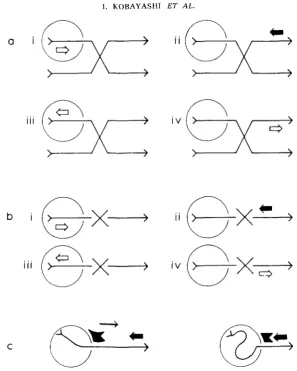
F l C U R E l,-a, X DNA cycle in lytic infection; b, Rcc-mediated recombination of X DNA. Rccom- bination takes place between two circular DNA molecules and produces a form from which chromosomes can be packaged, for examplc, a circular dimer. A figure-eight-shaped dimcr, in which two circles are joined at a homologous site via a Holliday junction, is one intermediate form. The possibility that packaging could be coupled with resolution of the figure-eight, or w e n its formation, in Chi-stimulated recombination is indicated by tht: bypass arrows.
recognizes and cuts the
cos’
to regenerate the cohesive ends. This interaction is
asymmetric (HOHN 1975; FEISS et al. 1979; FEISS and WIDNER
1982; FEISS,
KOBAYASHI
and WIDNER
1983), and
D N A
packaging proceeds in a polar way
starting from the left end (EMMONS
1974; FEISS and
BUBLITZ 1975; STERNBERG
and WEISBERG
1975). Under standard conditions (Red- Gam-) for Chi action,
the only effective route to a n efficiently packaged form is recA recBC-dependent
recombination.
As
illustrated in Figure I b , recA-dependent recombination of
X
can proceed via a figure-eight (“8”)-shaped intermediate form
(IKEDA and
KOBAYASHI
1979), in which two circles are joined at homologous sites by a
Holliday junction (HOLLIDAY
1964). The resolution of the Holliday junction can
convert a figure-eight into a circular dimer, which is a good substrate for
packaging (IKEDA
and KOBAYASHI
1979;
ROSS and FREIFELDER
1976). Chi somehow
enhances the overall recombination reaction, producing more packageable
DNA
forms and hence promoting phage particle formation (STAHL,
CRASEMANN
and
STAHL
1975; MALONE
and CHATTORAJ
1975).
Figure 2a schematizes the properties of Chi action in A. Chi on only one of the
D N A
molecules is sufficient to stimulate recombination (dominance)
(LAM
et al.
1974).Chi enhances exchanges even when the recombining partner carries a
large heterologous sequence opposite Chi (action opposite heterology) (STAHL
and STAHL
1975). Chi can stimulate exchange as far as 10 kb away (action a t a
distance) (LAM et al.
1974).The stimulated crossovers are located primarily to
one side of a given Chi (bias) (STAHL
and STAHL
1975).
COS AND
X
INh
RECOMBINATION551
-
/7
b
*
FIGURE 8.-Properties of Chi stimulation of recombination in X lytic growth. a , Recombination is stimulated even if only one of the participating chromosome carrics Chi (short thick arrow) (dominance). I t is active even opposite heterology (hatched box). It can stimulate recombination at a distance. The crossovers arc located primarily to the left of Chi when Chi is drawn as 5’-
GCTGGTGG (leftward arrow) (leftward bias and directionality); b, Orientation-dependence. Lcft- ward Chi is severalfold more active than rightward Chi throughout the h chromosome; c, Chi-cos interaction. The orientation of cos defines the active orientation of Chi.
most relevant to this study. All of the Chi detected on
h
have a leftward bias
(STAHL
and STAHL
1975; STAHL
et al. 1980b; CHATTORAJ
et al. 1979). By inverting
DNA segments carrying Chi, only one orientation of Chi (arbitrarily called
leftward orientation) was shown to give full activity irrespective of its location
along the chromosome, as illustrated in Figure 2b (FAULDS
et al. 1979; YAGIL et
al. 1980). Consistent with this finding, all of the Chi elements detected on
h
had
one orientation, that is, 5’-GCTGGTGG on the I-strand, irrespective of their
location along the chromosome (SPRAGIJE,
FAULDS
and SMITH
1978;
SMITH,
SCHULTZ
and CRASEMANN
1980; SMITH
et al. 1981b,c). These results suggest that
the Chi sequence has intrinsic bias (directionality) in its stimulation of recom-
bination (leftward when drawn as 5’-GCTGGTGG). They also suggest that Chi
has to be correctly oriented with respect to a global polarity of
h
(FAULDS
et al.
1979; STAHL
et al. 1980a).
552 I . KOBAYASHI ET A L .
iii
i v
n
n
FIGURE 3.-Packaging models for Chi-cos interaction. a , The resolution-packaging model (modi- fied from FALJLDS et al. 1979, and from STAHL 1979b). As soon as a figure-eight intermediate (drawn here in a linear version) is formed, it is packaged from the cos rightward up to the junction. Chi enhances resolution of the junction. Rightward Chi to the left of the junction is masked by the head and cannot perform its action (i). Leftward Chi to the right of the junction can stimulatc rcsolution (ii). In (iv) Chi is looking away from the junction and thus cannot help resolve it. In (iii) Chi is masked and looking in the wrong direction. Something is presumed to prevent Chi action until the packaging machinery is available. b, A packaging modcl at a mort: abstract Icvel. As soon as a recombinogenic alteration (indicated by a cross) is produced, h DNA is packaged from cos up to that alteration. Or, alternatively, the packaging machinery may produce that recombinogaoic alteration. In cithcr case only leftward (antiparallel to cos) Chi can act on that altered structure as in (a). c, One specific example of a positivc packaging modcl. A recombination enzyme travcls along with the packaging machinery in one orientation and in one direction (rightward) from the lcft cos. Tho enzyme interacts only with Chi antiparallel to cos.
COS A N D
x
INh
RECOMBINATION553
unspecified mechanism is assumed to set the timing of Chi action at the stage
of packaging.
A
central prediction of this model is that the orientation of
cos defines the
active orientation of Chi. By constructing
X
variants carrying cos in the two
possible orientations, we have verified this prediction
(KOBAYASHI
et al.
1982).
To be fully active, Chi and
cos
have to be correctly oriented relative to each
other as diagrammed in Figure 2c.
A second prediction
of
the resolution-
packaging model is that packaging from cos is essential for the interaction of
cos and Chi. In this work we test this prediction and find it not to be the case.
Packaging from cos is not necessary for its interaction with Chi. In contrast to
the predictions of the resolution-packaging model, our results indicate that cos
activates Chi. Its properties lead us to think of
C O Sa s one part of a two-
component recombinator system for generalized recombination.
MATERIALS A N D METHODS
Bacterial strains: Escherichia coli strains used are listed in Table 1. Other strains were described previously (YAGIL et al. 1980).
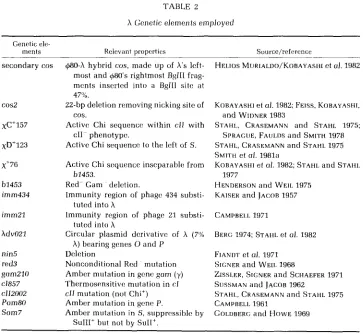
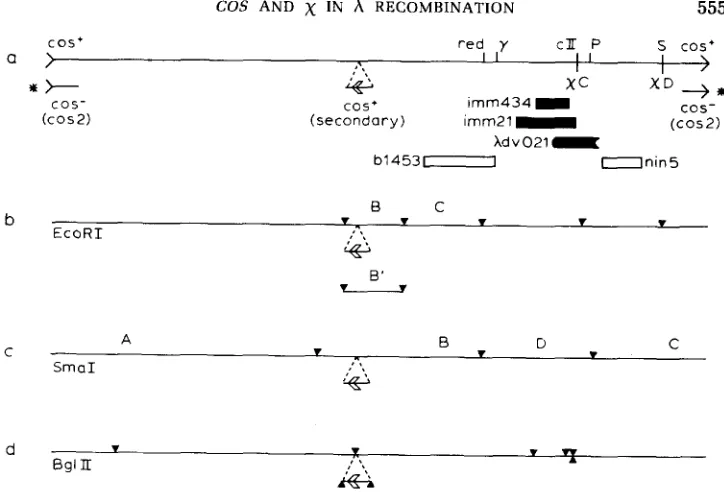
Phage genetic elements and nomenclature: The h mutants used are listed in Table 2 and shown in Fig. 4. hdv021 extends from about 77% h to 83% h (7% h in length). The intracellular form of hdvO21 in JC9937 [XdvOZl] was analyzed (STAHL et al; 1982).
Nomenclature of cos is slightly modified from previous usage (KOBAYASHI et al. 1982) (see also Table 2 and Figure 4). The ends of A’s genetic map define the site for the primary cos. The middle of A’s genetic map sometimes has a secondary, cloned cos. The cloned cos is a 4804 hybrid cos ($BO right end, -A left end) but has cosh specificity (that is, it is recognized by the h packaging machinery). The primary cos is oriented rightward by definition. cosh at the primary cos site can be intact (cos+) or inactivated by the cos2 mutation (cos-). The secondary cos can be oriented either leftward or rightward. We list the primary cos genotype first and then the secondary cos genotype. Nomenclature of
x
is as follows (KOBAYASHI et al. 1982):A
givenDNA
segment either has(x’)
or does not have(2)
a Chi sequence (SMITH et al. 1981b). On the h mapx+
can be oriented either leftward or rightward. X + is defined to be oriented leftward in h when J’GCTGGTGG is on the 1- strand. The phenotype can be Chi+ or Chi-. Whenx+
and cos have the samc orientation, they are said to he parallel. Otherwise they are antiparallcl.Phage strain construction involving cos: The interaction of
x
and cos (KOBAYASHI et al. 1982) wa s exploited during strain construction to test thc orientation and/or genotype of cos. T he method involves backcrosses to tester phage and has been outlined previously (STAHL, KOBAYASHI and STAHL 1982). The corroborating test was gel electrophoresis of restriction fragments from rapidDNA
preparation or purifiedDNA
as described later.The cos genotype of each phage preparation (set: Figure 9) used in h x hdv crosses was verified by cleavage with the restriction enzymt: SmaI as shown in Figurcs 5 and 6. The lcftmost fragment
(A)
and the rightmost fragmcnt (C) on tht: map arc fuscd bccausc the primary cos locus is not cleaved by in vivo packaging. The central fragment (B) is clcavcd into two by in vivo packaging at the cloned secondary cos. Thc sizes of the fragmcnts verify the orientation of the secondary cos.Further testing for cos2 in phage stocks uscd in h X hdv crosses was carried out as described later in this article. The cos2 mutation is mcasurably unstable as a rosult of homogonotization (“conversion” of cos2 to cos+ by interaction with the cloned cos). Consequently, individual cos2 stocks must be verified for that mutation. Our S m a I analysis (Figures 5 and 6) showed that most phagc particles in our prcparation havc cos2 mutation. Proccduros for gcnctic verification of cos2 depend on the interaction of cos and Chi and, thorcfore, diffor according to whcthcr thc cloned COS is leftward or rightward.
554
I . KOBAYASHI ET AL. TABLE 1 Bucteriol strainsStrain Propcrtics Soiir(:r:/ruferi:ni:e
.~
QR48 Sull+ recA SIGNER a n d WEII. 1968
KR3a SulII' recA I R A HERSKOWITZ
SuII' rec+ APPLEYARD 1954
C600
594 S u - rec+ WEIGLE 1966
IC8679 SuIl+ recB21 shcA20 STAtu. a n d STAHL 1977
JC9937 S u - ~ rec+ STAHL et ul. 1982
JM1 SuIII+ recB2l sbcA2O STAHL et 01. 1980b
IC9387 Su- recB21 recC22 sbcB15 STAHL a n d STAHI. 1977 TABLE 2
h Genetic elements employed
Genrtic el?- ments secondary cos
cos2
xC+157 xD+lZ3 ~ ' 7 6 b1453 imm434 imm21 Xdv021 nin5 red3 gum210 c1857 c1I2002 Pum8O S u m 7
Relcvmt propcrtics
480-A hybrid cos, m a d e u p of A's Icft- most a n d 480's rightmost BglII frag- m e n t s inserted into a BglII site at 47%.
22-bp deletion removing nicking site of
Active Chi sequence within cll with
Active Chi sequence to the left of S .
Active Chi sequence inseparable from
Red- Gam deletion.
Immunity region of phage 434 suhsti- tutt:d into h
Immunity region of phagt: 21 substi- tuted into X
Circular plasmid derivative of X (7% A) bearing genes 0 a n d P
Deletion
Nonconditional Red mutation Amber mutation in gene gam (U)
Thermoscnsitive mutation in cl cll mutation (not Chi')
Amber mutation in gent:
P.
Amber mutation in S, supprc:ssihle by SuIII' but not b y SuII+.
cos.
cII~. phenotype.
b1453.
Source/refrwnce
HELIOS MIIRIALDO/KOBAYASHI et al. 1982
KOBAYASHI et 01. 1982; FEISS, KOBAYASHI, STAHL, CRASEMANN a n d STAHI. 1975; STAHL, C R A S E M A N N a n d STAHL 1975 SMITH et al. 1981a
KOBAYASHI et al. 1982; STAtu. a n d STAtf1.
HENDERSON a n d W E I L 1975 KAISER a n d J A C O B 1957
a n d WIIINER 1983
S P R A G I I E , FAIJLDS a n d SMITH 1978
1977
CAMPBEIJ. 1971
BERG 1974; STAHL et 01. 1982 FIANDT et ol, 1971
S I G N E R a n d WEIL 1968
ZISXER, SIGNER a n d SCHAEFER 1971 SUSSMAN a n d J A C O B 1962
STAHI., C R A S E M A N N a n d STAHL 1975 CAMPBELL 1961
GOLDBERG a n d HOWE 1969
to see a n y large plaqlJt!S, in more t h a n 10' plaques cxamincd, adequately confirms tht: purity of tho stock.
555
COS A N D
X
IN RECOMBINATIONs
c o s *c o s ' r e d y c T P
,,'.
a
>
II
>
xc
X D + . cos- ( s e c o n d a r y ) imm21- (COS2)imm434
=
+
c o s +
XdvO21-
b1453- O n i n 5
0 C
I v I I I
I\ b
E c o R I I \
,&
0 '
A I B D C
C I w
IS I S
,rg;
S m a I
T v I W
, I d
0 g l It
A
FIGURE 4.-a, A genetic map. red represents two genes, exo and bet; h, X restriction cleavage map. Deletion of EcoRI-C fragment makes X Red-. The EcoRI-B fragment was inverted to invert the secondary cos.
C - A
I
6 3I
6 4I
C - A \b
* >
U>*
FIGURE 5.--SmaI cleavage map of X cos mutant phage in Figure 9. * indicates cos- mutat'ion (cos2). The thick vertical lines show the cleavage at cos by in vivo packaging. The thin vertical lines show the cleavage by SmaI. The leftmost fragment (A) and the rightmost fragment (C) are fused because the primary, natural, cos is inactive and not cleaved in packaging. Instead, packaging from the cloned secondary cos cleaves B fragment into two pieces. The sizes of the resulting two pieces verify the orientation of thc secondary cos. The cloned cos, b1453 deletion and imm21 substitution have made fragment sizes different from these in wild-type X and have eliminated D fragment. a: Figure Sa; b: Figure 9h.
plaques will not only carry the leftward, clear-Chi and the leftward cloned cos but will also inherit their primary cos from the phage being tested. When these plaques are picked and streaked on a host that discriminates Chi+ and Chi- phenotype [594(P2)], they will give tiny plaques only if they are cos2. We picked and tested 20 clear plaques for both strain MMS959 and 963 and found all 40 to be cos2.
The cos2 strains used in the cis-trans experiments (MMS912, 946 and 970) all have leftward cloned cos. They were tested for cos2 with crosses similar to that described for cos2 stocks with leftward cloned cos.
1. KOBAYASHI
ET
AL.01 02 bl b2 c
556
6 2
-
63
-
B4
-
,-A
t-B
-
6,
-
FIGURE 6.-Smol cleavage of A cos mutant phage in Figure 9. DNA was purified from the phage preparations used in the X x Xdv crosses (Figure 9) and in the genetic tests (Figures 7 and 8). Smol digests were run through 1% agarose (see Figure 5 for explanation). The faint B bands in al. a2. b l and b4 resulted from cohesive end joining. Absence of C fragment indicates that few. if any, phage have cos* at the primary cos locus. al: Figure Sa (Figure sa).
x*
(MMS874); a 2 Figure Sa (Figure sa).x"
(MMS878): bl: Figure 5b (Figure 9b).x+
(MMS959); b 2 Figure 5b (Figure 9b).x"
(MMS963); c: Wild type X (also cl857 Sam7)._ _ _ _ _ _ _ _ _ _ _ _ _ - - -
_ _ _ _ _ - - -
b1453
imm21
Pam80
/
XD+'Omms 874
* >
H1
>
*
o r 8 7 8
b1453
X76+
nin5
Sam7
>
#
m m s 8 4 8
* >
FIGURE 7.-Genetic test for cos2 in stocks of MMS874 and 878. Phage were crossed (in strain JC8679) to MMS848. and the P+
S+
recombinants were selected on 594. As indicated by the dashed line, most of the recombinants inherit the cos allele at the standard locus from theS+
parent. Symbolism is as defined in Figure 4. The map is not to scale.---
_ _ _ _ _ _ _ _ _ _ _ - - -
b1453
Pam80
/
XD+'Omms
959
*
>
I , > +>
*
o r 9 6 3
________________________________________-
FIGURE O.-Genetic test for cos2 in stocks of MMS959 and 963. Phages were crossed (in strain
lC8679) to MMS912. and clear ($+) plaques were picked off QR48. which selects against S7 and
b1453. All these recombinants inherit the rightward cloned cos, because the EcoRI-B fragment (between SRI and SR2). in which the cos resides, is inverted in MMS959 and 963. This inversion abuts AC, a deletion from SR2 to SR3. which, in turn, overlaps the Red-Gam- deletion b1453. Because of the proximity of S to the standard cos locus, most of the selected recombinants will carry the allele at that locus from the phage being tested. Each such particle that is cos2 will make small plaques on the rec+ Su- indicator 594 (P2). The map is not to scale; in particular. the actual distances from the left end to the cloned cos is about half the total X chromosome length.
The other media and methods were standard (HERSHEY 1971). X Tryptone ScaKem agarose plates contain A tryptone broth and 1.2% SeaKem
LE
agarose (FMC Corporation) plus 0.3% glucose, 4 Xlo-'
M FeCI:,. 7.5 xDNA isolation: (1) Purified DNA. The phage particles were prepared by the confluent lysis method or by liquid infection. They were purified by high-speed centrifugation and by banding in
COS AND
x
INh
RECOMBINATION557
a cesium formate or CsCl gradient. The DNA was prepared by two cycles of phenol extraction (KOBAYASHI and I K E D A 1977). ( 2 ) Rapid DNA. The mcthod is a modification of one by H EI DI KNICKERBOCKER and KAREN SPRAGUE. Plate lysate was prepared on fresh h tryptone SeaKem agarose plate from 10" phage particles. The plate was left overnight at 4" after overlay of 5 ml of 10 mM Tris- HCI, 10 mM MgSO,. The liquid was carefully removed. ScaKem plate lysate or liquid lysate freed of cell debris (0.4 ml) was mixed with 40 pl of 0.5 M EDTA (pH - 8 ) , 20 p1 of 2 M Tris acetate (pH -7.5). and 20 pl of 10% SDS and was incubated for 15 min at 70" in a n Eppendorf tube; 0.1 ml of 5 M
potassium acetate was mixed, and the tube was left on ice for 30 min and then spun for 10 min. To the supernatant 0.4 ml of SSC-saturated phenol was mixed, and the tube was spun. The upper phase was removed and mixed with 40 p1 of 3 M sodium acetate. Cold ethanol (1.1 ml) was mixed, and the tube was left on crushed dry ice for 10 min and then spun for 5 min. The supernatant was discarded, and the visible pellet was dissolved in 100 pl of 10 mM Tris
-
HC1 (pH 7.5) and 2 mM EDTA and mixed with 10 pl of 3 M sodium acetatt: and then with 0.3 ml ethanol. The tube was left on dry ice for 5 min. The tube was spun, and the supernatant was discarded. The pellet was dried under vacuum and then suspended in 40 pI of 10 mM Tris.HCI (pH 7.5) and 2 mM EDTA and stored at-zoo.
Restriction enzymes and gel electrophoresis: Tho enzymes SmaI and Hind111 were purchased from New England Biolab, and EcoRI was purchased from Miles Laboratories Inc. Rapid DNA preparations were digested in the presence of 100 pg/ml of RNase (Sigma Chemical Company) that had been boiled to inactivate DNase. Restriction digests were heated at 75O for 5 min to melt annealed cohesive ends and were quickly chilled in ice water. The electrophoresis wa s carried out at 4 O . We detected little cohesive end annealing under these conditions.
Cross: (1) Phage X phage crosses. Bacteria were grown in K-maltose to 1.5 X 10'/ml. Equal volumes of the bacterial culture and phage mixture containing 1.0 X 10y/ml each of the parental phage were mixed and aerated at room temperature for 30 min. The cultures were diluted tenfold in prewarmed K-maltose and aerated at 37' for 90 min. Chloroform and freshly prepared lyoszyme (to 20 pg/ml) were added, and tubes were left at room temperature for 10 min. (2) Phage X Xdv crosses. The cells carrying hdv were grown in h tryptone broth supplemented with maltose (0.2%) and vitamin B, (10 pg/ml) to 1.5 x 10"/ml. The phage particles were added at a multiplicity of 7. The phage-bacteria complexes were left at 25" for 30 min and then filtered through a Millipore membrane (0.22 pm). The complexes freed of unadsorbed phage were diluted 100-fold into prewarmcd broth and aerated at 37'. After 90 min, CHCh was added, and the phage was assayed.
RESULTS AND DISCUSSION
Strategy
The resolution-packaging model as cited before is a specific example of
models in which packaging from cos is necessary for Chi-cos interaction. The
experiments reported here have been devised to test this class of models. Such
models can be classified into two categories-positive
and negative. Chi is fully
active with a n antiparallel cos and much less active with a parallel cos, a s
diagrammed in Figure
2c.An antiparallel cos might activate Chi (positive
version),
or,
alternatively, a parallel
cos might inhibit Chi that would be
otherwise active (negative version). The resolution-packaging model is one
example of a negative model. Figure 3b shows another, less specific, example.
Packaging masks DNA from the left end up to a recombinogenic structure,
which is the site of action of properly oriented Chi. Figure
3c
illustrates one
example of a positive version. A recombination enzyme travels together with
the packaging machinery from left to right and recognizes a correctly oriented
Chi.
558
1. K O B A Y A S H I ET A L .illustrated in Figure Ib. Packaging using these cos sequences could be coupled
with the recombination process.
If, however, one of the parental chromosomes
carries a functional cos and the other does not, the cos without a partner cannot
be used for packaging. We carried out two experiments based on this principle.
The results exclude both positive and negative versions of the packaging model.
Recombination between
h
and hdv
hdv is a plasmid formed by circularization of a small part of the
h
genome
(MATSUBARA
and
KAISER 1968) and may be thought of as a mutant carrying a
huge deletion that removes the
cos region (Figure
4).
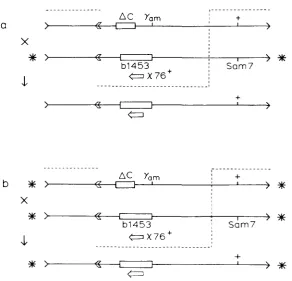
We crossed hdv with
h
carrying only one active
cos, in the middle of the genome, in the leftward
(Figure s a ) or rightward (Figure gb) orientation. The natural cos in these phage
was inactivated by a 22-bp deletion,
cos2
(Table
2).
A secondary, functional cos
was placed in the two possible orientations in the middle of
X
genetic map by
a molecular cloning technique as described in
MATERIALS AND METHODS.The
presence and orientation of this cos was verified by analyses with a restriction
enzyme as shown in Figures
5and 6.
Reciprocal recombination between
h
and Xdv does not result in a product
from which a chromosome can be packaged. The resulting recombinant DNA
is essentially a monomeric circle in its size and in its number of cos. If packaging
from cos is essential for the Chi cos interaction, there would be no Chi-cos
interaction in X
Xhdv recombination. Both positive and negative versions make
that prediction.
In the crosses diagrammed in Figure 9, we measured the frequency of the
recombinant P+ phage in the two cos orientations. The results in Table
3
show
that Chi stimulates
X
Xhdv recombination to a greater extent with a n antiparallel
cos (Figure 9b) than with a parallel
cos (Figure sa). In control crosses without
Chi
(x'),
the orientation of cos did not affect recombination frequency.
The recombinant phage detected here are of two types: one is accompanied
+to
P -
\ I
b
* >
-
> *
d v
-y
P
COS A N D
X
I NX
RECOMBINATION559
TABLE 3
cos-orientation-dependent Chi activity in h x hdv cross
Cross - hP’ in
x+
crosstotal h
“+
in x o cross total hcos-chi orientation Diagram Experiment 1 Experiment 2 Same (parallel) Figure 9a 6.5 X
lo-’
4.5 xlo-’
Opposite (antiparallel) Figure 9b 37 xlo-’
19 xlo-’
1.72 X
lo-’
= 3’8 1.62 Xlo-’
= 231.49 X
lo-’
= 3‘01.50 X
lo-’
- - 12.9 rect strain JC9937 carrying h dv021 was infected with the phages shown in Figure 9. Unadsorhed phages were removed. The resulting lysate was assayed for the total phage on a SuII+ strain (JC8679) and for the P+ recombinant phage on a Su- strain (JC9387).by addition of Xdv
DNA as well as P+ information. The other is replacement of
the Pam allele by P+ from the Xdv unaccompanied by addition of Xdv. Previous
analysis demonstrated that the ratios of the two types are the same for parallel
Chi-cos and for antiparallel Chi-cos (STAHL
et al. 1982).
These results show that packaging is not necessary for the Chi-cos interaction.
As pointed out by STAHL
et
al. (1982) they also argue that Chi stimulation of
splices and of patches (STAHL
1979a) are equally dependent on cos orientation.
Recovery of the recombinant chromosome depends on a second splice event
with another A.
Further implications of these results on the role of cos will be
discussed later.
Cross
A
cos+
x
X
cos-
The design of the second set of experiments is similar to the first one in that
only one of the parents carries functional cos, and the other is deleted for cos.
In this case, however, the deletion used is the 22-bp deletion cos2. Thus, the two
parents are essentially equivalent in size.
Figure 10a illustrates the principle. To be packaged efficiently a unit
X
DNA
has to be bounded by a pair of cos sites [Figure lOa(i)]. If
only one of the two
cos is intact, the other being inactive due to the cos2 deletion, the unit X
DNA
cannot be packaged [Figure lOa,(ii)]; but if we provide another pair of cos, the
recombinants, at least some of them, can be packaged into phage particles
[Figure loa,(iii)], The second cos pair could be of the opposite orientation. Figure
10b(i) shows the recombination between two X
COS+produces a packageable
dimer. As shown in Figure lOb(ii), recombination between
X
cos+ and X
cos-
will produce a circular dimer, but no
h
can be packaged from the wild-type cos
since it lacks a partner. If each of the parents has a second cos, however, DNA
can be packaged from these cos’ as shown in Figure 10b(iii). In Figure 1Oc the
principle is again explained, this time with the A chromosomes represented as
linear.
a
i
b i
Q
c 3
1
C I
I
i i iii
... I l l
' 1 ,
F I C ~ J R E 10.-Design of unpaired cos experiments. a , Principle. (i) Unit h DNA has to be bounded by a pair of cos sequences in order to be packaged into a phage particle. (ii) When one of the pair is inactive due to a deletion mutation (*), the unit A can not be packaged. (iii) However, if we provide another pair of cos, A DNA can be packaged. The orientation of this second cos pair can be opposite to that of the first cos pair. ti, Recombination between A-circular version. (i) A crossover between two circles produces a concatemer form in which unit h DNA is bounded by a pair of cos. The unit DNA is cut and packaged. (The crossover could be nonreciprocal, and the recombination might be coupled with packaging. But our discussion will not lose generality even if we use a circular dimer diagram). (ii) When one circle carries a mutated cos, the recombination docs not produce a packageable structure. (iii) When both circles carry a second cos, the recombinant genome can be packaged by cutting of this second pair of cos. c, Recombination between A-linear version. h chromosome is represented as a line. (i)-(iii) correspond to b (i)-(iii), respectively.
COS A N D
x
INh
RECOMBINATION561
a
I
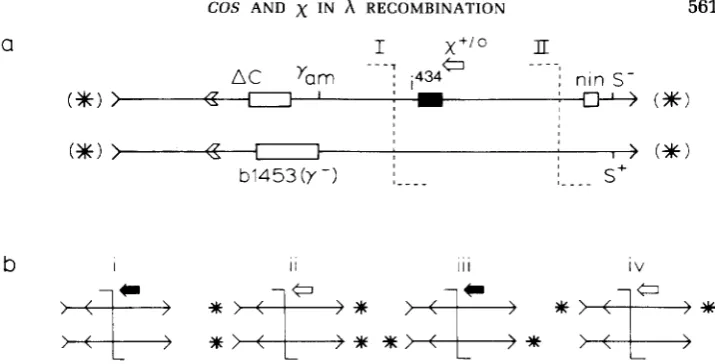
FIGURE 11.-Unpaired cos experiments. a, I is the interval to he stimulated by the leftward action of xC', and I1 is the reference interval. The ratio 1/11 is the measure of Chi activity. The primary cos is either active or inactivated by the cos2 mutation. The upper phage carries either xC+157 or X('c112002. xC+ is oriented leftward. Both phages carry secondary cos+ in leftward orientation. AC; deletion of EcoRI-C fragment. yam; yam210. 234; imm434. nin; nin5 deletion. S-; Sam7. The recombinants (gam210 immh S') in the interval I (between the right end of b1453 and the left end of imm434) were detected on QR48 (A imm434 Sam7), and the recombinants (gam210 imm434 S+) in the interval I1 (between the right end of imm434 and ~ o m 7 ) were detected on QR48 (A red3 Sam7). Order, hut not size or position, of the markers is accurate. h, Crosses with various cos combinations: (i), cos that is antiparallel to Chi is intact both in the parent carrying Chi and in the parent not carrying Chi. (ii), the antiparallel cos is inactivated by mutation in both of the parents. (iii), the antiparallel cos is intact only in the parent carrying Chi (iv), the antiparallel cos is intact only in the parent not carrying Chi.
various cos combinations tested. I
is the interval in which recombination is to
be stimulated by the leftward action of Chi. I1 is the reference interval. Chi
activity (recombination enhancement) is measured as ratio 1/11.
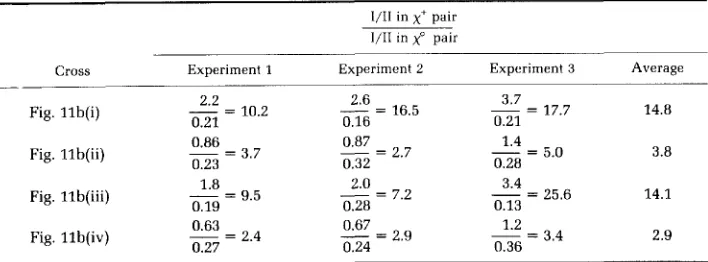
In the positive control [Figure Ilb(i)], both parents carry intact antiparallel
cos, and Chi activity is high as shown in Table
4.The positive packaging model
explains this phenomenon by saying that packaging from the antiparallel cos
activates Chi. The negative packaging model explains it by saying that, although
packaging from parallel cos normally inhibits Chi action, the alternative pack-
aging from antiparallel
cos bypasses this inhibition. In the negative control
[Figure Ilb(ii)], Chi activity is low. Positive packaing models explain this as the
effect of the absence of packaging from antiparallel
cos. Negative packaging
models explain this as a negative influence of packaging from the parallel
C O S .562
I. KOBAYASHI ET AL.TABLE 4
Chi activity in crosses with unpaired cos 1/11 in
.
Y+,.
oair L1/11 in ,yo pair
Cross Experiment 1 Experiment 2 Experiment 3 Average 3.7 -
_ - 17.7 14.8 2.6 -
16.5
- _
2.2
0.16 0.21
0.21
1.4 0.86 -
0.23 0.32 0.28
3.4 2.0
1.8
0.28 0.13
0.19
1.2 0.67
0.63
0.24 0.36
0.27
- _
- 10.2 Fig. Ilb(i)Fig. Ilb(ii) Fig. Ilb(iii) Fig. I l b ( i v )
3.8 - - - 5.0
_ -
0.87 - 2.7 3.7_ _
- - - 25.6 14.1 2.9 - 3.4
- - - 7.2 - 2.9
- _
- 9.5_ _
- -_ -
- 2.4nants still carry the cos2 mutation. In each cross we detected no large plaques
among approximately
1000
plaques. This control excludes the possibility that
the recombinant phage had been packaged from the primary, antiparallel cos.
Thus, a cos that is present in only one of the parents, and therefore cannot be
used for packaging, is sufficient to activate a n antiparallel Chi (positive models)
or sufficient to bypass a n inhibitory action of cos on a parallel Chi (negative
models).
In the cross Figure Ilb(iv) the genotype of antiparallel cos is reversed in the
two parents. Chi and antiparallel cos are in trans, that is, they are on different
chromosomes. Here Chi activity was low. Thus, full Chi activity requires that
Chi and antiparallel cos be cis, that is, on the same chromosome. Implications
will be discussed later. Reconstruction experiments showed that the data were
not influenced by recombination on the selective indicator plate.
The two sets of experiments provide evidence against the packaging model.
In order to interact with Chi, a cos does not have to be used for packaging. The
results exclude both positive and negative versions of the packaging model.
Packaging from antiparallel cos is not necessary to activate Chi; packaging from
parallel cos does not inhibit Chi.
At what stages of the
h
life cycle does the cos-Chi interaction occur?
Then what does account for the dependence of Chi activity on cos orientation?
Three types of models that draw upon features of the
h
life cycle can be
envisaged to explain this cos-Chi interaction;
(1)attempted packaging models,
(2)
preclosure models,
(3)silent cos models. Each of them can be classified into
positive versions and negative versions depending on whether a n antiparallel
cos+ activates Chi or parallel cos+ inhibits Chi.
COS A N D
x
INh
RECOMBINATION...
,...______.
+
I
a
>
U>
563
X
n
U
>
x
b1453
:
Sam7* >
I Q
X76'
n
U
>
x
b1453
:
Sam7* >
I Q
X76'
... ...
: +
I
b
? K >
U> *
X
m z
/7 U>
*
b1453 ~ Sam7
+
/;I
m >
U
I
1
I3 %
1
FIGURE 12.-A backcross to show that the recombinant phage produced by the interaction of Chi and a n antiparallel unpaired cos (interval I in cross iii of Figure l o b ) still carries cos2 mutation in the primary cos. The upper phage is the one to he tested. The lower phage is the tester. The tester phage carries a leftward Chi, x+76, that is inseparable from b1453 (red- gam-) deletion. The tester shows Chi- phenotype because it lacks an antiparallel cos. When X+ is combined with rightward cos, it shows Chi+ phenotype. Sam7 is closely linked to the primary cos. b1453 S + recombinants were selected on C600(P2), on which Chi' gives large plaques. a, If the upper phage carries cos+, this test cross will produce many h cos+ (rightward) X+ (leftward), which makes large plaques (Chi' phenotype); b, If the upper phage carries cos.2, no large plaque-forming phage will he produced.
chromosome carrying both an antiparallel and a parallel cos as shown earlier
(KOBAYASHI
et
al. 1982) and as confirmed in cross (i) of Table
4.
The positive
versions state that the interaction of packaging proteins at cos (with or without
a partner cos) activates a n antiparallel Chi.
A
deletion, cos2, abolishes this
interaction as shown earlier
(KOBAYASHI
et
al.
1982) and as confirmed here in
the two sets of experiments (Tables 3 and
4).
cos2 removes the nicking site of
cos but leaves the terminase-binding site intact (FEISS,
KOBAYASHI
and
WIDNER
1983). Therefore, terminase binding is not sufficient to activate Chi. That the
nicking site is required suggests that cutting is one of the relevant processes. If
cutting of cos is involved in the Chi-cos interaction, cos must be resealable to
explain our results in Table
4.
In
vivo,
cutting is coupled with packaging; no
cutting has been detected in the absence of packaging. But,
in
vitro, terminase
can cut cos without packaging
(WANG
and
KAISER
1973).
BECKER
and
GOLD
564
1. KOBAYASHI ET AL.cleaved in vitro as well as cos on a concatemer
(BECKER
and GOLD
1978). They
discussed the possibility that in vivo terminase introduces nicks at cos in the
absence of packaging. The nicks might be quickly sealed unless the subsequent
packaging makes the process irreversible (BECKER
and
GOLD 1978). The inter-
action of the packaging machinery with cos is asymmetric (HOHN
1975; FEISS
et
al.
1979). More specifically, the terminase-binding site is to the right of the
nicking site (FEISS
and WIDNER
1982; FEISS,
KOBAYASHI
and WIDNER
1983). This
asymmetry may underlie dependence on cos orientation. Partial encapsidation
like that originally proposed in the resolution-packaging model is not excluded
a s a basis of positive models.
Preclosure (injection) models: These models (KOBAYASHI
et al. 1982;
SMITH
et
al. 1981c) assume that the asymmetry of the two ends of
h
DNA upon entry into
the cell (for review, see
KATSURA 1983) underlies cos-Chi interaction. The
negative versions, where the cohesive ends inactivate parallel Chi, are difficult
to imagine. The positive versions seem more likely. Here the presence of
a
cos
as
cohesive ends at the time of DNA entry somehow results in activation of
antiparallel Chi. However, since Chi shows apparently full activity when it is
in
h
that is induced from either the prophage or the plasmid state (STAHL
et al.
1983), preclosure activation cannot be the sole basis of the cos-Chi interaction.
Silent cos models: The models suppose that neither the interaction of cos with
packaging proteins nor the presence of cos as DNA ends upon entry is relevant
in Chi-cos interaction. Negative versions were excluded because Chi on a
h
chromosome carrying both a n antiparallel cos and a parallel cos is active as
shown earlier
(KOBAYASHI et al. 1982) and in Table
4(i). However, positive
versions are possible.
cos as a n activator
ofChi
For the reasons stated we favor positive models in which a single cos sequence
activates a n antiparallel Chi. The modes of activation are further limited by the
following properties of cos revealed in the present study.
1. cos is active when present in only one
of
the two parents in a cross
(Dominance) (Tables 3 and 4). The activity is as high as when
cos+
is present in
both the parents (compare Table
4,lines
1and 3).
2. cos action is not impeded by a large heterology opposite cos nor by
heterology separating cos and Chi (action opposite and across heterology)
(Tables 3 and 4). In the
h
Xhdv crosses, cos is opposite a huge deletion (Figure
9). In the
h
Xh
cross, the
nin5
deletion and AEcoRI-C
b2453heterology stand
between Chi and
cos.
3.
cos can interact with Chi on the same chromosome (cis) but not on a
different chromosome (trans) (Table
4).4.
cos can interact with Chi at a distance (LAM et al.,
1974;STAHL,
CRASEMANN
and STAHL
1975;KOBAYASHI
et al.
1982).The distance can be
as
much as 20 kb.
Consequently,
C O Sand the exchanges can be far apart.
5.
cos
has to be antiparallel to Chi (orientation-dependence).
COS AND
X
INh
RECOMBINATION565
Presumably, some intracellular element, which we arbitrarily call a recombi-
nation machine, interacts with cos, and the machine changes state so that it
now can interact with a Chi that is antiparallel with that cos. The asymmetric
machine-cos interaction depends either on packaging-related reactions (at-
tempted packaging models), the presence of cos as ends at DNA entry (preclo-
sure models), or neither (silent cos models). We can not exclude the reverse of
this temporal sequence; the machine-Chi interaction first, then the machine-cos
interaction.
At a more concrete level, we speculate that the machine interacts with cos in
a n asymmetric way and travels along the DNA molecule (Figure 13). It will then
recognize a Chi of antiparallel orientation. The orientation of cos is “memorized”
either because the traveling machine takes one fixed orientation dictated by the
cos orientation, because it chooses only one of the two strands
or because it
travels in only one direction.
The two enzymes implicated in Chi action, recA protein and recBC enzyme
(STAHL
and STAHL
1977; GILLEN
and CLARK
1974), are candidates for (parts of) a
machine having the properties listed. The recBC enzyme travels through duplex
DNA (ROSAMOND,
TELANDER
and
LINN 1979; TAYLOR
and
SMITH
1980). Several
properties of recA protein are likewise suggestive; these include preferential
binding to single-stranded DNA (MCENTEE,
WEINSTOCK
and LEHMAN
1981),
recA
protein-recA protein interaction (OGAWA
et al. 1979) that leads to filament
formation (MCENTEE,
WEINSTOCK
and
LEHMAN 1981), and DNA unwinding
(CUNNINGHAM
et al. 1979). Of course, spreading by recA protein of a n homolo-
gous strand exchange initiated at cos cannot explain the cos action opposite a
heterology (property 2). Some other DNA enzymes show properties similar to
those of the traveling recombination machine. For example, type I restriction
enzymes have been proposed to translocate DNA (HORIUCHI
and ZINDER
1972;
YUAN, HAMILTON
and BURCKHARDT
1980).
A related question is which step of recombination is stimulated by Chi-cos
action. The requirement of cos and Chi on the same chromosome suggests that
the step occurs before two molecules becomes indistinguishable. cos stimulates
two types of Chi-mediated recombination, splicing and patching, to the same
extent (STAHL
et al. 1982). Presumably, cos stimulates Chi action before these
two pathways diverge.
Other viruses
Chi is also active in PI-mediated transduction in Escherichia coli (DOWER
and
STAHL
1981). When Chi is on the donor DNA, the end of the transducing DNA
fragment might play a role analogous to that of cos.
In bacteriophage T7, polarity of packaging causes asymmetry of recombina-
tion in a cell-free system (ROBERTS,
SHELDON
and SADOWSKI
1978). These authors
postulated attachment of packaging protein(s) to one end of the phage chro-
mosome to explain this asymmetry. In bacteriophage T4, endonuclease VII, the
gene
49product, catalyzes resolution of a Holliday structure (MIZUUCHI
et al.
566
I. KOBAYASHI ET AL.FIGLJRE 13.--Plausible role of cos in Chi stimulation of recombination. A machine (box in black) interacts with cos asymmetrically. It travels (wavy arrow) along X DNA taking a fixed orientation (or on only one particular strand or in only on[: direction). The choice of orientation (or strand or direction) is dictated by cos orientation, The machine will interact with
x+
(short arrows) antiparallel to cos orientation.enzyme with the packaging machinery is not known but is plausible. In a
mutant of bacteriophage P4 the head is larger than that of wild type and
contains a dimer of the P4 genome. Packaging might promote recombination
between monomeric circles; on the other hand, it might simply select for dimeric
recombination products (SHORE
et al. 1978).
cos can be regarded a s part
ofa two-element recombinator system
The properties listed for cos are rather like those of other recombination
stimulators that we call “recombinators.” One example is Chi itself as described
in the introduction. Another is
cog,a well-characterized “recombinator” in
Neurospora (ANGEL,
AUSTIN
and CATCHESIDE
1970;
CATCHESIDE
and ANGEL
1974;
CATCHESIDE
1974). Similarities between Chi and cog were pointed out earlier
(STAHL
1979a,
b). Some of the genetic elements that are called recombinators
because of their cis action might turn out to be a second, cos-like element of a
dual cis-acting system such as this Chi-cos system. In fact, cog was proposed to
be a recognition site for a recombinase (ANGEL,
AUSTIN
and CATCHESIDE
1970)
as cos is proposed to be a n entry site for a recombinase in the present work.
Recently, we demonstrated that Chi in an inactive state can be activated by
in vivo action of a restriction endonuclease at a distant site (STAHL
et al. 1983).
This result lends indirect, but strong, support to the model in which cos acts as
a n (oriented) entry site for a recombination machine.
LISA YOUNG helped us in restriction analyses of some phdge strains. ANDY TAYLOR provided insightful discussion. K A R E N SPRAGIJE, GERRY SMITH and their colleagues gave us helpful advice. HELIOS MrlRlALDo encouraged us and gave us helpful advice. The work was supported by grants from the National Science Foundation and thc National Institutes of Health.
LITERATURE CITED
ANGEL, T., B. A ~ J S T I N and D. G. CATCHESIDE, 1970 Regulation of recombination at the his-3 locus in Neurospora crassa. A u t . J. Bid. Sci. 23: 1229-1240.
strain derived from Escherichio coli K12. Genetics 39: 440-452.
APPLEYARD, R. K.. 1954 Segregation of new lysogenic types during growth of a doubly lysogcnic
BECKER, A. and M. GOLD, 1978 Enzymatic breakage of the cohesive cnd site of phage X DNA: terminase (ter) reaction. Proc. Natl. Acad. Sci. USA 75: 4199-4203.
mutants. J. Mol. Biol. 86: 59-68.
COS AND
X
INh
RECOMBINATION567
CAMPBELL, A., 1961 Sensitive mutants of bacteriophage A. Virology 14: 22-32.
CAMPBELL, A., 1971 Genetic structure. pp. 13-44. In: The Bacteriophage Lambda, Edited by A. D.
CATCHESIDE, D. G., 1974 Fungal genetics. Annu. Rev. Genet. 8: 279-300.
CATCHESIDE, D. G. and T. ANGEL, 1974 A histidine-3 mutant in Neurospora crassa due to an
CHATTORAJ. D. K.,
1.
M. CRASEMAN, N. DOWER, D. FAULDS, P. FAULDS, R. E. MALONE, F. W. STAHL and HERSHEY. Cold Spring Harbor Laboratory, New York.interchange. Aust. J. Biol. Sci. 27 219-229.
M.
M. STAHL, 1979Homologous pairing in genetic recombination: single strands induce recA protein to unwind duplex DNA. Nature 281:
x
activity in P1 transduction. Proc. Natl. Acad. Sci. USA 7 8Bacteriophage lambda derivatives carrying two copies of the cohesive end site.
1.
Mol. Biol. 83: 511-525.FAULDS, D., N. DOWER, M. M. STAHL and F. W. STAHL, 1979 Orientation-dependent recombination hotspot activity in bacteriophage A.
1.
Mol. Biol. 131: 681-695.FEISS, M. and A. BUBLITZ, 1975 Polarized packaging of bacteriophage lambda chromosomes. J. Mol. Biol. 94: 583-594.
FEISS, M., R. A. FISHER, D. A. SIEGELE, B. P. NICHOLS and J. E. DONELSON, 1979 Packaging of the bacteriophage lambda chromosome: a role for base sequence outside cos. Virology 9 2 56-67.
FEES, M., I . KOBAYASHI and W. WIDNER, 1983 Separate sites for binding and nicking of bacterio- phage lambda DNA by terminase. Proc. Natl. Acad. Sci. USA 80: 955-959.
FEISS,
M.
and W. WIDNER, 1982 Bacteriophage lambda DNA packaging: scanning for the terminal cohesive end site during packaging. Proc. Natl. Acad. Sci. USA. 79: 3498-3502.FIANDT, M., Z. HRADECNA, H. A. LOZERON and W. SZYBALSKI, 1971 Electron micrographic mapping of deletions, insertions, inversions, and homologies in the DNAs of coliphage lambda and phi 80. In The Bacteriophage Lambda, Edited by A. D. HERSHEY. Cold Spring Harbor Laboratory, Cold Spring Harbor. pp. 329-354.
The RecE pathway of bacterial recombination. pp. 123-136. In Mechanisms in Recombination, Edited by R. F. GRELL. Plenum Press, New York.
New mutations in the S cistron of bacteriophage lambda
Recombination-deficient deletions in bacteriophage A and their
The Bacteriophage Lambda. Cold Spring Harbor Laboratory, New
DNA as substrate for packaging into bacteriophage lambda in vitro. J. Mol. Biol. Chi. Cold Spring Harbor Symp. Quant. Biol. 43: 1063-1066.
CUNNINGHAM, R. P., T. SHIBATA, c . DASCUPTA and
c.
M. RADDING, 1979 191-195; 282: 426.DOWER, N. and F. W. STAHL, 1981 7033-7037.
EMMONS, S . W., 1974
GILLEN J , and A. J. CLARK, 1974
GOLDBERG, A. and
M.
HOWE, 1969affecting host cell lysis. Virology 3 8 200-202.
HENDERSON, D. and
1.
WEIL, 1975HERSHEY, A. D. (Editor), 1971
interaction with chi mutations. Genetics 7 9 143-174. York.
HOHN, B., 1975 98: 93-106.
HOLLIDAY, R., 1964
HORIUCHI, K. and N. D. ZINDER, 1972
A mechanism for gene conversion in fungi. Genet. Res. 5: 282-304.
Cleavage of bacteriophage f l DNA by the restriction enzyme
recA-mediated recombination of phage A: structure of recom- binant and intermediate DNA molecules and their packaging in vitro. Cold Spring Harbor Symp. Quant. Biol. 43: 1009-1021.
Recombination between tempcrate bactcriophagcs and the genetic control of immunity and prophage localization. Virology 4 509-521.
of Escherichia coli B. Proc. Natl. Acad. Sci. USA 69: 3220-3224.
IKEnA, H. and I. KOBAYASHI, 1979
568
I . KOBAYASHI ET A L .KATSIJRA, l., 1983 Tail assembly and injection. In Lambdu 11, Editcd by R. W . HENDRIX,
1.
W . ROBERTS, F. W . STAHL, a n d R. A. WEISBERG. Cold Spring Harbor Laboratory, New York. In press.Function of gene 49 of hacteriophagc: T4. 11. Analysis of intraccllular dcvelopmcnt a n d the structure uf very fast-scdimentary DNA. J. Virol. 18: 1000- 1015.
KEMPER, B. and D. T. BROWN, 1976
KOBAYASHI, I. a n d H. IKEDA, 1977 Formation of recombinant DNA of hacteriophagc: lambda by recA function of Escherichiu coli without duplication, transcription, translation, a n d matura- tion. Mol. Gen. Genet. 153: 237-245.
Oricntation of cohesive e n d site (cos) determines the active orientation of
x
in stimulating R N A . RccHC- mediated recombination in X lytic infections. Proc. Natl. Acad. Sci. USA 79: 5981-5985.Rcc-mcdiatcd rc:cumbinalional hot spot activity in bacteriophage lambda. 11. A mutation which causes hot spot activity. Gcnr:iic:s
77 425-433.
KOBAYASHI, I., H. MURIALDO, J. M. CRASEMANN, M. M. STAHL and F. W . STAHL, 1982
LAM, S. T., M. M. STAHL, K. D. MCMILIN a n d F. W . STAHL, 1974
LISSOIIBA, P., J. MOUSSEAIJ, G. RIZET and J.-L. ROSSINGNOI., 1962 Fin(: structurc of gc:nr:s in thr: ascomycete Ascobolus immersus. Adv. Genet. 11: 343-380.
LISSOIIBA, P. a n d G. RIZET, 1960 S u r l’cxistcnce d‘une unit6 gdnctiquc p o l a r i s k nt: suhissant quc:
d e s echanges n o n reciproquc. C.R. Acad. Sci (Paris) 250: 3408-3410.
phage A: lack of evidcncc fur a gene dalta. Mol. Gcn. Gcnot. 143: 35-41.
Spring Harbor Symp. Quant. Biol. 33: 769-776.
MCENTEE, K., G. M. WEINSTOCK and I. R. LEHMAN, 1 9 8 1
single- a n d double-strandcd DNA. J. Biol. Chem. 2 5 6 8835-8844.
MALONE, R. E. a n d D. K. CHATTORAJ, 1975 T h c r o l c of Chi mutations in thc Spi phcnotypc of
MATSIIBARA, K. a n d A. D. KAISER, 1968 hdv, a n autonomously replicating DNA fragment. Cold
Binding of tht: RccA protcin of E. coli to
MIZIIIJCHI, K., B. KEMPER,
1.
HAYS and R. A. WEISBERG, 1982 T4 c:ndonuclcasc VI1 clcaves HollidayPolarized recombination a n d fine structurc within tho me-2 gem: of Neuro- structures. Ccll 29: 357-365.
M U R R A Y , N. E., 1963
sporu crussu. Genetics 48: 1163-1183.
O G A W A , T., H. WABIKO, T. TSIIRIMOTO, T. HORII, H. MASIIKATA and H. O(;AWA. Characteristics of purified recA protoin and thc rt:gulation of its synthcsis in vivo. Cold 1979
Spring Harbor Symp. Q u a n t . B i d . 43: 909-915.
Gr:nc:tir: rccombination of bac:tr:riophagc: T 7 DNA in vitro. IV. Asymmetry of recombination frcqucnr:ic:s caused b y polarity of DNA packaging in vitro. Virology 8 9 252-261.
ROSAMOND, J., K. M. TELANIIER a n d S. LINN, 1979 Modulation of thi: action of tht: recRC enzymc: of Escherichia coli Kl2 by Cat+. J. Biol. Chcm. 254: 8646-8652.
Ross, D. G . a n d D. FREIFELDER, 1 9 7 6 Maturation of a singh: h phagc partick: from a dimc:ric circnlar
X
DNA. Virology 7 4 414-425.Determination of capsidr: sizt: hy satc:llitc: bacteriophage P4. Proc. Natl. Acad. Sci. USA 75: 400-404.
Rccombination in bacteriophagc: A. 1. Mutants dcficic,nt in gc:nc:r;~l recombination. J. Mol. Biol. 34: 261-271.
scquencc of the Chi recombinational hotspot x+D in phagr: A. [. Virol. 31: 336-342.
hotspots of generalized recombination. Ccll 24: 429-436. ROBERTS, L., R. SHELDON a n d P. D. SAI)OWSKI, 1978
SHORE, D., G. DEHO, J. TSIPIS a n d R. GOLDSTEIN, 1 9 7 8
S I G N E R , E. R. a n d J. W E I L , 1968
SMITH, C . R., M. COMB, D. W . SCHIILTZ, D. C. DANIEI.S and F. R. BI.ATTNER, 1981 Nuc:lt:oiitlt:
COS AND
x
IN RECOMBINATION569
Generalized recombination: nucleotide SMITH, G. R., D. W. SCHULTZ and
J.
M. CRASEMANN, 1980SMITH, G. R., D. W. SCHULTZ, A. F. TAYLOR and K. T R I M A N , 1981
SPRAGUE. K. U., D. H. FAULDS and G. R. SMITH, 1978
sequence homology between Chi recombinational hotspots. Cell 19: 785-793.
generalized recombination. Stadler Genet. Symp. 13: 25-37.
recombinational hotspot in bacteriophage A. Proc. Natl. Acad. Sci. USA 75: 6182-6186. STAHL, F. W. 1979a
San Francisco.
STAHL, F. W. 1979b
STAHL, F. W., D. CHATTORAJ, J. M. CRASEMANN, N. A. DOWER, M. M. STAHL and E. YAGIL, 1980a What accounts for the orientation dependence and directionality of Chi? pp. 919-926. In: Mechanistic Studies of DNA Replication und Genetic Recombination, Edited by B. ALBERTS. Academic Press, New York.
Rec-mcdiated hotspot activity in hacterio- phage A. 111. Chi mutations are site-mutations stimulating Rec-mediated recombination. J , Mol. Biol. 94: 203-212.
Chi sites, RecBC cnzyme, and
A single basepair change creates a Chi
Genetic Recombination. Thinking About It in Phage and Fungi. W. H. Freeman,
Special sites in generalized recombination. Annu. Rev. Genet. 13: 7-24.
STAHL, F. W., J. M. CRASEMANN and M. M. STAHL, 1975
STAHL, F. W., I. KOBAYASHI and M. M. STAHL, 1982 Distance from cos determines the replication requirement for recombination in phage A. Proc. Natl. Acad. Sci. USA 79: 6318-6321.
Activation of Chi, a recombinator, by the action of an endonuclease at a distant site. Proc. Natl. Acad. Sci. USA 80: STAHL, M. M., I. KOBAYASHI, F. W. STAHL and S. K. HUNTINGTON, 1983
2310-2313.
STAHL, M. M. and F. W. STAHL, 1971a DNA synthesis associated with recombination. I. Recom- hination in a DNA-negative host. pp. 431-442. In: The Bucteriophuge Lambda, Edited by A. D. HERSHEY. Cold Spring Harbor Laboratory, Cold Spring Harbor.
DNA synthesis associated with recombination. pp. 443- 453. In: The Bacteriophage Lambda, Edited by A. D. HERSHEY. Cold Spring Harbor Laboratory, Cold Spring Harbor.
Rec-mediated recombinational hotspot activity in bacterio- phage A. IV. Effect of heterology on Chi-stimulated crossing over. Mol. Gen. Genet. 140 29-37. Recombination pathway specificity of Chi. Genetics 86 715-
Directionality and
Chi-stimulated recombination STAHL, F. W. and
M.
M. STAHL, 1971bSTAHL, F. W. and M. M. STAHL, 1975
STAHL, F. W. and M. M. STAHL, 1977
STAHL, F. W., M. M. STAHL, R. E. MALONE and J. M. CRASEMANN, 1980h 725.
nonreciprocality of Chi-stimulated recombination in phage A. Genetics 9 4 235-248. STAHL, F. W., M. M. STAHL, L. YOUNG and I. KOBAYASHI, 1982
between phage h and the plasmid hdv. Genetics 102: 599-613.
STAHL, F. W., M. M. STAHL, L. YOUNG and I. KOBAYASHI, 1983 Injection is not essential for high level of Chi activity during recombination between h vegetative phages. In: The Proceedings of
the 5th John Innes Symposium, Editcd by D. A. Hopwood. Croom Helm, London. In press.
Packaging of prophage and host DNA by coliphage A.
Sur un systeme de repression thermosensible chez le bacteriophage
Unwinding and rewinding of DNA by the RecBC enzyme. Cell
Evidence that the cohesive ends of mature DNA h are STERNBERG, N. and R. WEISBERG, 1975
Nature 256 97-103. SUSSMAN, R. and F. JAGOB, 1962
h d’escherichio coli. C. R. Acad. Sci. (Paris) 254 1517-1519.
22: 447-457.
generated by the gene A product. Nature (N. Biol.) 241: 16-17. TAYLOR, A. and G. R. SMITH, 1980
WA NG , J. C. and A. D. KAISER, 1973
5
70
I. KOBAYASHI ET A L .Y A G I L , E., N. A. DOWER, D. CHATTORAJ,
M.
STAHL, C. PIERSON and F. W. STAHL, 1980 Chi mutation in a transposon and the orientation dependence of Chi phenotype. Genetics 96 43-57.DNA translocation by the restriction enzyme from E. coli K. Cell20, 237-246.
The role of recombination in growth of bacterio- phage lambda. I. The gamma gene. pp. 455-468. In: The Bucteriophoge Lambdo, Edited by A. D. HERSHEY. Cold Spring Harbor Laboratory, New York.
YUAN, R., D. L. HAMILTON and J. BURCKHARDT, 1980
ZISSLER, J. E., E. SIGNER and F. SCHAEFFER, 1971