Efficient and Non-Malleable Proofs of Plaintext
Knowledge and Applications
(Extended Abstract∗)
Jonathan Katz†
Abstract
We describe very efficient protocols for non-malleable (interactive) proofs of plain-text knowledge for the RSA, Rabin, Paillier, and El-Gamal encryption schemes whose security can be proven in the standard model. We also highlight some important ap-plications of these protocols, where we take care to ensure that our protocols remain secure when run in an asynchronous, concurrent environment:
• Chosen-ciphertext-secure, interactive encryption. In some settings where both parties are on-line (e.g., SSL), an interactive encryption protocol may be used. We construct chosen-ciphertext-secure interactive encryption schemes based on any of the schemes above. In each case, the improved scheme requires only a small overhead beyond the original, semantically-secure scheme.
• Password-based authenticated key exchange. We provide efficient protocols for password-based authenticated key exchange in the public-key model [27, 5]. Secu-rity of our protocols may be based on any of the cryptosystems mentioned above.
• Deniable authentication. We demonstrate deniable authentication protocols sat-isfying the strongest notion of security. These are the first efficient constructions based on, e.g., the RSA or computational Diffie-Hellman assumptions.
Our techniques provide a general methodology for constructing efficientnon-malleable (zero-knowledge) proofs of knowledge when shared parameters are available (for our intended applications, these parameters can simply be included as part of users’ public keys). Thus, non-malleable proofs of knowledge are easy to achieve “in practice”.
1
Introduction
Given an instance of a public-key encryption scheme with public key pk and secret key
sk, a proof of plaintext knowledge (PPK) allows a sender S to prove knowledge of the contentsm of some ciphertext C=Epk(m) to a receiver R (a formal definition appears in Section 2.1). To be useful, a PPK should additionally ensure that no information aboutm
is revealed, either to the receiver — which is important if the receiver does not havesk — or to an eavesdropper. As we show here, such PPKs have applications to the construction of chosen-ciphertext-secure (CCA2) public-key encryption schemes [29, 32], password-based
∗The full version of this work appears in [28, Chapter 5].
authentication and key exchange (password-AKE) protocols in the public-key model [27, 5], and deniable authentication [15, 17].
We note that PPKs may be achieved using completeness results for zero-knowledge (ZK) proofs [25] and proofs of knowledge [20]; non-interactive PPKs are also possible (assuming appropriate public parameters are included as part ofpk) based on the completeness results for non-interactive zero-knowledge (NIZK) [21] and NIZK proofs of knowledge [12]. For common encryption schemes such as Rabin [31], RSA [33], Paillier [30], or El-Gamal [19], the well-studied Σ-protocols [6] for these schemes (e.g., [23, 35, 7]) may be adapted to give PPKs, although modifications are needed to ensure security against a cheating verifier/receiver. For the intended applications listed above, however, solutions such as these are not enough; the following considerations additionally need to be taken into account:
• Non-malleability. An active adversary M may be controlling all communication
between the honest parties in a classic “man-in-the-middle” attack. We then need to ensure that the adversary cannot divert the proof of knowledge being given by S to
R. For example, S may be giving a PPK of C, yet M might be able to change this to a PPK of someC0 even though Mhas no knowledge of the real decryption of C0.
In many contexts this is unacceptable.
• Concurrency. A receiver may be interacting asynchronously and concurrently with
many senders who are simultaneously giving PPKs corresponding to different cipher-texts. The protocol should remain secure even when executed in this environment.
Some solutions to the above problems exist (cf. Section 1.2). However, these solutions — particularly in the case of non-malleability — are extremely inefficient. The non-malleable PPKs given here, on the other hand, are very efficient. In fact, the chosen-ciphertext-secure encryption, password-AKE, and deniable authentication schemes we build from our non-malleable PPKs are roughly as efficient as (in some cases, more efficient than) exist-ing provably-secure solutions which are based on different assumptions or consider weaker notions of security.
1.1 Applications and Results
We informally describe the principal applications of the non-malleable PPKs we give here. Formal definitions are given in Appendix A.
Interactive public-key encryption. When a sender and receiver are both on-line, it
may be possible to use an interactive encryption protocol1 if this protocol confers other advantages (e.g., stronger security properties, greater efficiency, etc.). For example, known (non-interactive) CCA2 encryption schemes are either impractical [15, 34, 13, 10] or are based on a specific, decisional assumption [9, 10]. Hence, it is reasonable to look for efficient constructions of interactive CCA2 encryption schemes which may be based on various computational assumptions.
Interactive schemes for CCA12 encryption based on PPKs have been proposed pre-viously [22, 26, 24]. For such an approach to yield adaptive CCA2 security, however, a
1
Note that interaction is generally taking place already (e.g., to establish a TCP connection) as part of the larger protocol in which encryption is taking place.
2
non-malleable PPK (as introduced here) must be used. A relatively efficient CCA2 interac-tive encryption scheme (which does not use proofs of knowledge) is given by [15]; however, their protocol requires a signature from the receiver, making it unsuitable for use in a de-niable authentication protocol (see below). Moreover, the protocol requires the receiver — for each encrypted message — to (1) compute an existentially unforgeable signature and (2) run the key generation procedure for a public-key encryption scheme (often the most computationally-intensive step).
Using the non-malleable PPKs presented here, we construct efficient interactive encryp-tion protocols which are provably secure (in the standard model) against chosen-ciphertext attacks. The efficiency of our protocols is comparable to that of the most efficient non-interactive scheme [9] which is based on the DDH assumption. In each case, our protocols require only a small computational overhead beyond a basic, semantically-secure scheme; furthermore, most of this extra computation may be done in a preprocessing stage. The se-curity of our protocols may be based on a variety of assumptions; e.g., the RSA assumption, thecomputational composite residuosity assumption [30], or the hardness of factoring.
Password-based authentication and key exchange. The usefulness of interactive
encryption schemes is even more apparent when such schemes are used to encrypt messages sent as part of a larger protocol in which interaction isalready taking place. As an example, consider password-based authentication and key exchange in the public-key model [27, 5]. In this setting, a client and a server share a weak, human-memorizable password which they use to authenticate each other and to derive a key for securing future communication; additionally, the server has a public key which is known by the client. Since the password is short, off-line dictionary attacks must be explicitly prevented. Previous work [27, 5] gives elegant (interactive3) protocols for securely realizing this task using any CCA2 public-key cryptosystem; our techniques allow the first efficient implementation of these protocols based on, e.g., the factoring assumption.
Deniable authentication. A deniable authentication protocol [15, 17, 16] allows a prover
P (who has a public key) to authenticate a message to a verifierV such that the transcript of the interaction cannot be used as evidence that P actually took part in the protocol (i.e., P can deny that the authentication took place). The strongest notion of deniability requires the existence of a simulator which, given access only to the verifier, can output a transcript indistinguishable from an interaction of the actual prover and verifier. In addition to deniability, we require (informally) that an adversary who interacts with the prover — where the prover authenticates messages m1, . . . of the adversary’s choice — should be unable to falsely authenticate any message m0 ∈ {/ m
1, . . .} for an honest verifier.
Constructions of deniable authentication protocols based on any CCA2 encryption scheme are known [17, 18, 16]. However, these protocols are not secure (in general) when a CCA2 interactive encryption scheme is used. For example, the interactive encryption scheme of [15] requires a signature from the prover and hence the resulting authentication protocol (using the above constructions) is no longer deniable; this problem is pointed out explicitly in [17].
The only previously-known deniable authentication protocol which is both practical and satisfies the strongest notion of deniability use the construction of [17] instantiated with the
3
practical CCA2 encryption scheme of [9]. We present here the first efficient deniable authen-tication protocols based on factoring (or related assumptions) which are secure under the strongest notion of security. Our constructions have the same round-complexity and require roughly the same computation as the most efficient previous solution, but the security of our protocols may be based on a wider class of assumptions.
Non-malleable proofs of knowledge. Efficient, non-malleable (interactive) proofs of
knowledge are of general interest, and have applicability in a variety of settings. In contrast to non-interactive proofs (even in the random oracle setting), interactive proofs automati-cally prevent replay attacks. In addition, they may prove useful in protocol design whenever man-in-the-middle attacks are a concern.
Previous constructions of non-malleable proofs of knowledge [15, 34, 13] — especially in the interactive case where a logarithmic number of rounds are needed — are very inefficient. The present work shows that, when public information is available, non-malleable proofs of knowledge can be obtained easily. In particular, for applications such as those outlined above, the public information may be published along with the already necessary public keys (and there is no motivation for the party publishing the information to cheat). Our results also extend to the auxiliary string model. Thus, analogous to the results of Damg˚ard [11] for concurrent zero-knowledge, we demonstrate that non-malleable proofs of knowledge are easy to obtain “in practice”. Yet, our results do not address the important theoretical question of obtaining constant-round non-malleable ZK proofswithout extra setup assumptions.
Concurrent proofs of knowledge. Although the issue of concurrency in the context
of zero-knowledge proofs has been investigated extensively (following the initial work by Dwork, Naor, and Sahai [17]), we are not aware of any previous work dealing with concur-rency in the context of proofs of knowledge. In the context of zero-knowledge, the difficulty is to ensure that the interaction of a single prover with multiple verifiers (in a concurrent fashion) can be simulated in expected polynomial time. In the context of proofs of knowl-edge, on the other hand, the difficulty arises from having to extract (in expected polynomial time) witnesses from multipleprovers all proving different statements and interacting con-currently with a single verifier. Following [17], we use timing constraints to ensure the security of our protocols when they are run in a concurrent, asynchronous environment.
1.2 Related Work
Proofs of plaintext knowledge are explicitly considered by Aumann and Rabin [1], who provide an elegant solution for any public-key encryption scheme. Our solutions improve upon theirs in many respects: (1) by working with specific, number-theoretic assumptions we obtain simple, 3-round schemes that are vastly more efficient; (2) we explicitly consider malleability and ensure that our protocols are non-malleable; (3) our protocols are secure even against a dishonest verifier, whereas Aumann and Rabin consider only security against an honest verifier (i.e., the intended recipient); (4) we explicitly handle concurrency and our protocols remain provably-secure under asynchronous, concurrent composition.
proofs of knowledge.4 Thus, in principal, solutions to our problem exist. Yet, these so-lutions are based on general assumptions and are completely impractical. In particular, known non-malleable interactive proofs [15] require a poly-logarithmic number of rounds, while in the non-interactive setting we do not even know how to give efficient NIZK proofs — let alone non-malleable ones — for number-theoretic problems of interest (i.e., without reducing the problem to a general NP-complete language).
Non-malleable PPKs were considered, inter alia, by Cramer, Damg˚ard, and Nielsen [7] in the context of communication-efficient multi-party computation; they also present an efficient construction suitable for their intended application (we note that no definitions of non-malleable PPKs are given in [7]). Here, in addition to constructions, we give formal definitions and also show applications to a number of other cryptographic protocols. Fur-thermore, we note some important differences between our approaches. First, the solution of [7] relies in an essential way upon the fact that the set of participants (and thus their number and their identities) is fixed and publicly known. Our protocols, on the other hand, do not require any notion of user identities and we assume no bound on the number of potential participants. When the set of users is known (e.g., in the context of multi-party computation), our approach improves upon previous work in that the size of our public parameters is independent of the number of users n (instead of O(n), as in [7]). Finally, Cramer, et al. assume a synchronous communication model; here, we allow for asynchronous and concurrent communication which is more realistic in the context of, e.g., public-key en-cryption.
2
Definitions and Preliminaries
Definitions for CCA2 interactive encryption and deniable authentication appear in Ap-pendix A.
2.1 Non-Malleable Proofs of Plaintext Knowledge
The definitions given in this section focus on proofs of plaintext knowledge, yet they may be easily extended to proofs of knowledge for general NP-relations. We assume a non-interactive public-key encryption scheme (K,E,D). The encryption of message m under public key pk using randomness r to give ciphertext C is denoted as C := Epk(m;r). In this case, we say that tuple (m, r) is a witness to the decryption of C under pk. For convenience, we assume that |pk| = k, where k is the security parameter. We let the notation hA(a), B(b)i(c) be the random variable denoting the output of B following an execution of an interactive protocol betweenA (with private inputa) andB (with private inputb) on joint inputc, where Aand B have uniformly-distributed random tapes.
Aproof of plaintext knowledge (PPK) allows a senderS to prove knowledge of a witness to the decryption of some ciphertextC to a receiver R. Both S and Rhave an additional joint inputσ generated by some algorithmG(pk); in practice,σ will be generated byRand published along withR’s public keypk.5 To ensure that no information aboutmis revealed, we require our PPKs to be zero-knowledge in the following sense: We require the existence
4
Interestingly, ours is the first work to explicitly consider non-malleableinteractive proofsof knowledge.
5
of a simulatorSIMwhich takespk as input and outputs parametersσ whose distribution will be equivalent to the output of G(pk). Furthermore, given any valid ciphertext C (but no witness to its decryption), SIM must be able to perfectly simulate a PPK of C with any malicious receiver R0 using parameters σ. The zero-knowledge property we require is
actually quite strong: SIM2 must achieve a perfect simulationwithout rewindingR0. This definition is met by our constructions.
Our definitions build on the now-standard one for proofs of knowledge [3], except that our protocols are technicallyarguments of knowledge and we therefore restrict ourselves to consideration of provers running in probabilistic, polynomial time.
Definition 1 Let Π = (G,S,R) be a tuple of ppt algorithms. We say Π is a proof of
plaintext knowledge (PPK)for encryption scheme (K,E,D) if the following conditions hold:
(Completeness)For all pkoutput byK(1k), all σ output byG(pk), and allC with witness
w to the decryption of C under pk we have hS(w),Ri(pk, σ, C) = 1 (when R outputs 1 we say it accepts).
(Perfect zero-knowledge) There exists a ppt simulator SIM = (SIM1,SIM2) such
that, for all pk output by K(1k), all computationally-unbounded R0, and all m, r, the
fol-lowing distributions are equivalent:
{σ ← G(pk);C :=Epk(m;r) :hS(m, r),R0i(pk, σ, C)}
{(σ, s) ← SIM1(pk);C:=Epk(m;r) :hSIM2(s),R0i(pk, σ, C)}.
(Witness extraction)There exists a functionκ:{0,1}∗ →[0,1], a negligible functionε(·),
and an expected-polynomial-time knowledge extractor KE such that, for all ppt algorithms
S0, with all but negligible probability over pk output by K(1k), σ output by G(pk), and
uniformly-distributed r, machine KE satisfies the following:
Denote byppk,σ,r the probability that R accepts when interacting with S0 (using
random taper) on joint inputpk, σ, C (whereCis chosen byS0). On inputpk, σ,
and access to S0
r, the probability that KE outputs a witness to the decryption of
C under pk is at least:
ppk,σ,r−κ(pk)−ε(|pk|).
Our definition of interactive non-malleable PPKs builds on the ideas of De Santis, et al. [13], who define a similar notion in the interactive setting. Informally, a non-malleable PPK should satisfy the intuition that “anything proven by a man-in-the-middle adversaryMis known byM(unlessMsimply copies a proof).” To formalize this idea, we allow Mto interact with a simulator (whose existence is guaranteed by Definition 1) while simultaneously interacting with a receiver R. M chooses (adaptively) ciphertexts C, C0
and then executes a PPK ofC0 to R while the simulator executes a PPK ofC toM. The following definition states (informally) that if R accepts M’s proof — yet the transcripts of the two proofs are different — then a knowledge extractorKE∗ can extract a witness to
Definition 2 PPK (G,S,R) is non-malleable if there exists a simulator SIM (satisfying the relevant portion of Definition 1), a function κ∗ : {0,1}∗ → [0,1], a negligible
func-tion ε∗(·), and an expected-polynomial-time knowledge extractor KE∗ such that, for all ppt
algorithms M, with all but negligible probability over pk output by K(1k), σ, s output by
SIM1(pk), and uniformly-distributed r, r0, machine KE∗ satisfies the following:
Assume M(using random tape r0) acts as a receiver withSIM
2(s;r) on joint input pk, σ, C and simultaneously as a sender with R on joint input pk, σ, C0
(where C is a valid ciphertext and C, C0 are adaptively chosen byM). Let the transcripts of these two interactions be π and π0. Denote by p∗ the probability
(over the random tape ofR) that Raccepts in the above interaction andπ6=π0.
On inputpk, σ, s, r, and access toMr0, the probability thatKE∗outputs a witness to the decryption of C0 under pk is at least:
p∗−κ∗(pk)−ε∗(|pk|).
Our definitions of zero-knowledge (in Definition 1) and non-malleability (in Definition 2) both consider the single-theorem case only. The definitions may be modified for the multi-theorem case; however, the present definitions suffice for our intended applications.
2.2 A Note on Complexity Assumptions
Our number-theoretic complexity assumptions are with respect to adversaries permitted to run in expected polynomial time. For example, we assume that RSA inverses cannot be computed with more than negligible probability by any expected polynomial-time algo-rithm. The reason for this is our reliance on constant-round proofs of knowledge, for which only expected polynomial-time knowledge extractors are currently known. For simplicity, security definitions ofprotocols are stated with respect topptadversaries. Thus, a deniable
authentication protocol is called secure (cf. Appendix A) if any ppt adversary attacking
the protocol has negligible success probability.
3
A Non-Malleable Proof of Plaintext Knowledge
In the present abstract we describe the RSA-based construction only. Non-malleable PPKs for the Rabin (based on the hardness of factoring), Paillier (based on the computational com-posite residuosity assumption), and El Gamal (based on the computational Diffie-Hellman assumption) encryption schemes appear in the full version of this work [28, Chapter 5].
We begin with an overview of our technique. Recall the parameter σ which is shared by the sender and receiver and which is used as a common input during execution of the PPK. Embedded inσ will be a particular value y for which the simulator knows a witness
x such thatR(y, x) = 1. A PPK for ciphertext C will be a witness indistinguishable proof of knowledge ofeither a witness to the decryption ofCor a witness fory, using the generic techniques for constructing such proofs [8]. Note that soundness of the protocol is not affected since a ppt adversary cannot derive a witness for y, while ZK simulation is easy
As stated, this simple approach does not suffice to achieve non-malleability. To see why, consider a simulator interacting with man-in-the-middleMwhileMsimultaneously inter-acts with verifierV. Since the simulator must simulate a proof of “worx” (wherew is the witness to the decryption of the ciphertextC chosen by the adversary), the simulator must know x. However, if we use the knowledge extractor to extract from M, who is proving “w0 or x” (where w0 is the witness to the decryption of C0), there is nothing which pre-cludes extractingx! Note that without initial knowledge ofxthe simulator cannot properly perform the simulation; yet, if the simulator initially knowsx, there is no contradiction in extracting this value fromM. Thus, a more careful approach is needed.
To overcome this obstacle, we borrow a technique used previously by Di Crescenzo, et al. [14]. Namely, the value y will depend on a parameter α which M cannot re-use; thus, the simulator proves knowledge of “worxα” whileMis forced to prove knowledge of “w0 or
xα0”, for someα0 6=α. The resulting proof will be non-malleable if the following conditions hold: (1) it is possible for the simulator to know the witnessxα; yet (2) learningxα0 forany
α0 6=α results in a contradiction; furthermore, (3)Mcannot duplicate the valueαused by
the simulator. Details follow in the remainder of this section.
We briefly review the RSA cryptosystem, extended to allow encryption of`-bit messages using the techniques of Blum and Goldwasser [4]. The public keyN is chosen as a product of two randomk/2-bit primes (wherek is the security parameter), andeis a prime number such that |e| = O(k).6 Let hc(·) be a hard-core bit [24] for the RSA permutation (so that, given re, hc(r) is computationally indistinguishable from random; note that hc(·) may depend on information included with the public parameters), and define hc∗(r) def= hc(re`−1)◦ · · · ◦hc(re)◦hc(r). Encryption of`-bit messagemis done by choosing a random elementr ∈Z∗N, computingC =re
`
modN, and sending hC, cdef= hc∗(r)⊕mi. It is easily
shown that this scheme is semantically secure under the RSA assumption.
Our protocol uses a Σ-protocol for proving knowledge of e`-th roots based on the Σ-protocol for proving knowledge of e-th roots [23]. To prove knowledge of r = C1/e`, the prover chooses a random element r1 ∈ Z∗N and sends A =re
`
1 to the verifier. The verifier replies with a challenge q selected randomly from Ze. The prover responds withR =rqr
1 and the receiver verifies thatRe` =? CqA. To see that special soundness holds, consider two accepting conversations (A, q, R) and (A, q0, R0). Since Re`
=CqA and (R0)e` = Cq0
A we
have (R/R0)e`
=Cq−q0
. Noting that|q−q0|is relatively prime toe`, standard techniques may be used to compute the desired witness C1/e`
[23]. Special honest-verifier zero knowledge is demonstrated by the simulator which, on input C and a “target” challenge q, chooses randomR∈Z∗N, computes A=Re
`
/Cq, and outputs the transcript (A, q, R).
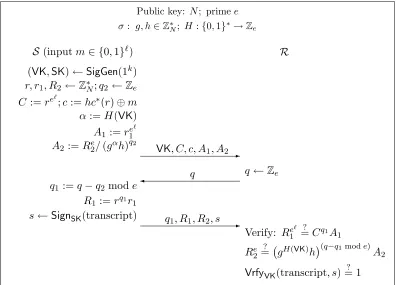
We now describe the non-malleable PPK in detail (cf. Figure 1). Parameters σ are generated by selecting two random elements g, h ∈ Z∗N. Additionally, a function H :
{0,1}∗ →Ze from a family of universal one-way hash functions is chosen at random. Once σ is established, a PPK for ciphertext hC, ci proceeds as follows: first, a key-generation algorithm for a one-time signature scheme is run to yield verification key VK and signing key SK, and α =H(VK) is computed. The PPK will be a witness indistinguishable proof of knowledge of either r = C1/e` or xα def= (gαh)1/e. In more detail, the sender chooses
6
Public key: N; primee σ: g, h∈Z∗
N; H :{0,1}∗→Ze
S (inputm∈ {0,1}`) R
(VK,SK)←SigGen(1k)
r, r1, R2 ←Z∗N;q2 ←Ze
C:=re`;c:=hc∗(r)⊕m α :=H(VK)
A1 :=re ` 1
A2 :=Re2/(gαh)q
2
VK, C, c, A1, A2
-q←Ze
q
q1:=q−q2 mode
R1:=rq1r1
s←SignSK(transcript) q1, R1, R2, s
-Verify: Re1` =? Cq1A
1
Re2 =? gH(VK)h(q−q1mode)
A2
VrfyVK(transcript, s)
? = 1
Figure 1: Non-malleable PPK for the RSA cryptosystem.
random elementsr1, R2 ∈Z∗N along with a random elementq2 ∈Ze. The sender computes
A1 = re `
1 and A2 = Re2/(gαh)q2. These values are sent (along with VK, C, c) as the first message of the PPK. The receiver chooses challenge q ∈ Ze as before. The sender sets
q1 =q−q2 mode and answers withR1 =rq1r1 (completing the “real” proof of knowledge with challenge q1) andR2 (completing the “simulated” proof of knowledge with challenge
q2). The values q1, R1, R2 are sent to the receiver. To complete the proof, the sender signs a transcript of the entire execution (includingC, c) usingSKand sends the signature to the receiver. The receiver verifies the correctness of the proofs by checking thatRe1` =? Cq1A
1 and Re2 = (? gαh)(q−q1mode)A
2. Finally, the receiver verifies the correctness of the signature on the transcript.
For greater efficiency, it is possible to modify the protocol for the case of small e(e.g.,
e= 3) without increasing the round complexity. We omit details in the present abstract.
Theorem 1 Assuming the hardness of the RSA problem for expected-polynomitime
al-gorithms, the protocol of Figure 1 is a non-malleable PPK (withκ∗(pk) = 1/e) for the RSA
encryption scheme outlined above.
Proof That the protocol is indeed a PPK will follow from the stronger properties we
prove below. We use the following simulator: SIM1(N, e) chooses random hash function
H, runs SigGen(1k) to generate (VK,SK), and computes α = H(VK). Random elements
with state information state =hVK,SK, xi. Note that σ output by SIM1 has the correct distribution. Furthermore, given state, SIM2 can simulate the witness indistinguishable proof of Figure 1 for any ciphertext: simply use verification keyVK and then the witness
x= (gαh)1/eis known. Note that the resulting simulation is perfect and is achieved without rewinding the (potentially) dishonest verifier.
Fix pk, σ, state, and randomness r for SIM2. We are given adversary Musing
(un-known) random tape r0 who interacts with both SIM
2(state;r) and honest receiver R. Recall that ciphertexthC, ci, for which SIM2 will be required to prove a witness, is cho-sen adaptively by M. Once the challenge q0 of R is fixed, the entire interaction is com-pletely determined; thus, we may defineπ(q0) as the transcript of the conversation between
SIM2(state;r) and Mr0 when q0 is the challenge sent by R; analogously, we defineπ0(q0) as the transcript of the conversation betweenMr0 and Rwhen q0 is the challenge of R.
The knowledge extractor KE∗ is given pk, σ,state, r, and access to M
r0. When we say that KE∗ runs Mr0 with challenge q we mean that KE∗ interacts with Mr0 by running algorithm SIM2(state;r) and sending challenge q for R. We stress that interleaving of messages (i.e., scheduling of messages to/from Rand SIM2) is completely determined by
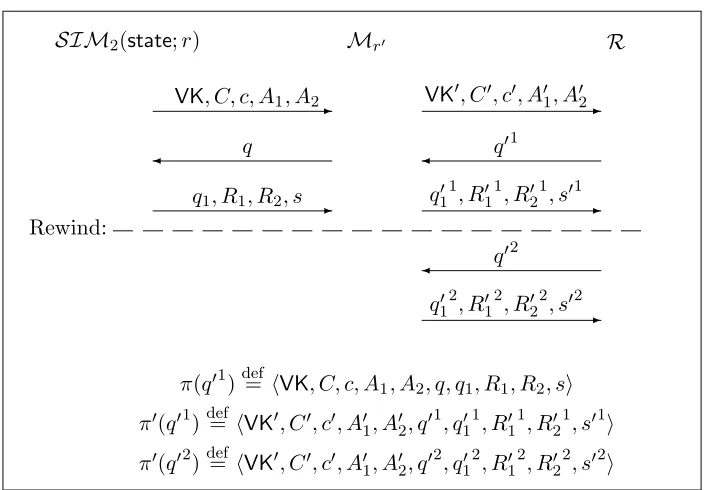
Mr0. KE∗ operates as follows: First, KE∗ picks a random value q01 ∈ Ze and runs Mr0 with challengeq01 (cf. Figure 2). If π0(q01) is not accepting, or if π0(q01) =π(q01), stop and output⊥. Otherwise, run the following:
Fori= 0 to e−1:
q02 ←Ze
Run Mr0 with challengeq02
Ifπ0(q02) is accepting and π(q02)6=π0(q02) and q02 6=q01:
Outputπ0(q02) and stop Run Mr0 with challengei
Ifπ0(i) is accepting andπ(i)6=π0(i) andi6=q01: Outputπ0(i) and stop
Output⊥and stop.
At this point, KE∗ has either output ⊥ or has the transcripts π(q01
), π0(q01), π0(q02), where π(q01) 6= π0(q01) and π0(q01), π0(q02) are accepting transcripts with q01 6= q02 (see
Figure 2).
We first verify that the expected running time of KE∗ until this point is polynomial in k. Fix pk, σ,state, and r as above. Let p∗ be the probability (over challenges q sent by
R) that Mr0 gives a valid proof and π(q) =6 π0(q). If p∗ > 1/e, the expected number of iterations of the loop above (assuming this loop is executed) is at most 2/p∗; furthermore, the probability of executing this loop (which is only done following an initial success) is exactly p∗. Thus, the expected running time is upper-bounded by p∗· poly(k)
p∗ = poly(k), wherepoly(k) is an upper bound on the running time ofM. On the other hand, ifp∗ ≤1/e,
the number of iterations of the loop above is at most e, yet the probability of executing the loop is at most 1/e. Thus, the expected running time of KE∗ in this case is at most 1
e·e·poly(k) =poly(k).
Let Good be the event that KE∗ does not output ⊥. In this case, let the transcripts
SIM2(state;r) Mr0 R
VK, C, c, A1, A2
-VK0, C0, c0, A01, A02
-q01
q
q1, R1, R2, s
-q101, R011, R021, s01
-Rewind:
q02
q102, R012, R022, s02
-π(q01)def= hVK, C, c, A1, A2, q, q1, R1, R2, si
π0(q01)def
= hVK0, C0, c0, A0
1, A02, q01, q011, R011, R201, s01i
π0(q02)def= hVK0, C0, c0, A0
1, A02, q0 2
, q0
1 2
, R0
1 2
, R0
2 2
, s02i
Figure 2: Knowledge extraction.
Assuming eventGoodoccurs,π0(q01) andπ0(q02) are accepting transcripts withq016=q02
and therefore we must have either q0
1 1
6
= q0
1 2
or q01−q0
1 1
6
= q02 −q0
1 2
mode (or possibly both). In caseq01−q0
11=q02−q102 mode(denote this event byReal) and hence q0116=q102, we have the two equations:
R011e
`
= C0q10 1
A01modN
R012e
`
= C0q10 2
A01modN.
Therefore, (∆R)e `
= (C0)∆q, where ∆
R def= R011/R012 (we assume all values in ZN are in-vertible; if not, N may be factored and eth roots easily computed) and ∆q def= q011−q102. Since ∆q and e` are relatively prime, we can efficiently compute integers A, B such that
A∆q+Be` = 1; we may then compute r0 def= (∆R)A(C0)B = (C0)1/e `
. Once r0 is known,
KE∗ may computehc∗(r0) and hence determine the witness to the decryption of ciphertext
hC0, c0i.
On the other hand, if q01−q0
11 6=q02−q102 mode(denote this event by Fake), we have the two equations:
R201e = gα0hq
01
−q0
1 1
A02
R202e = gα0hq
02
−q0
1 2
A02,
where α0 def= H(VK0), from which KE∗ may compute y0 def= (gα0
complete the proof (sinceReal∩Fake=∅), we show that Pr[Fake] (where the probability is over the random tapeω ofKE∗) is less than some negligible function with all but negligible probability over choice ofpk, σ,state, r, r0.
Claim 1 Prpk,σ,state,r,r0,ω[VK=VK0∧Good] is negligible.
Consider algorithm Forge which takes input VK, has access to a signing oracle, and runs as follows: emulating KE∗, algorithm Forge generates pk, σ, and parameters state and r
for SIM2. However, Forge does not run the key-generation procedure for the one-time signature scheme, but instead uses VK. Next, Forge runs the initial portion of KE∗ by
choosing randomr0 forM, choosingq0 randomly fromZe, and runningM
r0 with challenge
q0. When a signature under VK is needed (during the single execution of SIM
2), Forge obtains the required signature from its signing oracle. Once Mr0 completes its execution, Forge stops and outputs the transcriptπ0(q0).
The probability that the transcript output byForgecontains a valid forgery underVKis at least Prpk,σ,state,r,r0,ω[VK=VK0∧Good]. However, the security of the one-time signature scheme guarantees that this is negligible. Note that, since no rewinding is involved and consequentlyForge runs in strict polynomial time, the signature scheme need only be secure againstpptadversaries.
Claim 2 Prpk,σ,state,r,r0,ω[VK6=VK0∧H(VK) =H(VK0)∧Good] is negligible.
The proof is similar to that of Claim 1, but is based on the security of the family of universal one-way hash functions. As in Claim 1, the family of universal one-way hash functions need only be secure againstppt adversaries. Details omitted.
Claim 3 Prpk,σ,state,r,r0,ω[H(VK)6=H(VK0)∧Fake] is negligible.
Note that algorithm KE∗, as described previously, does not require any secret information aboutN, e, gin order to run. Thus, we can consider the expected polynomial-time algorithm
KE0 which takes as input a modulus N, a prime e, and a (random) element g ∈ Z∗N and otherwise runs identically to KE∗. Clearly, the probability that both Fake and H(VK) 6=
H(VK0) occur remains unchanged.
Letα =H(VK) andα0 =H(VK0); define ∆def= α0−α6= 0. By definition of event Fake,
KE0 may compute y0 such that (y0)e=gα0
h; but then:
y0def= gα0h1/e = g∆xe1/e
= g∆1/e x,
and therefore y def= y0/x satisfies ye =g∆. Note that |∆| and e are relatively prime since ∆∈(−e, e). The same techniques used above allow efficient computation of g1/e. In other words, whenever Fake and α0 6=α occur, algorithm KE0 inverts the given RSA instanceg.
Therefore, under the RSA assumption, Prpk,σ,state,r,r0,ω[H(VK) 6= H(VK0)∧Fake] must be negligible.
Claims 1–3 imply that Prpk,σ,state,r,r0,ω[Fake] < ε(k) for some negligible function ε(·). But then:
ε(k)> Pr
pk,σ,state,r,r0,ω[Fake]>
p
ε(k)· Pr
pk,σ,state,r,r0
h
Pr
ω[Fake]> p
and hence Prpk,σ,state,r,r0
h
Prω[Fake]≤ p
ε(k)i ≥ 1−p
ε(k). Thus, with all but negligible probability over choice ofpk, σ,state, r, r0, the probability of event Fakeis negligible
4
Applications
In this section, we discuss applications of non-malleable PPKs to the construction of (1) interactive CCA2 encryption protocols, (2) password-AKE in the public-key model, and (3) strong deniable-authentication protocols. We describe protocols based on the PPK of Figure 1 whose security is therefore based on the RSA assumption; analogous constructions based on the PPKs given in the full version of this work [28] yield protocols whose security is based on alternate assumptions (hardness of factoring, etc.).
Concurrent composition. In our intended applications, the man-in-the-middle adversary may conduct multiple PPKs in an asynchronous and concurrent fashion. Witness extraction will be required for each such execution; furthermore, extraction of this witness will be required as soon as the relevant proof is completed. If arbitrary interleaving of the proofs is allowed, extracting all witnesses in the naive way may require exponential time due to the nested rewinding of the prover (a similar problem is encountered in simulation of concurrent zero-knowledge proofs [17]). To avoid this problem, we introducetiming constraints [17] in our protocols. These are explained in detail below.
4.1 Interactive CCA2 Encryption
The non-malleable PPK of the previous section (cf. Figure 1) immediately yields an inter-active encryption scheme: The receiver generates N, e as in the original RSA scheme and also runs G(pk) to give parameters σ. The public key pk is (N, e, σ) and the secret key is the factorization of N. To encrypt message m under public key pk, the sender computes
C =re`
and c = hc∗(r)⊕m, sends hC, ci to the receiver, and then executes algorithm S
for the ciphertext using parameters σ (i.e., the sender proves knowledge of a witness to the decryption of C). To decrypt, the receiver uses R to determine whether to accept or reject the proof; if the receiver accepts, the receiver decryptshC, cias in the standard RSA scheme. If the proof is rejected, the receiver outputs⊥.
sending the second message and receiving the third message, and (2) the decrypted cipher-text is not returned to the adversary until after the acknowledgment message is sent (in particular, until timeβ has elapsed since sending the second message).
Theorem 2 Assuming the hardness of the RSA problem for expected-polynomitime
al-gorithms, the protocol of Figure 1 (with |e| = Θ(k)) is an interactive encryption scheme secure against sequential chosen-ciphertext attacks. If timing constraints are enforced as outlined above, the protocol is secure against concurrent chosen-ciphertext attacks.
The proof appears in Appendix B.
The resulting encryption scheme is computationally efficient, especially in comparison with the basic semantically-secure scheme. For example, the scheme of Figure 1 for encryp-tion of`-bit messages requires only 2`+4 exponentiations compared to the`exponentiations required by the underlying RSA scheme. Furthermore, most of the additional computation may be done in a preprocessing stage before the message to be sent is known.
4.2 Password-Based Authentication and Key Exchange
As shown by Halevi and Krawczyk [27] and Boyarsky [5], protocols for password-based authentication may be constructed from any CCA2 encryption scheme as follows: Let pw
be the password of the user which is stored by the server. A password-based authentication protocol using a (non-interactive) CCA2 encryption scheme has the server send a random, sufficiently-long noncento the user, who replies with an encryption ofpw◦n(actually, this brief description suppresses details which are unimportant for the discussion which follows; see [27, 5]). The server decrypts and verifies correctness of the password and the nonce; the nonce is necessary to prevent replay attacks. If desired, a keyK may be exchanged by encryptingK◦pw◦ninstead.
Our interactive CCA2 encryption schemes allow the first efficient implementations of these protocols based on, for example, the RSA or factoring assumptions. Note that these protocols already require interaction and therefore using an interactive encryption scheme is not a serious drawback. Furthermore, when an interactive encryption scheme is used the nonce is not necessary if the probability that a server repeats its messages is negligible [5]; in this case, authentication (for example) may be achieved by simply having the user perform a (random) encryption of pw. Thus, our constructions require only one more round than those of [27, 5].
4.3 Deniable Authentication
Public key: N; primee; g, h∈Z∗
N; H :{0,1}∗→Ze
V (inputm∈ {0,1}∗) P (inputd)
(VK,SK)←SigGen(1k)
y, r1, R2 ←Z∗N;q2 ←Ze
C:=ye;α :=H(VK)
A1 :=r1e
A2 :=Re2/(gαh)q
2
VK, m, C, A1, A2
-q←Ze
q
q1:=q−q2 mode
R1 :=yq1r1
s←SignSK(transcript) q1, R1, R2, s
-Verify: Re1=? Cq1A
1
Re2 =? gH(VK)h(q−q1mode)
A2
VrfyVK(transcript, s)
? = 1
Cd
Figure 3: A deniable-authentication protocol based on RSA.
We first present the paradigm for the construction of our deniable authentication pro-tocols. The basic idea is for the receiver to give a non-malleable PPK for a ciphertext C
encrypted using an encryption scheme which is one-way for random messages. Additionally, the messagemwhich is being authenticated is included in the transcript and is signed along with everything else. Assuming the verifier’s proof succeeds, the prover authenticates the message by responding with the decryption ofC.
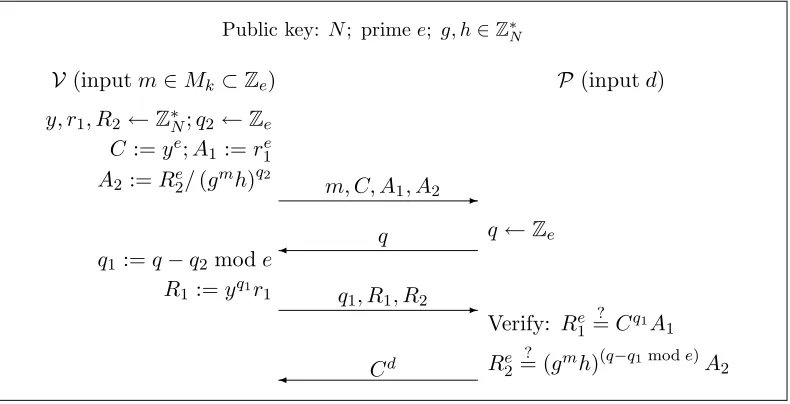
Figure 3 shows an example of this approach applied to the non-malleable PPK of Figure 1. The public key of the prover P is an RSA modulus N, a prime e (with |e| = Θ(k)), elementsg, h∈Z∗N, and a hash functionHchosen randomly from a family of universal one-way hash functions. Additionally, the prover has secret keyd such that de= 1 modϕ(N). The verifierVhas messagemtaken from an arbitrary message space (of course,|m|must be polynomial in the security parameter). To havemauthenticated by P, the verifier chooses a randomy∈Z∗N, computesC =ye, and then performs a non-malleable proof of knowledge of the witness y to the decryption of C (as in Figure 1). Additionally, the message m is sent as the first message of the protocol, and is signed along with the rest of the transcript. If the verifier’s proof succeeds, the prover computesCd and sends this value to the verifier. If the proof does not succeed, the prover simply replies with⊥.
sending the challenge (clearly, we must haveβ > α).
Theorem 3 Assuming the hardness of the RSA problem for expected-polynomitime
al-gorithms, the protocol of Figure 3 is a strong deniable-authentication protocol (over an arbitrary message space) for adversaries given sequential access to the prover. If timing constraints are enforced as outlined above, the protocol is a strongε-deniable-authentication protocol for adversaries given concurrent access to the prover.
The proof is similar to that of Theorem 2, and appears in the full version [28].
We stress that the resulting deniable authentication protocols are quite practical. For example, the full version of this work [28] shows a deniable authentication protocol based on the CDH assumption which has the same round-complexity, requires fewer exponen-tiations, has a shorter public key, and is based on a weaker assumption than the most efficient previously-known protocol for strong deniable authentication (i.e., the protocol of [17] instantiated with the Cramer-Shoup encryption scheme [9]). Furthermore, no previous efficient protocols were known based on the RSA, factoring, or computational/decisional composite residuosity assumptions.
We also remark that interactive CCA2 encryption schemes do not, in general, yield deniable authentication protocols using this paradigm. For example, when using the chosen-ciphertext-secure encryption scheme of [15], two additional rounds are necessary just to achieveweak deniable authentication (our use of the terms “strong” and “weak” is explained in Appendix A.2).
Further efficiency improvements are possible; however, the resulting protocols are prov-ably secure for polynomial-sized message spaces only. In Figure 4, we illustrate the improve-ment for the deniable authentication protocol of Figure 3. In the improved protocol, we rely on the fact that the adversary cannot re-use the valuem (since, to break the security of the scheme, the adversary must authenticate a new message which the prover does not authenticate). This eliminates the need for a verification key and a one-time signature on the transcript. However, since the adversary choosesm (and this value must be guessed by the simulator in advance), the scheme is only provably secure when the message space is polynomial-size.
Theorem 4 Assuming the hardness of the RSA problem for expected-polynomitime
al-gorithms, the protocol of Figure 4 is a strong deniable-authentication protocol (over any polynomial-size message space Mk ⊂ Ze) for adversaries given sequential access to the
prover. If timing constraints are enforced as outlined above, the protocol is a strong ε -deniable-authentication protocol for adversaries given concurrent access to the prover.
The proof appears in the full version of this work [28].
Acknowledgments. I am grateful to Moti Yung and Rafail Ostrovsky for their many
helpful comments and suggestions regarding the work described here.
References
Public key: N; primee; g, h∈Z∗ N
V(inputm∈Mk⊂Ze) P (inputd)
y, r1, R2 ←Z∗N;q2 ←Ze
C :=ye;A1 :=r1e
A2 :=Re2/(gmh)q
2
m, C, A1, A2
-q←Ze
q
q1:=q−q2 mode
R1 :=yq1r1 q1, R1, R2
-Verify: Re1=? Cq1A
1
Re2 = (? gmh)(q−q1mode)
A2
Cd
Figure 4: A deniable-authentication protocol with improved efficiency.
[2] M. Bellare, A. Desai, D. Pointcheval, and P. Rogaway. Relations Among Notions of Security for Public-Key Encryption Schemes. Crypto ’98.
[3] M. Bellare and O. Goldreich. On Defining Proofs of Knowledge. Crypto ’92.
[4] M. Blum and S. Goldwasser. An Efficient Probabilistic Public-Key Encryption Scheme which Hides All Partial Information. Crypto ’84.
[5] M. Boyarsky. Public-Key Cryptography and Password Protocols: The Multi-User Case. CCCS ’99.
[6] R. Cramer. Modular Design of Secure Yet Practical Cryptographic Protocols. PhD Thesis, CWI and U. Amsterdam, 1996.
[7] R. Cramer, I. Damg˚ard, and J.B. Nielsen. Multiparty Computation from Threshold Homomorphic Encryption. Eurocrypt ’01.
[8] R. Cramer, I. Damg˚ard, and B. Schoenmakers. Proofs of Partial Knowledge and Sim-plified Design of Witness Hiding Protocols. Crypto ’94.
[9] R. Cramer and V. Shoup. A Practical Public-Key Cryptosystem Provably Secure against Adaptive Chosen Ciphertext Attack. Crypto ’98.
[10] R. Cramer and V. Shoup. Universal Hash Proofs and a Paradigm for Adaptive Chosen Ciphertext Secure Public-Key Encryption. Eurocrypt ’02, to appear.
[11] I. Damg˚ard. Efficient Concurrent Zero-Knowledge in the Auxiliary String Model. Eu-rocrypt ’00.
[13] A. De Santis, G. Di Crescenzo, R. Ostrovsky, G. Persiano, and A. Sahai. Robust Non-Interactive Zero Knowledge. Crypto ’01.
[14] G. Di Crescenzo, J. Katz, R. Ostrovsky, and A. Smith. Efficient and Non-Interactive Non-Malleable Commitment. Eurocrypt ’01.
[15] D. Dolev, C. Dwork, and M. Naor. Non-Malleable Cryptography.SIAM J. Computing 30(2): 391–437 (2000).
[16] C. Dwork and M. Naor. Zaps and Their Applications. FOCS ’00.
[17] C. Dwork, M. Naor, and A. Sahai. Concurrent Zero-Knowledge. STOC ’98.
[18] C. Dwork and A. Sahai. Concurrent Zero-Knowledge: Reducing the Need for Timing Constraints. Crypto ’98.
[19] T. El Gamal. A Public-Key Cryptosystem and a Signature Scheme Based on Discrete Logarithms.IEEE Transactions on Information Theory 31(4): 469–472 (1985).
[20] U. Feige, A. Fiat, and A. Shamir. Zero-Knowledge Proofs of Identity.Journal of Cryp-tology 1(2): 77–94 (1988).
[21] U. Feige, D. Lapidot, and A. Shamir. Multiple Non-Interactive Zero-Knowledge Proofs Based on a Single Random String. FOCS ’90.
[22] Z. Galil, S. Haber, and M. Yung. Symmetric Public-Key Encryption. Crypto ’85.
[23] L.C. Guillou and J.-J. Quisquater. A Practical Zero-Knowledge Protocol Fitted to Security Microprocessors Minimizing Both Transmission and Memory. Eurocrypt ’88.
[24] O. Goldreich.Foundations of Cryptography: Basic Tools. Cambridge University Press, Cambridge, UK, 2001.
[25] O. Goldreich, S. Micali, and A. Wigderson. Proofs that Yield Nothing but Their Va-lidity or: All Languages in NP Have Zero-Knowledge Proof Systems. JACM 38(3): 691–729 (1991).
[26] S. Haber. Multi-Party Cryptographic Computations: Techniques and Applications. PhD Thesis, Columbia University, 1987.
[27] S. Halevi and H. Krawczyk. Public-Key Cryptography and Password Protocols. ACM Transactions on Information and System Security, 2(3): 230–268, 1999. Preliminary version in ACM CCCS ’98.
[28] J. Katz. Efficient Cryptographic Protocols Preventing “Man-in-the-Middle” Attacks. PhD Thesis, Columbia University, 2002.
[29] M. Naor and M. Yung. Public-Key Cryptosystems Provably Secure Against Chosen-Ciphertext Attack. STOC ’90.
[31] M. Rabin. Digitalized Signatures and Public-Key Functions as Intractable as Factor-ization. Technical Report MIT/LCS/TR-212, MIT Laboratory for Computer Science, January 1979.
[32] C. Rackoff and D. Simon. Non-Interactive Zero-Knowledge Proof of Knowledge and Chosen-Ciphertext Attack. Crypto ’91.
[33] R. Rivest, A. Shamir, and L.M. Adleman. A Method for Obtaining Digital Signatures and Public-Key Cryptosystems. Communications of the ACM 21(2): 120–126 (1978).
[34] A. Sahai. Non-Malleable Non-Interactive Zero-Knowledge and Adaptive Chosen-Ciphertext Security. FOCS ’99.
[35] C.P. Schnorr. Efficient Identification and Signatures for Smart Cards. Crypto ’89.
A
Additional Definitions
A.1 Chosen-Ciphertext-Secure, Interactive Encryption
A number of definitional approaches to chosen-ciphertext security in the interactive setting are possible. For example, the notion of non-malleability [15] may be extended for the case of interactive encryption. An oracle-based definition is also possible, and we sketch such a definition here.7
We have a sender, a receiver (where the receiver has published public-key pk), and a man-in-the-middle adversaryMwho controls all communication between them. To model this, we define anencryption oracleand adecryption oracleto whichMis given access. The encryption oracle Eb,pk plays the role of the sender. The adversary may interact with this oracle multiple times at various points during its execution, and may interleave requests to this oracle with requests to the decryption oracle in an arbitrary manner. At the outset of protocol execution, a bitb is chosen at random. An instance of the adversary’s interaction with the encryption oracle proceeds as follows: first, the adversary chooses two messages
m0, m1 and sends these to Eb,pk. The oracle then executes the encryption protocol for message mb. The adversary, however, need not act as an honest receiver. The oracle maintains state between the adversary’s oracle calls, and the adversary may have multiple concurrent interactions with the oracle. When Eb,pk sends the final message for a given instance of its execution, we say that instance iscompleted.
The decryption oracle Dsk plays the role of a receiver. This oracle also maintains ap-propriate state between oracle calls, and the adversary may again have multiple concurrent interactions with this oracle. Furthermore, the adversary need not act as an honest sender. Each time a given decryption-instance is completed, the decryption oracle decrypts using
sk and following the correct decryption protocol and then sends the result (i.e., a message or⊥) to the adversary.
The adversary succeeds if it can guess the bit b. Clearly, some limitations must be placed on the adversary’s access to the decryption oracle or else the adversary may simply
7
forward messages between Eb,pk and Dsk and therefore trivially determine b. At any point during the adversary’s execution, the set of transcripts of completed encryption-instances ofEb,pk is well defined. Upon completing a decryption-instance, let {π1, . . . , π`}denote the transcripts of all completed encryption-instances. We allow the adversary to receive the decryption corresponding to a decryption-instance with transcript π0 only if π0 6= π
i for 1≤i≤`.
Definition 3 Let Π = (K,E,D) be an interactive, public-key encryption scheme. We say that Π is CCA2-secure if, for any ppt adversary A, the following is negligible (in k):
Pr
h
(sk, pk)← K(1k);b← {0,1}:AEb,pk,Dsk(1k, pk) =b i
−1/2 ,
where A’s access to Dsk is restricted as discussed above.
A.2 Deniable Authentication
We review the definition given in [17, 16]. Formal definitions appear in the full version of this work [28]. We have a prover P who has established a public key and is willing to authenticate messages to a verifier V; however, P is not willing to allow the verifier to convince a third party (after the fact) thatP authenticated anything. This is formalized by ensuring that any transcript of an execution of the authentication protocol could have been simulated by a verifier alone (without any access toP). Furthermore, an adversaryM
(acting as man-in-the-middle betweenP and a verifier) should not be able to authenticate a messagem to the verifier whichP does not authenticate forM. More formally, astrong deniable authentication protocol should satisfy the following:
• Completeness. For any message m, if the prover and a verifier follow the protocol
for authenticatingm, then the verifier accepts.
• Soundness. Assume P concurrently authenticates any polynomial number of
mes-sages m1, m2, . . . chosen adaptively by a ppt adversary M. Then M will succeed with at most negligible probability in authenticating a message m6∈ {m1, . . .} to an honest verifier.
• Strong Deniability. AssumeP concurrently authenticates any polynomial number
of messages chosen adaptively by apptadversaryV0. Then there exists an
expected-polynomial-time simulator that, given black-box access toV0, can output a transcript
indistinguishable from a transcript of a real execution between V0 and P.
A relaxation of the above definition which has been considered previously (e.g., [17]) allows the simulator to have access to the realP when producing the simulated transcript, butP authenticates some fixed sequence of messages independent of those chosen byV0. We
The notion ofε-deniability [17] requires that for any givenε >0, there exists a simulator whose expected running time is polynomial in k and 1/ε and which outputs a simulated transcript such that the advantage of any poly-time algorithm in distinguishing real tran-scripts from simulated trantran-scripts is negligibly close to ε.
B
Proof of Theorem 2
A straightforward hybrid argument shows that it is sufficient to consider adversaries with only a single access to the encryption oracle. We prove security for the more challenging case of concurrent access to the decryption oracle. The protocol Π of Figure 1 is a PPK for encryption scheme (K,E,D) in which K(1k) outputs as the public key a k-bit modulus
N and a k-bit prime e. Encryption of `-bit message m is done by choosing random r ∈
Z∗N and sending ˜C = hre `
, hc∗(r)⊕mi, where hc∗(·) is a hard-core function for the RSA permutation. Assuming the hardness of the RSA problem for expected-polynomial-time algorithms, (K,E,D) is semantically secure against expected-polynomial-time adversaries. We transform anyppt adversaryA mounting a CCA2 attack against Π into an
expected-polynomial-time adversary A0 attacking the semantic security of (K,E,D). Furthermore,
we show that the advantage ofA0 is not negligible if the advantage of A is not negligible.
This will immediately imply CCA2 security of Π.
Let t(k), which is polynomial in k, be a bound on the number of times A accesses the decryption oracle when run on security parameter 1k; without loss of generality, we assume thatt(k)≥k(for convenience, in the remainder of the proof we suppress the dependence on
k and simply write t). In the real experimentExpt0, the final output b0 ofA is completely
determined bypk0 =hpk, σi, random coins r0 for A, the vector of challenges ~q=q
1, . . . , qt used during thetinstancesAinteracts with the decryption oracle, and the randomness used by the encryption oracle (this includes the bitb, the randomnessωused for the encryption, and the randomness used for execution of the PPK). LetSuccdenote the event thatb0 =b,
and let Pr0[Succ] denote the probability of this event in the real experiment.
We modify the real experiment, giving Expt1, as follows. Key generation is done by runningK(1k) to generatepk, sk. Additionally, SIM1(pk) (cf. the proof of Theorem 1) is run to generate parametersσ and state(in the real experimentσ was generated byG(pk)). The public keypk0 ishpk, σiand the secret key issk. The adversary’s calls to the decryption oracle are handled as inExpt0 (in particular, any ciphertext ˜Cmay be decrypted sinceskis known), but the adversary’s encryption oracle call will be handled differently. WhenAcalls the encryption oracle on messages m0, m1, we pick b randomly, compute ˜C∗ = Epk(mb;ω) for randomω, and simulate the PPK for ˜C∗using algorithmSIM
2(state;r) with randomly-chosenr. Now, the final outputb0 of A is completely determined bypk0 =hpk, σi, random
coins r0 for A, the vector of challenges ~q used by the decryption oracle, the values b and
ω used in computing ˜C∗, and the values state and r used by SIM
2 in simulating the encryption oracle. SinceSIM yields a perfect simulation of a real execution of the PPK, we have Pr1[Succ] = Pr0[Succ], where the first probability refers to the probability of an event inExpt1.
We now describe our adversary A0 attacking the semantic security of (K,E,D). Given
the public key pk, adversary A0 runs SIM1(pk) to generate parameters σ and state. A0
encryption oracle forAis done as follows: whenAsubmits two messagesm0, m1, adversary
A0simply forwards these to its encryption oracle and receives in return a ciphertext ˜C∗(note
that the encryption oracle thus implicitly defines valuesb∗ andω∗). Then,A0 simulates the
PPK for ˜C∗ using algorithmSIM
2(state;r) for randomly-chosen coinsr. Simulation of the decryption oracle forA is done by choosing a random vector of queries~q∗ and attempting
to extract the relevant witnesses (in expected polynomial time) from the PPKs given byA. Details of the simulation are described below. In case the simulation is successful, the final outputb0 is just the final output ofA; if the simulation is not successful, the final outputb0
is a randomly-chosen bit. As we show below, the simulation will succeed with sufficiently high probability such that if the advantage of A (in attacking the CCA2 security of Π) is not negligible then the advantage ofA0 (in attacking the semantic security of (K,E,D) is
not negligible as well. This will complete the proof.
It remains to show how to simulate the decryption oracle. Our proof requires techniques used in an analysis of concurrent composition of zero-knowledge proofs [17]. We assume thatA controls the scheduling of all messages to and from all the oracles; so, for example, the decryption oracle does not send its next message until A requests it. Define the ith
instance of the decryption oracle as the ith time A requests the second message (i.e., the challenge) of the PPK be sent by the decryption oracle. In any transcript of the execution ofA, we let Ci denote the ciphertext sent by Ain theith instance of the decryption oracle. For any instance of the decryption oracle, we say the instance succeeds if (1) an honest receiver would accept the instance, (2) the transcript of the instance is different from the transcript (if it yet exists) of the interaction ofA with the encryption oracle, and (3) the timing constraints are satisfied for that instance. Otherwise, we say the instancefails.
Recall that the simulator has valueshpk, σ, r0, ~q∗,state, riand has access to an encryption
oracle which, on inputm0, m1, outputs Epk(mb∗;ω∗) for random b∗ and ω∗. Note that the valuestatedefines a key VK which is used bySIM2 when giving its simulated proof. The valuespk, σ, r0,state, andrare fixed throughout the simulation. When we say the simulator
interacts with A using h~q, ω, bi we mean that the simulator runs A as in Expt1; that is, encryption oracle querym0, m1 is answered by encryptingmb using randomnessω and then runningSIM2(state;r), and the challenge sent by theithinstance of the decryption oracle isqi. We note that decryption requests cannot be immediately satisfied; this will not be a problem, as we show below.
We begin with simulation of the first instance. The simulator chooses random~q, ω, band interacts withAusing h~q, ω, bi. IfAmakes a call m0, m1 to the encryption oraclebefore q1 is requested, the simulator forwardsm0, m1 to its encryption oracle and receives in return a ciphertext ˜C∗; we then say theciphertext is defined at instance 1. Once the ciphertext is
defined, the simulator no longer needs to choose values ω, band, in effect, interacts withA
using h~q, ω∗, b∗i. If the verification key VK
1 used by A in the first instance is equal to VK defined by state, the first instance is declared conditionally delinquent and the simulator proceeds to simulation of instance 2.
If the ciphertext is not defined at instance 1, the simulator interacts with A using
h~q, ω, biuntil the first instance either succeeds or conclusively fails. Note that decryption of ciphertexts ˜Ci withi >1 is not required since such a request would imply that timeβ has elapsed since the sending of the second message of instancei, but this would mean that time
first instance has either succeeded or failed by that point). If the first instance succeeds, the simulator proceeds with witness extraction as described below. If the first instance fails, the simulator chooses new, random ~q, ω, b and interacts with A using h~q, ω, bi. This is repeated for a total of at mostt4/τ times (using new, random~q, ω, b each time) or until the first instance succeeds, where τ = τ(k) is an inverse polynomial whose value we will fix at the end of the proof and t = t(k) is a bound on the number of times A interacts with the decryption oracle. If the first instance ever succeeds, the simulator proceeds with witness extraction. Otherwise, the first instance is declared conditionally delinquent and the simulator proceeds to simulation of the second instance.
If the ciphertext is defined at instance 1, the simulator proceeds as above, but uses values ω∗, b∗ to interact with A (where these values are defined by ciphertext ˜C∗ received
from the simulator’s encryption oracle, as discussed previously).
If the first instance ever succeeds, witness extraction will be performed. Assume the first instance succeeded when interacting withA using h~q, ω, bi. The simulator then does the following:
Forn= 0 to e−1:
q0
1 ←Ze
Interact withAusing hq0
1, q2, . . . , qt, ω, bi
If the first instance succeeds andq016=q1, output the transcript and stop Interact withAusing hn, q2, . . . , qt, ω, bi
if the first instance succeeds andn6=q1, output the transcript and stop Output⊥ and stop
If ⊥ is not output, the simulator attempts to compute a witness to the decryption of ˜C1 as in the proof of Theorem 1. If such a witness is computed, we say the first instance is extracted and the simulator proceeds with simulation of instance 2. If⊥is output, or if⊥is not output but a witness to the decryption of ˜C1 cannot be computed, the entire simulation is aborted; we call this a failure to extract.
In general, when we are ready to simulate theithinstance (assuming the entire simulation has not been aborted), each of the firsti−1 instances has been classified as either extracted or conditionally delinquent. If instance j is extracted, the simulator knows the decryption of ˜Cj and can send it to A upon successful completion of that instance in the current simulation. On the other hand, if instance j is classified as conditionally delinquent, then with sufficiently high probability that instance will never succeed.
We say the ciphertext is defined before instance i if, for some j ≤ i, the ciphertext is defined at j. At the beginning of simulation of the ith instance, if the ciphertext is not defined before instance i−1, the simulator chooses random qi, . . . , qt, ω, b and interacts withAusinghq∗
1, . . . qi∗−1, qi, . . . , qt, ω, bi. IfA makes a callm0, m1 to the decryption oracle beforeqi is requested, the simulator forwardsm0, m1to its encryption oracle and receives in return a ciphertext ˜C∗; we then say the ciphertext is defined at instancei. If the verification keyVKi used byA during the ith instance of the decryption oracle is equal to VK defined by state, the ith instance is declared conditionally delinquent and the simulator proceeds with simulation of the next instance.
If the ciphertext is not defined before instance i, the simulator continues to interact withAusinghq∗