Efficient Cryptanalysis of
RSE(2)PKC and RSSE(2)PKC
Christopher Wolf, An Braeken, and Bart Preneel
Department Electrical Engineering, ESAT/COSIC, Katholieke Universiteit Leuven, Kasteelpark Arenberg 10,
B-3001 Heverlee-Leuven, Belgium
{christopher.wolf,an.braeken,bart.preneel}@esat.kuleuven.ac.be
Cryptology ePrint Archive, Report 2004/237 http://eprint.iacr.org/
Current Version: 2005-08-06 First Version: 2004-09-14
This is the extended version of the article with the same title [WBP04]. The original version was published in Conference on Security in Communication Networks — SCN 2004, volume 3352 of Lecture Notes in
Computer Science, pages 294–309. Springer, September 8–10 2004.
Abstract. In this paper, we study the new class step-wise Triangular Schemes (STS) of public key cryptosystems (PKC) based on multivar-iate quadratic polynomials. In these schemes, we havemthe number of equations, n the number of variables, L the number of steps/layers,r
the number of equations/variables per step, and q the size of the un-derlying field. We present two attacks on the STS class by exploiting the chain of the kernels of the private key polynomials. The first at-tack is an inversion atat-tack which computes the message/signature for given ciphertext/message inO(mn3Lqr+n2Lrqr), the second is a struc-tural attack which recovers an equivalent version of the secret key in
O(mn3Lqr+mn4) operations. Since the legitimate user has workloadqr for decrypting/computing a signature, the attacks presented in this paper are very efficient. As an application, we show that two special instances of STS, namely RSE(2)PKC and RSSE(2)PKC, recently proposed by Kasahara and Sakai, are insecure.
1
Introduction
1.1 PKC Schemes Based on Multivariate Quadratic Equations
In the last two decades, several public key cryptoschemes (PKC) have been proposed which use MultivariateQuadratic equations (MQ) over a finite field
S ∈ GLn(F) and T ∈ GLm(F) represent two linear transformations over the finite field F. The system P0 of m central equations in n variables of degree 2 is constructed with a trapdoor in order to speed up the decryption process. The secret key of the system consists of the triple (S,P0, T). Depending on the structure ofP0, these schemes can be divided into several classes:e.g., the initial polynomial substitution scheme from Fell and Diffie [FD85], C∗schemes [MI88], HFE-like schemes [Pat96,Cou01] or unbalanced oil-vinegar schemes [KPG99]. All of them rely on the fact that theMQ-problem,i.e., finding a solutionx∈Fnfor
a given system P is computationally difficult, namely N P-complete (cf [GJ79, p. 251] and [PG97, App.] for a detailed proof). Also decomposingP intoT,P0, S — called the Isomorphism of Polynomials Problem — is considered to be a hard problem ifS,P0, T do not have a special structure [PGC98].
In this paper, we concentrate on a special sub-class of MQ-schemes, namely schemes which have a triangular structure for their central equations P0 — tri-angular schemes for short. This idea is due to Shamir [Sha93] who developed such schemes (Birational Permutations) over large finite rings. To guard against special types of attacks, he removed some initial equations. Goubin et al. spe-cialised the approach from [Sha93] to the case of small finite fields, denoted TPM schemes (Triangle Plus Minus, [GC00]). They add to Shamir’s construction some equations in the last step (“Plus” modification) and fall in a similar class as the scheme described in this paper (cf Fig. 2).
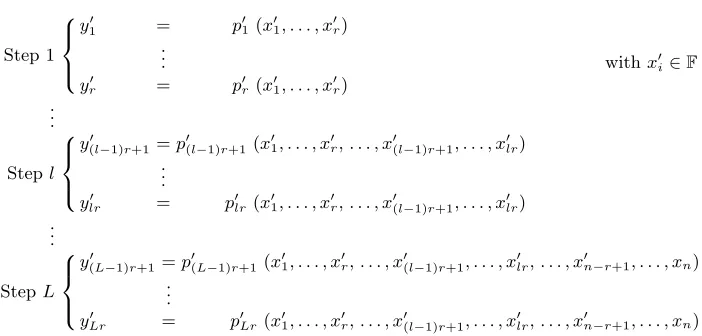
We now consider a further generalisation of the Birational Permutation and TPM family. These schemes are called STS (step-wise triangular schemes), which differ from the TPM class by allowing a “step” of more than one variable/equation in the triangular structure (cf Fig. 1 for regular STS). The step-width (number
Step 1
8
> <
> :
y0
1 = p01 (x01, . . . , x0r) ..
. withx0
i∈F
y0
r = p0r (x01, . . . , x0r) ..
.
Stepl 8
> <
> :
y0
(l−1)r+1=p0(l−1)r+1(x01, . . . , x0r, . . . , x0(l−1)r+1, . . . , x0lr) ..
.
y0
lr = p0lr(x01, . . . , xr0, . . . , x0(l−1)r+1, . . . , x0lr) ..
.
StepL 8
> <
> :
y0
(L−1)r+1=p0(L−1)r+1(x01, . . . , xr0, . . . , x0(l−1)r+1, . . . , xlr0 , . . . , x0n−r+1, . . . , xn) ..
.
y0
Lr = p0Lr(x01, . . . , x0r, . . . , x0(l−1)r+1, . . . , x0lr, . . . , x0n−r+1, . . . , xn)
Fig. 1.Central Equationsp0
of new variables) and the step-height (number of new equations) is controlled by the parameter r. For Birational Permutations and TPM, the parameterris fixed to 1. Therefore, they are a special case of STS (cf Sect. 1.2). The main part of this paper consists of the description of two very efficient attacks on STS schemes. They break STS inO(mn3Lqr+mn4) andO(mn3Lqr+n2Lrqr) — for
mthe number of equations, nthe number of variables,Lthe number of layers,
q the size of the ground field F, and r the step-width/step-hight. The attacks
are mainly based on the fact that the kernels of the private central polynomials
p0
iform a descending chain of subspaces (cf Sect. 2.1). As the recently proposed schemes RSE(2)PKC and RSSE(2)PKC by Kasahara and Sakai belong to the STS family (cf Sect. 3), both schemes are covered by these attacks and thus highly insecure. As an application of the attacks described in this paper, we broke the challenge for RSE(2)PKC (cf Sect. 3.2).
1.2 Step-wise Triangular Systems
A step-wise triangular scheme is defined over a finite field F withq :=|F|
ele-ments and prime characteristic char(F). Over this field, we define multivariate
quadratic polynomials
pi(x1, . . . , xn) := X
1≤j≤k≤n
γi,j,kxjxk+ X
1≤j≤n
βi,jxj+αi, (1)
for 1 ≤ i ≤ m and αi, βi,j, γi,j,k ∈ F (constant, linear, and quadratic terms). These polynomials form the public key as a system of equationsP := (p1, . . . , pm). The plaintextx∈Fn is transformed to the ciphertexty∈Fmas
yi:=pi(x1, . . . , xn) with 1≤i≤m .
The decryption, i.e., the inversion of this mapping, uses a trapdoor (cf Fig. 2). This trapdoor consists of two linear transformationsS ∈GLn(F),T ∈GLm(F) and central equations as outlined in Fig. 1. The public equations P are con-structed as a composition of P :=T◦ P0◦S where P0 has a special triangular structure (cf Fig. 1). The two linear transformations may be seen as invertible matrices, we hence have S ∈ Fn×n and T ∈ Fm×m, respectively. In our
de-scription, we always use a prime (0) for denoting the secret central part of the system.
Letr1, . . . , rLbeLintegers such thatr1+· · ·+rL=n, the number of variables, and m1, . . . , mL ∈ Nsuch that m1+· · ·+mL =m, the number of equations. Here L∈N denotes the number of layers or steps in the scheme,rl represents
the number of new variables (step-width) andmlthe number of equations (step-height), both in step l for 1≤l≤L. In a general step-wise Triangular Scheme (gSTS), the ml private quadratic polynomials of each layer l, contain only the variables x0
k with k ≤ Pl
inputx
?
x= (x1, . . . , xn)
? private:S
x0
? private:P0
y0
? private:T
outputy ¾
public: P= (p1, . . . , pn)
Fig. 2.MQ-trapdoor (S,P0, T) in STS
When not mentioned otherwise, we concentrate on regular STS schemes (rSTS or STS for short) in this paper. For regular STS schemes we set r1 = · · · =
rN =m1 =· · ·=mL, which we denote by r. Moreover, L=m/r and m=n. Note that the attacks we propose are also valid for the general STS schemes (cf Sect. 4.1). The structure of a regular STS has been outlined in fig. 1 and 2. As we see in Fig. 1, there are exactlyrnew variables in an rSTS for each layer. This way one can compute anx for a given vectory with qr attempts in each step. But as the legitimate user has a workload growing exponentially inr, this value has to be small in order to obtain a scheme of practical interest. The parameter rplays an important role for the complexity of our attack.
In order to decrypt a given ciphertext y, we need to invert the following steps:
x→S x0 P→0 y0→T y. WhileS, T are bijections and also easy to invert, this is not so obvious for the central equationsP0. In particular, these central equations may not form a bijection. Adding redundancy to the original messagexor transmit-ting some additional redundancy,e.g., in form of its hash-valueh:=H(x) where
H(·) denotes a cryptographically secure hash function (e.g., see [MvOV96]), al-lows to pick the correct messagexfor a given inputy. For a signature scheme, we do not need this redundancy as it is enough to obtain one x∈Fn such that
P(x) =y for a giveny; in most cases, this will be the hash of a longer message. As this point is not important for our attack, we refer to [Pat96,KS04b] for a broader discussion of this problem.
mL =v, m1=· · · =mL−1 =r2 =· · · =rL = 1, i.e., we removeu∈N initial layers, addv∈Npolynomials in the last step, and have exactly one new variable
at all intermediate levels. As STS, this class is not defined over a ring but over a field.
Shamir’s scheme was broken shortly after its publication in [CSV93,The95,CSV97]. The TPM scheme of Goubin and Courtois has been broken in the paper that proposed it [GC00]. In fact, the aim of their construction was to show that Moh’s TTM construction is weak. While we dwell on the basic ideas of the above at-tacks, it is necessary to extend them as they are not directly applicable to STS. In particular, Kasahara and Sakai conclude (cf [KS04c, Sect. 4.3.III] and [KS04b, Sect. 4.1.III]) that their constructions are secure against all known attacks — in particular, mentioning [GC00]. Although this observation is true, we will show in Sect. 2 that it is possible to generalise these attacks in a way that STS and consequently RSE(2)PKC and RSSE(2)PKC are covered by them, too.
1.3 Organisation
This paper is organised as follows: after this introduction, we move on to a cryptanalysis of regular STS schemes, showing both an inversion and a struc-tural attack in Sect. 2. The following section deals with special instances like RSE(2)PKC and RSSE(2)PKC. In Sect. 4, we study some generalisations of STS schemes. This paper concludes with Sect. 5.
2
Cryptanalysis
We now present two different types of attacks on STS. In the inversion attack (cf Sect. 2.3), we recover for given ciphertextythe corresponding messagex. In the structural attack (cf Sect. 2.4), we build a linear equivalent version of the private key, denoted ( ˜S,P˜0,T˜). Using ( ˜S,P˜0,T˜), the attacker is in the same position as the legitimate user for deciphering a given message y or forging a signature on it. For both attacks, we first need some observations on kernels.
2.1 Chain of Kernels
Letpibe a public key polynomial. For characteristic6= 2, we can uniquely express its homogeneous quadratic parts in a symmetric matrix Pi ∈ Fn×n. We show this with a toy-example with three variables:
γ1,1 γ
1,2
2
γ1,3
2
γ1,2
2 γ2,2
γ2,3
2
γ1,3
2
γ2,3
2 γ3,3
,
t denotes transposition). As division by 2 is not defined for characteristic 2, we
use the form Pi :=Li+Lti for lower triangular matricesLi instead to obtain unique symmetric matrices. This way, we loose the quadratic coefficientsγi,i of the public polynomials. However, in characteristic 2, these quadratic terms are linear and we can therefore ignore them. To the knowledge of the authors, the above observation has been initially reported in [KPG99] and is there credited toDon Coppersmith.
The private key polynomials p0
i may also be represented in the above matrix form. Following the notation outlined in the previous section, we denote the corresponding matricesP0
i. Obviously, the rank of each such matrix depends on its layer l. The matricesP0
i have a rank ofrlin each layer l for 1≤l ≤L and we have
ker0l={a
0 ∈Fn|a0
1=. . .=a
0 rl= 0} as common kernels of the matrices P0
i for (l−1)r < i ≤ lr. As these kernels are hidden by the linear transformation S, we also mark them with a prime 0. Moreover, we denote by a0
i ∈ F for 1 ≤ i ≤ n the coefficients of the vectors
a0∈Fn.
We now study the effect of the linear transformationS,i.e., the change of vari-ables. As we have ˆpi:=p0i◦S andx0=S(x), we obtain ˆPi:=SPi0Stin terms of the corresponding matrices. As S is invertible, we have Rank( ˆPi) = Rank(Pi0) and
kerl={a0S−1 |a0∈Fn∧a01=. . .=a0rl= 0} (2)
for the kernels of ˆPi for (l−1)r < i≤lr and an unknown matrixS. Moreover,
ker0
L⊂. . .⊂ker 0
1 and consequently kerL ⊂. . .⊂ker1 .
With the notation T = (τi,j)1≤i,j≤m, each individual public key matrixPi can be expressed by
Pi= m X
j=1
τi,j[SPi0St] = m X
j=1
τi,jPˆi.
The problem of finding the transformationT−1 and thus T has therefore been
reduced to finding a linear combination of the public key (in matrix notation) which has a specific rank. In the following two subsections, we describe two algorithms which can be used for this purpose.
2.2 Recovering the Transformation T
Attacking the High-Rank Side. We start with an attack on the high-rank side (cf the algorithm in Fig. 3). The overall idea of this algorithm is to exploit the step-structure of STS. To do so, we observe that a correct random guess of a row-vector inT−1will lead to a condition on the rank of the linear combination of
formally and also to verify the correctness of this algorithm, we consider the vector spaces
Jl:={b0T−1 |b0 ∈Fm∧b0lr+1=. . .=b0m= 0} for 1≤l≤L . (3)
Obviously, they form a descending chain of subspaces and each of them has dimension m−lr. Therefore, when picking a random element v ∈R Jl+1, we
have a probability ofq−r that the expressionv∈J
lholds. In addition, we have two efficient methods (matrixCheckorpolynomialCheck, respectively) to check whetherv∈Jlor v /∈Jl. First, we concentrate onmatrixCheck:
matrixCheck(P1, . . . , Pm, v, l) returnstrueiffRank(
m X i=1
viPi)≤lr .
For the sake of the argument, we look at the problem in the T−1-space, i.e.,
after the linear transformation T−1 has been applied. Using the notation from
(3), we consider vectorsb0 instead ofv. Hence we have
M := m X
i=1
b0 iPˆi=
rl X
i=1
b0 i ¡
SP0 iSt
¢ =S
à rl X
i=1
b0 iPi0
!
St.
Observing the step-wise structure of the private key polynomialsp0
i we conclude that the Rank(M)≤lr. This yields the result.
The expected running time of the algorithm from Fig. 3 is therefore bounded byO(mn3Lqr): by picking at mostcmqr vectors for each layer (cbeing a small constant, e.g., 10), we can compute the vector spacesJ1, . . . , JL with very high probability. Checking the matrix condition costs an additional factor of n3 as
we are processing matrices from Fn×n. In comparison, the running time of the other steps of the algorithm are negligible.
In characteristic 2 we may apply Dickson’s theorem instead to check directly for a given polynomial if it may be reduced to a form with less variables (procedure
polynomialCheck). Unfortunately, the proof is a bit lengthy, we therefore refer
to [MS91, Sec. 15.2, Thm. 4] for both the theorem and its proof. An algorithmic version of it can be found in [CGMT02, Sec. 3.2]. The time complexity of this algorithm is there estimated to be O(n3). Therefore, the overall complexity of
the above algorithm remains the same:O(mn3Lqr).
Remark:In both cases, we will not be able to recover the original transformation
T but the inverse of a linear equivalent copy of it, denoted ˆT for the inverse and ˜
T for the linear equivalent ofT. In fact, we will recover versions of T in which the rows of ˜T are linear combinations of the rows ofT within the same layer.
Attacking the Low-Rank Side. Instead of obtaining an equivalent copy of the transformationTdirectly, we can also exploit the fact that the kernelsKi:= keri (cf (2)) form a descending chain — starting with the large kernel ker1. This
procedurehighRankAttack(P)
Input: P: system of public equations
Output: ˜T: an equivalent copy of the transformationT Pi←computeMatrix(pi);JL←Fm
for l←L−1downto 1do Jl← {0}
repeat v∈RJl+1
if matrixCheck(P1, . . . , Pm, v, l)∨polynomialCheck(p1, . . . , pm, v, l)then
Jl∪ ← {v}
untilDimension(Jl) ? =lr
˜
J←Jl+1∩Jl
fori←1to rdo
RowVector( ˆT , lr+i)←BasisVector( ˜J , i)
endfor
return T˜←Tˆ−1 endproc
Fig. 3.High-Rank Algorithm for Computing the Transformation ˜Tfor a Given System of Equations
Therefore, setting ker0:=Fn, the statementw∈kerlis true with probabilityq−r for allw∈Rkerl−1and 1≤l≤L. Second, the linear equationPmi=1vi(wPi) = 0 hasqlr solutions for unknownv∈Fmif and only if the vector wis in the kernel kerl. With ˜J :=Jl∩Jl−1whereJl−1denotes the complement of the vector space
Jl−1, we obtain dimension rfor ˜J which yieldsrnew linearly independent rows
of the matrixT−1. The algorithm will therefore terminate with a correct solution
˜
T afterO(Ln3qr) steps on average. Thus it outperforms the algorithm from the previous section by a factor of m. As for the previous algorithm, we will not recover the original transformationT but an equally useful variant of it.
Remark: Specialised versions of the algorithms from fig. 3 and 4 can be found in [GC00] for the case of schemes with step-width 1 of the intermediate layers.
2.3 Inversion Attack
In the previous section, we discussed two different approaches to recover a linear transformation ˜T for given public key equations. In this section, we will use ˜T
and the polynomials ˆpi := ˜T−1◦pi to solve the problemy =P(x) for a given vectory ∈Fm, i.e., for theMQ-problem. We do so by computing a successive
affine approximation of x, cf Fig. 5. This algorithm exploits the fact that the kernelsKi := keri for 1≤i≤Lhave the form kerl={a0S−1 | a0 ∈Fn∧a01=
. . .=a0
rl= 0}. SettingK0:=Fn we have
˜
Kl=Kl−1∩Kl={a0S−1|a0∈Fn∧a01=. . .=a0(l−1)r=a 0
procedurelowRankAttack(P)
Input: P: system of public equations
Output: ˜T: an equivalent copy of the transformationT Pi←computeMatrix(pi);K0←Fn;J0← {0}
for l←Ldownto 1do repeat
w∈RKl−1
Jl←SolutionSpace(Pmi=1vi(wPi) = 0) for an unknownv∈Fm
untilDimension(Jl) ? =lr. ˜
J←Jl∩Jl−1
fori←1to rdo
ˆ
t←BasisVector( ˜J , i); RowVector( ˆT , lr+i)←ˆt; ˆP(l−1)r+i←Pmj=1ˆtjPj
Kl←Kernel(Plr)
endfor
return T˜←Tˆ−1 endproc
Fig. 4.Low-Rank Algorithm for Computing the Transformation ˜T for a Given System of Equations
for 1≤l≤L. Using this observation, we can “switch on” groups ofr (hidden) variablesx0 and therefore manipulate the output of the polynomials ˆp
i layer by layer. This is possible although we do not know the actual value of the secret matrixS. As the polynomial system ˆP inherits the layer structure of the original private polynomial system P0, the solutions form a chain of affine subspaces
x+ < Kl> — where Kl has dimension n−rl in step l. Therefore, we learn
rlog2qbits about the vector xfor each level of recursion.
With this inversion attack, we are now in a similar position as the legitimate user: at each level, we have to trycqrpossible vectors and to evaluater polynomials ˆ
pi— each step costing O(rn2). In case the STS is not a bijection, we may need to branch — but this is the same situation as for the legitimate user. The only additional overhead is the computation of the complement of vector spaces and to intersect them. Both can be done inO(n2). Assuming thatP is a bijection,
one application of this inversion attack has time-complexity O(n2Lrqr).
2.4 Structural Attack
The starting point of the structural attack (cf Fig. 6) is the same as for the inver-sion attack, namelyker1⊃. . .⊃kerL. As we have computed the transformation
˜
T in the previous step, we are able to compute the system of equations ˆP, the corresponding matrices ˆPland therefore their kernels for each layerl: 1≤l≤L. Due to its internal structure, the vector space ˜K :=Kl−1∩Kl consists of ex-actlyrrow-vectors of ˜S−1. We recover them in the for loop. As soon as we have
procedureinversionAttack(P, ˜T,K1, . . . ,KL,y)
Input: P: system of public equations, ˜T: linear transformation,
K1, . . . ,KL: descending chain of kernels,y: target-value Output: X: a set of solutions for the problemy=P(x)
procedurerecursivePart(x,l)
if l > Lthen return{x} ˜
K←Kl−1∩Kl;X← ∅
forw∈K˜ do
if (ˆpi(x+w)= ˜? yi : (l−1)r < i≤lr)then X ∪ ←recursivePart(x+w,l)
returnX
endproc
ˆ
pi←pi◦T˜−1 : 1≤i≤m ˜
y←yT˜−1;K0←Fn
return recursivePart(0,1)
endproc
Fig. 5.Inversion Attack fory=P(x) and Given ˜T
In terms of complexity, the second step of the structural attack is dominant: we need to evaluate mpolynomials with O(n2) quadratic terms each. As each
quadratic term has two variables, this costs O(n2) for each term. The overall
time complexity is therefore O(mn4). So depending on the value qr, either the structural or the inversion attack has a lower asymptotic running time as the constants are in the same range.
procedurestructuralAttack( ˆP,K1, . . . ,KL)
Input: Pˆ: system of equations;K1, . . . ,KL: descending chain of kernels Output: ˜S: an equivalent copy of the secret transformationS
˜
P0: an equivalent copy of the private key polynomials
K0←Fn
for l←1to Ldo
˜
K←Kl−1∩Kl
RowVector( ˆS, (l−1)r+i)←BasisVector( ˜K, i) : 1≤i≤r
˜
S←Sˆ−1
˜
p0
i←pˆi◦S˜−1 : 1≤i≤m
return S,˜ P˜0
endproc
3
Special Instances of STS
In this section, we show that the two schemes RSE(2)PKC [KS04c] and RSSE(2)PKC [KS04b], recently proposed by Kasahara and Sakai, are special instances of STS — and will therefore fall for the attacks discussed in the previous section. In par-ticular, we were able to break the challenge proposed in [KS04c, Sect. 6] using an inversion attack (cf Sect. 2.3) in both cases.
3.1 RSSE(2)PKC
In RSSE(2)PKC, the private polynomials p0
i for 1≤i≤rhave a special form, namely
p0
(l−1)r+i(x 0) :=φ
l,i(x0(l−1)r+1, . . . , x
0
lr) +ψl,i(x01, . . . , x(0l−1)r) for 1≤l≤L , where φl,i and ψl,i are random quadratic polynomials over F in r and (l−1)r variables, respectively. In both cases, the constant part is omitted. To simplify programming, the linear terms βxi are considered to be quadratic terms βx2i, for alli∈ {1, . . . , n}. This may be done as RSSE(2)PKC is defined over GF(2) and we hence havex2=xfor allx∈GF(2).
We observe that this special construction of the private key polynomials does not affect our attack. In particular, the maximum rank for the corresponding matrices P0
i stays the same, namely lr for each layer. Unfortunately, for small values of r (in particular, 2 ≤ r ≤ 4), there is a high probability that two polynomialsφl,i, φl,j fori6=j have the same coefficients: forr= 2, there is only one non-linear coefficient, forr = 3, there are only 3, and forr= 4, we obtain 6. The corresponding probabilities are therefore 2−1,2−3 and 2−6, respectively,
that the polynomials φl,i, φl,j share the same quadratic coefficients. In a linear combination of these two polynomials, the rank of the corresponding matrix will therefore drop byr. This change defeats thelowRankalgorithm from Fig. 4 as it only uses the matrix representation of the public key polynomialspi. That way, it will not only find solutions of the layerl, but also for such linear combinations. To attack RSSE(2)PKC, it is therefore advisable to use thehighRankalgorithm from Fig. 3 in connection with Dickson’s theorem (cf Sect. 2.2).
3.2 RSE(2)PKC
The system RSE(2)PKC is a special case of RSSE(2)PKC: the polynomialsφl,i are required to be step-wise bijections, i.e., we have (φl,1, . . . , φl,r) : Fr2 → Fr2
In [KS04c, Sect. 3.2], the authors suggest r ≤10 for their scheme which leads to qr = 210. Therefore, we expect all attacks from the previous section to be
efficient against these schemes.
Challenges. In [KS04c, Sect. 6], Kasahara and Sakai propose two challenges with the following parameters: F = GF(2), n = 100 and r = 4,5. Using a
(highly unoptimised) Magma [MAG] programme, we were able to break this challenge in a few hours on an AMD Athlon XP 2000+. For our attack, we implemented the inversion attack against the low-rank side (cf sect. 2.2 and 2.3). As pointed out earlier, the attack should have been more efficient using an attack against the high-rank side in combination with Dickson’s theorem (cf Sect. 2.2). In particular, we computed the solutionxfor the given value y. The two solutions are (in vector-notation, starting withx1 at the left):
– r= 4:(0 0 1 1 0 1 0 0 1 0 0 0 0 1 1 0 0 0 1 1 1 0 0 1 1 0 0 1 0 0 0 1 1 1 0 0 0 1 1 1 1 1 0 0 1 1 1 0 1 0 0 0 0 0 1 1 0 1 1 0 0 0 1 0 0 1 1 1 1 1 0 0 0 1 1 1 0 0 1 0 1 1 1 1 1 1 0 0 1 0 0 1 1 0 1 0 1 0 0 1),
– r= 5:(1 1 1 0 0 1 1 0 1 0 1 1 1 0 0 0 1 0 0 0 0 1 0 0 1 0 0 0 1 1 0 1 0 1 0 0 1 1 0 0 0 0 1 0 1 0 1 1 0 0 1 0 1 1 1 0 0 1 0 1 0 1 1 0 1 1 0 1 1 1 0 0 1 0 1 1 1 0 1 1 1 0 1 0 1 0 1 1 0 0 1 1 0 0 1 1 0 0 1 1).
These results have been confirmed by Kasahara and Sakai [KS04a].
Apart from the attacks presented in this paper, we also want to point out that the generic birthday attack for signature schemes applies against the parameter choice q= 2 andn= 100. In this case, the workload becomes only O(250). As
Kasahara and Sakai do not use special constructions as, e.g., Feistel-Patarin-Networks [CGP01], the generic birthday attack applies against RSE(2)PKC, RSSE(2)PKC, and also the hybrid type construction from the following section.
3.3 Hybrid type construction
In [KS04b, Sect. 4.2], Kasahara and Sakai propose a so-called “hybrid type con-struction” to enhance the security of RSSE(2)PKC. To simplify explanation, we restrict to the case with two branches as this is sufficient to point out its vulnerability to the attacks described in this paper.
In this case, the private polynomialsp0
iare partitioned into two sets: the polyno-mialsp0
1, . . . , p0m/2are constructed as for RSSE(2)PKC (see above). However, the
construction of the other polynomials now involves a third type of polynomial, denoted σ. ForL/2< l≤Land 1≤i≤rwe have:
p0
lr+i(x0) :=φl,i(x(0l−1)r+1, . . . , x0lr) +ψl,i(x01, . . . , x0(l−1)r) +σlr+i(x01, . . . , x0(L/2)).
As for φl,i andψl,i, the polynomials σlr+i are quadratic polynomials with ran-domly chosen coefficients and no constant term α. All of them depend on the first L/2 variables only. Therefore, the overall structure of the private polyno-mialsp0
4
Extensions of STS and Their Vulnerabilities
4.1 General Step-wise Triangular Systems
As outlined in Sect. 1.2, regular STS may be generalised by different step-sizes and also different number of equations in each individual level, denoted
r1, . . . , rL ∈ N and m1, . . . , mL ∈ N, respectively. Moreover, we may consider these L-tuples as part of the private key; only their sums nand m are public. However, the internal structure of the private key keeps the same, in particular, we still obtain the chain of kernels of the private key polynomials. The only part of the attack we have to be careful about are the values r1 and mL, i.e., the number of variables in the first layer and the number of equations in the last layer. If the first is too large, the attack at the low-rank side is no longer effective while a high value of the latter may preclude the attack from the high-rank side. Using gSTS for a signature scheme allows us r1 À m1. However, in this case
we may not allow rL ¿ mL as this leads to a highly overdetermined system of equations — which has only very few solutions on average. The situation is reverse for encryption schemes. Here, we may haverL¿mL but notr1Àm1.
As the system has a solution fory=P(x) by construction, a large value ofmL does not provide a problem here. Unfortunately, we are not able to find it back if the value forr1and consequently qr1 is too large.
Therefore, gSTS will either fall to an attack from the high-rank or from the low-rank side. In both cases the construction is insecure. We want to point out that gSTS is a generalisation of the Triangular Plus-Minus (TPM) construction. In particular, we relax the condition that there is only one new variable and one new equation at each intermediate level (cf Sect. 1.2).
4.2 Affine Transformations
In an attempt to strengthen gSTS, we investigate the replacement of the linear transformations S, T by affine ones, i.e., to include additional vectors vs ∈ Fn andvt∈Fm.
Consider two affine transformations S ∈ AGLn(F) and T ∈ AGLm(F). Then there exists a unique, invertible matrixMS ∈Fn×n (resp.MT ∈Fm×m) and an unique vectorvs∈Fn (resp.vt∈Fm) which describes the affine transformation
S (resp.T) byS(x) =MSx+vs wherex∈Fn is an input vector (resp.T(x) =
MTx+vt for x ∈ Fm). Moreover, we can rewrite the affine transformation S as S(x) = (x+vs)◦(MSx) where x denotes the output ofMSx. In addition, we can rewrite the affine transformation T as T(x) = (MTxˆ)◦(x+MT−1vt), where ˆxdenotes the output ofx+MT−1vt. AsMT is an invertible matrix, the matrixMT−1 ∈Fm×m exists and is unique. We now express the public key as a composition of the private key
P =T◦ P0◦S
where ˜x is the output of P0◦[(x0 +v
s)◦(MSx)] and ˆx is the output of (˜x+
MT−1vt)◦ P0◦[(x0+vs)◦(MSx)]. We have
P = (MTxˆ)◦[(˜x+MT−1vt)◦ P0◦(x+vs)]◦(MSx) = (MTxˆ)◦ P00◦(MSx)
for some system of equationsP00. As both (x+v
s) and (˜x+MT−1vt) are trans-formations of degree 1, they do not change the overall degree ofP00,i.e., asP0 consists of equations of degree 2 at most, so will P00. In addition, due to its construction, (MS,P00, MT) forms a private key for the public key P and the layer-structure of STS is not affected by these two operations.
Therefore, we can conclude that the use of affine instead of linear transformations does not enhance the overall security of STS. In fact, we are able to draw a similar conclusion for all such systems — as long as it is possible to replace the equation
P0 by an equation of similar shape. The corresponding observation for HFE has been made by Toli [Tol03].
4.3 Degree larger than 2
In [KS04c] and [KS04b], Kasahara and Sakai generalise their construction to the schemes RSE(d)PKC and RSSE(d)PKC where d∈Ndenotes the degree of
the public polynomials and d ≥ 2. In their construction, terms of all degrees 1, . . . , d appear in the public polynomials, e.g., linear and quadratic terms in RSSE(2)PKC and RSE(2)PKC (cf sect. 3.2 and 3.1). Therefore, we may apply the structural attack using the degree 2 terms in RSSE(d)PKC for d >2, con-sequently retrieving the transformations ˜S and ˜T, and then the corresponding private polynomials in the larger degreed. Similar, we may apply the inversion attack.
This construction is therefore not more secure. In addition, it leads to a much larger public key: the number of terms grows in O(mnd) ford >2.
4.4 Highly Overdetermined Schemes
When the scheme has more equations than variables, i.e., for m > n, we need to adapt the algorithmLowRankAttack (cf Section 2.2). Instead of picking one vector in each layer, we need to consider λ := §m
n ¨
vectors v1, . . . , vλ ∈ Fn simultaneously. Now we have to solve the system of equationsPm
i=0v
j
i(wPi) = 0 for j ∈ {1, . . . , λ} in order to have enough information for recovering the rows of ˜T. As for the case m ≤ n, this system of linear equations hasqlr solutions if and only if all vectors v1, . . . , vλ are in the kernel ker
l. Consequently, the complexity for the LowRankAttack increases exponentially withλand is equal to
4.5 Tame-like schemes
Moh proposed in 1999 a new type of triangular schemes which were based on the “Tame-transformation” method [Moh99]. Since the attack from Goubin et al.[GC00], the design of such schemes has drastically been improved. The latest variation on Tame-signature schemes, called the “Enhanced TTS” due to Yang and Cheng [YC04, Sect. 4.2], uses the following construction for the central equationsP0
p0i:=xi+
7
X
j=1
γi,j0 xjx8+(i+jmod 9) , fori= 8. . .16;
p0
17:=x17+γ170 ,1x1x6+γ017,2x2x5+γ170 ,3x3x4+γ170 ,4x9x16
+γ0
17,5x10x15+γ170 ,6x11x14+γ170 ,7x12x13;
p018:=x18+γ180 ,1x2x7+γ018,2x3x6+γ180 ,3x4x5+γ180 ,4x10x17
+γ0
18,5x11x16+γ180 ,6x12x15+γ180 ,7x13x14;
p0
i:=xi+γi,00xi−11xi−9+
i X
j=19
γ0
i,j−18x2(i−j)xj
+
27
X
j=i+1
γ0
i,j−18xi−j+19xj , fori= 19. . .27;
for γ0
i,j ∈ F. In lower-triangular representation, the equations p8. . . , p16 have
a rank of 7 each. The Tame-equations p17, p18 yield 7, too, and the equations
p19. . . , p27 give 10. This scheme is a type of triangular scheme since the
5
Conclusion
In this paper, we have generalised the systems TPM, RSE(2)PKC, and RSSE(2)PKC to the step-wise triangular system (STS). In particular, we allow “steps” which contain more than one new variable (restriction in TPM) and give the private key polynomialsp0
i more flexibility than in RSE(2)PKC or RSSE(2)PKC. We have presented two different types of attacks against the STS schemes: an inversion attack with complexity O(mn3Lqr+n2Lrqr) and a structural attack with complexityO(mn3Lqr+mn4). As the value ofqr has to be chosen rather small to derive a practical scheme, we conclude that STS is broken for all prac-tical values (TPM uses 2 here while RSE(2)PKC and RSSE(2)PKC allow 1024 as maximal value). This is a new result for the special cases RSE(2)PKC and RSSE(2)PKC which have been considered to be secure against rank-attacks by their inventors. In particular, we were able to compute the solutions for the challenges proposed by Kasahara and Sakai (cf Sect. 3.2).
We have demonstrated that the existing generalisations of STS are either inse-cure or impractical. At present, it does not seem likely that there will ever be secure versions of STS schemes. In particular, we see no way of avoiding both the large kernel at one end and the small kernel at the other end — leave alone the chain of kernels — and still obtaining a scheme which may be used in practice for either encryption or signing.
Acknowledgements
We want to thank Taizo Shirai (Sony, Japan) for his help in connection with the challenge. This work was supported in part by the Concerted Research Action (GOA) GOA Mefisto 2000/06, GOA Ambiorix 2005/11 of the Flemish Govern-ment and the European Commission through the IST Programme under Con-tract IST-2002-507932 ECRYPT. The second author was mainly supported by the FWO.
Disclaimer
References
[BWP05] An Braeken, Christopher Wolf, and Bart Preneel. A study of the secu-rity of Unbalanced Oil and Vinegar signature schemes. InThe Cryptog-rapher’s Track at RSA Conference 2005, volume 3376 ofLecture Notes in Computer Science. Alfred J. Menezes, editor, Springer, 2005. 13 pages, cf http://eprint.iacr.org/2004/222/.
[CGMT02] Nicolas Courtois, Louis Goubin, Willi Meier, and Jean-Daniel Tacier. Solv-ing underdefined systems of multivariate quadratic equations. InPublic Key Cryptography — PKC 2002, volume 2274 ofLecture Notes in Computer Sci-ence, pages 211–227. David Naccache and Pascal Paillier, editors, Springer, 2002.
[CGP01] Nicolas Courtois, Louis Goubin, and Jacques Patarin. Quartz: Primitive specification (second revised version), October 2001. https://www.cosic.esat.kuleuven.ac.be/nessie Submissions, Quartz, 18 pages.
[Cou01] Nicolas T. Courtois. The security of Hidden Field Equations (HFE). In The Cryptographer’s Track at RSA Conference 2001, volume 2020 ofLecture Notes in Computer Science, pages 266–281. D. Naccache, editor, Springer, 2001. http://www.minrank.org/hfesec.ps—dvi—pdf.
[Cr93] Douglas R. Stinson, editor. Advances in Cryptology — CRYPTO 1993, volume 773 ofLecture Notes in Computer Science. Springer, 1993. ISBN 3-540-57766-1.
[CSV93] Don Coppersmith, Jacques Stern, and Serge Vaudenay. Attacks on the birational permutation signature schemes. In Cr [Cr93], pages 435–443. [CSV97] Don Coppersmith, Jacques Stern, and Serge Vaudenay. The security of the
birational permutation signature schemes. Jounal of Cryptology, 10:207– 221, 1997.
[FD85] Harriet Fell and Whitfield Diffie. Analysis of public key approach based on polynomial substitution. InAdvances in Cryptology — CRYPTO 1985, volume 218 ofLecture Notes in Computer Science, pages 340–349. Hugh C. Williams, editor, Springer, 1985.
[GC00] Louis Goubin and Nicolas T. Courtois. Cryptanalysis of the TTM cryp-tosystem. InAdvances in Cryptology — ASIACRYPT 2000, volume 1976 of Lecture Notes in Computer Science, pages 44–57. Tatsuaki Okamoto, editor, Springer, 2000.
[GJ79] Michael R. Garey and David S. Johnson. Computers and Intractability — A Guide to the Theory of NP-Completeness. W.H. Freeman and Company, 1979. ISBN 0-7167-1044-7 or 0-7167-1045-5.
[KPG99] Aviad Kipnis, Jacques Patarin, and Louis Goubin. Unbalanced Oil and Vinegar signature schemes. In Advances in Cryptology — EURO-CRYPT 1999, volume 1592 of Lecture Notes in Computer Science, pages 206–222. Jacques Stern, editor, Springer, 1999.
[KS04a] Masao Kasahara and Ryuichi Sakai. private communication, 3rd of April 2004.
[KS04c] Masao Kasahara and Ryuichi Sakai. A construction of public key cryptosys-tem for realizing ciphtertext of size 100 bit and digital signature scheme. IEICE Trans. Fundamentals, E87-A(1):102–109, January 2004. Electronic version: http://search.ieice.org/2004/files/e000a01.htm#e87-a,1,102. [MAG] Computational Algebra Group, University of Sydney. The MAGMA
Com-putational Algebra System for Algebra, Number Theory and Geometry. http://magma.maths.usyd.edu.au/magma/.
[MI88] Tsutomu Matsumoto and Hideki Imai. Public quadratic polynomial-tuples for efficient signature verification and message-encryption. InAdvances in Cryptology — EUROCRYPT 1988, volume 330 ofLecture Notes in Com-puter Science, pages 419–545. Christoph G. G¨unther, editor, Springer, 1988. [Moh99] T. Moh. A public key system with signature and master key function. Communications in Algebra, 27(5):2207–2222, 1999. Electronic version: http://citeseer/moh99public.html.
[MS91] F.J. MacWilliams and N.J.A. Sloane. The Theory of Error-Correcting Codes. Elsevier Science Publisher, 1991. ISBN 0-444-85193-3.
[MvOV96] Alfred J. Menezes, Paul C. van Oorschot, and Scott A. Vanstone.Handbook of Applied Cryptography. CRC Press, 1996. ISBN 0-8493-8523-7, online-version: http://www.cacr.math.uwaterloo.ca/hac/.
[Pat96] Jacques Patarin. Hidden Field Equations (HFE) and Isomorphisms of Poly-nomials (IP): two new families of asymmetric algorithms. InAdvances in Cryptology — EUROCRYPT 1996, volume 1070 ofLecture Notes in Com-puter Science, pages 33–48. Ueli Maurer, editor, Springer, 1996. Extended Version: http://www.minrank.org/hfe.pdf.
[PG97] Jacques Patarin and Louis Goubin. Trapdoor one-way permutations and multivariate polynomials. In International Conference on Infor-mation Security and Cryptology 1997, volume 1334 of Lecture Notes in Computer Science, pages 356–368. International Communications and Information Security Association, Springer, 1997. Extended Version: http://citeseer.nj.nec.com/patarin97trapdoor.html.
[PGC98] Jacques Patarin, Louis Goubin, and Nicolas Courtois. Improved algo-rithms for Isomorphisms of Polynomials. In Advances in Cryptology — EUROCRYPT 1998, volume 1403 of Lecture Notes in Computer Science, pages 184–200. Kaisa Nyberg, editor, Springer, 1998. Extended Version: http://www.minrank.org/ip6long.ps.
[Sha93] Adi Shamir. Efficient signature schemes based on birational permutations. In Cr [Cr93], pages 1–12.
[The95] Thorsten Theobald. How to break Shamir’s asymmetric basis. InAdvances in Cryptology — CRYPTO 1995, volume 963 ofLecture Notes in Computer Science, pages 136–147. Don Coppersmith, editor, Springer, 1995.
[Tol03] Ilia Toli. Cryptanalysis of HFE, June 2003. arXiv preprint server, http://arxiv.org/abs/cs.CR/0305034, 7 pages.
[WBP04] Christopher Wolf, An Braeken, and Bart Preneel. Efficient cryptanalysis of RSE(2)PKC and RSSE(2)PKC. InConference on Security in Communi-cation Networks — SCN 2004, volume 3352 ofLecture Notes in Computer Science, pages 294–309. Springer, September 8–10 2004. Extended version: http://eprint.iacr.org/2004/237.
[Wol04] Christopher Wolf. Efficient public key generation for HFE and variations. InCryptographic Algorithms and Their Uses 2004, pages 78–93. Dawson, Klimm, editors, QUT University, 2004.
[WP04] Christopher Wolf and Bart Preneel. Asymmetric cryptography: Hidden Field Equations. InEuropean Congress on Computational Methods in Ap-plied Sciences and Engineering 2004. P. Neittaanm¨aki, T. Rossi, S. Korotov, E. O˜nate, J. P´eriaux, and D. Kn¨orzer, editors, Jyv¨askyl¨a University, 2004. 20 pages, extended version: http://eprint.iacr.org/2004/072/.
[WP05a] Christopher Wolf and Bart Preneel. Equivalent keys in HFE, C∗, and vari-ations. In Proceedings of Mycrypt 2005, volume 3715 of Lecture Notes in Computer Science, pages 33–49. Serge Vaudenay, editor, Springer, 2005. Extended version http://eprint.iacr.org/2004/360/, 12 pages.
[WP05b] Christopher Wolf and Bart Preneel. Superfluous keys in Multivariate Quadratic asymmetric systems. In Public Key Cryptography — PKC 2005, volume 3386 of Lecture Notes in Computer Science, pages 275–287. Serge Vaudenay, editor, Springer, 2005. Extended version http://eprint.iacr.org/2004/361/.
[WP05c] Christopher Wolf and Bart Preneel. Taxonomy of public key schemes based on the problem of multivariate quadratic equations. Cryptology ePrint Archive, Report 2005/077, 12th of May 2005. http://eprint.iacr.org/2005/077/, 64 pages.