ABSTRACT
THOMAS, AJIMON. Using a Multi-Resolution Approach to Improve the Accuracy and Efficiency of Flooding Predictions. (Under the direction of Dr. Joel Casey Dietrich.)
This research describes a method to improve the accuracy and efficiency of coastal
flooding predictions. First, an existing model is used to explore the effect of storm
forward speed and timing on tides and storm surge during Hurricane Matthew (2016).
It is hypothesized that the spatial variability of Matthew’s effects on total water levels
is due to the surge interacting nonlinearly with tides. If the storm occurred a few hours
earlier or later, then the largest surges would have been shifted to other regions of the U.S.
southeast coast. A change in forward speed of the storm also should alter its associated
flooding due to differences in the duration over which the storm impacts the coastal waters. If the storm had moved faster, then the peak water levels would have increased
along the coast, but the overall volume of inundation would have decreased.
Then this research explores ways to increase the model’s accuracy and efficiency. To
better represent Matthew’s effects, a mesh with detailed coverage of the coastal regions
from Florida to North Carolina was developed by combining regional meshes originally
developed for floodplain mapping. Compared to predictions using the earlier model,
the new mesh allows for simulations of inundation that better match to observations
especially inland.
Then, to best utilize this new mesh, a multi-resolution approach is implemented to use meshes of varying resolution when and where it is required. It is hypothesized that,
by ‘switching’ from coarse- to fine-resolution meshes, with the resolution in the fine mesh
concentrated only at specific coastal regions influenced by the storm at that point in
time, both accuracy and computational gains can be achieved. As the storm approaches
the coastline and the landfall location becomes more certain, the simulation will switch
to a fine-resolution mesh that describes the coastal features in that region. Application
of the approach during Hurricanes Matthew and Florence revealed the predictions to
improve in both accuracy and efficiency, as compared to that from single simulations on
coarse- and fine-resolution meshes, respectively.
Finally, the efficiency of the approach is further improved in the case of Hurricane
Matthew, by using multiple smaller fine-resolution meshes instead of a single
predicted values of water levels, wind speeds and wave heights, as triggers to switch
from one mesh to another. Results indicate how to achieve an optimum balance between
accuracy and efficiency, by using the above mentioned triggers, and through a careful
selection of the combination meshes to be used in the approach.
This research has the potential to improve the storm surge forecasting process. These
gains in efficiency are directly a savings in wall-clock time, which can translate into more
time to invest in better models and/or more time for the stakeholders to consider the
Using a Multi-Resolution Approach to Improve the Accuracy and Efficiency of Flooding Predictions
by
Ajimon Thomas
A dissertation submitted to the Graduate Faculty of North Carolina State University
in partial fulfillment of the requirements for the Degree of
Doctor of Philosophy
Civil Engineering
Raleigh, North Carolina
2020
APPROVED BY:
John Baugh Elizabeth Sciaudone
Rick Luettich Joel Casey Dietrich
DEDICATION
To my parents Elcy Abraham and K.T. Thomas
For their unconditional love, and for raising me to be the person I am today
&
To all my teachers
BIOGRAPHY
Ajimon Thomas was born in Thiruvananthapuram, India, in 1987 to Elcy Abraham and
K.T. Thomas. He grew up there, where he attended Loyola School. After graduating high
school, Ajimon pursued an undergraduate degree in Civil Engineering at College of
Engi-neering, Trivandrum, where he learned the basics of fluid behaviour, and was introduced
to the importance of numerical methods in Civil Engineering. He then started graduate
studies in Offshore Structures at National Institute of Technology, Calicut. Through the Masters thesis aimed at finding the response of semi-submersible under multi-directional
seas, he developed a taste for programming and modelling of the ocean environment.
Af-ter receiving his MasAf-ters degree, Ajimon spent the next two years working as an Assistant
Professor in the Department of Civil Engineering at Mar Baselios College of Engineering
and Technology, Thiruvananthapuram. He then made the long trip to the United States
to pursue his doctoral studies under the direction of Dr. Casey Dietrich in the
Depart-ment of Civil, Construction, and EnvironDepart-mental Engineering at North Carolina State
University. Beyond academics, Ajimon enjoys playing and watching soccer, travelling
ACKNOWLEDGEMENTS
It is a pleasure to thank the many people who have helped me build, and build toward
this dissertation over the last six years.
First and foremost, I would like to thank my advisor Dr. Casey Dietrich for the
encouragement and advice he has provided at every stage of my PhD. Casey’s passion,
guidance, moral support, and discipline have been indispensable to my growth as a
researcher and as a person over these past six years. I could not have imagined having a better advisor and mentor for my PhD study. There have been numerous occasions where
I remember feeling disheartened about the direction of my research, but inevitably, a
meeting with Casey would reinvigorate my enthusiasm and raise my spirits immeasurably.
I am also thankful to my thesis committee for for their time, interest, encouragement,
and insightful comments. Dr. Rick Luettich for sharing his deep knowledge in coastal
modeling, Dr. John Baugh for teaching me the basics of Python programming which
has helped me greatly throughout my research, and Dr. Elizabeth Sciaudone for being
really friendly, helpful and encouraging whenever I had a question for her. This thesis
would not be nearly as good without their help. I am also thankful to members of the ADCIRC community, especially Dr. Clint Dawson, Dr. Jason Fleming, Taylor Asher,
Ashley Kauppila and Mark Loveland for their active collaboration, and contribution to
my work over the years.
I gratefully acknowledge the funding sources that made my PhD work possible - North
Carolina Sea Grant and the Department of Homeland Security. I am also grateful to the
high performance computing clusters at NC State University (Henry2) and the University
of Texas (Stampede2), that allowed me in running countless simulations. Without these
supercomputers, my research would not be possible. I also want to thank the support
staff of these centers for helping me when issues arose. Special thanks goes out to my Masters advisor, Dr. V. Mustafa, for introducing me to the world of ocean modeling.
The members of the coastal engineering team has contributed significantly to my
personal and professional time at NC State. I am indebted to my many student colleagues
in Mann 428 for providing a stimulating and fun environment in which to learn and grow.
The group has been a source of friendships as well as good advice and collaboration. I
would like to thank Dr. Margery Overton, Dr. Billy Edge and Dr. Alejandra Ortiz, for
My thanks also goes out to former and current team members: Ayse Karanci, Rosemary
Cyriac, Liliana Vel´asquez Montoya, Alireza Gharagozlou and Nelson Tull. In particular,
I want to thank two people. Liliana for being my best friend for many years, for our
lunches together to talk about anything and everything, and for being a source of great
emotional support. Rosemary for the coffee-breaks and advice – you were always there
with a word of encouragement or listening ear. I would like to also thank my other friends
in Mann 428 who made my graduate school life more colourful. It’s amazing to be able
to go to work and know that you’ll get to see a bunch of friends throughout the day. I
am also thankful to the support given by my undergraduate researchers, Jenna Choi and
Chloe Stokes. Chloe’s contribution has been immense in getting work done, especially towards the end of my PhD.
My time at NC State was made enjoyable in large part due to the many friends and
groups outside the coastal team, that became a part of my life. I am grateful for the time
spent with them, our memorable trips into the mountains and beaches, and for many
other memories. I want to thank all my roommates over the years, especially Kripaharan
Ganesan and Abhilash Kusam, for the friendship, and interesting conversations we have
had together. I would not be the same person without the friendships of Arpit Sardana,
Poepoe Khaing, Josin Tom, Chelsea Armitage, and Sudharshana Mukhopadhyay. My
time here was also enriched by Raleigh Coed Soccer Group, NC Soccer Group, and the Raleigh Aquarium Society. To my many friends back home in India, thank you for your
thoughts, well-wishes, phone calls, and being there whenever I needed a friend.
Lastly, I am deeply thankful to my family for their love, support, and sacrifices. My
sister, Ajimol Elcy Thomas, and her husband Nebu Jacob, deserve special thanks for
their continued support and encouragement. My two nephews have been an endless
source of joy and happiness, and have always enlivened my spirits. Most importantly, I
wish to thank my parents, Elcy Abraham and K.T. Thomas, for supporting me in all my
pursuits, and for giving me all the tools and opportunity I needed to succeed. To them
TABLE OF CONTENTS
LIST OF TABLES . . . ix
LIST OF FIGURES . . . xi
Chapter 1 Introduction . . . 1
Chapter 2 Influence of Storm Timing and Forward Speed on Tides and Storm Surge during Hurricane Matthew . . . 7
2.1 Overview . . . 7
2.2 Introduction . . . 7
2.3 Hurricane Matthew . . . 10
2.3.1 Synoptic History . . . 10
2.3.2 Extensive Observations along U.S. East Coast . . . 11
2.4 Methods . . . 14
2.4.1 Surface Pressure and Wind Fields . . . 14
2.4.2 Coupled Models for Nearshore Waves and Circulation . . . 17
2.4.3 Unstructured Mesh to Describe the Southeast U.S. Coast . . . 18
2.4.4 Adjustments for Water Level Processes on Longer Time Scales . . 20
2.5 Model Validation . . . 21
2.5.1 Atmospheric Forcings . . . 22
2.5.2 Water Levels . . . 28
2.6 Surge Interactions with Tides, Storm Timing and Forward Speed . . . 34
2.6.1 Nonlinear Tide-Surge Interaction . . . 34
2.6.2 Storm Timing . . . 36
2.6.3 Forward Speed . . . 38
2.7 Conclusions . . . 42
Chapter 3 Benefits of a Higher-Resolution Mesh for Inland Flood Pre-dictions . . . 45
3.1 Overview . . . 45
3.2 Motivation . . . 46
3.2.1 Idealized Channel Test Case . . . 49
3.2.2 Hindcasts of Hurricane Matthew . . . 51
3.2.3 Forecasting during Hurricane Florence . . . 51
3.3 Component Meshes . . . 55
3.3.1 North Carolina (NC) . . . 55
3.3.2 South Carolina (SC) . . . 56
3.3.3 Georgia and Northeast Florida (GANEFL) . . . 58
3.3.5 South Florida (SFL) . . . 60
3.3.6 Open-Water Mesh . . . 61
3.4 Mesh Development . . . 61
3.4.1 Datum Conversion . . . 62
3.4.2 Reducing Total Number of Nodes . . . 63
3.4.3 Merging Component Meshes . . . 64
3.4.4 FEMA-SAB Mesh and Comparison to HSOFS Mesh . . . 66
3.5 Creating Nodal Attribute File . . . 70
3.5.1 Horizontal Eddy Viscosity . . . 72
3.5.2 Primitive Weighting in Continuity Equation . . . 72
3.5.3 Manning’sn at sea floor . . . 73
3.5.4 Surface Directional Effective Roughness Length . . . 74
3.5.5 Surface Canopy Coefficient . . . 76
3.5.6 Elemental Slope Limiter . . . 77
3.5.7 Advection State . . . 79
3.6 Hindcasts of Storms on the FEMA-SAB Mesh . . . 79
3.6.1 Storms . . . 79
3.6.2 Observations . . . 80
3.6.3 Atmospheric Forcing . . . 81
3.6.4 ADCIRC+SWAN Settings . . . 81
3.7 Results and Discussion . . . 82
3.7.1 Matthew (2016) . . . 82
3.7.2 Florence (2018) . . . 89
3.8 Conclusions . . . 94
Chapter 4 Using a Multi-Resolution Approach to Improve the Accuracy and Efficiency of Flooding Predictions . . . 96
4.1 Overview . . . 96
4.2 Introduction . . . 97
4.3 Multi-Resolution Approach . . . 99
4.3.1 Motivation . . . 99
4.3.2 Adcirpolate . . . 101
4.3.3 Simple Example . . . 102
4.3.4 Goal and Objectives . . . 104
4.4 Methods . . . 105
4.4.1 Historical Storms . . . 105
4.4.2 Simulation Settings . . . 106
4.4.3 Unstructured Meshes . . . 106
4.4.4 Error Statistics . . . 107
4.4.5 Validation of Fine Meshes . . . 107
4.5.1 Storm Simulations and Switching Parameters . . . 108
4.5.2 Accuracy Benefits . . . 110
4.5.3 Performance Benefits . . . 116
4.6 Conclusions . . . 118
Chapter 5 Optimizing the Multi-Resolution Approach by Exploring Cri-teria for Switching Between Meshes . . . 119
5.1 Overview . . . 119
5.2 Motivation . . . 120
5.3 Research Hypotheses and Objectives . . . 121
5.4 Methods . . . 123
5.4.1 Creating Smaller Fine-Resolution Meshes . . . 123
5.4.2 Criteria for Switching . . . 127
5.4.3 Simulations . . . 130
5.4.4 Error Metrics . . . 132
5.5 Results and Discussion . . . 133
5.5.1 Simulation using the HSOFS sub-meshes . . . 133
5.5.2 Simulations using the FEMA-SAB sub-meshes . . . 136
5.6 Conclusions . . . 147
Chapter 6 Concluding Remarks . . . 149
LIST OF TABLES
Table 2.1 Numbers of available observations for atmospheric, wave, and
water-level responses to Matthew. . . 13
Table 2.2 Error statistics for surface pressure deficits, wind speeds, water lev-els, and high water marks. . . 28
Table 3.1 Attributes in the nodal attribute files of the various component meshes. The classes for eddy viscosity and Tau0 are also given. . . 71
Table 3.2 Error statistics for the FEMA-SAB and HSOFS meshes, for both Matthew and Florence. . . 87
Table 4.1 Error Metrics for the Fine and Mixed Simulations . . . 108
Table 4.2 Switching times for Matthew and Florence . . . 109
Table 4.3 Distance to wind isotachs (km) at switching . . . 110
Table 4.4 Errors from simulations with coarse and mixed meshes, compared to a simulation on the fine mesh. . . 112
Table 4.5 Inundation Volume from maximum water levels . . . 115
Table 4.6 Comparison in simulation wall-clock times between the Mixed and Fine simulations . . . 117
Table 5.1 Applying the approach using HSOFS component meshes . . . 126
Table 5.2 Applying the approach using HSOFS component meshes . . . 134
Table 5.3 Modelled errors from the HSOFSTest approach compared to a Fine simulation (“truth”). . . 135
Table 5.4 Total wall-clock time (min) for all four simulations described in this chapter. . . 136
Table 5.5 The combination of meshes used in theFEMA-SABACC simulation. The starting time of this simulation is 0000 UTC 02 October, and the Days column counts forward from this starting time. Compo-nent meshes were added/subtracted when their water levels became greater/less than 1.1 times their tidal maxima. . . 137
Table 5.6 Water level (m), Wind speed (m/s), and Significant wave height (m) at the boundary points between the various component meshes during switching in the FEMA-SABACC simulation. The boundary points are the same as in Figure 5.4. . . 138
Table 5.8 The combination of meshes used in theFEMA-SABOPT simulation.
The starting time of this simulation is 0000 UTC 02 October, and the Days column counts forward from this starting time. Compo-nent meshes were added/subtracted when their water levels became greater/less than 1.2 times their tidal maxima. . . 141 Table 5.9 Water level (m), Wind speed (m/s), and Significant wave height
(m) at the boundary points between the various component meshes during switching in the FEMA-SABOPT simulation. The boundary
points are the same as in Figure 5.4. . . 142 Table 5.10 The combination of meshes used in the FEMA-SABEFF simulation.
The starting time of this simulation is 0000 UTC 02 October, and the Days column counts forward from this starting time. Compo-nent meshes were added/subtracted when their water levels became greater/less than 1.4 times their tidal maxima. . . 144 Table 5.11 Water level (m), Wind speed (m/s), and Significant wave height
(m) at the boundary points between the various component meshes during switching in the FEMA-SABEFF simulation. The boundary
LIST OF FIGURES
Figure 2.1 NHC best track for Matthew (black line and diamonds), along with observation locations (circles) on the U.S. southeast coast. High-water marks are not shown. The storm center positions are shown every 6 hr and color-coded to categories on the Saffir-Simpson scale. The storm positions are labeled in dates/times relative to UTC. The observation locations are color-coded to indicate whether they have data for meteorology (MET), waves (WH), and/or water levels (WL). . . 12 Figure 2.2 Coverage area of the WF (green) and OWI (red) wind grids over
the HSOFS unstructured mesh (black). . . 16 Figure 2.3 The HSOFS mesh topography and bathymetry (m relative to
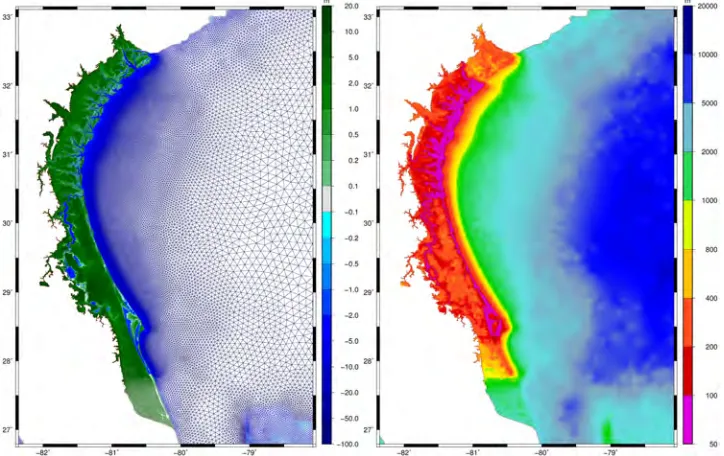
LMSL), contoured on the mesh elements (left figure). Colored boxes indicate specific regions as shown on the right: The Pam-lico Sound, North Carolina (pink), the Cooper and Savannah Rivers along the South Carolina-Georgia coast (orange) and Upper Florida showing the Fernandina Beach and St. Johns River (red). . . 19 Figure 2.4 Variation of offset values (m) along the U.S. southeast coast.
Ad-justments are shown for local sea level rise (dashed), steric effects (dotted), and total offset (solid). . . 21 Figure 2.5 Locations of selected stations for comparison of surface pressures,
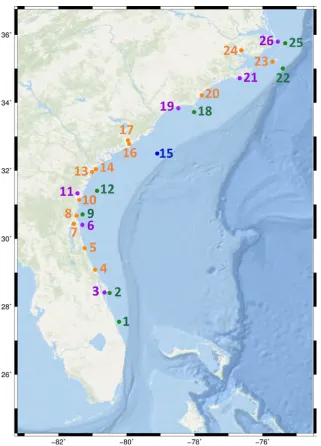
wind speeds, significant wave heights and water levels. The points are color coded as in Figure 2.1 and numbered from south to north. 23 Figure 2.6 Hindcasts of wind speeds (m/s) during Matthew along the U.S.
southeast coast. Rows correspond to: (top) 0800 UTC 07 October, approximately 31 hours before landfall; (second from top) 2000 UTC 07 October, approximately 19 hours before landfall; (second from bottom) 1500 UTC 08 October, approximately at landfall; and (bottom) 0600 UTC 09 October, approximately 15 hours after landfall. Columns correspond to: (left) GAHM; (center) WF; and (right) OWI. Black lines represent the storm track for each source. 24 Figure 2.7 Time series of pressure deficits in hPa (left column) and wind speeds
Figure 2.8 Contours of water levels (m relative to NAVD88) and vectors of OWI wind speeds (m/s) during Matthew along the U.S. southeast coast. Times correspond to: (top left) 0800 UTC 07 October, approximately 31 hours before landfall; (top right) 1700 UTC 07 October, approximately 22 hours before landfall; (center left) 0200 UTC 08 October, approximately 13 hours before landfall; (center right) 0800 UTC 08 October, approximately 7 hours before landfall; (bottom left) 1500 UTC 08 October, approximately during landfall; and (bottom right) 0600 UTC 09 October, approximately 15 hours after landfall. . . 30 Figure 2.9 Time series of water levels (m relative to NAVD88) at 12 locations
shown in Figure 2.5. Observed values are shown with gray circles, and predicted values using OWI (solid). . . 31 Figure 2.10 Locations (top row) and scatter plots (bottom row) of HWMs and
peak hydrograph values during Matthew. Columns correspond to: (left) GAHM; (center) WF; and (right) OWI. Colors indicate error expressed as a percentage of observed value. Green points indicate errors within 10%; yellow and light blue indicate errors between 10% and 25%; orange and dark blue indicate errors between 25% and 50%; and red and purple indicate errors over 50%. The thick gray and black lines representy=xand best-fit lines, respectively. Statistical metrics are shown in Table 2.2. . . 33 Figure 2.11 Nonlinear interactions on the U.S. southeast coast during Matthew.
Columns correspond to: (left) positive maximum values and (right) negative maximum values. OWI was used as the source of mete-orological forcing for the simulations with only winds, and winds and tides together. Boxes indicate the location of the region shown in Figure 2.12. . . 36 Figure 2.12 Nonlinear interaction terms during Matthew at three locations
along the Blackbeard Creek, south of Savannah, Georgia. Columns correspond to: (left) location of stations and (right) time-series of water levels (m relative to NAVD88) with line types correspond-ing to: (solid) total water levels, (dashed-dotted) surge only, (dot-ted) tides-only, and (dashed) nonlinear terms. OWI was used as the source of meteorological forcing for the simulations with only winds, and winds and tides together. . . 37 Figure 2.13 Change in maximum water levels on delaying the storm by: (a)
Figure 2.14 Variation in maximum water levels along the coastline on altering the storm timing (top) and forward speed (bottom). Water levels during the standard Matthew run are indicated by black solid lines and those from perturbations are shown using grey color with line types (solid, dashed, dotted or dashed-dotted) as indicated in the figure legends. OWI was used as the source of wind forcing for all these simulations. . . 40 Figure 2.15 Change in maximum water levels on changing the forward speed
of the storm: (left) decreasing by 50%, (center) increasing by 50%, and (right) increasing by 100%. OWI was used as the source of wind forcing for all these simulations. The coastline is shown in black and the mesh boundary in brown. . . 41
Figure 3.1 Resolution (m) in the North Carolina in the HSOFS (top) and NC9 (bottom) meshes. . . 48 Figure 3.2 Differences in bathymetry and topography (m) between the higher
resolution (left) and the coarser resolution (right) meshes used in the idealized channel test case. Blue contours indicate bathymetry and the zero contour represents the coastline. . . 49 Figure 3.3 Water levels (m) in the two meshes. Columns correspond to: (left)
finer and (right) coarser meshes. Rows correspond to water levels at the (top) peak flood stage and (bottom) peak ebb stage of the tides. . . 50 Figure 3.4 Bathy-topo (left) and resolution (right) in metres, along the
Sa-vannah River in the HSOFS mesh. The points indicate locations where time series of water levels are shown in Figure 3.5. . . 52 Figure 3.5 Time series of water levels (m relative to NAVD88) at 6 locations
shown in Figure 3.4. Observed values are shown with gray circles, and predicted values using black lines. . . 52 Figure 3.6 Difference in maximum water levels (m) between the HSOFS and
NC9 meshes corresponding to the 58th advisory. The hurricane track is shown in black. . . 53 Figure 3.7 Maximum water levels (m) predicted using the HSOFS (left) and
NC9 (right) meshes, corresponding to the 58th advisory. The hur-ricane track is shown in black. . . 54 Figure 3.8 Bathymetry and topography (m) in the NC9 mesh. . . 56 Figure 3.9 Bathymetry and topography in m (top), and resolution in m
(bot-tom) in the SC mesh. . . 57 Figure 3.10 Bathymetry and topography in m (left), and resolution in m (right)
in the GANEFL mesh. . . 58 Figure 3.11 Bathymetry and topography in m (left), and resolution in m (right)
Figure 3.12 Bathymetry and topography in m (left), and resolution in m (right) in the SFL mesh. . . 60 Figure 3.13 Maximum of the maximum water levels (m) from each storm
sim-ulation. The hurricane tracks are shown in black and the mesh-boundary in brown. . . 62 Figure 3.14 Difference in the GANEFL mesh-boundary after removing vertices
with elevations over 5 m. The boundaries before and after the cut down is shown in brown and green, respectively. . . 63 Figure 3.15 Merging the SFL and open-water meshes: (1) the open water mesh
without the buffer and SFL regional mesh, (2) the SFL regional mesh cut at the 30 m bathymetric contour, and (3) the buffer mesh used to provide a smooth transition in element spacing between 1 and 2. The elements and boundaries are shown using black trian-gles and lines respectively. . . 64 Figure 3.16 FEMA-SAB mesh bathymetry and topography (m relative to
NAVD88) contoured on the mesh elements. Colored boxes indi-cate specific regions as shown in Figure 3.18. . . 67 Figure 3.17 Element spacing (m) along the U.S. southeast coast in the (left)
FEMA-SAB mesh and (right) HSOFS mesh. . . 68 Figure 3.18 Bathymetry and topography (m) contoured on the mesh elements
at locations represented by coloured grids in Figure 3.16. Columns correspond to: (left) FEMA-SAB mesh, and (right) HSOFS mesh. Rows correspond to: (top) Saint Lucie Inlet, FL, (center) Up-stream Savannah River along the GA-SC border, and (bottom) Outer Banks, NC. The FEMA-SAB mesh bathymetry is relative to NAV888, whereas the HSOFS mesh values are referenced to LMSL). 69 Figure 3.19 Variation of horizontal eddy viscosity ( m2 s−1) along the U.S.
southeast coast in the FEMA-SAB mesh. . . 73 Figure 3.20 Variation of Tau0 (s−1) along the U.S. southeast coast in the
FEMA-SAB mesh. . . 74 Figure 3.21 Variation of ManningsN (m s−1/3) along the U.S. southeast coast
in the FEMA-SAB mesh. . . 75 Figure 3.22 Variation of surface directional effective roughness length (m) along
the U.S. southeast coast in the FEMA-SAB mesh, corresponding to the 60 degree direction. . . 76 Figure 3.23 Variation of VCanopy (unitless) along the U.S. southeast coast in
the FEMA-SAB mesh. . . 77 Figure 3.24 Variation of elemental slope limiter (unitless) along the U.S.
Figure 3.25 NHC best track for Florence (black line and diamonds), along with observation locations of water levels (blue circles) on the U.S. southeast coast. High-water marks are not shown. The storm cen-ter positions are shown every 6 hr and color-coded to categories on the Saffir-Simpson scale. The storm positions are labeled in dates/times relative to UTC. . . 80 Figure 3.26 Time series of water levels (m relative to NAVD88) at the 12
locations shown in Chapter 2. Observed values are shown with gray circles, and predicted results using black lines with line types corresponding to: (solid) FEMA-SAB mesh, and (dashed-dotted) HSOFS mesh. . . 83 Figure 3.27 Locations of selected stations for comparison of water levels. The
points are numbered from south to north. . . 84 Figure 3.28 Time series of water levels (m relative to NAVD88) at the 10
lo-cations shown in Figure 3.27. Observed values are shown with gray circles, and predicted results using black lines with line types corresponding to: (solid) FEMA-SAB mesh, and (dashed-dotted) HSOFS mesh. . . 85 Figure 3.29 Locations (top row) and scatter plots (bottom row) of HWMs and
peak hydrograph values during Matthew. Colors indicate error expressed as a percentage of observed value. Green points indicate errors within 10%; yellow and light blue indicate errors between 10% and 25%; orange and dark blue indicate errors between 25% and 50%; and red and purple indicate errors over 50%. The thick gray and black lines representy=xand best-fit lines, respectively. Statistical metrics are shown in Table 3.2. . . 88 Figure 3.30 Locations of selected stations for comparison of water levels. The
points are numbered from north to south. . . 90 Figure 3.31 Time series of water levels (m relative to NAVD88) at the 10
Figure 3.32 Locations (left column) and scatter plots (right column) of HWMs and peak hydrograph values during Matthew. Rows correspond to: (ltop) FEMA-SAB mesh; and (bottom) HSOFS mesh. Colors indicate error expressed as a percentage of observed value. Green points indicate errors within 10%; yellow and light blue indicate errors between 10% and 25%; orange and dark blue indicate errors between 25% and 50%; and red and purple indicate errors over 50%. In the location plots, the mesh-boundary is shown in brown. For the scatter plots, the thick gray and black lines representy =xand best-fit lines, respectively. Statistical metrics are shown in Table 3.2. 94
Figure 4.1 Panels showing (top row) bathymetry (m) and (bottom row) wa-ter levels (m) from the Mixed simulation on the example case. Columns correspond to: (left) the digital elevation model; (cen-ter) coarse mesh; and (right) fine mesh. The water levels shown are for: (bottom-center) at the end of the coarse part ofMixed be-fore the switch, and (bottom-right) at the beginning of the fine part ofMixed after the switch. (The water levels in (bottom-center) are interpolated/extrapolated to become the water levels in (bottom-right).) Black dots indicate locations of the points where water levels are shown in Figure 4.2, and triangles indicate locations of mesh elements. . . 103 Figure 4.2 Boundary forcing (m) and water levels (m) for the simple example.
On the top-left is the variation in input forcing with line types cor-responding to (dotted) tides-only, (dashed) surge-only, and (solid) tides plus surge. The other three plots indicates time-series of wa-ter levels (m) at the three locations shown in Figure 4.1 with line types corresponding to: (solid)Coarse, (dotted)Fine, and (dashed-dotted)Mixed. . . 104 Figure 4.3 Scatter plots of HWMs and peak hydrograph values during
Figure 4.4 Contours of wind speeds (knots) during Florence along the NC coast. The time corresponds to 0000 UTC 13 September 2018 (36 hours before landfall), when switching between the coarse and fine meshes was done in the Mixed approach. Red dot indicates the point used to calculate distances to the maximum wind isotachs in Table 4.3 . . . 111 Figure 4.5 Difference in maximum water levels (m) between: (a)Coarse and
Fine, (b)Coarse andMixed, (c)Mixed andFine, and (d)Coarse and Mixed, but only locations where theCoarse was dry andMixed was wet. The coastline is shown in black and the fine-mesh boundary in brown. . . 114 Figure 4.6 Columns correspond to: (left) Bathymetry and topography in the
coarse (upper) and fine (bottom) meshes; and (right) Time Series of water levels (m) at the 3 locations indicated by red dots, with line types corresponding to: (solid) Coarse, (dotted) Fine, and (dashed-dotted) Mixed. . . 116 Figure 4.7 Columns correspond to: (left) Difference in maximum water levels
(m) between Coarse; and Mixed and (right) Only locations where the Coarse was dry and Mixed was wet. The coastline is shown in black and the fine-mesh boundary in brown. Black dots indicates the locations of the three points in Figure 4.6 . . . 117
Figure 5.1 Time series of water levels (m relative to NAVD88) at 6 locations along the US coastline (south to north) during Matthew. Rows correspond to: (top) stations on East-Florida coastline; (center) stations along the GA-SC coastline; and (bottom) stations along the NC coastline. Columns correspond to: (left) station where the impact of the storm was first recorded; and (right) station where the impact was last recorded on that particular coastline. Observed values are shown with gray circles. Blue and red lines indicate the starting and ending time of storm’s impact on water levels along that particular coastline respectively. . . 121 Figure 5.2 Locations of eye of the Matthew (diamonds) along with
Figure 5.3 Application of the approach during Matthew. Black triangles(a) indicate the elements of the HSOFS mesh. Solid black lines (b to f) indicate the part of the single high resolution mesh (black dashed lines) to be used at that particular point in time. Times T1 to T5 are the same as in Figures 5.1 and 5.2. The NHC best track for Matthew is shown by red lines and the storm-eye by diamonds. . . 125 Figure 5.4 Watershed boundaries for the U.S. southeast coast. Orange dots
indicate points that will be used to trigger switching between the meshes. . . 128 Figure 5.5 High-resolution coverage of the WSB307+306+305 mesh. The
mesh-elements are shown as black triangles, the mesh-boundary in green, and the orange dots indicates watershed boundary points as in Figure 5.4. . . 129 Figure 5.6 Time series of water levels (m relative to NAVD88) at the 10
loca-tions shown in Figure 5.4. . . 130 Figure 5.7 Time series of wind speeds (m/s) at the 10 locations shown in
Figure 5.4. . . 131 Figure 5.8 Time series of significant wave heights (m) at the 10 locations shown
in Figure 5.4. . . 132 Figure 5.9 Panels of: (left) Maximum water levels (m, NAVD88) for the
HSOFS Fine simulation; and (right) difference in maximum wa-ter levels (m) between the HSOFSTest and Fine simulations. The
coastline is shown in black and the mesh-boundary in brown. . . . 135 Figure 5.10 Maximum water levels (m, NAVD88) from the Fine simulation
(top-left), and differences in maximum water levels (m) as com-pared to theFineresults for: (top-right)FEMA-SABACC;
(bottom-left) FEMA-SABOPT; and (bottom-right) FEMA-SABEFF
Chapter 1
Introduction
Coastal regions are under a constant threat of property damage and casualties from
hurricanes, tsunamis, Nor’easters, and winter storms. Sustained winds and heavy rainfall
are not the only deadly factors during these natural hazards. The greatest threat to life
comes in the form of storm surge, measured as the height of the water above the normal
predicted astronomical tide. In flat regions, this may lead to intrusion of the salt water 10 to 20 miles inland (Conner et al., 1957). This flooding can also be accompanied by
erosion processes due to wave action, including breaching of barrier islands. Large-scale
features that would influence this surge include: the intensity, size, speed, and path of
the storm; the general configuration of the coastline; bottom topography near the coast;
and the stage of the astronomical tide (Harris, 1956; Reid et al., 1954). There can be
also small-scale features that affect the surge locally, such as convergence or divergence
in bays and estuaries, local wind-setup, seiching, etc.
The coastal populations on every continent exploded as global trade flowed through
international ports, creating jobs and economic growth. In 2001, more than 50 percent of
the world population lived within 200 km of the coastline (Tibbetts, 2002; Creel, 2003). Presently, 44 percent of the world’s population lives within 150 km of the coast (UN Atlas
of the Oceans, 2018). In the U.S., more than 39 percent (123.3 million people) of the
population lived in coastal shoreline counties in 2010 (NOAA et al., 2013). These
loca-tions also had the highest population density of 446 persons per square miles, compared
to the average U.S. density of 105 persons per square miles. With this ever-increasing
growth and development of coastal areas, greater damage to property and loss of life
The development and implementation of numerical models allows in the prediction of
these natural hazards so their potential effects can be understood and lives and property
can be protected from future storms.
Storm surge forecasting begin as early as the 1950s when the central pressure of
cyclones was used to estimate the maximum surge height (Hoover, 1957; Conner et
al., 1957). Improvements to these methods included using wave heights and stratifying
the cyclones according to their wind direction (Tancreto, 1958), employing multistation
surge models (Pore, 1964) and using approach paths (Chan et al., 1979). Recognizing
the complexity of surge forecasting, Harris (1963) developed a computer-aided empirical
model that included pressure effect, direct wind effect, Coriolis force, waves and rainfall as processes affecting storm surge. His first approximation showed that the effects of the
Coriolis force, waves, and wind set-up at sea are all proportional to the wind stress, and
that the wind stress is proportional to the pressure gradient. Also in general, rainfall was
observed to be correlated with below-normal pressures, resulting in all five factors being
directly related to pressure gradients.
Advances in computing power allowed the inclusion of more parameters and usage of
more complex equations, leading to development of the Special Program to List
Ampli-tude of Surge from Hurricanes (SPLASH) (Jelesnianski, 1972). This approach computed
peak surge via nomograms that used maximum wind, radius of the maximum wind, direction of landing, bathymetry, and central pressure data. The Federal Emergency
Management Agency (FEMA) SURGE Model (Dresser et al., 1985) was first introduced
in 1976 as the TTSURGE Model, and uses an explicit, two-dimensional, space-averaged,
finite-difference scheme to simulate the surges caused by hurricanes. Inputs to the model
include the bathymetry, coastline configuration, boundary conditions, bottom friction,
and other flow resistance coefficients. Also required are the surface wind stress and
at-mospheric pressure distributions of a hurricane. The model uses a rectangular grid to
represent the area of interest and usually employs a nested grid system so that greater
detail can be added along the coastline. Hurricane Audrey of 1957 was successfully sim-ulated using the model and the results showed good agreement with the flood records
(Suhayda et al., 1988).
The Sea, Land, Overland Surge from Hurricane (SLOSH) model (Jelesnianski et al.,
1992) was later designed by the National Weather Service to estimate storm surge heights
atmospheric pressure, size, forward speed, and track data. During a hurricane, the
po-tential surge for an area is calculated by running the model with hypothetical hurricanes
with various landfall directions and locations, Saffir-Simpson categories, forward speeds,
sizes, and tide levels. The envelope of high water from each such run is then combined to
create worst case scenario to aid in hurricane evacuation plans. Although useful in
fore-casting and computationally fast, the spatial coverage of each SLOSH grid only ranges
from an area the size of a few counties to a few states. But larger domains are needed for
capturing large-scale processes and improved accuracy (Blain et al., 1994; Westerink et
al., 1994). Also the use of a structured mesh can limit the ability for localized resolution
and therefore potentially hampers accuracy in SLOSH (Kerr et al., 2013).
Coastal morphological features like inlets, lagoons, barrier islands and shoreline
con-figuration have a great influence on inundation. The accuracy of flooding predictions thus
depends on whether the model has sufficient resolution to resolve these features. Because
it is difficult for finite difference models with structured grids to represent such fine
fea-tures, finite element models using unstructured grids are employed in accurate storm
surge forecasting. ADvanced CIRCulation (ADCIRC) (Luettich et al., 1992; Luettich
et al., 2004; Westerink et al., 2008) is a depth-integrated, shallow-water, finite-element
model capable of simulating tidal circulation and storm-surge propagation over large
com-putational domains. ADCIRC is used by FEMA in the development of flood insurance rate maps and by the U.S. Army Corps of Engineers (USACE) for navigation and storm
protection projects. The National Oceanic and Atmospheric Administration (NOAA)
also uses ADCIRC for tidal calibrations and incorporation into its vertical datum
trans-formation software VDatum. The use of unstructured meshes in ADCIRC allows the
usage of triangular finite elements of varying sizes to represent complex coastal features,
barrier islands and internal barriers. This also permits for gradation of the mesh that
increases feature detail when moving from the deeper ocean, onto the continental shelf,
into estuaries and marshes, and over low-lying coastal floodplains. More details of the
model are given in Chapter 2.
These unstructured meshes can be still be large, composing of millions of elements.
For example, the SL18TX33 mesh (Hope et al., 2013) uses 9 M vertices and 18 M
ele-ments to provide a detailed description of coastal floodplains of Alabama, Mississippi,
Louisiana, and Texas. Element sizes varies from 20 km or larger in the Atlantic Ocean
features. Thus, although these models provide reliable and accurate results by virtue of
their high-resolution description of coastal features, simulations can be computationally
expensive, requiring several hours even on thousands of computational cores (Dietrich
et al., 2012). This is a challenge in storm surge modeling, especially in forecasting
appli-cations where model predictions are required on the order of 1 hr or so, to aid emergency
mangers in decision-making during a hurricane.
The present study describes a multi-resolution approach to cut down the total
compu-tational cost of running unstructured-mesh, storm surge models. The study begins with
an application of the state-of-the-art in storm surge modeling to predict coastal flooding
along the the U.S. southeast coast during Hurricane Matthew (2016). In the later chap-ters, I apply a multi-resolution method that permits the use of higher-resolution meshes
to increase the accuracy of flooding predictions. This method will also help in decreasing
the simulation time by using high-resolution only when required. This is attained by
us-ing multiple meshes with different levels of resolution at different times in the simulation.
Higher-resolution meshes will be used to resolve coastal inundation only when necessary
rather than during the entire simulation. An overview of each of the individual chapters
of this dissertation is provided below.
Storm surge and flooding due to hurricanes can cause significant damage to property,
loss of life, and long-term damage to coastal landscapes. Hurricane Matthew (2016) was a Category-5 storm that impacted the southeastern U.S. during October 2016, moving
mostly parallel to the coastline from Florida through North Carolina. In Chapter 2,
the tightly-coupled ADCIRC+SWAN storm surge forecasting model is used to simulate
Matthew’s effects on this long coastline, and then validated against extensive
observa-tions of surface pressures, wind speeds, waves, and water levels. Data-assimilated wind
products was found to better represent Matthew’s effects as compared to the
paramet-ric vortex model, which is based on best-track information from the National Hurparamet-ricane
Center. A relatively-coarse unstructured mesh having an average coastal resolution of
500 m, and having a coverage that included the coastal floodplains impacted by Matthew was then used to predict Matthew’s impact on the U.S. southeast coast. Even with this
relatively-coarse mesh, the modeled results showed good agreement to observations for
waves, water levels and high water marks, thus proving the capability of the coupled
ADCIRC+SWAN model to provide accurate coastal flooding predictions.
above-mentioned coarse-resolution mesh were comparable to that using meshes with much
higher-resolution, there were localized regions like rivers along the South Atlantic Bight,
sound-side of barrier islands in North Carolina, etc., where the errors where larger. This
was attributed to its larger coastal resolution, which is insufficient to represent smaller
features like channels, tidal inlets and dune crests. Therefore a mesh with detailed
cov-erage of floodplains on the U.S. southeast coast is developed and validated in Chapter 3.
This mesh will then be also used in later chapters for a coarse-grain mesh adaptivity, by
including the floodplains only when required.
This high-resolution mesh was created from existing regional meshes, which were
developed by FEMA for flood risk mapping. It has a resolution of less than 100 m in most places along the southeastern U.S. coastline with the element spacing going
down to less than 10 m in some of the smaller channels in South Florida. This mesh
was then tested by running ADCIRC+SWAN simulations of two storms that impacted
the U.S. southeast coast in different ways. For both these storms, the predictions of
water levels were either better or comparable to predictions using the coarse-resolution
mesh mentioned above, meanwhile flooding a larger number of observed-stations. The
main differences occurred inland away from the coastline, where it better captured the
tidal impacts and/or had a better match to the peak water levels, due to its detailed
representation of topography and bathymetry. Thus although this mesh has roughly three times the number of elements as that of the coarse-resolution mesh, its predictions
were a better match to observations, especially inland.
In Chapter 4, a method to reduce the computational workload of storm surge models
is proposed. Although different methods to increase resolution in storm surge models can
be seen in literature, the proposed approach is a first of its kind. Rather than using a
high-resolution mesh throughout the simulation, high-resolution can be turned on depending on
where the storm is located at a particular point in time. A coarse-resolution mesh without
extensive coastal detail is used when the storm is far away. As the storm approaches the
region of interest, results are mapped on to a high-resolution mesh. The simulation then continues on the fine mesh providing high-accurate results for that coastline. A save is
tine is also achieved as the use of a highly-refined mesh is avoided when the storm is far
away. The approach was tested in the case of two storms with different parameters like
track, intensity, etc, and results indicated a gain in accuracy and efficiency as compared
In Chapter 5, the multi-resolution approach described in Chapter 4 is again applied to
hindcasts of Hurricane Matthew along the U.S. southeast coast. But rather than using a
single switch between the coarse and the full resolution mesh, multiple smaller
fine-resolution meshes will be used depending on the storm’s impact area at different points
in time. Questions about how best to apply the approach given information about the
storm and predicted values of water levels, wind speeds, and wave heights will be explored
using three simulations, each targeting a different level of accuracy and efficiency. Results
from these simulations indicate how to achieve an optimum balance between accuracy
and efficiency using the approach, and the best ways to choose combinations of meshes for
representing the storm’s impact region. Thus, an efficient use of the proposed method during forecasting can allow for a more accurate and timelier guidance. Finally, the
Chapter 2
Influence of Storm Timing and
Forward Speed on Tides and Storm
Surge during Hurricane Matthew
2.1
Overview
In this chapter, the sensitivity of surge predictions to timing and forward speed of a
storm are analyzed in the context of Hurricane Matthew (2016). First, the effects of
Matthew on the southeastern U.S. coastline are explored by performing hindcasts of a
coupled hydrodynamic-wave model, using three sources of atmospheric forcing and an unstructured mesh with a widespread coverage that includes the areas impacted by the
storm. Then, the contribution of nonlinear interactions between surge and tides to the
spatial variability of Matthew’s effects on total water levels is analyzed. Finally, the
influence of storm timing and forward speed on tides and surge during Matthew are
separately analyzed. This chapter has been published in Ocean Modelling as Thomas et al. (2019).
2.2
Introduction
Matthew was a tropical cyclone that reached Category-5 hurricane status on the
Saffir-Simpson hurricane wind scale during 2016. Matthew affected about 1900 km of coastline
(Stewart, 2017). Between 1900 UTC 06 October when the storm was located offshore of
Miami, Florida, and 0600 UTC 09 October when it was located offshore of Cape Hatteras,
North Carolina, Matthew remained close to the coast and moved along a shore-parallel
track (Figure 2.1) with a relatively-slow forward speed of 5 to 7 m/s. Observations indicate large variations in peak water levels all along the U.S. Atlantic coast, and we
hypothesize that this was caused by the storm’s slower forward speed and shore-parallel
track, which allowed it to interact with different stages in the tidal cycle at different
locations and over several days.
Several studies have examined the interactions between tides and surge. In the 1950s,
Proudman developed theoretical solutions for the propagation of an externally forced tide and surge into an estuary of uniform section (Proudman, 1955; Proudman, 1957) and
also identified the tendency of peak surge to most often occur on high tides, which was
later confirmed (Rossiter, 1961; Prandle et al., 1978). Tides and surge can also interact
nonlinearly, thus causing the water levels to be even higher or lower than their individual
contributions would suggest, due to feedbacks through bottom friction, shallow-water
effects, and advection (Wolf, 1978). Nonlinear parameterization of bottom stress was
found to the primary contributor to nonlinear tide-surge interactions along the
Queens-land coast of Australia (Tang et al., 1996), on the east coast of Canada and northeastern
United States (Bernier et al., 2007), and along the Fujian coast (W. Zhang et al., 2010). Along the southeast coast of the United States, Coriolis acceleration was found to be a
significant contributing factor to these perturbations (Valle–Levinson et al., 2013; Feng
et al., 2016). The magnitude of these interactions can be large, reaching as high as
70% of the tidal amplitudes (Rego et al., 2010) along the Louisiana-Texas coast during
Hurricane Rita, and 74 cm (Idier et al., 2012) for storms in the English channel. The
tide-surge nonlinearities were also large with a mean absolute value of 60% of the tide
magnitude (Lin et al., 2012) for synthetic surge events in New York Harbor, and at least
15−20% for idealized cyclone tracks and straight coastlines representing the west coast
of India (Poulose et al., 2017).
It can be challenging to include these nonlinear interactions in surge predictions.
Flood risk studies typically represent the hurricane climate by using the Joint Probability
Method (JPM) with synthetic storms to determine the flooding at various return periods.
The effect of tides can be a crucial factor in these studies. For studies looking at smaller
addition to the JPM integral error term (Niedoroda et al., 2010). Other studies included
tides into the JPM analysis by randomly adding tidal heights to the surge response (Ho
et al., 1975; Blanton et al., 2012; U.S. Army Corps of Engineers, 2018). However, these
additions do not incorporate the often-large effect of the nonlinear interactions between
the surge and tides. The present study quantifies these interactions along the entire U.S.
southeast coast during Matthew, including their variation from the continental shelf into
the estuaries. The representation of coastal floodplains is larger than in previous studies
and can allow the flooding from the shore-parallel storm to interact with multiple phases
of the tides.
The effects of storm parameters like size, landfall location, wind speeds, and direction of approach on surge have also been studied previously ((Weisburg et al., 2006; Irish et
al., 2008; Sebastian et al., 2014)). The effect of storm forward speed can vary. The surge
can be greater for a faster storm, e.g., for a standard hurricane on a representative shelf
(Jelesnianski, 1972). Along the Louisiana-Texas shelf for Hurricane Rita, increasing the
forward speed of the storm caused higher surges but smaller total flooded volumes (Rego
et al., 2009). But the surge and inundation areas can also be greater for a slower storm,
e.g., for the estuaries of North Carolina (Peng et al., 2004), and for the Dutch coast (N. J.
Berg, 2013). For the Charleston Harbor in South Carolina, although a slower storm can
produce larger inundation areas, whether or not it can produce larger surge depends on the faster storm’s speed and the distance of the track from the harbor (Peng et al., 2006).
While these studies have identified the vulnerability of the coastline to hurricane storm
surge under different scenarios, they considered small regions or idealized coastlines, and
storms that moved perpendicular to the coastline. The present study uses Hurricane
Matthew’s track along the coast from Florida to North Carolina to examine how the
forward speed of a shore-parallel storm affects the surge and inundation along a complex
estuarine coastline and coastal floodplain.
This study uses the coupled ADCIRC+SWAN model, which has proven to be accurate
in flood predictions in many coastal systems (Hope et al., 2013; Suh et al., 2015; Dietrich et al., 2018). The model utilizes an unstructured, finite-element mesh developed for
surge and tide predictions for the U.S. Atlantic and Gulf coasts (Riverside Technology
et al., 2015). The unstructured mesh can represent a large domain, while using sufficient
resolution to represent the complex shoreline. This combination allows for comprehensive
influence of storm timing and forward speed on flooding for a shore-parallel storm in a
large domain. The goals are addressed by (a) validating model predictions of winds, and
water levels during Matthew on a mesh with floodplain coverage over a large extent, (b)
quantifying the contributions of nonlinear interactions to the total water levels, and (c)
quantifying the differences in flooding due to differences in the storm’s forward speed
and time relative to the tidal cycle.
2.3
Hurricane Matthew
2.3.1
Synoptic History
Matthew began as a tropical wave off the west coast of Africa on 23 September 2016
(Stewart, 2017), and by 1200 UTC 28 September, measurements indicated a tropical
storm formation about 27 km west-northwest of Barbados. Moving into the Caribbean
Sea, Matthew attained hurricane status on 1800 UTC 29 September about 300 km
north-east of Cura¸cao. Matthew then turned west-southwest and intensified to an estimated
peak intensity of 75 m/s (Category-5) on 0000 UTC 1 October. Over the next few days, the storm weakened to a category 4 status as it moved northward and made landfall with
peak wind speeds of 66 m/s over Haiti (1100 UTC 4 October) and 59 m/s over Cuba (0000 UTC 5 October). By 1200 UTC 6 October, the storm brought hurricane-force
winds and flooding rains to most of the central and northwestern Bahamas with a peak
wind speed of 64 m/s. The category 4 hurricane made landfall near West End, Grand Bahama Island, around 0000 UTC 7 October (Stewart, 2017).
A broad eastward-moving mid-latitude trough located over the central United States
then caused Matthew to turn toward the north-northwest (Stewart, 2017) and impact
much of the southeastern U.S. (Figure 2.1). The storm weakened to a category 3 hurricane around 0600 UTC 7 October about 64 km east of Vero Beach, Florida, and to a category
2 hurricane by 0000 UTC 8 October about 92 km east-northeast of Jacksonville Beach,
Florida. As the storm moved northward, its wind field expanded causing
hurricane-force wind gusts across the coastal regions of southeastern Georgia and southern South
Carolina. The mid-latitude trough then caused the storm to weaken to a category 1
status (Stewart, 2017). Moving nearly parallel to the coast of South Carolina, Matthew
The center of the hurricane then traveled offshore of the coast of South Carolina and
remained just offshore of the coast of North Carolina through 9 October. Contributions
from Matthew’s tropical moisture, the ongoing extratropical transition and an increasing
pressure gradient from an approaching cold front caused sustained hurricane-force winds
over the Outer Banks and significant sound-side storm-surge flooding during the early
hours of 9 October. Matthew lost its tropical characteristics by 1200 UTC 9 October, as
it moved away from the U.S (Stewart, 2017).
2.3.2
Extensive Observations along U.S. East Coast
Matthew’s effects on surface pressures and wind speeds, offshore and nearshore waves,
and coastal water levels are well-described by observational data. Along the southeastern
U.S. coast from Florida through North Carolina (Figure 2.1), the National Oceanic and Atmospheric Administration (NOAA), the U.S. Geological Survey (USGS), and other
agencies collected information at hundreds of buoys, permanent and rapidly deployed
gauges and stations, and real-time sensors. Along the storm’s path, surface pressures
were observed at 283 locations, wind speeds and directions were observed at 66 locations,
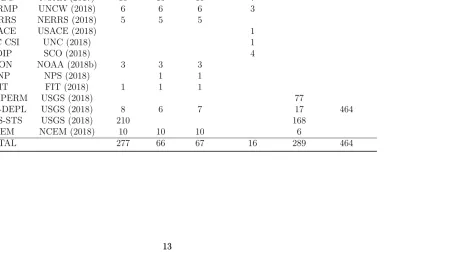
and significant wave heights were observed at 16 locations (Table 2.1). Time series
observations at buoys and stations operated by the NOAA National Data Buoy Center
(NDBC) and the NOAA National Ocean Service (NOS) show how the peak,
10-minute-averaged wind speeds evolved during the course of the storm. Wave parameters were also
observed at many of these same locations.
These winds and waves caused setup and storm surge along the southeastern U.S.
coastline. NOS and USGS permanent and rapidly-deployed gauges collected observations;
time series of water levels at 501 locations and 612 high-water marks (HWMs) were
identified within the model extent. For the analyses herein, observations were omitted
that did not operate during the storm peak or that showed elevated water levels after
the storm due to freshwater run-off or wave run-up, thus leaving 289 time series and 464
HWMs to describe storm surge (Table 2.1). These observations are used to validate our
Table 2.1 Numbers of available observations for atmospheric, wave, and water-level responses to Matthew.
Surface Wind Wind Significant Water High Data Source Reference Pressure Speed Direction Wave Height Levels Water Marks
NOS NOAA (2018a) 19 19 19 21
NDBC NOAA (2017) 15 15 15 7
CORMP UNCW (2018) 6 6 6 3
NERRS NERRS (2018) 5 5 5
USACE USACE (2018) 1
UNC CSI UNC (2018) 1
CDIP SCO (2018) 4
ICON NOAA (2018b) 3 3 3
ENP NPS (2018) 1 1
FIT FIT (2018) 1 1 1
USGS-PERM USGS (2018) 77
USGS-DEPL USGS (2018) 8 6 7 17 464
USGS-STS USGS (2018) 210 168
NCEM NCEM (2018) 10 10 10 6
2.4
Methods
Predictions of waves and storm surge are sensitive to the atmospheric conditions used as
forcing to the model simulations. In this study, we evaluate forcings from three sources: a
vortex model based on storm parameters like the track, forward speed, and isotach radii; and two data-assimilated products available after the storm. Then the most-accurate
atmospheric forcing is used for a detailed hindcast of Matthew’s effects on water levels
throughout the southeastern U.S., via comparison with extensive observations. This
study uses the depth-averaged, barotropic version of ADCIRC, because the strong surface
stresses during storms causes the water column to be well-mixed in shallow nearshore
and coastal regions. This hindcast is then used as the basis for studies of the nonlinear
interactions between tides and surge, and of the effects of storm timing and forward
speed. In this section, details are provided about the three sources for surface pressure
and wind fields that were evaluated for hindcasts of Matthew, as well as the input settings for the coupled ADCIRC+SWAN model.
2.4.1
Surface Pressure and Wind Fields
Hydrodynamic predictions are analyzed with three sources of atmospheric forcing: a
pa-rameterized vortex model based on storm parameters from the National Hurricane Center
(NHC), and two data-assimilated products. For all three sources, the surface pressures
and wind velocities are developed (either by the parametric model or by interpolation
from the data-assimilated products) at the computational points in the model domain.
ADCIRC accounts for canopy cover and applies a surface roughness reduction factor
increases to full marine winds as overland regions are inundated (Kerr et al., 2013).
2.4.1.1 Parametric Vortex Model
It is common to use parametric vortex models to represent storm wind fields based on
limited input information (Xie et al., 2006; Hu et al., 2012; Hu et al., 2015). These
mod-els assume a hyperbolic radial pressure field that depends on the ambient and cyclone
central surface pressures, the radius to maximum winds, and the hurricane-shape
pa-rameter (Schloemer, 1954; Holland, 1980). Several parametric vortex models have been
(Mattocks et al., 2006; Mattocks et al., 2008; Dietrich et al., 2013a). The most complete
is the Generalized Asymmetric Holland Model (GAHM),which has been shown to be a
better representation than earlier versions (Gao et al., 2017), and to compare well with
observation-based analysis products and full-physics numerical models (Dietrich et al.,
2018; Cyriac et al., 2018). In this study, GAHM is used with the NHC Best Track storm
parameters for Matthew (Stewart, 2017) to generate surface pressures and wind speeds at
every computational point in the ADCIRC domain. Unlike the two atmospheric forcings
described below, GAHM is not data-assimilated and only represents the vortex, with no
far-field meteorological representation.
2.4.1.2 Data-Assimilated Atmospheric Products
Surface pressure and wind velocities from WeatherFlow Inc. (WF) were developed using
the Weather Research and Forecasting (WRF) model (Skamarock et al., 2008), which
can simulate weather processes at synoptic scales down to large eddy simulations at
microscales. During Matthew, 52 stations measured sustained wind speeds greater than
22 m/s, with 32 stations measuring gusts of at least 33 m/s. These observations were assimilated into fields of surface pressures and wind velocities.These fields cover a period from 2000 UTC 06 October 2016 until 2000 UTC 09 October 2016, at 10-min intervals.
The fields cover from latitude 24.15◦N to 38.67◦N and from longitude 83.55◦W to 72.02◦W with square elements of 96.12 arc-seconds (approximately 3 km north-south by 3 km
east-west). The surface pressures and wind velocities are interpolated in space and time to
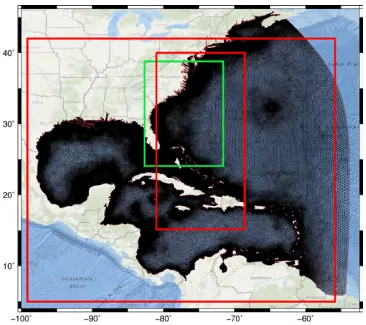
the ADCIRC computational points within the WF domain (Figure 2.2).
The second source for data-assimilated products was Oceanweather Inc. (OWI), whose
fields are based on observations from anemometers, airborne and land-based Doppler
radar, airborne stepped-frequency microwave radiometer, buoys, ships, aircraft, coastal
stations and satellite measurements (Bunya et al., 2010). For Matthew, the Tropical PBL (TropPBL) model (Cardone et al., 1994; Thompson et al., 1996) was applied in
the core during the entire storm, with hand analysis overlay from 2100 UTC 06
Octo-ber 2016 until 1500 UTC 09 OctoOcto-ber 2016, to better represent the interaction of the
storm with the coast. The resultant wind and pressure fields are then subject to manual
kinematic analysis using the IOKA system to add features that are not well-resolved by
the TropPBL model, as well as in-situ, satellite, and aircraft data, into the final fields.
Figure 2.2 Coverage area of the WF (green) and OWI (red) wind grids over the HSOFS unstructured mesh (black).
above the ground/sea level with consideration to marine exposure. Lagrangian-based
interpolation is then used to produce fields at 15 min intervals. For use as atmospheric
forcing to hydrodynamic models, the surface pressure and wind fields are represented
with a lower-resolution basin grid and a higher-resolution region grid (Figure 2.2). The basin grid covers from latitude 5◦N to 42◦N and from longitude 99◦W to 55◦W with a spatial resolution of 0.25◦, whereas the higher-resolution region field covers from latitude 15◦N to 40◦N and from longitude 82◦W to 68◦W with a spatial resolution of 0.05◦, both covering a period from 0000 UTC 01 October 2016 until 0000 UTC 11 October 2016, at
2.4.2
Coupled Models for Nearshore Waves and Circulation
The storm-induced waves and circulation during Matthew must be predicted by modelsthat can represent their interactions over a wide range of temporal and spatial scales,
including coastal flooding into overland regions. We use the coupled SWAN+ADCIRC
models (Dietrich et al., 2011b; Dietrich et al., 2012), which have been validated
exten-sively for flooding during tropical cyclones (Bhaskaran et al., 2013; Hope et al., 2013;
Suh et al., 2015; Dietrich et al., 2018).z
The unstructured-mesh version of SWAN uses a sweeping Gauss-Seidel method to
propagate efficiently the wave action density (Booij et al., 1999; Zijlema, 2010). The
action balance equation is used to incorporate source/sink terms for nearshore wave physics, such as triad nonlinear interactions, bottom friction and depth-limited breaking,
in addition to deep-water physics of quadruplet nonlinear interactions and whitecapping.
The simulations in this study use SWAN version 41.01 with a time step of 600 s. The
spectral space is discretized using 36 directional bins with directional resolution of 10◦ and 40 frequency bins with a logarithmic resolution over the range 0.031 to 1.42 Hz. This logarithmic discretization of frequencies is based on the ratio of ∆f /f = 0.1 for the discrete interaction approximation of the quadruplet interactions (Hasselmann et al.,
1985). This spectral discretization and other physical and numerical settings are the
same as used in previous hindcast studies by the authors (Dietrich et al., 2011a; Dietrich et al., 2013b). To prevent excessive directional turning or frequency shifting at a single
vertex due to steep gradients in bathymetry or ambient currents, the spectral velocities
in SWAN are limited using a CFL restriction (Dietrich et al., 2013b) with an upper limit
of 0.25.
ADCIRC uses the continuous-Galerkin finite element method to solve the shallow
water equations on unstructured meshes (Luettich et al., 1992; Kolar et al., 1994;
Luet-tich et al., 2004; Dawson et al., 2006; Westerink et al., 2008). Water levels are
calcu-lated using the Generalized Wave Continuity Equation (GWCE), which is a combined
and differentiated form of the continuity and momentum equations (Kinnmark, 1986), whereas depth-averaged current velocities are determined from the vertically-integrated
momentum equations. For the simulations in this study, ADCIRC version 52.30.13 is
used in explicit mode with the lumped mass matrix form of the GWCE (Tanaka et al.,
2011). The bottom drag is applied using a depth-dependent quadratic friction law, with
al., 1992; Luettich et al., 2004). These Manning’s n values are also used by SWAN to compute roughness lengths based on the updated ADCIRC water levels at each mesh
vertex (Bretschneider et al., 1986; Madsen et al., 1988; Dietrich et al., 2011a). The
min-imum bathymetric height and friction-surface velocity required for wetting are 0.10 m and 0.01 m/s, respectively. The spatially-constant horizontal eddy viscosity for the mo-mentum equations was set to 50 m2 s−1, and an ADCIRC time step of 1 s was used. The wind drag coefficients on the water surface are calculated using the Garratt formulation
(Garratt, 1977; Westerink et al., 2008) with an upper limit of CD = 0.002, similar to previous studies (Dietrich et al., 2011a; Dietrich et al., 2012). The advective transport
terms were enabled to account for nonlinear interactions between surge and tides. The unstructured-mesh spectral wave model SWAN and the shallow water circulation
model ADCIRC were integrated into a coupled SWAN+ADCIRC model so they share
the same computational cores and the same unstructured mesh (Dietrich et al., 2011b;
Dietrich et al., 2012). ADCIRC interpolates the wind velocities and computes water levels
and velocities, and then supplies them to SWAN, which uses them in its computations for
evolution of spectral action density. At the end of each SWAN time step, wave radiation
stresses and their gradients are computed by SWAN, and then passed on to ADCIRC,
which applies them as surface stresses in its momentum equations. The coupling interval
is taken to be the same as the SWAN time step of 10 min.
2.4.3
Unstructured Mesh to Describe the Southeast U.S. Coast
This study uses the Hurricane Surge On-Demand Forecasting System (HSOFS) mesh,which provides coverage of nearshore regions and coastal floodplains along the entire U.S.
coast from Texas through Maine (Riverside Technology et al., 2015). The widespread
coverage of the HSOFS mesh is possible because its local mesh resolution is typically
coarser than meshes for specific coastal regions. The mesh has an average resolution
of 500 m along the coast with some areas decreasing to a resolution of 150 m. At most
locations, the mesh extends inland to a smoothed version of the 10-m topographic contour
(Figure 2.3). It has a total of 1,813,443 vertices and 3,564,104 elements. Two primary data sources were used to provide bathymetry/topography: the USGS 1/9 arc second National Elevation Dataset (NED) Digital Elevation Model (DEM) (U.S. Geological
Survey, 2018) supplied overland topography and the NOAA East Coast 2012 (EC2012)
has been validated for 10 major tropical and extra-tropical storms covering a spectrum
of landfalls across the U.S. coast including Isabel, Katrina, Ike, and Sandy (Riverside
Technology et al., 2015). The HSOFS mesh is ideal for this study because its widespread
coverage includes the nearshore regions and floodplains impacted by Matthew along the
southeast U.S. coast.