VEGETATIVE INCOMPATIBILITY AND THE MATING-TYPE LOCUS I N
THE
CELLULAR SLIME MOLDDICTYOSTELIUM DZSCOZDEUM
GILLIAN E. ROBSON A N D KEITH L. WILLIAMS
Genetics Department, Research School of Biological Sciences, The Australian National University, P . 0. Box 475, Canberra City, A.C.T., 2601, Australia
Manuscript received February 13, 1979
Revised copy received May 21, 1979
ABSTRACT
The genetic basis of vegetative incompatibility in the cellular slime mold, Dictyostelium discoideum, is elucidated. Vegetatively compatible haploid strains form parasexual diploids at a frequency of between 10-6 and 10-5,
whereas “escaped” diploids are formed between vegetatively incompatible strains at a frequency of -10-8. There is probably only a single vegetative incompatibility site, which appears to be located at, or closely linked to, the mating-type locus. The nature of the vegetative incompatibility is deduced from parasexual diploid formation between wild isolates and tester strains of
each mating type, examination of the frequency of formation of “escaped” diploids formed between vegetatively incompatible strains, and examination of the mating type and vegetative incompatibility of haploid segregants obtained from “escaped’ diploids.
eukaryotes, there are two classical genetic systems, the sexual and para- I y e x u a l cycles. Since the sexual cycle (meiosis) has associated with it a high frequency of recombination, it can be used to determine the complexity of genetic loci and to map the relative distances between and the order of linked markers. On the other hand, the parasexual cycle, if it involves a relatively stable diploid phase, allows complementation tests to be performed easily. In addition, since the frequency of mitotic recombination is low, whole chromo- somes segregate independently during the haploidization phase of the parasexual cycle, making linkage assignment of genetic markers relatively easy ( PONTE- CORVO and KAFER 1958). This is important in simple eukaryotes where a n individual chromosome often comprises several meiotic linkage groups e.g., Aspergillus nidularis (KAFER 1977) and Saccharomyces cerevisiae (SHERMAN and
LAWRENCE
1974). Clearly, there is merit for the investigator in having both genetic systems working in the same organism. However, a complete parasexual cycle has been described only in the fungi (e.g., A . nidulans, PONTECORVO and KAFER 1958) and a few other simple eukaryotes (e.g., the cellular slime mold Dictyostelium discoideum, JACOBSEN and LODISH 1975). Only in A . nidulans have both the sexual and parasexual genetic systems been extensively exploited(KAFER 1977).
862 G. E. ROBSON A N D K . L. WILLIAMS
We are attempting to set u p both sexual and parasexual genetic analysis in
D.
discoideum. Although the parasexual cycle is well understood and is used extensively for genetic analysis, the sexual cycle has not yet been exploited (WALLACE and RAPER 1979; NEWELL 1978). There are still major unsolved problems, both practical (e.g., macrocyst dormancy and germination) and theoretical, (e.g., the fate of the meiotic products) concerning the sexual cycle of D. discoideum (WALLACE and RAPER 1979). Before tackling these problems, we plan to construct strains appropriate for use in both sexual and parasexual genetic analysis. We consider it important to use isogenic strains to avoid prob- lems of genetic background. The parasexual system of D. discoideum has been established using the type strain, NC4 (RAPER 1935). Since this strain is now well-marked genetically, it would be advantageous to construct the sexual genetic system around it.D.
discoideum is primarily a heterothallic organism, with mating most probably being controlled by a one locus two allele mating system (ERDOS, RAPER andVOGEN
1973; CLARKE, FRANCIS andEISENBERG
1973; ROBSON 1978). In order to obtain genetically marked strains of opposite mating type in predominantly isogenic strains, we planned to transfer the mating-type locus from the V12 isolate (mat&?) into the NC4 ( m a t A l ) genetic background. Since such an approach is not feasible using the sexual cycle at this stage, at- tempts were made to do this using the parasexual system. However, preliminary experiments indicated that parasexual diploid formation between haploid D.discoideum strains of opposite mating type is rare
(WILLIAMS,
unpublished) ; there is only one report of parasexual diploid formation between such strains(MOSSES,
WILLIAMS
andNEWELL
1975).In organisms that have different mating types, vegetative fusion between strains of unlike mating type is often restricted. Such self, not-self recognition systems have been observed within many species from fungi (GRINDLE 1963a and 1963b;
KWON
andRAPER
1967;MYLYK
1975) to Ascidians (OKA 1970). I t has been suggested that even the major histocompatibility complex, which is a complex group of genes controlling allograft reactions and the immune response in vertebrates, may have its origin in primitive self, not-self systems (KLEIN 1975). In heterothallic Ascomycetes (e.g.. Neurospora crasscz),
there exist vege- tative incompatibility (self, not-self) systems controlled by several loci, including the mating-type locus(MYLYK
1975). I n such systems, normal heterokaryons fail to form in strains carrying different alleles at any of the vegetative incom- patibility loci (including the mating-type locus). It seems likely that the failure of parasexual diploid formation inD.
discoidezim between strains of opposite mating type may result from a vegetative incompatibility system involving at least the mating-type locus. I n this report, we elucidate the vegetative incom- patibility system ofD.
discoideum. We show that there is probably only a single site of vegetative incompatibility, which resides at, o r closely linked to, the mating-type locus.MATERIALS A N D METHODS Media
VEGETATIVE INCOMPATIBILITY IN
D.
discoideum 863pared by adding an appropriate amount of a sterile Na,AsO,* solution (100 mg per ml) to melted SM agar.
Sirains
D. discoideum was grown on a cobalt-resistant strain of Klebsiella aerogems at 21 k 1" (WILLIAMS and NEWELL 1976). This bacterial strain grew on all of the inhibitor-containing
SM agar media used in this study. During experimental periods, strains of D. discoideum were maintained by clonal passage on SM agar plates (21 f I") at weekly intervals. Stocks of all strains were maintained at 4" desiccated on silica gel (WILLIAMS and NEWELL 1976). Most genetically marked strains of D. discoideum are derived from the type strain, NC4 (RAPER 1935) or VI2 (isolated by K. B. RAPER in 1937) and are described in Table 1. Other strains of
D. discoideum, which were all obtained from K. B. RAPER (University of Wisconsin), are named in Table 2 and details of them have been published previously (ERDOS, RAPER and VOGEN 1973; WALLACE 1977).
Macrocyst formation
The standard method for making macrocysts of D. discoideum is to grow together, under appropriate conditions, the two strains to be tested; macrocysts are formed directly on the growth plates (ERDOS, RAPER and VOGEN 1973). W e wanted to develop a method for making macrocysts by growing the amoebae separately before combining them f o r macrocyst formation. To this end, we modified techniques for making macrocysts i n liquid (FILOSA and DENCLER 1972; CLARKE, FRANCIS and EISENBERG 1973) and used multiwell plates f o r incubation of the com- bined amoebae for macrocyst formation. This allowed quantitative analysis of macrocyst forma- tion, using an inverted microscope. As a result of a series of unpublished experiments (POWELL
and WILLIAMS), 20 miv CaC1, was found to be a satisfactory liquid medium for macrocyst pro- duction in the dark. For the experiments reported here, a rapid and reliable mating-type test, the "toothpick test," was used: One ml of sterile 20 mM CaC1, was dispensed into each of 24 flat- bottomed clear plastic wells (capacity -3.2 ml) of a sterile Linbro FB-16-24TC multiwell dish. Amoebae of two strains, one of known mating type, were picked into each well from clonal SM-agar plates, using a toothpick. For good macrocyst production, large picks of cells were required (-IO6 to 2
x
106 amoebae per pick). The multiwell dish was swirled briefly before covering with foil for dark incubation. The dish was stored at 21 f 1" for seven days and was not shaken during this period. Macrocysts were scored at 44x
magnification with an Olympus CK inverted microscope with a mechanical stage that held the Linbro tissue culture dish. Forreasons not understood, macrocyst production was poor if the smaller 96-well Falcon 504.0 micro- test plates (containing 0.1 ml20 mix CaC1,) were used.
Parasexual diploid formation
CO-aggregation of haploid amoebae: In all experiments, except those described i n Figure 1, amoebae were co-aggregated in 20 miu CaCl, with shaking for 17 to 18 h r at 150 cycles per min on an orbital shaker at 21 2 I", in either a 96-well Falcon 3040 plate with 3041 lid (0.1 ml of CaCl, per well) or a 24-well Linbro FB-16-24TC plate ( I ml of CaC1, per well). The Falcon 3040 plate was used for rapid crosses in which amoebae of strains to be crossed were toothpicked into the wells (WILLIAMS and NEWELL 1976), while the Linbro FB-16-24TC plates were used for accurate quantitive crosses where cells were washed and wunted (WILLIAMS, KESSIN and NEWELL 1974a).
2
228
;ii" d
w ,
8 :
-4.s
b FUs
2
2
ba
2.2.g +%xz.gJgb d a U "
gg;
# 4 a m * 4 . 5 &
g
%&:a h acl
"B
g Q
gbkg,?*
A 2?- 8 4
C--D+.s&g
b 3 . 5o s : -8hC4X.S
mz
5 .,.gg$
m a g
%2u'p5m, 2 S:""z p
i l - q F l n M E k m 2 -mm3 s - 4 3 2 p-i.b 0
E
o@t$+* U e 2 9k k o ) z w
5
v a m$ S i
: m g z q : W % g:
a a hE.::%
. + @ z g p $
s
a r ; r 3k
c wg
2 . 2 0,.q,%-
C & ? S m * % C c 1 8 , # , a - c u g m E a S b EgJS
g;.:.g.p,"%9
S S . 2 E$&$* & Q D X
2
&%
% < w o.g'E;dmz 22 2 s
g E . G S aJ2
5$sg
p g
&E&;-
6w h ^ o k , . i ] u ~ a + _ ~ a
E
; $ S ik g 2
&:hw
a5.rr.2.5 c g 2 ; g5
m 2 t:&ax
a g z
B Z g % l l " . a VI5.2
-
. - m z . g e B $a?
2
$ 2g -.ss-,m-
hm z m w m + % . $ , . S S
g$-
g >
- mg
2 2 5
gB%&jS:$
E
Z f j PS a c c l a m zicUD;ii3+3 .-d,at:'o jj
gz.2
.gL$
A hG q T n G z ~ a
m a m m" P E . $ ' " 8
=$4 - g
;$q
g2\0,:+3
+j>3
- m w , & p ; s . z z
a
.- 4 s :.$;I
$ggz5gg
&
% m G m -kg:
p u p g . 28
F-.188
- S a o%+2.$g p" - U $ X a a
8 8 2 ~ E ~ p h p b k . ~
awl". %&+ sg
;
gzs
$32
+ a g m ; m 2 . k 3 v, Eoz.;
XZ.::".tr;=q
m5":.
.-
h'
jtj
5 . 9 g m - h9 . 2 ; s ";7 m Q
" 0 " h
+a*
m - m
, a 4
VEGETATIVE INCOMPATIBILITY I N
D.
discoideumTABLE 2
Macrocyst formation (sexual cycle) and parasexual diploid formation in "sexy" wild isolates of D. discoideum
865
Parasexual diploid+ Macrocyst formation withll formation with
IIapl?id$ Matings maiA mata matA mata
strain type Self tester tester tester tester
+
-WS472 matAl659
-
-WS1956 matAl654 -
WS2054 matAl455
-
-++
+
-+
-WS583 m t A 3 5 1 - -
WS51 matA352 -
(WSIO)
HU182' matAl451 - -
(++I
+
-(WS585)
HU188** matA353 -
-
++
+
-+
-
+
WS655 matA354 -
-
+
++
WS582 mata355 -
+
++
WS656 mata356 -
++
ws7
mataZ650 --
++
-
++
+
-
++
-
++
+
-
++
-
-
-
-
-
+Parasexual diploid formation was tested in two experiments involving at least 2
x
lo6 amoebae using rapid crosses involving toothpicks of amoebae (see MATERIALS AND METHODS) and selecting diploids at 26.8" on SM-CoCl, agar plates. Cobalt-resistant tester strains were HU32 (mafAZ) and HU156 or HU184 (mata2).+:
At least one diploid obtained; -: no diploids obtained in either experiment.$These strains are the partially and fully sexually competent strains described in ERWS,
RAPER and VOGEN (1973); WS655 and WS656 are two other sexually competent strains (WALLACE 1977). All of these strains were obtained from K. B. RAPER (University of Wisconsin). Strains WSlO and WS585 were diploids. HU182* and HU188** are haploid strains obtained i n this laboratory from diploid strains WSlO and WS585, respectively, by haploidizing on ben late
(U, pg per ml) -SM agar (WILLIAMS and BARRAND 1978).
i7
Macrocyst formation was assayed using the "toothpick test" (see MATERIALS and METHODS) using strain HUI, TS12, HU235 or WS583 as the matA tester and strain HU89 or WS582 as themata tester. -: no macrocysts;
++:
macrocysts formed; (++): poorly developed macrocysts.Haploidization of diploids
Haploids were segregated by plating about 2 x IO4 diploid amoebae, heterozygous for a recessive resistance marker, on an appropriate inhibitor-containing SM agar plate; e.g., 2% (v/v) methanol-SM agar for acrA/
+
diploids (WILLIAMS, KESSIN and NEWELL 1974b), or35 pg per ml ethidium bromide-SM agar for ebrA/
+
diploids (WRIGHT, WILLIAMS and NEWELL 1977). Some diploids were haploidized by clonal platings on SM agar containing 20 pg per ml or 50 pg per ml ben late (WILLIAMS and BARRAND 1978). The genotype of haploid segregants was determined by examining spore shape and fruiting body pigmentation on SM agar plates at 21 f 1 ', and by picking amoebae with toothpicks on to SM agar at 26.8+ 0.2" and appropriate
inhibitor-containing SM agar plates at 21 f 1".See legend to Table 1.
RESULTS
Mating type of the strains used
866 G . E. ROBSON AND K. L. WILLIAMS
1
o - ~
1
o-6
0
0 I
/-
i
I I I I I
Time
shaken (hr)
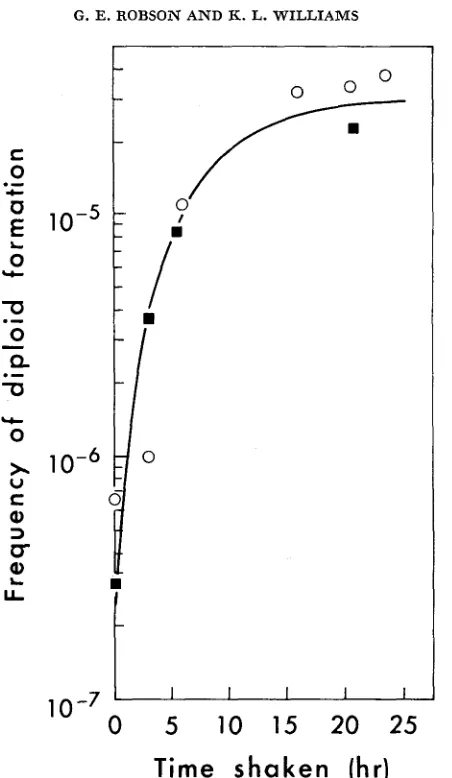
FIGURE 1 .-Time course of diploid formation between growth temperature-sensitive haploid strains M28 (matA1) and TS12 (matAl) co-aggregated in Linbro FB-16-24TC plates. 5 x 10⁶
washed amoebae of each strain were shaken at 150 cycles per min on an orbital shaker a t 21 & 1" in 1 ml H,O (0), or 1 ml Bonner's Salt solution: NaC1, 0.6g; KC1, 0.75g; CaC1, 0.3g dissolved in 1 1 of water.
(m).
The amoebae were plated on SM agar at the restrictive temperature and diploids obtained as described in the MATERIALS AND METHODS. The frequency of diploid forma- tion is the number of diploids formed divided by the total number of amoebae plated a t the restrictive temperature, as estimated by haemacytometer counts (WILLIAMS, KESSIN and NEWELL1974a). This frequency is higher than that (-7
x
10-6) obtained on the basis of diploids per106 amoebae plated, which assumes 100% recovery of amoebae. This is probably due to large clumps oE amoebae being excluded from the haemacytometer chamber.
were used. Studies on asexual, bisexual and homothallic strains will be reported elsewhere. Strains NC4 (matAl) and V12 (mata2 were used as reference strains. The nine sexually competent isolates of ERDOS, RAPER and VOGEN
VEGETATIVE INCOMPATIBILITY IN D. discoideum 867
production, using the “toothpick test.” All showed good mating competence, which confirmed the results of ERDOS,
RAPER
and VOGEN (1973) and, in the case of strains WS655 and WS656, the results ofWALLACE
(1977) (Table 2). The strains WSlO and WS585 were diploids; they were haploidized on ben late-SM agar (WILLIAMS andBARRAND
1978) ; the haploids, named HU182 and HU188, respectively, were used in this work instead of strains WSlO and WS585. Parasexual diploid formationVegetative incompatibility is defined here as the failure of two strains to form stable parasexual diploids at the usual frequency of between and le6. T o study this phenomenon, many crosses were performed, and hence a simple, yet reliable, method for making diploids was needed. Over the past few years, we have examined in some detail conditions required for parasexual diploid forma- tion, Vegetative haploid amoebae mixed together briefly form diploids at a fre- quency of about A major increase in the frequency of diploid formation (to about is obtained by co-aggregating haploid amoebae to be fused on filters (LOOMIS 1569) or in liquid salt solution for at least 17 hours (Figure 1). Varying the pH, temperature, molarity and composition of the incubation solution (e.g., NaC1, KC1, CaCl,, LiC1, MgSO, and K,PO, have been tested), while showing some differences, resulted in no significant and reproducible in- crease in diploid formation above about IO4. These experiments and all previ- ously published crosses in D. discoideum parasexual genetics (except for the cross involving diploid DP72, MOSSES, WILLIAMS and NEWELL 1975) involved crosses between strains derived from the NC4 isolate. To establish that the fre- quency of diploid formation observed previously was not isolate-specific, a quantitative experiment (see MATERIALS AND METHODS) was conducted using
strains derived from the NC4 ( m a t A l ) and VI2 (mata2) isolates of D. dis-
coideum. The frequency of diploid formation, calculated from the number of diploids formed per lo6 amoebae plated (see legend to Figure 1) was 7.4
x
le6
for the cross HM3 (mat&) X HU89 (mata2) and 7.2 X for the cross M28 ( m a t A l )
x
TS12 ( m a t A l ) . No diploids were obtained in the cross between strains X9 ( m a t A l ) and NP158 (mat&) of opposite mating type, which was conducted at the same time, although between 35 and 40 diploids would have been expected had the frequency been the same as that found for within mating- type crosses. For the rapid crosses, amoebae were toothpicked from clonal plates and the bacteria were not removed. Results obtained from these crosses were almost identical to those obtained for the quantitative technique, except that incubation in water alone was more variable (see WILLIAMS and NEWELL 1976). Incubation in 20 mM CaCl, resulted in reliable diploid formation; hence it has been used as the incubation solution for co-aggregation of amoebae in almost all experiments.Demonstration o/ vegetative incompatibility: parasexual diploid formation between wild isolates and tester strains of either matA or mata mating type
In order to test whether there is a series of vegetative incompatibility loci in
868 G. E. ROBSON A N D K. L. WILLIAMS
incompatibility is associated only with the mating-type locus, crosses were per- Sormed between wild isolates of
D.
discoideum and tester strains of each mating type. Since all of the strains (detailed in Table 2) were wild type (not growth temperature sensitive), the conventional method for constructing parasexual diploids in D. discoideum, involving complementation between different growth temperature-sensitive mutants (Loonm 1969; KATZ and SUSSMAN 1972), was not possible. However, recently we have shown that diploids can be formed between wild-type strains and strains carrying a growth temperature-sensitive mutation plus a dominant mutation whose phenotype is growth in the presence of toxic levels of CoC1, (WILLIAMS 1978). Temperature-sensitive, CoC1,-resistant strains of both mating types (HU32, matAl and HU156 or I-IU184, mata2) were con- structed (Table 1). The isolation of HU32 has been described previously (WIL- LIAMS 1978). HU156 (cob-364) is one of three spontaneous CoClz-I-esistant strains (HU156, HU157, HU158) isolated at a frequency of by plating the growth temperature-sensitive mata2 strain HU89 on SM agar containing 300 pg per ml or 350 pg per ml CoCl,.GH,O. The dominance of the three cob muta- tions was tested by constructing diploids between each cobalt-resistant mutant and strain HM3. The two strains HU157 (cob-365) and HU158 (cob-366) had cob mutations that were recessive to wild type, while cob-364 (in strain HU156) showed a high degree of dominance to wild type on SM agar containing 300 pg per ml CoCl,. Strain HU184 was isolated as a methanol-resistant (acrA) mutant of HU156.Table 2 shows the results of mating-type tests and success or failure of para- sexual diploid formation belween the wild isolates and matA or mata tester strains. Parasexual dipolids were formed at the normal frequency (between in all crosses between strains of the same mating type, but no diploids were formed between strains of opposite mating type. The 11 isolates shown in Table 2 were isolated in different geographical regions; yet, all were vegetatively compatible with a tester strain of their own mating type. This shows that we have encountered no vegetative-incompatibility locus unrelated to the mating type (see DISCUSSION). All parasexual diploids formed were shown to be heterozygous for several markers; e.g., diploids formed with HU32 were segre- gated on ethidium bromide (35 pg per ml)
SM
agar and shown to be hetero- zygous for ebrAl and bwnA2 (WRIGHT, WILLIAMS and NEWELL 1977). Diploids formed with HU184 were segregated on methanol (2% v/v) SM agar to show heterozygosity for acrA356, while bwnAl segregants were also detected; diploids formed with HU156 carry no selective markers; they were segregated on ben late (20 pg per ml) SM agar to show heterozygosity for bwunAl. I t was important to segregate the diploids, as cm a few occasions poorly growing isogenic diploids, caused by chromosome doubling or fusion of alike amoebae, were encountered. Why these diploids tolerate the selective conditions better than haploids is not known, but this phenomenon has also been observed in ts/ts crosses within NC4 strains (WILLIAMS unpublished).VEGETATIVE INCOMPATIBILITY IN
D.
discoideum 869Quantitative data on parasexual diploid formation between strains of like and unlike mating type
Most of the experiments described so far involved crosses between wild iso- lates and derivatives of strains NC4 ( m a t A l ) and VI2 ( m t a 2 ) . In no case was a diploid formed in parasexual crosses between strains of opposite mating type. We investigated whether the vegetative incompatibility between strains of oppo- site mating type could be overcome, and if so at what frequency. Since NC4 and V12 are perhaps the best known isolates oE
D.
discoideum, NC4 in particular being the strain in which almost all parasexual genetic analysis has been con- ducted, semi-quantitative results were collected for the frequency of parasexual diploid formation within and between derivatives of strains NC4 and V12.A
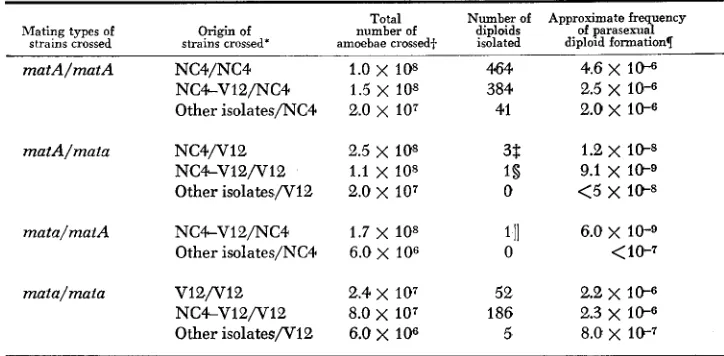
series of such experiments, plus the wild-isolate crosses (Table 2), are sum- marized in Table 3. While some of the crosses in Table 3 were performed quan- titatively (see MATERIALS AND METHODS), most of the crosses were done using the rapid technique in which cells were “toothpicked” and therefore not counted (see MATERIALS A N D METHODS). For this reason only approximate frequencies of
TABLE 3
Quantitative data on parasexual diploid formation between D. discoideum strains of like and unlike mating type
Mating types of origin of strains crossed strains crossed’
Total number of amoebae crossed:
matA/matA NC4/NC4 NC4-V 12/NC4 Other isolates/NC4
matA/matn NC4/V12 NC4-VI 2/V 12 Other isolates/Vl2
mata1matA NC4-VI 2/NC4 Other isolates/NC4
mata/maia v12/V12 NC4V12/V12 Other isolatesfl12
1.0
x
108 1.5 X lo82.0
x
1072.5
x
108 1.1x
108 2.0 x 1071.7 X lo8
6.0 x 10⁶
2.4
x
1078.0 x 107 6.0
x
106Number of diploids isolated 464 384 41 3$ 1 s 0
1
ll
0
52 186 5
Approximate fre uency of parasexu3 diploid formation(l
4.6
x
10-6 2.5x
10-6 2.0x
10-61.2
x
lo-* 9.1x
10-9<5
x
10-82.2
x
10-6 2.3x
le6 8.0 x lO-7* All strains used in these crosses were derived from the NC4 ( m a t A l ) or V12 (mata2) isolates, or from the wild isolates (Table 2) referred to as “other isolates”. NClb-VI2: haploid strains with a mixture of NC4-derived and Vl2-derived chromosomes.
+
Most: of the experiments reported here were from rapid crosses in which amoebae were picked up on toothpicks, so that the number of amoebae per cross is only approximate. An average of 5 x 10⁵ amoebae per toothpick was assumed, except in some difficult crosses where more amoebae (-106 per toothpkk) wereused.$ These are the diploids DP72, DU260 and the haploid HU89, whose parent diploid was lost. Inconclusive result as neither the diploid, nor a haploid segregant of it, was purified. Diuloid DU454.
8 70 G . E. ROBSON A N D K. L. WILLIAMS
diploid formation can be given. Since Table 3 is complex, the results will be discussed in detail.
Parasexual crosses between haploid strains of the same parental origin and therefore of the same mating type (NC4/NC4 or V12/V12): These experiments represent “standard” crosses in parasexual genetic analysis. The NC4/NC4 experiments reported in Table 3 are the most recent 100 crosses conducted in this laboratory, using a variety of NC4-derived haploids. The reliability of the method is illustrated by the fact that the average number of diploids formed per cross (- l o 6 amoebae) was 4.6. To examine the frequency of diploid formation in V12/V12 experiments, 12 crosses were performed between the Vl2-derived strains HM3 and NP84, and a further 12 crosses between the Vl2-derived strains HM3 and NP86. The frequency of diploid formation, -2.2 X was similar to that found for NC4/NC4 crosses, -4.6 x
Parasexual crosses between haploid strains deriued from NC4 and V I 2 and therefore of opposite mating type ( N C 4 / V l 2 ) : In crosses between NC4(matAl)
-
derived and V12( mata2) -derived haploids, two diploid strains and one recom- binant haploid strain were recovered from -2.5
x
lo8 amoebae crossed. One diploid, DP72, was formed in a cross between NP84 (mata2) and X23 ( m a t A l ) (MOSSES, WILLIAMS and NEWELL 1975) ; the second diploid, DU260, was formed in a cross between NP158 (matcz2) and HU1 ( m a t A l ) . In the third case, a diploid from a cross between NP158 (mata2) and HU1 ( m a t A l ) was lost, but a haploid, HU89, containing chromosomes from both parents and the mata2 mating type (Table 1) was isolated. Diploids DP72 and DU260 were haploidized and attempts were made to recover haploids with all combinations of chromo- somes. This could not be done with certainty in these diploids, since DP72 is marked on linkage groups I1 and IV only, while DU260 has linkage groupsI,
11, IV and possibly 111, marked. However. haploids were segregated that carried both parental and recombinant combinations of marked chromosomes. DU260 was examined in the greatest detail and 100 independently derived haploid segregants were obtained. The 100 segregants fell into eight phenotypic classes on the basis of spore shape, spore color and colony morphology (ROBSON 1978). All haploids in six of these classes gave a strong matA mating reaction, while haploids in the two remaining classes exhibited a weak matA mating reaction. None of the 100 haploid segregants from DU260 formed macrocysts with a matA tester strain; therefore, there was no evidence for the presence of the mata mating type. These results suggest that DU260 does not carry both mating- type alleles, but that it is homozygous at the mating-type locus ( m a t A l / m a t A l )
.
Similar analysis of DP72 suggests that this diploid is also homozygous at the mating-type locus, being mata2/mata2.Parasexual crosses inuoluing wild isolates (other isolates/NC4 and other iso-
VEGETATIVE INCOMPATIBILITY IN
D.
discoideum 871above. While exhaustive crosses were not done, no diploids were formed in any of the crosses between wild isolates and strains of opposite mating type.
Parasexual crosses between haploid NC4- or VI2-derived strains and haploid strains that carry vtrrious combinations of NC4 and V I 2 chromosomes: The crosses between strains of opposite mating type described so far involve those in which the participating strains were of different geographic origin. To examine the effect of genetic background on parasexual diploid formation, hap- loids with a mixed complement of NC4 and VI2 chromosomes were segregated from DP72 and DU260; the haploid HU89 was also used. These mixed haploids were backcrossed with pure NC4- or Vl2-derived haploids.
Parasexual crosses between strains of the same mating type (NC4-VI2 (matAl)/NC4 or NC4-V12(mata2)/VIZ): We made 150 crosses between NC4- derived strains ( m a t A I ) and 23 independently obtained haploid segregants of DU260 (all m a t A l ) , which comprised representatives of all eight phenotypic groups. Diploids were obtained at a frequency of -2.5
x
1 k 6 , which is similar to that found in normal NC4/NC4 crosses (Table 3). All 23 haploid segregants of DU260 showed a similar frequency of diploid formation when crossed with the NC4-derived matAI strain, HU77. Eighty crosses between Vl2-derived strains and haploid segregants of DP72 (all mata2) or strain HU89 (mata2) resulted in diploid formation at a frequency of -2.3 X le6, which is the sameas that found in Vl2/V12 crosses.
Parasexual crosses between strains of diflerent mating type (NC4-VI2 (matAl) /VI2 or NC4-VI2 (mata2)/NC4) : Haploid strains containing various combinations of NC4 and V12 chromosomes, but all of mat Al mating type, were segregated from DU260. The 23 independently obtained haploid segregants from DU260 used in the previous section were crossed several times with the V12- derived strain HM3. From -1.1 X los amoebae crossed, only one diploid was formed; this result is inconclusive since the diploid was lost before its genotype was established. Strain HU89 (mata2) and three independently obtained hap- ploid segregants of DP72 (all of mata2 mating type) were crossed repeatedly to NC4-derived strains. The crosses involved -1.7 X IOs amoebae, yet only one diploid, DU454, which was formed in a HU89
x
HU227 cross, was obtained. Analysis of DU454 and haploid segregants from this diploid (ROBSON 1978) show that it is heterozygous for all loci examined, involving markers on six linkage groups, except for the mating-type locus which appears to be homo- zygous m a t AI / ma t A l .To summarize the results in Table 3, all parasexual crosses between strains of the same mating type, regardless of the genetic background of the strains, resulted in diploid formation at a frequency of between Con- versely, no diploids containing both mating type alleles were found in para- sexual crosses between strains of opposite mating type involving -5.6
x
10" amoebae. However, three diploids apparently homozygous at the mating type locus and one recombinant haploid strain were isolated, showing that diploids are obtained from such crosses at a frequency of approximately or toand
8 72 G. E. ROBSON A N D K. L. WILLIAMS DISCUSSION
Two types of diploid are formed between haploid amoebae of heterothallic strains of
D.
discoideum: sexual diploids and vegetative diploids. Successful sexual fusion occurs only between haploid amoebae of opposite mating type during macrocyst formation, the sexual stage of the life cycle; there is no strong evidence for selfing in heterothallic strains (WALLACE 1977).In
D.
discoideum i t is likely, although not definitively shown, that the diploid so formed does not divide mitotically. Instead. the diploid probably proceeds into meiosis (ERDOS,
NICKERSON
and RAPER 1972). We will show elsewhere(ROBSON
andWILLIAMS
in preparation) that under appropriate conditions this sexual fusion occurs a t high frequency (greater than 1%) .
The results presented here show that successful vegetative fusion, leading to relatively stable mitotically dividing diploid amoebae, occurs at a frequency of
between all tested strains that are of the same mating type. Since the stability of diploid strains of D. discoideum has been a controversial issue in the past, the discussion section of the paper by BRODY and WILUAMS (1974) should be consulted for our views. A system of vegetative incompatibility has been elucidated here; the phenotype of this effect is failure to form stable, mitotically dividing diploids between strains of opposite mating type. While the mechanism of the vegetative incompatibility in D. discoideum will be discussed elsewhere, we have shown here that it has a simple genetic basis. There are three lines of evidence consistent with there being only a single vegetative in- compatibility locus, and indicating that this locus is almost certainly closely linked to, or coincident with, the mating-type locus ( m a t ) .
(1 ) All 1 I independent, sexually competent isolates (Table 2) formed vege- tative diploids with tester strains of their own mating type at the expected frequency. While exhaustive crosses were not done, the results are consistent with all isolates being vegetatively incompatible (no diploids formed) with tester strains of opposite mating type.
(2) The relatively high irequency at which vegetative incompatibility can be overcome ( to suggests a simple genetic basis f o r the phenomenon. “Escape” from vegetative incompatibility, (i.e., stable diploid formation between strains of opposite mating type) can perhaps be explained by a mitotic recom- bination event (which occurs at
MOSSES,
WILLIAMS
and NEWELL 1975) leading to homozygosis for vegetative incompatibility. The mating-type locus is strongly implicated in this phenomenon since the mating-type alleles also became homozygous in three independently isolated “escaped” diploids (DP72, DU260, DU454) despite the fact that these experiments selected only for over- coming vegetative incompatibility.( 3 ) Segregation of haploids from “escaped” diploids allowed examination of the effect of genetic background on vegetative incompatibility. I n every haploid examined, the presence or absence of vegetative incompatibility could be related to the mating-type allele, rather than to the rest of the genotype. For example, haploid strains carrying several chromosomes from a mata2 strain, but the matAI mating-type allele, exhibited vegetative incompatibility with mata2
VEGETATIVE INCOMPATIBILITY IN
D.
discoideum 8 73strains, but were compatible (formed vegetative diploids at to with matAI strains.
Vegetative incompatibility systems i n fungi, plants and animals have been reviewed by ESSER and BLAICH (1973). Vegetative incompatibility has also been observed in the acellular slime molds. This is fundamentally different from the process described here since it involves incompatibility between diploid plasmodia (CARLILE 1973). More relevant are the studies on vegetative incompatibility involving failure of stable heterokaryon formation in the fungi, particularly the Ascomycetes. Among the best studied organisms are Aspergillus species ( GRINDLE 1963a,b; KWON and
RAPER
1967; CATEN 1971) and Neurospora crassa (GARN- JOBST and WILSON 1956; MYLYK 1975,1976). Vegetative incompatibility inN .
crassa is controlled by at least ten het loci (MYLYK 1976). Strains are vegeta- tively incompatible unless they are homozygous for alleles a t all het loci. One of these het loci is the mating-type locus (GARNJOBST and WILSON 1956; NEW- MEYER 1970; GRIFFITHS and DELANGE 1978). The multiple het loci in N . crassa make analysis of vegetative incompatibility considerably more complex than that described here in D. discoideum. For example, whereas all 11 wild isolates ofD.
discoideum were vegetatively compatible with tester strains of their own mating type, only two strains were found to be vegetatively compatible at all five het loci studied from tests on 6 4 pairs of wild N . crassa strains of the same mating type(MYLYK
1976). Similar studies on wild isolates of Aspergillus species (GRINDLE 1963a,b; KWON and RAPER 1967; CATEN 1971) show that most wild isolates are vegetatively (heterokaryon) incompatible. because there is a low probability that any two strains will have the same alleles at all of several hetloci. Why is the vegetative incompatibility system less complex in
D.
discoideum than in the Ascomycetes? I n fungal mycelia (e.g.,N .
crassa),
extensive hyphal fusion occurs, so that a network of hyphae is formed. This would occur between genetically unlike hyphae in the absence of vegetative incompatibility. It has been suggested that vegetative incompatibility may represent a defense mech- anism against cytoplasmic invasion (e.g., by viruses) or exploitation of hetero- karyons by nuclei that are nonadaptive in homokaryons (CATEN 1971; HARTL, DEMPSTER andBROWN
1975). Since D . discoideum is primarily a uninucleate amoeba, and amoeba1 fusion is a rare event, elaborate isolating mechanisms seem unnecessary.Our studies have revealed a barrier to sexual and parasexual genetic analysis i n the same strains of
D.
discoideum, since parasexual analysis is feasible only between strains of the same mating type, and sexual analysis is feasible only between strains of opposite mating type. W e are currently exploring t h e pos- sibility of inactivating the vegetative incompatibility function, yet maintaicin: the mating function. Such a mutation has been found at the mating-type locus in Neurospora crassa recently (GRIFFITHS andDELANGE
1978). If this approach is successful, it would be possible to conduct sexual and parasexual genetic analysis in the same strains of D. discoideum.We thank K. B. RAPER and M. WALLACE for the wild isolates of D. discoideum, and J . H .
8 74 G . E . ROBSON A N D K. L. WILLIAMS
K. B. RAPER, F. ROTHMAN and R. R. KAY made helpful comments on the manuscript. M. WALLACE kindly sent a pre-print of his manuscript.
L I T E R A T U R E CITED
BRODY, T. and K. L. WILLLIAMS, 1974 Cytological analysis of the parasexual cycle in Dictyo-
CARLILE, M. J., 1973 Cell fusion and somatic incompatibility i n Myxomycetes. Ber. Deutsch.
CATEN, C . E., 1971 Heterokaryon incompatibility in imperfect species of Aspergillus. Heredity
CLARKE, M. A., D. FRANCIS and R. EISENBERG, 1973 Mating-types in cellular slime molds. Biochem. Biophys. Res. Commun. 52 : 672-678.
ERDOS, G. W., A. W. NICKERSON and K. B. RAPER, 1972 Fine structure of macrocysts i n Polysphondylium uiolaceum. Cytobiologie 6: 351-366.
ERDOS, G. W., K. B. RAPER and L. K. VOGEN, 1973 Mating types and macrocyst formation in Dictyostelium discoideum. Proc. Natl. Acad. Sci. U.S. 70: 1828-1830.
ESSER, K. and R. BLAICH, 1973 Heterogenic incompatibility in plants and animals. Advan. Genet. 17: 107-152.
FILOSA, M. F. and R. E. DENGLER, 1972 Ultrastructure of macrocyst formation in the cellular slime mold, Dictyostelium mucoroides: extensive phagocytosis of amoebae by a specialized cell. Develop. Biol. 29: 1-16.
FREE, S . J., R. T. SCHIMHE and W. F. LOOMIS, 1976 The structural gene for a-mannosidase-l in Dictyostelium discoid". Genetics 84 : 159-1 74.
GARNJOBST, L. and J. F. WILSON, 1956 Heterokaryosis and protoplasmic incompatibility in Nmrospora crassa. Proc. Natl. Acad. Sci. US. 42: 613-618.
GRINDLE, M., 1963a Heterokaryon compatibility of unrelated strains in the Aspergillus nidulans
group. Heredity 18: 191-2W.
-
, 196313 Heterokaryon compatibility of closely related wild isolates of Aspergillus nidulans. Heredity 18: 397-405.Mutations of the a mating-type gene in Neuro- spora crassa. Genetics 88: 239-254.
Adaptive significance of vegetative incompatibility in Neurospora crassa. Genetics 81 : 553-569.
Genetic control of development of the cellular slime mold Dictymtelium discoideum. Ann. Rev. Genet. 9 : 145-185.
Meiotic and mitotic recombination i n Aspergillus and its chromosomal aber- rations. Advan. Genet. 19: 33-131.
Parasexual recombination in Dictyostelium discoideum. Selection of stable heterozygotes and stable haploid segregants. Proc. Natl. Acad. Sci. US.
69: 495498.
stelium discoideum. J. Gen. Microbiol. 82: 371-383.
Bot. Ges. Bd. 86: 123-139.
26: 299-312.
GRIFFITHS, A. J. F. and A. M. DELANGE, 1978
HARTL, D. L., E. R. DEMPSTER and S . W. BROWN, 1975
JACOBSON, A. and H. F. LODISH, 1975
KAFER, E., 1977
KATZ, E. R. and M. SUSSMAN, 1972
KLEIN, J., 1975 Many questions (and almost no answers) about the phylogenetic origin of
Heterokaryon formation and genetic analysis of color
Temperature-sensitive mutants of Dictyostelium discoideum. J. Bacteriol. the major histo-compatibility complex. Advan. Exptl. Med. Biol. 64: 467478.
mutants of .4spergillus heterothallicus. Am. J. Botany 54: 49-60. KWON, K. J. and K. B. RAPER, 1967
LOOMIS, W. F., 1969
VEGETATIVE INCOMPATIBILITY IN
D.
discoideum 875The use of mitotic crossing-over for genetic analysis in Dictyostelium discoideum: mapping of linkage group 11. J. Gen. Micro- biol. 90: 247-259.
Heterokaryon incompatibility genes in Neurospora crassa detected using duplication-producing chromosome rearrangements. Genetics 80 : 107-124. -, 1976
Heteromorphism for heterokaryon incompatibility genes in natural populations of Neuro- spora crassa. Genetics 83 : 275-284.
MOSSES, D., K. L. WILLIAMS and P. C. NEWELL, 1975
MYLYK, 0. M., 1975
NEWW, P. C., 1978 Genetics of the cellular slime molds. Ann. Rev. Genet. 12: 69-93.
NEWMEYER, D., 1970 A suppressor of the heterokaryon-incompatibility associated with mating type in Neurospora crassa. Can. J. Genet. Cytol. 12: 914-926.
ORA, H.. 1970 Colony specificity in compound Ascidians. The genetic control of fusibility.
pp. 196-206. In: Profiles of Japanese Science and Scientists. Edited by H. YUKAWA, Kodansha, Tokyo.
PONTECORVO, G. and E. KAFER, 1958 Genetic analysis based on mitotic recombination. Advan. Genet. 9: 71-104.
RAPER, K. B., 1935 Dictyostelium discoideum, a new species of slime mold from decaying forest leaves. J. Agr. Res. 50: 135-147.
ROBSON, G. E., 1978 Mating and vegetatius incompatibility in the cellular slime mould Dictyostelium discoideum. M.Sc. thesis, Australian National University, Canberra.
SHERMAN, F. and C. W. LAWRENCE, 1074 Saccharomyces. pp. 359-394. In: Handbook of Genet- ics. Vol. 1, Ch. 24. Edited by R. C. KING. Plenum Press, New York.
SUSSMAN, M., 1966 Biochemical and genetic methods in the study of cellular slime mold devel- opment. pp. 397-410. In: Methods in Cell Physiology. Vol. 2. Edited by D. PRESCOTT. Academic Press, New York.
WALLACE, M. A., 1977 Cultural and genetic studies of the macrocysts of Dictyostelium dis- coideum. Ph. D. thesis, University of Wisconsin, Madison.
WALLACE, M. A. and K. B. RAPER, 1979 Genetic exchanges in the macrocysts of Dictyostelium discoideum. J. Gen. Microbiol. 113: 327-337.
WILLIAMS, K. L., 1976 Isolation of strains of the cellular slime mold Dictyostelium discoideum capable of growing after a single passage i n axenic medium. Appl. Envir. Microbiol. 32: 635-637. -, 1978 Characterization of dominant resistance to cobalt chloride in Dictyostelium discoideum and its use in parasexual genetic analysis. Genetics 90 : 37-47.
WILLIAMS, K. L. and P. BARRAND, 1978 Parasexual genetics in the cellular slime mould Dictyo- stelium discoideum: haploidization of diploid strains using ben late. FEMS Microbiol. Letters
4: 155-159.
Genetics of growth in axenic medium
of the cellular slime mould Dictyostelium discoideum. Nature 247: 142-143. 1974b
Parasexual genetics in Dictyostelium discoideum: mitotic analysis of acriflavin resistance and growth in axenic medium. J. Gen. Microbiol. 84: 59-69.
A genetic study of aggregation in the cellular slime mould Dictyostelium discoideum using complementation analysis. Genetics 82 : 287-307.
Ethidium bromide resistance, a selective marker located on linkage group IV of Dictyostelium discoideum. J. Gen. Micro- biol. 102: 423-426.
Corresponding editor: D. SCHLESSINGEB WILLIAMS, K. L., R. H. KESSIN and P. C. NEWELL, 1974a
-
,WILLIAMS, K. L. and P. C. NEWELL, 1976