Saving Private Randomness
in One-Way Functions and Pseudorandom Generators
Nenad Dedi´c∗ ‡ § Danny Harnik† § Leonid Reyzin∗ §
December 10, 2007
Abstract
Can a one-way functionf onninput bits be used with fewer thannbits while retaining comparable hardness of inversion? We show that the answer to this fundamental question is negative, if one is limited black-box reductions.
Instead, we ask whether one can save onsecretrandom bits at the expense of morepublicrandom bits. Using a shorter secret input is highly desirable, not only because it saves resources, but also because it can yield tighter reductions from higher-level primitives to one-way functions. Our first main result shows that if the number of output elements offis at most2k, then a simple construction using
pairwise-independent hash functions results in a new one-way function that uses only k secret bits. We also demonstrate that it is not the knowledge ofsecurity off, but rather of itsstructure, that enables the savings: a black-box reduction cannot, for a generalf, reduce the secret-input length, even given the knowledge that security off is only2−k; nor can a black-box reduction use fewer thanksecret input
bits whenf has2kdistinct outputs.
Our second main result is an application of the public-randomness approach: we show a construction of a pseudorandom generator based on anyregularone-way function with output range ofknownsize
2k. The construction requires a seed of only2n+O(klogk)bits (as opposed toO(nlogn)in previous constructions); the savings come from the reusability of public randomness. The secret part of the seed is of length onlyk(as opposed tonin previous constructions), less than the length of the one-way function input.
∗
Boston University, Department of Computer Science, 111 Cummington St., Boston, MA 02215. http://www.cs.bu. edu/∼reyzin.
†
IBM Research, Haifa, [email protected]. Research conducted while at the Technion, Haifa, Israel.
‡
Google, Inc., 76 9th Ave, 6th Floor, New York, NY 1001,http://cs-people.bu.edu/nenad/
§
1
Introduction
PRG Seed Length It is important to keep the seed required for a pseudorandom generator (PRG) as short as possible, lest the amount of true random bits needed to run it exceed the amount of pseudorandom bits its application requires, thus rendering it pointless. Moreover, in reductions from PRGs (or other constructs) to one-way functions, the blowup in the input length turns out to be the most central parameter in determining the security of the construct. It is therefore a major goal to reduce this parameter (as was addressed in [GIL+90, HL92, HHR06b, Hol06, HHR06a]). The ultimate goal is a linear blowup, a necessary, although not a sufficient, condition to achieve a reduction with tight security preservation, i.e. a linear preserving one [HL92, HILL99].
Consider, therefore, the following problem: when is it possible to build a pseudorandom generator out of a one-way functionf while keeping the generator seed length linear in the one-way function input length n? Certainly this is possible if f is a permutation—in fact, in the original PRG construction of [BM82, Yao82] the seed length is equal to the one-way function input length. However, no broader class of one-way functions satisfying this condition is currently known: even one-way bijections, if their output range is not easily mapped to{0,1}n, are not known to satisfy this condition (the best constructions for
them are the same as for other regular one-way functions, discussed below).
In this paper we demonstrate constructions of PRGs with the linear input length condition for a large class ofknown regularone-way functions. Specifically, if every output off hasαpreimages (thusfhas2k
distinct outputs wherek = n−logα) and (a lowerbound on)α is known, then we can build a PRG with seed length2n+O(klogk). Thus, for functions with high enough degeneracy, wherek = O(n/logn), our PRG has a linear-length seed, like the Blum-Micali-Yao PRG built from one-way permutations. The construction, described in Section 4, builds upon the techniques of Haitner, Harnik and Reingold [HHR06b], which require longer seed length ofO(nlogn), but assume only regularity rather thanknownregularity.
New Tool: One-Way Functions with Short Secret Inputs We arrive at our pseudorandom generator as part of a study of a more fundamental problem: when is it possible to reduce the input length of a one-way function while maintaining some of its security? In other words, given a one-one-way function f with input lengthn, when is it possible to build another functiong of input length`(n) < nwith comparable security? Indeed, if this were possible, then one could, for example, build a pseudorandom generator from
grather than fromf, and maintain a reasonable seed length even if the PRG construction blows up the input size. However, we show that in general it is impossible to significantly reduce the input length of one-way function in a black-box manner, even for regular one-way functions (Theorem 5). That is, one must invest essentially the fullnrandom bits when calling a one-way function.
This result, however, does not doom all efforts of using the one-way function with a shorter input. The insight is to use the paradigm introduced by Herzberg and Luby [HL92], which separatespublicrandomness fromsecretrandomness. It turns out to be possible to reduce the amount of secretrandomness at the cost of additionalpublicrandomness. In Theorem 1 we show how to convert any one-way functionf with2k
distinct outputs into acollectionof one-way functionsfhwith inputs of lengthk, where the indexhinto the
f
h
x
collection is the public randomness. The simple construction uses a pairwise inde-pendent family ofexpandinghash functions. The choice of the function from the collection is a choice of a hash functionh, and we definefh(x) =f(h(x)). This
choice is made using2npublicrandom coins, which are available to any potential inverter.
f
h^
h
1f
h
2…
f
h
kx
b
rb
rb
rb
rh^
h^
b
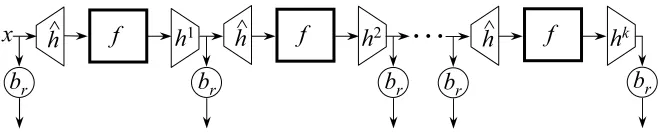
rFigure 1: Our pseudorandom generator on seedx. ˆhis a pairwise-independent hash function fromkbits to
nbits;h1, h2, . . . , hkare almost-pairwise independent hash functions from the output space off tokbits, generated by a bounded space generator from a common seedsof lengthO(klogk);br is the
Goldreich-Levin hardcore bit (the sameris used throughout).ˆh,sandrare included in the output or, equivalently, are public.
small, the result of [DS05] requires only linearly more input bits. However, the linear improvement we achieve over [DS05] is crucial for building our pseudorandom generator, as we explain shortly. To achieve this improvement, we take a different path from [DS05]: instead of showing that the distributions(f(x), h)
and(f(h(x)), h)are statistically close, we show they have polynomially related subset weights, a relation between distributions that we callg-domination.
The secret input to our one-way function need not consist of kuniform independent bits: inputs from any distribution of entropy1ksuffice (the same is true for our pseudorandom generator construction). This is beneficial, because uniform random bits may be harder to obtain that simply strings of high entropy.2 Moreover, this enables our pseudorandom generator construction.
Application: The PRG Construction We construct our pseudorandom generator by applying the ran-domized iterate construction of [HHR06b] (henceforth called “the HHR construction”) tofh for a known
regularf. Becausefhis secure even whenhis public, the coins forhcan be given only once and used for all
iterations, resulting in a shorter seed. As compared to the HHR construction, we replace the need for many large hash functions with one large hash function (theˆhused forfˆh), and many small ones (h1, . . . , hkused
in the randomized iterate construction). Our construction is illustrated in Figure 1.
To get some intuition for the construction, observe that iffis regular, then the number of secret random input bits we require forfh is the entropy of the output of fh. This enables iteration, because the output
offh has enough entropy to be used (after an appropriate transformation) as an input to the nextfh. We
could not use the result of [DS05], because it requires more input entropy than is output; nor could we use functions that are not regular, because they produce less output entropy than the input requires. The proof of pseudorandomness is not as simple as applying the HHR result tofˆh, because the HHR construction needs
to start with a regular one-way function, andfˆhis not necessarily regular even iff is.
In Appendix A we show how one can further exploit the knowledge of the regularity and further shorten the seed of our PRG to2n+O(klog logk), albeit at the cost of lowering its security.
In addition to considering the overall PRG seed length, it is also important to consider how much of the generator seed must be secret, because secret random bits tend to be much harder to obtain than nonsecret ones (again, this was already observed in [HL92]). Our PRG is the first to require asublinearnumber of secret bits, namely, justk (the HHR generator, like the generators of [BM82, GKL93], requires nsecret bits). Moreover, just like for our one-way function, the secret input to our PRG need not consist of uniform independent bits, but can come from any distribution of entropyk.
1Specifically, Renyi entropy of order 2, i.e., negative logarithm of collision probability. 2
Example: One-way Function and PRG Based on Factoring Consider the problem of building a one-way function based on the hardness of factoring products of twob-bit randomly chosen primes. If one is willing to assume a trusted party with secret coins, then it is easy: the trusted party chooses two secret randomb-bit primespandq, publishesN =pq, and the function can be, for example, squaring moduloN. However, without trusted setup, there is no such easy construction. In order to work on the domain
{0,1}n, the one-way function needs to include the process of generating the two random primes. A natural
way to do this is to test some number of random integers for primality. To guarantee that two primes are found with probability 2−sfor some security parameter s, the number of integers tested should beΘ(sb)
(because the probability that a randomb-bit integer is prime isΘ(1/b)). The natural function therefore gets
n= Θ(sb2)bits as input, splits them intoΘ(sb)integers of lengthbeach, finds the first two such integers
p, qthat are prime (if they do not exist, output0), and outputs their productN =pq. We call this function
fmult(observe that, for sufficiently larges, it is one-way under the assumption that factoring is hard).
For reasonably secure values forb(e.g., 2048) ands(e.g., 64), the input lengthnoffmult will be on
the order of tens of megabytes. To come up with such a long secret input is, naturally, quite costly. Because the output offmultis short, however, we can apply our result on converting one-way functions to families
with shorter secret inputs. Settingk= 2b = o(√n), we obtain a family of one-way functions with secret inputs of length only2b—as short as the description of the two primespandq. To sample a function from this family, one still needsΘ(n)random bits, but they can be public, and are therefore much less expensive to obtain (e.g., from adversarially observable sources such as user behavior or ambient noise). Finally we note that using our techniques, one can generate a product N = pq of two secretb-bit primes p,q using private randomness of entropy 2b(and the appropriate amount of public randomness). This can be used, for example, for generating public/secret key pairs for RSA or Paillier functions, from a modest amount of private randomness.
Consider now trying to make a PRG out offmult. The prior most efficient way (in terms of seed length)
to achieve this is to notice thatfmult is a regular one-way function (except the negligible2−sportion that
leads to the 0 output) and use the HHR construction, which takes a seed ofO(nlogn)bits withO(n)of the bits being secret.3 For reasonable parameter settings, it would be useful only in applications that can afford to gather tens of megabytes of secret randomness and gigabytes of public randomness before invoking the PRG.
Instead, observe thatfmultis also a known4regular one-way function, withk <2b. Applying our PRG
construction, we get a pseudorandom generator with just 2b = o(√n) secret seed bits (which is roughly what’s required to describe the two primes, anyway) and O(n) seed bits total (which is linear in what’s anyway required as an input tofmult).
Impossibility Results As already mentioned, Theorem 5 shows that the total input length of a one-way function cannot be reduced in a black-box manner, thus leading us to use public randomness in order to reduce the amount of secret randomness. It is natural to ask if this approach can also work for one-way functions with a large number of outputs. On the positive side, we show in Theorem 2 that if a sufficiently large portion of the inputs goes to a sufficiently small portion of the outputs, then the answer is yes. In general, however, this appears unlikely to be the case, for the following reasons. In Theorem 6 we show that the number of secret random bits used when calling a one-waypermutationf cannot be reduced to
3It seems fruitless to try to turnf
multinto a permutation to order to apply the efficient construction of [BM82, Yao82]. Indeed,
a natural way to build a bijection fromfmultis to include in the output all the unused bits as well as information on wherepand
qwere in the sequence. However, this does not make it a permutation, because the output range (which includes the product of two primes) is not easily mapped back to the input domain of bit strings. Unfortunately, known solutions for bijections are not any better than those for regular functions.
4
be substantially smaller thannby use of black-box reductions. This theorem is actually more general, and shows that our positive result is indeed tight for regular one-way functions, and the number of secret bits cannot be reduced any further in a box manner. Moreover, Theorem 7 shows that there is no black-box reduction that takes a one-way functionf with hardness2sonninput bits and produce a collection of one-way functions onn−s+O(logn)input bits. Thus, unlessfhas hardness very close to2n, in general the number of secret inputs bits must remain linear if one wants to haveanyhardness at all.
Discussion Ideally, one would like to use only as many secret bits as the security one gets from the one-way function (it is clear that at least that many bits are necessary: a one-one-way function withnsecret input bits can be easily inverted with probability2−n). Indeed, typical conjectured one-way functions, for example, RSA or discrete logarithm, are known to provide less security than2n (for the above examples, at most roughly2n1/3). Our negative results show that this is not possible in general with a black-box reduction (although we do not rule it out for specific functions such as discrete logarithm, of course). Our positive result, however, shows that if this weaker than optimal security manifests itself in a “structural” way, i.e., with the function having fewer outputs (a one-way function withkoutput bits can be easily inverted with probability2−k), then reduction in the number of inputs bits is possible.
It is natural to ask, of course, if one can not simply use the same one-way functionf on a shorter input. It should be noted that our negative results do not consider such constructions, and hence do not rule them out. However, this option is unavailable whenfis a fixed-length function secure in a concrete sense, such as a 128-bit block cipher or a hardware device implementing modular exponentiation for a 2,048-bit modulus. In this case, our impossibility results indicate that if we are given a hardware implementation of a one-way function we should use it with its full input length (unless we can look inside the box and learn something from there). This last observation adds motivation to results that take as input an exponentially hard one-way function and construct from it a pseudorandom generator withweakersecurity (ofnlogn) (e.g., some of the results stated in [Hol06, HHR06a] and the one in Appendix A in this paper). These results would be less interesting if there was a direct method of trading input length for security.
Even when the one-way function has variable input length, using it on a shorter input will reduce security. Of course, our construction also reduces security, but the security loss (i.e., security offh withn-bitf as
compared to security offonnbits) is polynomial. In contrast, simply usingfon a shorter input can reduce security more than polynomially when the reduction in input length is superlinear.
Security comparison of the originalf and our constructionfh depends on what parameters are set to
equal each other. For example, we can compare the security off onnbits to the security offhwith an-bit
f (thus equating the input length to f, and hence the output length and likely most of the computational cost). In that case,fh incurs a polynomial deterioration in security. Herzberg and Luby [HL92] advocate
equating the secret input length. In that comparison, our constructions can actually bemoresecure thatf, becausef needs allnbits to be secret, whilefh and our PRG need onlyk < nsecret bits.
2
Definitions and Notation
IfY is a set, we denote byY also the uniform distribution over that set, unless another distribution onY
is specified. We denote byUnthe uniform distribution over{0,1}n. Given a distributionXand a function
f :X →Y, we denote byf(X)the induced distribution onY.
LetP andQbe distributions over some finite domain X. The collision-probability ofP isCP(P) = P
x∈XP(x)2.PandQ ε-close (or have statistical distanceε) if for everyA⊆Xit holds that|Prx←P(A)−
We assume familiarity with the standard notions of computational indistinguishability, one-way func-tions and pseudorandom generators (with public inputs, or equivalently, as public-coin collecfunc-tions), which, for completeness, are recalled in Appendix B.
Definition 1 (Regular functions) A functionf : {0,1}∗ → {0,1}∗ isregular if for anyx, y ∈ {0,1}n,
|f−1(f(x))| = |f−1(f(y))|. Ifk(n) = −log(|{f(x) | x ∈ {0,1}n}|)then f is said to beregular with
output entropyk. Whenkis also polynomial-time computable on input1n,fisknown-regular.
It is also customary to say thatf is anα-regular function(for someα :N→ N) — this means thatf is a
regular function with output entropyk(n) =n−logα(n), i.e. preimage sizes are equal toα(n).
Definition 2 (Family of almost pairwise-independent hash functions) Let{Xn}n∈N,{Yn}n∈Nbe two fam-ilies of subsets of{0,1}∗. For anyn ∈ Nlet Hn be a collection of functions where eachh ∈ Hnis from
Xnto Yn. {Hn}n∈Nis an (efficient) family of δ-almost pairwise-independent hash functionsif: 1. there is a polynomial-time sampler which on n ∈ Noutputs a description of randomly chosenh ∈ Hn, 2. for anyh ∈ Hn,|h|(i.e., the description length ofh) is polynomial inlog|Xn|, 3. eachh ∈ Hn is a polynomially-computable function, and 4. for allx6=x0 ∈Xnand ally, y0 ∈Yn,
Pr
h← Hn
[h(x) =y^h(x0) =y0]− 1 |Yn|2
≤δ(n).
A0-almost pairwise independent family is called simplypairwise independent.
There are various constructions of efficient families of pairwise-independent hash functions (i.e.δ = 0) for anyXn ={0,1}nandYn={0,1}`(n)whose description length (i.e.,|h|) is linear inmax{n, `(n)}(e.g.,
[CW77]). It is possible to constructδ-almost pairwise independent families forδ > 0whose description size depends very mildly on the input size. In particular, using [CW77], [WC81] and [NN93] one gets constructions of efficient families of almost pairwise-independent hash functions for Xn = {0,1}n and
Yn={0,1}`(n)whose description length isO(log(n) +`(n) + log(1/δ)).
Proposition 1 Let {Hn} be a family of δ-almost pairwise independent hash functions from Xn to Yn. Then for anyn, and any distinctx1, x2 ∈ Xn the following distributions have statistical distance at most
δ|Yn|2/2: 1. uniform onYn×Yn, 2.(h(x1), h(x2))for uniformly randomh∈ Hn.
Proof:For anyy1, y2∈Yn,
Prh[(h(x1), h(x2)) = (y1, y2)]−Pr(z
1,z2)∈Yn×Yn[(z1, z2) = (y1, y2)]
≤ δ by definition. Summing over
ally1, y2 ∈Ynand dividing by 2, we get the desired result.
To simplify exposition, we will often work with (almost) pairwise independent hash functions on some fixed domain and rangeXandY (rather than consider families{Xn},{Yn}).
Definition 3 (g-Domination) LetBandCbe distributions on the same setΠ, andga real-valued function. We will say thatC g-dominatesBif∀S ⊆Π,PrC[S]≥g(PrB[S])(this is a generalization of the notion of “dominates” from [Lev86], which contemplated linearg).
Proof:LetE ⊂Φ×Π. Letp(π), forπ ∈Π, bePrφ←D[(φ, π)∈E].
Pr
D×C[E] = π←ECp(π)
= Z 1
0
Pr
π←C[p(π)> α]dα (usingE(x) =
R
Pr[x > α]dα)
≥
Z 1
0 g
Pr
π←B[p(π)> α]
dα
≥ g
Z 1
0
Pr
π←B[p(π)> α]dα
(Jensen’s inequality, sincegis convex)
= g
E
π←Bp(π)
=g
Pr
D×B[E]
.
A common approach in cryptographic reduction is to focus only on the subset ofB for whichp(π)is large, and use Markov’s inequality to obtaing0-domination ofD×BbyD×C, forg0 ∈ω(g). Instead, this lemma, which takes all subsets into account, saves the increase ingand the corresponding loss of tightness in reductions.
3
One-way Functions and Public Randomness
Here we show that a one-way function needs only as many secret input bits as the number of output bits it produces. We state our theorem in terms of bits in order to get a more concise statement; neither the domain nor the range need to be restricted to bit strings of a particular length, as shown in Lemma 2.
Theorem 1 Letf :{0,1}∗ → {0,1}∗ be a one-way function that onn-bit inputs has at most2k distinct outputs. LetHk,nbe a family of pairwise-independent functions from{0,1}kto{0,1}n. Define the domain-sampledf asfh(x)
def
=f(h(x))forh∈ Hk,nandx∈ {0,1}k. Then{fh}h∈Hk,n is a public-coin collection
of one-way functions.
The theorem is immediate from the following lemma.
Lemma 2 Letf :Y →Zbe a function, where|Z|=K. LetXbe a distribution with collision probability at most 1/K, and let HX,Y be a family of pairwise-independent functions from the elements ofX toY. For everyh ∈ HX,Y definefh :X → Z asfh(x)
def
= f(h(x)). Then any adversaryAthat invertsfh with probability at leastεoverx ∈Xandh ∈ HX,Y can be used to invertf on uniformly random inputs from Y with probability at leastε4/21−1/(4K2)(ε2/2iff is regular) in thesame running timeasA(plus the time required to pick and evaluate a random hash function fromHX,Y).
Proof: Suppose that an algorithmA, when given (fh(x), h) computesx0 such thatfh(x0) = fh(x) with
probabilityε. That is,
Pr
(x,h)←(X,HX,Y)
[fh(A(fh(x), h)) =fh(x)]≥ε
Consider the following procedureMA for invertingf: on inputz ∈ Z, choose a randomh0 ∈ HX,Y, let
x0 =A(z, h0), and outputh0(x0). Note that the notationh0 inMA, rather thanh, emphasizes that theh0
does not necessarily have to be consistent withz. While there exist manyhwithxsuch thatz=fh(x), the
We will analyze the success probability of MA as follows. The success ofA (and thereforeMA) is determined by its internal coin flips and its input(z, h0). We will show that the distribution of (coinflips, input) pairs that A sees when run within M g-dominates the distribution for which A is designed, for a polynomialg; therefore, the probability of the event that MA succeeds in invertingf is polynomially related to the probability of the event thatAinverts the domain-sampledf. We will first showg-domination for inputs only, ignoring the coinflips, and take care of the coinflips later.
It is worth comparing the following proposition, aboutg-domination of inputs, to the aforementioned lemma by Dodis and Smith [DS05, Lemma 12], which analyzes the same construction but with longer inputs toh, showing that(f(y), h0)is close to(f(h(x)), h). Our proof technique is entirely different and builds on the technique of [HHR06b].
Proposition 2 For any (not necessarily one-way) f : Y → Z with K distinct outputs, distribution X withCP(X)≤1/K, and pairwise-independent hash familyHX,Y, the distribution(f(y), h0)(wherey ←
Y, h0 ← HX,Y)g-dominates(f(h(x)), h)(wherex ← X, h ← HX,Y), forg(δ) =δ4/21−1/(4K2), or
g(δ) =δ2/2iff is regular.
Proof:We need show that for anyS ⊆Z× HX,Y,
if Pr
(x,h)←X×HX,Y
[(fh(x), h)∈S]≥δ , then Pr (y,h0)←Y×H
X,Y
[(f(y), h0)∈S]≥ δ
4
21 − 1 4K2
(replace the right-hand-side withδ2/2iff is regular).
First we give a one-paragraph outline of the proof of this proposition. Call the points inS good. Let
(y, h)∈Y × HX,Y be calledgoodif and only if(f(y), h)is good. We will divide the spaceY of inputs to
f into Kequal-size chunks, producing a set of chunks calledC. Call(c, h) ∈ C× HX,Y goodif∃y ∈ c
such that(y, h)is good (i.e., a chunk is good if contains a preimage of a good point inZ). We will show, simply using properties ofHX,Y, that the fraction of good chunks (under the uniform distribution) is at least
δ2/2.125. This will imply thatAworks on some portion of sufficiently many chunks. Then, using the fact thatfhas onlyKoutputs, we will show thatAworks on a sufficiently large portion of most of these chunks. The actual proof is in Appendix C.
MA succeeds wheneverAsucceeds; in turn, the success or failure ofA depends on the point(z, h0)
chosen, and on the coin flips ofA. LetΦ, with probability distributionD, be the space of all coin flips of
A. Let Π = Z × HX,Y, letB be the distribution onΠ obtained by choosingx ← X, h ∈ HX,Y, and
z = fh(x), and letC be the distribution on Πobtained by choosing a uniform y ∈ Y, h0 ∈ HX,Y, and
z=f(y). Applying Lemma 1 below to the eventE that thatAsucceeds (hereg(δ) =δ4/21−1/4K2, or
δ2/2in the case of regular functions), we obtain the desired statement.
3.1 The Case of Many Outputs
Theorem 1 can be used to reduce the number of secret input bits to a one-way function provided the function has a sufficiently small output range. As we show in this section, the same technique is useful even if the function has large output range, as long as an appreciable fraction of the inputs falls into a rather small subset of the output range. Namely, suppose there is a set of outputsOH of size2k such thatPry∈{0,1}n[f(y) ∈
OH]≥pH. Ifk <
√
pHn, then it is possible to reduce the number of secret input bits fromntok2/pH, as
follows.
LetX be a distribution of collision probability1/2k, andH
X,Y andfh(x)as above. Lemma 4 below
states thatfh(x)is a collection ofweakone-way functions, i.e., is not invertible with probability appreciably
We can then use the standard hardness amplification technique of Yao [Yao82] in order to convert the weak one-way function collection into a strong one. The technique simply concatenates many independent copies of the weak one-way function. The number of repetitions needed to reduce the easily invertible fraction of inputs to (negligibly more than)1/2kfrom1−pHisk/pH (thus requiringk2/pHsecret bits) This
gives the following result, whose proof is similar to the proof of Theorem 1 and is outlined in Appendix D.
Theorem 2 Letf : {0,1}∗ → {0,1}∗ be a one-way function and suppose for everynthere exists a set OH(n)of sizek(n)such thatPry∈{0,1}n[f(y) ∈OH(n)]≥pH(n). For everyn∈ NletHk,nbe a family
of pairwise-independent functions from kbits to nbits. Denote ` = k/pH and definefh(x1, . . . , x`)
def = (fh1(x1), . . . , fh`(x`)) for h = (h1, . . . , h`) ∈ H
`
k,n andx1, . . . , x` ∈ {0,1}k. Then {fh}h∈H` k,n is a
public-coin collection of one-way functions.
4
Pseudorandom Generator Collection from any Known Regular OWF
In this section we show a construction of a pseudorandom generator collection from any regular one-way function. Unlike in the randomized iterate constructions of [GKL93, HHR06b], here the underlying function
f hasknown(i.e. efficiently computable) regularity. We use this knowledge to get a PRG collection with particularly short secret input and little security loss.
Namely, suppose f is a regular OWF with output entropyk(n), and that (t(n), (n)) is the security of f. On secret seed of length sS(n) = k(n), our PRG collection attains the security of (poly(n) +
t(n),poly((n)))(Theorem 3). For example, ifk(n) =n1/3, then we get security comparable to(t(n), (n))
using onlyn1/3secret bits. And since, for sufficiently smallk, the public index of our PRG collection is of linear sizeO(n), one can also view it as a PRG, rather than collection, with good security preservation: on seed lengthO(n)it attains security(poly(n) +t(n),poly((n))).
Our construction in fact requires a somewhat weaker condition onfthan known regularity: f still must be regular, but it is sufficient to have an efficiently computable upper boundk(n)on the output entropy of
f. Note that a more accurate bound leads to greater savings in the number of secret seed bits.
Theorem 3 Let f be a regular one-way function with security (t(n), (n)) and output entropy at most k(n) (forkcomputable in time polynomial inn). Then there is a public-coin PRG collectionG, which is
(poly(n) +t(n),poly((n)))-indistinguishable on secret seeds of lengthsS(n) =k(n)and public seeds of lengthsP(n) = 2n+O(k(n) logk(n)). (In particularsP(n) =O(n)ifk=O(n/logn).)
Before the actual construction we present the basic tool of the randomized iterate [GKL93, HHR06b]. We define it slightly differently than [GKL93, HHR06b]: theirs outputs a value inIm(f), and ours outputs a hash function image.
Definition 4 (ThemthRandomized Iterate off) Let f : {0,1}k → {0,1}` and let H be a family of functions from {0,1}` to {0,1}k. For input x ∈ {0,1}k andh = (h1, . . . , ht) ∈ Ht define the mth
Randomized Iteratefm :{0,1}k× Ht→Im(f)for everym∈[t]recursively as:
fm(x, h) =hm(f(fm−1(x, h)))
wheref0(x, h) =x.
Construction 1 The generator takes the following as inputs: 1. A secret randomx∈ {0,1}k
2. A (public) description of one hash functionˆhfrom a familyHk,nof pairwise independent hash func-tions fromkbits tonbits (requires2nbits).
3. (Public) descriptions ofkhash functionsh = (h1, . . . , hk)from a familyH`,k of 2−3k-almost pair-wise independent hash functions from`bits tokbits (requiresO(k)bits each).
4. A (public) random stringr ∈ {0,1}kfor the Goldreich-Levin [GL89] hardcore bitb
r(requireskbits). The generator is defined as follows:
Gˆh,h,r(x) =br(x), br(fhˆ1(x, h)), . . . , br(fˆhk(x, h)),
wherefˆi
h denotes thei
thrandomized iterate of the functionf ˆ
h= ˆh◦f (see Figure 1).
Theorem 4 Supposef is regular one-way with output entropy at mostk(n)and security(t(n), (n)). Then Gin Construction 1 is a public-coin pseudorandom generator collection. It is(poly(n) +t(n),poly((n))) -indistinguishable on secret seeds of lengthsS(n) =k(n)(and public seeds of lengthsP(n) = 2n+O(k2)). (In particular,sP(n) =O(n)ifk(n) =O(
√
n)).
Proof:Gtakeskbits and outputsk+ 1bits. Thus it is expanding. We must now prove that it is indistin-guishable. It is tempting to first fixhˆand since by Theorem 1fˆhis a one-way function, simply plugfˆhin the
HHR construction. However, the HHR construction relies heavily on the fact that the underlying function is regular or at least very close to regular. The functionfˆh on the other hand isnotguaranteed to be regular
oncehˆis fixed, even iff is regular to begin with. Ifˆhwere from ak-wise independent family (rather than a pairwise independent one) then one can prove that with overwhelming probabilityfˆh is close to regular.
This is not the case with pairwise independentˆhand on the contrary, it is likely that with noticeable proba-bilityfhˆwill deviate too much from a regular function. Our proof follows the basic structure of the proof of
the HHR construction, so we give a sketch, detailing the parts which differ from [HHR06b]. As in the previous iterative constructions (such as [BM82, Yao82, Lev87],
[GKL93, HHR06b]), the key to the proof is the unpredictability of the sequence
fˆk
h(x, h), f k−1 ˆ
h (x, h), . . . , f 1 ˆ
h(x, h), x
,
even for an adversary who is given (h,ˆh). Once this is shown (Lemma 3), it follows from the stronger Goldreich-Levin theorem [Lev93], that the output of the PRG is next-bit unpredictable with essentially the same security. Next-bit unpredictability is equivalent to indistinguishability with a security loss1/kO(1)
(see [Gol01], Theorem 3.3.7). Thus the output ofGis indeed pseudorandom, with security essentially the same as of the above sequence. We now turn to the proof of unpredictability.
LetSupp(n) =Hk
`,k× Hk,n× {0,1}k, and call an element ofSuppaninstance. LetΦ ={0,1}Ndenote
the set of all coin toss sequences. We say that an algorithmAinvertsi-th iteration (on random coinsωand instance(h,ˆh, fˆi
h(x, h)))if
A(ω, h,ˆh, fˆhi(x, h)) =fˆi−1
h (x, h).
LetD(n)be the distribution of instances produced by the generator, i.e.
(h,ˆh, fˆi
h(x, h)) for uniform (h,ˆh, x). Let Z(n) be the uniform distribution of instances, i.e. uniform
Lemma 3 LetAbe an algorithm with running time≤t(n). Suppose that
Pr[Ainvertsi-th iteration on(ω, h,ˆh, fhˆi(x, h))]≥(n),
where ω is uniform and (h,ˆh, fˆi
h(x, h)) is distributed according toD(n). Then there is an algorithm B which runs in time≤poly(n) +t(n)and invertsf(x)with probability≥2.5(n)/(16(k+ 1))(for|x|=n).
Proof:On inputy, the algorithmBgenerates random(h,ˆh), setsu←A(h,ˆh, hi(y)), and outputsˆh(u).
Fix somenand then we can omit it from the notation. B chooses the hash functions independently of
y, i.e. it produces instances distributed according toZ. However,Ais guaranteed to invert with probability
on a different distributionD. The bulk of the proof is devoted to proving thatAinverts with comparable probability≈ 2 also on distributionZ. The basic idea of the proof is similar to [HHR06b]: we show that
collision probabilities ofZandDare closely relatedCP(Z)≥ O(k)·CP(D), and from that we conclude that event probabilities are closely related as wellPrZ[S] ≥(PrD[S])2/O(k). In particular, the inversion
event happens with probability2/O(k)underZ. The actual proof is more involved than this simple outline,
the main complications being: 1. there is a single expanding hash functionˆhwhich is used in every iteration, so the technique of [HHR06b] is not directly applicable, 2. contracting hash functionshi cause collisions, so an inverse ofi-th iteration may be unrelated toy. The proof continues in Appendix E.
Reducing the public seed length. To reduce the public seed length of the above construction from
2n+O(k2) to 2n+O(klogk), we follow exactly the same derandomization technique as in the HHR construction. The idea is to not use independent choices of hash functions forh = (h1, . . . , hk)but rather
choose functions that are correlated yet satisfy the proof of the previous section. The central observation is that the collision probability of a randomized iterate can be computed by abounded spaceprogram. More precisely, there is a simple bounded space branching program such that its input tape consists of the choice ofhand its acceptance probability is precisely the collision probability offˆk
h (the probability is over inputs
x, h) for every fixedˆh. Thus replacing the hash functions in the input tape by the output of a generator that fools bounded space programs (such as the generators of [Nis92, INW94]) changes the collision probabil-ity only by a small additive error. This is sufficient to make the proof of the previous section go through. Loosely speaking, the bounded space program takes two initial inputsx1 andx2.5 At the first step the
pro-gram reads the randomizing hash functionh1and computesfˆ1
h(x1, h
1)andf1 ˆ h(x2, h
1)and stores only these
two intermediate values (not storingx1 andx2). At each iteration the program reads a new randomizing
hash and computes the next randomized iterate of the two values, while not storing the previous one. At the end the program simply compares the two values and outputs1 only if they are the same value. An accurate account of such a program, bounded space generators and the revisions needed in the proof appears in [HHR06b].
Construction 2 The generator takes the following as inputs:
1. A secret randomx∈ {0,1}k
2. Description of one hash functionˆhfrom a familyHk,nof pairwise independent hash functions fromk bits tonbits (requires2nbits).
5The program actually computes the collision probability for one fixed pair of inputsx
1, x2. The actual collision probability is
3. Seeds∈ {0,1}O(klogk)to a bounded space generator BSG with space bound2kand error2−k. The outputBSG(s) = (h1, . . . , hk)of the generator consists of the descriptions ofkhash functions from a familyH`,kofalmostpairwise independent hash functions from`bits tokbits.
4. A random stringr∈ {0,1}kfor the Goldreich-Levin hardcore bitb
r(requireskbits). The generator is defined as follows:
G0(x,h, s, rˆ ) =br(x), br(fˆh1(x, BSG(s))), . . . , br(fhˆk(x, BSG(s))),ˆh, s, r
Wherefˆi
hdenotes thei
thrandomized iterate of the functionf ˆ
h = ˆh◦f.
The seed length of the aforementioned generators isO(log|H`,k| ·logk)(which equalsO(klogk)with our choice of parameters) and thus the overall construction takes seed length2n+O(klogk).
On using secret seeds from non-uniform distributions. A simple modification makes our PRG secure even when used with secret seed drawn from any distributionXas long asCP(X)≤2−k. The modification can be applied to either Construction 2 or Construction 1. The public seed then increases by only O(k)
bits, therefore it remains unchanged asymptotically. Please see Appendix E.2 for a brief description of the modification.
5
Black-Box Separations
As discussed in the introduction, it is natural to ask under which conditions one can reduce the input length to a one-way function below its “native” lengthn. More abstractly, we want to know:Is there a generic way of securely using a OWF onn-bit inputs, if we are given only` < nrandom bits? How small can`be?
We formalize these questions using circuits, where it is easy to talk about security on fixed-length input. (It is possible to formulate them in the uniform context, but they become too cumbersome.) We then give some indications that improving upon our results requires non-box reductions. Roughly, by “no black-box reduction ofP toQ” we mean that the security proof“ifQis secure thenP is too”is necessarily non-black-box (the construction ofPfromQ, however, may be black-box). Before elaborating, let us informally summarize the optimality results:
1. For anyl < n, there is no black-box reduction ofl-bit input OWF to regularn-bit-input OWF (and, as a corollary, no black-box reduction to either OWF of known hardness, or arbitrary OWF).
2. For anyl < n−logα, there is no black-box reduction ofl-bit input one-way-collection toα-regularn -bit-input OWF (and, as a corollary, no black-box reduction to either OWF of known hardness<2n/α, or arbitrary OWF).
3. For anys < nandl < n−s, there is no black-box reduction ofl-bit input one-way-collection to an
n-bit input OWF of hardness at mosts.
5.1 Formal Statements
LetFn denote the set of allf : {0,1}n → {0,1}n. Letν(n)denote a negligible function (one decaying
faster than any inverse polynomial). Note that1/ν(n)is then a superpolynomial function.
Circuits, oracle circuits. Let|A|denote the size of the circuitA. For an oracle circuitAand a function
f :{0,1}n → {0,1}m,Af denotes the oracle circuit in which each oracle gate with inputxoutputsf(x).
IfG={gi}i∈{0,1}n is a collection of functionsgi:{0,1}n→ {0,1}mthenAGdenotes the oracle circuit in
Inverter. A circuitA:{0,1}l→ {0,1}nis ap-inverter forf :{0,1}n→ {0,1}lifPr
x∈{0,1}n[A(f(x))∈
f−1(f(x))]≥p. A1-inverter is calledperfect.
Black-box reduction. LetF ⊆ Fn. A pair of circuits(R, g)is an(l, p)-reduction toF if for anyf ∈ F:
1.ghaslinput wires.
2. IfV is a perfect inverter forgf, thenRV,f is ap-inverter forf.
A sequence(Rn, gn)of(ln, pn)-reductions to Hn ⊆ Fn is calledd(n)-savingif: 1. (|Rn|+|gn|)/pn is
polynomial inn, 2. n−ln=d(n).
LetFREGn,α⊆ FALLdenote its subset of allα-regular functions. LetF n,s
LOW⊆ FALLdenote the subset of all at mosts-hard permutations(permutations which have a1/2-inverter of size< s).
Black-box collection reduction. A pair of circuits(R, g)is a(l, m, p)-collection-reduction toF if: 1. For anyf ∈ F, and any(i, x)∈ {0,1}m× {0,1}l,gf(i, x)is of the form(i, y).
2. IfV is a perfect inverter forgf, thenRV,f is ap-inverter forf.
A sequence(Rn, gn)of(ln, mn, pn)-reductions toHn⊆ Fnis calledd(n)-savingif: 1. mn(|Rn|+|gn|)/pn
is polynomial inn, 2. n−ln=d(n).
Theorem 5 Letα(n)=ν(n)2n. There is noω(logn)-saving reduction toFREGn,α(n).
Proof:Suppose to the contrary that(R, g)is aω(logn)-saving reduction toFREGn,α(n). Consider some partic-ularf, and letDbe the set of all possible oracle queries thatgf can ask, on any input. Then|S| ≤ |g|2l, because on each of the2ldistinct inputs,gasks at most|g|queries. The basic idea of the lower bound proof is that, forl < n−ω(logn), and polynomial-sizedg,S occupies a negligible fraction off’s domain. But the one-wayf can be easy onS, andgf is then not one-way.
Formally: apply Lemma 6 of Appendix F to (Rn, gn) with c = ω(log(n)) and p = p(n). Since
2c/2 = 1/ν(n)and2n−logα(n) = 2n/α(n) = 1/ν(n)we conclude that|Rn|+|gn|is superpolynomial.
Theorem 6 Letα(n) =ν(n)2n. There is no(ω(log(n))+logα(n))-saving collection-reduction toFREGn,α(n).
Proof: Suppose that (R, g) is the collection-reduction which contradicts the theorem statement, and let l
be the number of g’s input wires. We show that it is possible to build from (R, g) a circuit B of size about2l which inverts anyf ∈ FREGn,α(n). To do this, note thatRV inverts anyf ∈ FREGn,α(n)as long as it is given an inverterV forgf. ButV can be implemented as a circuit of size2l/ν(n). ThereforeRV can be implemented (without any oracle) as a circuit of size about|R|2l/ν(n). But this is too small to invert any functionf ∈ FREGn,α(n). The formal argument follows.
If|gn|is superpolynomial we are done. Else suppose|gn|grows polynomially fast. Apply Lemma 9 of
Appendix F withd = ω(log(n))(andlog|I| < |gn|sincelog|I|is at most the number of input wires of
gn), to get that|Rn|> p(n)2ω(log(n))/|gn|which is superpolynomial.
Theorem 7 Lets(n)< n. There is no(ω(log(n)) +s(n))-saving collection-reduction toFLOWn,s(n).
Proof Sketch: Letf be a random permutation and leth(p, y)outputx =f−1(y)ifpis ans-bit prefix of
x. This ensures that f is “exactly”s-hard. For any construction gf with input sizel = n−s−d(and description of family indexmpolynomial inn), we can show an oracleV which inverts it, but such thatV
does not significantly reduce the hardness off. Some minor modifications are needed to ensure that(f, h)
is a permutation.
V, on input(i, y), simply outputs a randomxfor whichgif(x) =y. To see thatfis stills-hard, suppose there is a poly-size inverterA(f,h),V forf. From it one can build a circuit Bf which perfectly simulates
A(f,h),V. Each call tohcan be simulated using2n−squeries tof, and each call toV using≈2lqueries to
Corollary 1 (To Theorem 5) There is noω(logn)-saving reduction toFn.
Corollary 2 (To Theorem 6) There is no(ω(logn) + logα(n))-saving reduction toFn.
Acknowledgements
We thank anonymous referees for their many helpful suggestions. Research of N.D. and L.R. was supported, in part, by the Institute for Pure and Applied Mathematics at UCLA, and by US National Science Foundation grants CCF-0515100, CNS-0546614 and CNS-0202067. Research of D.H. was supported by a Lady Davis Fellowship and by a grant from the Israeli Science Foundation.
References
[BM82] M. Blum and S. Micali. How to generate cryptographically strong sequences of pseudo random bits. In23rd FOCS, pages 112–117, 1982.
[CW77] I. Carter and M. Wegman. Universal classes of hash functions. In 9th ACM Symposium on Theory of Computing, pages 106–112, 1977.
[DS05] Y. Dodis and A. Smith. Correcting errors without leaking partial information. In37th STOC, pages 654–663, 2005.
[GIL+90] O. Goldreich, R. Impagliazzo, L. Levin, R. Venkatesan, and D. Zuckerman. Security preserving amplification of hardness. In31st IEEE Symposium on Foundations of Computer Science, pages 318–326, 1990.
[GKL93] O. Goldreich, H. Krawczyk, and M. Luby. On the existence of pseudorandom generators. SIAM Journal of Computing, 22(6):1163–1175, 1993.
[GL89] O. Goldreich and L.A. Levin. A hard-core predicate for all one-way functions. In21st ACM Symposium on the Theory of Computing, pages 25–32, 1989.
[GM84] S. Goldwasser and S. Micali. Probabilistic encryption. Journal of the ACM, 28(4):270–299, 1984.
[Gol01] O. Goldreich. Foundations of Cryptography. Cambridge University Press, 2001.
[HHR06a] I. Haitner, D. Harnik, and O. Reingold. Efficient pseudorandom generators from exponentially hard one-way functions. In 33rd ICALP, 2006, Pt. II, LNCS, volume 4052, pages 228–239. Springer, 2006.
[HHR06b] I. Haitner, D. Harnik, and O. Reingold. On the power of the randomized iterate. InCRYPTO ’06, LNCS, volume 4117, pages 22–40. Springer, 2006.
[HILL99] J. H˚astad, R. Impagliazzo, L. A. Levin, and M. Luby. A pseudorandom generator from any one-way function. SIAM Journal of Computing, 29(4):1364–1396, 1999.
[HL92] A. Herzberg and M. Luby. Pubic randomness in cryptography. InCRYPTO ’92, LNCS, volume 740, pages 421–432. Springer, 1992.
[INW94] R. Impagliazzo, N. Nisan, and A. Wigderson. Pseudorandomness for network algorithms. In
26th STOC, pages 356–364, 1994.
[Lev86] Leonid A. Levin. Average case complete problems. SIAM Journal on Computing, 15(1):285– 286, 1986.
[Lev87] L. A. Levin. One-way functions and pseudorandom generators. Combinatorica, 7:357–363, 1987.
[Lev93] Leonid A. Levin. Randomness and nondeterminism. The Journal of Symbolic Logic, 58(3):1102–1103, 1993.
[Nis92] N. Nisan. Pseudorandom generators for space-bounded computation. Combinatorica, 12(4):449–461, 1992.
[NN93] J. Naor and M. Naor. Small-bias probability spaces: Efficient constructions and applications.
SIAM Journal on Computing, 22(4):838–856, 1993.
[WC81] M. Wegman and J. Carter. New hash functions and their use in authentication and set equality.
Journal of Computer and System Sciences, 1981.
[Yao82] A. C. Yao. Theory and application of trapdoor functions. In23rd IEEE Symposium on Founda-tions of Computer Science, pages 80–91, 1982.
A
Further Shortening the PRG Seed
In our pseudorandom generator, the output of the last hash function has, intuitively, almostkbits of entropy. It entropy can be converted to pseudorandomness using an extractor with a public seed (of lengthk). To get this pseudorandomness to be, e.g.,nlogcn-close to uniform for somec, one will loseΘ(logc+1n)bits. If we take this approach, then the we need to run the randomized iterate construction not k times, but
Θ(logc+1n) times; thus, we need the space-bounded generator to produce not k, but Θ(logc+1n) hash functions, which can be done in spaceO(klog(logc+1n)) =O(klog logk). The result is a PRG with seed length2n+O(klog logk)of which onlykbits needs to be secret, but security reduced to the bare minimum
nlogcn.
B
Standard Definitions
A functionε(n)is negligible inn(denotedε(n)∈neg(n)) ifε(n) =o(1/p(n))for every positive polyno-mialp.
By aDistribution Ensemble we mean a series{Dn}n∈N whereDn is a distribution over{0,1}n. Let
{Xn}and{Yn}be distribution ensembles. Define the distinguishing advantage of an algorithmAbetween
the ensembles{Xn}and{Yn}denoted as∆A({Xn},{Yn}), by:
∆A({Xn},{Yn}) =|Pr[A(1n, Xn) = 1]−Pr[A(1n, Yn) = 1]|
where the probabilities are taken over the distributionsXnandYn, and the randomness ofA. We say that
{Xn} and {Yn} are computationally-indistinguishable [GM84] if for every PPT A, ∆A({Xn},{Yn}) ∈
Definition 5 (One-way functions) Letf :{0,1}∗ → {0,1}∗be a polynomial-time computable function.f isone-wayif for everyPPTA,Prx← {0,1}n[A(1n, f(x))∈f−1(f(x))]is negligible inn.
A few convention remarks: When the value of the security-parameter (i.e.,1n) is clear, we allow ourselves to omit it from the adversary’s parameters list. Since any one-way function is w.l.o.g. length-regular (i.e., inputs of same length are mapped to outputs of the same length), it can be viewed as an ensemble of functions mapping inputs of a given length to outputs of some polynomial (in the input) length. Therefore we can write: letf : {0,1}n → {0,1}`(n) be a one-way function, where `(n)is a polynomial-time computable
function ofn.
The following definition follows the definition of one-way functions with public randomness from [HL92] (though we do not require the amounts of public randomness and secret randomness to be poly-nomially related—it is possible to imagine, for instance, that forksecret random bits a one-way function could needklogkpublic ones).
Definition 6 (Public-coin collection of one-way functions) LetsP, sS :N→N. A collection of functions {fi}i∈{0,1}∗is public-coin one-way if it is:
1. Easy to compute:There exists an efficient (randomized) algorithmf such that for anyi, x,f(i, x) =
fi(x).
2. Hard to invert:For everyPPTA:
Pr
i← {0,1}sP(n),x← {0,1}sS(n)[A(i, fi(x))∈f
−1
i (fi(x))]∈neg(n).
For ease of notation, in the rest of the paper we use in place of isomething more meaningful, as long as it can be computed in polynomial-time from public coins, such as a descriptionhof a member of a hash function family.
Definition 7 (Pseudorandom-Generator (PRG) [BM82, Yao82]) LetG:{0,1}n→ {0,1}`(n)be a poly-nomial-time computable function where`(n)> n. We say thatGis aPseudorandom-GeneratorifG(Un) is computationally-indistinguishable fromU`(n).
The following definition follows the definition of pseudorandom generators with public randomness from [HL92].
Definition 8 (Public-coin collection of PRGs) Letd, sP, sS:N→Nandd >0. A collection of functions {Gi}i∈{0,1}∗is said to be a public-coin collection of PRGs if it is:
1. Easy to compute:There is an efficient algorithmGsuch that for anyi, x,G(i, x) =Gi(x).
2. Expanding:If|i|=sP(n)thenGi :{0,1}sS(n)→ {0,1}sS(n)+d(n).
3. Indistinguishable:The ensembles(i, Gi(x))and(i, Z)are indistinguishable (i,xandZare uniform on{0,1}sP(n),{0,1}sS(n)andBsS(n)+d(n), respectively).
C
Proof of Proposition 2
We continue where we left off on page 7. The division into chunks is as follows. Call two pointsy1, y2of Y siblingsiff(y1) =f(y2); asibling setis the setf−1(z)for somez ∈ Z. Order all the points ofY by
the number of siblings they have, in increasing order, keeping sibling sets together. Letσ =b|Y|/Kc, and letR = |Y|modKbe the remainder (note thatR = 0iff is regular). Put the firstσ+ 1points into the first chunk, the nextσ+ 1points into the second chunk, and so on for the firstRchunks; then put the next
σ points into chunkR+ 1, the nextσpoints into chunkR+ 2, and so on, obtaining a total ofK chunks. (Each chunk contains precisely one sibling set iff is regular.) For a pointy∈Y, letc(y)be the chunk that containsy. Call the set of theKchunksC, and define the functionˆh:X →Casˆh(x) =c(h(x)).
The following claim is adapted from [HHR06b]. It says, essentially, that if a set of chunks is heavy under the distribution imposed byˆh(x), then it also heavy under the uniform distribution.
Claim 1 For any setT ⊆C× HX,Y, ifPr(x,h)←X×HX,Y[(ˆh(x), h)∈T]≥δ, then
Pr
(c,h0)←C×H
X,Y
[(c, h0)∈T]≥δ2/2.125 (δ2/2iff is regular).
Proof: The statement we want to prove is equivalent to |T| ≥ δ2|HX,Y|K/2.125. We will prove it by
showing that ifT is too small, then collision probabilitypof the distribution(ˆh(x), h)is too high. On the one hand, the collision probabilityCP(x,ˆh)←X×HX,Y(ˆh(x),
ˆ
h)is equal to
p = Pr
(x1,h1),(x2,h2)←X×HX,Y
[(ˆh1(x1), h1) = (ˆh2(x2), h2)]
= Pr
h1,h2← HX,Y
[h1 =h2] Pr
(x1,h1),(x2,h2)←X×HX,Y
[(ˆh1(x1), h1) = (ˆh2(x2), h2)|h1 =h2]
= 1
|HX,Y|h← HX,YPr,x1,x2←X
[ˆh(x1) = ˆh(x2)].
The eventˆh(x1) = ˆh(x2) happens if x1 = x2 (whose probability, by the assumption on collision
prob-ability ofX, is at most 1/K), or if x1 6= x2, but the choice of h mapped them to the same chunk. The
probability of the latter event is analyzed easily if we assume all chunks are of sizeσ, i.e., K divides|Y|
(in particular, if f is regular). In such a case, for any fixed x1 6= x2, Prh← HX,Y[ˆh(x1) = ˆh(x2)] = P
c∈C
P
y1,y2∈cPrh← HX,Y[y1 = h(x1) ∧ y2 = h(x2)] = K· |Y|
K
2
· 1
|Y|2 = K1. The general case is a
bit messier: for any fixedx16=x2,
Pr
h← HX,Y
[ˆh(x1) = ˆh(x2)] =
= X
c∈{c1,...cR} X
y1,y2∈c Pr
h← HX,Y
[y1=h(x1) ∧ y2=h(x2)] +
X
c∈{cR+1,...cK} X
y1,y2∈c Pr
h← HX,Y
[y1=h(x1) ∧ y2 =h(x2)]
= R(σ+ 1)
2
|Y|2 +
(K−R)σ2
|Y|2 =
Kσ2+ 2Rσ+R
(Kσ+R)2 .
Looking at signs of partial derivatives with respect toσandR, and observing that|Y| ≥K, henceσ ≥1, shows that the maximum of this expression occurs at σ = 1 andR = K/3. Thus,Prh← HX,Y[ˆh(x1) = ˆ
Hence,p≤1/|HX,Y|(1/K+ 9/(8K)) = 2.125/(K|HX,Y|), andp≤2/(K|HX,Y|)for regularf. On the other hand, p is at least the probability that a collision occurs, and happens inside T: p ≥ Pr(x1,h1),(x2,h2)←X×HX,Y[(ˆh1(x1), h1) = (ˆh2(x2), h2) ∧ (ˆh1(x1), h1) ∈ T]. If both(ˆh1(x1), h1) and (ˆh2(x2), h2) end up inT (which happens with probability δ2), then they collide with probability at least
1/|T|(no matter what the distribution is inside T,1/|T|is the lowest possible collision probability), and hencep≥δ2/|T|.
Thus, the two bounds on pshow thatδ2/|T| ≤ 2.125/(K|HX,Y|) (2 instead of 2.125 for regularf), which is exactly what we needed to show.
Applying this claim to the setT of good pairs(c, h)(and observing thatPr(x,h)←X×HX,Y[(ˆh(x), h)∈
T]≥δ, because if(f(h(x)), h) ∈S, then(ˆh(x), h) ∈ T)), we see thatPr(c,h0)←C×H
X,Y[(c, h
0) ∈T]≥
δ2/2.125. For regular f (replacing 2.125with 2), this concludes the proof of the proposition, because a good chunk gives exactly|Y|/K good elements ofY. For generalf, we have to work harder.
Letαh= Prc←C[(c, h)∈T]; we have just shown thatEh← HX,Y αh≥δ
2/2.125. Now fixh, and call z, yorcgoodif(z, h),(y, h), or(c, h), respectively, is good. We will show that the fraction of good points
yis polynomially related toαh. (Of course, each chunk that contains a good point may also contain many
points that are not good, so this is not immediate. )
Claim 2 If, for a fixedh,Prc←C[cis good] =αh, thenPry∈Y[yis good]>2α2h/9−1/(4K2).
Proof:To prove this, we will make use of two facts: first, ifyis good, then so are all of its siblings (because the definition of good depends only onf(y)); second, manyyvalues have to have many siblings, because the total number of outputs off is onlyK.
LetThbe the set of good chunks; recall thatPrc←C[c∈Th] =αh, i.e.,|Th|=αhK. To see an intuitive
explanation for the second fact, assume for a moment that sibling sets do not cross chunk boundaries. Then the average number of siblings sets per chunk inTh cannot exceed1/αh: else, the total number of distinct
sibling sets (and hence outputs of f) would exceed (1/αh) ·(αhK) = K. The actual math involved,
unfortunately, is uglier, both because sibling sets can cross chunk boundaries, and because average number of sibling sets (and hence the weight of the average sibling set) is insufficient for our analysis: it is possible that only below-average sets are the ones that cause chunks to be included inTh.
We now proceed to the formal argument. Call the chunks inThc1, c2, . . . , ctaccording to the ordering
of points described at the beginning of the proof (i.e.,c1contains elements with smaller sibling sets, andct
contains elements with larger sibling sets); note thatt=αhK.
First, we will count all the large sibling sets. Namely, consider all goodywhose sibling sets are of size greater thanσ. Theseybelong to chunkscd+1, . . . , ctfor somed. Note that all elements of such a sibling
set are good, as long as a single element is good; and every chunk must contain at least one good element.
Sub-Claim 1 If a sibling set of size at least σ + 1intersects with v chunks, then it contains more than
(σ+ 1)v/3elements.
Proof:Note that the statement is trivial forv <3; and if a sibling set intersects with 3 chunks, then it must contain at leastσ+ 2elements; so we consider onlyv ≥4. If the sibling set containswelements, then it can intersect with at most(w−2)/σ+ 2chunks, because the rightmost and the leftmost chunk require at least one element each from the sibling set, and the remaining chunks require at leastσelements. Therefore,
v≤(w−2)/σ+ 2, and hencew≥(v−2)σ+ 2≥vσ/3 + (2v/3−2)σ+ 2≥vσ/3 + (2v/3−2) + 2≥
vσ/3 +v/3.
Therefore, the total number of goodys incd+1, . . . , c+tis at least(t−d)(σ+ 1)/3≥(t−d)|Y|/(3K).
Sub-Claim 2 Ify∈ci, then the size of the sibling set ofy(i.e.,|f−1(f(y))|) is greater than(i−1)|Y|/K2.
Proof:There arei−1chunks that come beforey, and their average size is least|Y|/K(because we arranged for chunks of sizeσ+ 1>|Y|/K to come before the chunks of sizeσ). Thus, total number of points that come before (and including)yin the ordering is at least1 + (i−1)|Y|/K. They are contained in at mostK
distinct sibling sets; hence, the size of the average sibling set is greater than(i−1)|Y|/K2. The sibling set that containsyis the largest of them (because of the ordering), and hence no smaller than the average.
Consider now the chunkcd. It is inThbecause of some goody∈cd; neither thisynor its siblings have
been counted above, when we were counting members of large sibling sets, because no goodyinc1, . . . , cd
has a sibling set of size greater thanσ. The sibling set of thaty(and note that every element of that sibling set is good) is of size greater than(d−1)|Y|/K2, by the above sub-claim. The chunkcd−1 may be in Th because of some other element of the same sibling set, and hence we will not count any points in it.
However, no elements of the same sibling set are in chunks precedingcd−1, because the size of the sibling
set of size no greater thanσ. Therefore, we can proceed tocd−2, and similarly identify a goodyin it, and
count its sibling set, of size greater than(d−3)|Y|/K2. Continuing in this manner, we get that the number of good points is more than
(t−d)|Y|
3K +
|Y|
K2 ((d−1) + (d−3) + (d−5) +...) =
|Y|
K
t−d
3 +
d2−1 4K
(because(d−1) + (d−3) + (d−5) +· · · ≥ (d2−1)/4). To get rid of the variabled, we use the fact that(t−d)/3 +d2/(4K)≥2t2/(9K)(this can be shown as follows: becaused≤t, ift <2K/3, then the derivative with respect todis negative, with the minimum reached whent=dand(t−d)/3 +d2/(4K)≥
t2/(4K) > 2t2/(9K); ift ≥ 2K/3, then the minimum is reached at the zero of the derivative, when
d= 2K/3and(t−d)/3 +d2/(4K) =t/3−K/9≥2t2/9K, with the last inequality holding because the quadratic2t2/9K−t/3 +K/9has rootst =K/2andt= K, andK/2 < t ≤ K). Thus, remembering thatt/K=αh, we get that the number of good points is more than
|Y|
K
2t2
9K −
1 4K
=|Y|
2α2h
9 −
1 4K2
,
and hence the probability that a uniformly chosen point inY is good is more than2α2/9−1/(4K2). This concludes the proof of Claim 2.
By Claim 2,Pr(y,h)←Y×HX,Y[(f(y), h)is good]≥Eh← HX,Y(2α
2
h/9−1/(4K2)). Because average
of squares is no less than the square of the average (by Jensen’s inequality), we have Eh← HX,Y α
2 h ≥
Eh← HX,Y αh 2
≥ 8δ2/172 by Claim 1. Thus,Pr(y,h)←Y×HX,Y[(f(y), h)is good] ≥ 2·8
2δ4/(9·
172)−1/(4K2). This proves Proposition 2.
D
Proof of Theorem 2
We state and prove the technical lemma that immediately implies the theorem.
Lemma 4 Letf :Y → Z be a function, letOH ⊂ Z be a set of sizeK, andIH = f−1(OH). Suppose
|IH|=pH|Y|. LetXbe a distribution with collision probability at most1/K, and letHX,Y be a family of pairwise-independent functions from the elements ofXtoY. For everyh ∈ HX,Y definefh :X →Z as
fh(x)
def
Proof: The proof is very similar to the proof of Lemma 2. We construct the sameMA and analyze its success probability. We highlight the differences in the analysis.
Proposition 3 For anyS0⊆Z× HX,Y, if
Pr
(x,h)←X×HX,Y
[(fh(x), h)∈S0]≥(1−pH) +δ
forδ >0, then
Pr
(y,h0)←Y×H
X,Y
[(f(y), h0)∈S0]≥ δ
4
21pH
− pH
4K2 .
Proof: Let S = S0 ∩OH × HX,Y. Note that the weight of S with respect to (fh(x), h) is least δ:
Pr(x,h)←X×HX,Y[fh(x), h)∈S]≥Pr(x,h)←X×HX,Y[fh(x), h)∈S
0]−Pr
(x,h)←X×HX,Y[fh(x)∈/ OH].
Because for any fixedxand randomh, the valueh(x)is uniformly distributed,Pr(x,h)←X×HX,Y[fh(x)∈/
OH] = Pr(x,h)←X×HX,Y[h(x)∈/ IH] = 1−pH. We will work withSinstead ofS
0 from now on.
Instead of dividing the entire Y intoK chunks as in Proposition 2 we divide only IH intoK chunks.
We do not defineˆh(x), because not every point inY belongs to a chunk. However, for everyy ∈ IH, we
definec(y)as the chunk to whichybelongs.
Claim 3 For any setT ⊆ C× HX,Y, ifPr(x,h)←X×HX,Y[h(x) ∈ IH ∧ (c(h(x)), h) ∈ T] ≥ δ, then Pr(c,h0)←C×H
X,Y[(c, h
0)∈T]≥δ2/(p
H + 1.125p2H)≥δ2/(2.125pH).
Proof:The proof is essentially the same as of Claim 1. Consider the probability
p= Pr
(x1,h1),(x2,h2)←X×HX,Y
[h1(x1)∈IH ∧ h2(x2)∈IH ∧ (c(h1(x1)), h1) =c((h2(x2)), h2)].
On the one handp≤1/(|HX,Y|K)(pH+ 1.125p2H). On the other hand,p≥δ2/|T|. This gives the desired
bound.
Observe that if(f(h(x)), h) ∈S, thenh(x) ∈IH and(c(h(x)), h)is good. Hence, we can apply the
above claim to the setT of good(c, h)pairs.
Claim 4 If, for a fixedh,Prc←C[cis good] =αh, thenPry∈Y[yis good]>(2α2h/9−1/(4K2))pH.
Proof:The proof is essentially the same as of Claim 2, replacing|Y|with|IH|.
Putting the two claims together gives the proof of the proposition.
The proof of Lemma 4 follows by an application of Lemma 1, which is applicable because(f(y), h0)
g-dominates(f(h(x)), h), for the convex function
g(β) = (
(β−(1−pH))4
21pH −
pH
4K2 if
(β−(1−pH))4
21pH −
pH
4K2 >0,
0 otherwise.
E
Proof of Lemma 3 (Unpredictable Sequence)
LetE⊆Φ×Suppbe the set of coins-instances on whichAsucceeds:
Also letL ⊆ Supp be the set of instances with no more than2/√ preimages underhi, which fall into
Im(fˆh)(wherefˆh(u) =f(ˆh(u))):
L={(h,ˆh, z)| |(hi)−1(z)∩Im(fˆh)| ≤2/
√
}.
Let us call(Φ×L)∩Ethegood setof coins-instances. We shall prove that its probability under the uniform distribution is at least 8(k+1)2 :
Pr
(ω,(h,ˆh,z))←Φ×Z
[(Φ×L)∩E]≥
2
8(k+ 1). (1)
This inequality is sufficient to claim the lemma. To see that, first note that instances(h,ˆh, z) = (h,ˆh, hi(y))
whichB prepares are distributed according toZ(i.e. they are uniform, becausef is regular). Suppose that
(ω,(h,h, zˆ ))∈(Φ×L)∩E(which by (1) happens with probability≥2/8(k+ 1)). By definition ofE, that means thatA’s outputuis the inverse ofi-th iteration on instance(h,ˆh, z); thereforehi(f(ˆh(u))) =
z = hi(y). Thusy andf(ˆh(u))are siblings underhi. But sincez ∈ L, f(ˆh(u))has at most2/√such siblings, from whichywas chosen at random. The view ofAis independent of which sibling is chosen, so with probability√/2we have that y = f(ˆh(u)), i.e. B’s output is an inversef−1(y). Thus the overall probability ofB’s success is2/8(k+ 1)·√/2 =2.5/(16(k+ 1)).
We now turn to proving (1). The first step is to show that the probability of the good set (Φ×L)∩E
under the distributionΦ×D, is at least/2. Indeed,PrΦ×D[E]≥by theorem assumption. We now use
2−3k-almost pairwise independence ofhito show thatPrΦ×D[Φ×L]≥1−/2(in fact this holds for any
coinsω∈Φ, i.e. we provePrD[L]≥1−/2).
Fix arbitraryˆh andz ∈ {0,1}k, and letL ˆ
h,z ={h |(hi)
−1(z)∩Im(f ˆ
h)| ≤ 2/
√
}. We proceed by a Chebyshev-like argument. For anyx ∈ Im(fˆh) define the indicator r.v. I(x) = 1 ⇐⇒ hi(x) = z.
ThenV = P
x∈Im(fhˆ)I(x) is the random variable which counts the number of z’s preimages underh
i,
which are inIm(fˆh). We are therefore interested inPrhi[V >2/
√
]. Recall thathiareδ-almost pairwise independent whereδ = 2−3kand we have
E
hi(V
2) =
E
X
x∈Im(fˆh)
I(x)
2
=E X
x,y
(I(x)I(y)) =X
x,y
E(I(x)I(y)) = X
x,y
Pr
hi[(h(x), h(y)) = (z, z)]
≤ X
x,y
(2−2k+δ)≤ |Im(fˆh)|2(2−2k+δ)≤22k(2−2k+δ)≤1 + 2−k≤2.
Using Markov’s inequality we get thatPr[V2 > 4/] ≤ /2 or equivalentlyPr[V > 2/√] ≤ /2, i.e.
Pr[Lˆh,z]≤1−/2. Averaging overh, zˆ yields the requiredPrD[L]≥1−/2.
So we have seen thatPrΦ×D[Φ×L]≥1−/2andPrΦ×D[E]≥. Therefore
Pr
Φ×D[(Φ×L)∩E]≥/2. (2)
The desired equation (1) now follows from Lemma 1 and the following
Claim 5 For any set of instancesS⊆Supp
Pr
Z[S]≥
(PrD[S])2