On-Line Ciphers and the Hash-CBC Constructions
M. Bellare∗ A. Boldyreva† L. Knudsen‡ C. Namprempre§
May 2007
Abstract
We initiate a study of on-line ciphers. These are ciphers that can take input plaintexts of large and varying lengths and will output theith block of the ciphertext after having processed only the firsti blocks of the plaintext. Such ciphers permit length-preserving encryption of a data stream with only a single pass through the data. We provide security definitions for this primitive and study its basic properties. We then provide attacks on some possible candidates, including CBC with fixed IV. We then provide two constructions,HCBC1 and HCBC2, based on a given block cipherE and a family of computationally AXU functions. HCBC1 is proven secure against chosen-plaintext attacks assuming thatEis a PRP secure against chosen-plaintext attacks, while HCBC2is proven secure against chosen-ciphertext attacks assuming that E is a PRP secure against chosen-ciphertext attacks.
Keywords: Ciphers, pseudorandom permutations, universal hash functions.
∗Dept. of Computer Science & Engineering, University of California at San Diego, 9500 Gilman Drive, La Jolla,
California 92093, USA. E-Mail: [email protected]. URL:http://www-cse.ucsd.edu/users/mihir. Supported in part by a 1996 Packard Foundation Fellowship in Science and Engineering, NSF grants CCR-0098123, CNS-0524765, and CNS-0627779, and a gift from Intel Corporation.
†
Department of Computer Science, Georgia Institute of Technology, 266 Ferst Dr., Atlanta, GA 30332-0765, USA. E-Mail: [email protected]. URL:http://www-static.cc.gatech.edu/~aboldyre/index.html. Work done while at University of California, San Diego, supported in part by above-mentioned grants of first author.
‡Department of Mathematics, Building 303, DK-2800 Lyngby, Denmark. E-Mail:
[email protected]. URL:
http://www.ramkilde.com.
§
Contents
1 Introduction 3
1.1 On-line ciphers . . . 3
1.2 A notion of security for on-line ciphers . . . 3
1.3 Candidates for on-line ciphers . . . 4
1.4 The HCBC1on-line cipher and its security . . . 4
1.5 The HCBC2on-line cipher and its security . . . 5
1.6 Usage and application of on-line ciphers . . . 5
1.7 Related work . . . 5
1.8 Versions of this paper . . . 6
2 Definitions 6 3 On-line ciphers and their basic properties 8 4 Analysis of some candidate ciphers 14 4.1 CBC as an on-line cipher . . . 14
4.2 ABC as an on-line cipher . . . 15
5 (Computational) AXU families 17
6 The HCBC1 cipher 18
7 The HCBC2 cipher 25
8 Usage of on-line ciphers 32
1
Introduction
We begin by saying what we mean by on-line ciphers. We then describe a notion of security for them, and discuss constructions and analyses. Finally, we discuss usage, applications, and related work.
1.1 On-line ciphers
A cipher over domain D is a function F: {0,1}k ×D → D such that for each key K the map
F(K,·) is a length-preserving permutation onD, and possession ofK enables one to both compute and invert F(K,·). The most popular examples are block ciphers, where D={0,1}n for some n
called the block length; these are fundamental tools in cryptographic protocol design. However, one might want to encipher data of large size, in which case one needs a cipher whose domain D
is appropriately large. (A common choice, which we make, is to set the domain to Dd,n, the set of
all strings having a length that is at most nd for some large number d.) Matyas and Meyer refer to these as “general” ciphers [18].
In this paper, we are interested in general ciphers that are computable in an on-line manner. Specifically, cipher F is said to beon-line if the following is true. View the input plaintextM =
M[1]. . . M[l] to an instanceF(K,·) of the cipher as a sequence ofn-bit blocks, and similarly for the output ciphertext F(K, M) =C[1]. . . C[l]. Then, given the key K, for all i, it should be possible to compute output block C[i] after having seen input blocks M[1]. . . M[i]. That is, C[i] does not depend on blocksi+ 1, . . . , l of the plaintext.
An on-line cipher permits real-time, length-preserving encryption of a data stream without recourse to buffering, which can be attractive in some practical settings.
The intent of this paper is to find efficient, proven secure constructions of on-line ciphers and to further explore the applications. Let us now present the relevant security notions and our results.
1.2 A notion of security for on-line ciphers
A commonly accepted notion of security to target for a cipher is that it be a pseudorandom permutation (PRP), as defined by Luby and Rackoff [17]. Namely, for a cipher F to be a PRP, it should be computationally infeasible, given an oracle g, to have non-negligible advantage in distinguishing between the case where g is a random instance of F and the case where g is a randomly-chosen, length-preserving permutation on the domain of the cipher. However, if a cipher is on-line, then the ith block of the ciphertext does not depend on blocks i+ 1, i+ 2, . . . of the plaintext. This is necessary, since otherwise it would not be possible to output the ith ciphertext block having seen only the first iplaintext blocks. Unfortunately, this condition impacts security, since a cipher with this property certainly cannot be a PRP. An easy distinguishing test is to ask the given oracle g the two-block queries AB and AC, getting back outputsW X and Y Z respectively, and ifW =Y then bet thatgis an instance of the cipher. This test has a very high advantage since the condition being tested fails with high probability for a random length-preserving permutation. For an on-line cipher, then, we must give up on the requirement that it meet the security property of being a PRP. Instead, we define and target an appropriate alternative notion of security. This is quite natural; we simply ask that the cipher behave “as randomly as possible” subject to the constraint of being on-line. We say that a length-preserving permutation π is on-line if for all i the ith output block of π depends only on the first i input blocks to π, and let OPermd,n
denote the set of all length-preserving permutationsπ on domain Dd,n. The rest is like for a PRP,
are compared: it should be computationally infeasible, given an oracle g, to have non-negligible advantage in distinguishing between the case wheregis a random instance ofF and the case where
g is a random member ofOPermd,n. A cipher secure in this sense is called an on-line-PRP.
The fact that an on-line-PRP meets a notion of security that is relatively weak compared to a PRP might at first lead one to question its value. The point however is that it requires two (or more) passes through the data to compute a PRP, which is prohibitive or even impossible in some settings. An on-line-PRP offers a good security to cost tradeoff, and in fact the best possible security subject to the constraint of being on-line and length-preserving.
1.3 Candidates for on-line ciphers
To the best of our knowledge, the problem of designing on-line ciphers satisfying our definition of security has not been explicitly addressed before. When one comes to consider this problem, however, it is natural to test first some existing candidate ciphers or natural constructions from the literature. We consider some of them and present attacks that are helpful to gather intuition about the kinds of security properties we are seeking.
It is natural to begin with standard modes of operation of a block cipher, such as CBC. However, CBC is an encryption scheme, not a cipher; each invocation chooses a new random initial vector as a starting point and makes this part of the ciphertext. In particular, it is not length-preserving. The natural way to modify it to be a cipher is to fix the initial vector. There are a couple of choices: make it a known public value, or, hopefully better for security, make it a key that will be part of the secret key of the cipher. The resulting ciphers are certainly on-line, but they do not meet the notion of security we have defined. In other words, the CBC cipher with fixed IV, whether public or private, can be easily distinguished from a random on-line permutation. Attacks demonstrating this are provided in Section 4.
We then consider the Accumulated Block Chaining (ABC) mode proposed by Knudsen in [15], which is a generalization of the Infinite Garble Extension mode proposed by Campbell [10]. It was designed to have “infinite error propagation,” a property that intuitively seems necessary for a secure on-line cipher but which, as we will see, is not sufficient. In Section 4, we present attacks demonstrating that this is not a secure on-line cipher.
1.4 The HCBC1 on-line cipher and its security
We provide a construction of a secure on-line cipher based on a given block cipher E: {0,1}ek
× {0,1}n→ {0,1}n and an auxiliary familyH: {0,1}hk
× {0,1}n→ {0,1}n. The key eKkhK for an
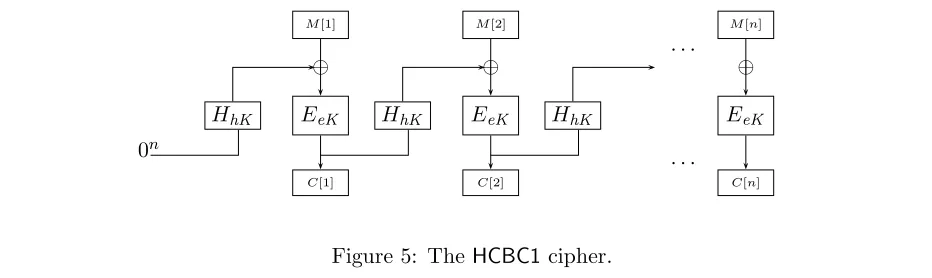
instance HCBC1(eKkhK,·) of the cipher consists of a key eK for the block cipher and a key hK specifying a member H(hK,·) of the family H. The construction is just like CBC, except that a ciphertext block is first hashed via H(hK,·) before being XORed with the next plaintext block. (The initial vector is fixed to 0n.) We stress that the hash functions map 2nbits tonbits, meaning work on inputs of the block length, as does the given block cipher. A picture is in Figure 5, and a full description of the construction is in Section 6. It is easy to see that this cipher is on-line.
1.5 The HCBC2 on-line cipher and its security
We provide a second, related construction which is proven to meet a stronger notion of security, namely it is a PRP under chosen-ciphertext attack. This is the analogue, for on-line-PRPs, of the notion of a PRP secure against chosen-ciphertext attacks. (The latter was called a strong PRP in [20] and a super-PRP in [17]). The adversary has an oracle not just for the challenge permutation, but also for its inverse. The assumption we make in the security result is that the underlying block cipher is a PRP under chosen-ciphertext attack. Additionally, we need a computationally AXU family of 2n bits to n bits. Instantiating the latter with a CBC MAC, we obtain a purely block-cipher based instantiation of HCBC2 that uses three block-cipher operations per block and has a key consisting of two block cipher keys. We note that this construction and result were not included in the preliminary version of this paper appearing in the Crypto 2001 conference [3].
1.6 Usage and application of on-line ciphers
There are settings in which the input plaintext is being streamed to a device that has limited memory for buffering and wants to produce output at the same rate at which it is getting input. The on-line property becomes desirable in these settings.
The most direct usage of an on-line cipher will be in settings where, additionally, there is a constraint requiring the length of the ciphertext to equal the length of the plaintext. (Otherwise, one can use a standard mode of encryption like CBC, since it has the on-line property. But it is length expanding in the sense that the length of the ciphertext exceeds that of the plaintext, due to the changing initial vector.) This type of constraint occurs when one is dealing with fixed packet formats, legacy code, or disk-sector encryption.
However, an on-line cipher is more generally useful, via the “encode-then-encipher” paradigm discussed in [7]. This paradigm was presented for ciphers that are PRPs, and says that enciphering provides semantic security if the message space has enough entropy, and provides integrity if the message space contains enough redundancy. Entropy and redundancy might be present in the data, as often happens when enciphering structured data like packets, which have fixed formats and often contain counters. Or, entropy and redundancy can be explicitly added, for example by inserting a random value and a constant string in the message. (This will of course increase the size of the plaintext, so is only possible when data expansion is permitted.)
Claims similar to those made in [7] remain true even if the cipher is an on-line-PRP rather than a PRP, but more restrictions on the message space are required. Specifically, we require not just that entropy be present in a message but that the same high entropy block be present both at the beginning and at the end of the message. While it is less likely that data already has such structure, one can prepend and append a random number to the message, getting the same properties but at the cost of small data expansion. In Section 8 we also discuss two other possibilities of message encodings for use with on-line ciphers.
In summary, an on-line cipher is a versatile tool that, when appropriately used, is able to provide some security under severe practical constraints, and yet provide security as high as that provided by standard primitives when practical constraints are less severe, motivating its isolation and study as a primitive in its own right.
1.7 Related work
The constructions of [20, Section 7] are not on-line; indeed, they cannot be, since they achieve the stronger security notion of a PRP. Our construction, however, follows that of [20] in using hash functions in combination with block ciphers.
Similarly, the CMC [13] and EME [14] enciphering modes are PRPs and not on-line. These constructs all incur latency that grows with the length of the message: the first bit of the output ciphertext is not produced until the entire message has been processed. In contrast, on-line ciphers likeHCBC1andHCBC2have no latency: an output block is produced as soon as the corresponding input block is processed.
A problem that has received a lot of attention is to take a PRP and produce another having twice the input block length of the original [17, 20]. We are, however, interested in allowing inputs of varying and very large size, not merely twice the block size.
Following the appearance of the preliminary version of our work [3], there has been further research on on-line ciphers and encryption schemes [11, 9, 2]. Our HCBC2cipher was used by [1] to achieve efficiently searchable symmetric encryption.
1.8 Versions of this paper
A preliminary version of this paper appeared in Crypto 2001 [3]. The current version includes a new construction, namely HCBC2, which did not appear in the preliminary version. Section 8 has also been updated to include an on-line cipher based authenticated encryption scheme for variable input-length data. (The scheme in the preliminary version was only secure for fixed-length data.) The proofs in the current version of our paper, as opposed to the ones from (the full version of) our Crypto 2001 paper, use code-based game playing [8]. This simplifies the proofs and also bypasses various conditional probability claims made in the prior analyses. (Some of these claims were pointed out by Nandi [19] to be false. However, the problems are minor, and as shown by our current proofs, easily resolved. Nandi [19] also provides his own proofs of security forHCBC1 and HCBC2.)
2
Definitions
Notation. Astring is a member of{0,1}∗. Ifxis a string, then|x|denotes its length. The empty
string is denoted ε. For integer n, d≥1, let Dn={0,1}n and let Dd,n be the set of all strings in
D∗
n whose length is at mostdn bits. We adopt the convention that Dn0 ={ε}. IfP ∈Dn∗, then we
let kPkn be the number of blocks inP, namely the value i such that P ∈ Din. If P ∈ D∗n, then
P[i] denotes its ith block, meaningP =P[1]. . . P[kPkn] where P[i]∈Dn for alli= 1, . . . ,kPkn.
We let P[1..i] denote P[1]. . . P[i] for any 0 ≤i ≤ kPkn. If x, y ∈ Dn∗ are strings, then we define
thelongest common n-prefix of x, y, denoted byLCPn(x, y), as the largest integer i≥0 such that
there exists a strings∈Di
n which is a prefix of bothx and y. For i≥1 andM1, . . . , Mi ∈D∗n, we
also define
LCP∗n(Mi, M1, . . . , Mi−1)
(s, p)← (i,0)
Forj = 1, . . . , i−1 do
l←LCPn(Mi, Mj)
Ifl > p thenp←l;s←j
Return (s, p)
A mapf: D→Ris apermutation ifD=Randf is a bijection (i.e. one-to-one and onto). A map
whose inputs and outputs are in Dd,n, so that both are viewed as sequences of blocks where each
block is n bits long. We let f(i) denote the function which on input M returns the ith block of
f(M), orεif|f(M)|< ni. Ifi, j are integers, then we let [i..j] denote {i, . . . , j}.
Function families and ciphers. A family of functions is a map F: Keys(F)×Dom(F) →
Ran(F) where Keys(F) is the key space of F; Dom(F) is the domain of F; and Ran(F) is the range of F. If Keys(F) = {0,1}k, then we refer to k as the key-length. The two-input function
F takes a key K ∈Keys(F) and an input x ∈Dom(F) to return a pointF(K, x) ∈Ran(F). For each key K ∈ Keys(F), we define the map FK:Dom(F) → Ran(F) by FK(·) = F(K,·) for all
x ∈ Dom(F). Thus, F specifies a collection of maps from Dom(F) to Ran(F), each map being associated with a key. (That is why F is called a family of functions.) We refer to F(K,·) as an instance of F. The operation of choosing a key at random from the key space is denoted
K ←$ Keys(F). We write f ←$ F for the operation K ←$ Keys(F) ; f ← F(K,·). That is,f ←$ F
denotes the operation of selecting at random a function from the family F. When f is so selected it is called a random instance of F. Let Randn be the family of all functions mapping Dn to
Dn so that f $
← Randn denotes the operation of selecting at random a function from Dn to Dn.
Similarly, let Permn be the family of all permutations mapping Dn to Dn so that π $
← Permn
denotes the operation of selecting at random a permutation on Dn. We say that F is a cipher if
Dom(F) = Ran(F) and each instance F(K,·) of F is a length-preserving permutation. A block cipher is a cipher whose domain and range equalDn for some integer ncalled the block size. (For
example, theAES has block size 128.) If F is a cipher, then F−1 is the inverse cipher, defined by
F−1(K, x) =F
K(·)−1(x) for all K∈Keys(F) and x∈Dom(F).
Pseudorandomness of ciphers. A “secure” cipher is one that approximates a family of random
permutations; the “better” the approximation, the more secure the cipher. This is formalized following [12, 17]. Let F: Keys(F)×Dn → Dn be a family of functions with domain and range
Dn. LetA1 be an adversary (algorithm) that has access to one oracle and outputs a bit. Let
AdvprpF -cpa(A1) = Pr
h
g←$ F : Ag1 = 1i−Prhg←$ Permn : Ag1 = 1
i
.
LetA2 be an adversary that has access to two oracles and outputs a bit. IfF:Keys(F)×Dn→Dn
is a cipher, then we also let
AdvprpF -cca(A2) = Pr
h
g←$ F : Ag,g2 −1 = 1i−Prhg←$ Permn : Ag,g
−1
2 = 1
i
.
These capture the advantage of the adversary in question in the task of distinguishing a random instance of F from a random permutation on D. In the first case, the adversary gets to query the challenge instance. In the second, it also gets to query the inverse of the challenge instance. We note that in measuring time complexity of an adversary, the time to reply to oracle calls by computation ofF(K,·) and F(K,·)−1 is included.
Games. Our proof will use code-based game-playing [8]. We recall some background here. A
game —look at Figure 6 for an example— has anInitialize procedure, procedures to respond to adversary oracle queries, and aFinalizeprocedure. A game G is executed with an adversaryAas follows. First, Initialize executes and its outputs are the inputs to A. Then, the latter executes, its oracle queries being answered by the corresponding procedures of G. When A terminates, its output becomes the input to the Finalize procedure. The output of the latter, denoted GA, is called the output of the game, and we let “GA⇒y” denote the event that this game output takes value y. The boolean flag bad is assumed initialized to false. Games Gi,Gj are identical until
bad if their code differs only in statements that follow the setting of bad to true. For example, games G1,G2 of Figure 7 are identical until bad. The following is the Fundamental Lemma of
Lemma 2.1 [8]Let Gi,Gj be identical untilbad games, andA an adversary. Then
Pr[ GAi ⇒1 ]−Pr[ GAj ⇒1 ] ≤ Pr[ Gj sets bad].
We will also use the following:
Lemma 2.2 [8]If Gi,Gj are identical until badthen for anyA
Pr[ GAi sets bad] = Pr[ GAj sets bad].
We often have a figure describe multiple games by indicating next to each procedure the games to which the procedure belongs. See for example Figure 2. This compacts the representation of a game sequence where successive games tend to have a lot of code in common.
3
On-line ciphers and their basic properties
We say that a function f: Dd,n → Dd,n is n-on-line if the i-th block of the output is determined
completely by the firstiblocks of the input. A more formal definition follows. We refer the reader to Section 2 for the definition off(i).
Definition 3.1 Let n, d≥1 be integers, and let f: Dd,n →Dd,n be a length-preserving function.
We say thatf is n-on-line if there exists a functionX: Dd,n →Dn such that for everyM ∈Dd,n
and every i∈ {1, . . . ,kMkn} it is the case that
f(i)(M) = X(M[1]. . . M[i]). (1) A cipherFhaving domain and range a subset ofDd,nis said to ben-on-line if for everyK∈Keys(F)
the functionF(K,·) is n-on-line.
An equivalent characterization can be made in terms of the longest common prefix function defined in Section 2, as follows.
Proposition 3.2 Letn, d≥1 be integers, and letf: Dd,n →Dd,n be a length-preserving function.
Then f isn-on-line if and only if the following is true:
LCPn(f(x), f(y)) ≥ LCPn(x, y). (2)
for everyx, y∈Dd,n.
Proof of Proposition 3.2: First suppose that f is n-on-line. Let X be as per Definition 3.1, and let x, y∈Dd,n. We need to show that Equation (2) holds. Let m =LCPn(x, y). This means
that blocksi= 1, . . . , m of xand y are the same. Equation (1) then implies thatf(i)(x) =f(i)(y)
fori= 1, . . . , m, meaning that LCPn(f(x), f(y))≥m.
Next, assume that Equation (2) holds for allx, y∈Dd,n. We defineX as follows:
X(M[1]. . . M[i]) =f(i)(M[1]. . . M[i])
whereM[1]. . . M[i]∈Did,n. We need to show that the functionXmeets the condition of Definition 3.1, namely that∀M∈Dd,n and ∀i∈ {1, . . . ,kMkn},
f(i)(M) = X(M[1]. . . M[i]).
LetM ∈Dd,n and i∈ {1, . . . ,kMkn}. First, we point out that Equation (2) implies that
This means that the first sequence of iblocks of f(M) and that of f(M[1]. . . M[i]) are the same. This in turn implies that
f(i)(M) =f(i)(M[1]. . . M[i])
which is equal toX(M[1]. . . M[i]) by the definition of X above. Therefore,X meets the condition of Definition 3.1 as claimed.
Definition 3.3 Let f be an n-on-line function. Let i ≥1. Fix M[1], . . . , M[i−1]∈ Dn. Define
the function ΠfM[1]...M[i−1]:Dn →Dn by
ΠfM[1]...M[i−1](x) =f(i)(M[1]. . . M[i−1]x) for all x∈Dn.
Proposition 3.4 If f is an n-on-line permutation, i ≥1 and M[1], . . . , M[i−1] ∈Dn, then the
map ΠfM[1]...M[i−1] is a permutation on Dn.
Proof of Proposition 3.4: LetM′ =M[1]. . . M[i−1], and letx, ybe distinctn-bit strings. We
claim that
ΠfM′(x)6= Π
f
M′(y). (3)
Since ΠfM′ maps Dn to Dn, this implies that it is a permutation. We now proceed to establish
Equation (3).
Sincef isn-on-line, we may fix a function X: Dd,n →Dnmeeting the conditions of Definition 3.1.
LetMx =M′kx and My =M′ky. Applyingf to Mx, we get
f(Mx) = f(1)(Mx)kf(2)(Mx)k · · · kf(i−1)(Mx)kf(i)(Mx)
= X(M[1])kX(M[1]M[2])k · · · kX(M[1]. . . M[i−1])kX(Mx).
Similarly,
f(My) = X(M[1])kX(M[1]M[2])k · · · kX(M[1]. . . M[i−1])kX(My).
By assumption x 6= y, which implies Mx 6= My. But f is a permutation, so it must be that
f(Mx)6=f(My). However, from the above we see that, for every j = 1, . . . , i−1, the j-th output
block of f(Mx) and the j-th output block of f(My) are equal. So it must be that the i-th blocks
of the outputs are unequal, meaning X(Mx)6=X(My). Finally, we observe that
X(Mx) = f(i)(M′x) = ΠfM′(x)
X(My) = f(i)(M′y) = ΠfM′(y),
so Equation (3) is established.
Pseudorandomness of on-line ciphers. Let OPermd,n denote the family of all n-on-line,
length-preserving permutations on Dd,n. A “secure” on-line cipher (namely, an on-line-PRP or
OPRP) is one that closely approximatesOPermd,n; the “better” the approximation, the more
“se-cure” the on-line cipher. This formalization is analogous to the previously presented formalization of the pseudorandomness of ciphers. LetF: Keys(F)×Dd,n →Dd,n be a family of functions with
domain and range Dd,n. Let A1 be an adversary with one oracle and A2 an adversary with two
oracles. Let
AdvoprpF -cpa(A1) = Pr
h
g←$ F : Ag1 = 1i−Prhg←$ OPermd,n : Ag1= 1
i
IfF is a cipher, then we also let
AdvoprpF -cca(A2) = Pr
h
g←$ F : Ag,g2 −1= 1i−Prhg←$ OPermd,n : Ag,g
−1
2 = 1
i
.
These capture the advantage of the adversary in question in the task of distinguishing a random instance of F from a random, length-preserving,n-on-line permutation on Dd,n. In the first case,
the adversary gets to query the challenge instance. In the second, it also gets to query the inverse of the challenge instance.
Tree-based characterization. We present a tree-based characterization of n-on-line ciphers
that is useful to gain intuition and to analyze constructs. Let N = 2n. An N-ary tree of functions
is anN-ary tree T each node of which is labeled by a function mappingDn to Dn. We label each
edge in the tree in a natural way via a string in Dn. Then, each node in the tree is described by
a sequence of edge labels defining the path from the root to the node in question. The function labelling node x in the tree, where x is a string of length nifor some 0 ≤ i≤d, is then denoted
Tx. A tree defines a functionT from Dd,n to Dd,n as described below. If the nodes in the tree are
labeled with permutations, then the tree also defines an inverse function T−1.
T(M[1]. . . M[l])
x←ε
For i= 1, . . . , l do
C[i]←Tx(M[i])
x←xkC[i] Return C[1]. . . C[l]
T−1(C[1]. . . C[l])
x←ε
Fori= 1, . . . , l do
M[i]←Tx−1(C[i])
x←xkC[i] Return M[1]. . . M[l]
Here, 1 ≤ l ≤ d. Let G : Keys(G)×Dn → Dn be a function family. (We are most interested
in the case where G is Permn orRandn.) We let Tree(n, G, d) denote the set of all 2n-ary trees of
functions in which each function is an instance ofGand the depth of the tree isd. This set is viewed as equipped with a distribution under which each node of the tree is assigned a random instance of G, and the assignments to the different nodes are independent. We claim that a tree-based construction defined above is a valid characterization of on-line ciphers, as stated in the following proposition.
Proposition 3.5 There is a bijection betweenTree(n,Permn, d) andOPermd,n.
Proof of Proposition 3.5: We specify a mapZ: OPermn,d→Tree(n,Permn, d) and then argue
that it is a bijection. Givenf ∈OPermn,d, the mapZreturns the treeTf =Z(f)∈Tree(n,Permn, d)
defined as follows: for any l = 0, . . . , d− 1 and any M[1]. . . M[l] ∈ Dd,n, C = f(M), node
C[1]. . . C[l] of tree Tf is labelled by the permutation ΠMf [1]...M[l]. Equivalently, Tf can be
de-fined as the function which, for any l = 1, . . . , d and any input M[1]. . . M[l] ∈ Dd,n, works as
follows:
Tf(M[1]. . . M[l])
For i= 1, . . . , l do
C[i]←ΠfM[1]...M[i−1](M[i]) Return C[1]. . . C[l]
Proposition 3.4 implies that the functions labelling the nodes of the tree are indeed in Permn, so
Tf ∈ Tree(n,Permn, d). Now we want to show that Z is a bijection. We need to show that it is
To show that Z is injective, let f and g be n-on-line permutations such that Z(f) = Z(g). We show thatf =g. As per the above and the assumption thatTf =Tg, the function labelling a node
C[1]. . . C[l] in Tf is ΠfM[1]...M[l] inTf and ΠgM[1]...M[l] inTg. The assumption Tf =Tg also implies
that ΠfM[1]...M[l]= ΠgM[1]...M[l]for alll= 0, . . . , d−1 and allM[1]. . . M[l]∈Dd,n. By Definition 3.3
we have
f(l+1)(M[1]. . . M[l]x) =g(l+1)(M[1]. . . M[l]x)
for all l= 0, . . . , d−1 and allM[1]. . . M[l]∈Dd,n. Therefore, f =g.
Next we show that Z is surjective. Let T ∈Tree(n,Permn, d). We need to show that there exists
an f ∈OPermn,d such thatTf =T. We letf be the function defined byT. From the definition, it
is clear that it isn-on-line, and since the inverse functionT−1 is also defined, is a permutation.
Inversion. It turns out that the inverse of an on-line permutation is itself on-line:
Proposition 3.6 Let f: Dd,n → Dd,n be an n-on-line permutation, and let g = f−1. Then g is
an n-on-line permutation.
Proof of Proposition 3.6: Sincef is by assumption a length-preserving permutation, so isg. So as per Definition 3.1, it suffices to show that there exists a functionY so that, for everyC ∈Dd,n
and for everyi≤ kCkn, we have
g(i)(C) =Y(C[1]. . . C[i]). (4) We defineY :Dd,n →Dn as follows for any i= 1, . . . , dand any input C[1]. . . C[i]∈Dd,n:
Y(C[1]. . . C[i])
M[0]←ε
For j= 1, . . . , i do
M[j]←(ΠfM[0]...M[j−1])−1(C[j])
Return M[i].
Here we used Proposition 3.4 and the assumption thatf is n-on-line to guarantee that the inverse of ΠfM[0]...M[j−1] is well-defined. Now, suppose C ∈ Dd,n and 1 ≤ i ≤ kCkn. We prove that
Equation (4) holds. Letting M =g(C) we have
Y(C) = Y(f(g(C)))
= Y(f(M))
= Y(f(1)(M)kf(2)(M)k · · · kf(i)(M))
= Y(Πfε(M[1])kΠ f
M[1](M[2])k · · · kΠ
f
M[1]...M[i−1](M[i]))
= M[i]
= g(i)(C),
as desired. The first line above is true becauseg=f−1. The second line is true becauseM =g(C).
The third line is by definition of f(j) for j = 1, . . . , i. The fourth line is by Proposition 3.4. The
proc Initialize
i←0
proc Encipher(M)
i←i+ 1 ; Mi ←M; li← kMikn
(s, p)←LCP∗n(Mi, M1, . . . , Mi−1)
Forj = 1, . . . , pdo Ci[j]←Cs[j]
Forj =p+ 1, . . . , li do
ΠMi[1..j−1](Mi[j])
$
←Rng(ΠMi[1...j−1])
Ci[j]←ΠMi[1...j−1](Mi[j])
Return Ci ←Ci[1..li]
proc Decipher(C)
i←i+ 1 ; Ci ←C; li ← kCikn
(s, p)←LCP∗n(Ci, C1, . . . Ci−1)
Forj = 1, . . . , pdo Mi[j]←Ms[j]
Forj =p+ 1, . . . , li do
Π−M1i[1...j−1](Ci[j]) $
←Dom(ΠMi[1...j−1])
Mi[j]← Π−M1i[1...j−1](Ci[j])
Return Mi ←Mi[1. . . li]
proc Finalize(d) Return d
proc Initialize
K←$ Keys(F)
proc Encipher(M) ReturnFK(M)
proc Decipher(C) ReturnFK−1(C)
proc Finalize(d) Returnd
Figure 1: Games for defining security of on-line ciphers. On the left are the procedures defining games OPRPCPAPermand OPRPCCAPerm, where theDecipherprocedure is included only in the
latter. On the right are the procedures defining games OPRPCPAF and OPRPCCAF, where the
Decipherprocedure is included only in the latter.
We note that the proof does not tell us anything about the computational complexity of func-tion f−1, meaning it could be the case that f is efficiently computable, but the f−1 given by
Proposition 3.6 is not. However, whenever we design a cipher F, we will make sure that both
F(K,·) andF−1(K,·) are efficiently computable given K, and will explicitly specify F−1 in order
to make this clear.
Game-based formulations. For our proofs, it is helpful to re-cast the advantages via the
games shown in Figure 1. Games OPRPCPAPerm and OPRPCPAF provide the adversary with an
Encipher oracle while games OPRPCCAPerm and OPRPCCAF additionally give it a Decipher
oracle, the latter in the case whereF is a cipher. Games OPRPCPAPermand OPRPCCAPermlazily
pick a permutation ΠM[1..j]for the tree node with labelM[1..j], so that
AdvoprpF -cpa(A) = Pr[ OPRPCPAFA⇒1 ]−Pr[ OPRPCPAAPerm⇒1 ]
AdvoprpF -cca(A) = Pr[ OPRPCCAFA⇒1 ]−Pr[ OPRPCCAAPerm⇒1 ].
In the games, the domain Dom(ΠM[1..j]) and range Rng(ΠM[1..j]) of ΠM[1..j] start out empty, and
an assignment ΠM[1..j](x) ← y adds x to the first set and y to the second. We are denoting
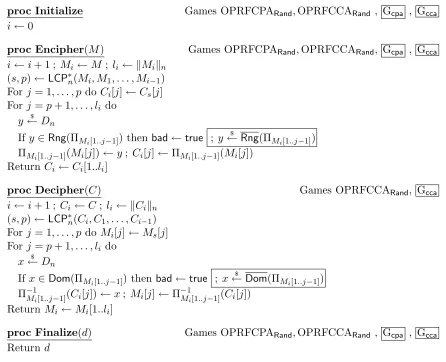
proc Initialize Games OPRFCPARand,OPRFCCARand , Gcpa , Gcca i←0
proc Encipher(M) Games OPRFCPARand,OPRFCCARand, Gcpa , Gcca
i←i+ 1 ; Mi ←M; li ← kMikn
(s, p)←LCP∗n(Mi, M1, . . . , Mi−1)
Forj = 1, . . . , pdo Ci[j]←Cs[j]
Forj =p+ 1, . . . , li do
y ←$ Dn
If y∈Rng(ΠMi[1..j−1]) thenbad←true ; y←$ Rng(ΠMi[1..j−1]) ΠMi[1..j−1](Mi[j])←y; Ci[j]←ΠMi[1..j−1](Mi[j])
Return Ci←Ci[1..li]
proc Decipher(C) Games OPRFCCARand, Gcca
i←i+ 1 ; Ci ←C; li ← kCikn
(s, p)←LCP∗n(Ci, C1, . . . , Ci−1)
Forj = 1, . . . , pdo Mi[j]←Ms[j]
Forj =p+ 1, . . . , li do
x←$ Dn
If x∈Dom(ΠMi[1..j−1]) thenbad←true ; x←$ Dom(ΠMi[1..j−1]) Π−M1
i[1..j−1](Ci[j])←x;Mi[j]←Π −1
Mi[1..j−1](Ci[j])
Return Mi←Mi[1..li]
proc Finalize(d) Games OPRFCPARand,OPRFCCARand , Gcpa , Gcca
Return d
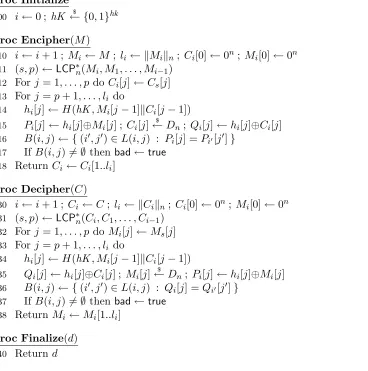
Figure 2: Games for proof of Lemma 3.7. Games Gcpaand Gcca include the boxed statements while
the other games do not.
Switching Lemma. It will be useful in our proofs to consider games which reply to queries with
random block values unless constrained otherwise by the prefix condition. That is, consider games OPRFCPAPermand OPRFCCAPermof Figure 1. In analogy with the PRP/PRF Switching Lemma
of [8], we have the following lemma.
Lemma 3.7 [OPRP/OPRF Switching Lemma.] LetAbe an adversary making oracle queries totalling at mostµ blocks. Then,
Pr[ OPRPCPA
A
Perm⇒1 ]−Pr[ OPRFCPAARand⇒1 ]
≤
µ(µ−1)
2n+1 and (5)
Pr[ OPRPCCA
A
Perm⇒1 ]−Pr[ OPRFCCAARand⇒1 ]
≤
µ(µ−1)
2n+1 . (6)
Note in the second case we mean the total number of blocks across queries to both oracles together is at mostµ.
Proof of Lemma 3.7: We have
Pr[ OPRPCPA
A
Perm⇒1 ]−Pr[ OPRFCPAARand⇒1 ]
= Pr[ G
A
cpa⇒1 ]−Pr[ OPRFCPAARand⇒1 ]
≤ Pr[ OPRFCPAARand setsbad],
the last line by Lemmas 2.1 and 2.2. However, the last probability is certainly at mostµ(µ−1)/2n+1.
The analysis for the CCA case is similar and is omitted.
We conjecture that the bounds in Equations (5) and (6) can be improved to q(q−1)/2n+1 where
q is an upper bound on the number of oracle queries made by A. (In the CCA case, we mean the total number of queries across both oracles.) That is, the bound does not depend on the number of blocks but only on the number of queries. We do not attempt to prove this since it does not (much) affect our results. We leave settling this as an open question.
4
Analysis of some candidate ciphers
We consider several candidates for on-line ciphers. First, we consider one based on the basic CBC mode. Then, we consider the Accumulated Block Chaining (ABC) proposed by Knudsen in [15], which is a generalization of the Infinite Garble Extension mode proposed by Campbell [10]. In this section, we let E: {0,1}ek
×Dn→Dn be a given block cipher with key size ek and block sizen.
4.1 CBC as an on-line cipher
In CBC encryption based on E, one usually uses a new, random IV for every message. This does not yield a cipher, let alone an on-line one. To get an on-line cipher, we fix the IV. We can, however, make it secret; this can only increase security. In more detail, the CBC cipher associated to E, denotedOCBC, has key space{0,1}ek+n. ForM, C∈D
d,n,eK ∈ {0,1}ek andC[0]∈Dn, we define
OCBC(eKkC[0], M) Fori= 1, . . . , ldo
C[i]←E(eK, M[i]⊕C[i−1]) ReturnC[1..l]
OCBC−1(eKkC[0], C) Fori= 1, . . . , l do
M[i]←E−1(eK, C[i])⊕C[i−1] ReturnM[1..l]
Here, C[0] is the IV. The key is the pair eKkC[0], consisting of a key eK for the block cipher, and the IV. It is easy to check that the above cipher is on-line. For clarity, we have also shown the inverse cipher. We now present the attack. The adversaryA shown in Figure 3 gets an oracle
g where g is either an instance of OCBC or an instance of OPermd,n. The idea of the attack is
to gather some input-output pairs for the cipher. Then we use these values to construct a new sequence of input blocks so that one of the input blocks toE collides with one of the previous input blocks to E. This enables us to predict an output block of the cipher. If our prediction is correct, then we know that the oracle is an instance of OCBCwith overwhelming probability. Specifically, we claim that
AdvoprpOCBC-cpa(A)≥1−2−n . (7)
We now justify Equation (7). We claim that
Prhg←$ OCBC : Ag = 1i= 1 and Prhg←$ OPermn,d : Ag = 1
i
≤2·2−n,
from which Equation (7) from Section 4 follows. We justify these two claims as follows. First, suppose gis an instance of OCBC. Since the first block ofM3 is M2[1], we have
AdversaryAg
Let M[2], . . . , M[l] be any n-bit strings
Let M1= 0nM[2]. . . M[l] and let M2= 1nM[2]. . . M[l]
Let C1[1]. . . C1[l]←g(M1) and letC2[1]. . . C2[l]←g(M2)
Let M3[2] =M[2]⊕C1[1]⊕C2[1] and letM3 = 1nM3[2]M[3]. . . M[l]
Let C3[1]. . . C3[l]←g(M3)
If C3[2] =C1[2] then return 1 else return 0
Figure 3: Attack on the CBC based on-line cipher.
= E(eK, C2[1]⊕M[2]⊕C1[1]⊕C2[1])
= E(eK, M[2]⊕C1[1])
= C1[2].
This means that adversary A will always return 1 when g is an instance of OCBC, and the first equation is true. Now, consider the case wheregis a random instance ofOPermn,d. Here, there are
two possible ways in whichC3[2] =C1[2] holds. First, M3[2] can happen to be the same as M[2].
This happens with the probability at most 2−nwhen g is a random instance ofOPerm
n,d. Second,
ifM3[2]6=M[2], then it can happen that C3[2] = C1[2] with the probability at most 2−n when g
is a random instance of OPermn,d. Therefore, the adversary Ag outputs 1 with the probability at
most 2·2−n, and this justifies the second equation.
Since A made only 3 oracle queries, this shows that the CBC mode with a fixed IV is not a secure on-line cipher.
4.2 ABC as an on-line cipher
Knudsen in [15] proposes the Accumulated Block Chaining (ABC) mode of operation for block ciphers. This is an on-line cipher that is a natural starting point in the problem of finding a secure on-line cipher because it has the property of “infinite error propagation.” We formalize and analyze ABC with regard to meeting our security requirements.
Description. The mode is parameterized by initial values P[0], C[0] ∈ Dn and also by a public
function h: Dn → Dn. (Instantiations for h suggested in [15] include the identity function, the
constant function always returning 0n, and the function which rotates its input by one bit.) We
are interested in the security of the mode across various settings and choices of these parameters. (In particular, we want to consider the case where the initial values are public and also the case where they are secret, and see how the choice of h impacts security in either case.) Accordingly, it is convenient to first introduce auxiliary functions EABC and DABC. For M, C ∈ Dd,n and
eK ∈ {0,1}k, we define
EABC(eK, P[0], C[0], M) Fori= 1, . . . , l do
P[i]←M[i]⊕h(P[i−1])
C[i]←E(eK, P[i]⊕C[i−1])
⊕P[i−1] Return C[1..l]
DABC(eK, P[0], C[0], C) Fori= 1, . . . , l do
P[i]←E−1(eK, C[i]⊕P[i−1])
⊕C[i−1]
AdversaryAg
Let M[2], . . . , M[l] be any n-bit strings
Let M1= 0nM[2]. . . M[l] and let M2= 1nM[2]. . . M[l]
Let C1[1]. . . C1[l]←g(M1) and letC2[1]. . . C2[l]←g(M2)
Let M3[2] =M[2]⊕C1[1]⊕C2[1]⊕h(0n⊕h(P[0]))⊕h(1n⊕h(P[0]))
Let M3= 1nM3[2]M[3]. . . M[l]
Let C3[1]. . . C3[l]←g(M3)
If C3[2] =C1[2]⊕1n, then return 1 else return 0
Figure 4: Attack on the ABC based on-line cipher.
We now define two versions of the ABC cipher. The first uses public initial values, while the second uses secret initial values. TheABC cipher with public initial values associated toE, denotedPABC, has key space{0,1}k and domain and rangeD
d,n. We fix values P[0], C[0]∈Dnwhich are known
to all parties including the adversary. We then define the cipher and the inverse cipher as follows:
PABC(eK, M)
Return EABC(eK, P[0], C[0], M)
PABC−1(eK, C)
Return DABC(eK, P[0], C[0], C)
TheABC cipher with secret initial values associated toE, denotedSABC, has key space{0,1}k+2n
and domain and range Dd,n. The key is eKkP[0]kC[0]. We then define the cipher and the inverse
cipher as follows:
SABC(eKkP[0]kC[0], M)
Return EABC(eK, P[0], C[0], M)
SABC−1(eKkP[0]kC[0], C) Return DABC(eK, P[0], C[0], C)
It is easy to check that both the above ciphers are n-on-line.
Security ofPABC. We show that the ABC cipher with public initial values is not a secure OPRP
forall choices of the function h. The attack is shown in Figure 4. The adversary A gets an oracle
g whereg is either an instance ofPABCor an instance of OPermd,n. The adversary can mount this
attack because the function h as well as the valueP[0] are public. We claim that
AdvoprpPABC-cpa(A)≥1−2·2−n. (8)
Since Amade only three oracle queries, this means that PABC is not a secure on-line cipher. We now analyze the attack against PABC, meaning we justify Equation (8). We claim that
Prhg←$ PABC : Ag = 1i= 1 and Prhg←$ OPermn,d : Ag = 1
i
≤3·2−n,
from which Equation (8) follows. We justify these two claims below. First, supposegis an instance of PABC, namely g(·) =PABC(eK,·). Since the first block of x3 is 1n, we have
C3[2] = E(eK, P3[2]⊕C3[1])⊕P3[1]
= E(eK, x3[2]⊕h(P3[1])⊕C3[1])⊕P3[1]
= E(eK, x3[2]⊕h(P2[1])⊕C2[1])⊕P2[1]
= E(eK, x3[2]⊕h(1n⊕h(P[0]))⊕C2[1])⊕P2[1]
= E(eK, x[2]⊕C1[1]⊕h(0n⊕h(P[0])))⊕P2[1]
= E(eK, P1[2]⊕C1[1])⊕P2[1]
= (C1[2]⊕P1[1])⊕P2[1]
= C1[2]⊕(0n⊕h(P[0]))⊕(1n⊕h(P[0]))
= C1[2]⊕1n.
This means that adversaryAwill always return 1 whengis an instance ofPABC. Now, consider the case wheregis an instance ofOPermn,d. We claim that this event has low probability, namely 2·2−n.
The reason is similar to that in Section 4.1. In particular, there are two possible ways in which
C3[2] =C1[2]⊕1n holds. First, it may be the case thatx3[2] =x[2]. This means that the attack is
invalid sincex3 =x2. Second, ifx3[2]6=x[2], then it may be the case thatC3[2] =C1[2]⊕1n. Each
of these events happens with probability at most 2−n when g is a random instance of OPermn,d.
Upper-bounding the aggregate probability, we obtain 2·2−n and Equation (8) follows.
Security ofSABC. We show that the ABC cipher with secret initial values is not a secure OPRP
for a class of functions h that includes the ones suggested in [15]. Specifically, let us say that a functionh: Dn→Dn islinear ifh(x⊕y) =h(x)⊕h(y) for allx, y ∈Dn. (Notice that the identity
function, the constant function always returning 0n, and the function which rotates its input by one bit are all linear.) For any linear hash functionh, we simply note that the above attack applies. This is because the fourth line of the adversary’s code can be replaced by
Let M3[2] =M[2]⊕C1[1]⊕C2[1]⊕h(0n)⊕h(1n)
The adversary can compute M3[2] because h is public. The fact that h is linear means that the
valueM3[2] is the same as before, so the attack has the same success probability.
Avoiding the attacks. There are several ways one might try to avoid such attacks while keeping
intact the basic structure of the ABC mode. One could use secret initial values and a more complex public functionh that in particular is non-linear. Another suggestion is to allow the function hto depend on a secret key. A concrete suggestion in this regard is to choose some family of functions
H: {0,1}2n×D
n→Dnthat is pairwise independent. Then, the key for the ABC cipher iseKkhK
where eK ∈ {0,1}k and hK ∈ {0,1}2n, and the construction replaces h(·) by H(hK,·). We do
not attempt to analyze these, since we propose a somewhat simpler construct that we prove to be secure.
5
(Computational) AXU families
Our constructions utilize a block cipher and an auxiliary family H that meets a computational relaxation of the notion of AXU (Almost XOR Universal) of Krawczyk [16]. To detail this, let us begin by recalling the measure of [16]:
Definition 5.1 Let m, n,hk ≥1 be integers, and let H: {0,1}hk
× {0,1}m → D
n be a family of
functions. Let
AdvaxuH = max
x1,x2,y
n
PrhK ← {$ 0,1}hk
: H(K, x1)⊕H(K, x2) =y
i o
where the maximum is over alldistinctx1, x2 ∈ {0,1}m and ally ∈Dn.
security definitions. We now define an adversary-based measure that will underly a computational relaxation of the above:
Definition 5.2 Let m, n,hk ≥1 be integers, and let H: {0,1}hk
× {0,1}m → D
n be a family of
functions. LetXbe an adversary that takes no inputs and outputs a setS ⊆ {0,1}m×D
n. Consider
the experiment in which we first run X to get S and then pick K at random from {0,1}hk
. Let AdvaxuH (X) denote the probability that there exists (x1, y1),(x2, y2)∈S such thatH(K, x1)⊕y1=
H(K, x2)⊕y2 and x1 6=x2, where the probability is over the coins of X and the choice of K.
We (informally) say that H is cAXU if AdvaxuH (X) is “small” for all X of “practical” resources. (Resources means running time and size of the output set S.) The following shows that any AXU family is cAXU:
Proposition 5.3 Letm, n,hk ≥1 be integers, and let H: {0,1}hk
× {0,1}m→D
n be a family of
functions. Let X be an adversary that takes no inputs and returns a setS ⊆ {0,1}m×D
n of size
at mosts. Then,
AdvaxuH (X) ≤ s(s−1)
2 ·Adv
axu
H .
Proof of Proposition 5.3: Fix a sequence of coins that maximize the success probability of X, and let S be the set it outputs with these coins. For each (x1, y1),(x2, y2) ∈S with x1 6=x2, we
have
PrhK ← {$ 0,1}hk
: H(K, x1)⊕y1=H(K, x2)⊕y2
i
≤ AdvaxuH .
The lemma follows from the union bound.
However, there are cAXU families that are not necessarily AXU. For example, any PRF is cAXU. To detail this, we let
AdvprfH (B) = Prhg←$ H : Bg = 1i−Prhg←$ Randm,n : Bg = 1
i
whereRandm,n is the family of all functions mapping{0,1}m to Dn.
Proposition 5.4 Letm, n,hk ≥1 be integers, and let H: {0,1}hk
× {0,1}m→D
n be a family of
functions. LetXbe an adversary of running time at mosttthat takes no inputs and outputs a set of size at most s. Then, there is an adversaryB such that
AdvaxuH (X) ≤ AdvHprf(B) +s(s−1) 2n+1 .
Furthermore,B makes at mostsoracle queries and has running time at mostt+O((m+n)slogs).
The proof is trivial and is omitted. Now, from the above we have multiple ways to obtain cAXU families suitable for our constructs. First, by Proposition 5.3, any AXU family suffices. Refer to [16, 22, 21] for constructions and performance comparisons for such families. These constructs are all unconditionally secure. On the other hand, by Proposition 5.4, any PRF suffices. In particular, ifm=n, a block cipher suffices, and if m= 2n, a 2-fold CBC MAC suffices [5]. These constructs are conditionally secure, the condition being that the block cipher is a PRP.
6
The
HCBC1
cipher
0n
HhK
M[1]
⊕
EeK
C[1]
HhK
M[2]
⊕
EeK
C[2]
HhK
· · ·
· · · M[n]
⊕
EeK
C[n]
Figure 5: TheHCBC1cipher.
encryption. The difference is that each output block passes through a keyed hash function before getting exclusive-or-ed with the next input block and there is no IV. The key of the hash function is kept secret.
Construction 6.1 Letn, d≥1 be integers, and letE: {0,1}ek
×Dn→Dnbe a block cipher. Let
H: {0,1}hk
×Dn → Dn be a family of hash functions. We associate to them a cipher HCBC1:
{0,1}ek+hk
×Dd,n →Dd,n. A key for it is a paireKkhK whereeK is a key forE andhK is a key
for H. The cipher and its inverse are defined as follows for M, C ∈Dd,n. Figure 5 illustrates the
cipher.
HCBC1(eKkhK, M)
C[0]←0n; l← kMk n
Forj = 1, . . . , l do
P[j]←H(hK, C[j−1])⊕M[j]
C[j]←E(eK, P[j]) Return C[1..l]
HCBC1−1(eKkhK, C)
C[0]←0n; l← kCk n
Forj = 1, . . . , l do
P[j]←E−1(eK, C[j])
M[j]←H(hK, C[j−1])⊕P[j] Return M[1..l]
The following theorem implies that ifE is a PRP secure against chosen-plaintext attacks andH is a cAXU family of hash functions, thenHCBC1is an OPRP secure against chosen-plaintext attacks.
Theorem 6.2 Let E: {0,1}ek
×Dn → Dn be a block cipher, and let H: {0,1}hk ×Dn → Dn
be a family of hash functions. Let HCBC1 be the n-on-line cipher associated to them as per Construction 6.1. Then, for any adversaryA against HCBC1running in time tand making oracle queries totalling at mostµ blocks, there is an adversaryB against E and an adversary X against
H such that
AdvHCBC1oprp-cpa(A) ≤ AdvEprp-cpa(B) +3µ(µ−1)
2n+1 +Adv axu
H (X).
Furthermore, B runs in time t+O(nµ+hk) and makes at most µoracle queries, while X runs in timet+O(nµ) and outputs a set of size at most µ.
By Proposition 5.4, we can simply let H =E to obtain a purely block cipher based instantiation of HCBC1that has cost two block cipher computations per block and uses two block cipher keys. Proposition 5.3 says that other (possibly more efficient) instantiations are possible by settingH to an AXU family.
Proof of Theorem 6.2: For anyi, j ≥1, we let
proc Initialize Game G0
000 i←0 ; eK ← {$ 0,1}ek
001 π←E(eK,·) 002 hK ← {$ 0,1}hk
proc Initialize Game G1
100 i←0 101 π←$ Permn
102 hK ← {$ 0,1}hk
proc Encipher(M) Games G0,G1
010 i←i+ 1 ; Mi ←M; li← kMikn; Ci[0]←0n
011 (s, p)←LCP∗n(Mi, M1, . . . , Mi−1)
012 Forj= 1, . . . , pdoCi[j]←Cs[j] 013 Forj=p+ 1, . . . , li do
014 Pi[j]←H(hK, Ci[j−1])⊕Mi[j]
015 Ci[j]←π(Pi[j]) 016 ReturnCi ←Ci[1..li]
proc Finalize(d) Games G0,G1
020 Returnd
Figure 6: Games G0,G1 for proof of Theorem 6.2.
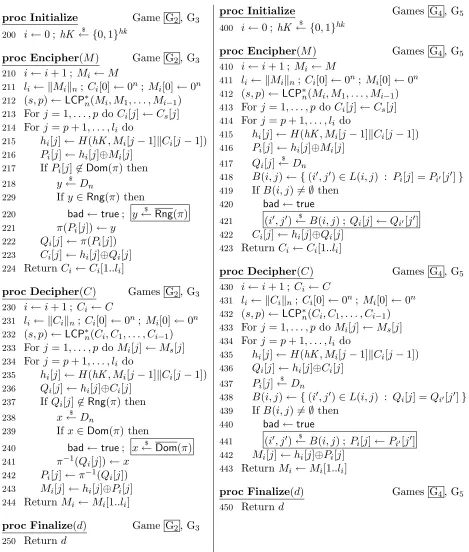
proc Initialize Game G2, G3
200 i←0 ; hK ← {$ 0,1}hk
proc Encipher(M) Game G2, G3
210 i←i+ 1 ; Mi ←M
211 li← kMikn;Ci[0]←0n
212 (s, p)←LCP∗n(Mi, M1, . . . , Mi−1)
213 Forj= 1, . . . , pdoCi[j]←Cs[j]
214 Forj=p+ 1, . . . , li do
215 Pi[j]←H(hK, Ci[j−1])⊕Mi[j]
216 If Pi[j]6∈Dom(π) then
217 y←$ Dn
218 Ify∈Rng(π) then
219 bad←true; y←$ Rng(π) 220 π(Pi[j])←y
221 Ci[j]←π(Pi[j])
222 ReturnCi ←Ci[1..li]
proc Finalize(d) Game G2, G3
230 Returnd
proc Initialize Games G4, G5
400 i←0 ; hK ← {$ 0,1}hk
proc Encipher(M) Games G4, G5
410 i←i+ 1 ; Mi ←M
411 li ← kMikn; Ci[0]←0n
412 (s, p)←LCP∗n(Mi, M1, . . . , Mi−1)
413 Forj= 1, . . . , pdoCi[j]←Cs[j]
414 Forj=p+ 1, . . . , li do
415 Pi[j]←H(hK, Ci[j−1])⊕Mi[j]
416 Ci[j]←$ Dn
417 B(i, j)← {(i′, j′)∈L(i, j) : Pi[j] =Pi′[j′]}
418 If B(i, j)6=∅ then
419 bad←true
420 (i′, j′)←$ B(i, j) ; Ci[j]←Ci′[j′]
421 ReturnCi ←Ci[1..li]
proc Finalize(d) Games G4, G5
430 Returnd
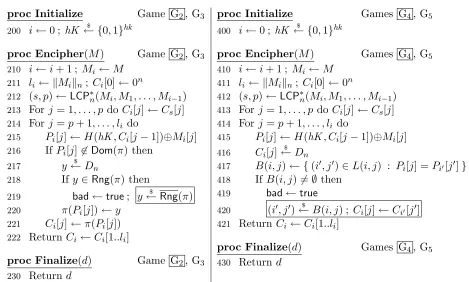
Figure 7: Games G2,G3,G4,and G5 for proof of Theorem 6.2. Game G2 and G4 include the boxed
code while G3 and G5 do not.
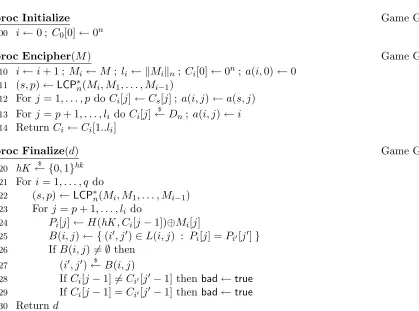
The proof is based on the sequence G0–G6 of games in Figures 6, 7, and 8. Let us begin with some
proc Initialize Game G6
600 i←0 ; C0[0]←0n
proc Encipher(M) Game G6
610 i←i+ 1 ; Mi ←M; li← kMikn; Ci[0]←0n; a(i,0)←0
611 (s, p)←LCP∗n(Mi, M1, . . . , Mi−1)
612 Forj= 1, . . . , pdo Ci[j]←Cs[j] ; a(i, j) ←a(s, j)
613 Forj=p+ 1, . . . , li doCi[j]←$ Dn; a(i, j) ←i
614 ReturnCi ←Ci[1..li]
proc Finalize(d) Game G6
620 hK ← {$ 0,1}hk
621 Fori= 1, . . . , qdo
622 (s, p)←LCP∗n(Mi, M1, . . . , Mi−1)
623 For j=p+ 1, . . . , li do
624 Pi[j]←H(hK, Ci[j−1])⊕Mi[j]
625 B(i, j)← {(i′, j′)∈L(i, j) : Pi[j] =Pi′[j′]}
626 IfB(i, j)6=∅ then 627 (i′, j′) $
←B(i, j)
628 IfCi[j−1]6=Ci′[j′−1] then bad←true
629 IfCi[j−1] =Ci′[j′−1] then bad←true
630 Returnd
Figure 8: Game G6 for proof of Theorem 6.2. Here, q denotes the number of oracle queries made
by A, with the wlog assumption that it always makes exactly q queries.
SayAhas queriedM1, . . . , Mi−1 (i≥1) and received backC1, . . . , Ci−1. Say it now queriesMi. Let
(s, p) =LCP∗n(Mi, M1, . . . , Mi−1). Then, blocks 1, . . . , pofCiare determined viaCi[1..p] =Cs[1..p].
What aboutCi[j] forj≥p+1? We haveCi[j] =E(eK, Pi[j]) wherePi[j] =H(hK, Ci[j−1])⊕Mi[j].
Intuitively, the cxu property tells us that Pi[j] 6= Pi′[j′] for all (i′, j′) ∈ L(i, j) where Pi′[j′] =
H(hK, Ci′[j′−1])⊕Mi′[j′]. SinceE is a PRP, this means thatE(eK, Pi[j]) looks random.
There are a couple of difficulties. One is that the cxu property as per Definition 5.2 refers to a setting where adversaryXchooses its setSbeforehK is chosen. Yet, above,Ais getting information about hK via responses to its queries. We address this by moving to a game in which blocks in replies to queries are random unless prefix-constrained, and in particular independent ofhK. The second difficulty is that the cxu property is only violated by the collisionH(hK, Ci[j−1])⊕Mi[j] =
H(hK, Ci′[j′−1])⊕Mi′[j′] if Ci[j−1] =6 Ci′[j′ −1]. We will use the randomness of the blocks to
show that the last condition is usually true.
Let us now provide the full proof. We note that
Pr[ OPRPCPAAHCBC1⇒1 ] = Pr[ GA0 ⇒1 ]
= Pr[ GA1 ⇒1 ] + (Pr[ GA0 ⇒1 ]−Pr[ GA1 ⇒1 ]) (9)
It is easy to define an adversary B so that
Namely, Bπ initializes ito 0 and picks hK at random from{0,1}hk
. It then runsA, answering its oracle queries with the code of the Encipher procedure of G0 but with the role of π played by
its own oracle. B returns what A returns. The running time of B is that of A plus the time to computeLCP∗nfor each oracle invocation and the time to pickhK at random. ImplementingLCP∗n with a tree data structure, rather than directly as described in Section 2, allows B to answer the
i-thEncipherquery in time O(nli). Thus,B’s total running time is that ofAplus O(nµ+hk).
Game G2 samplesπ lazily. The convention is thatRng(π) andDom(π) are initially empty. Rng(π)
always denotesDn\Rng(π), and an assignmentπ(x)←yaddsy toRng(π) andxtoDom(π). Now,
we have
Pr[ GA1 ⇒1 ] = Pr[ GA2 ⇒1 ]
= Pr[ GA3 ⇒1 ] +Pr[ GA2 ⇒1 ]−Pr[ GA3 ⇒1 ]
≤ Pr[ GA3 ⇒1 ] + Pr[ GA3 sets bad], (11)
the last by Lemma 2.1. However,
Pr[ GA3 sets bad]≤ µ(µ−1)
2n+1 . (12)
Now,
Pr[ GA3 ⇒1 ] = Pr[ GA4 ⇒1 ]
= Pr[ GA5 ⇒1 ] + (Pr[ GA4 ⇒1 ]−Pr[ GA5 ⇒1 ])
≤ Pr[ GA5 ⇒1 ] + Pr[ GA5 sets bad], (13)
the last by Lemma 2.1. Next, we see that
Pr[ GA5 ⇒1 ]
= Pr[ OPRFCPAARand⇒1 ]
= Pr[ OPRPCPAAPerm⇒1 ] +Pr[ OPRFCPAARand⇒1 ]−Pr[ OPRPCPAAPerm⇒1 ]
≤ Pr[ OPRPCPAAPerm⇒1 ] + µ(µ−1) 2n+1
where the last line holds due to Lemma 3.7. Putting Equations (9), (10), (11), (12), and (13) together, we have
AdvoprpHCBC1-cpa(A) = Pr[ OPRPCPAHCBC1A ⇒1 ]−Pr[ OPRPCPAAPerm⇒1 ]
≤ AdvprpE -cpa(B) +µ(µ−1)
2n + Pr[ G A
5 sets bad]. (14)
It remains to upper bound the probability that the execution of G5 withAsetsbad. TheEncipher
procedure of G5 sets bad but does not use it, so G6 delays its setting to Finalize, also breaking
line 419 into the equivalent lines 628 and 629. It additionally introduces theancestor function a, defining it at lines 612 and 613, but this does not affect the setting of bad, so
Pr[ GA5 sets bad] = Pr[ GA6 sets bad]. (15)
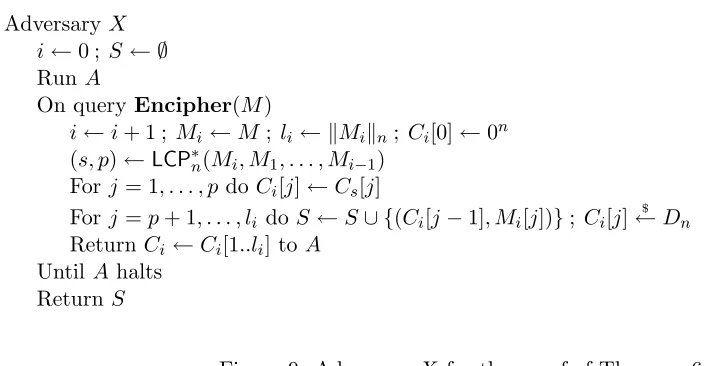
AdversaryX i←0 ; S ← ∅
Run A
On queryEncipher(M)
i←i+ 1 ; Mi ←M; li ← kMikn; Ci[0]←0n
(s, p)← LCP∗n(Mi, M1, . . . , Mi−1)
Forj = 1, . . . , pdo Ci[j]←Cs[j]
Forj =p+ 1, . . . , li do S←S∪ {(Ci[j−1], Mi[j])}; Ci[j] $
←Dn
Return Ci ←Ci[1..li] to A
Until A halts Return S
Figure 9: AdversaryX for the proof of Theorem 6.2.
Pr[ G6 setsbad at line 628 ]≤AdvaxuH (X), (16)
and X runs in time that of A plusO(nµ) and outputs a set of size at mostµ. We now claim that
Pr[ G6 sets badat line 629 ]≤
µ(µ−1)
2n+1 . (17)
To justify this, we consider the following cases.
Case 1: j ≥p+ 2.
In this case,j−1≥p+ 1, soCi[j−1] was chosen at random at 613 after Ci′[j′−1] was determined.
So the probability of their being equal is at most 2−n.
2
Case 2: j =p+ 1 and j′ =p+ 1 and LCP
n(Mi, Mi′)≥p.
In this case, we claim that the condition Pi[j] =Pi′[j′] implies thatCi[j−1]6=Ci′[j′−1], meaning
bad cannot be set at line 629. We now justify this. Since (i′, j′) ∈ L(i, j) and j = j′, it must
be that i′ < i. But (s, p) = LCP∗
n(Mi, M1, . . . , Mi−1), so LCPn(Mi, Mi′) ≥ p implies that in fact
LCPn(Mi, Mi′) =p. So Mi[p+ 1]6=Mi′[p+ 1]. Now note that
Pi[j] = Pi[p+ 1] = H(hK, Ci[p])⊕Mi[p+ 1]
Pi′[j′] = Pi′[p+ 1] = H(hK, Ci′[p])⊕Mi′[p+ 1].
So Ci[p] =Ci′[p] would imply Pi[j]6=Pi′[j′]. 2
A proof by induction can be used to verify that the ancestor functionahas the following properties. First, Ck[m] = Ca(k,m)[m], for any k ∈ [1..q] and m ∈ [0..lk]. Second, Ca(k,m)[m] was chosen at
random by Game G6 (at line 613), for any k∈ [1..q] and m ∈ [1..lk]. Third, if a(k, m) < k then
LCPn(Mk, Ma(k,m)) ≥m, for any k ∈[1..q] and m ∈ [1..lk]. We are now ready to tackle the last
case.
Case 3: j =p+ 1 and (j′ 6=p+ 1 or LCPn(Mi, Mi′)≤p−1).
By the first property of the ancestor functionanoted above, we haveCi[j−1] =Ca(i,j−1)[j−1] and
Ci′[j′−1] =Ca(i′,j′−1)[j′−1]. So we want to upper bound the probability thatCa(i,j−1)[j−1] =
AdversaryAg,g−1
Let C[2], . . . , C[l] be anyn-bit strings
Let C1= 1nC[2]. . . C[l] and let C2= 0n1nC[2]. . . C[l−1]
Let M1[1]. . . M1[l]←g−1(C1) and letM2[1]. . . M2[l]←g−1(C2)
If M1[1] =M2[2], then return 1 else return 0.
Figure 10: Chosen-ciphertext attack on HCBC1.
at random, and ifj′ 6= 1, thenC
a(i′,j′−1)[j′−1] was chosen at random. So as long as (j, j′)6= (1,1)
and (a(i, j−1), j) 6= (a(i′, j′−1), j′), the probability thatC
a(i,j−1)[j−1] =Ca(i′,j′−1)[j′−1] is 2−n.
Let us now check that the conditions above are met. We know that j = p+ 1, so if p ≥ 1 then
j 6= 1, so (j, j′) 6= (1,1). If p = 0 then the condition LCP
n(Mi, Mi′) ≤ p−1 is not met (because
LCPn(Mi, Mi′) is always non-negative) so it must be thatj′ 6=p+ 1 = 1, meaning we again have
(j, j′) 6= (1,1). Now consider whether (a(i, j−1), j) = (a(i′, j′−1), j′). If j′ 6= p+ 1 = j, then
certainly this condition is not true. So suppose j′ = p+ 1 = j. In that case, we are given that
LCPn(Mi, Mi′)≤p−1. Suppose towards a contradiction thata(i, j−1) =a(i′, j′−1) and call this
common valueα. Since (i′, j′)∈L(i, j) andj=j′, it must be that i′ < i. So 1≤α≤i′ < i. Then,
by the third property of the ancestor function anoted above, it must be that LCPn(Mi, Mα) ≥p.
If α = i′, this contradicts LCP
n(Mi, Mi′) ≤ p−1, so assume α < i′. But then, again by the
third property, we have LCPn(Mi′, Mα) ≥ p, which, together with LCPn(Mi, Mα) ≥ p, implies
LCPn(Mi, Mi′)≥p, contradicting LCPn(Mi, Mi′)≤p−1.2
Equations (15), (16), and (17) imply that
Pr[ GA5 sets bad]≤AdvHaxu(X) +µ(µ−1)
2n+1 . (18)
Combining Equations (14) and (18) completes the proof.
A Chosen-Ciphertext Attack againstHCBC1. We just showed thatHCBC1is secure against
chosen-plaintext attack. It is however not secure against chosen-ciphertext attacks, as we now observe. Figure 10 shows the attack. The adversaryA is given oracle access to g and g−1 where g
is either an instance ofHCBC1or an instance ofOPermn,d. We claim that
AdvoprpHCBC1-cca(A)≥1−2−n. (19) Since A made only 2 oracle queries, this shows that, as an on-line cipher, HCBC1 is not secure against chosen-ciphertext attack. The idea of the attack is to exploit the oracle access to g−1 and
the fact that, underHCBC1, two fixed, consecutive ciphertext blocks yield two consecutive message blocks where the second message block is also fixed. We claim that
Prhg←$ HCBC1 : Ag = 1i= 1 and Prhg←$ OPermn,d : Ag = 1
i
≤2−n,
from which Equation (19) follows. We justify these two equations as follows. First, supposegis an instance ofHCBC1. Since the first block ofC1 is 1n, we have
M1[2] =E−1(eK, C[2])⊕H(hK,1n) =M2[3].
This means that adversaryAwill always return 1 whengis an instance ofOCBC, and the first equa-tion is true. Now, consider the case wheregis a random instance ofOPermn,d. Here,M1[2] =M2[3]
holds with probability at most 2−n. Therefore, the adversaryAg outputs 1 with the probability at
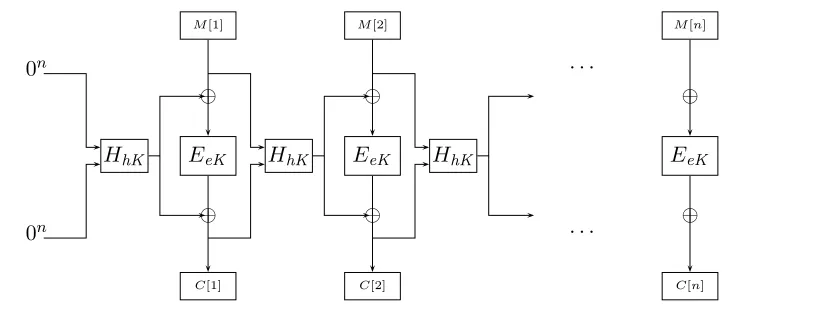
0n
HhK
0n
M[1]
⊕
EeK
⊕
C[1]
HhK
M[2]
⊕
EeK
⊕
C[2]
HhK
· · ·
· · ·
M[n]
⊕
EeK
⊕
C[n]
Figure 11: TheHCBC2cipher.
7
The
HCBC2
cipher
We construct an on-line cipher that is secure against chosen-ciphertext attacks.
Construction 7.1 LetE: {0,1}ek
×Dn→Dn be a block cipher. LetH: {0,1}hk×Dn2 →Dnbe
a family of functions. We associate to them a cipher HCBC2: {0,1}ek+hk
×Dd,n → Dd,n. A key
for it is a paireKkhK whereeK is a key for E and hK is a key for H. The cipher and its inverse are defined as follows for M, C∈Dd,n. Figure 11 illustrates the cipher.
HCBC2(eKkhK, M)
C[0]←0n; M[0]←0n; l← kMkn
Forj = 1, . . . , l do
h[j]←H(hK, M[j−1]kC[j−1])
P[j]←h[j]⊕M[j]
Q[j]←E(eK, P[j])
C[j]←h[j]⊕Q[j] Return C[1..l]
HCBC2−1(eKkhK, C)
C[0]←0n; M[0]←0n; l← kCkn
Forj = 1, . . . , l do
h[j]←H(hK, M[j−1]kC[j−1])
Q[j]←h[j]⊕C[j]
P[j]←E−1(eK, Q[j])
M[j]←h[j]⊕P[j] Return M[1..l]
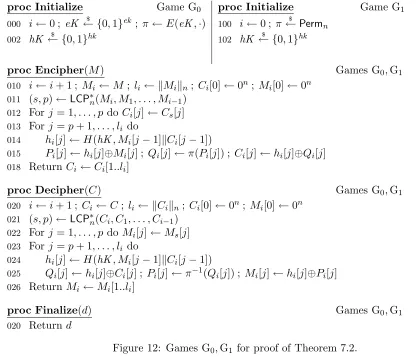
The following theorem implies that ifE is a PRP secure against chosen-ciphertext attacks and H
is an cAXU family of hash functions, then HCBC2 is an OPRP secure against chosen-ciphertext attacks.
Theorem 7.2 Let E: {0,1}ek
×Dn → Dn be a block cipher, and let H: {0,1} hk
×D2n → Dn
be a family of hash functions. Let HCBC2 be the n-on-line cipher associated to them as per Construction 7.1. Then, for any adversaryAagainstHCBC2running in timetand making forward queries totalling at most µe blocks and backward queries totalling at most µd blocks, there is an
adversaryB againstE and an adversary X againstH such that
AdvHCBC2oprp-cca(A) ≤ AdvEprp-cca(B) +3µ(µ−1)
2n+1 +Adv axu
H (X),
where µ= µe+µd. Furthermore, B runs in timet+O(nµ+hk) and makes at most µe forward
queries and at mostµd backward queries, whileX runs in timet+O(nµ) and outputs a set of size