Examining Indistinguishability-Based Proof Models for Key
Establishment Protocols
?Kim-Kwang Raymond Choo & Colin Boyd & Yvonne Hitchcock Information Security Institute
Queensland University of Technology GPO Box 2434, Brisbane, QLD 4001, Australia
{k.choo,c.boyd,y.hitchcock}@qut.edu.au
Abstract. We examine various indistinguishability-based proof models for key establishment protocols, namely the Bellare & Rogaway (1993, 1995), the Bellare, Pointcheval, & Rogaway (2000), and the Canetti & Krawczyk (2001) proof models. We then consider several variants of these proof models, identify several subtle differences between these variants and models, and compare the relative strengths of the notions of security between the models. For each of the pair of relations between the models (either an implication or a non-implication), we provide proofs or counter-examples to support the observed relations. We also reveal a drawback with the original formulation of the Bellare, Pointcheval, & Rogaway (2000) model, whereby the Corrupt query is not allowed. As a case study, we use the Abdalla & Pointcheval (2005) three-party password-based key exchange protocol (3PAKE), which carries a proof of security in the Bellare, Pointcheval, & Rogaway (2000) model. We reveal a previously unpublished flaw in the protocol, and demonstrate that this attack would not be captured in the model due to the omission of theCorruptquery.
1 Introduction
Key establishment protocols are used for distributing shared keying material in a secure manner. How-ever, despite their importance, the difficulties of obtaining a high level of assurance in the security of almost any new, or even existing, protocols are well illustrated with examples of errors found in many such protocols years after they were published (Bao 2003, Pereira & Quisquater 2003, Wan & Wang 2004, Wong & Chan 2001, Zhang 2005). The treatment of computational complexity analysis adopts a deductive reasoning process whereby the emphasis is placed on a proven reduction from the problem of breaking the protocol to another problem believed to be hard. Such an approach for key establishment protocols was made popular by Bellare & Rogaway (1993) who provide the first formal definition for a model of adversary capabilities with an associated definition of security (which we refer to as the BR93 model in this paper). Since then, many research efforts have been oriented towards this end which have resulted in numerous protocols with accompanying computational proofs of security proposed in the literature.
The BR93 model has been further revised several times. In 1995, Bellare and Rogaway analysed a three-party server-based key distribution (3PKD) protocol (Bellare & Rogaway 1995) using an exten-sion to the BR93 model, which we refer to as the BR95 model. A more recent reviexten-sion to the model was proposed in 2000 by Bellare et al. (2000), hereafter referred to as the BPR2000 model. Collectively, the BR93, BR95, and BPR2000 models will be referred to as the Bellare–Rogaway models. In independent yet related work, Bellare et al. (1998) built on the BR93 model and introduced a modular proof model. However, some drawbacks with this formulation were discovered and this modular proof model was subsequently modified by Canetti & Krawczyk (2001), and will be referred to as the CK2001 model in this paper.
Proof Models. There are several important differences between the BR93, BR95, BPR2000, and CK2001 models (which have a significant impact on the security of the models), as follows:
1. the way partner oracles are defined (i.e., the definition of partnership), 2. the powers of the probabilistic, polynomial-time (PPT) adversary, 3. the modular approach adopted in the CK2001 model, and
4. the provable security goals provided by the models.
DIFFERENCE 1: Security in the models depends on the notions of partnership of oracles and in-distinguishability of session keys. The BR93 model defines partnership using the notion of matching conversations, where a conversation is a sequence of messages exchanged between some instances of communicating oracles in a protocol run. Partnership in the BR95 model is defined using the notion of a partner function, which uses the transcript (the record of allSendoracle queries) to determine the part-ner of an oracle by providing a mapping between two oracles that should share a secret key on completion of the protocol execution. However, such a partner definition can easily go wrong. One such example is the partner function described in the original BR95 paper for the 3PKD protocol (Bellare & Rogaway 1995), which was later found to be flawed (Choo et al. 2004).
The BPR2000 model and the CK2001 model define partnership using the notion of session identifiers (SIDs). Although in the BPR2000 model, the construction of SIDs is suggested to be the concatenation of messages exchanged during the protocol run, protocol designers can construct SIDs differently. There is no formal definition of how SIDs should be defined in the CK2001 model. Instead, SIDs are defined to be some unique values agreed upon by two communicating parties prior to the protocol execution. We observe that the way SIDs are constructed can have an impact on the security of the protocol in the model.
DIFFERENCE 2: The CK2001 model enjoys the strongest adversarial power (compared to the Bellare– Rogaway models) as the adversary is allowed to ask theSession-State Reveal query that will return all the internal state (including any ephemeral parameters but not long-term secret parameters) of the target session to the adversary. In contrast, most models only allow the adversary to reveal session keys for uncorrupted parties. In the original BR93 and BPR2000 models, theCorruptquery (that allows the adversary to corrupt any principal at will, and thereby learn the complete internal state of the corrupted principal) is not allowed.
In this paper, we consider the BR93 model which allows the adversary access to a Corrupt query be-cause later proofs of security in the BR93 model (Al-Riyami & Paterson 2003, Blake-Wilson et al. 1997, Blake-Wilson & Menezes 1997, Chen & Kudla 2003, MacKenzie & Swaminathan 1999, McCullagh & Barreto 2005, Wong & Chan 2001) allow the Corruptquery. However, we consider the original BPR2000 model without Corrupt query because the basic notion of BPR2000 freshness restricts the adversary,A, from corrupting anyone in the model (i.e., effectively restrictingAfrom asking anyCorruptquery). However, we show that the omission of such a (Corrupt) query in the BPR2000 model allows an insecure protocol to be proven secure in the model.
where protocol components may be combined by “mix and match” to tailor to the application at hand (analogous to a Java API library).
DIFFERENCE 4: Both the BR93 and BPR2000 models provide provable security for entity authentica-tion & key distribuauthentica-tion, whilst the BR95 model provides provable security for only the key distribuauthentica-tion. Intuitively, protocols that provide both entity authentication and key distribution are “stronger” than protocols that provide only key distribution. In this paper, we refer to the BR93 and BPR2000 models that provide provable security for only key distribution as BR93 (KE) and BPR2000 (KE) respectively, and the BR93 and BPR2000 models that provide provable security for both entity authentication & key distribution as BR93 (EA+KE) and BPR2000 (EA+KE) respectively.
Motivations. We are motivated by the observations that no formal study has been devoted to the com-parisons of relations and relative strengths of security between the Bellare–Rogaway and the Canetti– Krawczyk models. Although Shoup (1999) provides a brief discussion on the Bellare–Rogaway models and the Canetti–Krawczyk model, his discussion is restricted to an informal comparison between the Bellare–Rogaway model and his model, and between the Canetti–Krawczyk model and his model. To the best of our knowledge, no distinction has ever been made between the Bellare–Rogaway proof model and its variants shown in Table 1.
Bellare–Rogaway (Bellare et al. 2000, Bellare & Rogaway 1993, 1995)
. ↓ &
BR93 BR95 BPR2000
. & . &
BR93 (KE) BR93 (EA+KE) BPR2000 (KE) BPR2000 (EA+KE) Table 1.The Bellare–Rogaway proof model and its variants
Contributions. We regard the main contributions of this paper to be three-fold:
1. contributing towards a better understanding of the different flavours of proof models for key estab-lishment protocols by working out the relations between the Bellare–Rogaway proof model (and its variants) and the Canetti–Krawczyk proof model,
2. demonstrating that the Bellare–Rogaway (and its variants) and the Canetti–Krawczyk proof models have varying security strength by providing a comparison of the relative strengths of the notions of security between them, and
3. identifying a drawback in the BPR2000 model (not identified in any previous studies) which allows an insecure protocol to be proven secure in the BPR2000 model, as presented in Section 4.
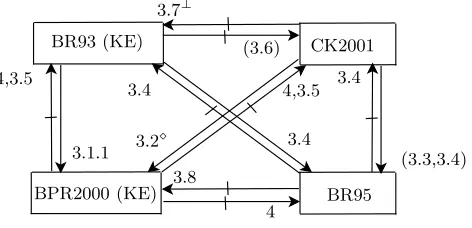
arrows represent the sections in which the proof is provided, and the numbers in brackets on the arrows represent the sections in which the implication relation is proven.
PSfrag replacements
CK2001 BR93 (KE)
BPR2000 (KE) BR95
4,3.5
4 4,3.5
3.1.1 3.4
(3.6)
3.8
3.4 3.4
3.2 3.7⊥
(3.3,3.4)
holds if SIDs are constructed in the same manner in both models.
⊥holds if SIDs are not defined to be the concatenation of messages exchanged during the protocol run.
Fig. 1. Notions of security between the Bellare–Rogaway and Canetti–Krawczyk key establishment proof models
PSfrag replacements CK2001
BR93 (EA+KE) BPR2000 (EA+KE)
3.1
4 CK2001
BR93 (KE) CK2001
(3.6) 3.3∇
∇holds if SIDs are defined to be the concatenation of messages exchanged during the protocol run.
Fig. 2. Additional comparisons
Organization. Section 2 provides an informal overview of the Bellare-Rogaway and Canetti–Krawczyk models. Section 3 provides the proofs of the implication relations and counter-examples the for non-implication relations shown in Figures 1 and 2. In these counter-examples, we demonstrate that these protocols though secure in the existing proof model (in which they are proven secure) are insecure in another “stronger” proof model. Section 4 presents the drawback in the original formulation of the BPR2000 model by using a three-party password-based key exchange protocol (3PAKE) due to Abdalla & Pointcheval (2005) as a case study. Section 5 presents the conclusions.
2 The Proof Models
Adversarial Powers. In the Bellare-Rogaway and Canetti–Krawczyk models, the adversary A is defined to be a probabilistic machine that is in control of all communications between parties via the predefined oracle queries described below:
Send: This query computes a response according to the protocol specification and decision on whether to accept or reject yet, and returns them to A.
Session-Key Reveal(U1, U2, i): Oracle ΠUi
1,U2, upon receiving a Session-Key Reveal query, and if it has
accepted and holds some session key, will send this session key back toA. This query is known as a
Reveal(U1, U2, i) query in the Bellare–Rogaway models.
Session-State Reveal: Oracle ΠUi1,U2, upon receiving aSession-State Reveal(U1, U2, i) query and if it has
neither accepted nor held some session key, will return all its internal state (including any ephemeral parameters but not long-term secret parameters) toA.
Corrupt: Corrupt(U1, KE) query allows A to corrupt the principal U1 at will, and thereby learn the
complete internal state of the corrupted principal. The corrupt query also gives A the ability to overwrite the long-lived key of the corrupted principal with any value of her choice (i.e. KE). Test: Test(U1, U2, i) query is the only oracle query that does not correspond to any ofA’s abilities. If
ΠUi
1,U2 has accepted with some session key and is being asked aTest(U1, U2, i) query, then depending
on a randomly chosen bitb, Ais given either the actual session key or a session key drawn randomly from the session key distribution.
Table 2 provides a comparison of the types of queries allowed for the adversary between the various BR93, BR95, BPR2000, and CK2001 models.
Oracle Queries BR93 BR95 BPR2000 CK2001 Send Yes Yes Yes Yes
Session-Key Reveal Yes Yes Yes Yes
Session-State Reveal No No No Yes
Corrupt Yes Yes No Yes
Test Yes Yes Yes Yes
Table 2.Summary of adversarial powers
Definition of Freshness. The notion of freshness of the oracle to whom the Test query is sent remains the same for the Bellare–Rogaway and Canetti–Krawczyk models. Freshness is used to identify the session keys about which A ought not to know anything because A has not revealed any oracles that have accepted the key and has not corrupted any principals knowing the key. Definition 1 describes freshness, which depends on the respective partnership definitions.
Definition 1 (Definition of Freshness) Oracle ΠA,Bi is fresh (or holds a fresh session key) at the end of execution, if, and only if,
1. ΠA,Bi has accepted with or without a partner oracle ΠB,Aj ,
2. bothΠA,Bi andΠB,Aj oracles have not been sent aRevealquery (orSession-State Revealin the CK2001 model), and
3. both A and B have not been sent a Corrupt query.
Definition of Security. Security in the Bellare–Rogaway and the Canetti–Krawczyk models is defined using the gameG, played between a malicious adversaryAand a collection ofΠi
Stage 1:Ais able to send any oracle queries at will.
Stage 2:At some point duringG,Awill choose a fresh session on which to be tested and send a Testquery to the fresh oracle associated with the test session. Depending on the randomly chosen bitb,Ais given either the actual session key or a session key drawn randomly from the session key distribution.
Stage 3:Acontinues making any oracle queries at will but cannot makeCorruptand/orSession-Key Revealand/orSession-State Revealqueries (depending on the individual proof model) that trivially expose the test session key.
Stage 4:Eventually,Aterminates the game simulation and outputs a bit b0
, which is its guess of the value ofb.
Table 3.Setting of game G
Success of AinG is quantified in terms of A’s advantage in distinguishing whether Areceives the real key or a random value. A wins if, after asking a Test(U1, U2, i) query, where ΠUi1,U2 is fresh and has
accepted, A’s guess bit b0 equals the bit b selected during the Test(U1, U2, i) query. Let the advantage
function ofA be denoted by AdvA(k), where
AdvA(k) =2×Pr[b=b0]−1. 2.1 The Bellare-Rogaway Models
2.1.1 The BR93 Model Partnership is defined using the notion of matching conversations, where a conversation is defined to be the sequence of messages sent and received by an oracle. The sequence of messages exchanged (i.e., only the Sendoracle queries) are recorded in the transcript, T. At the end of a protocol run,T will contain the record of theSend queries and the responses. Definition 2 describes security for the BR93 model.
Definition 2 (BR93 Security) A protocol is secure in the BR93 model if for all PPT adversaries A, 1. if uncorrupted oracles Πi
A,B and Π j
B,A complete with matching conversations, then the probability
that there exist i, j such that ΠA,Bi accepted and there is no ΠB,Aj that had engaged in a matching session is negligible, and
2. AdvA
(k) is negligible. If both requirements are satisfied, then Πi
A,B andΠ j
B,A will also have the same
session key.
Requirement 1 of Definition 2 implies entity authentication, whereby entity authentication is said to be violated if some fresh oracle terminates with no partner.
2.1.2 The BR95 Model Partnership in the BR95 model is defined using the notion of a partner function, which uses the transcript (the record of allSendoracle queries) to determine the partner of an oracle. However, no explicit definition of partnership was provided in the original paper since there is no single partner function fixed for any protocol. Instead, security is defined predicated on the existence of a suitable partner function.
Definition 3 describes security for the BR95 model.
Definition 3 (BR95 Security) A protocol is secure in the BR95 model if both the following require-ments are satisfied
1. when the protocol is run between two oraclesΠi
A,BandΠ j
B,Ain the absence of a malicious adversary,
2.1.3 The BPR2000 Model Partnership in the BPR2000 model is defined based on the notion of session identifiers (SIDs) where SIDs are suggested to be the concatenation of messages exchanged during the protocol run. In this model, an oracle who has accepted will hold the associated session key, a SID and a partner identifier (PID). Definition 4 describes partnership in the BPR2000 model. Definition 4 (BPR2000 Partnership) Two oracles, ΠA,Bi and ΠB,Aj , are partners if, and only if, both oracles
– have accepted the same session key with the same SID,
– have agreed on the same set of principals (i.e. the initiator and the responder of the protocol), and
– no other oracles besides ΠA,Bi and ΠB,Aj have accepted with the same SID.
In the BPR2000 model, security is described in Definition 5. The notion of security for entity authenti-cation is said to be violated if some fresh oracle terminates with no partner.
Definition 5 (BPR2000 Security) A protocol is secure in the BPR2000 model under the notion of
– key establishment if for all PPT adversaries A,AdvA(k) is negligible.
– mutual authentication if for all PPT adversaries A, the advantage that A has in violating entity authentication is negligible.
2.2 The Canetti-Krawczyk Model
In the CK2001 model, there are two adversarial models, namely the unathenticated-links adversarial / real world model (UM) and the authenticated-links adversarial / ideal world model (AM). Let AUM
denote the (active) adversary in the UM, and AAM denote the (passive) adversary in the AM. The
difference between AAM and AUM lies in their powers, namely AAM is restricted to only delay, delete,
and relay messages but not to fabricate any messages or send a message more than once. Prior to explaining how a provably secure protocol in the AM is translated to a provably secure protocol in the UM with the use of an authenticator, we require definitions of an emulator and an authenticator, as given in Definitions 6 and 7.
Definition 6 (Definition of an Emulator (Bellare et al. 1998)) Letπandπ0 be two protocols for
n parties where π is a protocol in the AM and π0 is a protocol in the U M. π0 is said to emulate π if for anyU M-adversaryAU M there exists an AM-adversaryAAM, such that for all inputs, no polyomial
time adversary can distinguish the cumulative outputs of all parties and the adversary between the AM
and the U M with more than negligible probability.
Definition 7 (Definition of an Authenticator (Canetti & Krawczyk 2001)) An authenticator is defined to be a mapping transforming a protocol πAM in the AM to a protocol πUM in the UM such
that πUM emulates πAM.
In other words, the security proof of the UM protocol in the CK2001 depends on the security proofs of the MT-authenticator used and that of the AM protocol. If any of these proofs break down, then the proof of the UM protocol is invalid.
Definitions 8 and 9 describe partnership and security for the CK2001 model.
Definition 9 (CK2001 Security) A protocol is secure in the CK2001 model if for all PPT adver-saries A,
1. if two uncorrupted oracles Πi
A,B and Π j
B,A complete matching sessions, then both ΠA,Bi and Π j B,A
must hold the same session key, and 2. AdvA(k) is negligible.
3 Relating The Notions of Security
In our proofs for each of the implication relations shown in Figure 1, we construct a primary adversary,
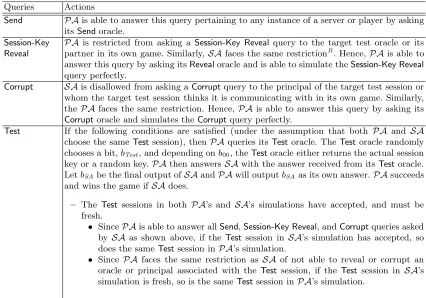
PA, against the key establishment protocol in PA’s model using a secondary adversary, SA, against the same key establishment protocol inSA’s model.PAsimulates the view ofSAby asking all queries of SA to the respective Send, Session-Key Reveal, Session-State Reveal, Corrupt, and Test oracles (to which PAhas access), and forwards the answers received from the oracles to SA. The specification of the simulation is given in Figure 3.
Note that Shoup (Shoup 1999, Remark 26) pointed out that an adversary A in the Bellare–Rogaway model wins the game if A is able to make two partner oracles accept different session keys without making any Revealand Test queries. His findings are applicable to only the BR93 and CK2001 models where the definitions of security requires two partner oracles to accept with the same session key, as described in Definitions 2 and 9 respectively. However, this is not the case for the BR95 and BPR2000 models.
The notation in this section is as follows: {·}Kenc
U1U2 denotes the encryption of some message under the encryption key KUenc1U2, the notation [·]KM AC
U1U2 denotes the computation of MAC digest of some message under the MAC key KUM AC1U2 , and SigdU(·) denotes the signature of some message under the signature key dU, H denote some secure hash function, || denote concatentation of messages, and pwd denote
some secret password shared between two users.
3.1 Proving Implication Relation: BR93 (EA+KE) → BPR2000 (EA+KE)
Recall that theCorrupt query is not allowed in the BPR2000 model but is allowed in the BR93 model as shown in Table 2. Intuitively, the model with a greater adversarial power, especially one that allows the adversary access to the entire internal state of a player (i.e., via the Corrupt query), has a tighter definition of security than the model with a weaker adversarial power.
3.1.1 Proof for the key establishment goal: Let the advantage of some PPT adversary, A00, in
the BPR2000 (EA+KE) model beAdvA00, and the advantage of some PPT adversary,A93, in the BR93
(EA+KE) model beAdvA93.
Lemma 1 For any key establishment protocol, for any A00, there exists an A93, such that AdvA00 =
AdvA93.
Proof (Lemma 1). An adversary A93 against the key establishment protocol in the BR93 (EA+KE)
model is constructed using an adversary A00 against the same key establishment protocol in the
BPR2000 (EA+KE) model, as shown in Figure 3. In other words, letA93be the primary adversary and
A00 be the secondary adversary where A93 simulates the view of A00. A93 asks all queries by A00 to
Queries Actions
Send PAis able to answer this query pertaining to any instance of a server or player by asking itsSendoracle.
Session-Key Reveal
PA is restricted from asking a Session-Key Reveal query to the target test oracle or its partner in its own game. Similarly,SAfaces the same restrictionR
. Hence,PAis able to answer this query by asking itsRevealoracle and is able to simulate theSession-Key Reveal query perfectly.
Corrupt SAis disallowed from asking aCorruptquery to the principal of the target test session or whom the target test session thinks it is communicating with in its own game. Similarly, the PAfaces the same restriction. Hence,PAis able to answer this query by asking its Corruptoracle and simulates theCorruptquery perfectly.
Test If the following conditions are satisfied (under the assumption that both PA and SA
choose the sameTestsession), thenPAqueries itsTestoracle. TheTestoracle randomly chooses a bit,bTest, and depending onb00, theTestoracle either returns the actual session
key or a random key.PAthen answersSAwith the answer received from itsTestoracle. LetbSAbe the final output ofSAandPAwill outputbSAas its own answer.PAsucceeds
and wins the game ifSAdoes.
– The Testsessions in both PA’s and SA’s simulations have accepted, and must be fresh.
• SincePAis able to answer allSend,Session-Key Reveal, andCorruptqueries asked bySA as shown above, if the Testsession in SA’s simulation has accepted, so does the sameTestsession inPA’s simulation.
• Since PAfaces the same restriction as SAof not able to reveal or corrupt an oracle or principal associated with the Testsession, if the Test session in SA’s simulation is fresh, so is the sameTestsession inPA’s simulation.
R: subject to the following requirements:
1. Non-partners in the simulation ofSAare also non-partners in the simulation ofPAso that whatever we can reveal in the simulation ofSA, we can also reveal in the simulation ofPA. Alternatively, we require that partners in the simulation of PAare also partners in the simulation of SAso that whatever we cannot reveal in the simulation of
PA, we also cannot reveal in the simulation ofSA.
2. A fresh oracle in the simulation ofSAis also a fresh oracle the simulation ofPAso that whatever we cannot reveal in the simulation ofSA, we also cannot reveal in the simulation ofPA.
forwards the answers received from the oracles toA00. Eventually, A00outputs a guess bitb00and A93
will outputb00 as its own answer. A93 succeeds and wins the game ifA00 does.
In order to demonstrate that the primary adversary, A93, is able to answer the queries asked by the
secondary adversary, A00, we need to satisfy requirements 1 and 2 described in Figure 3. Using the
example protocol execution shown in Figure 4,B is said to have a matching conversation withAif, and only if, messagem0Areceived is the same messagemA(i.e., m0A=mA) sent byA, andAis said to have
matching conversation (in the BR93 model) with B if, and only if, message m0
B received is the same
messagemB(i.e.,m0B =mB) sent byB. In the context of Figure 4,sidA=mA||m0BandsidB =m0A||mA
(in the BPR2000 model), andsidA=sidB if message m0A received byB is the same message mA(i.e.,
m0A =mA) sent by A, and message m0B received by A is the same message mB (i.e., m0B = mB) sent
by B. Hence, if both A and B have matching conversations, then sidA =mA||m0B =m0A||mA =sidB.
IfA and B are BR93-secure protocols, thenA and B will also accept with the same session key.
A B
Choose some messagemA −−−−−−−−−−→m . . .
m0A
−−−−−−−−−−→Receive some messagem0 A
Receive some messagem0 B
m0 B
←−−−−−−−−−−. . .←−−−−−−−−−−mB Choose some messagemB
Fig. 4. An example protocol execution
Recall that the BPR2000 definition of partnership requires two oracles to accept with the same SID, corresponding PID, and the same key, in order to be considered partners. Now, ifAandB do not have matching conversations, thenA and B are not BR93 partners. This also implies that A andB are not BPR2000 partners sincesidA6=sidB. Since non-partners in the simulation of the secondary adversary,
A00, are also non-partners in the simulation of the primary adversary,A93, requirement 1 (described in
Figure 3) is satisfied.
An oracle is considered fresh in the BPR2000 model if it (or its associated partner, if such a part-ner exists) has not been asked a Reveal query. An oracle is considered fresh in the BR93 model if it (or its associated partner, if such a partner exists) has not been asked either a Reveal or a Corrupt
query. It follows easily that a fresh oracle in the BPR2000 model is also fresh in the BR93 model. Both requirements 1 and 2 (described in Figure 3), therefore, are satisfied.
To analyse AdvA93, we first consider the case in which the Test oracle associated with A
93 returns
a random key. The probability of A00 guessing the correct b00 bit is 12 since it cannot gain any
infor-mation about the hiddenb93 bit. We then consider the case where theTest oracle associated with A93
returns the actual session key. In this case, the proof simulation (ofA00) is perfect and A93 runs A00
exactly in the game defining the security of A00. Therefore, if A00 has a non-negligible advantage, so
does A93 (i.e., Adv
A93
=AdvA00). This is in violation of our assumption and Lemma 1 follows.
u t
does. Since non-partners in the simulation ofA00 are also non-partners in the simulation ofA93, if A00
has a non-negligible probability in violating mutual authentication, so does A93. This is in violation of
our assumption. The proof for entity authentication follows.
3.2 Proving Implication Relation: CK2001 → BPR2000 (KE)
Recall that one of the key differences between the BPR2000 and the CK2001 models is that the Canetti– Krawczyk adversary is allowed to ask the additionalSession-State Reveal andCorrupt queries, as shown in Table 2. Intuitively, the model with a greater adversarial power has a tighter definition of security than the model with a weaker adversarial power. To support our observation, let the advantage of some PPT adversary in the BPR2000 (KE) model beAdvA00KE, and the advantage of some PPT adversary in the CK2001 model beAdvA01.
Lemma 2 For any key establishment protocol and for any A00KE, there exists an A01, such that
AdvA00KE =AdvA01.
Proof. An adversaryA01against the security of a key establishment protocol in the CK2001 (UM) model
is constructed using an adversary A01 against the security of the same key establishment protocol in
the BPR2000 (EA+KE) model. The primary adversary,A01, runs the secondary adversary,A00KE, and
has access to its Send oracles, Session-State Reveal oracles, Session-Key Reveal oracles, Corrupt oracles, and Testoracle.
Recall that we assume in Figure 1 that this relation holds if, and only if, SIDs for both the BPR2000 (KE) and CK2001 model are constructed in the same manner. If A and B are BPR2000 partners, thensidA =sidB and A and B will also be partners in the CK2001 model, since sidA =sidB implies
that both A and B will have matching sessions. Hence, we can say that all CK2001 partners are also BPR2000 partners (under the assumption that SIDs for both the BPR2000 (KE) and CK2001 model are constructed in the same manner) and all partners of CK2001-secure protocols are also BPR2000 partners (recall that in CK2001 security, two partners within a secure protocol must accept the same session key). This implies requirement 1.
An oracle is considered fresh in the BPR2000 model if it (or its associated partner, if such a part-ner exists) has not been asked a Reveal query and an oracle is considered fresh in the CK2001 model if it (or its associated partner, if such a partner exists) has not been asked either aReveal or a Corrupt
query. Hence, it follows easily that a fresh oracle in the BPR2000 model is also fresh in the CK2001 model. Hence, both requirements 1 and 2 (described in Figure 3) are satisfied.
To analyse AdvA01, we first consider the case in which the Test oracle associated with A01 returns
a random key. The probability of A00KE guessing the correct b01 bit is 12 since it cannot gain any
information about the hiddenb01 bit. We then consider the case where the Testoracle associated with
A01returns the actual session key. In this case, the proof simulation (of A00KE) is perfect andA01runs
A00KE exactly in the game defining the security of A00KE. Therefore, if A00KE has a non-negligible
advantage, so does A01 (i.e., AdvA00KE = AdvA01 is also non negligible). In other words, if such an
adversary,A00KE, exists, so does A01. This is in violation of our assumption and Lemma 2 follows.
3.3 Proving Implication Relation: CK2001 → BR93 (KE)
This proof follows on from Section 3.2. Let the advantage of some PPT adversary in the BR93 (KE) model,A93KE, beAdvA93KE.
Lemma 3 For any key establishment protocol and for any A93KE, there exists an A01, such that
AdvA93KE =AdvA01.
Proof. We construct an adversaryA01against the security of a key establishment protocol in the CK2001
model using an adversary A93KE against the security of the same key establishment protocol in the
BR93 model. Since we assume that SIDs in the CK2001 model are defined to be the concatenation of messages exchanged during the protocol run (similar to how SIDs are defined in the proof that appears in Section 3.1), the discussion on the notion of partnership between the BPR2000 and BR93 models applies in the discussion on the notion of partnership between the CK2001 and BR93 models. Hence, we can say that all BR93 partners are also CK2001 partners and all CK2001 partners are also BR93 partners (under the assumption that SIDs in the CK2001 model are defined to be the concatenation of messages sent and received during the protocol execution). Therefore,A01is able to simulate the view
of A93KE. Note that since A93KE is not allowed to ask any Session-State Reveal in the BR93 model,
A93KE will not be asking any such queries in the simulation.
To analyse AdvA01, we first consider the case in which the Test oracle associated with A01 returns
a random key. The probability ofA93KE guessing the correctb01 bit is 12 since it cannot gain any
infor-mation about the hiddenb01 bit. We then consider the case where theTest oracle associated with A01
returns the actual session key. In this case, the proof simulation (ofA93) is perfect andA01runsA93KE
exactly in the game defining the security of A93KE. IfA93KE has a non-negligible advantage, so does
A01 (i.e., AdvA01 =AdvA93KE is also negligible), in violation of our assumption. Lemma 3 follows. ut
3.4 Discussion on Implication Relation: BR93 (KE) → BR95 and Non-Implication Relations: BR93 (KE)8 BR95 and CK2001 8 BR95
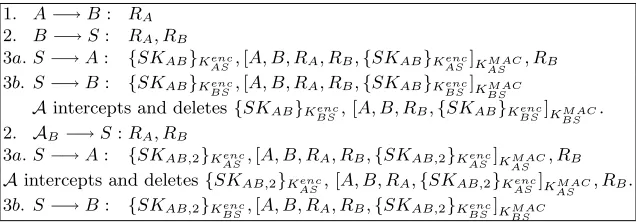
In key establishment protocols proven secure in the BR93 and CK2001 models, two parties in the same session must accept the same session key, which we term a functional requirement. However, this functional requirement is not required in the BPR2000 and the BR95 models. Consider the scenario of an example execution of a BR95 provably-secure protocol in the presence of a malicious adversary that resulted in two partner oracles accepting different session keys. This scenario does not violate BR95 security described in Definition 3. Hence, this protocol is still secure in the BR95 model. However, when two partner oracles accept two different session keys, the BR93 and CK2001 security are violated. Hence, this same protocol is not secure in the BR93 (KE) and CK2001 model. One such example protocol is the Bellare–Rogaway 3PKD protocol proven secure in the BR95 model (Bellare & Rogaway 1995), as shown in Figure 5.
1. A−→B:RA 2. B−→S:RA, RB 3a. S−→A: {SKAB}Kenc
AS,[A, B, RA,{SKAB}K enc AS]KM ACAS
3b. S−→B:{SKAB}Kenc
BS,[A, B, RB,{SKAB}K enc BS]KBSM AC
Figure 6 depicts an example execution of the Bellare–Rogaway 3PKD protocol in the presence of a malicious adversary. At the end of the protocol execution, both uncorrupted principalsA andB accept different session keys (i.e.,Aaccepts session keySKAB andB accepts session keySKAB,2). BothAand
B, however, are BR93 partners since they have matching conversations. The BR93 security is violated since Aand B accept different session keys. The protocol, therefore, is not secure in the BR93 model. Similarly, CK2001 security is violated (in the sense of Definition 9) since both uncorrupted princi-palsAandB have matching sessions, according to Definition 8 but accept different session keys (i.e.,A accepts session key SKAB and B accepts session keySKAB,2). The Bellare–Rogaway 3PKD protocol,
therefore, is also not secure in the CK2001 model. A similar observation was made by Choo & Hitchcock (2005), whereby it was shown that the (same) 3PKD protocol proven secure by Tin et al. (2003) in the CK2001 model is, in fact, insecure.
1. A−→B: RA 2. B−→S: RA, RB 3a. S−→A: {SKAB}Kenc
AS,[A, B, RA, RB,{SKAB}KencAS]KM ACAS , RB
3b. S−→B: {SKAB}Kenc
BS,[A, B, RA, RB,{SKAB}KencBS]KM ACBS Aintercepts and deletes{SKAB}Kenc
BS,[A, B, RB,{SKAB}K enc BS]KM ACBS .
2. AB−→S:RA, RB 3a. S−→A: {SKAB,2}Kenc
AS,[A, B, RA, RB,{SKAB,2}KencAS]KASM AC, RB Aintercepts and deletes{SKAB,2}Kenc
AS,[A, B, RA,{SKAB,2}K enc
AS]KASM AC, RB.
3b. S−→B: {SKAB,2}Kenc
BS,[A, B, RA, RB,{SKAB,2}K enc BS]KBSM AC
Fig. 6. Execution of Bellare–Rogaway 3PKD protocol in the presence of a malicious adversary
The attack we present on the Bellare–Rogaway 3PKD protocol is similar to the attack on the Otway– Rees key establishment protocol revealed by Fabrega et al. (1999), in which they showed that a malicious adversary is able to make the initiator and the responder agree on a different session key by asking a trusted third party (i.e., server) to create multiple session keys in response to the same message. Although Fabrega et al. were perhaps the first to reveal that two communicating parties in a protocol might not agree on the same key in the presence of a malicious adversary, they did not see this as a serious flaw. This, however, is a flaw in the BR93 and CK2001 models where the definitions of security require two partner oracles to accept with the same session key.
3.5 Proving Non-Implication Relation: BR93 (KE) / CK2001 8 BPR2000 (KE)
As a counter-example, we revisit and use the improved (Bellare–Rogaway) three-party key distribution (3PKD) protocol due to Choo et al. (2004) which has a proof of security in the BPR2000 (KE) model. We then demonstrate that this protocol fails to satisfy the functional requirement. Consequently, the protocol is insecure in the BR93 (KE) and CK2001 models. Figure 7 desribes the CBHM-3PKD protocol, which was proven secure in the BPR2000 model. In the protocol, there are three entities, namely: a trusted server S and two principalsA and B who wish to establish communication.
Figure 8 depicts an example execution of the CBHM-3PKD protocol in the presence of a malicious adversary. At the end of the protocol execution, both uncorrupted prinicpals A and B have matching sessions according to Definition 8. However, they have accepted different session keys (i.e., A accepts session keySKAB andB accepts session keySKAB,2). This violates Definitions 2 and 9, which implies
1. A−→B:RA 2. B−→S:RA, RB 3a. S−→A: {SKAB}Kenc
AS,[A, B, RA, RB,{SKAB}KASenc]KM AC AS , RB
3b. S−→B:{SKAB}Kenc
BS,[A, B, RA, RB,{SKAB}KBSenc]KBSM AC
Fig. 7. Choo, Boyd, Hitchcock, & Maitland provably secure 3PKD protocol
to Definition 4, bothA and B are not BPR2000 partners since they do not agree on the same session key and hence, the protocol does not violate the BPR2000 security (i.e., Definition 5).
1. A−→B: RA 2. B−→S: RA, RB 3a. S−→A: {SKAB}Kenc
AS,[A, B, RA, RB,{SKAB}K enc
AS]KASM AC, RB
3b. S−→B: {SKAB}Kenc
BS,[A, B, RA, RB,{SKAB}K enc BS]KBSM AC Aintercepts and deletes{SKAB}Kenc
BS,[A, B, RB,{SKAB}K enc BS]KM ACBS .
2. AB−→S:RA, RB 3a. S−→A: {SKAB,2}Kenc
AS,[A, B, RA, RB,{SKAB,2}K enc
AS]KASM AC, RB Aintercepts and deletes{SKAB,2}Kenc
AS,[A, B, RA,{SKAB,2}K enc AS]KASM AC.
3b. S−→B: {SKAB,2}Kenc
BS,[A, B, RA, RB,{SKAB,2}K enc BS]KBSM AC
Fig. 8. Execution of CBHM-3PKD protocol in the presence of a malicious adversary
3.6 Proving Non-Implication Relation: CK2001 8 BR93 (EA+KE)
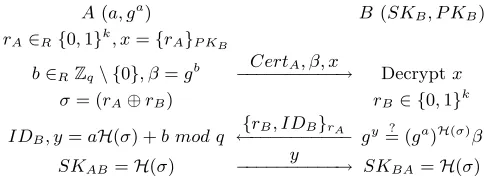
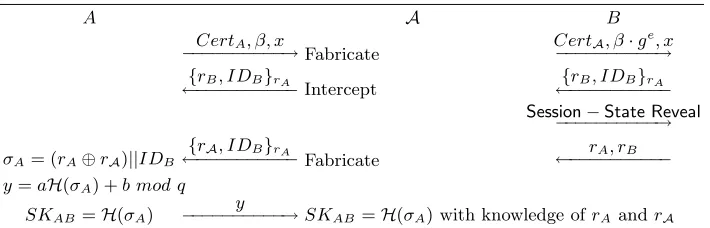
We use the mutual authentication and key establishment protocol (MAKEP) due to Wong & Chan (2001), which was proven secure in the BR93 (EA+KE) model. Note that Figure 9 describes the corrected version of WC-MAKEP, where the computation of σ = (rA ⊕rB) by A is replaced by
σ = (rA⊕rB)||IDB. There are two communicating principals in MAKEP, namely the server B and
the client of limited computing resources, A. A and B are each assumed to know the public key of the other party. At the end of the protocol execution, both A and B accept with session keys SKAB =H(σ) =SKBA. Figure 10 depicts an example execution of MAKEP in the presence of a
ma-A(a, ga) B (SK
B, P KB)
rA∈R{0,1}k, x={rA}P KB b∈RZq\ {0}, β=gb
CertA, β, x
−−−−−−−−−−→ Decryptx σ= (rA⊕rB) rB∈ {0,1}k
IDB, y=aH(σ) +b mod q
{rB, IDB}rA ←−−−−−−−−−− gy ?
= (ga)H(σ)β SKAB=H(σ)
y
−−−−−−−−−−→ SKBA=H(σ)
Fig. 9. Wong–Chan MAKEP
licious adversary. Aintercepts the message sent by A and sends a fabricated message, CertA, β ·ge, x,
claiming the message originated from itself (A). B, upon receiving the message, thinks that A (and notA) wants to establish a session, will respond as per protocol specification. Ais then able to send a
the protocol execution and accepts session key, SKAB =H(σA), thinking that the key is being shared
withB, when in fact, B knows nothing about this session. Since A obtains the values ofrB, Ais able
to compute H(rA⊕rA)||IDB) = SKAB, in violation of the key establishment goal (i.e., Definition 9).
Hence, Wong–Chan MAKEP though secure in the BR93 (EA+KE) model, is insecure in the CK2001 model.
A A B
CertA, β, x
−−−−−−−−−−→Fabricate CertA, β·g e, x
−−−−−−−−−−→ {rB, IDB}rA
←−−−−−−−−−−Intercept {rB, IDB}rA ←−−−−−−−−−−
Session−State Reveal
−−−−−−−−−−→
σA= (rA⊕rA)||IDB
{rA, IDB}rA
←−−−−−−−−−−Fabricate ←−−−−−−−−−−rA, rB y=aH(σA) +b mod q
SKAB=H(σA)
y
−−−−−−−−−−→SKAB=H(σA) with knowledge ofrA andrA
Fig. 10.Execution of Wong–Chan MAKEP in the presence of a malicious adversary
3.7 Proving Non-Implication Relation: BR93 (KE)8 CK2001
Canetti & Krawczyk prove the basic Diffie–Hellman protocol secure in the UM (Canetti & Krawczyk 2001). In order to prove BR93 (KE) 8 CK2001, we modified the (Canetti–Krawczyk) Diffie–Hellman protocol to include a redundant nonceNBA, as shown in Figure 11. The modified Diffie–Hellman protocol
does not authenticate the redundant nonceNBA. Although NBAis not authenticated, addition of NBA
does not affect the security of the protocol.
A B
x∈Zq
A, sid, gx
−−−−−−−−−−→ y∈Zq
Verify SignatureB, sid, g y, Sig
dB(B, sid, g
y, gx, A), N BA
←−−−−−−−−−− y, NBA∈Zq
SKAB=gxy
A, sid, gy, Sig
dA(A, sid, g
y, gx, B), N BA
−−−−−−−−−−→ SKAB=gxy
Fig. 11.A modified (Canetti–Krawczyk) Diffie–Hellman protocol
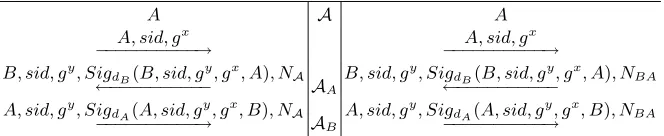
Figure 12 depicts an example execution of the (Canetti–Krawczyk) Diffie–Hellman protocol in the presence of a malicious adversary. Recall that we assume that the non-implication relation: BR93 (KE)
8 CK2001 holds if, and only if, SIDs in the CK2001 model are not defined to be the concatenation of messages exchanged during the protocol run, as shown in Figure 1. Let AU denote A intercepting the
message and sending a fabricated message impersonatingU.
At the end of the protocol execution, bothA and B are partners according to Definition 8, since they have matching SIDs and corresponding PIDs (i.e., P IDA = B and P IDB = A). In addition, both
uncorrupted A and B accept the same session key, SKAB =gxy = SKBA. The CK2001 definition of
A A A A, sid, gx
−−−−−−−−−−→ A, sid, g
x
−−−−−−−−−−→ B, sid, gy, Sig
dB(B, sid, g
y, gx, A), N A
←−−−−−−−−−− AA
B, sid, gy, Sig
dB(B, sid, g
y, gx, A), N BA
←−−−−−−−−−− A, sid, gy, Sig
dA(A, sid, g
y, gx, B), N A
−−−−−−−−−−→ AB
A, sid, gy, Sig
dA(A, sid, g
y, gx, B), N BA
−−−−−−−−−−→
Fig. 12. Execution of the modified (Canetti–Krawczyk) Diffie–Hellman protocol in the presence of a malicious adversary
norB’s replies were all in response to genuine messages byB andArespectively. Both Aand B are not BR93 partners. A, however, can obtain a fresh session key of either A or B by revealing non-partner instances ofB orA respectively, in violation of BR93 security (Definition 2).
3.8 Discussion on Non-Implication Relation: BPR2000 (KE) 8 BR95
Recall that security in the models depend on the notion of partnership. No explicit definition of part-nership, however, was provided in the BR95 model and there is no single partner function fixed for any protocol in the BR95 model. The flawed partner function for the 3PKD protocol described in the original BR95 paper was fixed by Choo et al. (2004). As Choo et al. have pointed out, however, there is no way to securely define an SID for the 3PKD protocol that will preserve the proof of security. Protocols that are secure in the BR95 model, therefore, may not necessarily be able to be proven secure in the BPR2000 (KE) model.
4 A Drawback in the Original Formulation of the BPR2000 Model
4.1 Case Study: Abdalla–Pointcheval 3PAKE
We revisit the protocol 3PAKE due to Abdalla & Pointcheval (2005), which carries a proof of security in the BPR2000 model, as shown in Figure 13. Let A and B be two clients who wish to establish a shared session key, SK, S be a trusted server,pwdA (andpwdB) denote the password shared between
A and S (B and S respectively), G1,G2, and H denote random oracles, and lr and lk denote security
parameters.
4.2 New Attack on Abdalla–Pointcheval 3PAKE
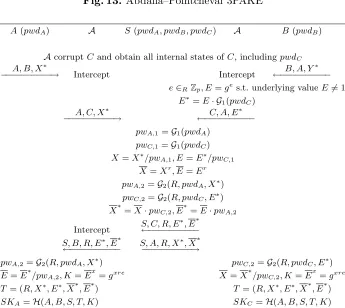
Figure 14 describes an execution of 3PAKE in the presence of a malicious adversary,A. LetCbe another client who has a shared password,pwdC, with the server, S. Prior to the start of the communication
initiated byA, A corrupts a non-related player,C (i.e., static corruption), thereby learning all internal states ofC (including the shared password with S, pwdC).
In the attack outlined in Figure 14,Aintercepts the first message fromAand changes the identity field in the message fromA, B toA, C.AimpersonatesAand sends the fabricated messageA, C, X∗ toS.A
impersonatesC and sends another fabricated messageC, A, E∗ to S. S, upon receiving both messages, will respond as per protocol specification. At the end of the protocol execution, A believes that the session key, SKA=H(A, B, S, T, K), is being shared with B. However, B is still waiting forS’s reply,
which will never arrive, since A has intercepted and deleted the message from the network. However,
A(pwdA) S (pwdA, pwdB) B(pwdB)
x∈RZp, X=gx r∈RZp y∈RZp, Y =gy
pwA,1=G1(pwdA) R∈R{0,1}lR pwB,1=G1(pwdB)
X∗
=X·pwA,1 pwA,1=G1(pwdA) Y∗=Y ·pwB,1 A, B, X∗
−−−−−−−−−−→ B, A, Y
∗
←−−−−−−−−−− pwB,1=G1(pwdB)
X=X∗
/pwA,1, Y =Y ∗
/pwB,1 X=Xr, Y =Yr
pwA,2=G2(R, pwdA, X∗)
pwB,2=G2(R, pwdB, Y ∗
)
S, B, R, Y∗, Y∗
←−−−−−−−−−− X∗=X·pwB,2, Y ∗
=Y ·pwA,2 S, A, R, X
∗
, X∗ −−−−−−−−−−→ pwA,2=G2(R, pwdA, X
∗
) pwB,2=G2(R, pwdB, Y
∗ )
Y =Y∗/pwA,2, K=Y x
=gxry X=X∗/pw
B,2, K=Y x
=gxry
T = (R, X∗
, Y∗
, X∗, Y∗) T = (R, X∗
, Y∗
, X∗, Y∗)
SKA=H(A, B, S, T, K) SKB =H(A, B, S, T, K)
Fig. 13.Abdalla–Pointcheval 3PAKE
A(pwdA) A S (pwdA, pwdB, pwdC) A B (pwdB)
AcorruptCand obtain all internal states ofC, includingpwdC
A, B, X∗
−−−−−−−−−−→ Intercept Intercept B, A, Y
∗
←−−−−−−−−−− e∈RZp, E=ge s.t. underlying valueE6= 1
E∗
=E· G1(pwdC)
A, C, X∗
−−−−−−−−−−→ C, A, E
∗
←−−−−−−−−−− pwA,1=G1(pwdA)
pwC,1=G1(pwdC) X=X∗
/pwA,1, E=E∗/pwC,1 X=Xr, E=Er
pwA,2=G2(R, pwdA, X∗)
pwC,2=G2(R, pwdC, E ∗
)
X∗=X·pwC,2, E ∗
=E·pwA,2
Intercept S, C, R, E ∗
, E∗ ←−−−−−−−−−− S, B, R, E∗
, E∗
←−−−−−−−−−− S, A, R, X
∗
, X∗ −−−−−−−−−−→
pwA,2=G2(R, pwdA, X∗) pwC,2=G2(R, pwdC, E∗)
E=E∗/pwA,2, K=E
x
=gxre X=X∗/pw
C,2, K=E x
=gxre
T = (R, X∗, E∗, X∗, E∗) T= (R, X∗, E∗, X∗, E∗)
SKA=H(A, B, S, T, K) SKC=H(A, B, S, T, K)
Fig. 14. Execution of 3PAKE in the presence of a malicious adversary
Consequently, protocol 3PAKE is insecure. This attack1, however, cannot be detected in the exist-ing BPR2000 model since Corruptquery is not allowed. Protocols proven secure in a proof model that allows the “Corrupt” query (in the proof simulation) ought to be secure against the unknown key share attack. If a key is to be shared between some parties, U1 and U2, the corruption of some other
(non-related) player in the protocol, say U3, should not expose the session key shared between U1 and U2
(Choo et al. 2005). Protocol 3PAKE, therefore, will be insecure in the BR93, BR95, and CK2001 mod-els, sinceA is able to trivially expose a fresh session key (i.e., AdvA(k)is non-negligible) by corrupting a non-partner player.
5 Conclusion and Future Work
We examined the Bellare–Rogaway and Canetti–Krawczyk proof models. We analysed some non-intuitive gaps in the relations and the relative strengths of security between both models and their variants. We then provided a detailed comparison of the relative strengths of the notions of security between the Bellare–Rogaway and Canetti–Krawczyk proof models. We also revealed a drawback with the BPR2000 model and a previously unpublished flaw in the Abdalla–Pointcheval protocol 3PAKE (Abdalla & Pointcheval 2005). Such an attack, however, would not be captured in the model due to the omission of Corrupt
queries. Our studies concluded that
1. if the session identifier (SID) in the CK2001 model is defined to be the concatenation of messages exchanged during the protocol run, then the CK2001 model offers the strongest definition of security compared to the Bellare–Rogaway model and its variants, and
2. the BPR2000 model is the weakest model.
As a result of this work, we hope to have contributed towards a better understanding of the different flavours of proof models for key establishment protocols (whether protocols proven secure in one model are also secure in another model). While our studies focus only on the Bellare–Rogaway and Canetti– Krawczyk models, it would be interesting to extend our work to other computational complexity proof models (e.g., the proof model due to Shoup (1999)) or other simulation-based proof models (e.g., the universal composability approach and the black-box simulatability approach due to (Canetti 2000, Canetti & Fischlin 2001, Canetti & Krawczyk 2002) and Backes (2004a,b), Backes & Jacobi (2003), Backes et al. (2002, 2004), Backes & Schunter (2003) respectively).
Acknowledgements
This work was partially funded by the Australian Research Council Discovery Project Grant DP0345775. We would like to thank the anonymous referees of Asiacrypt 2005 for their comments.
Bibliography
Abdalla, M. & Pointcheval, D. (2005), Interactive Diffie-Hellman Assumptions with Applications to Password-based Authentication (Extended version available from http://www.di.ens.fr/∼pointche/pub.php), in A. Patrick & M. Yung, eds, ‘9th
Interna-tional Conference on Financial Cryptography - FC 2005’, Springer-Verlag, pp. 341–356. Volume 3570/2005 of Lecture Notes in Computer Science.
Al-Riyami, S. S. & Paterson, K. G. (2003), Tripartite Authenticated Key Agreement Protocols from Pairings,inK. G. Paterson, ed., ‘9th IMA Conference on Cryptography and Coding’, Springer-Verlag, pp. 332–359. Volume 2898/2003 of Lecture Notes in Computer Science.
Backes, M. (2004a), ‘A Cryptographically Sound Dolev-Yao Style Security Proof of the Needham– Schroeder–Lowe Public–Key Protocol’, IEEE Journal on Selected Areas in Communications
22(10), 2075–2086.
Backes, M. (2004b), A Cryptographically Sound Dolev-Yao Style Security Proof of the Otway-Rees Protocol, in P. Samarati & D. Gollmann, eds, ‘9th European Symposium on Research in Computer Security - ESORICS 2004’, Springer-Verlag, pp. 89–108. Volume 3193/2004 of Lecture Notes in Computer Science.
Backes, M. & Jacobi, C. (2003), Cryptographically Sound and Machine-Assisted Verification of Security Protocols, in H. Alt & M. Habib, eds, ‘20th International Symposium on Theoretical Aspects of Computer Science - STACS 2003’, Springer-Verlag, pp. 310–329. Volume 2607/2003 of Lecture Notes in Computer Science.
Backes, M., Jacobi, C. & Pfitzmann, B. (2002), Deriving Cryptographically Sound Implementations Using Composition and Formally Verified Bisimulation, in L.-H. Eriksson & P. A. Lindsay, eds, ‘Formal Methods - Getting IT Right’, Springer-Verlag, pp. 310–329. Volume 2391/2002 of Lecture Notes in Computer Science.
Backes, M., Pfitzmann, B. & Waidner, M. (2004), A General Composition Theorem for Secure Reactive Systems, in M. Naor, ed., ‘1st Theory of Cryptography Conference - TCC 2004’, Springer-Verlag, pp. 336–354. Volume 2951/2004 of Lecture Notes in Computer Science.
Backes, M. & Schunter, M. (2003), From Absence of Certain Vulnerabilities towards Security Proofs: Pushing the Limits of Formal Verification, in ‘10th ACM Workshop on New Security Paradigms -NSPW 2003’, ACM Press, pp. 67–74.
Bao, F. (2003), Security Analysis of a Password Authenticated Key Exchange Protocol,in C. Boyd & W. Mao, eds, ‘6th Information Security Conference - ISC 2003’, Springer-Verlag, pp. 208–217. Volume 2851/2003 of Lecture Notes in Computer Science.
Bellare, M., Canetti, R. & Krawczyk, H. (1998), A Modular Approach to The Design and Analysis of Authentication and Key Exchange Protocols, inJ. Vitter, ed., ‘30th ACM Symposium on the Theory of Computing - STOC 1998’, ACM Press, pp. 419–428.
Bellare, M., Pointcheval, D. & Rogaway, P. (2000), Authenticated Key Exchange Secure Against Dictio-nary Attacks,inB. Preneel, ed., ‘Advances in Cryptology – Eurocrypt 2000’, Springer-Verlag, pp. 139 – 155. Volume 1807/2000 of Lecture Notes in Computer Science.
Bellare, M. & Rogaway, P. (1993), Entity Authentication and Key Distribution,in D. R. Stinson, ed., ‘Advances in Cryptology - Crypto 1993’, Springer-Verlag, pp. 110–125. Volume 773/1993 of Lecture Notes in Computer Science.
Bellare, M. & Rogaway, P. (1995), Provably Secure Session Key Distribution: The Three Party Case,
Blake-Wilson, S., Johnson, D. & Menezes, A. (1997), Key Agreement Protocols and their Security Anal-ysis,in M. Darnell, ed., ‘6th IMA International Conference on Cryptography and Coding’, Springer-Verlag, pp. 30–45. Volume 1355/1997 of Lecture Notes in Computer Science.
Blake-Wilson, S. & Menezes, A. (1997), Security Proofs for Entity Authentication and Authenti-cated Key Transport Protocols Employing Asymmetric Techniques, in B. Christianson, B. Crispo, T. M. A. Lomas & M. Roe, eds, ‘Security Protocols Workshop’, Springer-Verlag, pp. 137–158. Volume 1361/1997 of Lecture Notes in Computer Science.
Boyd, C., Mao, W. & Paterson, K. (2004), Key Agreement using Statically Keyed Authenticators, in
M. Jakobsson, M. Yung & J. Zhou, eds, ‘Applied Cryptography and Network Security - ACNS 2004’, Springer-Verlag, pp. 248–262. Volume 3089/2004 of Lecture Notes in Computer Science.
Canetti, R. (2000), ‘Universally Composable Security: A New Paradigm for Cryptographic Protocols’, Cryptology ePrint Archive, Report 2000/067. http://eprint.iacr.org/2000/067/.
Canetti, R. & Fischlin, M. (2001), Universally Composable Commitments,in J. Kilian, ed., ‘Advances in Cryptology – Crypto 2001’, Springer-Verlag, pp. 19–40. Volume 2139/2001 of Lecture Notes in Computer Science.
Canetti, R. & Krawczyk, H. (2001), Analysis of Key-Exchange Protocols and Their Use for Build-ing Secure Channels (Extended version available from http://eprint.iacr.org/2001/040/), in
B. Pfitzmann, ed., ‘Advances in Cryptology - Eurocrypt 2001’, Springer-Verlag, pp. 453–474. Volume 2045/2001 of Lecture Notes in Computer Science.
Canetti, R. & Krawczyk, H. (2002), Universally Composable Notions of Key Exchange and Secure Channels. (Extended version available from http://eprint.iacr.org/2002/059/),in L. R. Knud-sen, ed., ‘Advances in Cryptology - Eurocrypt 2002’, Springer-Verlag, pp. 337–351. Volume 2332/2002 of Lecture Notes in Computer Science.
Chen, L. & Kudla, C. (2003), Identity Based Authenticated Key Agreement Protocols from Pair-ings (Corrected version at http://eprint.iacr.org/2002/184/),in‘16th IEEE Computer Security Foundations Workshop - CSFW 2003’, IEEE Computer Society Press, pp. 219–233.
Choo, K.-K. R., Boyd, C. & Hitchcock, Y. (2005), Errors in Computational Complexity Proofs for Protocols (Available fromhttp://sky.fit.qut.edu.au/∼choo/publication.html),inB. Roy, ed.,
‘(Accepted to appear in) Advances in Cryptology - Asiacrypt 2005’, Springer-Verlag. Lecture Notes in Computer Science.
Choo, K.-K. R., Boyd, C., Hitchcock, Y. & Maitland, G. (2004), On Session Identifiers in Provably Secure Protocols: The Bellare-Rogaway Three-Party Key Distribution Protocol Revisited (Extended version available from http://eprint.iacr.org/2004/345), in B. Carlo & S. Cimato, eds, ‘4th Conference on Security in Communication Networks - SCN 2004’, Springer-Verlag, pp. 352–367. Volume 3352/2005 of Lecture Notes in Computer Science.
Choo, K.-K. R. & Hitchcock, Y. (2005), Security Requirements for Key Establishment Proof Mod-els: Revisiting Bellare–Rogaway and Jeong–Katz–Lee Protocols (Extended version available from http://sky.fit.qut.edu.au/∼choo/publication.html),inC. Boyd & J. M. Gonz´alez Nieto, eds,
‘10th Australasian Conference on Information Security and Privacy - ACISP 2005’, Springer-Verlag, pp. 429–442. Volume 3574/2005 Lecture Notes in Computer Science.
Fabrega, F. J. T., Herzog, J. C. & Guttman, J. D. (1999), ‘Strand Spaces: Proving Security Protocols Correct’, Journal of Computer Security 7, 191–230.
MacKenzie, P. D. & Swaminathan, R. (1999), ‘Secure Network Authentication with Password Identifi-cation’, Submitted to the IEEE P1363 Working Group.
Pereira, O. & Quisquater, J.-J. (2003), ‘Some Attacks Upon Authenticated Group Key Agreement Protocols’, Journal of Computer Security11, 555–580.
Shoup, V. (1999), On Formal Models for Secure Key Exchange (Version 4), Technical Report RZ 3120 (#93166), IBM Research, Zurich.
Tin, Y. S. T., Boyd, C. & Gonz´alez Nieto, J. M. (2003), Provably Secure Key Exchange: An Engineering Approach, in ‘Australasian Information Security Workshop Conference on ACSW Frontiers 2003’, Australian Computer Society, pp. 97–104. Volume 21 of Conferences in Research and Practice in Information Technology.
Wan, Z. & Wang, S. (2004), Cryptanalysis of Two Password-Authenticated Key Exchange Protocols,in
H. Wang, J. Pieprzyk & V. Varadharajan, eds, ‘9th Australasian Conference on Information Security and Privacy - ACISP 2004’, Springer-Verlag. Volume 3108/2004 of Lecture Notes in Computer Science. Wong, D. S. & Chan, A. H. (2001), Efficient and Mutually Authenticated Key Exchange for Low Power Computing Devices, in C. Boyd, ed., ‘Advances in Cryptology - Asiacrypt 2001’, Springer-Verlag, pp. 172–289. Volume 2248/2001 of Lecture Notes in Computer Science.