Provably Sublinear Point Multiplication on
Koblitz Curves and its Hardware
Implementation
V.S. Dimitrov1?, K.U. J¨arvinen2, M.J. Jacobson, Jr.3, W.F. Chan3, and Z. Huang1??
1 Department of Electrical and Computer Engineering, University of Calgary, 2500
University Drive NW, Calgary, Alberta, Canada T2N 1N4, (dimitrov,huangzh)@atips.ca
2 Signal Processing Laboratory, Helsinki University of Technology, Otakaari 5A,
02150, Espoo, Finland,[email protected]
3 Department of Computer Science, University of Calgary, 2500 University Drive
NW, Calgary, Alberta, Canada T2N 1N4,(chanwf,jacobs)@cpsc.ucalgary.ca
Abstract. We describe algorithms for point multiplication on Koblitz
curves using multiple-base expansions of the formk = P
±τa(τ −1)b andk=P
±τa(τ
−1)b(τ2−τ−1)c.We prove that the number of terms in the second type is sublinear in the bit length of k, which leads to the first provably sublinear point multiplication algorithm on Koblitz curves. For the first type, we conjecture that the number of terms is sublinear and provide numerical evidence demonstrating that the number of terms is significantly less than that ofτ-adic non-adjacent form expansions. We present details of an innovative FPGA implementation of our algorithm and performance data demonstrating the efficiency of our method.
1
Introduction
In 1985, Koblitz [2] and Miller [3] independently proposed the use of the additive finite abelian group of points on elliptic curves defined over a finite field for cryptographic applications. The Koblitz curves [4], or anomalous binary curves, are
Ea :y2+xy=x3+ax2+ 1 (1) defined over F2,where a∈ {0,1}. The number of points on these curves when considered overF2m can be computed rapidly using a simple recurrence relation,
and there are many prime values ofm for which the number of points is twice a prime (when a= 1) or four times a prime (whena= 0). Five Koblitz curves are recommended for cryptographic use by NIST [5].
The main advantage of Koblitz curves is that the Frobenius automorphism of F2 acts on points via τ(x, y) = (x2, y2) and is essentially free to compute.
Because τ satisfies (τ2+ 2)P =µτ(P) for all points P ∈ E
a(F2m) where µ=
(−1)1−a, we can consider τ as a complex number satisfying x2−µx+ 2 = 0, i.e.,τ = (µ+√−7)/2.Thus, computingkP,wherek∈ZandP ∈Ea(F2m),can
be done using a representation of k involving powers of τ instead of the usual binary representation using powers of 2,yielding a point multiplication algorithm similar to the binary “double-and-add” method in which the point doublings are replaced by applications of the Frobenius [4, 6]. Solinas [6] shows how the non-adjacent form (NAF) and window-NAF methods mentioned earlier can be extended to τ-adic expansions. The resulting point multiplication algorithms require on average (log2k)/3 point additions or (log2k)/(w+ 1) point additions using width-wwindow methods requiring precomputations based onP.A recent result of Avanzi et. al. [7] reduces this to (log2k)/4 at the cost of one additional point halving, but the practicality of this method has not yet been demonstrated. Recently, double-base integer representations have been used to devise effi-cient point multiplication algorithms [8–10]. For example, it can be shown that the number of terms of the form ±2a3b required to representk is bounded by
O(logk/log logk). These representations can be computed efficiently and the resulting point multiplication algorithms are the only known methods for which the number of required point additions is sublinear in logk.
In this paper, we extend the double-base idea toτ-adic expansions for point multiplication on Koblitz curves by representingkas a sum of terms±τa(τ
−1)b. Our algorithm requires no precomputations based on the pointP,no point dou-blings, and fewer point additions thanτ-adic NAF (τ-NAF) for the five recom-mended Koblitz curves from [5]. Our algorithm for computing the double-base representation ofkis very efficient; it requires only the unsignedτ-adic expansion of k plus a few table-lookups. A precomputed table of optimal representations for a small number of τ-adic integers is required, but these are independent of the multiplier k and the base point P. We have developed a novel FPGA im-plementation of both the conversion and point multiplication algorithms that demonstrates the efficiency of our method.
We conjecture that the average density of our representations is sublinear in logk, and provide extensive numerical evidence showing that the density is lower than that ofτ-NAF expansions. Although we do not have a proof that the number of point additions required by our algorithm is sublinear, we provide a proof that sublinearity is obtained using similar expressions involving three bases of the form±τa(τ −1)b(τ2−τ −1)c.This work represents the first rigorously-proven sublinear point multiplication algorithm using complex bases.
Avanzi and Sica [11] have independently investigated applying the double-base idea to Koblitz curves using double-basesτand 3.It is not clear how their algorithm performs in practice. They include a proof that the density of their multiplier representations is sublinear under the unproven but reasonable assumption that the irrationality measure of log23 and arg(τ)/π is 2, but his proof has been shown to have a gap [12].
al-gorithm using only two complex bases in Sec. 3. Although we cannot prove sublinearity for this algorithm, we conjecture that the density of the represen-tations is in fact sublinear, and provide numerical evidence in Subsection 3.2 indicating that the density of our representations is lower than that of τ-NAF representations. A description of our FPGA implementation and numerical data demonstrating its efficiency are presented in Sec. 4. Finally, we conclude with an outlook on possible directions for further research.
2
Multi-dimensional Frobenius Expansions
We start with the following two definitions:
Definition 1. A complex number,ξ of the form e+f τ, e, f-integers is called a Kleinian integer [13].
Definition 2. A Kleinian integer ω of the form ω =±τx(τ
−1)y, x, y
≥0is called a{τ, τ−1}-Kleinian integer.
Definition 3. A Kleinian integer ω of the form ω = ±τx(τ −1)y(τ2−τ − 1)z, x, y, z≥0is called a{τ, τ−1, τ2−τ−1}-Kleinian integer.
The main idea of the new point multiplication algorithm over Koblitz curves is to extend the existing and widely-used τ-NAF expansion of the scalar to a new form which will speed up the computations. The improvements obtained in the paper are based on the following representation, which we will call two-dimensional or three-two-dimensional Frobenius expansions (or{τ, τ−1}-expansion and{τ, τ−1, τ2−τ−1}-expansion, for short):
k= d
X
i=1
siτai(τ−1)bi, si=±1, ai, bi∈Z≥0, (2)
k= d
X
i=1
siτai(τ −1)bi(τ2−τ−1)ci, si=±1, ai, bi, ci∈Z≥0 . (3)
Such representations are clearly highly redundant. If we rearrange the summands in the above formula, then, using two bases, we can represent the scalarkas
k= max(bi)
X
l=1
(τ −1)l
max(ai,l) X
i=1
si,lτai,l
(4)
where max(ai,l) is the maximal power ofτ that is multiplied by (τ −1)lin (2). Using three bases, we can representk as
k= maxci
X
l2
(τ2−τ −1)l 2
max(bi) X
l1=1
(τ −1)l1
max(ai,l1,l2) X
i=1
si,l1,l2τ
ai,l1,l2
where max(ai,l1,l2) is the maximal power ofτ that is multiplied by (τ−1)
l1(τ2−
τ −1)l2 in (3).
Alg. 1 computes kP given a {τ, τ−1}-expansion of k. The corresponding algorithm for{τ, τ−1, τ2−τ−1}-expansions will be described later, along with a proof that the number of point additions is sublinear in logk. Essentially,kP
Algorithm 1Point multiplication using{τ, τ−1}-expansions.
Input: k, P Output: Q=kP
P0←P
Q← O
fori= 0 tojdo
S←ri(k)Pi{One dimensionalτ-NAF corresponding to (τ−1)lin (4)}
Pi+1←τ Pi−Pi
Q←Q+S
is computed via a succession of one-dimensionalτ-adic expansions.
The representation of kgiven in (4) is the cornerstone of our algorithm, so some comments on it are in order.
1. The multiplications byτ−1 cost one Frobenius mapping (free in our compu-tational model) and one point subtraction. The multiplications byτ2−τ−1 cost two Frobenius mappings and two point subtractions. Therefore, the total number of point additions/subtractions,AS(k),is given by
AS(k) = max(bi) +d−1 in the case of{τ, τ−1}-expansions and
AS(k) =d+ max(bi) max(ci)−1
in the case of{τ, τ−1, τ2−τ −1}-expansions. The smallest possible value of max(bi) and max(ci), 0, corresponds to the classical (one-dimensional)
τ-NAF expansion, for which it is known that the expected number of point additions/subtractions is (log2k)/3.It is clear that by allowing larger values for max(bi) and max(ci) one would decrease the corresponding number of summands,d.Therefore, it is vital to find out the optimal values for max(bi) as a function of the size of the scalar.
2. Finding an algorithm that can return a fairly short decomposition of k as the sum of {τ, τ −1}-Kleinian integers is absolutely essential. The most straightforward idea seems to be the greedy algorithm described in Alg. 2. A greedy algorithm for computing{τ, τ−1, τ2−τ −1}-expansions is an easy generalization of this algorithm.
Algorithm 2Greedy algorithm for computing{τ, τ−1}-expansions.
Input: A Kleinian integerξ=e+f τ
Output: {ω1, . . . , ωd},a{τ, τ−1}-expansion ofξ
i←1
whileξ6= 0 do
Findωi=±τai(τ−1)bi, ai, bi≥0,the closest{τ, τ−1}-Kleinian integer toξ.
ξ←ξ−ωi
i←i+ 1
Unfortunately we were not able to find a significantly more efficient method to do this than precomputing all Kleinian integers ±τx(τ
−1)y for x, y less than certain bounds and finding the closest one using exhaustive search. In the next subsection, we present an efficient algorithm for computing{τ, τ−1}-expansions with slightly more weight than those produced by the greedy algorithm and an algorithm for computing{τ, τ−1, τ2−τ−1}-expansions with weight provably sublinear in logk.
2.1 Comparison to Double-base Number Systems
The similarities between (2) and the double-base number system (DBNS), in which one represents integers as the sum or difference of numbers of the form 2a3b, a, bnon-negative integers (called
{2,3}-integers), are apparent. In the case of DBNS, one can prove the following result:
Theorem 1. Every positive integer, n, can be written as the sum of at most
O(logn/log logn){2,3}-integers and (one) such representation can be found by using the greedy algorithm.
The key point in proving this theorem is the following result of Tijdeman [14]. Theorem 2. Letx andy be two{2,3}-integers,x > y. Then there exist effec-tively computable constants,c1 andc2, such that
x
(logx)c1 < x−y <
x
(logx)c2 .
The proof of Theorem 1 uses only the first inequality.
Theorem 2 provides a very accurate description of the difference between two consecutive{2,3}-integers. More to the point, it can be generalized easily to any set of{p1, p2,· · ·, ps}-integers ifpsis fixed. The proof depends on the main result of [15] from the theory of linear form in logarithms.
Theorem 3. Leta1, a2,· · ·, ak be nonzero algebraic integers and b1, b2,· · · , bk rational integers. Assume ab1
1 a b2
2 · · ·a bk
k 6= 1 and B = max(b1, b2,· · ·, bk). Then the following inequality holds:
a
b1
1 a b2
2 · · ·a bk
k −1
≥exp(−C(k) loga1loga2· · ·logak)
The constantC(k) is huge, even in the case of linear forms in two logarithms, approximately exp(6·109),By using some results aimed specifically at the case of two logarithms [16], one can reduceC(k) to exp(107),but this is still enormous. However, practical simulations suggest that this constant is likely to be much smaller, perhaps less than 100.
There are two very essential points that are often overlooked in the formula-tions of the above theorems [17]:
1. the estimates are correct if the algebraic numbers used are real,
2. if the algebraic numbers are complex, then the estimates provided remain unchanged if one of them, saya1,has an absolute value strictly greater than absolute values of the other algebraic numbers.
The latter point is what prevents us from applying Tijdeman’s Theorem 2 to the case of a1 =τ, a2 =τ −1. Thus, we are not in position to trivially extend the proof of Theorem 1 to the case of {τ, τ −1}-expansions of Kleinian inte-gers. Nevertheless, extensive numerical simulations (by using several attempted optimizations of Alg. 2) has led us to the following conjecture:
Conjecture 1. Every Kleinian integer,ξ=a+bτ,can be represented as the sum of at mostO(logN(ξ)/log logN(ξ)){τ, τ−1}-Kleinian integers, whereN(ξ) is the norm ofξ.
A very recent paper by Avanzi and Sica [11] contains a proof that Con-jecture 1 is true if one uses {τ,3}-Kleinian integers under the unproven but reasonable assumption that the irrationality measure of log23 and arg(τ)/π is 2.Unfortunately, the proof, even with the assumption on irrationality measures, has a gap [12]. The use of two complex bases, used in this paper, increases the theoretical difficulties in proving the conjecture, but provides much more practical algorithms.
However, in the case ofthree bases we can prove without any assumptions the following:
Theorem 4. Every Kleinian integerζ =a+bτ can be represented as the sum of at most O(logN(ζ)/(log logN(ζ))) {τ, τ−1, τ2−τ −1}-Kleinian integers, such that the largest power of bothτ−1andτ2−τ−1isO(logα
N(ζ))for any real constantαwhere0< α <1/2.
Proof. We assume thatb= 0; otherwise, one applies the same proof for the real and imaginary part of ζ,which leads to doubling the implicit constant hidden in the big-O notation.
representation using bases 2 and 3.According to Theorem 1, these numbers will require at most
O(logαN(ζ)/(log logαN(ζ))) =O(logαN(ζ)/(log logN(ζ))) summands of the form 2x3y where x, y
≥0 and x, y∈O(logαN(ζ)). Using the fact that 2 = τ(1−τ) and 3 = 1−τ −τ2, we substitute the 2’s and 3’s in the 2,3-expansions ofci anddi to obtain{τ, τ−1, τ2−τ −1}-Kleinian integer expansions of eachci+diτ, i= 0,1, . . . ,dlog1−αN(ζ)e.To obtain the expansion of ζ = a+bτ, we multiply each term of the form ±τx(τ
−1)y(τ2−τ −1)z by τi where i is the index of the corresponding block. Note that x, y, z
∈
O(logαN(ζ)). Since the number of blocks is
dlog1−αN(ζ)
eand each block re-quires O(logαN(ζ)/(log logN(ζ))
{τ, τ−1, τ2 −τ −1}-Kleinian integers, we conclude that the overall number of Kleinian integers used to representζ is
O
logαN(ζ)
log logN(ζ)log 1−α
N(ζ)
=O
logN(ζ)
log logN(ζ)
.
The exponents ofτ −1 andτ2−τ −1 are bounded byO(logα
N(ζ)). ut
Theorem 4 is in fact constructive and leads to the following sublinear point multiplication algorithm (Algorithm 3).
Algorithm 3 Point multiplication algorithm using {τ, τ −1, τ2 − τ −1} -expansions.
Input: An Kleinian integerζ,a pointP on a Koblitz curve, a real constantα with
0< α <1/2
Output: Q=ζP
Compute in succession fori= 0,1, . . . ,dlogαN(ζ)
ethe points Pi(1) = (τ −1)P (1) i−1 andPi(2)= (τ
2
−τ−1)Pi(2)−1 whereP (1) 0 =P
(2) 0 =P. Compute the pointsQi1,i2 =P
(1) i1 +P
(2)
i2 forii, i2 = 0,1, . . . ,dlog
αN(ζ)e. Compute a{τ, τ−1, τ2−τ−1}-expansion of the form (5) using Theorem 4. Apply in successionτ-NAF based point multiplications based on (5) to computeQ.
The analysis of Alg. 3 is simple. Step 1 requiresO(logαN(ζ)) point addi-tions and Step 2 requiresO(log2αN(ζ)) point additions. Becauseα <1/2,the total number of point additions for Steps 1 and 2 is o(logN(ζ)). According to Theorem 4, Step 3 requiresO(logN(ζ)/(log logN(ζ))) point additions. The to-tal number of point additions for Alg. 3 is thereforeO(logN(ζ)/(log logN(ζ))).
Thus, one can computekP in O(logk/(log logk) point additions by computing
ζ ≡k (mod (τm−1)/(τ −1)) and applying Alg. 3 to computeζP.
Note that the first two steps of Alg. 3 are independent ofk. If a fixed base pointP is to be used, the pointsQi1,i2 may be precomputed.
2 logN(ζ)/(αlog logN(ζ)); for 163< N(ζ) <571, taking αsuch that 0.365< α < 0.368 minimizes this quantity. Smaller values of α reduce the number of pointsQi1,i2 that must be precomputed and stored at the cost of increasing the
number of point additions that must be performed in Step 3. On the other hand, larger values ofαdecrease the number of point additions in Step 3 at the cost of having to precompute and store more points.
3
A Practical Blocking Algorithm
Although, as proved in Theorem 4, using{τ, τ−1, τ2−τ−1}-expansions does lead to a sublinear point multiplication algorithm, the resulting algorithm is likely not suitable for practical purposes. Nevertheless, assuming the truth of Conjecture 1, we can devise an efficient algorithm that computes {τ, τ−1} -expansions with sublinear density of Kleinian integers. This algorithm is based on the following theorem.
Theorem 5. Assuming Conjecture 1, every Kleinian integer,ξ=a+bτ,can be represented as the sum of at mostO(logN(ξ)/log logN(ξ)){τ, τ−1}-Kleinian integers such that the largest power of τ−1isO(logN(ξ)/log logN(ξ)).
Proof. We shall assume that b = 0; otherwise, one applies the same proof for the real and imaginary part of ξ, which leads to doubling the implicit con-stant hidden in the big-O notation. Next, we represent a, the real part of
ξ, in base-τ expansion with digits 0 and 1. The length of this expansion is
O(logN(ξ)).Now we break this representation into log logN(ξ) blocks, each of lengthO(logN(ξ)/log logN(ξ)).Every block of digits corresponds to a Kleinian integer and, if Conjecture 1 is true, then every block can be represented as the sum at most
O
logN(ξ)/log logN(ξ)
log (logN(ξ)/log logN(ξ))
= O
logN(ξ)
log2logN(ξ)−log logN(ξ) log log logN(ξ)
= O
logN(ξ)
log2logN(ξ)
{τ, τ−1}-Kleinian integers. As the number of blocks is log logN(ξ),we conclude that this representation consists of at mostO(logN(ξ)/log logN(ξ)){τ, τ−1} -Kleinian integers. The highest power ofτ−1 that can occur in such a represen-tation is governed by the highest power that can occur in every block and it is
at mostO(logN(ξ)/log logN(ξ)). ut
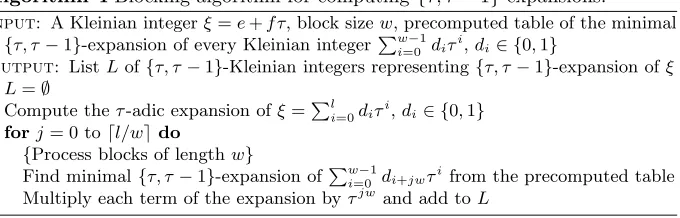
This theorem leads to an efficient method to compute{τ, τ−1}-expansions with sublinear density under Conjecture 1. The idea, described in Alg. 4, is to apply the blocking strategy described in the proof and compute optimal{τ, τ−
1}-expansions for each block.
Algorithm 4Blocking algorithm for computing{τ, τ−1}-expansions.
Input: A Kleinian integerξ=e+f τ,block sizew,precomputed table of the minimal
{τ, τ−1}-expansion of every Kleinian integerPw−1 i=0 diτ
i, d
i∈ {0,1}
Output: ListLof{τ, τ−1}-Kleinian integers representing{τ, τ−1}-expansion ofξ L=∅
Compute theτ-adic expansion ofξ=Pl
i=0diτi, di∈ {0,1}
forj= 0 todl/wedo
{Process blocks of lengthw}
Find minimal{τ, τ−1}-expansion ofPw−1
i=0 di+jwτifrom the precomputed table Multiply each term of the expansion byτjwand add toL
1. All powers ofτcan be reduced modulom,as (τm)P =Pfor allP ∈E a(F2m).
2. The bit-string dw−1. . . d1d0 corresponding to any block can be used as an index into the table of minimal{τ, τ−1}-expansions.
3. One can choose the size of the blocks based on available memory. The larger the block size, the lower the density of the{τ, τ−1}-expansions produced. 4. If the block size is not too big, one can precompute the minimal {τ, τ−1}
-expansion of every Kleinian integer of the form Pw−1
i=0 diτi, di ∈ {0,1}, thereby ensuring as low a density as possible. This precomputation can be done using exhaustive search and need only be done once per elliptic curve, as it does not depend onknor the base pointP.
3.1 Example
Consider the representation of 6465 into a {τ, τ −1}-expansion by using the two different algorithm we have described. Assume that we intend to compute (6465)P for some pointP ∈E1(F2163),so τ = (1 +
√
−7)/2.As in the case of computing theτ-NAF expansion, we first do a partial reduction of 6465 modulo (τ163−1)/(τ −1) as in [6], yielding ξ = −104 + 50τ. The greedy algorithm, Alg. 2, returns
ξ =τ8(τ −1) +τ2(τ −1)2+τ8(τ−1)6 .
The blocking algorithm, Alg. 4, using a block size w = 7 returns the same representation.
Fig. 1 illustrates the idea behind the blocking algorithm. Theτ-adic expan-sion ofξisτ2+τ5+τ9+τ11+τ12+τ13.This 14-bit expansion ofξis broken into two 7-bit blocks. The right block corresponds to τ2+τ5, and τ2(τ −1)2 is its optimal{τ, τ−1}-expansion. The left block corresponds toτ2+τ4+τ5+τ6,and
τ(τ−1) +τ(τ−1)6is its optimal expansion. Finally, multiplying the expression for the left block byτ7 yields the{τ, τ−1}-expansion ofξ.
τ-adic expansion: 1 1 1 0 1 0 0 0 1 0 0 1 0 0
⇓ ⇓
Segment size = 7 : 1 1 1 0 1 0 0 0 1 0 0 1 0 0
⇓ ⇓
Table look-up: τ(τ−1) +τ(τ−1)6 τ2(τ−1)2
⇓ ⇓
{τ, τ−1}-expansion: τ7[τ(τ−1) +τ(τ−1)6] +τ2(τ−1)2
Fig. 1.Expansion of−104 + 50τ using Alg. 4.
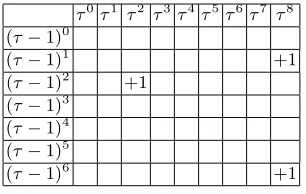
Table 1.The 2-dimensional pictorial representation of the{τ, τ−1}-expansion of 6465
obtained by both Alg. 2 and Alg. 4.
τ0τ1 τ2 τ3τ4τ5τ6τ7 τ8 (τ−1)0
(τ−1)1 +1
(τ−1)2 +1 (τ−1)3
(τ−1)4 (τ−1)5
(τ−1)6 +1
maximum power of τ and (τ −1)6 is the maximum power of τ −1,only three actually occur in the expansion. Furthermore, note that when computing kP
using this representation, each row in the table represents a one-dimensional
τ-adic expansion, and that these are very sparse.
3.2 Numerical Evidence
In this section, we present results from software implementations of Alg. 2 and Alg. 4, the greedy and blocking-based{τ, τ−1}-expansion algorithms. The ob-jective is to compare the density of the {τ, τ−1}-expansions computed by our algorithms withτ-NAF expansions. Our algorithms and the algorithm for com-puting the τ-NAF [6] of k were implemented in C, using the GMP library for multi-precision integer arithmetic. Tests were run on an Intel Xeon 2.8 GHz CPU running Linux.
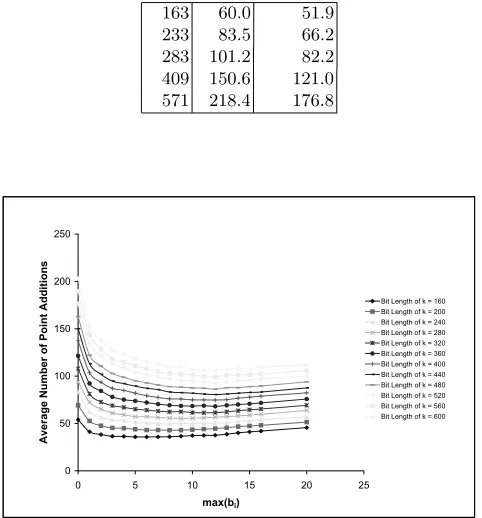
In Table 2 we present the average time required to compute the{τ, τ−1} -expansion ofkcompared with the time to compute theτ-NAF ofkfor the sizes of k corresponding to the five Koblitz curves recommended by NIST [5]. We used the blocking algorithm Alg. 4 with w = 10 and max(bi) = 6 to compute the (τ, τ −1)-expansions, and 500000 random values of k for each size. Our implementation of Alg. 4 is faster than that for computing the τ-NAF, by a factor of up to 20%.
Table 2.Average time (inµ-seconds) to compute representations ofk.
log2k τ-NAF{τ, τ−1} 163 60.0 51.9 233 83.5 66.2 283 101.2 82.2 409 150.6 121.0 571 218.4 176.8
0 50 100 150 200 250
0 5 10 15 20 25
max(bi)
A
v
e
ra
g
e
N
u
m
b
e
r
o
f
P
o
in
t
A
d
d
it
io
n
s
Bit Length of k = 160 Bit Length of k = 200 Bit Length of k = 240 Bit Length of k = 280 Bit Length of k = 320 Bit Length of k = 360 Bit Length of k = 400 Bit Length of k = 440 Bit Length of k = 480 Bit Length of k = 520 Bit Length of k = 560 Bit Length of k = 600
Fig. 2.Average number of point additions to computekP as a function of max(bi).
we need to know what value of max(bi) gives us minimal weight expansions on average.
In Fig. 2 we plot the average number of point additions required to compute
kP using a{τ, τ−1}-expansion of k,i.e., the number of non-zero terms in the expansion plus max(bi)−1,as a function of max(bi).These average values were computed using 1000 random values ofkof each size. This graph illustrates that each size ofkhas an optimal value of max(bi) ranging from 4 to 12.The precise value of max(bi) to use corresponds to minimizing the overall time required to compute kP given a {τ, τ−1}-expansion. As shown in Sec. 4.4, max(bi) = 3 turns out to be optimal for our FPGA implementation of point multiplication onE1(F2163).
In Table 3 we list the average number of point additions required to compute
taken as the average over 500000 random values of k. Our algorithm requires significantly fewer point additions thanτ-NAF in all cases.
Table 3.The average number of point additions required to computekP for the five
Koblitz curves in [5].
Alg. 2 Alg. 4 (blocking) log2k τ-NAF (greedy)w= 5 w= 10w= 16
163 54.25 36.37 47.86 40.00 37.22 233 77.59 49.31 66.23 54.96 50.76 283 94.25 58.64 79.37 65.66 60.49 409 137.12 81.84 113.64 93.63 85.68 571 190.25 111.90 154.98 127.21 117.04
4
FPGA Implementation
An FPGA implementation was designed in order to investigate the performance of the new algorithm in practice. The design implementskP on the NIST curve K-163 defined by (1), wherea= 1,overF2163 [5].
As the number of zero coefficients in a{τ, τ−1}-expansion is large, a normal basisF2m was selected. In a normal basis, an elementA∈F2m is represented as
A =Pm−1
i=0 aiα2
i
where ai ∈ {0,1}and α2
i
6
=α2j
for all i6=j and α2m
=α.
Thus, it is obvious that the squaring operation A2 is a cyclic right shift of the bit vector (a0, a1, . . . , am−1) which is fast if implemented in hardware.
Affine coordinates,A, and L´opez-Dahab coordinates,LD [18], are used for representing points on Ea(F2m). InA, a pointP is represented with two
coor-dinates as P = (x, y), and, in LD, with three coordinates as P = (X, Y, Z).
The LD triple represents the point (X/Z, Y /Z2) in A [18]. Three elements
x, y,y¯=x+y∈F2m are required to representP and−P inA. A point addition
inAis performed as presented, e.g., in [19], and its cost isI+ 2M+S+ 8Awhere I, M, S, andA denote inversion, multiplication, squaring, and addition in F2m,
respectively. A point addition in LD is performed as presented in [20], and it requires 13M+ 4S+ 9A.A point additionQ+P,whereQis inLDandP inA, is
called the mixed coordinate point addition, and it requires only 9M+5S+9A[21].
If the curve is fixed and bothP and −P are available, one multiplication and one addition can be omitted resulting 8M+ 5S+ 8A.TheA 7→ LDmapping does
not require any operations inF2m whileLD 7→ ArequiresI+ 2M+S.The cost of
a Frobenius mapping is 3SinLDand 2SinA. An inversion inF2m is computed
as suggested by Itoh and Tsujii in [22]. The Itoh-Tsujii inversion requiresm−1 squarings andblog2(m−1)c+Hw(m−1)−1 multiplications, whereHw(m−1) is the Hamming weight ofm−1 [22]. Hence,I= 9M+ 162Sifm= 163.
Different coordinates are used in Alg. 1 as follows: the point addition in A
used inS ←S±Picomputations. Because the results of row multiplications are in LD, the point addition inLDmust be used for Q←Q+S computations.
The implementation was designed especially for Xilinx Virtex-II family FP-GAs. The implementation includes a field arithmetic processor (FAP) for arith-metic inF2m, control logic for controlling the FAP, and a converter for converting
kto a{τ, τ−1}-expansion. The FAP is considered in Sec. 4.1, the control logic in Sec. 4.2, and the conversion unit in Sec. 4.3.
4.1 Field Arithmetic Processor (FAP)
The FAP includes a multiplier, a squarer, an adder, a storage element and control logic. A storage element form-bit elements ofF2m is required in order to store
points and temporary variables during computation ofkP.As Xilinx devices offer embedded memory blocks which can be used without consuming logic resources, the storage element is implemented in BlockRAMs. One dual-port BlockRAM can be configured into a 512×36-bit mode. All m bits of an element must be accessed in parallel in the FAP architecture. Hence, m
36
= 5 BlockRAMs are required. Write and read operations require both one clock cycle, i.e.W=R= 1.
The squarer is a shifter which is capable of performing operationsA2d
,where
A∈F2m and 0≤d≤dmax = 26−1,. Thus, A2 d
operations can be performed with a cost of S. Addition inF2m is simply a bitwise exclusive-or (xor). Both
squaring and addition are performed in one clock cycle, i.e.S=A= 1.
Field multiplication is critical for the overall performance. The multiplier is a digit-serial implementation of the Massey-Omura multiplier [23]. In a bit-serial Massey-Omura multiplier, one bit of the output is calculated in one clock cycle and, hence,mcycles are required in total. One bitci of the resultC=A×B is computed fromAandBby using anF-function. TheF-function is field specific, and the sameFis used for all output bitscias follows:ci=F(A≪i, B≪i),where ≪idenotes cyclical left shift by ibits. [5, 23]
In a digit-serial implementation,Dbits are computed in parallel. Hence,m D
cycles are required in one multiplication. In this FAP,D = 24.TheF-function is pipelined in order to increase clock frequency by adding one register stage. As loading the operands into the shift registers requires one clock cycle and pipelining increases latency by one clock cycle, the latency isM=163
24
+ 2 = 9.
4.2 Control Logic
Logic controlling the FAP consists of a storage for k, a control finite state ma-chine (FSM) and a ROM for control sequences.
the next symbol). If the run of consecutive Frobenius maps is longer thandmax, the run must be divided into two symbols and, for the latter one,s= 0.Eachκ,
with the exception of the row change symbol, transforms into an operationS ←
τd(S+sP) onE
a(F2m). LetZ(k) denote the maximum number of consecutive
Frobenius mappings required byk.Then, the number ofκ-symbols,e,required to representk,is given bye≥Hw(k) +j,with equality if and only ifdmax≥Z(k). Control FSM takesκ-symbols as input and, according tosanddofκ,it sets addresses of the control sequence ROM. The control sequences controlling the FAP consist of successive FAP instructions directly controlling the FAP. There are separate control sequences forPi+1←τ Pi−Picomputation (Frobenius map and point addition inA), point addition and subtraction (point addition in the mixed coordinates), Frobenius map, row change (point addition in LD), and
LD 7→ Amapping. They are all stored in a ROM implemented in a BlockRAM. If implemented so that, for each operation, the operands would be first read from the memory, then the operation calculated and finally the result saved to the memory, the latency of an operation would be the latency of the operation (M,S or A) plus two clock cycles (R+W). However, different operations can
be performed with the same operands without reading the operands more than once, and the operands of the next operation can be read while the previous operation is performed if the result is not required in the next operation. When the control sequences were carefully hand-optimized, different operations have the following latencies: point addition in the mixed coordinates LM = 98, the
Frobenius map LF = 6, row change (point addition in LD) LLD = 153, the
computation of Pi LPi = 182,and the LD 7→ A mapping LLD7→A = 160. The
first point addition of each row is simply S ← ±Pi and the first row change operation is given byQ←S.Both of these operations have a latency ofLC = 6.
In the beginning, an initialization including, e.g., the transferring of P into the FAP, needs to be performed. The latency of the initialization isLI = 10.Thus,
it follows that the latency of the computation ofkP becomes
LkP = (Hw(k)−(j+1))LM+(j+2)LC+(e−j)LF+j(LLD+LP
i)+LI+LLD7→A (6)
and, by assuming thatdmax≥Z(k),i.e.e=Hw(k) +j, (6) simplifies to
LkP = 104Hw(k) + 243j+ 84. (7)
4.3 Conversion Unit
The conversion unit, which converts an integerkinto a{τ, τ−1}-expansion, is a straightforward implementation of Alg. 4, our blocking-based method.
which produces one bit per cycle, from the least significant bit to the most significant bit.
For our implementation, we selected a block size of 10, so every 10 bits of the τ-adic expansion are used as an index into a look-up table. This table has one entry for each possible index (b9b8. . . b0), bi ∈ {0,1}, where each entry is the optimal {τ, τ−1}-expansion of P9
i=0biτi allowing a maximum exponent of 6 for τ −1. At most 3 terms of the form ±τa(τ
−1)b are required for each representation, so each entry in the table consists of three tuples of the form (dn, in, jn) representingdnτin(τ −1)jn. Hence, each entry requires 27 bits and the whole look-up table requires 27 KB RAM. Note that, according to the data in Sec. 3.2, using a block size of 5 would still give us a significant improvement overτ-NAF and in this case the table would require less than 1 KB.
Because integer operations are slower than theF2m operations in the FAP,
the conversion unit will be the bottleneck if the two units use the same clock. So a dual-port RAM is used in order to separate these units into different clock domains. The look-up results are written into the dual-port RAM using one port, and the ECC processor will read them out from the another port later.
4.4 Results
The FPGA design was written in VHDL and implemented on a Xilinx Virtex-II XC2V2000-6. The design was synthesized with Synplify Pro 8.0 and Xilinx ISE 6.2 was used for the place & route. The design (excluding the converter) requires 6,494 slices and 6 BlockRAMs on the XC2V2000-6, and it operates at a maximum clock frequency of fmax = 128 MHz. The converter requires 2251 slices, 2 BlockRAMs and 2 multipliers. The maximum clock frequency is 88 MHz. It takes 335 clock cycles, or 3.81µs to convert one 163-bit integer.
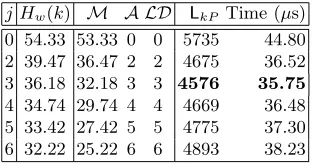
Average timings of the design are presented in Table 4. The latencyLkP is
Table 4.Performance calculations of the FPGA implementation on a Xilinx Virtex-II
XC2V2000-6 with different values ofj. Hw(k) forJ >0 are based on empirical data. The numbers of point additions in the mixed coordinates, inAand inLDare denoted asM,AandLD, respectively.
j Hw(k) M A LD LkP Time (µs) 0 54.33 53.33 0 0 5735 44.80 2 39.47 36.47 2 2 4675 36.52 3 36.18 32.18 3 3 4576 35.75
4 34.74 29.74 4 4 4669 36.48 5 33.42 27.42 5 5 4775 37.30 6 32.22 25.22 6 6 4893 38.23
whenJ = 3 which is smaller than estimated in Sec. 3.2, because the latencies of point additions differ. In Sec. 3.2, all point additions were assumed equal.
Numerous publications considering implementation of elliptic curve cryptog-raphy on FPGAs have been published, e.g., in [24–27]. To the best of the authors’ knowledge, the only FPGA-based implementation usingτ-NAF expansions was presented by Lutz and Hasan [27] where a kP operation onE1(F2163) was
re-ported to require 75µs on a Xilinx Virtex-E XCV2000E.
5
Further Work
Our results demonstrate that{τ, τ−1}-expansions lead to a competitive point multiplication algorithm for Koblitz curves when the base pointP is not fixed. Nevertheless, there are a number of aspects we are continuing to explore.
The latency of a point multiplication using our FPGA implementation could be significantly reduced at the expense of larger area requirements by computing each row in parallel. This possibility will be studied in the future. In addition, alternative choices of the bases, or even using three bases, may lead to further improvements. For example, using {τ, τ+ 1} may be advantageous in our im-plementation because computing (τ + 1)jP from (τ + 1)j−1P requires a point addition as opposed to a point subtraction when using bases τ and τ −1,and subtraction is slightly more expensive than addition.
Our point multiplication algorithm does not require any precomputations involving the base point P nor storage of additional points, and hence is well-suited to applications whereP is random. We are investigating the possibility of generalizing window methods, using two-dimensional windows, to our algorithm in order to obtain further improvements when precomputations involvingP are permitted.
Although our numerical data suggests that the density of the {τ, τ−1} -expansions obtained by our conversion algorithm is sublinear in the bit length of
k,we do not yet have a proof of this fact. In addition, our conversion algorithm requires a modest amount of storage. These precomputed quantities are inde-pendent of both the base pointP and multiplier k and can be viewed as part of the domain parameters. Nevertheless, we continue to search for an efficient memory-free conversion algorithm.
References
1. Dimitrov, V., J¨arvinen, K., Jacobson, Jr., M., Chan, W., Huang, Z.: FPGA im-plementation of point multiplication on Koblitz curves using Kleinian integers. To appear in CHES 2006 (2006)
2. Koblitz, N.: Elliptic curve cryptosystems. Math. Comp.48(1987) 203–209 3. Miller, V.: Use of elliptic curves in cryptography. In: CRYPTO ’85. Volume 218
of Lecture Notes in Computer Science (LNCS). (1986) 417–426
5. National Institute of Standards and Technology (NIST): Digital signature standard (DSS). Federal Information Processing Standard, FIPS PUB 186-2 (2000) 6. Solinas, J.: Efficient arithmetic on Koblitz curves. Designs, Codes, and
Cryptog-raphy19(2000) 195–249
7. Avanzi, R., Heuberger, C., Prodinger, H.: Minimality of the Hamming weight of the τ-naf for Koblitz curves and improved combination with point halving. In: SAC 2005. Volume 3897 of LNCS. (2005) 332–344
8. Dimitrov, V., Jullien, G., Miller, W.: An algorithm for modular exponentiation. Inform. Process. Lett.66(1998) 155–159
9. Ciet, M., Sica, F.: An analysis of double base number systems and a sublinear scalar multiplication algorithm. In: Mycrypt 2005. Volume 3715 of LNCS. (2005) 171–182
10. Dimitrov, V., Imbert, L., Mishra, P.: Efficient and secure elliptic curve point multiplication using double-base chains. In: ASIACRYPT 2005. Volume 3788 of LNCS. (2005) 59–78
11. Avanzi, R., Sica, F.: Scalar multiplication on Koblitz curves using double bases. Technical Report Number 2006/067, Cryptology ePrint Archive (2006)
12. Sica, F.: Personal communication. (2006)
13. Conway, J., Smith, D.: On quaternions and octonions. AK Peters (2003)
14. Tijdeman, R.: On integers with many small prime factors. Compos. Math. 26
(1973) 319–330
15. Baker, A.: Linear forms in the logarithms of algebraic numbers IV. Mathematica
15(1968) 204–216
16. Mignotte, M., Waldshmidt, M.: Linear forms in two logarithms and Schneider’s method III. In: Annales Fas. Sci. Toulouse. (1990) 43–75
17. Tijdeman, R.: Personal communication. (2006)
18. L´opez, J., Dahab, R.: Improved algorithms for elliptic curve arithmetic inGF(2n). In: SAC ’98. Volume 1556 of LNCS. (1998) 201–212
19. Doche, C., Lange, T.: Arithmetic of elliptic curves. In Cohen, H., Frey, G., eds.: Handbook of Elliptic and Hyperelliptic Curve Cryptography. Chapman & Hall/CRC (2006) 267–302
20. Higuchi, A., Takagi, N.: A fast addition algorithm for elliptic curve arithmetic in
GF(2n) using projective coordinates. Inform. Process. Lett.76(2000) 101–103 21. Al-Daoud, E., Mahmod, R., Rushdan, M., Kilicman, A.: A new addition formula
for elliptic curves overGF(2n). IEEE Trans. Comput.
51(2002) 972–975 22. Itoh, T., Tsujii, S.: A fast algorithm for computing multiplicative inverses in
GF(2m) using normal bases. Inform. Comput.78(1988) 171–177
23. Wang, C., Troung, T., Shao, H., Deutsch, L., Omura, J., Reed, I.: VLSI architec-tures for computing multiplications and inverses inGF(2m). IEEE Trans. Comput.
34(1985) 709–717
24. Bednara, M., Daldrup, M., von zur Gathen, J., Shokrollahi, J., Teich, J.: Reconfig-urable implementation of elliptic curve crypto algorithms. In: IPDPS 2002. (2002) 157–164
25. Leong, P., Leung, K.: A microcoded elliptic curve processor using FPGA technol-ogy. IEEE Trans. VLSI Syst.10(2002) 550–559
26. Eberle, H., Gura, N., Shantz, S., Gupta, V.: A cryptographic processor for ar-bitrary elliptic curves over GF(2m). Technical Report SMLI TR-2003-123, Sun Microsystems, Inc. (2003)
![Table 3. The average number of point additions required to compute kP for the fiveKoblitz curves in [5].](https://thumb-us.123doks.com/thumbv2/123dok_us/1850581.1240180/12.612.214.399.191.274/table-average-number-additions-required-compute-vekoblitz-curves.webp)