MARKOW, TANYA THAIS. A Knowledge Maturity Model: An Integration of Problem Framing, Software Design, and Cognitive Engineering. (Under the direction of DR. THOMAS LYNN HONEYCUTT).
The Knowledge Maturity Model (KMM) is a new model proposed as an
alternative to an existing software engineering evaluation model, the Capability Maturity Model (CMM). The KMM is offered as a solution to some key weaknesses of the CMM. The CMM was developed in the early 1980s, when highly structured programming and business practices were the standard. In the current agile methods computer science environment, it is often difficult to evaluate a company which employs agile methods using the CMM methodology. The CMM consists of five levels; in order to claim the next higher level, all tasks of that level must be accomplished. Many companies operating with agile software engineering and management practices tend to be performing at many levels within the CMM, making it difficult to assign such an organization an appropriate CMM level designation. The KMM proposes instead an evaluation of the actual inner processes the company uses to develop software, rather than it’s ability to achieve a given set of tasks, as required by CMM.
the information they need. The Knowledge Maturity Model incorporates the concept of levels or states of maturity from the CMM, and the core fundamentals of the KIM: the roles and an iterative process. The synergy of these concepts gives rise to the four state model of the KMM: recognition and use of the Plan, Do, Check, Act cycle, use of the four roles of KIM, use of an iterative process, and finally, the fully working inner mechanism or sharing mechanism of the KIM. The KMM allows an organization to choose any traditional software engineering methodology for a given project by providing the roles-based structure to make shifting between software engineering methodologies easier, allowing companies to tailor their process for specific projects.
KMM ties together the three fundamental centers that comprise the process of developing software: systems engineering, software engineering, and cognitive engineering. The KMM solves the systems engineering problem by providing a generalized process that is a superset of any given software engineering methodology. Because KMM provides a superset to all existing software engineering methodologies, it frees up an organization to choose the one that best suits a given project, rather than always having to use one standard approach, therefore addressing the software
Software Design, and Cognitive Engineering
By
Tanya Thais Markow
A thesis submitted to the Graduate Faculty in partial fulfillment of the requirements for the Degree of
Master of Science in COMPUTER SCIENCE
Department of Computer Science North Carolina State University
2004
Approved By ___________________________________________________ Dr. Thomas L. Honeycutt, Chairperson of Advisory Committee
___________________________________________________ Dr. Christopher G. Healey
___________________________________________________ Dr. Robert St. Amant
To my husband, Pete and my daughter, Morgan, for their tremendous love, support and patience.
To my mother, Annette Fogarty,
for raising me believing that with perseverance, ALL things are possible.
BIOGRAPHY
Tanya Thais Markow (nee Tolles) was born in Mayfield Heights, Ohio on August 19, 1973. She attended Lakewood High School (1987-1990), and the United States Military Academy at West Point (1991-1995), where she earned a Bachelor of Science in
Mechanical Engineering (Aerospace) and was commissioned as a Second Lieutenant in the United States Army. She graduated from the Aviation Officer Basic Course as an Honor Graduate in June 1996, designated an Army Aviator, and became an AH-64A Apache Pilot in October 1996. She then served as an Attack Platoon Leader in
A Troop, 1-6 Cavalry, in the Republic of Korea (1996-1997). She returned to the United States to 3-229th Aviation Regiment (Attack), Ft. Bragg, North Carolina, where she served as Battalion Intelligence Officer. She deployed with her battalion to
Bosnia-Herzegovina in support of Stabilization Force IV, Operation Joint Endeavor (1998-1999). Tanya then attended the Aviation Captain’s Career Course (2000). She served as
ACKNOWLEDGEMENTS
I wish to thank Dr. Thomas L. Honeycutt for recognizing the potential for this thesis in my eighteen-page answer to a homework problem he assigned in Software Engineering. Thanks for your guidance and wisdom. I would also like to thank my committee
members, Dr. Christopher G. Healey and Dr. Robert St. Amant for their suggestions and assistance during the course of my thesis.
TABLE OF CONTENTS
TABLE OF FIGURES ... vii
1. INTRODUCTION ... 1
1.1 Research Motivation: ... 1
1.2 Statement of the Problem:... 2
1.3 Goals for this thesis:... 3
1.4 Knowledge Maturity Model (KMM): ... 4
1.5 Objectives of this thesis: ... 5
1.6 Thesis Layout:... 6
2. CAPABILITY MATURITY MODEL (CMM) ... 7
2.1 History of the Capability Maturity Model (CMM):... 7
2.2 CMM Overview: ... 8
2.3 Evolution of the CMM, Rise of the CMMI: ... 11
3. PROCESS IMPROVEMENT METHODS ... 12
3.1 Review of Literature: ... 12
3.2 Application of the Capability Maturity Model: ... 12
3.3 Methods for Advancing within the CMM Framework: ... 13
3.4 Advantages and Disadvantages of KIM: ... 16
3.5 Existing Process Analysis:... 17
4. KNOWLEDGE INSIGHT MODEL (KIM) ... 19
4.1 Knowledge Insight Model (KIM) ... 19
4.2 Plan, Do, Check, Act (PDCA) Cycle... 20
4.3 External, Internal, Discover, Refine Transition Matrix ... 21
4.4 Framer: ... 26
4.5 Maker: ... 27
4.6 Finder: ... 30
4.7 Sharer: ... 32
5.0 CLIMBING THE CMM USING THE KIM ... 34
5.1 Method Introduction: ... 34
5.2 CMM Level 1 to Level 2 using KIM: ... 34
5.3 CMM Level 2 to Level 3 using KIM: ... 39
5.4 CMM Level 3 to Level 4 using KIM: ... 42
5.5 CMM Level 4 to Level 5 using KIM: ... 46
6.0 KNOWLEDGE MATURITY MODEL... 51
6.1 Introduction:... 51
6.2 KMM Overview... 53
6.3 KMM Evaluation ... 54
6.4 KMM as a Superset of The Waterfall Model... 57
6.5 KMM as a Superset of The Spiral Model ... 59
6.6 KMM as a Superset of the Rational Unified Process ... 61
6.8 KMM as a Superset of SCRUM ... 67
7. NASA AND THE KMM ... 70
7.1 Columbia... 70
7.2 Challenger / Columbia and the NASA Culture ... 70
7.3 New Culture with KMM... 72
8. CONCLUSIONS AND FUTURE WORK ... 74
8.1 Conclusions:... 74
8.2 Future Work: ... 76
TABLE OF FIGURES
Figure 1. Diagram of the five levels of the Capability Maturity Model [12]. ... 10
Figure 2. Plan, Do, Check, Act (PDCA) Cycle ... 20
Figure 3. Four Quadrant Matrix... 21
Figure 4. Refinement Evolution: Creative phase to development phase of design process ... 23
Figure 5. Creative Evolution: Creative phase of design process to a new design process ... 24
Figure 6. Knowledge Insight Model ... 25
Figure 7. Framer... 26
Figure 8. Maker... 28
Figure 9. Finder... 30
Figure 10. Sharer... 32
Figure 11. Transitioning from CMM Level 1 to Level 2 using KIM ... 36
Figure 12. Transitioning from CMM Level 2 to Level 3 using KIM ... 40
Figure 13. Transitioning from CMM Level 3 to Level 4 using KIM ... 44
Figure 14. Transitioning from CMM Level 4 to Level 5 using KIM ... 48
Figure 15. The Three Aspects of Software Design and KMM ... 52
Figure 16. KMM Levels ... 56
Figure 17. Waterfall Model Instance of KMM ... 58
Figure 18. Spiral Model ... 60
Figure 19. KMM as a Superset of the Spiral Model ... 61
Figure 20. KMM Applied to RUP ... 64
Figure 21. KMM Applied to XP ... 66
Figure 22. SCRUM [18] ... 68
1. INTRODUCTION
1.1 Research Motivation:
There is “no silver bullet.” The truth of this statement is highly evident in the constantly evolving world of software engineering. This fact has not hampered the attempts by many to claim the latest “silver bullet” that would solve all of the discipline’s problems in one magic methodology or process. Extreme programming, SCRUM,
company to company. The Capability Maturity Model is one of the best-known ways to evaluate the potential success of a software engineering firm. Using the Capability Maturity Model (CMM), however, is also problematic. The CMM provides only a checklist of key process areas, which must be accomplished to claim a particular level on the five-level model. It does not provide the methodology, or “how” of process
improvement. A more generalized layer may not only aid in software development, but might also provide the answer to the “how” of process improvement.
1.2 Statement of the Problem:
methods that would be rated at level five and some that would put them at level two. Strict adherence to the CMM would require such an organization to claim a level two status, but does not portray their higher skills in other areas. This can result in a company being underrated. True maturity of a software engineering company should be based on the inner workings, how the company actually develops software and how able that company is to adapt as needed to accommodate the needs of the customer, without such changes imposing great stress to the rest of the organization.
1.3 Goals for this thesis:
This paper will demonstrate a new paradigm for software engineering, the Knowledge Maturity Model (KMM). The foundation for the KMM, the Knowledge Insight Model (KIM), will be introduced and validated by demonstrating its use as a process improvement methodology by showing how it can be employed to climb the levels of the CMM. The KMM will be shown to represent another level of maturity in software engineering. The KMM will also be demonstrated to serve as a superset of current software engineering methodologies, allowing organizations to employ the aspects of KMM to customize their own method(s), as appropriate for a given problem frame. The KMM paradigm will provide the layer above software engineering
1.4 Knowledge Maturity Model (KMM):
The Knowledge Maturity Model (KMM) is a new paradigm that employs the concept of levels from the CMM, but also integrates the idea of roles-based software engineering. The KMM provides a layer above software engineering and process improvement methodologies, providing a method of control for these activities. At the heart of the KMM is the KIM, a generalized process that is capable of multiple instances. The KIM incorporates four roles: Framer, Maker, Finder, and Sharer. The KIM employs a means by which to transition between these states: the Plan, Do, Check, Act (PDCA) cycle. The KIM takes into account both internal and external factors that can influence an organization.
Each of the four roles allow team members to understand what their mission is, based on which role they are assigned at any given time. The Framer is responsible for defining the “big picture,” determining project scope, requirements and goals. The Maker establishes new concepts that support the project goals. The Finder seeks out existing knowledge that can aid in solving the problem at hand. The Sharer establishes a database that all in the organization can access, to ensure that efforts are not duplicated.
level of communication both inside and outside the company. Such an organization maintains a constantly updated database of all available knowledge that pertains to a particular project. All team members have access to the database and it is maintained for use on future projects and is considered a “living” database. The reason for the Inner Mechanism as the highest level is that a lack of communication within companies is the leading cause of duplicated efforts and stagnation of projects, due to the fact that one department may not realize that another has already discovered the solution to a show-stopping problem. An organization with a highly developed Inner Mechanism avoids such pitfalls, and is at the pinnacle of maturity. The levels of the KMM may be used to determine the overall maturity of an organization, however, the KMM levels are always a part of an organization’s framework. An organization that has achieved the Inner
Mechanism level will not always need to apply this level to every project. A simple, straightforward problem may be quickly solved, stored in a database and never require the high level of communication of extremely large or complex problems. However, a company at this level always has the ability to handle such problems, should they arise.
1.5 Objectives of this thesis:
The objectives of this paper are:
(1) Review relevant literature related to the Capability Maturity Model and existing methodologies being used to climb the CMM “ladder.”
(3) Validate the KIM by applying it to the CMM, demonstrating how it can be employed by a software engineering organization to achieve the desired level on the CMM, given the organization’s current level on the CMM and the target level.
(4) Introduce the Knowledge Maturity Model (KMM), a new paradigm that provides a control layer situated above both software engineering methodologies and process improvement concepts. The KMM also offers another way to evaluate software engineering process maturity.
1.6 Thesis Layout:
Chapter 2 covers the Capability Maturity Model, its uses and evolution since its introduction. Chapter 3 provides a review of literature and gives an overview of methods that may be used for process improvement. Chapter 4 introduces the Knowledge Insight Model. Chapter 5 validates the KIM by demonstrating its use in process improvement within the framework of the Capability Maturity Model. Chapter 6 introduces the Knowledge Maturity Model as a new paradigm that provides another way to evaluate process maturity, as well as a new approach to employing existing software engineering methodologies thereby allowing organizations to customize their own method(s). Chapter 7 consists of conclusions from this research and proposes possible future
2. CAPABILITY MATURITY MODEL (CMM)
2.1 History of the Capability Maturity Model (CMM):
2.2 CMM Overview:
One common misconception about the CMM is that it is a process by which an organization may improve its software engineering methodologies. This is not the case. The CMM is simply a measure of the organization’s current software engineering process and provides a set of goals, a checklist, of what the organization must accomplish in order to advance up the CMM “ladder” of levels. The CMM was derived from the basics of Total Quality Management (TQM) [12]. The CMM consists of five “levels” that are may be equated to a ladder. Each of the levels corresponds with an improved state of the company’s overall software engineering process.
1. Initial – a few “smart guys” devise solutions to software engineering requests from customers. No organized, company-wide process in place. Such an organization may produce quality software, but the timeframe and cost are often unknown at the outset of the project. Even if the organization makes some predictions of time and cost, they are likely to miss these goals.
2. Repeatable – the organization establishes a simple process that can be used to develop software. A method of project management is established to ensure that the organization can track project cost, time, and effectiveness (ie – does the software meet the customer’s specifications?).
employees are using the same methodologies, to ensure standardization. Because the process is so well-defined, management is better able to track where any project is at any time, within the organization, making it easier for management to communicate time, cost, and functionality changes to the customer in a timely fashion.
4. Managed – the organization not only tracks project data such as cost, timeliness and customer satisfaction, but goes a step further by establishing a set of standards for these product measures. In this way, the organization is now able to determine how effective it is in meeting goals and deadlines. The level 4 organization also attempts to limit variations in its product, based on its standards. By further controlling the quality of the final product, a level 4 organization is known for its reliability.
Figure 1. Diagram of the five levels of the Capability Maturity Model [12].
(1)
Initial
(2)
Repeatable
(3)
Defined
(4)
Managed
(5)
Optimizing
Disciplined
Process
Standard,
consistent
process
Predictable
Process
2.3 Evolution of the CMM, Rise of the CMMI:
The Capability Maturity Model for Software Engineering has evolved over the years, and the Software Engineering Institute at Carnegie Mellon University was poised to release version 2.0 of the SW-CMM, and the other CMM categories, which include P-CMM (People), IPD-P-CMM (Integrated Product Development), SA-P-CMM (Software Acquisition), and SE-CMM (Systems Engineering). However, there has been a growing desire in the industry, and within the Department of Defense, to see the entire CMM suite of products brought into one suite that would be generalized enough to accommodate all of the separate disciplines, allowing organizations to use one plan and reduce confusion between departments. Thus, SEI scrapped the release of CMM 2.0 and instead the Capability Maturity Model Integration (CMMI®) has come into being and will
eventually replace all the categories of the CMM on the market [4]. There was clearly a desire on the part of SEI to attempt to provide potential users of the CMMI with
3. PROCESS IMPROVEMENT METHODS
3.1 Review of Literature:
The literature review of this paper is divided into four sections. The first section deals with the Capability Maturity Model; its application in the computer science world as well as some key issues to consider when using the CMM. The second section addresses some other processes being used today to climb the CMM ladder of levels. The third section discusses advantages and disadvantages of using the Knowledge Insight Model to climb the CMM ladder. The fourth section provides an introduction to the Knowledge Insight Model, the foundation for the KMM.
3.2 Application of the Capability Maturity Model:
3.3 Methods for Advancing within the CMM Framework:
IDEAL – IDEAL is “a life-cycle model for software process improvement based upon the Capability Maturity Model ® (CMM®) for software [3].” IDEAL is comprised of the following phases:
Initiating – lay the groundwork for improvement
Diagnosing – determine where the organization is and what the goal is Establishing – come up with a plan for process improvement
Acting – Execute the plan
Learning – Get feedback from the improvement process to help refine the new process or to use for future iterations
Advantages:
1. Extremely generalized method; may be used for many areas of organization. 2. Already well known and established in the computer science world.
3. Iterative process that may be used over until the end goal is reached. Disadvantages:
1. Does not give guidance on the roles of personnel in the improvement process. 2. May be too generalized.
CMMI – The Capability Maturity Model Integration is an attempt by SEI to 1.
Consolidate its CMM products into one suite that may be used for several different types of work (Software, People Management, Systems Engineering, Software Acquisition, and Integrated Product Development), and 2. To introduce “best practices,” that were
organizations how to climb the CMM ladder. There are two different methodologies within the CMMI, staged and continuous. The staged representation is a more static methodology that is very similar to the original CMM; it is best represented by the stair-step depiction of the CMM. The organization generally improves or develops the required traits to move up each step of the ladder and generally will do this in sequential fashion. The continuous method is better suited for organizations who wish to make improvements at different time frames from different categories, rather than taking the step-by-step approach of the staged method. The continuous method may be best for organizations who look at the CMMI and recognize that they have achieved level 2 in one arena, level 4 in another, level 3 in yet another, and they are best to continue to develop in all areas at different paces, than to slow progression in other areas, while the remaining catch up and the like.
Advantages:
1. One product may be potentially used across an organization for process improvement.
2. Based on an established, well-known process in the industry (CMM).
3. Employs “best practices” learned over the years from organizations who have used CMM.
4. Ability to use continuous or staged methods, as preferred by the organization. Disadvantages:
2. Does not explicitly address the “people” aspect of process improvement.
Consultants – Consultants are a wonderful way to climb the CMM/CMMI; if your business can afford it!
Advantages:
1. Very tailored, specific plans for your organization.
2. Consultants tend to focus only the particular contract they are currently working (ie – they are generally totally devoted to your problem or may only be working for a few organizations at a given time, allowing them to spend a lot of time focusing on your problem). When attempting to improve an organization internally, while also trying to continue to produce (ie – multiple distracters), there is less likelihood of completion of the process improvement within the desired timeframe.
3. Generally, outsiders, such as consultants, are less likely to be defensive of current practices. They are able to take a more objective view of where the organization currently is and what must be done to get them where they want to be.
on past experiences. Most organizations have not had the ability to look into what other similar organizations have done in the line of process
improvement, and therefore do not have a body of knowledge of “best practices” to use.
Disadvantages:
1. Can be VERY expensive; may be cost prohibitive for small companies that really need it.
2. Some consultants may try to “sell” their idea, even if it is not what’s truly best for the organization.
3. Consultants may tell the organization exactly what they want to hear, in order to appease the management that hired them.
3.4 Advantages and Disadvantages of KIM:
Advantages of the Knowledge Insight Model are:
1. Assigning well-defined roles to all members of the project team (Framer, Finder, Maker, Sharer), thus reducing ambiguity.
2. It is an iterative process, allowing for multiple runs to achieve the organization’s ultimate goals [7]
3. KIM does not lock the organization into any specific programming methodology (ie – Waterfall, Spiral, SCRUM, XP, RUP), as it is highly adaptable to different scenarios.
Knowledge Insight Model; this is one of the weaknesses of many current software engineering organizations.
5. Existing processes may be easily mapped to the KIM; thus organizations with existing processes may make use of the KIM and potentially optimize with it.
A disadvantage of the KIM is that it is a new process. Typically, those in both the corporate world and academia are resistant to change. However, the Knowledge Insight Model is easy to learn and is applicable in many areas of study, which may help
overcome the usual resistance to new ideas and models [7]
3.5 Existing Process Analysis:
The review of literature shows that there are several possible ways to tackle the problem of climbing up the CMM ladder. However, there is a lack of definition in the “how” of process improvement. Roles within the organization are not well-defined as they pertain to software engineering process improvement. While consultants certainly take a lot of the problem off the back of the organization seeking to improve their process, it is just not cost effective for many smaller software engineering companies looking to improve their CMM standing. Once the consultants leave, there may be a lack of understanding of what was done and therefore require some dependency on the
consultants for future improvements or changes. The CMMI is an attempt to give more of the “how” to climb the ladder, but is far too specific and cannot be viewed as a
4. KNOWLEDGE INSIGHT MODEL (KIM)
4.1 Knowledge Insight Model (KIM)
The Knowledge Insight Model (KIM) was created in an effort to construct “an instrument for acquiring knowledge [7]”. The KIM also addresses the need to collect and share knowledge. The KIM is based off a Japanese idea, “Kaizen,” meaning to
4.2 Plan, Do, Check, Act (PDCA) Cycle
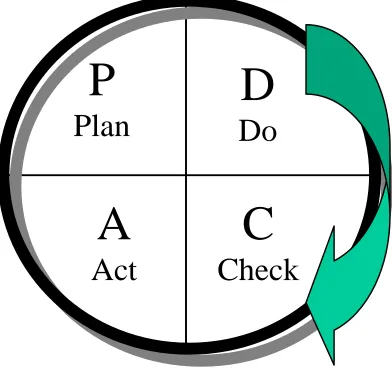
The Plan, Do, Check, Act (PDCA) Cycle plays a key role in the KIM. PDCA provides the transitions between the states of Framer, Maker, Finder and Sharer. The PDCA is four cycle methodology used to help identify and solve problems, and is especially well suited to process improvement.
Figure 2. Plan, Do, Check, Act (PDCA) Cycle
Plan to make changes to achieve process improvement; determine what the
problem is and devise a way to try to solve the problem(s).
Do changes in a series of small increments. A good way to do this is
select one group within the company to serve as a test bed, allowing them to work under the changed process, while all other groups continue under the legacy process, so as not to disrupt business on a large scale.
Check to see if the small changes are having the desired effect before moving on
P
Plan
D
Do
A
Act
C
to larger scale changes. Compare the test group with the norms throughout the organization, and with historical data.
Act to make the changes on a large scale and continue to monitor across the
organization to determine if the changes in process should be made permanent [13].
4.3 External, Internal, Discover, Refine Transition Matrix
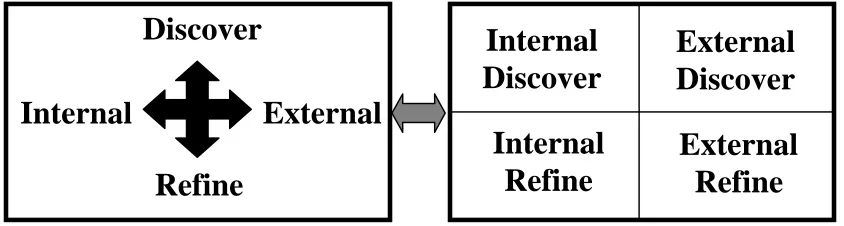
The KIM considers the external and internal influences on a project, and how an organization transitions between the effects of both. A process will begin in the
discovery mode, move into refinement, then continuously iterate between the two stages. Discovery and refinement may occur due to internal or external forces or ideas, and thus both must be considered by the organization. The four quadrant matrix in the figure below demonstrates the relationship between these factors.
Figure 3. Four Quadrant Matrix
Internal
Discover
External
Discover
Internal
Refine
External
Refine
Discover
Internal
Refine
Solution increments occur when transitioning from discover to refinement, while consolidation is indicated by a transition from refinement back to discover. These transitions are continued iteratively until the refinement goal is achieved. Transitioning from external to internal and vice versa is accomplished in order to discover and
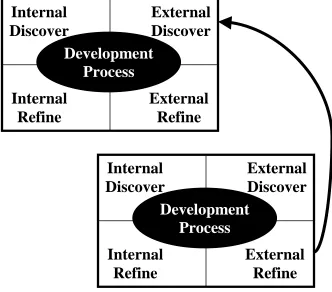
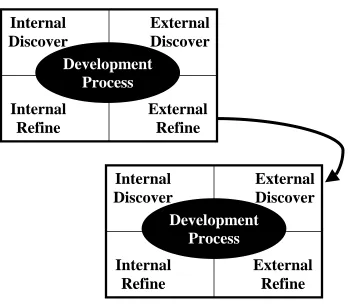
incorporate both ideas from within an organization and without. Generally, an
organization will look outside for inspiration, devise a new concept, and then turn inward for ideas on how to implement the new idea. The organization may then again look outside to help refine their innovation. Iteration between external and internal influences continues until the concept reaches a desired maturity level.
Figure 4. Refinement Evolution: Creative phase to development phase of design process
Internal
Discover
External
Discover
Internal
Refine
External
Refine
Development
Process
Internal
Discover
External
Discover
Internal
Refine
External
Refine
Figure 5. Creative Evolution: Creative phase of design process to a new design process
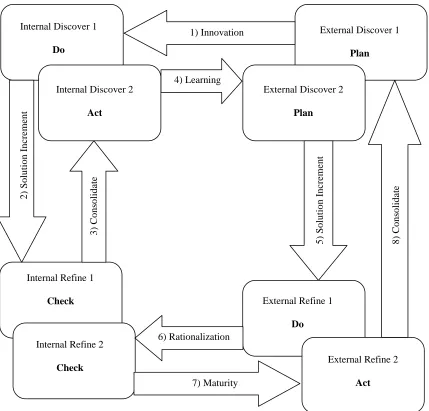
The KIM is generalized process that combines all of the facets of the PDCA cycle and the External/Internal, Discover/Refinement transitions. The synthesis of these concepts is illustrated in the overall graphic of the Knowledge Insight Model in Figure 6 below:
Internal
Discover
External
Discover
Internal
Refine
External
Refine
Development
Process
Internal
Discover
External
Discover
Internal
Refine
External
Refine
Figure 6. Knowledge Insight Model
External Discover 1
Plan
1) Innovation Internal Discover 1
Do
Internal Discover 2
Act
Internal Refine 1
Check
Internal Refine 2
Check
External Refine 1
Do
External Refine 2
Act
External Discover 2
Plan
4) Learning
6) Rationalization
7) Maturity
2) Solution Increment
3) C
ons
ol
id
at
e
5) Solution Increment 8) C
ons
ol
id
at
4.4 Framer:
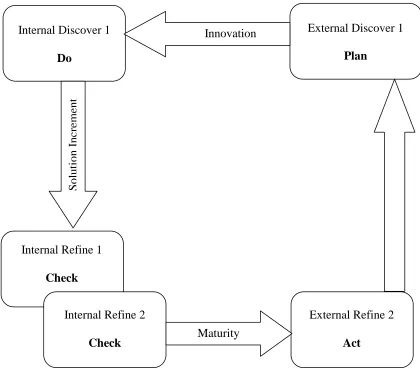
Figure 7. Framer
The Framer is concerned with devising an overall plan for how to accomplish the task at hand. As the name suggests, and as evidenced in Figure 2, the Framer provides the “frame” for the entire KIM process. The Framer must define the problem, establish a
External Discover 1
Plan
Innovation Internal Discover 1
Do
Internal Refine 1
Check
Internal Refine 2
Check
External Refine 2
Act
Maturity
S
o
lu
ti
on Increm
timeline for the project, provide guidelines and requirements of the particular problem, and offer potential solutions that the group should tackle to solve the problem [8]. The Framer corresponds to the Plan phase of the Plan, Do, Check, Act cycle [7]. As such, the Framer devises plans to carry out the project or to solve a problem. The focus of the framer during each of the eight steps is as follows:
External Discover 1: In this plan stage, the Framer must ask: “what problem
does the group seek to solve?”
Internal Discover 1: In this do stage, the Framer must break the problem down
into smaller tasks to be tackled
Internal Refine 1: In the first check stage, the Framer needs to determine and
compile a list of the potential risks in solving the problem
Internal Refine 2: In this second check phase, the Framer must determine, based
on initial estimates, if the group possess the ability to accomplish the tasks needed to solve the problem. The Framer may also determine what additional resources and/or additional study may be required to complete the project.
External Refine 2: In this act phase, the Framer must establish an initial timeline
for the project [10].
4.5 Maker:
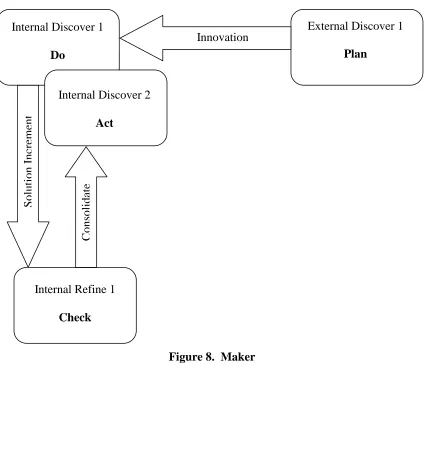
accomplish the objectives, based on initial analysis. The Maker comprises much of the creative force behind the project, and must work closely with the Finder to ensure that there is not a sufficient existing process or product that can be used, thus avoiding “reinventing the wheel.”
Figure 8. Maker
External Discover 1
Plan
Innovation Internal Discover 1
Do
Internal Discover 2
Act
Internal Refine 1
Check
S
o
lu
ti
on Increm
ent
The steps of the KIM that comprise the Maker are:
External Discover 1: In this plan stage, the Maker must determine what is
already in existence that may solve the problem or may contribute to the development of a new concept for the project.
Internal Discover 1: In this do stage, the Maker needs to compile the
requirements that the new product or process must meet.
Internal Refine1: In the check phase, the Maker must perform a risk analysis
must be performed to assess the risks as
determined by the Framer and possibly add risks as seen by the Maker. The Maker will also try to find ways to mitigate risks in this step.
Internal Discover 2: In this act phase, the Maker creates a new product or
4.6 Finder:
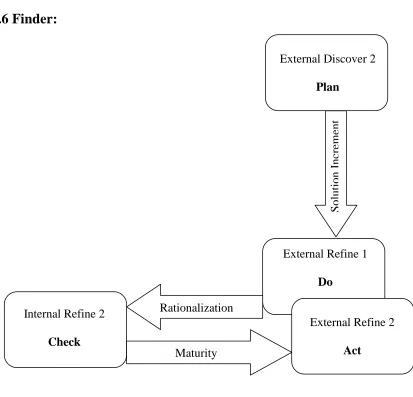
Figure 9. Finder
The Finder must scour all existing knowledge in the field being considered. In doing this, the Finder keeps the Maker from creating “new” concepts that are already proven and in existence elsewhere. In some cases, the contributions of the Finder may be research-oriented, offering ideas to the Maker for how to tackle an existing solution in a new way. The Finder is also responsible for seeking out a need or market for the new
Internal Refine 2
Check
External Refine 1
Do
External Refine 2
Act
External Discover 2
Plan
Rationalization
Maturity
S
o
lu
ti
on Increm
product or process that the group is creating. The details of the steps that make up the Finder phase are as follows:
External Discover 2: In this plan stage, the Finder must determine what
information must be found by the Finder.
External Refine 1: In the do stage, the Finder researches information external to
the organization; the Finder may at this stage refine his search based on information discovered.
Internal Refine 2: The Finder in the check stage will look internally for past
projects or other efforts that may aid in the current project.
External Refine 2: The Finder in the act stage again looks outside the
4.7 Sharer:
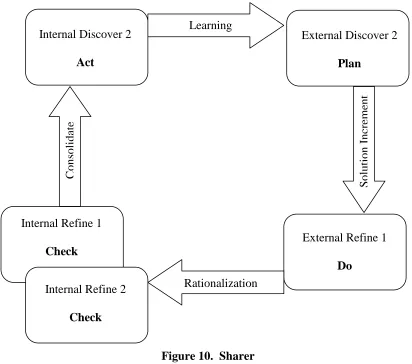
Figure 10. Sharer
The mission of the Sharer is to create and maintain an accurate and up-to-date database of the data collected or created by all other members of the team. The Sharer must also ensure that all involved have appropriate access to the information, to avoid duplicated efforts. The role of the Sharer is the most important of all, as the Sharer is at the center of all internal and external communications. One of the most common
problems in many major corporations today is a lack of communication within as well as with outside organizations that contribute toward a common effort (ie – contractors,
Internal Discover 2
Act
Internal Refine 1
Check
Internal Refine 2
Check
External Refine 1
Do
External Discover 2
Plan
Learning
Rationalization
Solution
Increm
ent
companies involved in partnerships, etc…) [2]. In order for an organization to make the Sharer concept work, it must instill within the company a core value of information sharing. Oftentimes, managers or project leaders may possess information that is vital to another department of the company, but are reluctant to share this information, thinking they will lose some real or imagined advantage over a peer (the proverbial “knowledge is power” mentality). If this way of thinking can be eradicated, organizations can more effectively exploit the use of the Sharer concept. The steps that comprise the Sharer mechanism are as follows:
External Discover 2: In this plan stage, the Sharer must determine what
types of data will likely need to be collected and who it should be shared with.
External Refine 1: In this do stage, the Sharer builds the first cut of the
database
Internal Refine 2: In this check phase, the Sharer may poll those on the
project to see if the database provides the information they truly need.
Internal Refine 1: The Sharer alters the database according to feedback
from Internal Refine 2, and then checks again to see if the updated database meets the needs of those on the project.
Internal Discover 2: In this act phase, the Sharer seeks out what major
5.0 CLIMBING THE CMM USING THE KIM
5.1 Method Introduction:
The CMM may be viewed as a series of steps to be climbed by an organization. The KIM may be used to iterate through the steps of the CMM, and the KIM may be applied multiple times just to climb one level, or may only need to be applied once to achieve similar results. This chapter shows how each of the personnel filling the four roles of the KIM can work toward the goal of process improvement, and a higher CMM level. It also demonstrates the KIM process in action; how an organization considers both internal and external influences. While the CMM is the focus of this chapter, the KIM may be used for any process improvement, as it is general enough to adapt to various situations.
5.2 CMM Level 1 to Level 2 using KIM:
The transition from level 1 to level 2 is the first time a company makes an attempt at some kind of order and framework for the software engineering process. This
transition is illustrated in Figure 11 below:
Each of the four KIM patterns play key roles throughout this transition:
appropriate method being successfully used in the industry, which may be modified, or appended to with ideas generated from within the organization.
The Maker supports the Framer during this transition by trying to come up with new ideas and software engineering methodologies internally.
The Finder supports the Framer during this transition by researching
methodologies used by other organizations or those used currently within the organization, but not on a company-wide basis. This research will aid the Framer in making a decision on which method is most appropriate.
36
F
igure 11. Transitioning f
rom
C
MM Level 1 to Level 2 using K
IM
Figure 11. Transition from CMM Level 1 to Level 2 using KIM
1) Innovation
4) Learning
6) Rationalization
7) Maturity
8) C
o n sol id at e 2) Solu tion In crem en t 3) C o n sol id at e 5) Solu tion In crem en t
Inputs: Level 1 company Plan: establish plan to move up to level 2 Do: Devise trial SOPs
based on previous software eng. successes.
Check: Will these SOPs Work for most of the Programming requests?
Act: Use new SOPs on a limited trail within the organization.
Plan: Revise timeline as required. Plan to employ the SOPs across the board if limited trails successful.
Do: Implement the SOPs company-wide and use on all new projects.
Check: Evaluate the effectiveness of the new process. Is there an improvement? Collect into a database.
Act: Market the company as a CMM Level 2 organization. Determine which
SOPs best suited for which RQTS
Distribute the SOPs to trial department.
Where are the gaps?
Get feedback from within organization on the SOPs.
Try out new SOPs on projects.
Maker: Responsible for devising any new software engineering procedures that may be needed in order to implement a company-wide standardized software engineering process that may be used for various types of software engineering problems. The Maker may create new processes in their entirety, or may generate part of the overall process to compliment existing processes as researched by the Finder.
The Framer supports the Maker during this transition by providing the final decision on which process improvement method will be used, as well as the tentative timeline, and cost allocated for the process improvement project. The Finder supports the Maker during this transition by providing
information on methods being used throughout the industry to solve similar software engineering problems.
The Sharer supports the Maker during this transition by providing the Maker with a database appropriate for collecting information about the various software engineering processes that the Maker creates.
Finder: Attempts to discover all available SE process information for use within the company.
The Framer supports the Finder during this transition by incorporating the new methods of SE into the overall SE process plan
The Maker supports the Finder during this transition by providing new information that they create to solve the current problem
current problem is incorporated into a database for future use
Sharer: Responsible for codifying all compiled information on the SE process used by the company for solving problems and completing projects. Starts a database of SE methods.
The Framer supports the Sharer during this transition by determining what information should be included in the SE database
5.3 CMM Level 2 to Level 3 using KIM:
The transition of a company from level 2 to level 3 is marked by the codifying of the both the software engineering process and management procedures. This transition is shown in Figure 12 .
Framer: Devises a plan to codify the SE policies created in the level 1 to level 2 transition; plan to design standard software process and management procedures The Maker supports the Framer during this transition by creating methods to “fill in the blanks” of the standard software process; especially if those being used in industry do not perfectly fit the needs of the company
The Finder supports the Framer during this transition by collecting both internal and external knowledge of standard software processes that may be incorporated into the final product for the company to use
The Sharer supports the Framer in this transition by ensuring that all
the gathered information on standard software processes is distributed to all throughout the company for approval for a codified system
Maker: Throughout this transition, the Maker must create solutions for the “holes” in a potential standard software process; while a company may select an “off the shelf” process that is used throughout industry, there will usually need to be slight or major modifications to make the system work for the particular company in question
40
F
igure 12. Transitioning f
rom
C
MM Level 2 to Level 3 using K
IM
1) Innovation
4) Learning
6) Rationalization
7) Maturity
8) C
o n sol id at e 2) Solu tion In crem en t 3) C o n sol id at e 5) Solu tion In crem en t
Template standard software process.
Get input from all at company on draft Software Engineering process.
Compile ideas and feedback for standard software process from co-workers.
Look at some standard software processes used by competitors.
Get each dept’s piece of the std software process.
Standard software process allows company to be more efficient.
Level 3 achieved.
Inputs: Level 2 company, many more customers Plan: transition from level 2 to 3
Do: Draft standard software process for review by company.
Act: Does software made using standard software process meet customer rqts with minor or no variations in the process?
Check: Distribute standard software process
throughout the company. Check: How does company standard software process
compare w/ competitors’? Do: Codify the standard software process; publish it for
the company.
Act: Seek out new Customers that may have more complex requirements. Plan: Decide to codify
a std software process for the entire company.
The Finder supports the Maker during this transition by checking to see what standard software processes are being used in industry so that the Maker knows what “holes” must be filled via creation of new processes
The Sharer supports the Maker during this transition by getting feedback from others both inside and outside the company on what may need to be created to ensure a usable standard software process. Others within the company may have ideas that must be shared among all involved in the evolution of processes Finder: The Finder concerns himself with ensuring that the standard software process being developed will allow the company to produce products that fall within the acceptable range of the average customer
The Framer supports the Finder during this transition by refining the standard software process and management system to ensure that it will meet the industry standard for software
The Maker supports the Finder during this transition by creating new processes to ensure the company’s standard software process produces quality software products
The Sharer supports the Finder during this transition by passing along all refinements and process changes until the final process is established
only way in which all members may have their ideas heard, debated, and incorporated or rejected for the final process.
The Framer supports the Sharer in this transition by providing the proposed framework for the candidate standard software processes as well as the proposed management processes
The Maker supports the Sharer during this transition by creating new knowledge, as required, to fill in the blanks and round out the data to be passed around the company
The Finder supports the Sharer during this transition by collecting all the ideas, both internal and external, for both processes
5.4 CMM Level 3 to Level 4 using KIM:
The transition from level 3 to level 4 is a step toward a truly mature process. A level 4 company thoroughly understands the workings of the company, the software and management processes, and has collected enough data on performance, cost, etc… to predict how changes, such as producing on a new product, or trying out a new process, may affect the company. This can be especially useful in weathering out “bumps” in the corporate road, such as stock drop-offs, poor sales due to weak economy, and the
43 1) Innovation 4) Learning 6) Rationalization 7) Maturity 8) C o n sol id at e 2) Solu tion In crem en t 3) C o n sol id at e 5) Solu tion In crem en t
Collect data on all previous projects.
Based off collected data, draft performance standards.
Compile performance standards and input from all departments of the company.
Can we achieve these standards on a regular basis?
Look at data to
detect a pattern in effects of changes.
Better able to deal with changes and “spikes” in the model.
Level 4 achieved.
Inputs: Level 3 company, data from all previous projects. Do: Draft set of
standards by which to measure performance.
Check: How do these standards compare with those of competitors?
Act: Will these standards ensure we produce products that are the industry standard?
Plan: Way to predict effect of changes in process and effect of introducing a new product.
Do: Draft the pattern of the effects of changes on the overall process. Check: Does the pattern
take into account all possible “spikes” that the company
could encounter?
Act: Company can now handle big changes; accept risk by trying out new concepts and ideas.
Framer: The Framer is primarily concerned with establishing what types of performance data to track from previous projects, such as product performance, cost, completion time against industry standards.
The Maker supports the Framer during this transition by devising new ways to track the various performance measures of the software engineering process. The Sharer supports the Framer during this transition by passing along all previous data on the projects completed by the company and compiles a database of this information. The Sharer is also responsible for modifying the database to capture new information, as determined by the other members of the process improvement team.
The Finder supports the Framer during this transition by researching the industry standards for the type of software the company creates to compare the performance, cost, etc… data against.
Maker: The Maker helps establish a set of standards by which to measure the company based on all previous projects and the external information on the industry standard; also looks for trends in the performance data (ie – effects of changes on the process over time)
The Finder supports the Maker during this transition by providing research on what other companies use to measure their products, as well as what measures the organization has used internally in the past.
Sharer: The Sharer must ensure that all data, both that collected internally, and that researched externally, is compiled and placed in a database so that all may see it and decide on what performance aspects of the company should be measured and what those standards should be.
The Framer guides the Sharer by continuously updating the overall plan for what data to collect; the “plan” for data collection should be a living document until all involved in the process improvement team have reviewed and given input on the matter.
The Maker supports the Sharer during this transition by reviewing what the sharer compiles and collects and may add or subtract from that to ensure the
final tracking methodology will live up to industry standards.
The Finder supports the Sharer during this transition by providing all collected performance data, both internally and externally, so that it may be distributed to all for review.
Finder: The Finder must continuously seek out ideas on what performance data to collect, both within and outside the company. Research on what is done throughout the industry will ensure that the company stays on the cutting edge
by the Finder
The Maker supports the Finder during this transition by supplying all the ideas that were generated internally for how and what data to collect. The Sharer supports the Finder during this transition by supplying all the previously collected performance data.
5.5 CMM Level 4 to Level 5 using KIM:
Level 5 has been achieved by only a select few in the software engineering field. The company transitioning from level 4 to level 5 takes the data collected and analyzed as a level 4 company and seeks ways to reduce discovered errors. If they find an error rate of say two errors per million lines of code, a level 5 company will attempt to modify their process to get that down to one error per million. This transition is demonstrated in Figure 14.
Framer: The Framer introduces a plan to overhaul the current software and management processes to minimize existing errors.
The Maker supports the Framer during this transition by supplying ideas that may allow the company to change the current software engineering process to optimize the product and reduce errors
48
rom
C
MM Level 4 to Level 5 using K
IM
1) Innovation
4) Learning
6) Rationalization
7) Maturity
8) C
o n sol id at e
2) Solution
3) C o n sol id at e 5) Solu tion In crem en t Decide where changes could be made to reduce # of current errors.
Decide what changes to make to reduce errors
Is it enough improvement over competition?
Ensure all depts. are able to make the changes.
Will be at top of SE field; able to focus on future projects.
Level 5 achieved.
Inputs: Level 4 company, data on number of errors for company
Do: Compute current number of errors per a set number lines of code.
Check: Can we realistically change the process enough to eliminate those errors? Will it be worth cost?
Act: Will this reduction of errors increase sales and overall product quality?
Plan: Create plan to revise standard software process and management process to accommodate changes that reduce errors
Do: Execute all changes to reduce overall number of errors
Check: Did we reduce errors by amount predicted?
Act: Look for innovative, new, future products; autopilot; free to create new products that customer doesn’t even know it needs.
Maker: The Maker is concerned with finding a way to revise the software engineering process to optimize the product and reduce/eliminate errors
The Framer supports the Maker during this transition by providing the overall plan and goals of optimizing
The Sharer supports the Maker during this transition by providing methods used by other companies to optimize their process so the Maker can better decide what changes should be made to the current process
The Finder supports the Maker during this transition by seeking out information on optimizing processes that have worked for other companies Sharer: The Sharer must ensure the constant flow and availability of process optimizing data that is found by the Finder
The Framer supports the Sharer during this transition by providing the goals of the optimization and plan for optimization
The Maker supports the Sharer during this transition by creating new ideas for optimizing based on information provided by the sharer
The Finder supports the Sharer during this transition by seeking out the information that the sharer will pass along to the rest of the company to optimize the company’s processes
Finder: The Finder checks to see if the optimization will improve sales and demand for the product. This may aid in the final decision of whether to optimize or not based on the investment required to do so
to optimize based on reports on whether the optimization will improve demand for the product; the Framer may even scrap the plan altogether if costs to optimize outweigh potential benefits
The Maker comes up with the actual changes that would have to be made to achieve the next step of optimization
6.0 KNOWLEDGE MATURITY MODEL
6.1 Introduction:
The Knowledge Maturity Model (KMM) is a new paradigm, which introduces a layer of control above software engineering and process improvement methodologies. It also introduces a new way to evaluate an organization’s level of maturity. The KMM does not address an organization’s ability to accomplish a set of key tasks, as the CMM does, but instead looks at the inner workings of how a company tackles software
engineering by providing a process (KIM) that allows an organization to employ any software methodology to work in a particular problem frame. The KMM addresses the final aspect, systems engineering, by giving an organization a framework that allows them to shift from one software engineering methodology to another, even in the
execution of the same project, adding another level of agility to the software development process.
Figure 15. The Three Aspects of Software Design and KMM
Software Engineering
Cognitive Engineering
Systems Engineering
KMM
XP SCRUM RUP Spiral Waterfall
6.2 KMM Overview
Dr. Nancy Leveson, in her paper “Software Engineering: A Look Back and A Path to the Future,” discusses the fact that modern software engineering has progressed to the point where complex problem frames require more than simply sitting down and hacking out some code. The complexity and scope of modern problems often requires large teams of people to write, integrate, test and validate. Dr. Leveson argues that software engineering can no longer be viewed as an entity unto itself. Modern software design must integrate three key engineering disciplines: Systems, Software and Cognitive Engineering. The argument for employing Systems Engineering can be made by simply reviewing a definition of the discipline itself: “Systems engineering is the branch of engineering concerned with the development of large and complex systems, where a system is understood to be an assembly or combination of interrelated elements or parts working together toward a common objective [19].” Software engineering is an obvious factor in software design, bringing the concepts of programming, verification, validation, and software methodologies, such as the Waterfall and Spiral models, RUP, XP, and SCRUM to the overall system. Cognitive engineering is the least intuitively obvious of the three aspects of software design, but is coming quickly into the forefront. Cognitive engineering includes the people, and their mental abilities and limitations, in the overall equation of software design. This can include the ability of people to work together in teams, the assignment of roles to team members, as well as the limitations of
employed or the laws of physics, was only limited by the imagination and skill of the programmer [9]. This romantic notion is not true. There are very real human limitations that do drive how software products are developed [9].
The KMM takes agility to the next level, by allowing companies to select the method that works best for a particular problem frame, by employing the four roles. The KMM is a superset of any software engineering methodology. The four roles, used in conjunction with the KIM generalized process and the awareness of and proper use of the four states of the software design process allow an organization to quickly assume the use of existing models by assigning roles to team members. The tasks and processes of current software engineering methodologies can be decomposed and performed by each of the four roles of the KMM. The KIM process is employed to execute the process of the method of choice. The KMM evaluation scale consists of four level: Process Cycle, Roles, KIM and Inner Mechanism, which are used to assess an organization’s abilities.
6.3 KMM Evaluation
The four levels of the KMM consist of the Process Cycle, Roles, KIM, and the Inner Mechanism. Many companies work at the Process Cycle level. These
problem frame. The third level, KIM, describes a company that employs both roles and an iterative process for software engineering problems. The highest level of maturity in KMM, Inner Mechanism, defines organizations with a highly developed Sharing process. A company at the Inner Mechanism level communicates very effectively both internally and externally. All knowledge for a given project and any knowledge that may even pertain to the project is readily available in a continuously updated database, thus
Figure 16. KMM Levels
(1)
Process
Cycle
(2)
Roles
(3)
KIM
6.4 KMM as a Superset of The Waterfall Model
The Waterfall Model is one of the classic software engineering methodologies, which has served as the basis for many of the agile methods currently being practiced and developed. The Waterfall Model employs a simple, logical process for software
engineering. To demonstrate that KMM is a superset of this methodology, each of the aspects of the PDCA cycle are assigned to each part of the Waterfall Model:
Requirements Analysis: Plan Design: Plan/Do
Implementation: Do/Act Testing: Check
Integration and Maintenance: Act
The interpretation of these roles is fairly straightforward. The requirements and design phases are attributed to the Plan aspect of the cycle, which correlates to the Framer process of the KIM. Design and Implementation are a part of the Do cycle, which is encompassed by the Maker process. The implementation and integration and
Figure 17. Waterfall Model Instance of KMM
The Waterfall Model only employs the Process Cycle level of the KMM evaluation model. Most organizations using it do not assign roles. Roles have been assigned here, for the purpose of demonstrating it as an instance of the KMM.
Requirements Analysis Innovation
Design
Implementation
Test
Integration and Maintenance Maturity
Consolidate
S
o
lu
ti
on Increm
6.5 KMM as a Superset of The Spiral Model
The Spiral Model introduced the concept of a truly iterative process for software engineering. Rather than simply completing a given set of steps or phases in a particular order, the Spiral Model may be applied to any phase of the software development
process. The Spiral Model consists of six “task regions” which are traversed starting from the center of the diagram (figure 20), and works outward in a clockwise fashion. The blocks in the diagram represent potential starting points for different kinds of projects [14].
The six phases of the Spiral Model can be assumed by the parts of the PDCA cycle as follows:
Customer Communication: Check Planning: Plan
Risk Analysis: Act Engineering: Do/Plan
Construction & Release: Do/Check Customer Evaluation: Act
Figure 18. Spiral Model
The Spiral Model starts in the Check phase, obtaining customer communication,
driven by the Maker and Sharer mechanisms. Finally, the Customer Evaluation phase is part of the Act phase and are also encompassed by the Finder process.
Figure 19. KMM as a Superset of the Spiral Model
6.6 KMM as a Superset of the Rational Unified Process
Much of the software engineering world has moved away from the structured programming concepts of the past. The Rational Unified Process (RUP) was devised in
Customer Communication
Construction & Release
Engineering Planning Learning
Rationalization Risk Analysis
Consolidate
S
o
lu
ti
on Increm
the structured, procedural environment of the past few decades. Such projects were “big picture,” and business based projects. RUP consists of four phases, with each phase having multiple iterations that must be completed before moving onto the next phase [16]. The four phases are: inception, elaboration, construction and transition (figure 15). During the inception phase, the project size is defined, and the “big picture” is
established. The elaboration phase consists of defining the problem and analyzing requirements. During the construction phase, the developers actually write the programs to complete the project. Finally, in the transition phase, the software product is delivered to the customer for use [16].
The different aspects of the RUP can be linked to the different phases of the PDCA cycle. They correlate as follows:
Business Modeling: Plan Requirements: Plan Analysis and Design: Do Implementation: Do Test: Check
Deployment: Act
Configuration and Change Management: Check Project Management: Plan
Environment: Plan
Figure 20. KMM Applied to RUP Plan Plan Do Do Check Act Check Plan Plan
D
P
C
C
A
D
C
P
A
FRAMER
Initial, Elab #1
MAKER
Elab #2, Const #1
6.7 KMM as a Superset of Extreme Programming (XP)
Extreme programming (XP) takes a bottom-up approach to programming projects. XP is agile enough to allow for major changes to be made very late in the project
development. XP does not need every requirement be known and completely understood in the first phase of the project, as in RUP. XP consists of twelve practices that help ensure its flexibility. These twelve practices can be assigned to each of the four aspects of the PDCA cycle as follows:
The Planning Game: Plan Small Releases: Check System Metaphor: Plan Simple Design: Plan, Do Continuous Testing: Act Refactoring: Do
Pair Programming: Do
Collective Code Ownership: Do Continuous Integration: Act Forty Hour Work Week: Plan On-Site Customer: Check Coding Standards: Plan, Do
Figure 21. KMM Applied to XP
Figure 21 demonstrates the XP cycle as a subset of the KMM. XP consists of one overall project plan with multiple iterations lasting from one to three weeks, each
External Discover 1
Plan
Innovation Internal Discover 1
Do
Internal Refine 1
Check
Internal Refine 2
Check
External Refine 2
ending with the delivery of a working prototype, until the final product is produced and delivered. XP is depicted in KMM as two processes, the Framer for the overall plan or “outer loop,” and the Sharer, which defines the multiple iterations, occurring on the “inner loop.” Some of the twelve practices are attributes of the cycle, rather than comprising the cycle itself. The practices of pair programming and refactoring are simply attributes of how coding will be accomplished. Likewise, the forty-hour workweek, coding standards, and collective code ownership are simply guidelines that the Framer and Maker use to ensure a healthy and orderly work environment. The On Site Customer attribute describes the relationship between customer and client, but is not a part of the software development cycle, and so is also not included in the actual KMM model.
6.8 KMM as a Superset of SCRUM
The concept of SCRUM has its origins in the sport of Rugby. In Rugby, SCRUM is the term used to describe the group of players that move together down the field. SCRUM is based around the use of a daily SCRUM or 15 minute meeting of the team members, which is intended to allow members to share what they have done since the last SCRUM, any obstacles that they need to work through, and what they intend to do before the next SCRUM [18]. SCRUM takes all the customer requirements and desired
changes to occur as the product is being developed, rather than trying to make major changes in functionality after all the coding is already complete, as is often the case in more structured methods, such as RUP. During the sprints, the team members work through sprint backlog in order to accomplish all the desired requirements of the customer, as defined in the product backlog. SCRUM may be used independently, or may be used as a “wrapper” around other engineering processes, such as XP [18]. The workings of SCRUM are illustrated in figure 21 below:
Figure 22. SCRUM [18]
![Figure 1. Diagram of the five levels of the Capability Maturity Model [12].](https://thumb-us.123doks.com/thumbv2/123dok_us/1540674.1188962/19.612.106.520.148.611/figure-diagram-levels-capability-maturity-model.webp)