Data Security Using Colors and Whole
Numbers
Nutan Gurav, S. Pratap Singh
M.E Second year Student, Dept. of I.T., IOK OCE, Savitribai Phule Pune University, Maharashtra, India Assistant Professor, Dept. of I.T., IOK OCE, Savitribai Phule Pune University, Maharashtra, India
ABSTRACT: Now a day’s data security is the main issue. Confidentiality, integrity, non-repudiation, authentication,
mainly comprises by the data security. The universal technique for contribute confidence of transmitted data is cryptography. I have implemented a novel approach to provide security and encryption of the data using a colors as the password and key involving Whole numbers. Secure data transmission are provided by the three set of keys with the as vital security element acted by the colors thereby providing authentication.
KEYWORDS: Whole Numbers, security, authentication, cryptography, color security, cipher text.
I. INTRODUCTION
Mobile Today, different methods are used to make secure data transmission. One of the techniques is Cryptography. In Cryptography, the simple data is converted into indecipherable form and again get back it in original form using the encryption and decryption process. In existing system is the Security Using Whole Numbers with Color. In that the first step is to authorize a different color for each recipient. Set of three values represented with each color. For example In RGB format (238, 58,140) is represented by violet red color. In the next step a set of three key values are assign to each receiver. At Sender and Receiver ends the data is present. The sender know about the required receiver to which the data will have to send. So as the password, the receiver's unique color is used.
In the color value the set which has three key values are added and encrypted at the sender's side. As a password use this encrypted color. Using whole numbers the actual data is encrypted. The receiver known his own color and key value. At the receiver's side, the key values are subtracted from actual color value and decrypt the encrypted color. Then receiver send that decrypted color send to the sender for matching. If that color match with senders color then using Whole number the actual data decrypted.Cryptography, to most of people, is concerned with keeping communications private. The transforming the content into indecipherable form is the encryption. Its intension is to keep the information hidden from anyone which gives surety of privacy. The reverse process of encryption is the decryption; it is get the original information from the encrypted information. The secret information are used for both of these processes, usually called as a key. The plain text is the data to be encrypted. As a result of encryption process the encrypted data is obtained is called as cipher text. The same key is used for encryption as well as decryption, depending on the encryption mechanism, there may be different keys are used for encryption and decryption.
In this technique assign a unique color for each receiver is the first step. A set of three key values are represented with each color. i. e. RGB format as (238, 58,140) is represented by violet red color. In the next step to each receiver, assign a three key value’s set.
The sender is known about the required receiver which has to send the data. So that as a password use the receiver's unique color. In the original color values the set of three color values are added and which are encrypted at the sender's side. Then as a password this encrypted color is use. Using Whole numbers the actual data is encrypted.
II. RELATED WORK
In the information protection the use of public-key cryptography is persistent and privacy areas. The prime numbers are a crucial part of the public key systems so that the prime numbers utilizes by public key cryptography algorithms broadly. This technique ensures that data transfer can be performed with protection using two main steps. In that first step is the convert the data into ASCII form, then by adding it with the Whole numbers digits. Second step is to generate the required encrypted data, encode it using a matrix. With this technique the tracing process becomes difficult. Because in each step by different ways the Whole number is used. Three different keys are used which are Whole numbers, key values added with the colors and the colors. If all the three key values along with this technique is known then only data can be retrieved. Encoding and decoding the actual data involve by Simple encryption and decryption techniques. But in this proposed technique to provide maximum security for accessing the initial information, the password itself is encoded. Whole numbers and colors are used in this technique. To whom the message has to be sent, the sender is known about the required receiver [1],[5]-[7].
A. Types of Cryptographic Algorithms
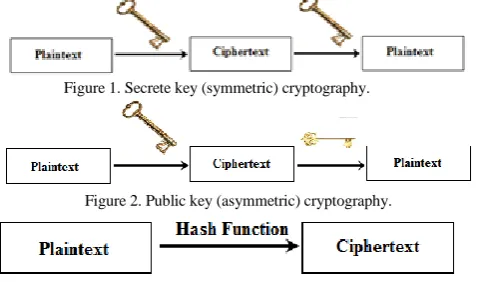
The cryptographic algorithms classified by several ways. Depending on the number of keys are occupied for encryption as well as decryption, they are classified, and further describe by their application, there are three types of algorithms’ which are
1. Secret Key Cryptography (SKC)
In this algorithm for both encryption and decryption uses a single key. Ex. Advanced Encryption Standard (AES), Data Encryption Standard (DES) .
2. Public Key Cryptography (PKC)
In this algorithm, uses different keys for encryption and decryption. Ex. RSA (Rivest, Shamir, Adleman) algorithm.
3. Hash Functions:
To irreversibly "encrypt" information uses a mathematical transformation. Ex. MD (Message Digest) algorithm.
Figure 1. Secrete key (symmetric) cryptography.
Figure 2. Public key (asymmetric) cryptography.
Figure 3. Hash Function (One way cryptography)
B. RGB Color Format:
possible values. 16 777 216 (256^ 3 or 2^24) various combinations of intensity and hue can be specified with this system.
III.PROPOSED ALGORITHM
In the existing techniques there is the use of prime number and like for involving keys. Then the further step ahead in that we use Whole numbers and colors. For surety of information security, we also use a merging of permutation and substitution methods.
A. System Architecture:
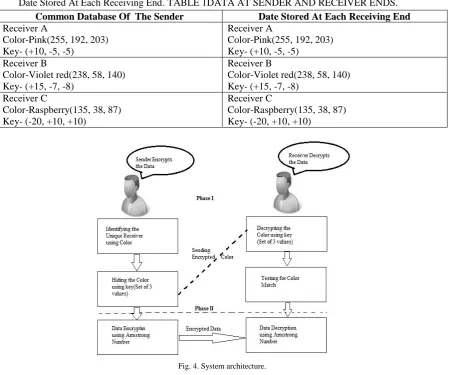
We assign the ASCII equivalent to the characters, this is the substitution process. Using matrices and Whole number the permutation process is complete. The first step of this technique is to appoint a different color for each and every receiver. Set of three values are represented with each color. For example in RGB format as (238, 58,140) is represented by violet red color. In the next step a set of three key values assign to each receiver.
Common Database of the Sender.
Date Stored At Each Receiving End. TABLE 1DATA AT SENDER AND RECEIVER ENDS.
Common Database Of The Sender Date Stored At Each Receiving End
Receiver A
Color-Pink(255, 192, 203) Key- (+10, -5, -5)
Receiver A
Color-Pink(255, 192, 203) Key- (+10, -5, -5)
Receiver B
Color-Violet red(238, 58, 140) Key- (+15, -7, -8)
Receiver B
Color-Violet red(238, 58, 140) Key- (+15, -7, -8)
Receiver C
Color-Raspberry(135, 38, 87) Key- (-20, +10, +10)
Receiver C
Color-Raspberry(135, 38, 87) Key- (-20, +10, +10)
Fig. 4. System architecture.
The sender is known about the required receiver. So that as a password use the receiver’s unique color. The original color values are added with the set of three key values and then encrypted at the sender’s side. Then as a password use this encrypted color. Then using Whole numbers actual data is encrypted.
matched with the color which is stored at the sender’s database. The certain information decrypted with the help of Whole numbers only when the colors are matched. For surety of maximum security to the information providing, for authentication usage of colors as a password. This is because the actual data could be accessed after matching the colors at sender and receiver’s side with each other.
B. Illustration:
i. Encryption: Assume that the information has to be sent to a receiver (say A) which the color (120, 35, 20) is assigned. Let with this color value the key value (10,3,4 ) to be added. And let the Whole number 153 be used for data encryption.
Step 1: (Password creation)Initially the sender knows about the required receiver which is to be A. So that the some color values are appoint for receiver A, and the key values are added.
120 35 20 +10 3 4
--- 130 38 24 Now for security check, a newly encrypted color is designed. Step 2: (Actual data Encryption)
Let the transmitted message be “SECURITYTECH”. Then find ASCII equivalent values of the above all characters.
S E C U R I T Y T E C H 83 69 67 85 82 73 84 89 84 69 67 72
Step 3: Now perform addition of the digits of the Whole number with these numbers as follows: 83 69 67 85 82 73 84 89 84 69 67 72
(+) 3 7 1 9 49 1 27 343 1 3 7 1 ---
86 76 68 94 131 74 111 432 85 72 74 73 Step 4: Then, convert the above data into a matrix form as follows:
A=
86
94
111
72
76 131
492
74
68
74
85
73
Step 5: Now, consider an encoding matrix. B =
3
7
1
9
49
1
27
343
1
Step 6: Then, perform multiplication of two matrices (B X A) we get:
𝐶 =
858
1273
3442
807
4566
7339
22252
4347
28458
47545
151258
27399
After multiplication, we get encrypted data which
is,858,4566,28458,1273,7339,47545,3442,22252,151258,807,4347,27399. The above values are the encrypted mode of original information.
ii. Decryption: The process retake original information back using decryption key is the decryption. Then sender’s end data is matched with the data which is given by the receiver (the color). The receiver must be aware of the key values and his own color being assigned for this process.
Step 1: (The receiver Authentication)
The actual color being assigned is (120,35,20) for the receiver A (as assumed), the original color can get back by subtracting the key values from the color value.The decryption process is as follow:
-10 3 4 values of key --- 120 35 20.
The data stored at the sender’s side, the above set of values (135, 38, 87) is compared. The original data can get back by performing following steps, only when they both match.
Step 2:(Original data Decryption) Take the inverse of the encoding matrix: D=B-1
D =
−7/24
1/3
−1/24
1
56
−1/42
1/168
7/4
−5/6
1/12
Step 3: Now perform multiplication of decoding matrix and the encrypted data matrix i. e. (D X C), we get: DXC=
86
94
111
72
76
131
492
74
68
74
85
73
Step 4: Then the above result transform as given below:
86 76 68 94 131 74 111 432 85 72 74 73 Step 5: Now, Subtract Whole numbers from the digits as follows:
86 76 68 94 131 74 111 432 85 72 74 73 (-) 3 7 1 9 49 1 27 343 1 3 7 1 ---
83 69 67 85 82 73 84 89 84 69 67 72 Step 6: From the above ASCII equivalent obtain the characters:
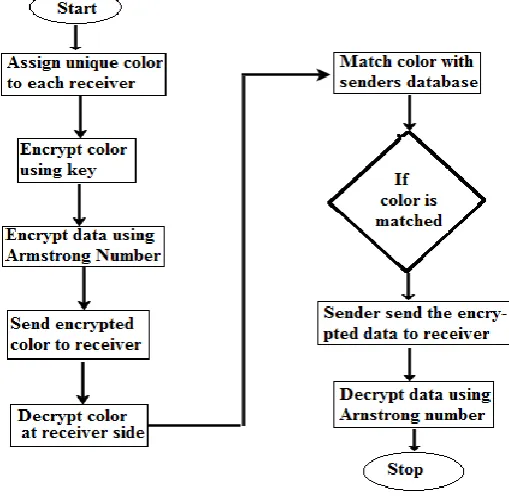
C. Flowchart of proposed system:
D.
Fig. 5. System Flowchart
E. Advantages
The above technique requires the minimum 8 bits of length key for Whole numbers. The efforts taken to encrypt the data are reduces this minimum key length. If needed the key length can be increased, with increase in the length of character. So that the complexity increases and hence, security gets increases.
This technique gives the surety that the data can be transfer with the protection since it consist of two main steps. First step is that, the character convert into another form after addition of it with the Whole numbers. In the second step, to form the required encrypted data, encode by using a matrix.
With this technique, tracing process becomes difficult. Because in each step the Whole number is used differently. If the total steps associated with the encoding process is known previous, then only key can be hacked.
We use three different keys which are key values added with the colors, Whole numbers and the colors, so that this technique could be treated as a kind of triple DES algorithm.
Until all the process of encryption and decryption as well as key values is not known the data cannot be obtained. So because of the usage of colors, hacking becomes difficult.
Encoding and decoding of the actual data involve by simple encryption and decryption techniques. But in this proposed technique for giving maximum security for original data access, the password itself is encoded.
IV.SYSTEM METHODOLOGY
A. Mathematical Models:
i) Formal assertion of validity: Set (V)={v0,v1,v2,v3}
ii) Colors and Whole number based encryption: Set(C)={c0,c1,c2,c3}
c0-The sender choose unique color value for each and every receiver. c1-Assign a set of three key values to each receiver.
c2-Three key values are added to the original color values and encrypted at the sender’s side c3-Encrypt files using Whole numbers
iii) Message transmission: Set(M)={c0,c1,c2,c3,m0} m0-send message to the Receiver iv) Confirmatory evidence:
Set(E)={e0,e1,e2,e3}
e0-The encrypted color from the sender is decrypted by subtracting the key values from thereceived set of color values.
e1-Tested for a match with the color stored at the sender’s database.
e2-If colors are matched the actual data can be decrypted using Whole numbers. e3-Usage of colors as a password
v) Decryption:
Set(D)={d0,d1,d2,d3}
d0-inverse of the encoding matrix
d1-Multiply the decoding matrix with the encrypted data d2Subtract with the digits of the Whole numbers d3=Obtain the characters from the above ASCII equivalent.
V. EXPERIMENTALRESULTS
Table 2: Comparison of Existing and Proposed System
Existing System Proposed System
Whole number was used as a key Color is used as a key Diffie-Hellman key exchange algorithm involves
expensive exponential operations.
Using colors and Whole number the system is lass expensive
Less Secure. More Secure
The speed of execution is slow The speed of execution is fast
VI. RESULTS
Figure 6 Text of file before encryption
Figure7 Generation of key from color pixel
In this, there uses color and Whole number for encrypt data at sender side. For that, first the image taken to generate the key. After the key generation the RGB values taken from selected color. Then that RGB values and key values are added to generate the secrete key. Then this secrete key send to the receiver. After that take the data which will have to send to the receiver. By using Whole number that data will be encrypted. And generate the output as follows:
Fig. 8 Text of input image after encryption
VII. CONCLUSIONS AND FUTURE WORK
The In military, the above combination of public key and secrete key cryptography can be applied because, more importance is for security of data. When the length of the key of the Whole numbers increase, then this technique provides more security. Thus by the use Whole numbers, additional set of key values and colors in this technique there is surety that the data is deliver securely and that only authorized peoples can access it .The limitation with proposed system if we select the number containing zero then result produced is not proper. As a future scope we will work to remove this limitations.
REFERENCES
[1] S. PavithraDeepa,S. Kannimuthu, V. Keerthika., “Security Using Colors and Whole Numbers”, Proceedings of the National Conference on Innovations in Emerging Technology-2011. India.17 & 18 February, 2011.pp.157-160.
[2] Gordon L. Miller and Mary T. Whalen, “Whole Numbers”, University of Wisconsin, Stevens Point, WI 54481 (Submitted October 1990). [3] S.Belose, M.Malekar ,G.Dharmawat, “Data Security Using Whole Numbers”, International Journal of Emerging Technology and Advanced
Engineering. Website: www.ijetae.com (ISSN 2250-2459, Volume 2, Issue 4, April 2012). [4] M.F.Whole “A brief introduction to Whole Numbers” .
[5] Chavan Satish, Lokhande Yogesh, Shinde Pravin, Yewale Sandeep, Sardeshpande S. A, “Secure Email using Colors and Whole Numbers over web services”, International Journal Of Research In Computer Engineering And Information Technology VOLUME 1 No. 2.
[6] M.Renuga Devi, S.Christobel Diana, “Enhancing Security in Message Passing Between Sender and Receiver Using Colors and Whole Numbers”, International Conference on Computing and Control Engineering(ICCCE 2012), 12 & 13 April, 2012
[7] G.Ananthlakshmi, S.Ramamoorthy “A Multilevel Encryption Scheme for Secure Network Data Transfer”. International Conference on Computing and Control Engineering (ICCCE 2012), 12 & 13 April, 2012.
[8] AtulKahate, “Cryptography and Network Security”, Tata McGraw Hill Publications [9] http://aix1.uottawa.ca/~jkhoury/cryptography.htm
[10] http://mathworld.wolfram.com/UnimodularMatrix.html
BIOGRAPHY