University of Windsor University of Windsor
Scholarship at UWindsor
Scholarship at UWindsor
Electronic Theses and Dissertations Theses, Dissertations, and Major Papers
2009
Improved web page traverse using genetic algorithm
Improved web page traverse using genetic algorithm
Man Li
University of Windsor
Follow this and additional works at: https://scholar.uwindsor.ca/etd
Recommended Citation Recommended Citation
Li, Man, "Improved web page traverse using genetic algorithm" (2009). Electronic Theses and Dissertations. 8076.
https://scholar.uwindsor.ca/etd/8076
NOTE TO USERS
This reproduction is the best copy available.
Improved Web Page Traverse Using Genetic
Algorithm
by
Man Li
A Thesis
Submitted to the Faculty of Graduate Studies
through Computer Science
in Partial Fulfillment of the Requirements for
the Degree of Master of Applied Science at the
University of Windsor
Windsor, Ontario, Canada
1*1
Library and Archives CanadaPublished Heritage Branch
395 Wellington Street Ottawa ON K1A 0N4 Canada
Bibliotheque et Archives Canada
Direction du
Patrimoine de I'edition
395, rue Wellington OttawaONK1A0N4 Canada
Your file Vote reference ISBN: 978-0-494-57565-9 Our file Notre reference ISBN: 978-0-494-57565-9
NOTICE: AVIS:
The author has granted a
non-exclusive license allowing Library and Archives Canada to reproduce, publish, archive, preserve, conserve, communicate to the public by
telecommunication or on the Internet, loan, distribute and sell theses
worldwide, for commercial or non-commercial purposes, in microform, paper, electronic and/or any other formats.
L'auteur a accorde une licence non exclusive permettant a la Bibliotheque et Archives Canada de reproduire, publier, archiver, sauvegarder, conserver, transmettre au public par telecommunication ou par Nnternet, prefer, distribuer et vendre des theses partout dans le monde, a des fins commerciales ou autres, sur support microforme, papier, electronique et/ou autres formats.
The author retains copyright ownership and moral rights in this thesis. Neither the thesis nor substantial extracts from it may be printed or otherwise reproduced without the author's permission.
L'auteur conserve la propriete du droit d'auteur et des droits moraux qui protege cette these. Ni la these ni des extraits substantiels de celle-ci ne doivent etre im primes ou autrement reproduits sans son autorisation.
In compliance with the Canadian Privacy Act some supporting forms may have been removed from this thesis.
Conformement a la loi canadienne sur la protection de la vie privee, quelques
formulaires secondaires ont ete enleves de cette these.
While these forms may be included in the document page count, their removal does not represent any loss of content from the thesis.
Bien que ces formulaires aient inclus dans la pagination, il n'y aura aucun contenu manquant.
AUTHOR'S DECLARATION OF ORIGINALITY
I hereby certify that I am the sole author of this thesis and that no part of this thesis has
been published or submitted for publication.
I certify that, to the best of my knowledge, my thesis does not infringe upon anyone's
copyright nor violate any proprietary rights and that any ideas, techniques, quotations, or
any other material from the work of other people included in my thesis, published or
otherwise, are fully acknowledged in accordance with the standard referencing practices.
Furthermore, to the extent that I have included copyrighted material that surpasses the
bounds of fair dealing within the meaning of the Canada Copyright Act, I certify that 1
have obtained a written permission from the copyright owner(s) to include such
material(s) in my thesis and have included copies of such copyright clearances to my
appendix.
I declare that this is a true copy of my thesis, including any final revisions, as approved
by my thesis committee and the Graduate Studies office, and that this thesis has not been
submitted for a higher degree to any other University or Institution.
ABSTRACT
Correct navigational behavior of a web application is essential to its reliability. An
effective means to improving our confidence in the correct behavior of a web application
is to test it by exploring the possible navigation among the web pages at the client side:
The tester carries out the testing by consecutively clicking the hyperlinks along with
some possible search parameters and checking whether the returned web pages are as
expected. Traditional conformance testing techniques based on graph can be adopted in
this setting to automatically generate suitable test sequences to traverse among client
pages. In this thesis, we present an improvement on T-method for test sequence
generation to reduce considerably its length by making use of a genetic algorithm. Our
experiments show a 34%-68% saving on the test sequence lengths compared to the direct
application of T-method.
ACKNOWLEDGEMENTS
I would like to thank my supervisor, Dr. Jessica Chen, for her great ideas, invaluable
guidance and enthusiastic encouragement. Without her help, the work presented here
would not have been possible. Sincere thanks to Dr. Xiaobu Yuan, Dr. Kevin W. Li and
Dr. Dan Wu for their precious time and ardent assistance in the development of this
thesis.
Additional thanks to Dr. Lihua Duan for her contributions and assistance.
Finally, special thanks to my parents Zhigang Li and Xiangli Hu, my husband Kui jiao.
Thank you for putting up with my difficult times and for understanding and endless
TABLE OF CONTENTS
AUTHOR'S DECLARATION OF ORIGINALITY iii
ABSTRACT iv
DEDICATION v
ACKNOWLEDGEMENTS vi
LIST OF TABLES x
LIST OF FIGURES xii
1. INTRODUCTION AND PROBLEM DESCRIPTION 1
2. REVIEW OF LITERATURE AND BACKGROUND 10
2.1 RELATED WORK 10
2.1.1 WEB APPLICATION VERIFICATION MODELS 11
2.1.2 TESTING MODELS ON WEB APPLICATION 11
2.1.3 SUMMARY 14
2.2 BACKGROUND 15
2.2.1 URL 16
2.2.2 SERVER PAGE, STATIC PAGE AND CLIENT PAGE 17
2.2.3 SESSION AND COOKIE 18
2.2.4 HYPERLINK AND DYNAMIC HYPERLINK 19
2.2.5 THE PROPERTIES OF A CLIENT PAGE 19
2.2.6 ARCHITECTURE OF WEB APPLICATION 21
2.2.7 HISTORY STACK 22
2.2.8 USING BACK BUTTON 22
3. MODELING WEB APPLICATIONS WITH GRAPHS 26
4. IMPLEMENTATION 41
4.1 THE IMPLEMENTATION OF THE CPP ALGORITHM 41
4.2 THE IMPLEMENTATION OF THE GENETIC ALGORITHM 43
4.2.1 DESCRIPTION OF GA 43
4.2.2 CHROMOSOME AND GENOME 46
4.2.3 ENCODING 46
4.2.4 CROSSOVER 47
4.2.5 MUTATION 49
4.2.6 FITNESS FUNCTION 52
4.2.7 THE ALGORITHM 52
5. METHOD EVALUATION 58
5.1 The NUMBER OF BACK EDGES 59
5.2 SIZE OF G 60
5.3 DIAMETER OF G 62
5.4 RATIO OF COOKIE-AFFECTING TRANSTION IN G 64
5.5 SPECIAL CASE 66
6. CONCLUSIONS AND RECOMMENDATIONS 69
APPENDICES 71
LIST OF TABLES
Table 3.1 explanations of the symbols 35
LIST OF FIGURES
Figure 1.1 the website of the eBay 4
Figure 1.2 the graph of part of the website of eBay 8
Figure 2.1 an example of a client page 20
Figure 2.2 the structure of web applications 21
Figure 2.3 history stack operation 23
Figure 3.1 some client page of the website of YahooTravel 30
Figure 3.2 an example graph for the cheap airfare search engine 34
Figure 3.3 an example to show how to use the back button 39
Figure 4.1 an example of the CPP 43
Figure 4.2 block diagram of basic GA cycle 44
Figure 4.3 crossover rule 49
Figure 4.4 mutation rule 50
Figure 4.5 (a) no mutually exclusion 51
Figure 4.5 (b) mutually exclusion 51
Figure 5.1 an illustration of the changes of the lengths of the test sequences according to
the number of back edges of G 60
Figure 5.2 (a) the changes of the lengths of the test sequences according to the increase of
the size of G 61
Figure 5.2 (b) the time changes with the lengths of the test sequences according to the
increase of the size of G 61
Fiugre 5.3 (a) the changes of the lengths of the test sequences according to the increase of
Fiugre 5.3 (b) the time changes with the lengths of the test sequences according to the
increase ofthe diameter of G 63
Fiugre 5.4 (a) the change of lengths of the test sequences according to the ratio of the
privilege transitions 64
Fiugre 5. 4 (b) the time changes according to the ratio ofthe privilege transitions 65
Figure 5.5.1 a special case ofthe changes ofthe lengths ofthe test sequences according to
the increase of the size of G 67
Figure 5.5.2 a special case ofthe changes ofthe lengths ofthe test sequences according to
CHAPTER I
INTRODUCTION AND PROBLEM DESCRIPTION
With the rapid advancement of networking and web technology, more and more
information is being posted into and retrieved from the Web. Web systems are becoming
the primary device for information sharing and retrieval. Some of them now play so
important roles that they have been applied to all major areas. An exiguous mistake in an
online store system may put thousands of people around the world in trouble and lead a
business company to millions of dollars of income loss. Assuring the web system quality
and reliability has become one of our major concerns. The quality of features and
characteristics of a product or services determines its ability to meet stated or implied
needs, and reliability is a measure of success on how the observed behavior of a system
conforms to its specifications. They both directly affect the quality of our daily life.
The existing rigorous software engineering methods and techniques can greatly improve
the quality of the software product. As we place very high expectations on software
engineering methods and techniques to this important application domain to achieve
better effectiveness and higher efficiency, we have great interests in enhanced techniques
for reliability control of web applications. As software testing has been well recognized
as an essential part of software development techniques to gain confidence in the
reliability of the software product, we discuss issues in conducting software testing on
The correct navigational behavior is a key measurement of the reliability of web
applications. That is, starting from any accessible client page (i.e. a web page displayed
to the clients via web browsers), by clicking on any available hyperlink together with any
possible input data as search parameters, the users should always access the correct
information including both the text and the available hyperlinks on the displayed client
page. To assure the correct navigational behavior of a web application is a non-trivial
task due to the emergence of more and more complex web applications. Although a
simple personal homepage may only consist of a small set of static web pages, a
complicated commercial web application like an online-store system has to handle
various kinds of transaction requests from millions of clients worldwide. One of the
possibilities of checking the correct navigational behavior is to conduct conformance
testing: to test the web application, viewed as Implementation Under Test (IUT), from the
client side by browsing the client pages. Of course, here we need to assume the correct
functionality of the web browser we use during the test procedure, just like we assume
that the operating system is functioning well.
We also assume that the expected navigational behavior of the IUT is available in terms
of a deterministic Finite State Machine (FSM) [10]. An FSM is a 5-tuple
M = (I,0,S,S,A,), where / , O and S are finite and nonempty sets of input symbols,
output symbols and states, respectively. 5 :SxI -» S is the state transition function and
X: S x / -» O is the output function. Here we use each state to represent a client page
and each transition to represent a possible transformation from one client page to another.
generated by the server page associated with the triggered hyperlink forms the output of
the transition.
Problem description: A test sequence is generated from the specification FSM. In general,
we apply a test sequence that satisfies a certain test criterion to the implementation to
check its correctness by comparing the actual output sequence with the expected one.
Based on the test purpose, a test criterion can be used to generate a test sequence to check,
for example, the correctness of the output, the start or the end states of each transition of
the implementation FSM triggered by a specific input. In the following, we adopt the
well-known transition coverage criterion, i.e., to test each transition at least once. Very
often, we apply results in graph theory to the specification FSM to generate a test
sequence because an FSM can be viewed as a directed graph G = (V, E) where V is a
finite set of vertices and E is a finite set of edges. Each vertex stands for a state of the
FSM and an edge represents a transition. Given a directed graph representing a
specification FSM, we can use an algorithm to resolve the Chinese Postman Problem
(CPP) [9] to generate a test sequence. The CPP is to find a least-cost walk to travel all
edges in a directed graph.
We use part of the website of eBay as a simple example to show how to model a web
application in terms of directed graph. People can enter the home pages of all categories
from the homepage of the eBay to find out more detailed information about each category.
Figure 1.1(a) shows the homepage Px of the website that provides hyperlinks to all
for the list of the books. Figure 1.1(b) shows web page P2 that lists the hyperlinks to
categories where hyperlinksL2, L3 and L4 refer to the homepages of antiques genus,
collectibles genus and eBay separately. Figure 1.1(c) shows web page P3 which is the
home page of the antiques genus. Here hyperlinks i5and L6 refer to the home page of
the eBay and the web page that lists the hyperlinks to all the categories respectively.
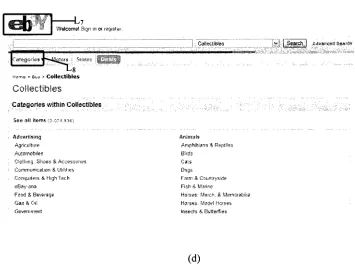
Figure 1.1(d) shows web page P4 which is the home page of the collectibles genus
where hyperlinks Ln and Zg link to the home page of the eBay and the web page that
lists the hyperlinks to all the categories respectively.
I j'A
€2y
Welcome! Sign In or registeri All Categories
; Caterings" | fctoksrs ; Mut*, l,uC'J*"
Love tfeep discounts ami free shipping? Check cut the Dally Deal.
Cool itirtf tor y « i
DAILY DEAL
A J
HEWBsvns Sabre SI...
$27.99
MSRF 3?S.3?
sftjjpiMbr
APPit Poe 1GS S t . . .
$29.99
M S * P 5*900
s ^ i M w
Ss*<raJ!*-:l»Jyveal3
::WMcor«eto «8#y',.,-• /
Welcome
Buy ; Self: Ky eBay j Community Help
Contact us | Site Map
v ' J Search 1 Advanced Searcft
N e w t o ^Say? *•
frig&tXim H *s5t and ^ee
Wan! great buy*? C&sck i t e e out
FEELTHE LOVE
, Rcs<ihtiim &3»#.cr
^ J ^ f
-u
Welcome! Si j i in or register
' . T * » Ei.., •* Alt Categories
All Categories
J ' J X S * I ^ $ p ,S«H :.My eBay . Community
U SeaitMtiles & descriptions
Browse Cgtegortes
Caiegoiy Fo . All Categories ^ Al
S Show number of (tans in category
Items ! v j : All Actae
C Show category numbers
Location v Available on. eBay.com
I Antiques i21247If
Aichileciaiai & Garden (14135) ftsign Antiques (29497) Books & Manuscripts (3238) DBCwafeveArts (33M7) Etlinffisasriic (47721 Furniture (14184) Noma & Hearth (851) Linens STexiitssiPie-1930'; (87131 Maps Atlases & Globes (10366)
KolHxtfcles (2083284) I - - w ^ B s m i i t 1 3 3 Q u 7 }
Ararrate t97493i
Animation Aft ft-ffiffgcters; {82533) Arcade. Jukeboxss & Flnbali (10010) Autographs (7795}
Banks. Registers & Vending (57731 BanwwMMHM
Beads (1340} Bottles & Instates {147795
U Jewelry 8 Watches (1830474) Children's JesieliY (11257) Designer SrsiKJs (37623) Engagement & Wedding (74013) EUBK. Recronta > Tribal {39W0) Fashion Jwraliv (7363611 Finedaweiiv (98735) H3ndcrrted. Artisan Jeselrv (58335) Jewelry Boxes. Cases Si Display (22798) Jewelry Design & Repair (54615) LcoseS SJ160552)
(b)
iPltl ^saSsJjJf
1 Cafe y J * ,
Homs > Bo ..; * T •'•' \^t>
•' Welcome!
i A n t t q B e s
Antiques
^Caisgerirf s &tthWM$q
l See all items (ass,*?!)
= Antiquities
Ths America? : Byzantine
Ce&c • Egyptian ; Fsr Essiern
i Grsek : Ho»yUrjd
islamic Near Esst *ro
" n i l i
JECV
ut$
- Of C5
K1 Me*
•'»
Antiques
Architectural & Garden
Banisters Barn Doors
Beams Ceiling !ms
Chandeliers. Fixtures, Sccnces
Columns & P&sts
Corbels Doors
Fms\s
Wmffk S e l l; My eBay Community; Heip ;
SM.9. Map
f..:iearch|::;^dvEr!tsd 3*s'di
Opt o u t of t h e new search experience
PMTiQlif.il
43[| u
L7Welcome! Sign in 01 rsgistgi
| "m' "u u l m\ v ' ' : • •
^ L g ' " i-uvrvs > euv > Collectibles
Collectibles
Cst^rl®® w$itn ColtectlbI$tii
- See ait items tz.o-t.nm)
•. Advertising
Automobiles
CioUitfic). Sho«s & Acesssorfa-s C&rmTHjnk;aUon & Utrtitos
Ct?mf;(fl*?fs & High Tech
FQOG & Beverage
Gas & Oil Govern men!
Animals
Amphibians %> Rs&tUss
Birds Gats Dogs
farm & Crjunuysirie Fish & Marine
Horsss- Msrch. & MsmGrabiisa
Mors^S. M K & ! Hfirses insects & Butterflies
i ^ I ' l J . - ^ ^ y A^accs^stsfcK
(d)
Figure 1. 1 the website of the eBay
Figure 1.2 shows the directed graph of the above selected part of the website. Web page
Pi, P2, P3 and P4 are represented by vertexes Vi, V2, V3 and V4 respectively. The
transitions ti, ti, ts, tj, /$, to, tymd h represent eight different navigations in the web site
triggered by clicking on hyperlinks Li, L2, L3, L4, L5, Lc„ Lj and Ls in the vertexes V], V2,
F^and V4 respectively.
There are two major tasks in graph-based conformance testing: one is to generate an
input/output sequence, called test sequence, that is both effective in terms of fault
detestability and efficiency in terms of its length; the other is to apply automatically the
the expected one. Here we focus on the former problem of generating an efficient test
sequence which represents a traversal among client side web pages.
There are several methods proposed in the literature for test sequence generation,
typically known as T-method [23], U-method [1, 22, 28], W-method [7] and D-method
[11, 14, 33]. For testing web navigation, however, they all converge to the simplest one:
the T-method, with the test criterion to require that each transition in the given FSM be
traversed at least once in the generated path of the test sequence.
In the above example, a generated test sequence is ii/oi, {3/03, h/ 07, ii/oi, {3/03, Ul 04, \5I05,
\%lo%, i 1 /o 1, is/os, i6/06, i2/02,and its length is 12.
Proposed solution: In regard to efficient test sequences in terms of their lengths, we show
in this paper that by making use of the functionality of the web browsers, we can generate
test sequences more efficiently than those generated from the T-method. We present an
algorithm to considerably reduce the test sequence length based on some assumptions by
using the backward and forward button provided by the web browsers as an auxiliary
means to transfer among client pages.
In the above example, suppose that we take into consideration the behavior of the
backward button provided by the browser. A test sequence could be \\lo\, hlo?,, hi 07,
Figure 1. 2 the graph of part of the website of eBay
The above example is illustrative so the reduction on the test sequence length is not
significant. In reality, if we can make use of the behavior of backward button and forward
button to generate a test sequence, the test sequence could be reduced significantly. We
apply genetic algorithm to provide a solution of generating efficient test sequences.
In [8], a network-flow algorithm was applied to generate efficient test sequences using
back button. Sessions and cookies however are not allowed in the applications. In the
present work we do consider sessions and cookies and their effect on the algorithm. In the
special cases when sessions and cookies are not present, we have also carried out
experiment to compare the lengths of the generated test sequence by using our proposed
The soundness of our algorithm is provided. The saving on the test sequence length
compared to the one generated by CPP however depends on the graph structure and thus
it is hard to be theoretically calculated. In this regard, we have carried out various kinds
of experiments and we present our result together with our analysis on the quantity of the
reduction of test sequence lengths according to various factors.
The rest of the thesis is organized as follows. We first introduce some notational
background related to web applications in Chapter 2. Then we show how to model web
applications in terms of graphs in Chapter 3. We discuss the major issues in the
implementation of the existing algorithms related to our work in Chapter 4. This is
followed by our experimental results in Chapter 5 which demonstrates the significant
reduction of test sequence length generated by our proposed method. Related work is
CHAPTER II
REVIEW OF LITERATURE AND BACKGROUND
2.1 RELATED WORK
In the last decade, there are various types of generic testing techniques explored.
According to the testing methodology, there are white-box testing, black-box testing etc.
Most of them can be used for testing web applications with proper adaptation. Some
general discussions can be found in [19].
For white-box testing, a typical approach is to conduct data flow analysis on the source
code of the server pages and generate proper test suites satisfying certain test selection
criteria. A comprehensive survey on various test selection criteria on data flow testing
proposed in the literature can be found in [36], and how to apply data flow analysis to
testing web applications is discussed in [18].
Along the black-box testing approach, no information about the source code of the server
pages is available: all what we can do with the implementation is to execute it.
Depending on whether the expected behavior is available or not, different research
2.1.1 WEB APPLICATION VERIFICATION MODELS
Sciascio et al. [29, 30] presents how to verify a web application with Symbolic Model
Verifier (NuSMV) and Computation tree logic (CTL). NuSMV is an updated version of
the SMV symbolic model checker. CTL is a branching-time temporal logic. The model of
a web application is a web graph, which consists of nodes and arcs. In a web graph, nodes
include pages, links, and windows, and the arcs connect the nodes. The browsing from
one page to another following a hyperlink includes at least three nodes and two arcs. The
first arc connects the start page to one of its hyperlinks, and the second connects the
hyperlink to the destination page. All the requirement properties are written in CTL
formulas. A symbolic model verifier, NuSMV, is applied after the web application model
and requirement properties are ready. The final results and counter examples are reported.
In order to make it easy to use model checking tool, a series of patterns are developed.
2.1.2 TESTING MODELS ON WEB APPLICATION
When the expected behavior is unknown, we can first retrieve the design or test cases
from the implementation via reverse engineering techniques. Ricca and Tonella [26, 27]
proposed testing strategy on web site analysis through web browser. A tool called Re Web
is developed to gather all web pages and their relations within one web site, and a
UML-based model for the web site is constructed by this ReWeb. A testing tool,
TestWeb, is responsible for testing the UML web application model. The authors
considered white-box testing on a web application. The testing is mainly concentrated on
generate test cases, and the generation is based on a reduced graph by removing static
web pages without forms in a navigation paths. VeriWeb is designed to explore client
pages while performing testing at the same time. The derived test cases are then reused
for regression testing.
Kung, Liu and Hsia [16] use an ORD (Object Relation Diagram) based web application
testing model (WTM) for testing web applications. A WTM model of a web application
is created by reverse engineering on the source documents it. The testing work is divided
into three parts: object perspective, behavior perspective and structure perspective. Each
part is tested separately. The object perspective of the WTM describes the class structures
of a web application including request, response, navigation and redirection. The
behavior perspective of the WTM focuses on page navigation, and page navigation
diagram (PND) derived from ORD is employed. Finally a navigation tree started from the
home page is constructed and the testing of the navigation behavior is based on this PND.
The structure perspective of the WTM is related to control flow and data flow
information of a web application. Block branch diagram (BBD) and function cluster
diagrams (FCD) are used respectively for describing control flow and data flow.
Lucca and Penta [20] proposed a base-line testing strategy that creates a testing model by
adding browser statechart to a series of pages with inter-related hyperlinks. [20]
considered the influence of web browser's behaviors on a web application. Each web
buttons can force the browser to display the previously visited page or refresh the current
web page with the same URL. In order to test a web application with browser's behavior,
a statechart of back and forward buttons is constructed with four states, BDFD (Back
Disable, Forward Disable), BEFD (Back Enable, Forward Disable), BEFE (Back Enable,
Forward Enable) and BDFE (Back Disable, Forward Enable). For each navigation path,
e.g. a base line, the testing model is a navigation tree generated by adding the statechart
of browser's behavior. The root of the tree is the home page of the web application, and
each path of the tree is tested separately.
Graunke et al. adopted ^.-Calculus to model web form related web applications in [12].
Each web application in this model is divided into a single server and a single client. The
server contains a table that maps the requested URL to a process program. A client
consists of a current form web page, and all previously visited web pages. Each form
contains variables and the URL that the form data will be sent to. A set of rules is defined
that regulates the transitions from one page to another.
Beek and Mauw [3] used labelled transitions systems to model web applications and the
conformance testing is applied to this model. An MRRTS (Multi Request-Response
Transition Systems), in which request is considered as input and response as output, is
used. With this model, the navigation behaviour of a web application are modeled as
2.1.3 SUMMARY
When the expected behavior of a web application is available in terms of graph, our
major task is to generate a test sequence from it. Due to the problem of limited resource
to carry out software testing, much of our effort has been put on reducing the length of
the generated test sequence. This can be accomplished in two ways: one is to
divide-and-conquer, and another is to search for optimal solution for the minimal-length
test sequence. Discussion on the former issue can be found in [2], where the authors
proposed a hierarchical approach to model and test potentially large web applications.
Our approach to checking the correct navigational behavior of a web application falls into
the latter category.
Of course, the specification of the expected behavior of a web application is not restricted
to FSMs: it can take any format according to various test purposes. Chang and Hon [4]
proposed a mechanism to generate test suit based on statistical usage model of the web
applications for link validation. An agent-based framework to automatically generate and
coordinate test agents proposed by Qi, Kung, and Wong [25] is based on
Belief-Desire-Intention model. Lee and Offutt [17, 35] used mutation testing techniques
to generate test cases from XML-based documents.
Most of the test procedure can be carried out either on the server side or on the client side.
For the latter, there must be a web browser involved. A web browser introduces
complicates the original model of the web applications. At the same time, we will show
in this thesis, that this new feature can also be well used to achieve better solution
towards test sequence reduction.
Lucca and Penta [20] considered that the browser behavior has influences on the
navigation behavior of a web application. According to our analysis on web browser,
although Lucca and Penta proposed a testing method considering browser behavior, the
browser model they used is not sufficient to describe the real browsers we use. It is
necessary to consider the browser cache and history stack on testing a web application.
Duan and Wang [8] presented a network flow algorithm to solve the NP-hard problem of
generating a minimal-length test sequence of hyperlink validation by making use of the
back button provided by the web browsers. The present thesis work also applies back
button feature of web browsers to reduce the length of the generated test sequence. While
[8] does not consider the presence of cookies and sessions, the present work does. Thus,
we are providing a more general solution.
2.2 BACKGROUND
In this part, we introduce some related concepts on web applications, such as the
architecture of web applications, URLs, web servers and dynamic hyperlinks. This is
2.2.1 URL
URL stands for Universal Resource Locator. It is used to locate any resources in the
Internet. URL typically consists of a URL scheme, an authority, and a path. An URL
scheme indicates a category of resources, such as http, https, and ftp. The authority
typically consists of the name or IP address of a server and the port number. A path is to
show the relative path of the resource inside the host server in the Internet. The format of
an HTTP URL is often parameterized as: http://<host>: <port>/<path>? <request
parameters>. Here "http://" indicates the resource type is http, and the communication
protocol used to send this request is HTTP. <host> is the web server's IP address. It
identifies a unique web server in the Internet address. <port> is the port number that the
web server uses for HTTP communication. <path> specifies the relative storage position
of the request resource. <request parameters> consists of request parameters a client
passes to the web server. The request parameters can come from the input of the client
and the cookies/sessions. These parameters could be used to compute and generate a
client page. For example, http://www.baidu.com/search?ie=gb2312 shows the basic
elements of a URL. "http://" indicates the resource type is HTTP, "www.baidu.com" is
the domain name and its corresponding IP address can be resolved by querying a DNS
(Domain Name Service) server. The port number is implicit and it is 80 by default,
2.2.2 SERVER PAGE. STATIC PAGE AND CLIENT PAGE
When a web application server receives a request message that contains a URL and
cookie (if provided) information from a browser, which can be triggered by clicking on a
hyperlink or typing a URL in the address bar of the browser, it sends back the
corresponding HTML web page according to the request. We call such a corresponding
HTML web page a client page. A client page is an HTML document with embedded
scripts and is rendered by the web browser on the client side. A client page can be
generated from two different template pages: static page and server page. Static pages
have predefined page templates that are stored in a local directory of the web server. The
web server can access these static pages with their file name and file path. For a static
page request, the web server reads that HTML file, packs the file into the response
message and sends the message back to the requested web browser as a client page. A
server page can be a Common Gateway Interface (CGI) script, an Active Server Page
(ASP), a Java Server Page (JSP), or a servlet. If a server page is requested, the web server
dynamically creates a client page according to the information of the request message.
After a client page has been generated, it is packed in a response message like a client
page in the form of a static page and sent back to the requesting web browser.
Here we use the term "page" to stand for both of static and server page. Each web page
has a page ID, to uniquely identify it in the web application. In practice, a web page is
identified by its URL which includes the web server address and the relative directory.
2.2.3 SESSION AND COOKIE
Since HTTP is a stateless protocol, an HTTP server cannot recognize two different
requests from the same client. After a response has been sent to a requested browser that
issued the request, the connection is closed. The web server does not keep any
information about the client. In many cases, some sort of relationship is required between
two requests made by the same client. In order to resolve the problem, the concepts of
session and cookie are introduced into web technology.
A session is the time duration used to uninterruptedly browse client pages spent by a
certain user at a web site (application) from starting to browse the first client page to
closing the web browser. In some web applications, a session is setup after the login of a
client and closed when the client logouts. The concept of session puts a strong emphasis
on recording a certain user's state.
A cookie is a piece of small text that records identification and some related information
of a certain client. It is stored in the web browser. Once the cookie is created on the
client's side, for every further request made by the same user, the cookie is sent along
with the request message until the expiration of the cookie. Based on the cookie
technique, a web application can overcome the shortcoming of HTTP protocol by
recognizing a certain client and establishing a session between a web browser and a web
2.2.4 HYPERLINK AND DYNAMIC HYPERLINK
Normally, all pages of a web application are interconnected by hyperlinks. These
hyperlinks form the navigational behavior of the web application. A hyperlink identifies a
unique page that will be requested by a web browser. The format of a hyperlink includes
web server address, relative directory that stores the page, and file name. Here we give
each hyperlink in a certain static or server page a unique linkID which is used to identify
the link to a particular page.
According to the different information of cookies/sessions, database or request
parameters, a hyperlink could be dynamically shown on a client page. Such a hyperlink is
called a dynamic hyperlink. For example, in the online student information system of
the University of Windsor (SIS), after a current student logged into the SIS, the student
can see a hyperlink to view his/her transcript but it is impossible for a non-registered
student to see such a hyperlink after his or her login.
2.2.5 THE PROPERTIES OF A CLIENT PAGE
On abstract level, a client page can be viewed as a pair <T, H> of a set J of text symbols
and a set H of hyperlink symbols. A text symbol represents the information of the text. A
hyperlink symbol represents the existence of a hyperlink: it means that user's clicking on
Note that although the format of a hyperlink symbol and that of a hyperlink are the same,
a hyperlink symbol is however different from a hyperlink used to retrieve a client page. A
hyperlink to retrieve a client page contains host address, request parameter which may
come from cookie or input variables. A hyperlink symbol is a hypertext displayed in a
web page. It does not contain the input from the client to this page.
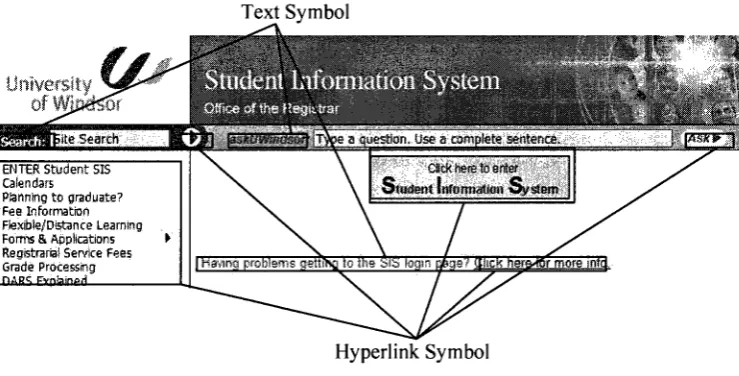
Figure 2.1 shows an example of a client page that is generated by a single server page. It
is the homepage of the student webmail system of the University of Windsor. In this
client page, the black lines point out all the text and hyperlink symbols: the pair <T, H>.
The hyperlink symbol "Sign in" cannot contain any input of the clients because the input
of the current page has not yet been given.
Text Symbol
ENTER Student SK
Calendars
Panning to graduate? Fee Information Fiexibte/Dtetance Learning Forms & Applications Registrariai Service Fees Grade Processing nABS FYfiiainpd
Hyperlink Symbol
2.2.6 ARCHITECTURE OF WEB APPLICATION
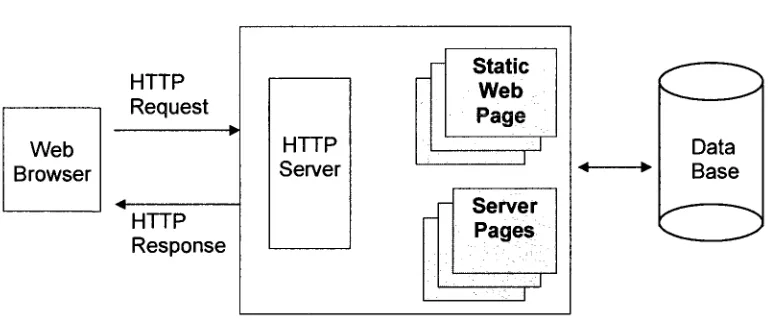
Figure 2.2 illustrates a generic architecture of web applications. A web application is an
interactive system which contains web browser, the web application server and the
database. It is a typical 3-tier model. While realizing more complicated functions, the
modern web applications have expanded from a 3-tier model to an N-tier model.
Web Browser
HTTP Request
^
HTTP Response
HTTP Server
- Static Web Page
.-i
i
- Server Pages
• • • i
i
Data Base
Figure 2.2 the structure of web applications
A web browser is a standard window application and users use it to visit a web
application by clicking hyperlinks or typing in URLs. After sending out a request
message for a client page, the browsers will receive a response message from the web
2.2.7 HISTORY STACK
A browser's history stack [11] stores the previously visited URLs, and the stack is
maintained by the browser module. Generally speaking, the history stack is a kind of
stack with similar operations as normal stacks. A history stack maintains a stack pointer,
top position and bottom position. The values of these variables determine whether a
backward or forward button can be enabled. Compared with normal stacks, the stack
pointer of the browser's history stack can be moved back and forth if more than one item
is stored in it.
When a browser starts up, its history stack is empty. The stack pointer points to nothing
and the top position and bottom position are set to a null value. At this time, the
backward and forward button are disabled. After a URL is requested and a web page is
received, the URL is pushed into the stack and the stack pointer points to the newly
inserted URL. The top position and bottom position are set to their corresponding values.
The browser's backward and forward buttons are enabled or disabled according to how
many items are stored and according to the position of stack pointer. If the stack has more
than two items and the stack pointer does not point to the first URL stored in the history
stack, the backward button is enabled. This means that there exists an item before the
current item that the stack pointer points to. At this time, a user can click the backward
button, and the stack pointer will move from current position to its previous one. The
URL stored in the position that the stack pointer points to is retrieved and sent to network
from local cache or the web server that sent the page before. The use of local cache
depends on the cache policy set in the browser or HTTP cache controls that came with
the received web page.
Similarly, the forward button is enabled when the stack has more than two items and the
stack pointer does not point to the top item in the history stack. The clicks on the forward
button can force the stack pointer moving from the current position to its next one. The
URL that the stack pointer points to is used to request its corresponding web page.
When a user clicks on a backward or forward button and goto menu, the stack pointer
moves back or forth from current position and go to the desired page. If a user clicks on a
hyperlink or types a URL in the browser's address textbox, the URL of newly requested
web page is pushed into the history stack after the browser receives the web page
successfully. Before the push operation, all URLs above stack pointer's current position
are popped up, and after the push operation, the stack pointer points to the top position of
the stack.
D
A
(a) (b) (c) (d)
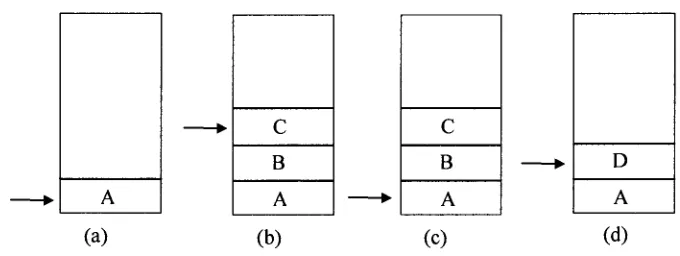
Figure 2.3 history stack operation
Figure 2.3 gives an example to show the operations on the history stack. Figure 2.3(a)
shows that page A's URL A is pushed into the stack after receiving page A. The stack
pointer points to A. In Figure 2.3(b), page B and C have been received and their URLs B
and C are pushed into the stack. In Figure 2.3(c), the user clicks back button twice, and
the stack pointer points to the first URL A. Because page A contains hyperlinks, after a
user clicks a link to page D in page A, page D's URL is pushed into the stack on the
position above A. Before D is pushed into the stack, previous URLs B and C are popped
up.
2.2.8 USING BACK BUTTON
According to major web browsers we use nowadays, such as the Internet Explore,
Mozilla Firefox, Safari, and Opera, each web browser maintains a history stack to keep
the previously visited URLs and uses a stack pointer to record the URL of the current
client page. The history stack can be accessed by making use of the forward button and
the back button on the navigation bar of the browser.
For any two client pages cph cpj in the web application under test, let r be the shortest
path to navigate from cp, to cpj. With the use of the back button, it is possible that there
exists a path r' to navigate from cpt to cpj such that r' is shorter than T. Consequently, by
making use of the back button, the total length of the test sequence may be reduced.
to back a web page in the history stack due to the existence of the cookies. We say a test
sequence % uses the back button properly if it conforms to the semantics of the web
CHAPTER 111
MODELING WEB APPLICATIONS WITH GRAPHS
A directed graph (digraph) G is defined by a tuple (V, E, L) in which V\s a set of vertices.
E is a set of directed edges between the vertices. Each edge may have a label in L. An
edge e from vertex v, to vertex v,- with label / will be represented by (v„ vf, e), and we say
edge e leaves v, and enters v/.
A path x in a digraph G is either null, denoted by s, or a finite sequence of edges eie2...eu
(k> 1) in G such that for k > 2, the ending vertex of e, is the starting vertex of e,+i for all /
S {1, 2, ..., k-\}. Given path r = e\e2—ek (k> 1), we use starting (r) and ending (r) to
denote the starting vertex of ei and the ending vertex of eu respectively. A tour is a path
starting from and ending at the same vertex.
A digraph is strongly connected if for any ordered pair of vertices (v„ v,) there is a path
from v, to Vj. The graphs we consider here are all strongly connected. In fact, we assume
that all client pages are reachable from the home page and that from any page we can
reach the home page by finite steps of hyperlink clicks. When G is strongly connected, a
postman Tour of G is a tour which contains every edges of E at least once. Given a
graphG = {V,E,cost), where cost is a cost function that associates each edge in E with a
cost. The CPP is to find the minimum-cost Postman Tour in E that traverses each edge of
In our context, a web application refers to its server side implementation, which consists
of a set of server pages. Typical server pages include HTML files, Java Server Pages,
Java Servlets, ASPs, PHP files, etc. They can be generally viewed as a piece of program
that dynamically generates client pages. Taking this set of server pages as a black-box
implementation, its behavior is tested from the client side by navigating among the output
client pages.
Each vertex uniquely represents one client page, which is an output of the execution of a
server page. Apparently, we cannot exhaustively enumerate all client pages. For the
purpose of testing, we only select some representations. This can be achieved by the
following two techniques:
We consider a closed system in the sense that the hyperlinks all refer to the server pages
within the same web application. An open system can be modeled in our setting by
augmenting an additional page to represent all the Internet web pages not generated by
the web application under test. If there is a hyperlink in a client page pointing to
www.uwindsor.ca, for example, we can simply represent it as a hyperlink pointing to this
special page.
We can use an abstract representation for a group of similar pages. For example, in a
student information system, when student A and student B both have regular transcripts, a
client page displaying the transcript of A and B both have regular transcripts. In this case,
can be considered as members of a same group with a single representative client page. A
label of a graph is an input/output pair in our context.
An input x represents the user's (or the tester's) input. It includes the triggering of a
hyperlink possibly with some user's input data (for form submission) which is used as
search parameters. In practice, people also use hyperlink to represent the hyperlink
together with search parameters. As we mentioned before, here we explicitly separate
these two parts. A URL is associated with each hyperlink together with possible search
parameters and points to unique server page to be executed to generate the next client
page.
An output y represents the characteristics of a client page. For testing purpose, it can be
understood as a multi-set of texts displayed and a multi-set of hyperlinks. The text can be
normal text, images, some places for users to type in input data, the text portion of a
hyperlink, or other non-hyperlink content. A hyperlink can be a normal hyperlink
uniquely identified by its context and the server page it refers to. A client page is correct
if the multi-set of texts and the multi-set of hyperlinks are all correct. Here we do not
consider the test oracle problem on how to automatically check the correctness of various
types of web content against the expected one. Readers interested in this issue are
referred to [5, 21,24, 34].
A transition t is defined by a tuple (v„ vjt x/y) in which v, is the starting vertex, x is the
transformation from client page cp, represented by vertex v, to client page cpj represented
by vertex y, triggered by user's input x.
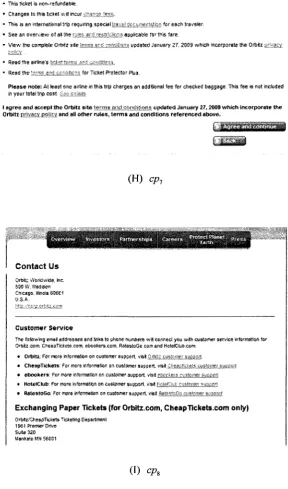
Let us consider the cheap airfare search engine of the online system YahooTravel.com
('http://travel.valioo.com') as an example web application. Here, we only focus on the
major functionalities of this search engine. In home page cpo, the user can issue a search
by providing search criteria such as the date, departure city, destination city, and so on. If
no such flight is available, a client page with information "Our providers do not have any
flights for your search criteria" will be returned, and we use cpi to denote this client page.
Otherwise, a client page with the detailed information about all the available flights will
be displayed in cp2. When the information for the search criteria is incomplete (e.g., no
destination city is entered) or infeasible (e.g., the return date is before the departure date
for a round trip), an error page cpi will be returned. In client page cp2, the user can select
any available flight for reservation by clicking the corresponding hyperlink. Then the
personal information is required from the user in a new client page cp4. Again, when the
keyed-in personal information is incomplete or erroneous (e.g., no last name is entered or
telephone number contains alphabet letter), client page cps will be prompted to user for
correction. Client page cpc is generated with all the personal and flight information for
the user to review. In cpc, the user can choose "Continue", or "back", which will result in
client page cpi (for request confirmation), and client page cp4, respectively. The "Contact
us" page (denoted by cps) and the home page can be reached by special image hyperlinks
from all the client pages, cpo and cpsare generated by the server page represented by vo,
server page represented by v^, cpe is generated by server page represented by vj, cp7 is
generated by server page represented by v4 and cp$ is generated by server page
represented by v.,-. Figure 3.1 shows the web pages of the online system.
L-jHe^e:-..,:R»*«»icn.-raws.GUIDES T Book FWECMSE • Deals my Travel r
SEARCH TRAVEL: | j
Find It Fast
yt^tl ^i^fo? :^vr<? J'J .yi'if-*^ hi'-'s ry~ tf. "9- dnd vscstions
O C'frmc if-iidi © tieaich iMulnuie s :*•» wi:<> FareQsase
' .0
O
i "
' tmti m OtCASI :•••• JKTOW
*2/09/09 fiilwio/os
ADULTS -CONNECTIONS
1 v ; .'. I Any v [
(a) cp0
,tli> Our providers do n«^t have ar;y flights fc-i your stsarth n i t e r i a .
Please try a new search
..._J
M**m:: ''&**&$
* r*^<sj*v s«?a? f
N ! M l . ,
Fn 02,13/08 -'.it f •> 02 V 38 •- 11 <
j ^ - \ "*^J8^*ff^^ *1
OUTBOUND
©before 9am. E! 9am - 3pm 1?J 3pm•- 9pm RETURN 0before 0 9 s n ) - 3pm 0 3 p m - 9pm i3a«*r 3pm Assise*. -. 0W<jf>-it(jp J59M -1 S3Si i fefil 1 SSS1 | SS61 | 3i.?s:; ] fro"! i 5i! i 1».§J |
• S M i .'•[
1
: $961®
Yahoo! F multiple in Air Canada 78ft*» Searched B>
Yahoo! Far«Cha$« is now searching
08 am . !:«l am Msn-s!ss> YQG-YYZ • , 7:H> «m • 8:29 am ifen-stss YYZ-YOG * * « , ' *
$981 AfrCanada;
t">:5f! am • 9:5? am Nan-slap YOG-YYZ 7:2P am . 0:Z9 am MSB-stop YVJ-YQS -*'«MS
(c) cp2
[ H Flights | i«2M o t e , s l«3G a r e
Please fix the following errorfsl:
&s Please enter am/a! ci*/
© Rourai-TrSp O One-way
FrOfTI - f liKi ai> airpsH
l Y Q G
T o - Find an airpoi I
(Wo" ~~~™~
[?] Check n*af by airports
Messenc
D e p a r t
J02/09/09
Return
I Anytime ! v | |02/10/03
A<Mt cwtd Senior Infant l l w , 0 i v i 0 v | 0 | v l
»More Search Cations
I Anytime \g£
<ti&;$4W-\
3 Who's t r a v e l i n g ?
Za&i traveler** name must mate* the name srs his/her governnwnt-sssued prictc SJ.
Aaibes do not a Bow passsogers to transfer tickets or to chaogs names on tickets.
Traveler
TiratfgHfers name M i 'Lest mrr&t&um&me SufflK
:H
p i lama resident of the European UniciHEU). Wh> vf?(e) c/?4
We guard your privacy
dtuaz piedg*? is kmp your peFsonaJ siforroai&rt
3 Who's t r a v e l i n g ?
Each travelers rrsrra must match the name or> hts/ner gcvernirseit-issuet! p-^ctc 8J Airtsie* do not eSew passsogers to transfer tickets or to change names or* iscsets.
Traveler
$& S^eesfc specify she ia&tnsnie of this trawter. (M«$$aytt t$i
Tirst/giver! name M.i. *Laat name/surname Suffix * * « jab
[ ] ] JamaresEJHi'ofttwEifropeanl'nicrtiEiJ}.;.
We gstard your privacy
(f) cp5
Review trip cost
Total Trip Duration: 15 days / 1 4 nights
1 traveler, round-trip
Total Airfare
Tajseui'd Feet
T o t a l trip c o s t
$815.00
S146.40
\Zl l*r»ee A s s u r a n c e Get an automatic
-*|9 o s t t r e h r t , if another c u s t o m e r books t h e same flights at a lower price.
$961.40 USD
Continue booking your flight only.
f mmmai
Review fare rules, terms, and conditions
- This ticket is non-re fundable.
• Changes to this ticket will incur c.hanf^e.fss-S;.
• This s an international *rip requiring s p e c i a l ^ a i ^ i ^ e " - ' ' ' ^ M l t e f ; for each traveler.
• See an overview of a8 h * t I applicable for this fare.
• View the complete Grbez *ite f i updated January 27, 2809 which i n c o r p o r a t e t h e O r f e i l z ^ s f ; ^
• Read the a^iines i^i'
• R e a d t h e ' ~ " v 3"-"<~_:_ i __for"cketP^i3tec*crPius
P l e a s e n o t e : A i least one airline in this trip charges an additional fee for checked baggage. TNs fee is not included in your total trio- cost. . "< *d
I a g r e e a n d a c c e p t t h e O r b t t i s i t e t § r ? H S . M M £ * E H M S ^ u p d a t e d J a n u a r y 27,2009 w h i c h I n c o r p o r a t e t h e
O r b l t z t>I^3M.Mdi'Ll s n d all o t h e r r u l e s , t e r m s a n d c o n a t i o n s r e f e r e n c e d a b o v e .
(H) cPl
Contact Us
Orbit! Worldwide, Inc. 530 W. Madison Chicago, Hiincts 536€1
V.SA.
Customer Service
The following emaa addresses and Sinks to phone fiumfcers wffl connect you with custofrter service information for
0rbt2.com. CneaoTicfceis.com, ebscfcersxorfi. RatestoGo.com and HctefClu&.com • Grbrfct: For more information on customer support visitQrMz..&y$M.$M.M££3&
• ChespTtckets: For mors information on customer support, visit Ci>S3i;tJcK&ts Of-stc-mei support
• e b o o k e r s : For more information on customer support, visit gr/cckgrs -?-j,stc;;>gr s^sgcr;
• BoteJCIub. For more information on customer support, visit HmsCl-iS costc-n«?r y j ^ j c H
• RatestoGo; For more information on customer support, visit Sf^M&SxM&^L&tiMPM
Exchanging Paper Tickets (forOrbitz.com, CheapTfckeis.com only J Or&ftz/ChespTicfcets Tjcxetin-s Department
1361 Premier Drive Suite 320 Manfcsto MM 56001
(I) cp%
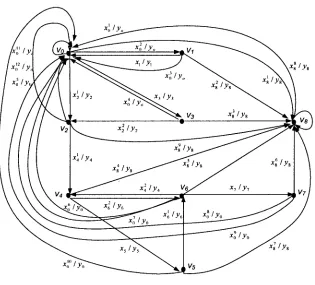
This part of the web application is specified as digraph G shown in Figure 3.2 and Table
3.1. Here, for 0 < / < 8, vertex v, represents cp,. Since hyperlinks in different client pages
or even within one client page can refer to the same client page, we use xf to denote the
input symbol that can produce y,, where j is some integer, y, denotes the characteristics
of cp,.
Symbol yo y2 y4 yf. y« VI V3 V5 V?
4
x3 MeaningThe characteristic of client
page cp0
The characteristic of client
page cp2
The characteristic of client
page cp4
The characteristic of client
page cp6
The characteristic of client
page cp8
Client page cpi
Client page cps
Client page cps
Client page cp?
Clicking the hyperlink to vo
with null (search parameters)
in cp«
Clicking one hyperlink to v0
with null (search parameters)
mcpi
Clicking the other hyperlink
to vo with null (search Symbol yi ys ys yj Vo V2 V4 V6 Vg XJ
4
A
MeaningThe characteristic of client
page cpi
The characteristic of client
page cps
The characteristic of client
page cps
The characteristic of client
page cp7
Client page cpo
Client page cp2
Client page cp4
Client page cpc,
Client page cps
Clicking the hyperlink to v/
with the no-flight-return
search parameters
Clicking the hyperlink to v/
with correct search
parameters
Clicking the hyperlink to v/
x4
4
x6 x1 x8 x9 •*oparameters) in cp/
Clicking the hyperlink to v»
with null (search parameters)
in cp3
Clicking the hyperlink to vn
with null (search parameters)
in cp2
Clicking one hyperlink to vo
with null (search parameters)
incp6
Clicking the other hyperlink
to vo with null (search
parameters) in cpc,
Clicking one hyperlink to v(,
with null (search parameters)
incpz
Clicking the other hyperlink
to vo with null (search
parameters) in cpx
X j *\ < X5
4
A
parametersClicking the hyperlink to vo
with incomplete search
parameters
Clicking one hyperlink to V2
with flight information
(search parameters)
Clicking another hyperlink
to V2 with flight information
(search parameters)
Clicking the hyperlink to V2
with flight and customer's
information (search
parameters)
Clicking the hyperlink to vj
with flight and customer's
information (search
parameters)
Clicking the hyperlink to V3
with flight and customer's
information (search
x10
x"
4
xg
xg
Clicking the hyperlink to v»
with null (search parameters)
in ops
Clicking the hyperlink to vo
with null (search parameters)
in cpo
Clicking the hyperlink to vo
with null (search parameters)
in cp2
Clicking the hyperlink to v5
with flight and customer
information (search
parameters)
Clicking the hyperlink to vj
with flight and customer
information (search
parameters)
Clicking the hyperlink to vj
with flight and customer
information (search X7 x8 x8 x8 Xg Xg
Clicking the hyperlink to v^
with flight and customer's
information (search
parameters)
Clicking the hyperlink to vj
with flight and customer's
information (search
parameters)
Clicking the hyperlink to v.5
with flight and customer's
information (search
parameters)
Clicking the hyperlink to vs
with flight and customer's
information (search
parameters)
Clicking the hyperlink to vj
with flight and customer's
information (search
parameters)
Clicking the hyperlink to v^
with flight and customer's
parameters) parameters)
Table 3. 1 explanations of the symbols
Given a digraph describing the expected behavior of a web application under test, we
would like to see, for each transition t, if we click on a hyperlink (possibly with some
input data) corresponding to an input of the page represented by the starting vertex of t,
then the resulting client page is correctly generated in the sense that both the displayed
text content and hyperlinks are as characterized in the output oft. Furthermore, we would
like to generate an input/output sequence (called a test sequence) from a sequence of
transitions such that each transition in the graph is traversed at least once.
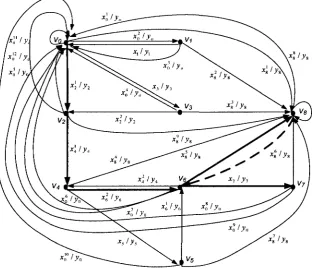
In the above example, suppose that the current navigation history is cpo cp2 cp4 cp6 cpg.
Now we want to visit client page cp7. Without the back button, the shortest path to reach
cp7 is to visit the following client pages in sequence: cpo cp2 cp4 cp6cp7. By making use
of the back button, cpi can be reached by only two clicks: first click the back button to
return to cpr, and then click the hyperlink associated with cp7 in cpg, and Figure 3.3 shows
Figure 3.3 an example to show how to use the back button
Note that we do not consider the forward button because its use cannot save the steps of
hyperlink clicks for the navigation between any two client pages.
A complete specification of the cheap Airfares Search Engine application in the above
sequence generated by our method is of length 157 while the one generated by CPP is of
CHAPTER IV
IMPLEMENTATION
In this section, we give a brief introduction to CPP algorithm which can be applied to our
context without using back button. Then we explain our proposed algorithm by applying
Genetic Algorithm, considering the use of back button.
4.1 THE IMPLEMENTATION OF THE CPP ALGORITHM
To well understand the algorithm to solve the CPP, we introduce some graph-theoretic
terms first. The number of edges going into a vertex v is the in-degree denoted by
deg,„(v), and the number of edges pointing out of a vertex v is the out-degree denoted
by deg0„,(v). Let 8 be the difference between the in and out degrees: S(v) =
deg„„,(v)-deg,„(v). If S(v) = 0, we say the vertex v is balanced. Otherwise, let D+
= {v| S(v)>0} be the set of unbalanced vertices with an excess of out-going edges, and
D~ = {v | 5{v) <0} the set of unbalanced vertices with an excess of in-coming edges. Let
path p,j be a path from vertex v, to vertex y, where v, e D~ and y, e D+. In general, a
CPP may take some of the p^ paths more than once. Let ftj be the number of times the
path py must be taken, specifically, how many times the path must be added to the graph
as an edge to make it Eulerian.
In [13], an algorithm of CPP can be sketched as follows.
Step 2: determine D+ and D mG .
Step 3: For each vertex in G, find the shortest paths piJ and minimal costs c,y to all
vertices by the Floyd-Warshall algorithm [32].
Step 4: find / to minimize <j> = ^ C ^ by the algorithm of cycle canceling, where
f.j>0 should be integer, £ ^ fu = -<*(') and^T^. fu = S(i).
Step 5: Construct an Eulerian circuit by Fleury's algorithm [31] based on the least cost
paths / -> j and each path repeated fn > 0 times.
The complexity of this algorithm isO(nzm3(\ogn)).
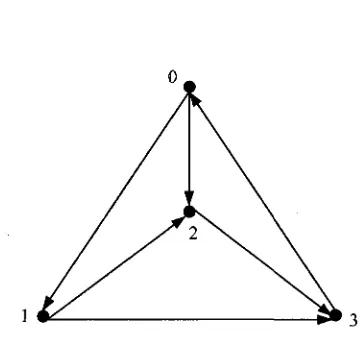
Here we use Figure 4.1 to show the algorithm to solve the CPP. In this figure, the weight
of each edge is ' 1 ' . In Step 1, J(0) = 1, S(Y) = 1 , 5{2) = -1 and S(3) = -\ are
computed. From the result of Step 1, we can determine that D+ = {0,1} and
D~ ={2,3} in Step 2. In Step 3, we determine pn and minimal costsc^. In Step 4,
based on D+, D~, pj} and cn, we find that there are two ways to choose the set of
extra paths. If one path is 2 -> 0, then the other path is 3 -> 1; the alternative is to use
the paths 2-> 1 (from vertex 2, pass by vertex 3, 0, to vertex 1) and 3 - » 0 . As it
happens, the choices have the equal cost (c2l +c30 =3 + l,c20 + c3l =2 + 2), and both can
be used for an optimal CPT. Let us say that we choose the paths 2 -> 1 and 3 -» 0. In
° .
2
Figure 4. 1 an example of the CPP
4.2 THE IMPLEMENTATION OF THE GENETIC ALGORITHM
The present work focuses on the Genetic Algorithms (GA), a learning algorithm, and its
application to improving the efficiency of the traverse of web pages. GA is a
population-based, robust global optimization method. That is, it is able to find a global
optimal solution without being trapped in local minima. As a result, it has been
successfully employed in a variety of real-life optimization problems.
4.2.1 DESCRIPTION OF GA
GA is a part of evolutionary computing, which is a rapidly growing area of artificial
intelligence. Genetic algorithms are inspired by Darwin's theory about evolution. In
simple words, solution to a problem solved by genetic algorithms is evolved. Idea of
evolutionary computing was introduced in the 1960s by I. Rechenberg. He introduced
developed by other researchers. GA was invented by John Holland and developed by him
and his students and colleagues [15].
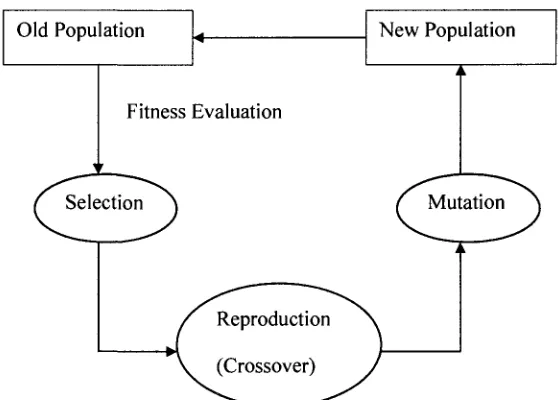
The GA is started with a set of solutions (represented by chromosomes) called population.
Solutions from one population are taken and used to form a new population. This is
motivated by a hope, that the new population will be better than the old one. New
solutions (offspring) are selected according to their fitness (the more suitable they are the
more chances they have to reproduce). This evolution is repeated until some condition
(for example the number of populations or improvement of the solution) is satisfied. In
general, there are three genetic operators (processes): selection, reproduction (crossover),
and mutation, which make the transition from one population generation to the next. The
process is shown in Figure 4.2. The microbiological and model terminology are explained
in Table 4.1.
Old Population
Fitness Evaluation
Selection
New Population