Implementation of Lean Tools and Principles
In Precast Construction Process - Cost Case
Study
Lekha Shankar G R1, Janakaraj M2
PG Scholar, Department of Civil Engineering, NMAM Institute of Technology, Nitte Udupi, India
Assistant Professor, Department of Civil Engineering, NMAM Institute of Technology, Nitte Udupi, India
ABSTRACT:The implementation of lean construction principles in precast casting is achievable when it is applied in a strategic way. Lean construction focuses on improving productivity and providing value to the customer.
Construction industry is often questioned about low productivity, with respect to schedule, cost overrun, quality. To overcome productivity problems, to achieve higher productivity, new management tools were introduced. One among such methodology was Lean construction. Article presents an idea of introducing lean construction tools and principles in precast casting process in casting yard,to avoid cost overrun and loss.
Article is based on study and observations made in precast casting yard in Bangalore. The casting process was divided into different phases and two process were prioritized to reduce and save cost overrun. Proposed possible solutions could be used for other construction sites.
KEYWORDS: Lean construction, Precast technology, Kanban, kaizen.
I.INTRODUCTION
A. GENERAL
Projects are considered as a key factor in success of an organization. An organisation grows with increase in successful projects. There is an increase in demand for improved project management practices to overcome or to avoid factors, which threaten to damage the successful execution of projects. While looking at the failed projects, studies highlighted on schedule delay and cost overrun as major factors.
Execution in construction projects involves many hurdles, one such hurdle is avoiding cost overrun. Many projects experience cost overrun or loss incurred due to many unforeseen reasons. One such reason could be seen in over procurement of materials to avoid risking in last minute delay and shortage of materials. Notable loss occurs in materials procurement and loss due to mistakes during execution.
B. PRECAST TECHNOLOGY
Precast concrete is produced by casting concrete in a reusable moulds, these moulds are cured in a controlled environment and temperature. The product is later carried to the construction site, where the precast product is placed as per requirement and design. Precast technology helps in reducing waste and helps in faster construction. It is standardized with machines and it is more economical when compared to conventional type.
has demonstrated faster construction with improved quality control, which has led to better method when compared to conventional construction.
II. LITERATUREREVIEW
Implementation of lean principles is dependent on management learning and knowledge creation, acceptance of new technology and management methods can increase in productive construction. Furthermore, lean also reduces the cost and time delay and in turn improves the quality. (LianyingZhang, 2016).
Lean principles can determine and reduce waste and delay in construction projects (U. Vimal Kumar,2018), we can enhance both projects deliver time and cost of project by adopting lean construction (Sreema Moha,2017), by adopting lean principles, we can identify and reduce Non-value added activities and delivering high quality at lower cost in short time (Phaniraj k,2015). Questionnaire surveys have shown many factors which are responsible for the schedule delay of the construction project (MulengaMukuka ,2015). From the survey conducted it was observed that 8 projects out of 13, lean applied projects was completed ahead of schedule (Helena O’Connor,2015),there is a need or implementation of lean to reduce waste in construction projects (Harsh N,2013). Precast construction has effective role in time, labour, quality, material requirement etc. but the productivity in precast construction is not taken up by the construction firms (Shreyanka Murari,2017).
III. OBJECTIVE
Fundamentally, this paper prioritizes in identifying the problems in casting yard, which has potential in contributing loss of expenditure. The objective focused is on
1. To Examine the cost incurred in the project phase and suggestion of lean tool for avoiding over expenditure.
IV. CASESTUDY
The study area for precast casting yard is located in Bangalore. The yard covers an area of 40acres, where it produces precast products, like Box girders, I Girders/ Beams, Pier arms, Concourse beam and Parapet walls.
This is an open factory, it means it is exposed to sun, wind and rain. It is a notable factor cause, change in weather can effect in labour productivity, inventory maintenance and daily productivity.
Fig 1: Casting of box girder
A. COST ESTIMATION
In this study area it was observed that, the total cost required for casting of 10 box girder for 28m span was calculated and it was found that, the total quantity of concrete used for S1-S10 box girder is 155.82 cu.m and reinforcement used was 31.164 MT.
Data collection
In this study, effort has been made to propose solution to the problem identified in the casting yard.
Data required was collected by focusing on two process in precast yard, where changes can be done without investing much money. Identified stage of casting were,
1- Steel bar stocking yard. 2- Bent and cut rebar scrap yard.
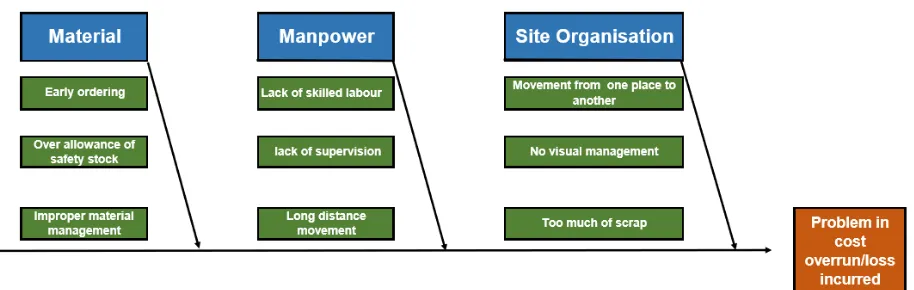
Problem identified:During the casting of box girders, it was observed that, there is an over procurement of steel for the casting yard and too many mistakes is costing in the proper production of the girders. It was drawn out by using Ishikawa diagram. It is presented in Fig 2.
Fig 2: Ishikawa diagram showing root cause of problems.
1- Steel bar stocking yard:
The rebar stocking yard comprises of an area of 3200sqft, rebar for the casting yard is procured from JSW. The monthly procured quantity of rebar is 300MT, this 300MT will be used for various casting activities in yard. The safety stock maintained in the yard is 30% of the stock. i.e. when the rebar quantity reaches 30%, new order is placed. There is 13% of oxidised steel in the yard.
Problem Identified: The yardcomprises of raw materials resulting in excess inventory. Due to poor site management. When a new order is placed, the previous stock is not completely used or relocated for the new stock to be placed. From this, the worker uses only new load and the previous stock lies beneath the new load of steel bar.
Fig 3: Oxidised safety stock.
2- Cut and bent rebar scrap generated
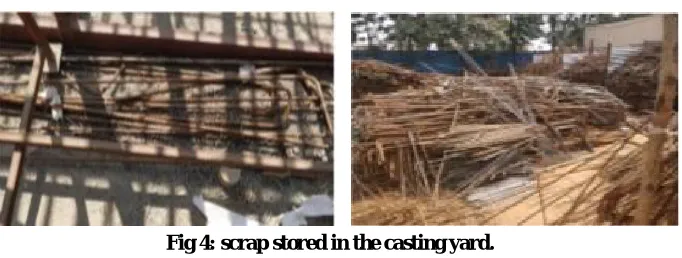
Steel scrap in the yard stacked in the yard is nearly 40MT. This is due to improper cutting and bending work done by the labours ad lack of supervision by the engineers.
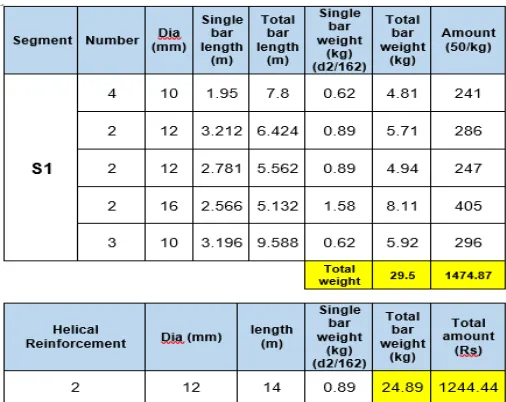
Problem Identified: In the filled, it was observed that, due to improper cuts from one box girder, there is a wastage of 4-7 rebar’s and 1 helical reinforcement.
This has led to following things; 1- Waste of raw materials.
2- Waste of time spent for bending and cutting. 3- Loss in re-selling of the scrap.
The scrap generated in the casting yard can be seen in Fig 4.
Fig 4: scrap stored in the casting yard.
Table1: The quantity of bars wasted from one box girder
The bar bending schedule was used for all 10 box girders, which showed, following quantity of rebar wasted during casting of 28m span segment. It is given the Table 2.
Table 3: Total quantity of rebar wasted from 28m span segment and amount of wasted rebar
From 28m span, it can be seen that, total of 190 kg of rebar wasted. Which results to loss of Rs 9,510. The resell value of rebar/kg is Rs 28. Which gives total amount of Rs 5,320. This leads to loss of Rs 4,190.
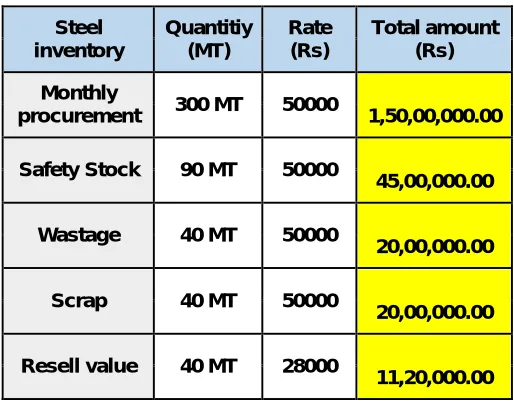
The overall loss in steel inventory and Scrap storage is given in Table 3.
Table 3: Overall loss incurred in steel inventory and scrap storage
Steel inventory
Quantitiy (MT)
Rate (Rs)
Total amount (Rs)
Monthly
procurement 300 MT 50000
1,50,00,000.00
Safety Stock 90 MT 50000 45,00,000.00
Wastage 40 MT 50000 20,00,000.00
Scrap 40 MT 50000 20,00,000.00
Resell value 40 MT 28000 11,20,000.00
Total scrap found in the yard is around 40MT (40000kg) Total cost of rebar of 40MT is = 40 x 50000
= Rs 20,00,000/-
Resell value of scrap rebar is
= 40 x 28000 = Rs 11,20,000/-
Loss incurred in steel scrap = 20,00,00 – 11,20,000 = Rs 8,80,000/-
Loss incurred in wastage = 20,00,000 - 11,20,000 = 8,80,000/-
Total loss incurred in the steel = 8,80,000 + 8,80,000 = Rs 17,60,000/-
Total Weight 190
V. RESULTS AND DISCUSSION IN COST SAVINGS.
Analysis of cost estimation of implementation for suggested tools is difficult, it is very hard to compare and measure different management ideas in the same
process.
1. Steel bar stocking yard
It was observed that problem is due to lack of utilization of old stock, which is resulting in oxidisation of steel and generating waste. This can be avoided by providing 2 basket system. It is given in figure 6
Two Basket System: The basket size of 20*80ft could be built, in horizontal side of 20ft, 4 divisions should be made to sort and store different dia of rebar in each.
1. Once the rebar in 1st basket is over, 2nd basket stock should be used.
2. when the stock in 2nd bin is almost 50%, new order should be placed to fill the bin.
Fig 5: Two Basket System.
2. Cut and Bent rebar scrap
It was observed that, the problem is due to lack of skilled labours, negligence during work, lack of supervision. This can be avoided by providing Muda walk, kanban system and training workers.
Problem in Process Problem Solution
Steel bar stocking yard
1. Wastage of safety stock due to oxidisation
2. Over procurement of materials
Two Basket System
Cut and Bent rebar scarp
1. Improper cutting and bending leading to excess of scrap.
1. GembaWalk
2. Training
1. Muda walk: Muda walk requires a supervisor to walk through the work place every hour and check the accuracy of work.
2. Training Workers: Instead of making labours by look and learn, training should be provided.New labours or unskilled labours should be taught for 1 hour every day for a week by an experienced labour or a skilled labour.
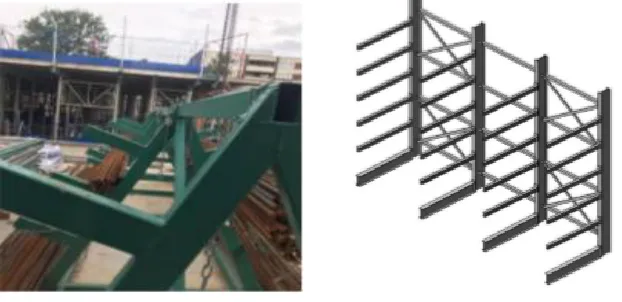
3. Kanban system: A rack system should be provided near rebar bending and cutting area to store properly bent and cut bars in one place. This can avoid in mixing up of improper cut bar with properly cut bar.
Fig 6: Cut and bent rebar storage rack.
VI. CONCLUSION
The cost estimation was concentrated on points in the casting process, which are Steel inventory and scrap yard. Implementation of lean tool can help in avoiding wastage of safety stock, mistakes in cutting and bending of rebar’s, increase of wastage during binding of reinforcement cage.
1. Two basket system from Kanban lean tool can reduce wastage of safety stock from 13% to 3%, oxidation of safety stock, loss in inventory.
2. Gemba walk helps in identifying delays of the casting work process and monitoring the labours. The monitoring of labours will facilitate the skills of labours in completion of work.
3. Continued training process will help in maintaining constant productivity.
4. Gemba walk helps in monitoring casting process.
5. Training labours monthly once can help in saving cost and reducing waste by turning a a. Semi-skilled labour to skilled labour.
b. Unskilled labour to skilled labour.
The paper gives an outline for a framework for the company to adopt Lean tools to improve the process in the casting yard. Due to lack of knowledge about lean construction, there is a high resistance in the management to adopt new techniques but implementation of the innovative methodologies, tools will result in improvement of casting process.
REFERENCES
[1] Sreema Mohan, Mr. Babu S, “Estimating the impact of lean construction practices on project duration and cost using Monte Carlo Simulation”, International journal of recent trends in engineering and research, Volume 03, May 2017.
[2] Serdar Durdyev, Maksat Omarov, Syuhaida Ismail, Mengheng “Significant contributors to cost overruns in construction projects of combodia”, Cogent Engineering May 2017, Volume 4
[3] A. L. Agarwal, D. A. Mahajan “A probability Analysis of construction project schedule using risk management tool” International Journal of Science and Technology, Volume 3, January 2017
[4] Archana M S, Renuka S, Karthigai Priya “Identification and Analysis of Lean Technique in Indian Construction Projects”, Journal of Mechanical and Civil Engineering, April 2017, Volume 14.
[5] Shumank Deep, Mohd Asim, Mohd Kashif Khan “Review of various delay causing factors and their resolution by application of lean principles in India” , Baltic Journal of Real Estate Economics and Construction Management, November 2017,
[6] Swapnesh.P, Dr.S.S. Valunjka “Improve the Productivity of Building Construction Project using Clash Detection Application in Building Information Modelling”, International Research Journal of Engineering and Technology, Volume-5, April 2017.
[7] Shreyanka Murari, Ashwin Joshi, “Precast Construction methodology in construction industry”, July-2017.
[8] Lianyig Zhang, Xi Chen, “Role of lean tools in supporting knowledge creation and performance in lean construction”, Elsevier, 2016
[9] U. Vimal Kumar, Ganapathy Ramaswamy “A critical study of various lean techniques in practice and developing a framework for different construction building projects” April 2016.
[10] Huseyin Erol, Irem Dikmen, M. Talat Birgonul “Measuring the impact of lean construction practices on project duration and variability: a simulation-based study on residential buildings”, Journal of civil engineering and management, Volume 23, 24 May 2016.
[11] Piotr Nowotarskia, Jerzy Pasaawskia, Jakub Matyjaa “Improving Construction Processes Using Lean Management Methodologies” World Multidisciplinary Civil EngineeringArchitecture-Urban Planning Symposium, Volume 161, 2016.
[12] Zakia Bouayed “Using Monte Carlo Simulation to Mitigate the Risk of Project Cost Overruns”International journal of safety and security engineering, Volume 2, issue 4, December 2016.
[13] Prathik Ganame, Pravin Chaudhari “Construction building schedule risk analysis using Monte carlo simulation” . International Research journal of engineering, Volume: 02 Issue: 04, July2015.
[14] Claudius a. peleskei, vasile dorca, Radu a. munteanu “Risk Consideration and cost estimation in construction projects using Monte Carlo Simulation” March 2015, Volume 10.
[15] Mulenga Mukuka, Clinton Aigbavboa, Wellington Thwala “Effects of construction projects schedule overruns: A case of the Gauteng Provinance, South Africa” May 2015, Volume 7.
[16] Mr. J. Rajprasad, Shuaibu Saminu, Harish Babu S “A Study and Application of Lean Construction Techniques Using Last Planner Concept in Residential Building”, Internatonal journal of engineering development and research, Volume 2, Issue 3, 2014.
[17] Richard Hannis Ansah, Shahryar, Sorooshian and Shariman Bin Mustafa “Lean Construction: An effective approach for project management”, Journal of Engineering and applied sciences, Volume 11, February 2016.
[18] Helena O’Connor, Cau-RJ, Leep AP, Khalid Siddiqi “Impact of Lean Principles on Timely Project Completion”, Perkins+Will research journal, volume 06.02, December 2014.Marieta Olaru, Mircea Sandru, Lonel Carmen Pirnea “Monte Carlo method application for environment risks impact assessment in investment projects”, 2nd World Conference on business, Economics and Management. January 2014, Volume 109. [19] Remon Fayek Aziz,Sherif Mohamed Hafez “Applying lean thinking in construction and performance improvement” Alexandria Engineering
Journal, Volume-52, Issue-4, December2013.
[20] Harsha N, Dr. A. V. Suresh, Mr. Nagaraj N. “Implementation of Lean Concepts in the Construction Engineering Project”, International Journal of Engineering Research & Technology, Volume 2, May 2013.
[21] Ismail Abdul Rahman, Aftab Hameed Memon, Ahmad Tarmizi Abd. Karim “Relationship between Factors of Construction Resources Affecting Project Cost” Modern Applied Science, Volume- 7, October 25,2012.
[22] Daniel forgues, Ivanka Iordanova, Fernando valdivesio , Sheryl staub-French “Rethinking the cost Estimating Process through 5D BIM: A case study” Construction Research Congress, May 2012.