REVIEW
Genetic Control of Wiring Speci
fi
city
in the Fly Olfactory System
Weizhe Hong*,1and Liqun Luo†
*Division of Biology and Biological Engineering, California Institute of Technology, Pasadena, California 91125, and †Department of Biology, Howard Hughes Medical Institute, Stanford University, Stanford, California 94305
ABSTRACTPrecise connections established between pre- and postsynaptic partners during development are essential for the proper function of the nervous system. The olfactory system detects a wide variety of odorants and processes the information in a precisely connected neural circuit. A common feature of the olfactory systems from insects to mammals is that the olfactory receptor neurons (ORNs) expressing the same odorant receptor make one-to-one connections with a single class of second-order olfactory projection neurons (PNs). This represents one of the most striking examples of targeting specificity in developmental neurobiology. Recent studies have uncovered central roles of transmembrane and secreted proteins in organizing this one-to-one connection specificity in the olfactory system. Here, we review recent advances in the understanding of how this wiring specificity is genetically controlled and focus on the mechanisms by which transmembrane and secreted proteins regulate different stages of the Drosophila olfactory circuit assembly in a coordinated manner. We also discuss how combinatorial coding, redundancy, and error-correcting ability could con-tribute to constructing a complex neural circuit in general.
The Larry Sandler Memorial Lecture was established in rec-ognition of Dr. Larry Sandler’s many contributions to Dro-sophila genetics and his dedication to the training of Drosophila biologists. The recipient of the Larry Sandler Award for the most outstanding Ph.D. dissertation submitted presents the Larry Sandler Memorial Lecture at the Annual Genetics Society of America Drosophila Research Conference. As the 2013 Larry Sandler Award winner,Weizhe Hong was invited to write the following Review article on the subject of his dissertation.
T
HE precise assembly of neural circuits during develop-ment is required for the proper function of the nervous system. One of the key steps in establishing a functional circuit is to ensure that neurons make precise connections with ap-propriate synaptic partners. Deciphering the molecular mech-anisms of how such connections are established and how neural circuits are assembled will contribute to our general understanding of the organization, development, and functionof the nervous system. The olfactory system offers an intriguing model to study the mechanisms underlying wiring specificity. In this review, we focus our discussion on recent advances in the understanding of the Drosophila olfactory system and highlight the role of transmembrane and secreted molecules in providingfine control over the target selection process. For comprehensive reviews of olfactory system development and function in other organisms, see Hildebrand and Shepherd 1997; Wilson and Mainen 2006; Vosshall and Stocker 2007; Suet al.2009; and Sakano 2010.
Organization of the DrosophilaOlfactory System
From insects to mammals, the olfactory system displays re-markable similarities with respect to circuit organization. In Drosophila, each of the1300 adult olfactory receptor neu-rons (ORNs) expresses only 1 or 2 of 60 olfactory receptors (ORs) or ionotropic receptors (IRs) (Clyneet al.1999; Gao and Chess 1999; Vosshallet al.1999; Goldmanet al.2005; Bentonet al.2009; Silberinget al.2011). The axons of ORNs expressing a common OR or IR converge onto one specific glomerulus in the antennal lobe, although their cell bodies are dispersed in the olfactory epithelia (Gao et al. 2000; Vosshallet al.2000; Coutoet al.2005; Fishilevich and Vosshall 2005; Silbering et al.2011). The antennal lobe consists of
Copyright © 2014 by the Genetics Society of America doi: 10.1534/genetics.113.154336
Manuscript received September 20, 2013; accepted for publication November 7, 2013
1Corresponding author: Division of Biology and Biological Engineering, California
50 glomeruli, which can be uniquely identified by their ste-reotypical size, shape, and relative position (Laissue et al. 1999).
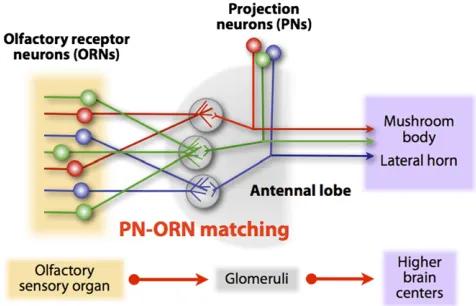
Olfactory information is relayed to higher brain centers by the second-order olfactory projection neurons (PNs), which send their dendrites to the antennal lobe and make synaptic connections with ORN axons. The majority of PNs send their dendrites to individual glomeruli in a stereotyped manner within the antennal lobe and project their axons to higher brain centers, including the mushroom body calyx and the lateral horn (Laissueet al.1999; Jefferiset al.2001; Marin et al. 2002; Wong et al. 2002). Thus, a given PN makes synaptic connections with axons of only one ORN class (Fig-ure 1). This one-to-one organizational principle is shared from insects to mammals.
In most other sensory systems, neurons are interconnected in a spatially continuous manner along particular axes in space. For example, the visual centers in the brain are spatially organized by a continuous two-dimensional representation of photoreceptors. In contrast, the peripheral sensory organs in the olfactory system show much less spatial order, and the connections between olfactory neurons in the central nervous system are organized in a structurally discrete manner (reviewed in Luo and Flanagan 2007). The class-specific convergence of ORN axons and PN dendrites onto a single glomerulus and their precise one-to-one matching are among the most striking examples of targeting specificity in developmental neurobiology and provide a unique opportunity to study how these connections are established in discrete structural units.
Development of PN–ORN Connections
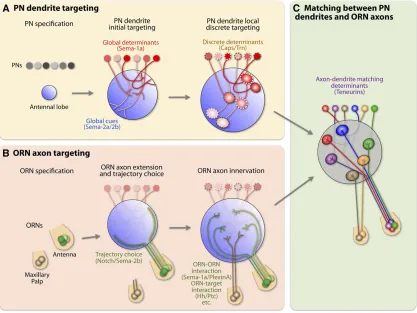
The organization of specific connections between ORNs and PNs emerges from sequential developmental events, which can be roughly divided into three phases (Figure 2) (Jefferis et al.2004). In thefirst phase, PNs send dendritic processes to the antennal lobe at the beginning of puparium formation and elaborate diffuse dendritic processes at stereotypical posi-tions in the proto-antennal lobe (Figure 2A). This phase occurs before the ORN axons arrive at the antennal lobe. In the second phase, the ORNs send axons from the antenna and maxillary palps to the antennal lobe, where the incoming axons defasciculate and primarily form axon bundles along two main trajectories surrounding the antennal lobe. ORN axons further converge onto subregions near thefinal target area. In the third phase, ORN axons recognize the earlier-arriving PN dendrites in the local vicinity and establish specific synaptic connections with their cognate PN partners. Mean-while, both dendrites and axons are refined to form discrete glomeruli so that the processes of neighboring classes of PNs and ORNs do not overlap.
When50 classes of PN dendrites and ORN axons reach the proto-antennal lobe, they are faced with a complex envi-ronment. How each class of neurons uniquely responds to this complex environment and establishes class-specific wiring
patterns relies on differentially expressed transmembrane and secreted proteins, which serve as receptors and ligands to mediate interactions between different PNs, different ORNs, and extracellular cues from the antennal lobe. In the following sections, we collectively term transmembrane and secreted proteins as“cell-surface molecules”and review recent advances in the understanding of these molecules in regulating different wiring stages in a coordinated manner.
PN Dendrite Targeting
Mosaic analysis with a repressible cell marker (MARCM) studies demonstrated that PN dendrite target choice is specified by cell lineage and birth timing within the lineages (Jefferis et al.2001). A number of transcription factors have been iden-tified to link lineage and birth timing with dendrite targeting specificity of the 50 PN classes (Komiyamaet al. 2003; Zhu et al.2006b; Komiyama and Luo 2007; Spletteret al.2007). Furthermore, genetic screens for genes regulating PN dendrite targeting isolated mutants involved in multiple biological reg-ulatory processes, including chromatin remodeling (Teaet al. 2010; Tea and Luo 2011), microRNA processing (Berdniket al. 2008), protein translation (Chihara et al.2007), glycosylation (Sekine et al.2013), and sumoylation (Berdnik et al. 2012). Thus, it is clear that a variety of processes contribute to the specification of PN target choice, presumably by regulating the expression of cell-surface molecules, the key effectors for cell– cell interactions.
Repulsive and attractive forces establish dendriticfields
As PNs elaborate dendrites in the proto-antennal lobe, dendrites of the same class are restricted to a subregion within the antennal lobe (Jefferiset al.2004). Meanwhile, dendrites of the same class expand and fully cover this sub-region. Expanding dendriticfields to cover a specific region
of a certain size is likely important for the further development of the antennal lobe, providing enough space andflexibility to interact with ORN axons and eventually establishing the morphology of individual glomeruli.
The cell adhesion molecule N-cadherin (Ncad) has been shown to restrict dendrites to the appropriate glomerular space. Loss of Ncad causes dendrites to spread beyond the developing antennal lobe or invade neighboring glomeruli (Zhu and Luo 2004). This phenotype was observed at an early developmental stage, suggesting that Ncad functions in initial confinement of dendrites to the appropriate glomerular space. Ncad likely mediates adhesion between PN dendrites (possibly between dendrites from the same classes) and in this capacity dendrite–dendrite adhesion would restrict den-drites of the same classes to a single glomerulus.
Dscam, a member of the Ig-domain superfamily of trans-membrane proteins, was found to promote the elaboration of PN dendrites to occupy individual glomerular space (Zhuet al.
2006a). Loss of Dscam in PNs leads to a drastic reduction of their dendriticfield size, suggesting that Dscam plays a re-pulsive role between sister dendrites of the same PN class. This suggests that Dscam functions in PN dendrites to ex-pand and occupy the local space, while also preventing them from collapsing onto each other. Both Dscam and Ncad do not appear to play instructive roles for class-specific target-ing, as they equally affect all PN classes examined (Zhu and Luo 2004; Zhuet al.2006a).
Molecular gradients determine coarse positions
How is glomerulus-specific targeting of PNs achieved? It is likely that a set of cell-surface receptors, differentially expressed in the various PN classes, enables them to uniquely respond to extracellular cues. A transmembrane semaphorin, Sema-1a, was found to directly regulate PN dendrite targeting specificity (Komiyamaet al.2007). Sema-1a protein forms a concentration gradient along the dorsolateral–ventromedial axis of the
developing antennal lobe, and the removal of Sema-1a in dorsolateral PNs cause their dendrites to mistarget to ven-tromedial glomeruli (Figure 2A). This suggests that the lev-els of Sema-1a in PN dendrites instruct their coarse target positions along this Sema-1a-specific axis. Interestingly, the function of Sema-1a in regulating dendrite targeting is cell autonomous and requires its cytoplasmic domain, suggest-ing that it functions as a receptor. Its putative ligand is likely also distributed in a gradient along the same dorsolateral– ventromedial axis.
Two secreted semaphorins, Sema-2a and Sema-2b, direct PN dendrite targeting along the dorsolateral–ventromedial axis and are candidate extracellular ligands for Sema-1a (Sweeneyet al.2011). Sema-2a/-2b proteins form counter-gradients to the Sema-1a gradient along the same axis, and loss of Sema-2a/-2b also causes ventromedial mistargeting of PN dendrites that normally target to dorsolateral glomeruli, similar to what was observed in Sema-1a loss-of-function mutants. Thus, the novel interaction between secreted and membrane-bound semaphorins generates a coarse map of PN dendrites along one axis (Figure 2A). Interestingly, Sema-2a is predominantly expressed by ORN axons of the larval antennal lobe, which undergoes degeneration during metamorphosis (Sweeney et al. 2011). The degenerating larval ORNs occupy a ventromedial position with respect to the developing adult antennal lobe, suggesting that se-cretion of Sema-2a by the larval axons could participate in patterning a developing adult neural circuit.
Discrete determinants constrain glomerular targeting
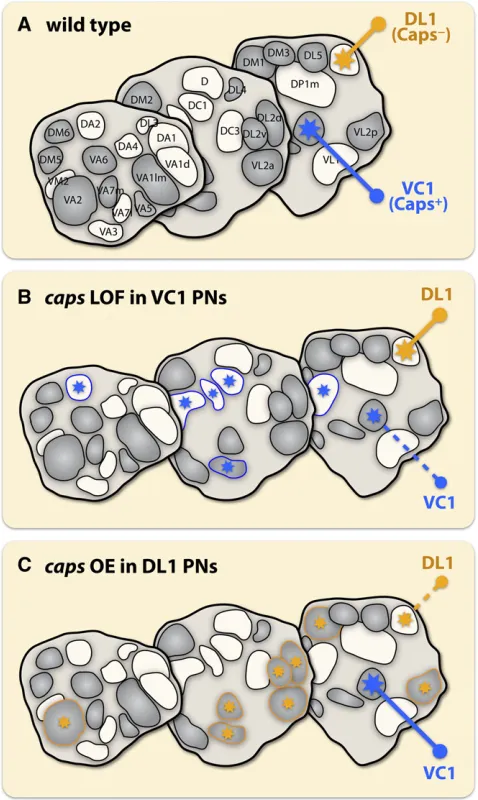
After the initial coarse targeting of PN dendrites along one axis, neighboring PN dendrites need to be segregated and confined to class-specific glomeruli. The leucine-rich repeat (LRR)-containing transmembrane protein Capricious (Caps) plays an essential role in this class-specific targeting process (Hong et al. 2009). Unlike semaphorins, which are distrib-uted in continuous gradients, Caps is differentially expressed in a subset of PN classes that innervate intercalated glomeruli (Figure 2A and Figure 3A). The differential Caps expression instructs the segregation of Caps+and Caps2dendrites into class-specific, discrete glomeruli. Loss of Caps in Caps+PNs causes their dendrites to invade glomeruli occupied by Caps2 PNs (Figure 3B), whereas misexpressing Caps in Caps2PNs causes their dendrites to make ectopic innervation of glomer-uli occupied by Caps+PNs (Figure 3C). The function of Caps in PN dendrite targeting is likely mediated by PN–PN inter-actions and is independent of presynaptic ORNs. Furthermore, Caps does not mediate PN dendrite targeting through homo-philic interactions. Identification of the putative heterophilic ligand(s) will provide new insight into this discrete targeting process.
Caps provides only a single discrete cell-surface identity code for the various PN classes. Since the antennal lobe contains50 different classes of PNs, other cell-surface mol-ecules functioning together with Caps are likely required to further distinguish within the groups of Caps+ or Caps2
PNs. Indeed, a closely related LRR transmembrane protein Tartan is expressed in a distinct subset of PNs that partially overlap with Caps-expressing PNs (Honget al.2009). Tartan and Caps play partially redundant roles in regulating PN dendrite targeting. Additional cell-surface molecules are likely involved in determining the unique identity of each of the 50 PN classes.
ORN Axon Targeting
ORNs are born in the olfactory sensilla that derive from an undifferentiated epithelium, the antennal disc. The sensillar types are initially specified by two transcription factors, Atonal
Figure 3 Discrete expression of Caps instructs PN dendrite targeting into class-specific glomeruli. (A) Schematic showing differential expression of Caps in a subset of PNs that innervate intercalated glomeruli (in gray) in the antennal lobe (e.g., VC1 is Caps+and DL1 is Caps2). (B) Loss of Caps
and Amos (Gupta and Rodrigues 1997; Goulding et al. 2000). In each sensillum, a common sensory organ precursor gives rise to ORNs and nonneuronal supporting cells (Endo et al. 2007). In contrast to the mouse olfactory system, Dro-sophila ORNs target their axons to the antennal lobe before the onset of their OR gene expression, and these two processes do not depend on each other. Both processes, however, are regulated by the common upstream Notch signaling pathway (Endoet al.2007). ORNs with high Notch activity (Notch ON) and low Notch activity (Notch OFF) differentiate into distinct classes within each sensillum and target axons to distinct glomeruli.
Initial trajectory choice
When ORN axons reach the brain, they defasciculate and form two main trajectories to circumnavigate the developing antennal lobe: one goes ventromedially and the other dorsolaterally. Selecting the proper trajectory is essential for targeting specificity of certain ORN classes (Jooet al.2013). A key determinant of this trajectory choice is the secreted semaphorin Sema-2b. Notch signaling restricts Sema-2b ex-pression to ORN axons that take the ventromedial but not dorsolateral trajectory. Sema-2b functions cell autonomously in ORNs for trajectory choice in response to antennal lobe-produced Sema-2a and Sema-2b, which also regulate PN den-drite targeting along the ventromedial–dorsolateral axis just before ORNs arrive (see above). Sema-2b further mediates axon–axon interactions that consolidate trajectory choice and promote the formation of the ventromedial axon bundle (Figure 2B). Semaphorins thus demonstrate how the same molecules can coordinate multiple stages of neural circuit assembly along a common developmental axis.
Axon ingrowth and coarse targeting
In addition to Sema-2a/-2b, Hedgehog (Hh) is another central brain-derived cue that regulates axon targeting of ORNs (Chou et al. 2010b). Peripheral Hh signaling in the antennal disc divides ORNs into two distinct subsets: one subset expresses low levels of the Patched (Ptc) receptor, and the other expresses high levels of Ptc. Different Ptc levels in ORNs determine the responsiveness of ORN axons to brain-derived Hh. Only low-Ptc ORNs respond to brain-brain-derived Hh for target selection (Figure 2B). Thus, the peripheral and central Hh signaling serves as a two-step mechanism to co-ordinate ORN cell body positions in the periphery and their axonal targets in the brain (Chouet al.2010b).
The infiltration of ORN axons into the antennal lobe requires Ncad. When Ncad is removed from ORNs, their axons reach the vicinity of the antennal lobe, but the initial axonal convergence into the protoglomeruli is disrupted (Hummel and Zipursky 2004). This in turn affects subse-quent steps of axon targeting and results in severe disorga-nization of the adult antennal lobe. Several additional molecules have been shown to be required for the initial coarse targeting of ORN axons to specific glomeruli. For example, Dscam and two downstream effectors of Dscam,
the SH2/SH3 adaptor Dock and the serine/threonine kinase Pak, are broadly expressed in the developing antennal lobe, and their loss-of-function mutants display ectopic targeting of ORN axons (Ang et al.2003; Hummelet al.2003). The Robo receptors are also involved in the coarse targeting of ORN axons, as removal of Robo receptors results in wide-spread mistargeting phenotypes (Jhaveri et al. 2004). The mechanisms by which Dscam and Robo receptors regulate ORN axon targeting remain to be further investigated.
Axon–axon repulsion for sequential targeting
ORN axon–axon interactions not only regulate trajectory choice but also play a direct role in their proper targeting of specific glomeruli. For example, maxillary palp ORN axons enter the antennal lobe later than antennal ORN axons, and their target choice is constrained by early-arriving antennal axons. Sema-1a was found to mediate this interaction (Sweeney et al. 2007). Here, as opposed to its function as a receptor in PNs, Sema-1a functions as a repulsive ligand on antennal ORN axons to prevent late-arriving maxillary palp axons from invading regions already occupied by the antennal axons (Figure 2B) (Sweeneyet al.2007). PlexinA likely serves as the receptor for Sema-1a in ORN axon targeting.
Involvement of glial cells
Evidence suggests that glial cells are also involved in patterning the antennal lobe. The transient interhemispheric fibrous ring (TIFR) is a glial structure located between the antennal lobes, and its glial processes are closely associated with ORN axons (Simonet al.1998). The Derailed (Drl) re-ceptor tyrosine kinase is expressed in these glial cell processes near the antennal lobe, and its ligand, Wnt5, is expressed in ORN axons (Yaoet al.2007; Sakuraiet al.2009). Drl acts in glial cells to modulate the Wnt5 signaling, and this ORN–glia interaction contributes to the precise targeting of ORNs to specific glomeruli.
PN–ORN Matching
Evidence for axon–dendrite recognition
How do ORN axons make final connections with early-arriving PN dendrites within a particular glomerulus? Three scenarios can be envisioned: (1) ORN axons may initially form connections with many classes of PNs in the vicinity, after which the incorrect connections are pruned by sensory activity; (2) ORN axons and PN dendrites may indepen-dently target to precise locations in the antennal lobe where thefinal connections are made; and (3) ORNs and PNs may target to a rough target area and the mutual interaction between the two determines connection specificity.
overexpressed in a subset of PNs, it causes PN dendrites to shift to a neighboring location (Zhuet al.2006a). This den-dritic position shift occurs early in development, before the PN dendrites contact the ORN axons. Interestingly, the cog-nate partner ORN axons subsequently arrive and follow the shifted PN dendrites to the new position, suggesting that the PN–ORN connection specificity is maintained despite the shift of the relative position of PNs. Therefore, late-arriving ORN axons could recognize cues on correct partner PN den-drites to finalize PN–ORN connections. This provides the first evidence supporting an essential role of axon–dendrite recognition in determining theirfinal connectivity.
Matching determinants
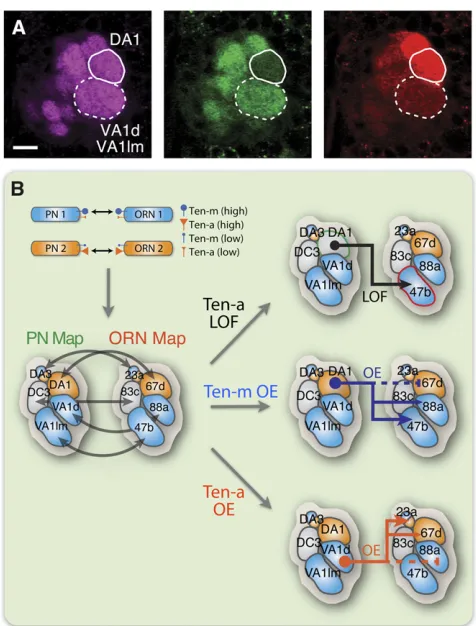
Based on the above observations, two unbiased genetic screens were performed to search for molecules controlling PN–ORN matching (Honget al.2012). These screens identi-fied two evolutionarily conserved EGF repeat-containing transmembrane Teneurins, Ten-m and Ten-a, as synaptic partner matching molecules (Hong et al. 2012). Ten-m and Ten-a are highly expressed in select PN and ORN matching pairs (Figure 4A). Loss- and gaof-function experiments in-volving Teneurins cause class-specific ectopic connections be-tween ORNs and PNs (Figure 4B). Specifically, increasing Teneurin levels in Teneurin-low PNs causes their dendrites to lose endogenous connections with Teneurin-low ORNs and mismatch with Teneurin-high ORNs, whereas overexpressing Teneurins in PNs that already express high levels of Teneurins does not disrupt the proper PN–ORN connections. Moreover, Teneurins mediate homophilic interactionsin vitroand pro-motetrans-cellular PN–ORN attraction via homophilic inter-actionsin vivo. Thesefindings suggest that Teneurins instruct synaptic matching specificity between PNs and ORNs through homophilic attraction, by matching Ten-m and Ten-a levels in PN and ORN partners (Figure 2C).
Teneurins are unlikely to be the only molecules regulating PN–ORN matching. Since the antennal lobe contains50 pairs of PNs and ORNs, additional cell-surface molecules most likely work together with Teneurins to further distinguish matching specificity among different Teneurin-high classes or among different Teneurin-low classes, so that each of the50 PN– ORN connections can be precisely established.
Refinement, Maintenance, and Synaptogenesis
After converging onto individual glomeruli and making the proper connections, PN dendrites and ORN axons are restricted into single glomeruli with no overlap between neighboring classes. It is likely that in addition to restricting dendriticfields in an early developmental stage, N-cadherin continues to contribute to the refinement of dendrites to single glomeruli through interactions between dendrites from the same classes. Once the adult antennal lobes are formed and proper axon–dendrite connections are established, the organization of the PN dendrites and ORN axons appears stable and in-sensitive to perturbations. Selective cell ablation or different
olfactory experience leads to minimal changes in glomerular organization (Devaudet al.2003; Berdniket al.2006).
Synaptogenesis occurs at a late stage of antennal lobe development. Ultrastructural analysis using electron micros-copy suggests that the formation of presynaptic specializa-tion occurs 48–72 hr after puparium formation, although synaptobrevin-GFP, a synaptic marker, is already accumu-lated in the developing axons before this period (Devaud et al. 2003). This suggests that synapse formation follows after the establishment of connections between PN den-drites and ORN axons. Teneurins, the instructive molecules involved in matching proper PN and ORN partners, were found to be required for synaptogenesis in the Drosophila neuromuscular junction (Mosca et al. 2012); it will be
interesting to test whether they also contribute to the for-mation of synapses in the olfactory system.
Local Interneurons
In addition to the processes of1300 ORNs and200 PNs, the antennal lobe also contains neurites from 200 local interneurons (LNs) (Daset al.2008; Laiet al.2008; Okada et al.2009; Chouet al.2010a). LNs make connections with both ORN axons and PN dendrites and play important roles in ORN-to-PN information transformation (Wilson 2013). In contrast to the one-to-one PN–ORN connectivity, LNs show a remarkable diversity and variability in their glomerular innervation patterns (Chou et al.2010a). Some LN classes extend neurites throughout the antennal lobe, whereas other LN classes restrict dendrites only to a subset of glomeruli. Among LN classes that show restricted patterns, some inner-vate continuous glomerular regions and others innerinner-vate the antennal lobe in a patchy configuration. Surprisingly, certain LN classes display a striking variability in their glomerular innervation pattern across different animals.
Arborization of LN dendrites requires Dscam. Similar to its function in PN dendrites, Dscam plays a repulsive role between sister dendrites of the same LNs, causing the dendrites to expand and preventing them from collapsing onto each other (Zhu et al.2006a). In addition, the estab-lishment of LN arborization also requires interactions with ORN axons during development (Chou et al. 2010a). The molecular mechanism underlying the variability of the LN dendritic arborization, however, is still largely unknown. It would be interesting to further characterize the developmental process of LNs and to examine whether PN dendrites contrib-ute to the glomeruli-specific arborization of LNs, and whether LNs contribute to the establishment of PN–ORN connectivity.
Interestingly, LN dendrites and ORN axons appear to occupy distinct subcompartments within a glomerulus (Hummel and Zipursky 2004). Dendrites of at least some LNs predominantly occupy only a small region in the central part of each glo-merulus, and these dendrites are surrounded by synapses formed by ORN axons in the peripheral areas of a glomeru-lus. In contrast to the lack of overlap between LN dendrites and ORN synapses, PN dendrites extend throughout an entire glomerulus and overlap extensively with ORN axons (Hummel and Zipursky 2004). This subcompartmental specialization within a glomerulus would be an intriguing topic for further investigation.
Principles and Open Questions
A working model for olfactory circuit assembly
The advances summarized above suggest that a series of coordinated mechanisms regulate three major stages in the assembly of thefly olfactory system (Figure 2):
1. PN dendrite patterning precedes ORN axon targeting and relies on adhesive and repulsive molecules to establish their
dendriticfield. Their glomerulus-specific targeting is con-trolled by global gradients, including 1a and Sema-2a/-2b, as well as local discrete determinants such as Capricious and Tartan that are distributed in a“ salt-and-pepper”fashion on dendrites projecting to different glo-meruli (Figure 2A).
2. Prior to arriving at their coarse target in the antennal lobe, ORN axonsfirst make critical developmental trajec-tory choices through both axon-derived and central-brain-derived cues such as Sema-2a and Sema-2b. The initial targeting of axons into appropriate antennal lobe regions involves several cellular and molecular mechanisms that include axon–axon interactions mediated by Sema-1a and PlexinA as well as axon–target interactions mediated by Hh and its receptor Ptc (Figure 2B).
3. Thefinal one-to-one matching between ORN axons and PN dendrites is coordinated by Teneurin-mediated homo-philic attractive interactions between axons and dendrites (Figure 2C). These mechanisms act in a sequential and coordinated manner, which eventually leads to the precise one-to-one connectivity between 50 PN and ORN classes in 50 glomeruli.
Given the number of ORN and PN classes that need to be precisely wired in the olfactory circuit, the molecules identified so far are most likely incomplete. Future identification and mechanistic studies of additional players might reveal new principles that have not been uncovered thus far (discussed below).
Continuous vs. discrete neural maps
Spatial representation of the external world in neural maps is important for the nervous system to effectively process and integrate sensory information (McLaughlin and O’Leary 2005; Luo and Flanagan 2007). In many sensory systems, such as the visual and auditory systems, neurons connect nearby spatial/tonic inputs to nearby target regions in the brain and form a spatially continuous neural map. In the olfactory system, however, synaptic connections are organized into spatially separated structural units, thereby forming a dis-crete neural map.
for neural map formation is also seen in the targeting process of the mammalian ORN axons to the olfactory bulb (Imai et al.2010; Sakano 2010) and thus may represent a general solution to the problem of constructing a discrete map.
Multiple types of cellular interactions
Recent advances have highlighted several types of inter-actions between neurons in the developing antennal lobe, including interactions between axons from different ORN classes (Sema-1a/PlexinA and Sema-1b/PlexinB), repulsive interactions between dendrites from the same PN classes (Dscam), attractive interactions between dendrites from the same PN classes (Ncad), interactions between dendrites from different PN classes (Caps/Trn), and attractive interactions between axons and dendrites that target the same glomeruli (Teneurins), as well as the interactions between ORNs and glia (Wnt5/Drl). It should be noted that these previous works largely focused on part of the antennal lobe where reagents are available to genetically label and manipulate specific classes of neurons. It remains to be tested whether these previously identified mechanisms are generalizable to other classes of PNs and ORNs or whether new mechanisms are involved.
Other conceptually different types of interactions may also contribute to wiring specificity of the olfactory circuit. For example, axon–dendrite repulsions between nonpartner PNs and ORNs that innervate neighboring glomeruli could serve as a mechanism to avoid inappropriate PN–ORN connections and ensure the proper matching. In addition, dendrite–dendrite repulsions between neighboring PN classes may help confine dendrites of a single class of PNs into a single glomerulus and prevent them from entering neighboring glomeruli. Fi-nally, LNs may interact with PNs to contribute to patterning of the antennal lobe or may directly regulate wiring speci-ficity. These hypotheses remain to be tested.
Combinatorial Code in Constructing a Complex Circuit
Identifying individual genes and examining how each of them functions in select neurons is a common experimental approach to reveal the mechanisms underlying wiring spec-ificity. In a complex system involving interactions among thousands of neurons, this bottom-up approach sometimes has limitations in understanding system-level features that could be critical in gaining a complete picture of the target selection process. In the following section, we make an attempt to consider this problem in a top–down approach and speculate how combinatorial coding, redundancy, and error-correcting ability could contribute to establishing identi-ties and wiring patterns of different classes of neurons.
One neuron, many molecules
To specify targeting of different neuronal classes, the nervous system could utilize two alternative strategies: each neuron could be encoded (1) by expressing one unique molecule or
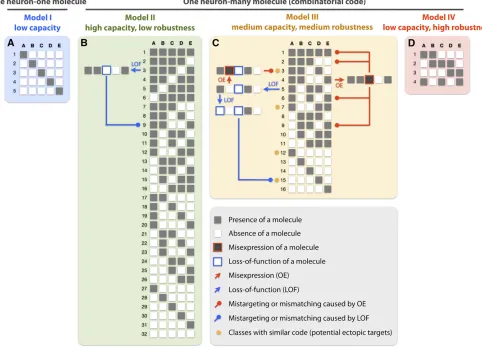
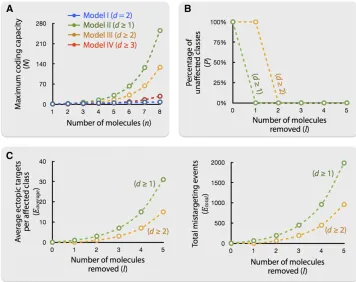
(2) by expressing a unique combination of molecules. Several studies suggest that the olfactory system adopts the latter strategy; namely, a single neuron expresses a combination of molecules, and each molecule is expressed in multiple neurons. For example, both Caps and Tartan are expressed in multiple classes of PNs; some PNs express both whereas others express either one of them (Honget al.2009). This distinct and partially overlapping pattern of expression forms a combinatorial code to regulate PN dendrite targeting. Sim-ilarly, both Ten-m and Ten-a are expressed in distinct and partially overlapping subsets of PNs and ORNs; some PN– ORN pairs express both of them whereas others express only either one of them (Hong et al. 2012). In this capacity, Teneurins form part of a combinatorial code for PN–ORN matching. Both cases exemplify how combinatorial action of multiple molecules assigns identities to individual PN and ORN classes. The use of a combinatorial code could greatly reduce the number of molecules required to uniquely iden-tify each neuronal class (Figure 5, A and B, Figure 6A, and Table 1, comparing models I and II).
Different ways of using a combinatorial code
We next discuss how combinatorial actions of multiple molecules determine the identities and wiring patterns of different neuronal classes. To simplify our discussion, we take only the presence or the absence of a molecule into account and propose three possible models (models II–IV, Figure 5 and Table 1). In all three models, each class of neurons expresses a combination of molecules. But these models have different minimum Hamming distance (Hamming 1950). Here, Hamming distance is defined as the molecular differ-ence between any two classes of neurons. In model II, at least one molecule is different between any two classes; in model III, at least two molecules are different; and in model IV, at least three molecules are different. Although these models are simplified from the real target selection process, this simpli-fication allows us to focus on a few important system-level properties, discuss how these properties may contribute to wiring specificity, and evaluate which models are more con-sistent with experimental observations.
Coding capacity and redundancy
a class may mistarget following perturbation, and total mis-targeting events following perturbation (Table 2).
Among these three models, model II has the highest coding capacity, but is also the least robust, because altering one molecule may affect a large number of neurons expressing this molecule and render them indistinguishable from other classes that do not express this molecule (Figure 5B and Fig-ure 6, B and C). This does not seem to be what was observed in vivo. All single-gene loss-of-function mutants of the cell-surface molecules studied thus far tend to cause weak phe-notypes; dendrites or axons tend to still occupy their original glomeruli and only a small fraction of neurites innervate ectopic targets (Komiyama et al. 2007; Hong et al. 2009; Chouet al.2010b; Sweeneyet al.2011). Loss of cell-surface
proteins tends to produce phenotypes that are weaker than those produced by mutating nuclear factors (Tea and Luo 2011) or protein modification enzymes (Sekineet al.2013). One possibility is that cell-surface molecules are partially re-dundant with each other, and mutating transcription factors or protein modification enzymes causes misregulation of mul-tiple cell-surface molecules and leads to stronger defects.
Indeed, several cell-surface molecules previously identi-fied play partially redundant roles in regulating targeting of axons and dendrites (Hong et al. 2009; Sweeney et al. 2011). Thus, a redundant coding system illustrated in model III, in which two or more molecules are different between any two classes of neurons, is more consistent with what was observedin vivo(Figure 5C). Compared to model II, model
III keeps the entire system intact when removing one mol-ecule and produces fewer average ectopic targets and fewer total mistargeting events when removing more molecules (Figure 6, B and C). This is reminiscent of what was observed in the loss of function of Tartan, Sema-2a, or Sema-2b alone (Hong et al. 2009; Sweeney et al. 2011). Thus, model III would not only achieve a marked reduction of molecules re-quired but also increase the redundancy that makes wiring specificity more robust (Figure 6, A–C).
Note that during evolution there is less selection pressure on any gene that serves completely redundant functions, unless the gene is required elsewhere for thefitness of the organism. This may limit the degree of redundancy even though redundancy increases robustness.
Error-correcting ability
Wiring specificity could be impaired by two types of errors that may occur spontaneously or artificially. Adding/removing a molecule in all the neurons within a class or in all classes is considered type A. In this case, all neurons from a single class still possess a uniform combination of molecules. This occurs in a whole-animal mutant of a gene or in complete removal of a gene from a neuronal class. By contrast, adding/removing a molecule in a subset of neurons within a class is considered type B. In this situation, a single class of neurons is divided into two subpopulations of neurons that possess different combinations of molecules. This could occur when genes are mutated in a mosaic manner.
Model III (d $2) offers redundancy for type A errors; a perturbed class still possesses a unique identity that can be
distinguished from that of all other classes. But model III may not tolerate the type B errors, which may cause the perturbed subpopulation to have the same Hamming dis-tance to the unchanged subpopulation of the same class as to other classes with the closest identity (yellow dots in Figure 5C), so that the system is unable to determine which class the perturbed neurons belong to and correct the error. Since PNs and ORNs are separately specified, PN–ORN matching seems more susceptible to type B errors than PN dendrite targeting. However, misexpression screens of the same set of cell-surface molecules identified many fewer molecules affecting PN–ORN matching than those affecting PN dendrite targeting (Honget al.2009, 2012; W. Hong and L. Luo, unpublished results), suggesting the PN–ORN match-ing might possess a higher robustness, especially with re-spect to type B errors.
Model IV (d$3) has the highest redundancy among all three models and offers correcting ability for type B errors based on relative Hamming distance. A neuron with one molecule removed has a shorter Hamming distance to its original class than to other classes with the closest identity. This error-correcting ability could contribute to the specifi c-ity of PN–ORN matching. Although the higher redundancy greatly limits the number of identities certain molecules are able to encode, as indicated by the Hamming bound (Hamming 1950) (Table 1, Figure 6A), this reduced capacity may not pose a problem for PN–ORN matching as matching occurs at the last stage of the wiring process after both PNs and ORNs arrive at the local target area where they only encounter a limited number of possible partners.
One hypothesis, which is the most consistent with our observations so far, is that model III (d$2) is more broadly used in targeting of the same type of neurons in an initial stage (e.g., PN dendrite targeting) and model IV (d $3) is used locally to match multiple types of neurons in a final stage (e.g., PN–ORN matching). To what extent and how broadly the error-correcting ability is involved in controlling wiring specificity of neural circuits is an intriguing avenue to explore in the future.
How to reverse-engineer a redundant system
Although redundancy enhances wiring robustness, it presents a greater challenge for geneticists to identify molecules and examine their loss-of-function phenotypes, as it is more dif-ficult to perturb a redundant system using genetic experi-ments. How can we reverse-engineer a redundant system? First, it appears to be easier to cause a noticeable phenotype with misexpression compared with loss of function, partly because misexpression of a molecule may increase its ex-pression to a level much higher than its endogenous level
and this may create a stronger force that partially overrides other molecules (Honget al.2009, 2012). Second, simulta-neous manipulation of two molecules could also potentially create a larger change of identity code and cause a stronger phenotype. Indeed, in PN dendrite targeting, loss of Caps or Trn alone causes only partial or no mistargeting of a single PN VC1, whereas removing both Caps and Trn causes VC1 dendrites to completely mistarget to an ectopic glomerulus (Hong et al. 2009). Third, when a class contains multiple neurons, removing or misexpressing a molecule from a single neuron or a subset of neurons using MARCM (type B errors) may produce a partial but noticeable mistargeting pheno-type (Komiyamaet al.2007; Honget al.2009).
Although several molecules have been identified as part of the combinatorial code to determine targeting and connec-tion specificity, they are clearly not enough for all50 pairs of PNs and ORNs. To overcome redundancy in future identifi ca-tion of addica-tional wiring specificity molecules, enhancer screens in a sensitized background in which one molecule is removed and/or misexpression screens (Figure 5C and Figure 6, B
Table 2 Definition of properties related to robustness
Propertya Definitionb
No. maximum identities encoded NðnÞ
No. molecules removed l
No. neuronal classes affected following the removal of lmolecules Aðn;m;d;lÞ
Percentage of unaffected classes following the removal of lmolecules P¼NðnÞ2Aðn;m;d;lÞ
NðnÞ
Ectopic targets of a particular class following the removal of lmolecules Eiðn;m;d;lÞ
Average ectopic targets per affected class following the removal of lmolecules Eaverage¼
PA i¼1Eiðn;m;d;lÞ
A
Total mistargeting events following the removal of lmolecules Etotal¼P
A
i¼1Eiðn;m;d;lÞ
aOnly type A errors are considered.
bn; m; and dare parameters defined by different models in Table 1.
Table 1 Comparison of different models encoding neuronal identities
Model Case
Coding redundancya
(d)
Total no. molecules (n)
No. molecules in a neuron
class (m)
Maximum coding
capacity (N) Robustness
I. Each neuron class expresses a unique molecule Specific 2 5 1 5 High
General 2 n 1 n High
II. Each neuron class expresses a unique combination of molecules; at least one is different between two classes
Specific $1 5 ½0::5 32 Low
General $1 n ½0::n 2n Low
III. Each neuron class expresses a unique combination of molecules; at least two are different between two classes
Specific $2 5 ½0::5 16 Medium
General $2 n ½0::n P
½n=2
i¼0
n
n22i
¼2n21 Medium
IV. Each neuron class expresses a unique combination of molecules; at least three or more are different between two classes
Specific $3 5 ½0::5 4 High
General $d n ½0::n Hamming boundb
"
2n
Pt i¼0
n
i
#
wheret¼d21 2
High
aDefined as the Hamming distance between two classes.
and C) should be considered in addition to classic loss-of-function screens. Identification of combinatorial code in each of the50 PN and ORN classes remains a future chal-lenge. It would also be important to discover how multiple molecules work together in the same neuron to respond to external cues and whether they regulate independent or common downstream signaling pathways.
It should be emphasized that all four models are drasti-cally simplified in the sense that only the presence or the absence of a molecule is considered. In reality, molecules could be expressed at different levels, and identities could be specified in a spatial and/or temporal manner; all these contribute to the specificity. Moreover, the real biological system is unlikely to be designed via a top–down mechanism such that all classes use the same strategy. During evolution, different molecules and mechanisms were recruited gradually in anad hocbasis. Nevertheless, the discussion of these sim-plified hypothetical models could guide our thinking about how the system could work, how we should design genetic experiments that allow us to perturb the specificity, and how we should interpret results and ultimately uncover the code.
Concluding Remarks
The convergence of ORN axons and PN dendrites onto single glomeruli and the precise one-to-one matching between ORNs and PNs are remarkable examples of targeting specificity in neural development. Recent studies have uncovered several key mechanisms that control different aspects of this target speci-ficity. These mechanisms not only enhance the understanding of olfactory system assembly but also provide general insights into the principles by which complex neural circuits are assembled. As discussed above, many questions still remain to be addressed. Combining sophisticated genetic manipulations, we could identify additional cell-surface molecules that work together with the ones that have been identified and uncover the combinatorial code for each of the50 pairs of PNs and ORNs. All of these joint endeavors will help create a more comprehensive picture of the olfactory circuit wiring process and help us better understand the principles govern-ing wirgovern-ing specificity in general.
Acknowledgments
The authors thank A. Ward, W. Joo, X. Gao, J. Charalel, F. Ding, B. Wu, E. Wu, and Y. Hong for commenting on the manuscript. W. Hong is a Helen Hay Whitney Fellow. L. Luo is an investigator of the Howard Hughes Medical Institute. Research on the olfactory circuit wiring in the Luo labora-tory has been supported by National Institutes of Health grant R01 DC-005982.
Literature Cited
Ang, L.-H., J. Kim, V. Stepensky, and H. Hing, 2003 Dock and Pak regulate olfactory axon pathfinding in Drosophila. Development 130: 1307–1316.
Benton, R., K. S. Vannice, C. Gomez-Diaz, and L. B. Vosshall, 2009 Variant ionotropic glutamate receptors as chemosensory receptors in Drosophila. Cell 136: 149–162.
Berdnik, D., T. Chihara, A. Couto, and L. Luo, 2006 Wiring sta-bility of the adult Drosophila olfactory circuit after lesion. J. Neurosci. 26: 3367–3376.
Berdnik, D., A. P. Fan, C. J. Potter, and L. Luo, 2008 MicroRNA processing pathway regulates olfactory neuron morphogenesis. Curr. Biol. 18: 1754–1759.
Berdnik, D., V. Favaloro, and L. Luo, 2012 The SUMO protease Verloren regulates dendrite and axon targeting in olfactory pro-jection neurons. J. Neurosci. 32: 8331–8340.
Chihara, T., D. Luginbuhl, and L. Luo, 2007 Cytoplasmic and mi-tochondrial protein translation in axonal and dendritic terminal arborization. Nat. Neurosci. 10: 828–837.
Chou, Y.-H., M. L. Spletter, E. Yaksi, J. C. S. Leong, R. I. Wilson
et al., 2010a Diversity and wiring variability of olfactory local
interneurons in the Drosophila antennal lobe. Nat. Neurosci. 13: 439–449.
Chou, Y.-H., X. Zheng, P. A. Beachy, and L. Luo, 2010b Patterning axon targeting of olfactory receptor neurons by coupled hedge-hog signaling at two distinct steps. Cell 142: 954–966. Clyne, P. J., S. J. Certel, M. de Bruyne, L. Zaslavsky, W. A. Johnson
et al., 1999 The odor specificities of a subset of olfactory
re-ceptor neurons are governed by Acj6, a POU-domain transcrip-tion factor. Neuron 22: 339–347.
Couto, A., M. Alenius, and B. J. Dickson, 2005 Molecular, anatom-ical, and functional organization of the Drosophila olfactory system. Curr. Biol. 15: 1535–1547.
Das, A., S. Sen, R. Lichtneckert, R. Okada, K. Itoet al., 2008 Drosophila olfactory local interneurons and projection neurons derive from a common neuroblast lineage specified by the empty spiracles gene. Neural Dev. 3: 33.
de Wit, J., W. Hong, L. Luo, and A. Ghosh, 2011 Role of leucine-rich repeat proteins in the development and function of neural circuits. Annu. Rev. Cell Dev. Biol. 27: 697–729.
Devaud, J.-M., A. Acebes, M. Ramaswami, and A. Ferrús, 2003 Structural and functional changes in the olfactory pathway of adult Drosophila take place at a critical age. J. Neurobiol. 56: 13–23.
Endo, K., T. Aoki, Y. Yoda, K.-I. Kimura, and C. Hama, 2007 Notch signal organizes the Drosophila olfactory cir-cuitry by diversifying the sensory neuronal lineages. Nat. Neu-rosci. 10: 153–160.
Fishilevich, E., and L. B. Vosshall, 2005 Genetic and functional subdivision of the Drosophila antennal lobe. Curr. Biol. 15: 1548–1553.
Gao, Q., and A. Chess, 1999 Identification of candidate Drosoph-ila olfactory receptors from genomic DNA sequence. Genomics 60: 31–39.
Gao, Q., B. Yuan, and A. Chess, 2000 Convergent projections of Drosophila olfactory neurons to specific glomeruli in the anten-nal lobe. Nat. Neurosci. 3: 780–785.
Goldman, A. L., W. van der Goes van Naters, D. Lessing, C. G. Warr, and J. R. Carlson, 2005 Coexpression of two functional odor receptors in one neuron. Neuron 45: 661–666.
Goulding, S. E., P. zur Lage, and A. P. Jarman, 2000 amos, a pro-neural gene for Drosophila olfactory sense organs that is regu-lated by lozenge. Neuron 25: 69–78.
Gupta, B. P., and V. Rodrigues, 1997 Atonal is a proneural gene for a subset of olfactory sense organs in Drosophila. Genes Cells 2: 225–233.
Hamming, R. W., 1950 Error detecting and error correcting codes. Bell Syst. Tech. J. 29: 147–160.
Hong, W., H. Zhu, C. J. Potter, G. Barsh, M. Kurusu et al., 2009 Leucine-rich repeat transmembrane proteins instruct dis-crete dendrite targeting in an olfactory map. Nat. Neurosci. 12: 1542–1550.
Hong, W., T. J. Mosca, and L. Luo, 2012 Teneurins instruct synaptic partner matching in an olfactory map. Nature 484: 201–207. Hummel, T., and S. L. Zipursky, 2004 Afferent induction of
olfac-tory glomeruli requires N-cadherin. Neuron 42: 77–88. Hummel, T., M. L. Vasconcelos, J. C. Clemens, Y. Fishilevich, L. B.
Vosshall et al., 2003 Axonal targeting of olfactory receptor neurons in Drosophila is controlled by Dscam. Neuron 37: 221–231.
Imai, T., H. Sakano, and L. B. Vosshall, 2010 Topographic mapping— the olfactory system. Cold Spring Harb. Perspect. Biol. 2: a001776. Jefferis, G. S., and T. Hummel, 2006 Wiring specificity in the
olfactory system. Semin. Cell Dev. Biol. 17: 50–65.
Jefferis, G. S., E. C. Marin, R. F. Stocker, and L. Luo, 2001 Target neuron prespecification in the olfactory map of Drosophila. Na-ture 414: 204–208.
Jefferis, G. S., R. M. Vyas, D. Berdnik, A. Ramaekers, R. F. Stocker
et al., 2004 Developmental origin of wiring specificity in the
olfactory system of Drosophila. Development 131: 117–130. Jhaveri, D., S. Saharan, A. Sen, and V. Rodrigues, 2004 Positioning
sensory terminals in the olfactory lobe of Drosophila by Robo signaling. Development 131: 1903–1912.
Joo, W. J., L. B. Sweeney, L. Liang, and L. Luo, 2013 Linking cell fate, trajectory choice, and target selection: genetic analysis of Sema-2b in olfactory axon targeting. Neuron 78: 673–686. Komiyama, T., and L. Luo, 2007 Intrinsic control of precise
den-dritic targeting by an ensemble of transcription factors. Curr. Biol. 17: 278–285.
Komiyama, T., W. A. Johnson, L. Luo, and G. S. Jefferis, 2003 From lineage to wiring specificity. POU domain transcription factors control precise connections of Drosophila olfactory projection neurons. Cell 112: 157–167.
Komiyama, T., L. B. Sweeney, O. Schuldiner, K. C. Garcia, and L. Luo, 2007 Graded expression of semaphorin-1a cell-autonomously directs dendritic targeting of olfactory projection neurons. Cell 128: 399–410.
Lai, S.-L., T. Awasaki, K. Ito, and T. Lee, 2008 Clonal analysis of Drosophila antennal lobe neurons: diverse neuronal architec-tures in the lateral neuroblast lineage. Development 135: 2883–2893.
Laissue, P. P., C. Reiter, P. R. Hiesinger, S. Halter, K. F. Fischbach
et al., 1999 Three-dimensional reconstruction of the antennal
lobe in Drosophila melanogaster. J. Comp. Neurol. 405: 543–552. Luo, L., and J. G. Flanagan, 2007 Development of continuous and
discrete neural maps. Neuron 56: 284–300.
Marin, E. C., G. S. Jefferis, T. Komiyama, H. Zhu, and L. Luo, 2002 Representation of the glomerular olfactory map in the Drosophila brain. Cell 109: 243–255.
McLaughlin, T., and D. D. M. O’Leary, 2005 Molecular gradients and development of retinotopic maps. Annu. Rev. Neurosci. 28: 327–355. Mosca, T. J., W. Hong, V. S. Dani, V. Favaloro, and L. Luo, 2012 Trans-synaptic Teneurin signalling in neuromuscular synapse organization and target choice. Nature 484: 237–241. Okada, R., T. Awasaki, and K. Ito, 2009 Gamma-aminobutyric
acid (GABA)-mediated neural connections in the Drosophila an-tennal lobe. J. Comp. Neurol. 514: 74–91.
Sakano, H., 2010 Neural map formation in the mouse olfactory system. Neuron 67: 530–542.
Sakurai, M., T. Aoki, S. Yoshikawa, L. A. Santschi, H. Saitoet al., 2009 Differentially expressed Drl and Drl-2 play opposing
roles in Wnt5 signaling during Drosophila olfactory system de-velopment. J. Neurosci. 29: 4972–4980.
Sekine, S. U., S. Haraguchi, K. Chao, T. Kato, L. Luo et al., 2013 Meigo governs dendrite targeting specificity by modulat-ing ephrin level and N-glycosylation. Nat. Neurosci. 16: 683– 691.
Silbering, A. F., R. Rytz, Y. Grosjean, L. Abuin, P. Ramdya et al., 2011 Complementary function and integrated wiring of the evolutionarily distinct Drosophila olfactory subsystems. J. Neu-rosci. 31: 13357–13375.
Simon, A. F., I. Boquet, M. Synguélakis, and T. Préat, 1998 The Drosophila putative kinase linotte (derailed) prevents central brain axons from converging on a newly described interhemi-spheric ring. Mech. Dev. 76: 45–55.
Spletter, M. L., J. Liu, J. Liu, H. Su, E. Ginigeret al., 2007 Lola regulates Drosophila olfactory projection neuron identity and targeting specificity. Neural Dev. 2: 14.
Su, C.-Y., K. Menuz, and J. R. Carlson, 2009 Olfactory perception: receptors, cells, and circuits. Cell 139: 45–59.
Sweeney, L. B., A. Couto, Y.-H. Chou, D. Berdnik, B. J. Dickson
et al., 2007 Temporal target restriction of olfactory receptor
neurons by Semaphorin-1a/PlexinA-mediated axon-axon inter-actions. Neuron 53: 185–200.
Sweeney, L. B., Y.-H. Chou, Z. Wu, W. Joo, T. Komiyama et al., 2011 Secreted semaphorins from degenerating larval ORN ax-ons direct adult projection neuron dendrite targeting. Neuron 72: 734–747.
Tea, J. S., and L. Luo, 2011 The chromatin remodeling factor Bap55 functions through the TIP60 complex to regulate olfac-tory projection neuron dendrite targeting. Neural Dev. 6: 5. Tea, J. S., T. Chihara, and L. Luo, 2010 Histone deacetylase Rpd3
regulates olfactory projection neuron dendrite targeting via the transcription factor Prospero. J. Neurosci. 30: 9939–9946. Vosshall, L. B., and R. F. Stocker, 2007 Molecular architecture of
smell and taste in Drosophila. Annu. Rev. Neurosci. 30: 505– 533.
Vosshall, L. B., H. Amrein, P. S. Morozov, A. Rzhetsky, and R. Axel, 1999 A spatial map of olfactory receptor expression in the Drosophila antenna. Cell 96: 725–736.
Vosshall, L. B., A. M. Wong, and R. Axel, 2000 An olfactory sen-sory map in thefly brain. Cell 102: 147–159.
Wilson, R. I., 2013 Early olfactory processing in Drosophila: mechanisms and principles. Annu. Rev. Neurosci. 36: 217–241. Wilson, R. I., and Z. F. Mainen, 2006 Early events in olfactory
processing. Annu. Rev. Neurosci. 29: 163–201.
Wong, A. M., J. W. Wang, and R. Axel, 2002 Spatial representa-tion of the glomerular map in the Drosophila protocerebrum. Cell 109: 229–241.
Yao, Y., Y. Wu, C. Yin, R. Ozawa, T. Aigakiet al., 2007 Antagonistic roles of Wnt5 and the Drl receptor in patterning the Drosophila antennal lobe. Nat. Neurosci. 10: 1423–1432.
Zhu, H., and L. Luo, 2004 Diverse functions of N-cadherin in dendritic and axonal terminal arborization of olfactory projec-tion neurons. Neuron 42: 63–75.
Zhu, H., T. Hummel, J. C. Clemens, D. Berdnik, S. L. Zipurskyet al., 2006a Dendritic patterning by Dscam and synaptic partner matching in the Drosophila antennal lobe. Nat. Neurosci. 9: 349–355.
Zhu, S., S. Lin, C.-F. Kao, T. Awasaki, A.-S. Chiang et al., 2006b Gradients of the Drosophila Chinmo BTB-zinc finger protein govern neuronal temporal identity. Cell 127: 409–422.