Design an Energy-Efficient Approximate
Multiplication for Digital Signal Processing
Application
S. Paranthaman1, S. Vijay Murugan2
PG Scholar, Department of ECE, Adhiyamaan College of Engineering, Hosur, Tamilnadu, India1
Asst. Professor, Department of ECE, Adhiyamaan College of Engineering, Hosur, Tamilnadu, India2
ABSTRACT: The need to support various digital signal processing (DSP)and classification applications on energy-constrained devices has steadily grown. Such applications often extensively perform matrix multiplications using fixed-point arithmetic while exhibiting tolerance for some computational errors. Hence, improving the energy efficiency of multiplications is critical. In this brief, we propose multiplier architectures that can tradeoff computational accuracy with energy consumption at design time. Compared with a precise
multiplier, the proposed multiplier can consume 58% less energy/op with average computational error of ∼1%.
Finally, we demonstrate that such a small computational error does not notably impact the quality of DSP and the accuracy of classification applications.
KEYWORDS: VLSI, Embedded Systems, Integrated Circuits, DSP
I. INTRODUCTION
In this brief, we propose an approximate multiplication techniquethat takes m consecutive bits (i.e., m -bit segment) from each n-bit operand, where m is equal to or greater than n/2. An m-bit segment can start only from one of two or three fixed bit positions depending on where the leading one bit is located for a positive number. This approach can provide much higher accuracy than one simply truncating the LSBs, because it can more effectively capture more noteworthy bits. Although we can capture m-bit segments starting from the exact leading one bit position, such an approach requires expensive LODs and shifters to take m-bit segments starting from the leading one position, steer them to an m ×m multiplier, and expand 2m bits to 2n bits. In contrast, our approach is more scalable than one that captures m-bit segments starting from the leading one bits since it limits the possible starting bit positions of an m-bit segment to two or three regardless of m and n chosen at design time, eliminating LODs, and replacing shifters with multiplexers. Finally, we also observe that one of two operands in each multiplication for DSP and classification algorithms is often stored in memory (e.g., coefficients in filter algorithms and trained weight values in artificial neural networks) and repeatedly used. We exploit it to further improve the energy efficiency of our approximate multiplier.
II. APPROXIMATE COMPUTATION TECHNIQUES
particular n-bit approximate arithmetic circuit, several error criteria can be used such as Error magnitude, Relative error, Average error magnitude and Error probability (error rate). Approximate circuits have been considered for error-tolerant applications that can tolerate some loss of accuracy with improved performance and energy efficiency. Applications including recognition, multimedia and data mining are inherently error-tolerant and do not require a perfect accuracy in computation. For such applications, approximate circuitsmay play an important role as an effective alternative for reducing power, area and delay in digital systems that can tolerate some loss of accuracy, thereby achieving better performance in energy efficiency. Such exhibit the interesting property of high inherent algorithmic resilience to “errors” from both extrinsic and intrinsic sources.
To improve energy efficiency of multipliers, previous studies have explored various techniques exploiting computational error tolerance. They can be classified into three categories:Aggressive voltage scaling, Truncation of bit-width, use of inaccurate building blocks. In a new systematic approach based on the concept of scalable effort hardware, for the design of efficient hardware implementations for algorithmsthat demonstrate inherent error resilience was presented. The efficiency of digital multiplication can be improved tremendously by truncation methods provided precise outputs are not required for the operation. In the paper a new multiplexer based truncation scheme with lower average and mean square errors than existing truncation methods wasproposed.
III. PROPOSED APPROXIMATE MULTIPLICATION TECHNIQUE
1. SEGMENT BASED MULTIPLICATION
Energy efficiency of multiplication is a critical objective. Since many digital applications use fixed- point arithmetic, it exhibits tolerance for computational errors. In this project, a multiplier is proposed that can tradeoff computational accuracy with energy consumption. “Segmenting the original operands with significant bits and performing the multiplication only for those segments is the main principle”. The proposed technique performsapproximate multiplication exploiting significant segments ofoperands unlike the existing techniques such as aggressive voltage scaling; truncation of bit-width and use of inaccurate building blocks for approximate multiplication. The general procedure for the segmentation based multiplication is given below: If two n- bit operands are to be multiplied then the general procedure for multiplication through the method of segmentation is given below:
·Given two n-bit (say 16-bit) operands
·Select m-bit (say 8-bit)segment from each n-bit operand ·This Segment must contain the leading one bit
·Multiply these two m-bit segments
·Expand the 2m-bit product to 2n-bit product
2. Methods
Based on the way in which a segment is selected from the operand, three methods are followed: ·Dynamic Segment Method (DSM)
.Static Segment Method (SSM)
. Enhanced Static Segment Method (ESSM)
3.2.1 Dynamic Segment Method (DSM)
In order to motivate and describe the proposed multiplier, we define an m-bit segment as m contiguous bits starting with the leading one in an n-bit positive operand. We dub this method dynamic segment method (DSM) in contrast to static segment method (SSM) that will be discussed later in this section. With two m-bit segments from two n-m-bit operands, we can perform a multiplication using an m ×m multiplier. In this method, we can achieve 99.4% accuracy for a 16 × 16 multiplication even with an 8 × 8 multiplier. This method can capture m-bit segments starting from the exact leading one bit position as shown in Figure 1.
Figure 1: An example of Dynamic Segment Method
Such a multiplication approach has little negative impact on computational accuracy because it can eliminates redundant bits (i.e., sign-extension bits) while feeding the most useful m significant bits to the multiplier. Furthermore, anm×m multiplier consumes much less energy than an n×n multiplier, because the complexity (and thus energy consumption) of multipliers quadratically increases with n. For example, the 4 × 4 and 8 × 8 multipliers consume almost 20 × and 5 × less energy than a 16×16 multiplier per operation on average. A DSM requires: Two LODs; Two n-bit shifters to align the leading one position of each n-bit operand to the MSB position of each m-bit segment to apply their m-bit segments to the m×m multiplier; and One 2n-bit shifter to expand a 2m-bit result to 2n bits. Hardware requirements incur considerable area and energy penalties completely negating the energy benefit of using the m × m multiplier; The area and energy penalties associated with three requirements in DSM are to capture an m-bit segment starting from an arbitrary bit position in an n-bit operand because the leading one bit can be anywhere. Thus, to limit possible starting bit positions to extract an m-bit segment from an n-bit operand to two or three at most in SSM is proposed.
3.2.2 Static Segment Method (SSM)
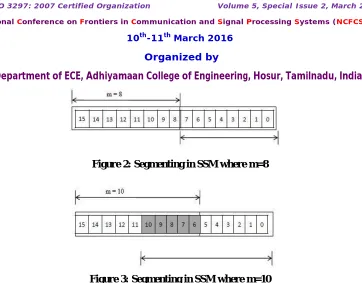
The proposed method for approximate multiplication is the Static Segment Method (SSM).Regardless of m and n, we have four possible combinations of taking two m-bit segments from two n-bit operands for a multiplication using the m-bit SSM. For a multiplication, we choose the m-bit segment that contains the leading one bit of each operand and apply the chosen segments from both operands to the m×m multiplier. Two design architectures using two different numbers of bits for the segment is given as shown in figure 2 and 3 below:
·SSM_8X8 – where the segment size (m) is 8 bit ·SSM_10X10 – where the segment size (m) is 10 bit
--- SEGMENT STARTING FROM LEADING 1
Figure 2: Segmenting in SSM where m=8
Figure 3: Segmenting in SSM where m=10
The SSM greatly simplifies the circuit that chooses m-bit segments and steers them to the m×m multiplier by replacing two n-bit LODs and shifters for the DSM with two (n–m)-input OR gates and m-bit 2-to-1 multiplexers; if the first (n–m) bits starting from the MSB are all zeros, the lower m-bit segment must contain the leading one. Furthermore, the SSM also allows us to replace the 2n-bit shifter used for the DSM with a 2n-bit 3-to-1 multiplexer.
Figure 4: Three possible shifting processes in SSM
Figure 5: SSM architecture
For applications where one of operands of each multiplication is often a fixed coefficient, we propose to pre compute the bit-wise OR value of B[n–1:m] and preselect between two possible m-bit segments (i.e., B[n– 1:n–m] and B[m–1:0]) in Figure 5, and store them instead of the native B value in memory. The accuracy of an SSM with m = n/2 can be significantly low for operands shown in figure
Here many MSBs of m-bit segments containing the leading one bit are filled with zeros. On the other hand, such a problem becomes less severe as m is larger than n/2; there is an overlap in a range of bits covered by both possible m-bit segments as shown for m = 10.
3.2.3 Enhanced Static Segment Method (ESSM)
To support three possible starting bit positions for picking an m-bit segment where m = n/2, the two 2-to-1 multiplexers at the input stage and one 3-to-1 multiplexer at the output stage are replaced with 3-to-1 and 5-to-1 multiplexers, respectively, along with some minor changes in logic functions generating multiplexer control signals. These changes lead to an enhanced architecture method called Enhanced Static Segment Method (ESSM) which is shown in figure 7. This enhanced SSM design for m = 8 and n = 16 (denoted by ESSM8×8) can provide as good accuracy as SSM10×10 at notably lower energy consumption.
Figure 6: Segmenting in ESSM where m=8
3.2.4 Optimization of Proposed Architecture
IV. SIMULATION ANDIMPLEMENTATION RESULTS
In this project, design and implementation of energy efficient multiplier architectures were simulated using Verilog Hardware Description Language. The Xilinx Design ISE (Integrated Software Environment) 13.2 was used to analyze the performance parameters of these architectures. The performance parameters include power, delay and area. Spartan 6 was considered as the operating device.
4.1 Comparative Analysis of Approximate Multipliers
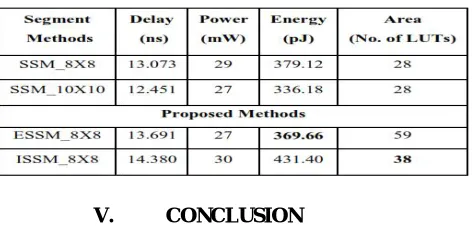
The comparison here involves around the performance parameters of approximate multiplier methods discussed so far. Table 1 represents the average computational error (in %) of the product obtained from different methods discussed. On an average, 30 different pairs of operands are considered for this tabulation. ESSM proves to be better in accuracy.
Table 1: Analysis of Average Computational Error
Methods Analysis Avg. Computational Error%
Segment Methods SSM_8X8, SSM_10X10 ~6, ~1
Proposed Methods ESSM_8X8, ISSM_8X8 ~1, ~3
Table 2 represents the analysis of performance parameters such as delay, power, energy and area consumed for all the four methods. ESSM proves to be better in energy whereas ISSM reduces the area overhead.
Table 2: Analysis of Delay, Power and Area
V. CONCLUSION
maintaining the quality even in energy efficient devices. It can also lead to better performances when one of the operands of the multiplication is kept fixed.
REFERENCES
[1] SrinivasanNarayanamoorthy,HadiAsghariMoghaddam, Zhenhong Liu, Taejoon Park, and Nam Sung Kim, July 2015, “Energy-Efficient Approximate Multiplication for Digital Signal Processing and Classification Applications”, IEEE Transactions on Very Large Scale Integration (VLSI) Systems, Early Access Articles, pp. 1 – 5.
[2] ZdenekVasicek and Lukas Sekanina, April 2014, Evolutionary Design of Approximate Multipliers under Different Error Metrics”, Design and Diagnostics of Electronic Circuits & Systems, 17th International IEEE Symposium, pp. 135 – 140.
[3] K. S. Ganesh Kumar, J. Deva Prasannam, M. Anitha Christy, March 2014, “Analysis of Low Power, Area and High Performance Multipliers for DSP applications”, International Journal of Emerging Technology and Advanced Engineering, Volume 4, Issue 3,pp.278-382.
[4] Vinay K. Chippa, Srimat T. Chakradhar, Kaushik Roy and AnandRaghunathan, May- June 2013, “Analysis and Characterization of Inherent Application Resilience for Approximate Computing”, IEEE Design Automation Conference (DAC), 2013 50th ACM / EDAC / IEEE, pp. 1- 9.
[5] Jie Han, Michael Orshansky, May 2013, “Approximate Computing: An emerging Paradigm for Energy-Efficient Design”, Test Symposium (ETS), 2013 18th IEEE European, pp. 1-6.
[6] A.Kishore Kumar, D. Somasundareswari, V. Duraisamy and T. ShunbagaPradeepa, February 2013 , “Design of Low Power Multiplier with Energy Efficient Full Adder Using DPTAAL” Hindawi Publishing Corporation,VLSI Design, Volume 2013, pp. 1-9.
[7] P. Kulkarni, P. Gupta, and M. Ercegovac, January 2011 “Trading accuracy for power with an under designed multiplier architecture,” in
Proc.24th IEEE Int. Conf. VLSI Design (VLSID), pp. 346–351.
[8] C.H. Chang and R. K. Satzoda, December 2010, “A low error and high performance multiplexer-based truncated multiplier,” IEEE Trans. Very Large Scale Integr. (VLSI) Syst., vol. 18, no. 12, pp. 1767–1771.
[9] V. K. Chippa, D. Mohapatra, A.Raghunathan, K. Roy, and S. T. Chakradhar, June 2010, “Scalable effort hardware design: Exploiting algorithmic resilience for energy efficiency,” in Proc. 47th IEEE/ACM Design Autom. Conf., pp. 555–560. [10]Sjalander.M, Larsson-Edefors,P., Aug. 31 2008-Sept. 3 2008, “High-speed and low-power multipliers using the Baugh-