Free vibration of rectangular composite plates with localized patch mass
A. Alibiglu1) , M. Shakeri2)and M.R. Kari1)1) Bu Ali Sina Univ., Iran
2) Amirkabir Univ. of Technology, Iran
ABSTRACT
The free vibration of composite plate with various edges condition and carrying distributed patch mass is presented. The Rayleigh_Ritz approach is applied to give frequency characteristic of the rectangular plates. The deflection of the plate is postulated by a double fourier series function. The effect of the various combination of clampad(c) and simply supported(s) edges conditions on the response of plates, is also presented. Finally the results for the simple form of the plate is compared with the results of available in the published literature.
INTRODUCTION
Free vibration problems of plates with and without mass loading are very common in engineering applications. Rectangular plates have wide applications in civil and mechanical engineering. A large number of structural components in the engineering industries such as the aircraft and aerospace industry can be modeled as beams, plates, and shells. These structural components, in many instances, are subjected to vibration. The problem of plates carrying distributed patch mass initiated from the design of electronic systems. The printed circuit boards and plate like chassis can be approximated as flat rectangular plates carrying distributed patch mass and subjected to vibration. Chai Gin Boay presented a complete analysis for natural frequencies of plates with and without concentrated mass for various edges condition of the plate [1,2,3]. Also there are some papers on frequency analysis of orthotropic and anisotropic plates, for example Laura [4] and Ming [5]. Wong [6] and Kompaz [7] presented an analysis on plates vibration with distributed mass.
In this paper the free vibration of anisotropic is emphasized. It deals with the determination of the transverse, dynamic response of rectangular anisotropic plates carrying distributed patch mass. The problem is solved using Rayleigh_Ritz method by means of a double fourier series when the plate is isotropic or anisotropic. Good convergence is obtained by expanding number of terms in the double fourier series function.
PLATE WITH DISTRIBUTED PATCH MASS
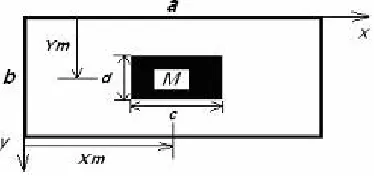
Consider a thin anisotropic rectangular plate of length a, width b and thickness t, and carrying a distributed patch mass located at
x
=
x
m,
y
=
y
m with length c and width d (Fig. 1).Fig. 1 Coordinate system for plate
The strain energy of bending without rotary inertia effects is:
)} / ( 4 )] / ( ) / ( [
) / ( 4 ) / ( /
/ 2
) / ( { 2 / 1
2 66 2
2 26 2 2 16
2 2 2 2 22 2 2 2 2 12 2 2 2 11
y x w D y w D x w D
y x w y
w D y w x w D x
w D Ub
+ +
×
+ +
× +
=
(1)
Where
w
is the displacement amplitude of the plates andD
ij are the flexural rigiditiesThe maximum kinetic energy of the plate carrying distributed patch mass is given as:
;
} dxdy ) y , x ( w ) y , x ( dxdy ) y , x ( w ) y , x ( { / T m A m p A pmax = 2 + (2)
Where
A
pandA
m are the areas of the plate and distributed patch mass respectively.Using Eq. (1) and (2), the total energy of the vibrating plate is obtained as the follows
max max T U
V= (3)
Eq. (3) can be write in a non-dimensional form by introducing
b d d a c c D a h b y y a x x a w w a b r p m
r , / , /
, / , / , / , / 4 2
2= = = =
= = = = (4) ) y w D D r x w D D ( ) y x w ( r ) y w ( D r D y w x w D r D ) x w [( rD V V p A nd 2 2 11 26 2 2 2 11 16 2 2 2 2 11 4 22 2 2 2 2 11 2 12 2 2 2 11 1 4 2
2 = + + + + +
=
}
y
d
x
d
w
y
d
x
d
w
{
y
d
x
d
]
)
y
x
w
(
D
D
r
Ap Am pm
+
2 2 2 2 211 26 2
4
(5)
Displacement can be assumed in the classical form such as
= M m N n n m mn
a x y A X xY y
w ( , ) ( ) ( ) (6)
The various shape function for
X
(
x
)
andY
(
y
)
to describe the different combination of edge support conditions are given in Table1.Table1. Assumed shape function using a single term trigonometric function
n m, ) (y Yn ) (x Xm
Two opposite edge
,... 2 , 1 ,... 2 , 1 = = n m b y n sin a x m sin s-s ,... 4 , 2 ,... 4 , 2 = = n m b y n b y 2 sin 2 sin a x m a x 2 sin 2 sin c-s ,... 2 , 1 ,... 2 , 1 = = n m b y n b y sin sin a x m a x sin sin c-c
To find fundamental frequencies, based on the principle of minimum potential energy, Eq. (5) is minimized with respect to the unknown coefficients to give a series of homogeneous simultaneous equations:
0 , 0 , 0 12 11 = = = mn A V A V A V (7)
Rearranging the Eq. (7) yields
}
]{
[
}
]{
[
K
A
=
2S
A
(8)Where
K
is the stiffness matrix,S
is the mass matrix andA
is the vector of the unknown coefficients. By minimizing Eq. (7) respect to unknown coefficients, a linear system of non_homogeneous Equations in term ofmn
A
constants are obtained. Solution of Eq. (8) are the values of non dimensional frequencies.RESULTS
B
By setting =0
p
m in Eq. (5) the results should be same as for isotropic or anisotropic plates without mass. We
compare our results for three cases with Wong [6] in Table 2. These results are for isotropic and we have:
10 , 15 . 0 , 1 . 0 , 45 . 0 , 3 . 0 , 5 . 1 , 1 : 3
10 , 15 . 0 , 1 . 0 , 75 . 0 , 5 . 0 , 5 . 1 , 1 : 2
4 . 0 , 75 . 0 , 5 . 0 , 75 . 0 , 5 . , 5 . 1 , 1 : 1
= =
= =
= =
=
= =
= =
= = =
= =
= =
= =
=
h M d
c y
x b a case
h M d
c y
x b a case
h M d
c y
x b a case
c c
c c
c c
Table 2. Comparative results with WONG
Case no. Result Mode 1 Mode 2 Mode 3 Mode 4 Mode 5
Wong 12.66 25.39 40.61 46.57 54.28 Case 1
Present 12.66 25.42 40.64 46.63 54.38 Wong 12.08 26.89 41.99 45.35 56.89 Case 2
Present 12.02 27.25 43.54 43.59 57.02 Wong 13.05 24.75 39.95 48.53 53.15 Case3
Present 13.07 24.86 40.29 48.58 53.51
For an anisotropic plate (
D
12/
D
11=
0
.
3
,
D
22/
D
11=
D
66/
D
11=
0
.
5
,
D
16/
D
11=
D
26/
D
11=
1
/
3
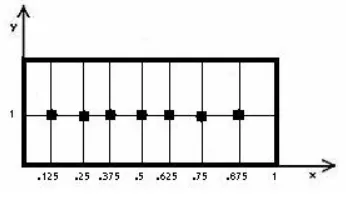
) Fig. 3 shows the effect of the distributed patch mass placed along the plate`s length at position y=1. In this case we have05
.
,
1
.
,
100
,
2
=
=
=
=
c
d
r
.Fig. 2 Mass position along length
Location of Mass along Length
0 5 10 15 20 25
0 0.2 0.4 0.6 0.8 1
Position
M
o
d
e
1
F
re
q
u
en
c
y
cccc
cccs
ccss
scsc
scss
ssss
Fig. 3 Location of mass along length with y=1
E
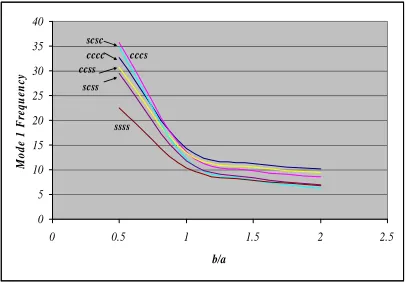
Another analysis is calculating the effect of r on plate`s frequency. These results are shown in Fig. 4.
0 5 10 15 20 25 30 35 40
0 0.5 1 1.5 2 2.5
b/a
M
o
d
e
1
F
re
q
u
en
cy
scsc cccs
ssss scss ccss cccc
Fig. 4 The effect of r on frequency for anisotropic
For the anisotropic plate with r=1, =100 you can see the effect of distributing patch mass area on the plate in Fig. 5 for various boundray edge condition.
0 5 10 15 20 25 30
0 0.2 0.4 0.6 0.8 1 1.2
c
M
o
d
e
1
F
re
q
u
en
cy scsc
ccss cccs
scss ssss
cccc
Fig. 5 The effect of distributing mass on frequency
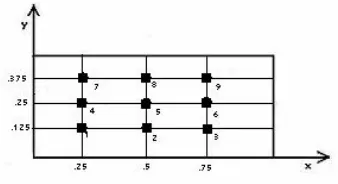
The last analysis is computig the frequency of an anisotropic plate with distributed patch mass in deferent position
on it. You can see the results in Table 3 for
r
=
.
5
,
=
25
,
c
=
.
1
,
d
=
.
2
.Table 3. Fundamental frequency with mass on different position
cccc
cccs ccss scsc scss ssss position
55.86
67.21 54.93 51.47 48.38 29.35 1
45.94
48.14 47.14 49.16 45.68 27.22 2
63.17
48.17 43.15 53.76 50.29 32.43 3
42.03
58.36 51.56 36.98 33.53 26.26 4
32.69
35.76 30.66 34.8 29.54 22.43 5
42.03
33.17 26.82 36.98 33.54 26.26 6
63.17
70.13 52.28 53.76 35.74 32.43 7
45.94
51.82 31.96 49.16 30.43 27.22 8
55.86
44.02 27.94 51.47 31.7 29.35 9
H
Fig. 6 Different position of mass
CONCLUSION
A free vibration of rectangular anisotropic plates with distributed patch mass has been presented. The edges of the plates are combination of clamped and simply supported. The effect of the size and location of a distributed patch mass and excitation on the plate`s behavior has been investigated. The Rayleigh_Ritz method based on the principle of minimum potential energy is used to determine fundamental frequency of plate. It is well known that fundamental frequencies obtained using the Rayleigh-Ritz method are always higher than the exact values, since the plate`s mode shape is postulated by a finite number of terms in the shape funetion Which inherently increase the rigidity of the plate. Then the accuracy of the Rayleigh-Ritz method deponds on the number of terms we consider. You see the effect of the distributed patch mass placed along the plate`s length at position y=1 Fig. 3. Also the effect of ron plate`s frequency has been presented in Fig. 4. With increasing r frequencies of plate are decreased and it show us that increasing r decreases stiffness. You can see the effect of distributing patch mass area on the plate in figure Fig. 5. It increses stiffness and then frequencies are increased too. The last analysis is computig the frequency of plate with distributed patch mass in deferent position on it. You can see the results in Table 3.
REFERENCES
1. Chai. G.B., "Free vibration of rectangular isotropic plates with and without a concentrated mass," J. Computer & structure, Vol. 48, No. 3, 1992, pp. 529-533.
;. Chai. G.B., "Frequency analysis of rectangular isotropic plates carrying a concentrated mass," J. Computer & structure, Vol. 48, No. 3, 1994, pp. 529-533.
3. Low. K.H, Chai. G.B., Lim. T.M., "Comparisons of experimental and theoritical frequencies for rectangular plates with various boundary conditions and added masses,"J. Mech. Sci, Vol. 40, No.11, 1998, pp. 1119-1131.
4. Laura. P.A.A., "Forced vibration of simply supported anisotropic rectangular plates," J. Sound Vibr., 220(1), 1999, pp. 178-185.
5. Ming. H.H., "Vibration analysis of isotropic and orthotropic plates with mixed boundary condition," J. Science & Engineering, Vol. 6, No. 4 , 2003, pp. 217-226.
6. Wong. W.O., "The effects of distributed mass loading on plate vibration behavior," J. Sound Vibr., Vol. 252(3), 2002, pp. 577-583.
7. Kompaz.O, Telli., "Free vibration of a rectangular plate carrying distributed mass," J. Sound Vibr., Vol. 251(1), 2002, pp. 39-57.