DOI: 10.1534/genetics.110.125419
Genetic Analysis Implicates the Set3/Hos2 Histone Deacetylase in the
Deposition and Remodeling of Nucleosomes Containing H2A.Z
Mingda Hang* and M. Mitchell Smith*
,†,1*Department of Microbiology, University of Virginia Health System, Charlottesville, Virginia 22908 and†University of Virginia Cancer Center, University of Virginia Health System, Charlottesville, Virginia 22908
Manuscript received November 23, 2010 Accepted for publication January 26, 2011
ABSTRACT
Histone variants and histone modification complexes act to regulate the functions of chromatin. In
Saccharomyces cerevisiaethe histone variant H2A.Z is encoded byHTZ1.Htz1is dispensable for viability in budding yeast, buthtz1Dis synthetic sick or lethal with the null alleles of about 200 nonessential genes. One of the strongest of these interactions is with the deletion ofSET3, which encodes a subunit of the Set3/Hos2histone deacetylase complex. Little is known about the functions of Set3, and interpreting these genetic interactions remains a highly challenging task. Here we report the results of a forward genetic screen to identify bypass suppressors of the synthetic slow-growth phenotype of htz1D set3D. Among the identified loss-of-function suppressors are genes encoding subunits of theHDA1deacetylase complex, theSWR1complex, the H2B deubiquitination module of SAGA, the proteasome,Set1, andSir3. This constellation of suppressor genes is uncommon among the global set ofhtz1Dsynthetic interactions.
BDF1,AHC1,RMR1, andCYC8were identified as high-copy suppressors. We also identified interactions withSLX5andSLX8, encoding the sumoylation-targeted ubiquitin ligase complex. In the context ofhtz1D set3D, suppressors in the SWR1 and the H2B deubiquitination complexes show strong functional similarity, as do suppressors in the silencing genes and the proteasome. Surprisingly, while bothhtz1D set3D and swr1D set3D have severe slow-growth phenotypes, the htz1Dswr1D set3Dtriple mutant grows relatively well. We propose thatSet3has previously unrecognized functions in the dynamic deposition and remodeling of nucleosomes containing H2A.Z.
H
IGHLY sophisticated coordination of distinct sets of chromatin regulators is required for the information to flow correctly from DNA to RNA in eukaryotic cells. Reconstructing the temporal and spatial structure of this coordination is the central task of studying eukaryotic gene expression. The direct entry points are physical interactions among the chromatin regulators but many functional relationships are beyond immediate physical interactions and only visible through genetic interactions. Interpreting the genetic interactions in the context of physical process remains extremely challenging. In recent years, func-tional genomics studies utilizing yeast deletion collec-tion (Tonget al.2001; Ooiet al.2003; Panet al.2006; Collinset al.2007; Linet al.2008; Fiedleret al.2009; Costanzoet al.2010) have generated large data sets of genetic interactions but most of these await prioritiza-tion and investigaprioritiza-tion. In this report, we chose to study the genetic interactions between the gene for histone H2A variantHTZ1and the gene forSET3because of thecritical roles of their functional homologs in metazoan development.
The results of early chromatin immunoprecipitation experiments in the budding yeastSaccharomyces cerevisiae showed thatHtz1preferentially occupies the promoter regions of two transcriptionally inactive but inducible genes,GAL1andPHO5(Santistebanet al.2000). This promoter enrichment was later revealed to be a global pattern in budding yeast by several independent studies (Guillemetteet al.2005; Liet al.2005; Raisneret al. 2005; Zhanget al.2005; Albertet al.2007). Both the protein sequence of H2A.Z and its distinct genomic geography are highly conserved from budding yeast to mammalian cells as the promoter enrichment pattern of H2A.Z has been reported in worm (Whittle et al. 2008), fly (Mavrichet al.2008), plant (Zilbermanet al. 2008), murine (Creyghton et al. 2008), and human cells (Barskiet al.2007). It is well established in yeast that the ATP-dependentSWR1complex deposits H2A.Z onto chromatin (Kroganet al.2003; Koboret al.2004; Mizuguchiet al.2004). Although the specific targeting mechanism remains to be determined, NuA4-mediated histone acetylation and the double bromodomain sub-unit of SWR1complex, Bdf1, have been suggested to be the contributing factors of the selective deposition Supporting information is available online athttp://www.genetics.org/
cgi/content/full/genetics.110.125419/DC1.
1Corresponding author: Department of Microbiology, University of Virginia Health System, 1300 Jefferson Park Ave., Box 800734, Charlottes-ville, VA 22908-0734. E-mail: [email protected]
(Altafet al.2010). In budding yeast, the Htz1 mole-cules are removed from the promoters during the activation process of inducible genes (Santisteban et al.2000), which may be partially facilitated by the in-trinsic fragility of Htz1–H2B dimer compared to the canonical H2A–H2B dimer (Zhang et al. 2005). The detailed mechanism and the relationships between this dynamic process and other transcriptional initiation events are largely unclear. The 59-end enrichment pattern of H2A.Z appears to be dynamic in metazoan cells as well, observed most prominently during development (Creyghtonet al. 2008; Whittleet al. 2008; Cuiet al. 2009) and regulated gene expression responding to environmental signals ( Johnet al.2008; Sutcliffeet al. 2009). One striking example is in murine embryonic stem cells. H2A.Z molecules occupy the promoters of genes critical for development and this genomic distri-bution shows remarkable correlations with the patterns of Polycomb group (PcG) proteins. In lineage-committed cells, H2A.Z molecules redistribute to the promoters of different sets of genes (Creyghtonet al.2008). The link between H2A.Z and PcG group proteins was revealed earlier by genetic studies in Drosophila (Swaminathan et al. 2005). It was reported that the developmental abnormalities of Pc mutants could be enhanced by addi-tional mutation inHis2AV, the H2A.Z gene in Drosophila. Consistently, the mutant phenotypes of Trithorax group (TrxG) genes, encoding the development regulators an-tagonizing PcG proteins, could be suppressed byHis2AV mutation.
In budding yeast, Set3was found by TAP-tag affinity purification to be a component of a 7-subunit HDAC complex (Pijnappelet al.2001). Based on the complex composition, Set3 complex was proposed to be a functional homolog of metazoan NCoR/SMRT com-plexes, which are transcriptional corepressors directly interacting with unliganded nuclear receptors to shape the chronology of gene expression through mediat-ing active repression. They play critical roles durmediat-ing development, tissue differentiation and metabolism (Mckennaand O’malley2002). As a platform, NCoR/ SMRT forms various complexes with different sets of subunits to achieve cell-type and promoter specificities. NCoR/SMRT forms a stable ternary complex with histone deacetylase HDAC3 (Guentheret al.2000; Li et al.2000) and TBL1 (Guentheret al. 2000), a WD-repeat-containing protein. HDAC3 and TBL1 are mam-malian homologs ofHos2andSif1, both of which are core subunits of the budding yeastSet3complex. The functional homology betweenSet3complex and NCoR/ SMRT extends further to the SANT domain shared by NCoR/SMRT and another core subunit ofSet3 com-plex,Snt1 (Yu et al.2003). Histone methyltransferase activity has not been associated with NCoR/SMRT and no methyltransferase activity has been reported forSet3
complex either. The main enzymatic activity of Set3
complex appears to be the HDAC subunitHos2, which
deacetylates histone H3 and H4 at the 59ends of actively transcribing genes. The recruitment of theSet3complex to the 59end requires both the H3K4 methylation and the plant homeo domain ofSet3(Kimand Buratowski 2009). Interestingly, in addition to the different com-positions of the NCoR/SMRT complex, another level of specificity of nuclear receptor responses can be achieved by cell-specific localization of H2A.Z. It is re-ported that H2A.Z plays a critical role in shaping the chromatin signature at the nuclear receptor interaction sites ( Johnet al.2008).
Although it is dispensable for budding yeast to grow under optimal conditions, htz1D is synthetic sick or lethal with null alleles of about 200 genes, together covering a wide spectrum of cellular functions. A major subgroup of genes having genetic interactions withhtz1D
consists of chromatin regulators, among which are the genes encoding the four core subunits ofSet3complex,
SET3,HOS2,SIF2,andSNT1. The synthetic interaction between Htz1and Set3complex suggests overlapping roles in at least one essential biological process. While
Htz1 is convincingly involved in a variety of cellular functions such as transcription (Santisteban et al. 2000), chromatin boundary maintenance (Meneghini et al.2003), chromosome segregation (Rangasamyet al. 2004), and cell-cycle control (Dhillonet al.2006), the function ofSet3complex is relatively poorly examined. Disruption ofSet3 complex results in early induction of meiotic gene program upon nitrogen starvation (Pijnappel et al. 2001), indicating a repressive role of Set3complex in transcription, which is reminiscent of its metazoan corepressor homologs. This notion is complicated by another report (Wang et al. 2002), which showed that Set3 and Hos2 are required for efficient transcription of GAL1, and HOS2 physically associates with actively transcribing genes. This result has been recently reinforced and the mechanism behind this active role is linked to H3K4 methylation-dependent recruitment ofSet3complex to the 59of the gene andHos2-dependent deacetylation of the region (Kimand Buratowski2009). The association of Set3 with actively transcribed genes can also be methylation independent, as phosporylation of the Pol II C-terminal domain by Kin28 has been found to stimulate the cotranscriptional recruitment of the Set3 complex to coding regions (Govindet al.2010).
MATERIALS AND METHODS
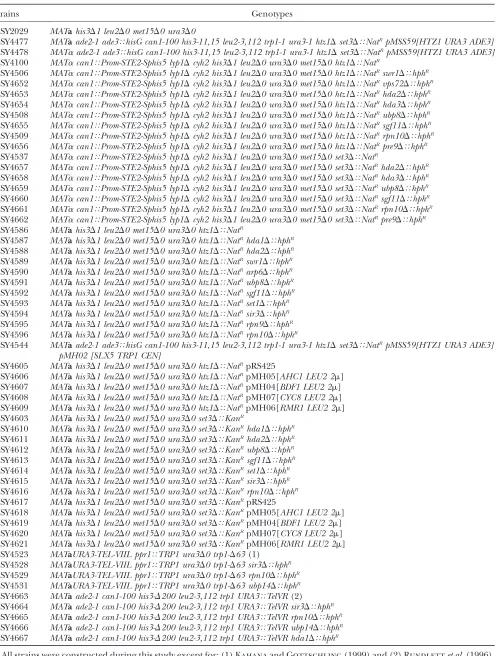
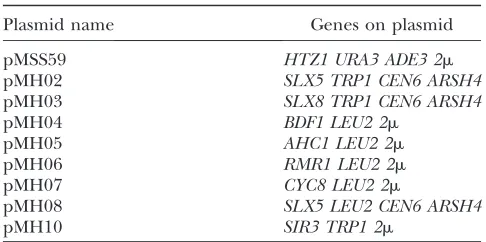
Yeast strains, plasmids, and methods:Yeast strains used in this study are listed in Table 1. Plasmids used are listed in Table 2. Standard yeast manipulations were performed as described (Adamset al.1998). 5-Fluoroortic acid (5-FOA) was added to
the final concentration of 1 mg/ml. The concentrations of other drugs are described in relevant contexts. Yeast trans-formation is based on the lithium acetate method. Cells were grown to 23107cells/ml, and the transformation mix was subject to heat shock at 42° for 30 min. For recovery of plasmids, 5 ml overnight yeast cultures were resuspended in STET buffer (8% sucrose, 50 mmTris HCl pH 8.0, 50 mm
EDTA, 5% Triton X-100) and mechanically disrupted in the presence of glass beads. After removing the impurities, DNA was ethanol precipitated, recovered, and used to transform aleu-Escherichia coli strain JA221.
Mutagenesis, screening, and cloning: ThemTn-LEU2/lacZ
yeast genomic library was constructed and described by Ross
-MacDonaldet al. (1999). Plasmid DNA collected with
midi-prep kit (Qiagen) from the 14 pools of the mTn3 library was digested withNotI and gel purified. MSY4477 was transformed with purified DNA and the cells were plated onto SC–Leu plates at about 1200 colonies/large petri dish (150315 mm). Approximately 90,000 colonies were subjected to the sub-sequent screening. The transformants were microscopically examined and colonies that displayed sectoring phenotype were streaked onto SC–Ura–Leu plates to select the pMSS59[HTZ1 URA3 ADE3] plasmids. Nonsectoring red colonies of these candidates from SC–Ura–Leu plates were restreaked onto YPD plates to confirm their sectoring pheno-type. Candidates maintaining the sectoring phenotype were crossed with MSY4478, which is isogenic to MSY4477 except for having the opposite mating type. The diploids were subjected to tetrad analysis. If a single transposon-disrupted ORF is responsible for the sectoring phenotype, the sectoring phenotype cosegregates with theLEU2marker on the trans-poson and follow a 2:2 segregation pattern. The transtrans-poson insertion sites in the final candidates were determined by inverse PCR. Genomic DNA from these candidates was purified and digested withRsaI. The digested genomic DNA was treated with T4 ligase at low concentration (1mg/ml) to promote self-ligation. The ligation products were used as PCR templates and amplified using the primer pair 59-TAAGT TGGGTAACGCCAGGGTTTTC-39 and 59-TGTTGCCACTCG CTTTAATG-39. The PCR products were gel purified and sequenced with primer 59-CGTTGTAAAACGACGGGATCC CCC-39. The sequencing results were subject to BLAST search and the transposon insertion sites on the chromosome were determined.
EMS mutagenesis: After the determination of the ethyl methanesulfonate (EMS) kill curve, the actual mutagenesis screen was performed by adding 23ml EMS (Sigma) to 3 ml fresh cell culture (grown to log phase at 13107 cells/ml). After 1 hr incubation at 28°, 1 ml 5% sodium thiosulfate was added to quench the mutagen. The cell mix was sonicated and diluted, after which 6000 cells were plated onto each YPD plate (150315 mm) to achieve roughly 2000 surviving colonies per plate. Approximately 60,000 cells were subjected to the visual screening as described in the transposon mutagenesis method and 14 suppressor candidates were isolated. These candidates were crossed to MSY4478 to determine whether the suppressor mutations were recessive or dominant, and the resultant diploids were subjected to tetrad analysis. To clone the recessive suppressor candidate, a p366-based yeast genomic library was used to transform the suppressor strain. The Leu1 transformants were visually screened for revertants displaying nonsectoring color pattern due to the complementation of
the suppressor gene by the wild-type copy on the library plasmid.
Generating deletion mutations: All deletion mutants were generated by one-step replacement by homologous recombination. The knockout DNA fragments consisted of the ORF-flanking sequences PCR amplified together with a drug-resistant gene using GoTaq polymerase (Promega). The
natMX template was plasimd pAG25 and the hphMX tem-plate was plasmid pAG32 using primers with following features: from 59to 39, forward (reverse) primers have40 nucleotides homologous to the 59 ends (39 ends) of the genomic target loci followed by 59-CGTACGCTGCAGGTC GAC-39(59-ATCGATGAATTCGAGCTCG-39). The PCR prod-ucts were gel purified (Qiagen) and 1mg DNA was used for each transformation. After heat shock, cells were recovered in YPD media for at least 4 hr before being plated onto YPD 1drug plates (kanamycin, 400mg/ml; clonNAT, 100mg/ml; hygromycin B, 500mg/ml). The transformants were screened by analytical PCR using a forward primer located upstream of the replacement DNA and a common reverse primer located inside the drug-resistant cassette (59-GTATGGGCTAAATGTACGGGC-39).
Highcopy suppressor screen: The 1588 clones of the systematic yeast genomic library ( Jones et al. 2008) were
individually cultured overnight at 37° in 200ml/well LB 1
kanamycin (50 mg/ml) in 96-well plates. The overnight cultures from all the wells were pooled and plasmids were extracted by midi-prep kit (Qiagen). MSY4477 was trans-formed with the library plasmids and plated onto SC–Leu in large petri plates. About 40,000 Leu1 transformants were visually screened for color-sectoring phenotype. The suppres-sor candidates that showed color sectoring were restreaked onto SC–Ura–Leu plates to select for the pMSS59[HTZ1 URA3 ADE3]plasmids and the solid red colony morphology. After this step, the candidates were restreaked again on SC–Leu plates to determine which candidates would maintain the color-sectoring phenotype. The plasmids were extracted from the yeast cells and sequenced to identify the library plasmid and the genes it carried. All individual genes with their endogenous promoters on the candidate library plasmids were subcloned into pRS425, used to transform MSY4477, and tested for their suppressor activities on the basis of color sectoring and 5-FOA sensitivity.
Synthetic genetic array analysis: Yeast strains for the specialized miniarrays were manually selected from the systematic gene knockout collection created in the MATa BY4741 background (Giaever et al. 2002) (EUROSCARF,
Institute for Molecular Biosciences, Frankfurt, Germany). Deletions having negative genetic interactions with htz1D
and set3D were chosen on the basis of annotations in the Saccharomyces Genome Database (http://www.yeastgenome. org). Spreadsheets of the miniarrays are presented in support-ing information,Table S1andTable S2. The query strains were constructed in the background of MATa can1T Prom-STE2-Sphis5lyp1Dcyh2his3D1leu2D0ura3D0met15D0(Tonget al.
2004). The htz1Dand set3Dalleles were replaced by natMX
in the single query strains. These two strains were then used to construct the double-query strains, each of which has a suppressor allele replaced byhphMX. Synthetic genetic array analysis was carried out as described previously (Tonget al.
inter-TABLE 1
Yeast strains
Strains Genotypes
MSY2029 MATahis3D1 leu2D0 met15D0 ura3D0
MSY4477 MATaade2-1 ade3ThisG can1-100 his3-11,15 leu2-3,112 trp1-1 ura3-1 htz1Dset3DTNatRpMSS59[HTZ1 URA3 ADE3] MSY4478 MATaade2-1 ade3ThisG can1-100 his3-11,15 leu2-3,112 trp1-1 ura3-1 htz1Dset3DTNatRpMSS59[HTZ1 URA3 ADE3] MSY4100 MATacan1TProm-STE2-Sphis5 lyp1Dcyh2 his3D1 leu2D0 ura3D0 met15D0 htz1DTNatR
MSY4506 MATacan1TProm-STE2-Sphis5 lyp1Dcyh2 his3D1 leu2D0 ura3D0 met15D0 htz1DTNatRswr1DThphR MSY4652 MATacan1TProm-STE2-Sphis5 lyp1Dcyh2 his3D1 leu2D0 ura3D0 met15D0 htz1DTNatRvps72DThphR MSY4653 MATacan1TProm-STE2-Sphis5 lyp1Dcyh2 his3D1 leu2D0 ura3D0 met15D0 htz1DTNatRhda2DThphR MSY4654 MATacan1TProm-STE2-Sphis5 lyp1Dcyh2 his3D1 leu2D0 ura3D0 met15D0 htz1DTNatRhda3DThphR MSY4508 MATacan1TProm-STE2-Sphis5 lyp1Dcyh2 his3D1 leu2D0 ura3D0 met15D0 htz1DTNatRubp8DThphR MSY4655 MATacan1TProm-STE2-Sphis5 lyp1Dcyh2 his3D1 leu2D0 ura3D0 met15D0 htz1DTNatRsgf11DThphR MSY4509 MATacan1TProm-STE2-Sphis5 lyp1Dcyh2 his3D1 leu2D0 ura3D0 met15D0 htz1DTNatRrpn10DThphR MSY4656 MATacan1TProm-STE2-Sphis5 lyp1Dcyh2 his3D1 leu2D0 ura3D0 met15D0 htz1DTNatRpre9DThphR MSY4537 MATacan1TProm-STE2-Sphis5 lyp1Dcyh2 his3D1 leu2D0 ura3D0 met15D0 set3DTNatR
MSY4657 MATacan1TProm-STE2-Sphis5 lyp1Dcyh2 his3D1 leu2D0 ura3D0 met15D0 set3DTNatRhda2DThphR MSY4658 MATacan1TProm-STE2-Sphis5 lyp1Dcyh2 his3D1 leu2D0 ura3D0 met15D0 set3DTNatRhda3DThphR MSY4659 MATacan1TProm-STE2-Sphis5 lyp1Dcyh2 his3D1 leu2D0 ura3D0 met15D0 set3DTNatRubp8DThphR MSY4660 MATacan1TProm-STE2-Sphis5 lyp1Dcyh2 his3D1 leu2D0 ura3D0 met15D0 set3DTNatRsgf11DThphR MSY4661 MATacan1TProm-STE2-Sphis5 lyp1Dcyh2 his3D1 leu2D0 ura3D0 met15D0 set3DTNatRrpn10DThphR MSY4662 MATacan1TProm-STE2-Sphis5 lyp1Dcyh2 his3D1 leu2D0 ura3D0 met15D0 set3DTNatRpre9DThphR MSY4586 MATahis3D1 leu2D0 met15D0 ura3D0 htz1DTNatR
MSY4587 MATahis3D1 leu2D0 met15D0 ura3D0 htz1DTNatRhda1DThphR
MSY4588 MATahis3D1 leu2D0 met15D0 ura3D0 htz1DTNatRhda2DThphR
MSY4589 MATahis3D1 leu2D0 met15D0 ura3D0 htz1DTNatRswr1DThphR
MSY4590 MATahis3D1 leu2D0 met15D0 ura3D0 htz1DTNatRarp6DThphR
MSY4591 MATahis3D1 leu2D0 met15D0 ura3D0 htz1DTNatRubp8DThphR
MSY4592 MATahis3D1 leu2D0 met15D0 ura3D0 htz1DTNatRsgf11DThphR
MSY4593 MATahis3D1 leu2D0 met15D0 ura3D0 htz1DTNatRset1DThphR
MSY4594 MATahis3D1 leu2D0 met15D0 ura3D0 htz1DTNatRsir3DThphR
MSY4595 MATahis3D1 leu2D0 met15D0 ura3D0 htz1DTNatRrpn9DThphR
MSY4596 MATahis3D1 leu2D0 met15D0 ura3D0 htz1DTNatRrpn10DThphR
MSY4544 MATaade2-1 ade3ThisG can1-100 his3-11,15 leu2-3,112 trp1-1 ura3-1 htz1Dset3DTNatRpMSS59[HTZ1 URA3 ADE3] pMH02 [SLX5 TRP1 CEN]
MSY4605 MATahis3D1 leu2D0 met15D0 ura3D0 htz1DTNatRpRS425
MSY4606 MATahis3D1 leu2D0 met15D0 ura3D0 htz1DTNatRpMH05[AHC1 LEU2 2m]
MSY4607 MATahis3D1 leu2D0 met15D0 ura3D0 htz1DTNatRpMH04[BDF1 LEU2 2m]
MSY4608 MATahis3D1 leu2D0 met15D0 ura3D0 htz1DTNatRpMH07[CYC8 LEU2 2m]
MSY4609 MATahis3D1 leu2D0 met15D0 ura3D0 htz1DTNatRpMH06[RMR1 LEU2 2m]
MSY4603 MATahis3D1 leu2D0 met15D0 ura3D0 set3DTKanR
MSY4610 MATahis3D1 leu2D0 met15D0 ura3D0 set3DTKanRhda1DThphR
MSY4611 MATahis3D1 leu2D0 met15D0 ura3D0 set3DTKanRhda2DThphR
MSY4612 MATahis3D1 leu2D0 met15D0 ura3D0 set3DTKanRubp8DThphR
MSY4613 MATahis3D1 leu2D0 met15D0 ura3D0 set3DTKanRsgf11DThphR
MSY4614 MATahis3D1 leu2D0 met15D0 ura3D0 set3DTKanRset1DThphR
MSY4615 MATahis3D1 leu2D0 met15D0 ura3D0 set3DTKanRsir3DThphR
MSY4616 MATahis3D1 leu2D0 met15D0 ura3D0 set3DTKanRrpn10DThphR
MSY4617 MATahis3D1 leu2D0 met15D0 ura3D0 set3DTKanRpRS425
MSY4618 MATahis3D1 leu2D0 met15D0 ura3D0 set3DTKanRpMH05[AHC1 LEU2 2m]
MSY4619 MATahis3D1 leu2D0 met15D0 ura3D0 set3DTKanRpMH04[BDF1 LEU2 2m]
MSY4620 MATahis3D1 leu2D0 met15D0 ura3D0 set3DTKanRpMH07[CYC8 LEU2 2m]
MSY4621 MATahis3D1 leu2D0 met15D0 ura3D0 set3DTKanRpMH06[RMR1 LEU2 2m]
MSY4523 MATaURA3-TEL-VIIL ppr1TTRP1 ura3D0 trp1-D63(1) MSY4528 MATaURA3-TEL-VIIL ppr1TTRP1 ura3D0 trp1-D63 sir3DThphR MSY4529 MATaURA3-TEL-VIIL ppr1TTRP1 ura3D0 trp1-D63 rpn10DThphR MSY4531 MATaURA3-TEL-VIIL ppr1TTRP1 ura3D0 trp1-D63 ubp14DThphR MSY4663 MATaade2-1 can1-100 his3-D200 leu2-3,112 trp1 URA3TTelVR(2) MSY4664 MATaade2-1 can1-100 his3-D200 leu2-3,112 trp1 URA3TTelVR sir3DThphR MSY4665 MATaade2-1 can1-100 his3-D200 leu2-3,112 trp1 URA3TTelVR rpn10DThphR MSY4666 MATaade2-1 can1-100 his3-D200 leu2-3,112 trp1 URA3TTelVR ubp14DThphR MSY4667 MATaade2-1 can1-100 his3-D200 leu2-3,112 trp1 URA3TTelVR hda1DThphR
actions were scored using as a cutoff a reduction of at least 25% in colony spot size relative to the single mutant alone. Bypass suppression was scored using a criterion of an increase in colony spot size of at least 33% with the suppressor relative to the double-mutant strain. Forhtz1D, each interacting deletion strain was represented once on the array (Table S1) and each candidate suppressor was screened in three independent experiments. Forset3D, each deletion strain was represented three times on the array (Table S2) and each suppressor was screened once.
RESULTS
Isolation ofhtz1Dset3Dbypass suppressor mutations:
To characterize the network ofHTZ1andSET3genetic interactions, we sought to isolate suppressors of the
htz1Dset3Dslow-growth phenotype using a colony color screen (Benderand Pringle1991). Growth of thehtz1D
set3Dstrain MSY4477 is maintained by the presence of plasmid pMSS59[HTZ1 URA3 ADE3], which also confers 5-FOA sensitivity and nonsectoring red colony color. The introduction of a suppressor mutation that by-passes thehtz1Dset3Dsynthetic slow-growth phenotype allows the plasmid to be lost during mitotic growth, giving rise to red/white sectored colonies and the seg-regation of 5-FOA-resistant isolates. We exploited the sectoring pattern for visual screening and 5-FOA re-sistance for secondary characterization.
Bypass suppressors were generated by transposon mutagenesis (Ross-MacDonald et al. 1999). Pooled DNA prepared from the transposon library was used to transform MSY4477 and 90,000 Leu1 transformants were subjected to several steps of screening and verifi-cation (materials and methods). DNA sequence anal-ysis of the transposon gene disruptions identified the following 12 candidate suppressor genes (and the number of times each was isolated): hda2 (7), hda3
(10),ubp8(2),sgf11(3),swr1(2),vps72(2),arp6(3),set1
(1),sir3(2),rpn10(3),pre9(2), andubp14(1). These candidates were crossed to MSY4478 and the diploids were subjected to tetrad analysis (sir3 was not tested due to sterility). In all cases, the sectoring phenotype segregated together with the transposon disrupted allele, marked by LEU2, and the tetrads showed 2:2 segregation. Finally, we confirmed the identities of the suppressors by deleting each of the candidate genes in MSY4477 and found that all the deletions resulted in strong suppression of thehtz1Dset3Dsynthetic slow-growth phenotype (Figure 1, A and B).
One striking feature of this collection is that most of the genes encode subunits of protein complexes with broad functional significance, including the trimeric
Hda1histone deacetylation complex (hda2,hda3), the H2B deubiquitination submodule of the SAGA com-plex (ubp8, sgf11), the SWR1 complex (swr1, arp6,
vps72), and the proteasome (rpn10,pre9). Thus, we next tested whether the deletion of other nonessential subunits of these complexes could also suppresshtz1D
set3D(data not shown). We found that deletions of the
genes encoding all three subunits of the Hda1HDAC complex, including HDA1, which encodes the enzy-matic subunit, suppress htz1Dset3D. In the case of the SAGA complex, only deletion of the H2B deubiquitina-tion module genes could suppress. We tested the de-letion of three genes outside the H2B deubiquitination module (gcn5,spt3, andspt8)and found that they actu-ally exacerbate the synthetic phenotype of htz1Dset3D. Deletions of all the nonessential subunits of the SWR1
complex, exceptYAF9, are strong suppressors, and the same is true for all the nonessential subunits of the proteasome. These results collectively indicate that it is the functions of these multisubunit protein complexes that become toxic in the absence ofHtz1andSet3.
SLX5is a dosage inhibitor of a subset of suppressors:
We also isolated 13 recessive suppressor mutations following random mutagenesis with EMS. We attempted to clone the corresponding wild-type alleles by comple-mentation using a wild-type yeast genomic plasmid library and screening for restoration of the nonsectoring color colony phenotype. Out of60,000 transformants of one candidate strain, we repeatedly isolated two differentCENplasmids, both containingSLX5. Surpris-ingly, however, DNA sequence analysis showed that the the candidate suppressor strain did not contain mutations in either the ORF or the promoter region of chromosomal SLX5. To confirm this unexpected re-sult, we cloned the chromosomal copy of SLX5 from the suppressor strain into a CEN yeast shuttle vector (pRS315), transformed the candidate suppressor strain with this plasmid, and found that it also restored the nonsectoring phenotype. Thus, while the suppressor mutation in the candidate strain remains unidentified, these results did reveal that an extra gene dose ofSLX5
inhibits suppression. Transformation of htz1D set3D
double mutants with a CEN plasmid copy of wild-type
SLX5also eliminates the marginal viability of the strain. Interestingly, SLX8 has a similar, although milder, ef-fect (data not shown).
Slx5 and Slx8 comprise a SUMOylation targeted ubiquitin ligase (STUbL) complex, a functionally con-served entity from fission yeast to human cells. Slx5
binds to the SUMOylated subunit andSlx8acts as the E3
TABLE 2
Plasmids strains
Plasmid name Genes on plasmid
pMSS59 HTZ1 URA3 ADE3 2m
pMH02 SLX5 TRP1 CEN6 ARSH4
pMH03 SLX8 TRP1 CEN6 ARSH4
pMH04 BDF1 LEU2 2m
pMH05 AHC1 LEU2 2m
pMH06 RMR1 LEU2 2m
pMH07 CYC8 LEU2 2m
pMH08 SLX5 LEU2 CEN6 ARSH4
ligase (Burgesset al.2007; Liet al.2007b; Mullenand Brill2008). This heterodimer complex has been pro-posed to participate in DNA repair (Zhanget al.2006; Burgesset al.2007; Liet al.2007a; Nagaiet al.2008), telomere silencing (Darst et al. 2008), and protein quality control (Wangand Prelich2009). No endog-enous SUMOylated substrates of the Slx5–Slx8 complex have been identified although two recent reports identified mating-type switching regulators alpha2
(Xie et al.2010) andalpha1(Nixonet al.2010) to be un-SUMOylated endogenous substrates.
Phenotypic classification ofhtz1Dset3Dsuppressors:
We took advantage of the serendipitous discovery that
SLX5 could eliminate the activity of at least one suppressor and tested the effect of a pMH02[SLX5
CENTRP1] plasmid on our set of known transposon-mediated suppressor mutations. Deletion of genes encoding theSWR1complex and the H2B deubiquiti-nation module of SAGA complex were no longer able to bypass htz1D set3D in the presence of extra copies of
SLX5. However, the other gene deletions retained the ability to suppress (Figure 1, B and C).
The isolation of sir3 as a suppressor of htz1D set3D
indicates that this silent information regulator becomes toxic in the absence of Htz1 and Set3, and the direct removal of this genetic toxin is sufficient to rescue the double mutant.Set1-mediated H3K4 methylation contrib-utes to preventingSir3from spreading into euchromatin andset1Dcauses dilution of the limited pool of cellularSir3
from its physiological targets (Venkatasubrahmanyam et al.2007). We hypothesized that the suppressor activity of
set1Dmight be an indirect consequence of mimickingSir3
depletion and predicted that its suppressor activity would
be reduced by overexpressingSIR3. Consistent with this hypothesis, suppression byset1Dwas impaired whenSIR3
was overexpressed. Surprisingly, however, the suppression phenotypes exhibited byrpn10D,pre9D, andubp14Dwere also notably reduced in the presence of the SIR3 2m
plasmid (Figure 1, B and D). Thus, on the basis of their distinct responses to overexpression of either SLX5 or
SIR3, the bypass suppressors can be categorized into three phenotypic classes (Table 3).
Telomere silencing requires the protein degradation pathway:The responses ofrpn10D,pre9D, andubp14Dto
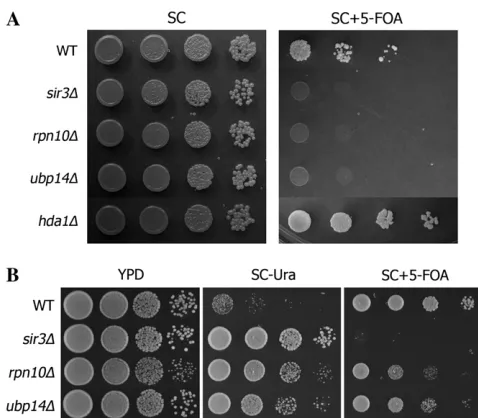
SIR3overexpression suggested that the protein degra-dation pathway might have a previously unrecognized role inSir3-dependent silencing. To test this, subtelo-meric position effect variegation (PEV) was examined in these mutants. PEV was measured by monitoring the 5-FOA sensitivity of a strain in whichURA3is integrated 2.1 kb away from the right end of chromosome V (Rundlett et al.1996).URA3is randomly silenced in wild-type clonal cells (Figure 2A). Deletion of SIR3
substantially removes the clonal repression as expected. Interestingly, ubp14D and rpn10D both show strong
URA3derepression at a level comparable tosir3D (Fig-ure 2A). Deletion of HDA1, whose suppression activity does not respond to SIR3 overexpression, increases subtelomeric silencing, consistent with previous results (Rundlettet al.1996).
To further confirm this novel relationship between
SIR3 and protein degradation, we used another re-porter strain in which the URA3 reporter gene is integrated at the left tip of chromosome VII (Kahana and Gottschling1999). This strain is barely viable on plates lacking uracil because URA3is strictly silenced.
Figure1.—Loss-of-function
In this strain sir3D dramatically improves growth on Ura plates as expected because of the derepression ofURA3. Consistent with our PEV results at the telomere of chromosome V, rpn10D and ubp14D also increase
URA3 expression (Figure 2B) although the derepres-sion inrpn10Dandubp14Dis at a lower level compared tosir3D, as indicated by the growth on 5-FOA plates.
We investigated whether the silencing defects of the protein degradation mutants are associated with a decrease ofSir3at the telomere region. We introduced
rpn10D and ubp14D into a strain carrying an allele of
SIR3encoding a triple-HA epitope tag at the C terminus ofSir3.Sir3–3HA binding at the right end of chromo-some V in these deletion mutants was then compared to wild type using chromatin immunoprecipitation (ChIP). No differences between these deletion mutants and the wild-type strain were observed (data not shown), suggesting that in addition toSir3binding, one or more additional steps involving the protein degradation pathway are required for efficient telomere silencing.
Suppression of htz1Dand set3D single defects:The
htz1D set3D double mutant encounters genetic stress from each of the gene deletions individually as well as the synthetic effect of the double deletion. Thus, in principle, we might expect at least three classes of suppressors: those that bypass one or the other of the single deletions and those that bypass the synthetic defects. Indeed,hda1Dhas been reported to rescue the growth phenotype ofhtz1Dand reduce its sensitivity to hydroxyurea (HU), methyl-methanesulfonate (MMS), and the microtubule-interfering drug benomyl (Lin et al.2008). Therefore, we investigated the effect of the other htz1D set3D suppressors on htz1D single-mutant defects. A series of double mutants containinghtz1Dand each of the suppressor genes were constructed in the BY4741 strain background. Their growth conditions on YPD and in the presence of various drugs were com-pared to wild-type and htz1D cells. Each functional module was represented by two members to monitor the phenotypic consistency within the group.
In agreement with the observations of Lin et al. (2008), disruption of the Hda1 complex weakly
sup-presses the sensitivities ofhtz1Dto HU and benomyl and strongly suppresses its MMS sensitivity (Figure 3A). Suppressors within the SWR1 complex genes also improve the growth of htz1D in the presence of these drugs, but with a more prominent effect on HU sensitivity (Figure 3A). Deletions of genes encoding the SAGA H2B deubiquitination module strongly res-cue benomyl sensitivity but only display subtle effects on the sensitivities to the DNA-damaging reagents (Figure 3A). In the case of 6-azauracil (6-AU) and mycophenolic acid (MPA), two drugs that affect transcription elonga-tion by reducing the cellular pool of ribonucleotides, both swr1D and ubp8D but not hda2D, reduce the sensitivity ofhtz1D(Figure 3B).
We carried out a similar set of tests forset3D. Fewer phenotypes are known for set3; however, the deletion strain is hypersensitive to MPA (Kimand Buratowski 2009) and tunicamycin (Cohen et al. 2008), which induces secretory stress response. We again constructed a set of double mutants containingset3Dand each of the suppressor genes and assayed their growth in the presence of MPA and tunicamycin. The set3D swr1D
andset3Darp6Ddouble mutants could not be made due to synthetic lethality between set3Dand loss of SWR1
complex function in the background of BY4741. As expected, MPA markedly inhibited the growth ofset3D. Among the tested suppressors, only those in the H2B deubiquitination module show an ability to rescue the drug sensitivities (Figure 4). Interestingly, set1D,sir3D,
Figure2.—Sir3-dependent telomere silencing requires the
protein degradation pathway. (A) The indicated strains were constructed in a reporter strain in which theURA3gene is in-serted approximately 2.1 kb away from the left end of the chromosome VII (Rundlettet al.1996). Serial dilutions were
plated on SC and SC 1 5-FOA plates. (B) The indicated strains were constructed in a reporter strain in which the
URA3 gene is placed at the very end of the chromosome V (kahana and gottschling 1999). Serial dilutions were
plated on YPD, SC–Ura, and SC15-FOA plates. TABLE 3
Categorization of loss of function suppressors into three classes on the basis of their responses to overexpression
ofSLX5orSIR3
Suppression in the presence of
Suppressors SLX5(CEN) SIR3(2m)
Hda1 complex Yes Yes
SWR1 complex No Yes
Ubp8–Sgf11 No Yes
Set1 Yes Reduced
Sir3 Yes Reduced
and the deletion of genes encoding proteasome sub-units all rescue the tunicamycin sensitivity ofset3Dcells (Figure 4), providing additional evidence for the functional relationship between Sir3 and the protein degradation pathway.
Bypass suppressorsubp8Dand sgf11Dcan act at the level of Htz1- and Set3-dependent gene expression:We next sought to determine if any of thehtz1Dset3Dbypass suppressors might be acting at the level of Htz1- and
Set3-dependent gene transcription. The hypersensitiv-ity of htz1D to benomyl is due, in part, to reduced transcription ofRBL2 and CIN4, two genes encoding factors required forb-tubulin folding (A.Allison, M. Santisteban, and M.M.S., unpublished results). Since suppressors in genes encoding the Hda1 complex,
SWR1complex, and H2B deubiquitination subcomplex suppress the benomyl sensitivity ofhtz1D, we assayed the levels ofRBL2 and CIN4 mRNAs in these suppressor strains. As expected, the mRNA levels of RBL2 and
CIN4inhtz1Dare significantly lower than in wild-type cells (Figure 5A). In the case of the tested suppressors, the pattern of mRNA expression matched that of the benomyl sensitivity (Figure 3A). The most potent suppressors ofhtz1D benomyl sensitivity are ubp8and
sgf11. Similarly, CIN4 transcription is markedly in-creased inubp8 and sgf11 (Figure 5A). Lesser effects are observed forhda1D,hda2D,swr1D, andarp6D.
The induction of GAL1 transcription is known to be impaired in set3D (Wang et al. 2002; Kim and Buratowski2009). Therefore, sinceubp8Dandsgf11D
are strong suppressors of the MPA phenotype ofset3D, we compared the induction of GAL1 transcription in wild type,set3D,set3Dubp8D, andset3Dsgf11D. Consistent with the previous reports, induction ofGAL1 transcrip-tion is notably slower inset3Dcells. Interestingly,GAL1
transcription is partially restored in set3D ubp8D and
set3Dsgf11D(Figure 5B). Together, these results define examples in which bypass suppressorsubp8Dandsgf11D
affectHtz1- andSet3-dependent gene transcription.
Suppression of the global set of htz1D and set3D
negative genetic interactions: All of the suppressors isolated in our genetic screen are general factors with broad roles in gene expression, rather than regulators of a specific gene or pathway. Consequently, we rea-soned that this set of suppressors might be rather general and bypass most synthetic defects involving
htz1Dorset3D. To test this prediction, we carried out a modified synthetic genetic array (SGA) analysis to assess the genome-wide suppression ofhtz1Dandset3D nega-tive genetics interactions (Figure 6). First, for each of the htz1Dset3Dbypass suppressor genes, we created a pair of query strains carrying both the suppressor deletion and eitherhtz1Dorset3D. These double-mutant query strains were then crossed against specialized miniarrays that included strains with gene deletions that have negative genetic interactions with eitherhtz1D
or set3D (materials and methods). Control strains that show no genetic interactions withhtz1Dandset3D
were also included in the arrays to normalize colonies sizes across replicate plates. After mating with the query
Figure3.—Suppression ofhtz1Ddrug
pheno-types by gene deletions. (A) Serial dilutions were plated on YPD, YPD 1 MMS (0.025%), YPD1hydroxyurea (150 mm), and YPD1
strain and sporulation, the triple mutants were selected and their relative colony sizes were quantified.
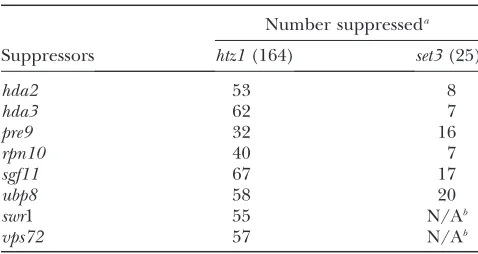
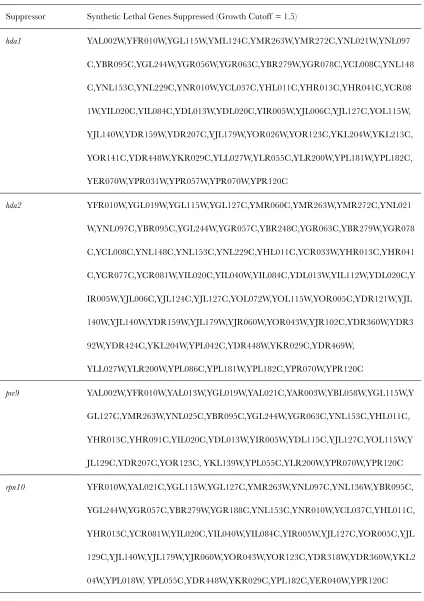
The htz1D-based miniarray was composed of 241 strains with gene deletions known or suspected to produce negative genetic interactions. In control screens where bypass suppressors were not included, 164 gene deletions in the miniarray scored as having negative genetic interactions with htz1D. We next analyzed the ability of hda2D, hda3D, swr1D, vps72D,
ubp8D, sgf11D, pre9D, and rpn10D to suppress these negative synthetic genetic interactions. Contrary to expectations, each suppressor only bypassed a limited number of interactions (Table 4 and Table S3). Fur-thermore, thehtz1Dset3Dsuppressors, as a group, did not function coordinately to suppress other htz1D
synthetic interactions. Only 14 of the 164 negative genetic interactions were bypassed by at least 7 of the suppressors, and growth of the average double mutant was improved by less than 3 of the htz1D set3D
suppressors.
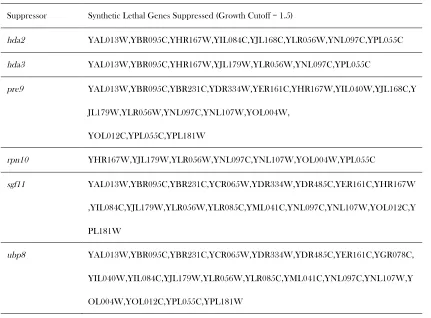
The set3D miniarray was composed of 53 gene deletions. Of these, 25 deletions were scored as having a synthetic negative growth phenotype in combination with set3D. Since swr1D and vps72D are themselves synthetic lethal withset3Din the SGA strain background, we could create only double-mutant query strains with
hda2D,hda3D,ubp8D,sgf11D,pre9D, andrpn10D. As with the htz1D analysis, most of the 25 synthetic negative interactions withset3Dwere suppressed by relatively few of the query genes; only 7 of the 25 interactions were suppressed by more than 4 of the 6 suppressors. However, unlike thehtz1Dcase, thesgf11D, andubp8D
suppressors in the H2B ubiquitination module stand out as interacting with a majority of the scored set3D
interactions (Table 4 and Table S4). Taken together, these results argue that htz1D set3D has defects in chromatin function that are relatively restricted to that double mutant. These defects are bypassed by a set of
suppressors that is also an uncommon constellation of genes suggesting a special functional relationship amonghtz1D,set3D, and their bypass suppressors.
High-copy suppressors of htz1D set3D genetic in-teraction: To gain further insights into the genetic interaction between htz1D and set3D, we performed a genome-wide screen to isolate high-copy suppressors of thehtz1Dset3Dsynthetic growth phenotype using a 2m -plasmid-based systematic genomic library ( Joneset al. 2008). Each clone of this library contains a sequenced fragment of the yeast chromosome and together they
Figure4.—Suppression ofset3Ddrug phenotypes by gene
deletions. Serial dilutions were plated on YPD, YPD1MPA (40mg/ml), and YPD1tunicamycin (1mg/ml).
Figure5.—Suppression ofhtz1Dandset3Dtranscriptional
phenotypes byubp8Dandsgf11D. (A) Total RNA (20mg) iso-lated from each strain was subjected to Northern analysis. The membrane was blotted sequentially with probes that detect
RBL2,CIN4,andACT1. The membrane was stripped with boil-ing 0.1% SDS between each probboil-ing. (B) Northern analysis of 20mg of total RNA from each strain is shown following galac-tose addition. The membrane was assayed sequentially with probes detecting GAL1and ACT1. (C) The ratios ofGAL1
cover the complete S. cerevisiae genome. The library plasmids were used to transform MSY4544, which is MSY4474 containing a low-copy SLX5 plasmid to en-hance sensitivity. Leu1
transformants were screened for color sectored colonies (materials and methods) and five library plasmids showing strong suppression of htz1D set3D were recovered (data not shown). The promoter and ORF of each individual gene on these library plasmids were subcloned into a 2m plasmid shuttle vector and tested individually in MSY4544. These assays identified the following high-copy suppressors (and the number of times they were isolated):BDF1(6),
AHC1(2), RMR1(3), and CYC8(2). Suppression was independent of low-copySLX5overexpression (Figure 7). The suppression of a fifth library plasmid could not be assigned to any single gene on the plasmid. Inter-estingly, this plasmid contains a copy of the HMR
locus, which could theoretically serve as a titrator of
Sir3protein and mimic the suppression bysir3D. Since
BDF1provided strong suppression, we also tested over-expression ofBDF2, but it failed to confer suppression of thehtz1Dset3Dsynthetic phenotype (data not shown).
Suppression of htz1D and set3D single defects by high-copy suppressors: Loss-of-function suppressors differentially alleviate the single defects of htz1D or
set3Dcells and we attempted to characterize the high-copy suppressors using the same approach. Derivatives of the 2m plasmid pRS425 containing BDF1, AHC1,
RMR1and CYC8were introduced intohtz1Dcells and pRS425 empty vector was transformed as control. We then compared the sensitivities of these transformants to MMS, HU, and benomyl (Figure 8). CYC8 over-expression notably suppresses the MMS sensitivity of
htz1Dbut it has very subtle, if any, effects on the HU and benomyl sensitivities. This profile is similar to that observed earlier for deletions of genes encoding the
Hda1 complex. Interestingly, Cyc8 forms a transcrip-tional corepressor complex withTup1and together they recruit theHda1complex to its targets (Wuet al.2001).
Thus, CYC8 overexpression could exert its dominant suppression by sequestering the Hda1 complex away from its physiological targets mimicking the disruption of the complex by theHda1 complex gene deletions. Overexpression of BDF1 exhibits a wide spectrum suppression of all of thehtz1Dphenotypes tested, while overexpression of AHC1andRMR1does not suppress any (Figure 8). In the case ofset3D, the overexpression ofRMR1markedly improves growth in the presence of MPA (Figure 9), suggesting a regulatory role ofRmr1in transcription. We also observed thatBDF1 overexpres-sion exacerbates theset3DMPA sensitivity.
DISCUSSION
The results reported here reveal a surprisingly close functional relationship between Htz1 and Set3 and suggest a model forSet3activity. Synthetic growth defects for the binary combinations of both htz1D set3D and
swr1Dset3Dare well known (Kroganet al.2003; Collins Figure6.—SGA miniarray analysis. Three final ordered
ar-rays from one set of the suppressor SGA experiments are shown. Crosses incorporatingswr1Dare used in this example, but similar assays were carried out for all of the suppressors tested. After colony sizes were first normalized across the plates using a set of control strains, synthetic negative gene interac-tions were scored by comparing plate A to plate B (materials and methods). Bypass suppression was then scored as an
in-crease in colony size of at least 33% comparing plate C to plate B. Reductions or increases in colony sizes can be visualized for the selected deletions showing interactions withhtz1D. The en-larged areas show examples of suppression with the genes and their locations in the miniarray indicated. Note thatsnt1(E11) is one of the core subunits of the Set3 HDAC complex.
TABLE 4
Suppression of genome-wide interactions ofhtz1andset3
Number suppresseda
Suppressors htz1(164) set3(25)
hda2 53 8
hda3 62 7
pre9 32 16
rpn10 40 7
sgf11 67 17
ubp8 58 20
swr1 55 N/Ab
vps72 57 N/Ab
a
The total numbers of scored interactions are shown in pa-rentheses.
b
swr1and vps72 are synthetic lethal in combination with
et al. 2007; Wilmes et al. 2008; Costanzo et al. 2010). Furthermore,Swr1is detrimental to cells in the absence of its normal Htz1–H2B substrate (Halleyet al.2010; Morillo-Huescaet al.2010). What is surprising, then, is the striking finding thathtz1Dswr1Dset3Dtriple mutants grow relatively well. This implies that not only is Swr1
severely detrimental in the absence ofHtz1andSet3, but
Htz1is also severely detrimental in the absence ofSwr1
and Set3, a previously unrecognized activity of Htz1. Furthermore, the partial redundancy of these three genes is likely to be in a specific pathway of chromatin function since we find that the particular combination of suppressor genes that can bypasshtz1D set3Dis uncom-mon auncom-mong the global set ofhtz1Dsynthetic interactions. This interlocking genetic relationship between HTZ1,
SWR1, andSET3argues thatSet3may participate in the dynamic deposition and remodeling ofHtz1-containing nucleosomes. In the absence ofHtz1, we propose that the
Set3HDAC complex can partially overcome the effect of
SWR1 complex either by decreasing its recruitment or modifying its target nucleosomes. In the absence ofSwr1, we reason thatSet3activity may partially overcome either the negative effects ofHtz1nucleosomes no longer re-modeled by the SWR1 complex or the stochastic mis-incorporation ofHtz1into abnormal sites of deposition. The phenotypic characterization of our suppressor collection also revealed a surprising functional
similar-ity between the SWR1 complex and the SAGA H2B deubiquitination subcomplex with respect to htz1D
set3D. The simplest interpretation of these results is that the activities of these two complexes are partially redundant for achieving dynamic regulation of chro-matin byHtz1. In the context of our experiments, the toxic effects of Swr1in the absence of Htz1 might be relieved by the increased H2B ubiquitination inubp8D
orsgf11Dmutants. This hypothesis is supported by the observation that H2B ubiquitination increases nucleo-some stability over the promoters of repressed genes (Chandrasekharanet al.2009). We carried out initial tests of this model by examining the steady-state levels of
Htz1at the promoters of repressedGAL1andPHO5by chromatin immunoprecipitation in UBP8 and ubp8D
cells. We also examined the rate of Htz1deposition at the PHO5 promoter following repression. Neither of these experiments revealed any effect ofubp8DonHtz1
occupancy (data not shown). However, both studies were carried out in the context ofHTZ1andSWR1and it remains possible thatubp8Dandsgf11Dcan relieve the detrimental Swr1-dependent remodeling of nucleo-somes in the absence of Htz1. Alternatively, the Swr1
complex and the Ubp8–Sgf11 H2B deubiquitination subcomplex might function sequentially in a common pathway, although the downstream effect of this hypo-thetical pathway is unlikely to beHtz1deposition.
Figure7.—(A) Anhtz1Dset3Dstrain
carrying pMSS59[HTZ1 ADE3 URA3] and pMH02[SLX5 TRP1] was trans-formed with the indicated plasmids. The transformants were cultured in SC–Ura–Leu–Trp media and serial dilu-tions were plated on SC–Ura–Leu–Trp plates to maintain the three plasmids. (B) Strains from A were then grown in SC–Leu–Trp media overnight to per-mit loss of pMSS59. Serial dilutions of the overnight cultures were plated on SC–Leu–Trp 1 5-FOA plates. Growth at different times is shown.
Figure 8.—Suppression of htz1D
drug sensitivities by high-copy suppres-sors. Serial dilutions of the cell cultures of htz1D cells containing the indica-ted plasmids were plaindica-ted on SC–Leu, SC–Leu1 MMS (0.025%), SC–Leu 1
hydroxyurea (150 mm) and SC–Leu1
Our suppressor analysis also revealed a second functional similarity betweenSir3and the proteasome protein degradation pathway. Overexpression of SIR3
not only reducedhtz1D set3D suppression by set1, but also antagonized suppression by rpn10D, pre9D, and
ubp14D. Furthermore, we also found that telomere silencing is impaired in rpn10D, pre9D, and ubp14D, just as it is in sir3D. A number of links between pro-tein degradation and silencing are known. Physical interactions have been reported between the ubiqui-tin-specific protease Ubp3 and Sir4, and increased telomere silencing was observed in ubp3D (Moazed and Johnson1996). Another ubiquitin protease,Ubp6, and the proteasome subunit Sem1 are also involved in telomere silencing. Silencing is reduced insem1D, suggesting a positive role in silencing, while defective silencing inubp10Dis rescued by ubp6D, suggesting a negative role for Ubp6 (Qin et al. 2009). Our results suggest additional functional overlaps between the proteasome, ubiquitin recycling, and Sir3-dependent silencing.
It was curious that the deletion of genes encoding the
HDA1 deacetylase complex would bypass defects in-volving the deletion set3D, which is a subunit of a deacetylase complex. However, a similar antagonism between theHDA1andHOS2deacetylases has recently been observed inCandida albicans(Zacchiet al.2010). HDA1specifically deacetylates H2B and H3 and, in its absence, intergenic promoter regions and so-called
HDA1-affected subtelomeric regions (HAST) become hyperacetylated (Robyr et al. 2002). Interestingly, HDA1 is a downstream effector of the Tup1–Cyc8 repressor complex, establishing transcriptionally re-pressive chromatin at promoter regions (Wu et al. 2001; Green and Johnson 2004). Furthermore,Tup1
likely participates in specifying some of the sites ofHtz1
deposition bySWR1(Gligoriset al.2007). Although we did not recovertup1Din our suppressor screens, the fact that CYC8 is a high-copy suppressor suggests that reducingHDA1activity at itsTup1-independent targets might contribute to the suppression ofhtz1Dset3D.
The functional involvement of Slx5–Slx8 in theHtz1
and Set3 network is provocative. SLX5 was previously recovered in a systematic study of overexpression toxicity (Sopko et al. 2006). Interestingly, SLX5 over-expression specifically blocks the ability of deletions in genes encodingSWR1and the SAGA H2B deubiquiti-nation subcomplex to suppress the growth phenotype ofhtz1Dset3D. We reason that overexpression ofSLX5
increases the polyubiquitination and degradation of one or more target proteins critical for growth in the suppression genotypes. Given the DNA damage sensitivity of htz1D, and the roles of H2B ubiquitina-tion in repair (Lis and Romesberg 2006; Game and Chernikova 2009), one potential pathway for these targets is DNA damage repair. Nagaiet al.(2008) have proposed that Slx5–Slx8 is required to target degrada-tion of an unknown SUMOylated factor that must be removed for repair to proceed. Thus, excess degrada-tion could be lethal in htz1D set3D regardless of the altered chromatin structure provided by swr1D or
ubp8D. Transcription initiation is a second candidate pathway. Temperature-sensitivemot1-301, which cannot efficiently dissociate TATA-binding protein from the promoter DNA, is suppressed by slx5D (Wang et al. 2006). This model suggests that Slx5–Slx8 polyubiqui-tinates an unknown SUMOylated protein that enhances transcription initiation and that the increased concen-tration of this factor in theslx5Dcan suppress themot1 -301 defect. Because SLX5 overexpression diminishes the beneficial effects of disrupting either SWR1 com-plex or Ubp8–Sgf11 in htz1D set3D and because both
Htz1-containing nucleosomes andSet3HDAC modified nucleosomes are promoter proximal (Albert et al. 2007; Kim and Buratowski 2009), the transcription initiation pathway is an attractive model for the targets of Slx5–Slx8 in our network.
Both models predict that overexpression of genes encoding Slx5–Slx8 substrates might relieve the negative effect of increased SLX5 dosage and that the proteins expressed should be SUMOylated. BothBdf1andRmr1
have been isolated in proteomics screens for SUMOy-lated proteins (Wohlschlegelet al.2004; Hannichet al. 2005; Yuet al.2008). As a component ofSWR1, increased Slx5–Slx8 targeted degradation of Bdf1 might further impair transcription in htz1D set3D. Overexpression of
BDF1would compensate for this increased degradation. Furthermore, high-copy BDF1 might confer additional suppression by dilutingSWR1 complex and mimicking suppression byswr1D. However, the mechanism is likely to be more complicated since the suppression ofhtz1D
phenotypes byBDF1is more extensive than that achieved
Figure9.—Suppression ofset3Ddrug sensitivities by
byswr1D. Indeed,Bdf1is more widely distributed across chromosomes than would be expected on the basis of its association with TFIID and SWR1 (Chua and Roeder 1995; Matangkasombutand Buratowski2003). In the case ofRMR1, relatively little is known about its functions, although our results suggest a potential role in transcrip-tion. Interestingly,RMR1is a weak high-copy suppressor of the null allele of ulp2, one of two essential SUMO proteases in budding yeast (Hannichet al.2005).
Expanding the binary synthetic htz1D set3D interac-tion to a network of ternary gene interacinterac-tions has revealed strong functional links among a small set of protein complexes with general regulatory functions. Importantly, these results suggest an important new role for the Set3 HDAC complex in Htz1–nucleosome dynamics. Further genetic, biochemical, and molecular studies will help to dissect these interactions at a mechanistic level, providing new insights into the epigenetic regulation of chromatin function.
This work was supported by a Robert R. Wagner Fellowship to M.H. and grants GM28920 and GM60444 from the National Institutes of Health to M.M.S.
LITERATURE CITED
Adams, A., C. Kaiserand C. S. H. Laboratory, 1998 Methods in Yeast Genetics: A Cold Spring Harbor Laboratory Course Manual.Cold Spring Harbor Laboratory Press, Plainview, NY.
Albert, I., T. N. Mavrich, L. P. Tomsho, J. Qi, S. J. Zantonet al., 2007 Translational and rotational settings of H2A.Z nucleosomes across theSaccharomyces cerevisiaegenome. Nature446:572–576. Altaf, M., A. Auger, J. Monnet-Saksouk, J. Brodeur, S. Piquet
et al., 2010 NuA4-dependent acetylation of nucleosomal histo-nes H4 and H2A directly stimulates incorporation of H2A.Z by the SWR1 complex. J. Biol. Chem.285:15966–15977.
Barski, A., S. Cuddapah, K. Cui, T. Y. Roh, D. E. Schoneset al., 2007 High-resolution profiling of histone methylations in the human genome. Cell129:823–837.
Bender, A., and J. R. Pringle, 1991 Use of a screen for synthetic lethal and multicopy suppressee mutants to identify two new genes involved in morphogenesis in Saccharomyces cerevisiae. Mol. Cell Biol.11:1295–1305.
Burgess, R. C., S. Rahman, M. Lisby, R. Rothsteinand X. Zhao, 2007 The Slx5–Slx8 complex affects sumoylation of DNA repair proteins and negatively regulates recombination. Mol. Cell Biol.
27:6153–6162.
Chandrasekharan, M. B., F. Huang and Z. W. Sun, 2009 Ubi-quitination of histone H2B regulates chromatin dynamics by en-hancing nucleosome stability. Proc. Natl. Acad. Sci. USA 106:
16686–16691.
Chua, P., and G. S. Roeder, 1995 Bdf1, a yeast chromosomal pro-tein required for sporulation. Mol. Cell Biol.15:3685–3696. Cohen, T. J., M. J. Mallory, R. Strichand T. P. Yao, 2008 Hos2p/
Set3p deacetylase complex signals secretory stress through the mpk1p cell integrity pathway. Eukaryot. Cell7:1191–1199. Collins, S. R., K. M. Miller, N. L. Maas, A. Roguev, J. Fillingham
et al., 2007 Functional dissection of protein complexes involved in yeast chromosome biology using a genetic interaction map. Nature446:806–810.
Costanzo, M., A. Baryshnikova, J. Bellay, Y. Kim, E. D. Spearet al., 2010 The genetic landscape of a cell. Science327:425–431. Creyghton, M. P., S. Markoulaki, S. S. Levine, J. Hanna, M. A.
Lodato et al., 2008 H2AZ is enriched at polycomb complex target genes in es cells and is necessary for lineage commitment. Cell135:649–661.
Cui, K., C. Zang, T. Y. Roh, D. E. Schones, R. W. Childset al., 2009 Chromatin signatures in multipotent human
hematopoi-etic stem cells indicate the fate of bivalent genes during differen-tiation. Cell. Stem Cell4:80–93.
Darst, R. P., S. N. Garcia, M. R. Kochand L. Pillus, 2008 Slx5 promotes transcriptional silencing and is required for robust growth in the absence of Sir2. Mol. Cell Biol.28:1361–1372. Dhillon, N., M. Oki, S. J. Szyjka, O. M. Aparicio and R. T.
Kamakaka, 2006 H2A.Z functions to regulate progression through the cell cycle. Mol. Cell Biol.26:489–501.
Fiedler, D., H. Braberg, M. Mehta, G. Chechik, G. Cagneyet al., 2009 Functional organization of theS. cerevisiae phosphoryla-tion network. Cell136:952–963.
Game, J. C., and S. B. Chernikova, 2009 The role of RAD6 in recombinational repair, checkpoints and meiosis via histone modification. DNA Repair8:470–482.
Giaever, G., A. M. Chu, L. Ni, C. Connelly, L. Riles et al., 2002 Functional profiling of theSaccharomyces cerevisiaegenome. Nature418:387–391.
Gligoris, T., G. Thireosand D. Tzamarias, 2007 The Tup1 core-pressor directs Htz1 deposition at a specific promoter nucleo-some marking the GAL1gene for rapid activation. Mol. Cell Biol.27:4198–4205.
Govind, C. K., H. Qiu, D. S. Ginsburg, C. Ruan, K. Hofmeyeret al., 2010 Phosphorylated Pol II CTD recruits multiple HDACs, in-cluding Rpd3C(S), for methylation-dependent deacetylation of ORF nucleosomes. Mol. Cell39:234–246.
Green, S. R., and A. D. Johnson, 2004 Promoter-dependent roles for the Srb10 cyclin-dependent kinase and the Hda1 deacetylase in Tup1-mediated repression inSaccharomyces cerevisiae.Mol. Biol. Cell15:4191–4202.
Guenther, M. G., W. S. Lane, W. Fischle, E. Verdin, M. A. Lazar et al., 2000 A core SMRT corepressor complex containing HDAC3 and TBL1, a WD40-repeat protein linked to deafness. Genes Dev.14:1048–1057.
Guillemette, B., A. R. Bataille, N. Gevry, M. Adam, M. Blanchette et al., 2005 Variant histone H2A.Z is globally localized to the pro-moters of inactive yeast genes and regulates nucleosome position-ing. PLoS Biol.3:e384.
Halley, J. E., T. Kaplan, A. Y. Wang, M. S. Kobor and J. Rine, 2010 Roles for H2A.Z and its acetylation inGAL1transcription and gene induction, but notGAL1-transcriptional memory. PLoS Biol.8:e1000401.
Hannich, J. T., A. Lewis, M. B. Kroetz, S. J. Li, H. Heide et al., 2005 Defining the SUMO-modified proteome by multiple ap-proaches in Saccharomyces cerevisiae. J. Biol. Chem. 280:4102– 4110.
John, S., P. J. Sabo, T. A. Johnson, M. H. Sung, S. C. Biddieet al., 2008 Interaction of the glucocorticoid receptor with the chro-matin landscape. Mol. Cell29:611–624.
Jones, G. M., J. Stalker, S. Humphray, A. West, T. Cox et al., 2008 A systematic library for comprehensive overexpression screens inSaccharomyces cerevisiae.Nat. Methods5:239–241. Kahana, A., and D. E. Gottschling, 1999 DOT4links silencing
and cell growth in Saccharomyces cerevisiae. Mol. Cell Biol. 19:
6608–6620.
Kim, T., and S. Buratowski, 2009 Dimethylation of H3K4 by Set1 recruits the Set3 histone deacetylase complex to 59transcribed regions. Cell137:259–272.
Kobor, M. S., S. Venkatasubrahmanyam, M. D. Meneghini, J. W. Gin, J. L. Jenningset al., 2004 A protein complex containing the conserved Swi2/Snf2-related ATPase Swr1p deposits histone variant H2A.Z into euchromatin. PLoS Biol.2:E131.
Krogan, N. J., M. C. Keogh, N. Datta, C. Sawa, O. W. Ryanet al., 2003 A Snf2 family ATPase complex required for recruitment of the histone H2A variant Htz1. Mol. Cell12:1565–1576. Li, B., S. G. Pattenden, D. Lee, J. Gutierrez, J. Chen et al.,
2005 Preferential occupancy of histone variant H2AZ at inactive promoters influences local histone modifications and chromatin remodeling. Proc. Natl. Acad. Sci. USA 102:
18385–18390.
Li, J., J. Wang, Z. Nawaz, J. M. Liu, J. Qinet al., 2000 Both corepres-sor proteins SMRT and N-CoR exist in large protein complexes containing HDAC3. EMBO J.19:4342–4350.
Li, T., J. R. Mullen, C. E. Slagleand S. J. Brill, 2007b Stimulation of in vitro sumoylation by Slx5-Slx8: evidence for a functional in-teraction with the SUMO pathway. DNA Repair6:1679–1691. Lin, Y. Y., Y. Qi, J. Y. Lu, X. Pan, D. S. Yuanet al., 2008 A
compre-hensive synthetic genetic interaction network governing yeast histone acetylation and deacetylation. Genes Dev.22:2062–2074. Lis, E. T., and F. E. Romesberg, 2006 Role of Doa1 in the Saccharo-myces cerevisiaeDNA damage response. Mol. Cell Biol.26:4122– 4133.
Matangkasombut, O., and S. Buratowski, 2003 Different sensitiv-ities of bromodomain factors 1 and 2 to histone H4 acetylation. Mol. Cell11:353–363.
Mavrich, T. N., C. Jiang, I. P. Ioshikhes, X. Li, B. J. Venterset al., 2008 Nucleosome organization in the Drosophila genome. Nature453:358–362.
McKenna, N. J., and B. W. O’Malley, 2002 Combinatorial control of gene expression by nuclear receptors and coregulators. Cell
108:465–474.
Meneghini, M. D., M. Wuand H. D. Madhani, 2003 Conserved his-tone variant H2A.Z protects euchromatin from the ectopic spread of silent heterochromatin. Cell112:725–736.
Mizuguchi, G., X. Shen, J. Landry, W. H. Wu, S. Sen et al., 2004 ATP-driven exchange of histone H2AZ variant catalyzed by SWR1 chromatin remodeling complex. Science303:343–348. Moazed, D., and D. Johnson, 1996 A deubiquitinating enzyme in-teracts with Sir4 and regulates silencing inS. cerevisiae.Cell86:
667–677.
Morillo-Huesca, M., M. Clemente-Ruiz, E. Andujarand F. Prado, 2010 The SWR1 histone replacement complex causes genetic instability and genome-wide transcription misregulation in the absence of H2A. Z. PLoS One5:e12143.
Mullen, J. R., and S. J. Brill, 2008 Activation of the Slx5-Slx8 ubiq-uitin ligase by poly-small ubiqubiq-uitin-like modifier conjugates. J. Biol. Chem.283:19912–19921.
Nagai, S., K. Dubrana, M. Tsai-Pflugfelder, M. B. Davidson, T. M. Robertset al., 2008 Functional targeting of DNA damage to a nuclear pore-associated SUMO-dependent ubiquitin ligase. Sci-ence322:597–602.
Nixon, C. E., A. J. Wilcoxand J. D. Laney, 2010 Degradation of the Saccharomyces cerevisiaemating-type regulator alpha1: genetic dis-section of cis-determinants andtrans-acting pathways. Genetics
185:497–511.
Ooi, S. L., D. D. Shoemakerand J. D. Boeke, 2003 DNA helicase gene interaction network defined using synthetic lethality ana-lyzed by microarray. Nat. Genet.35:277–286.
Pan, X., P. Ye, D. S. Yuan, X. Wang, J. S. Baderet al., 2006 A DNA integrity network in the yeastSaccharomyces cerevisiae. Cell124:
1069–1081.
Pijnappel, W. W., D. Schaft, A. Roguev, A. Shevchenko, H. Tekotte et al., 2001 TheS. cerevisiaeSet3 complex includes two histone deacetylases, Hos2 and Hst1, and is a meiotic-specific repressor of the sporulation gene program. Genes Dev.15:2991– 3004.
Qin, S., Q. Wang, A. Ray, G. Wani, Q. Zhaoet al., 2009 Sem1p and Ubp6p orchestrate telomeric silencing by modulating histone H2B ubiquitination and H3 acetylation. Nucleic Acids Res.37:
1843–1853.
Raisner, R. M., P. D. Hartley, M. D. Meneghini, M. Z. Bao, C. L. Liu et al., 2005 Histone variant H2A.Z marks the 59ends of both ac-tive and inacac-tive genes in euchromatin. Cell123:233–248. Rangasamy, D., I. Greavesand D. J. Tremethick, 2004 RNA
inter-ference demonstrates a novel role for H2A.Z in chromosome seg-regation. Nat. Struct. Mol. Biol.11:650–655.
Robyr, D., Y. Suka, I. Xenarios, S. K. Kurdistani, A. Wanget al., 2002 Microarray deacetylation maps determine genome-wide functions for yeast histone deacetylases. Cell109:437–446. Ross-MacDonald, P., A. Sheehan, C. Friddle, G. S. Roederand
M. Snyder, 1999 Transposon mutagenesis for the analysis of protein production, function, and localization. Methods Enzy-mol.303:512–532.
Rundlett, S. E., A. A. Carmen, R. Kobayashi, S. Bavykin, B. M. Turneret al., 1996 Hda1 and Rpd3 are members of distinct yeast histone deacetylase complexes that regulate silencing and transcription. Proc. Natl. Acad. Sci. USA93:14503–14508.
Santisteban, M. S., T. Kalashnikovaand M. M. Smith, 2000 His-tone H2A.Z regulats transcription and is partially redundant with nucleosome remodeling complexes. Cell103:411–422.
Sopko, R., D. Huang, N. Preston, G. Chua, B. Pappet al., 2006 Map-ping pathways and phenotypes by systematic gene overexpression. Mol. Cell21:319–330.
Sutcliffe, E. L., I. A. Parish, Y. Q. He, T. Juelich, M. L. Tierney et al., 2009 Dynamic histone variant exchange accompanies gene induction in T cells. Mol. Cell Biol.29:1972–1986. Swaminathan, J., E. M. Baxterand V. G. Corces, 2005 The role of
histone H2Av variant replacement and histone H4 acetylation in the establishment of Drosophila heterochromatin. Genes Dev.
19:65–76.
Tong, A. H., M. Evangelista, A. B. Parsons, H. Xu, G. D. Bader et al., 2001 Systematic genetic analysis with ordered arrays of yeast deletion mutants. Science294:2364–2368.
Tong, A. H., G. Lesage, G. D. Bader, H. Ding, H. Xu et al., 2004 Global mapping of the yeast genetic interaction network. Science303:808–813.
Venkatasubrahmanyam, S., W. W. Hwang, M. D. Meneghini, A. H. Tongand H. D. Madhani, 2007 Genome-wide, as opposed to local, antisilencing is mediated redundantly by the euchro-matic factors Set1 and H2A. Z. Proc. Natl. Acad. Sci. USA
104:16609–16614.
Wang, A., S. K. Kurdistaniand M. Grunstein, 2002 Requirement of Hos2 histone deacetylase for gene activity in yeast. Science
298:1412–1414.
Wang, Z., and G. Prelich, 2009 Quality control of a transcriptional regulator by SUMO-targeted degradation. Mol. Cell Biol. 29:
1694–1706.
Wang, Z., G. M. Jonesand G. Prelich, 2006 Genetic analysis con-nects Slx5 and Slx8 to the SUMO pathway inSaccharomyces cerevi-siae.Genetics172:1499–1509.
Whittle, C. M., K. N. McClinic, S. Ercan, X. Zhang, R. D. Green et al., 2008 The genomic distribution and function of histone variant htz-1 duringC. elegans embryogenesis. PLoS Genet.4:
e1000187.
Wilmes, G. M., M. Bergkessel, S. Bandyopadhyay, M. Shales, H. Braberget al., 2008 A genetic interaction map of RNA-processing factors reveals links between Sem1/Dss1-containing complexes and mRNA export and splicing. Mol. Cell32:735–746.
Wohlschlegel, J. A., E. S. Johnson, S. I. Reedand J. R. Yates, 3rd, 2004 Global analysis of protein sumoylation inSaccharomyces cer-evisiae.J. Biol. Chem.279:45662–45668.
Wu, J., N. Suka, M. Carlsonand M. Grunstein, 2001 Tup1 utilizes histone H3/H2B-specific Hda1 deacetylase to repress gene activ-ity in yeast. Mol. Cell7:117–126.
Xie, Y., E. M. Rubenstein, T. Matt and M. Hochstrasser, 2010 SUMO-independent in vivo activity of a SUMO-targeted ubiquitin ligase toward a short-lived transcription factor. Genes Dev.24:893–903.
Yu, H., P. Braun, M. A. Yildirim, I. Lemmens, K. Venkatesanet al., 2008 High-quality binary protein interaction map of the yeast interactome network. Science322:104–110.
Yu, J., Y. Li, T. Ishizuka, M. G. Guentherand M. A. Lazar, 2003 A SANT motif in the SMRT corepressor interprets the histone code and promotes histone deacetylation. EMBO J.22:3403–3410. Zacchi, L. F., W. L. Schulzand D. A. Davis, 2010 HOS2 and HDA1
encode histone deacetylases with opposing roles in Candida albi-cans morphogenesis. PLoS One5:e12171.
Zhang, C., T. M. Roberts, J. Yang, R. Desai and G. W. Brown, 2006 Suppression of genomic instability by Slx5 and Slx8 in Sac-charomyces cerevisiae.DNA Repair5:336–346.
Zhang, H., D. N. Robertsand B. R. Cairns, 2005 Genome-wide dy-namics of Htz1, a histone H2A variant that poises repressed/ basal promoters for activation through histone loss. Cell 123:
219–231.
Zilberman, D., D. Coleman-Derr, T. Ballingerand S. Henikoff, 2008 Histone H2A.Z and DNA methylation are mutually antag-onistic chromatin marks. Nature456:125–129.
GENETICS
Supporting Information
http://www.genetics.org/cgi/content/full/genetics.110.125419/DC1
Genetic Analysis Implicates the Set3/Hos2 Histone Deacetylase in the
Deposition and Remodeling of Nucleosomes Containing H2A.Z
Mingda Hang and M. Mitchell Smith
Copyright
Ó
2011 by the Genetics Society of America
M. Hang and M. M. Smith 2 SI
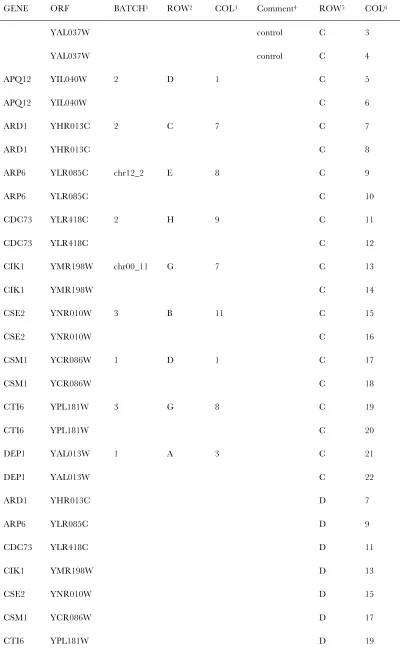
TABLE S1
htz1∆ mini-array spreadsheet
M. Hang and M. M. Smith 3 SI
TABLE S2
set3∆ mini-array spreadsheet
GENE ORF BATCH1 ROW2 COL3 Comment4 ROW5 COL6
YAL037W control C 3
YAL037W control C 4
APQ12 YIL040W 2 D 1 C 5
APQ12 YIL040W C 6
ARD1 YHR013C 2 C 7 C 7
ARD1 YHR013C C 8
ARP6 YLR085C chr12_2 E 8 C 9
ARP6 YLR085C C 10
CDC73 YLR418C 2 H 9 C 11
CDC73 YLR418C C 12
CIK1 YMR198W chr00_11 G 7 C 13
CIK1 YMR198W C 14
CSE2 YNR010W 3 B 11 C 15
CSE2 YNR010W C 16
CSM1 YCR086W 1 D 1 C 17
CSM1 YCR086W C 18
CTI6 YPL181W 3 G 8 C 19
CTI6 YPL181W C 20
DEP1 YAL013W 1 A 3 C 21
DEP1 YAL013W C 22
ARD1 YHR013C D 7
ARP6 YLR085C D 9
CDC73 YLR418C D 11
CIK1 YMR198W D 13
CSE2 YNR010W D 15
CSM1 YCR086W D 17
M. Hang and M. M. Smith 4 SI
GIM3 YNL153C 3 B 4 E 3
GIM3 YNL153C E 4
GCR2 YNL199C chr14_2 D 9 E 5
GCR2 YNL199C E 6
ERG3 YLR056W chr14_2 D 9 E 7
ERG3 YLR056W E 8
SED4 YCR067C control E 9
SED4 YCR067C control E 10
GIM4 YEL003W 1 G 9 E 11
GIM4 YEL003W E 12
HCM1 YCR065W 1 C 8 E 13
HCM1 YCR065W E 14
HCS1 YKL017C chr11_1 B 6 E 15
HCS1 YKL017C E 16
HTZ1 YOL012C chr15_5 B 11 E 17
HTZ1 YOL012C E 18
LGE1 YPL055C 3 F 12 E 19
LGE1 YPL055C E 20
MDM35 YKL053C-A 3 F 12 E 21
MDM35 YKL053C-A E 22
GIM3 YNL153C F 3
GCR2 YNL199C F 5
ERG3 YLR056W F 7
SED4 YCR067C control F 9
GIM4 YEL003W F 11
HCM1 YCR065W F 13
HCS1 YKL017C F 15
HTZ1 YOL012C F 17