University of Windsor University of Windsor
Scholarship at UWindsor
Scholarship at UWindsor
Electronic Theses and Dissertations Theses, Dissertations, and Major Papers
1-1-2020
Performance Evaluation of Pathfinding Algorithms
Performance Evaluation of Pathfinding Algorithms
Harinder Kaur Sidhu University of Windsor
Follow this and additional works at: https://scholar.uwindsor.ca/etd
Recommended Citation Recommended Citation
Sidhu, Harinder Kaur, "Performance Evaluation of Pathfinding Algorithms" (2020). Electronic Theses and Dissertations. 8178.
https://scholar.uwindsor.ca/etd/8178
This online database contains the full-text of PhD dissertations and Masters’ theses of University of Windsor students from 1954 forward. These documents are made available for personal study and research purposes only, in accordance with the Canadian Copyright Act and the Creative Commons license—CC BY-NC-ND (Attribution, Non-Commercial, No Derivative Works). Under this license, works must always be attributed to the copyright holder (original author), cannot be used for any commercial purposes, and may not be altered. Any other use would require the permission of the copyright holder. Students may inquire about withdrawing their dissertation and/or thesis from this database. For additional inquiries, please contact the repository administrator via email
Performance Evaluation of Pathfinding
Algorithms
By
Harinder Kaur Sidhu
A Thesis
Submitted to the Faculty of Graduate Studies
through the School of Computer Science
in Partial Fulfillment of the Requirements for
the Degree of Master of Science
at the University of Windsor
Windsor, Ontario, Canada
2019
Performance Evaluation of Pathfinding Algorithms
by
Harinder Kaur Sidhu
APPROVED BY:
______________________________________________
C. Semeniuk
Great Lakes Institute for Environmental Research
______________________________________________
A. Jaekel
School of Computer Science
______________________________________________
S. Goodwin, Advisor
School of Computer Science
iii
DECLARATION OF ORIGINALITY
I hereby certify that I am the sole author of this thesis and that no part of this
thesis has been published or submitted for publication.
I certify that, to the best of my knowledge, my thesis does not infringe upon
anyone’s copyright nor violate any proprietary rights and that any ideas, techniques,
quotations, or any other material from the work of other people included in my thesis,
published or otherwise, are fully acknowledged in accordance with the standard
referencing practices. Furthermore, to the extent that I have included copyrighted
material that surpasses the bounds of fair dealing within the meaning of the Canada
Copyright Act, I certify that I have obtained a written permission from the copyright
owner(s) to include such material(s) in my thesis and have included copies of such
copyright clearances to my appendix.
I declare that this is a true copy of my thesis, including any final revisions, as
approved by my thesis committee and the Graduate Studies office, and that this thesis
iv
ABSTRACT
Pathfinding is the search for an optimal path from a start location to a goal
location in a given environment. In Artificial Intelligence pathfinding algorithms are
typically designed as a kind of graph search. These algorithms are applicable in a wide
variety of applications such as computer games, robotics, networks, and navigation
systems. The performance of these algorithms is affected by several factors such as
the problem size, path length, the number and distribution of obstacles, data
structures and heuristics. When new pathfinding algorithms are proposed in the
literature, their performance is often investigated empirically (if at all). Proper
experimental design and analysis is crucial to provide an informative and
non-misleading evaluation. In this research, we survey many papers and classify them
according to their methodology, experimental design, and analytical techniques. We
identify some weaknesses in these areas that are all too frequently found in reported
approaches. We first found the pitfalls in pathfinding research and then provide
solutions by creating example problems. Our research shows that spurious effects,
control conditions and sampling bias data can provide misleading results and our
v
DEDICATION
vi
ACKNOWLEDGEMENTS
I would like to express my sincere gratitude towards my advisor Dr. Goodwin for
guiding me through my thesis and also for being patient with me and understanding
the whole time. I would like to thank him for providing me the knowledge and
resources like books and papers required to complete my research work and
providing continuous feedback on my work to make it better.
I would also like to thank my committee members Dr. Jaekel and Dr. Semeniuk for
vii
TABLE OF CONTENTS
DECLARATION OF ORIGINALITY ... iii
ABSTRACT ... iv
DEDICATION ... v
ACKNOWLEDGEMENTS ... vi
LIST OF TABLES... x
LIST OF FIGURES ... xi
LIST OF APPENDICES ... xii
CHAPTER 1 Introduction ... 1
1.1 Thesis Claim ... 1
1.2 Pathfinding- Overview ... 2
1.2.1 Pathfinding Problem Definition: ... 3
1.3 Map Representations: ... 3
1.3.1 Tile Grids: ... 3
1.3.2 Navigation Mesh: ... 5
1.3.3 Waypoints: ... 5
1.4 Algorithms ... 6
1.4.1 Informed Pathfinding Algorithms: ... 6
1.4.2 Uninformed Pathfinding Algorithms: ... 8
1.5 A* Algorithm and its variants: ... 8
1.6 Thesis Contribution ... 9
1.7 Thesis Organization ... 10
viii
2.1 Empirical Research ... 12
2.2 Need of Empirical Studies ... 13
2.3 Problems with Current Research Practices ... 14
2.4 Critical Review of Pathfinding Research Papers ... 15
2.5 Summarizing the critically reviewed papers ... 17
CHAPTER 3 Empirical Research in Pathfinding... 19
3.1 Motivation... 19
3.2 Empirical Research and its basic components ... 19
3.3 Guidelines for Empirical Research ... 21
3.3.1 Objective ... 21
3.3.2 Experimental Setup ... 22
3.3.3 Data Collection ... 23
3.3.4 Data Analysis ... 24
3.3.5 Representing results ... 24
CHAPTER 4 Case Studies and Results ... 26
4.1 Pitfalls in empirical studies ... 26
4.1.1 Spurious effects: ... 27
4.1.2 Control conditions: ... 30
4.1.3 Sampling Bias: ... 30
4.2 Experimental Setup: ... 32
4.3 Solutions to Pitfalls ... 34
4.3.1 Case 1 – Four Spurious effects:... 34
4.3.2 Case 2 – Control conditions: ... 36
4.3.3 Case 3 – Sampling Bias: ... 37
4.3.4 Case 4 – Example problem from research papers: ... 39
CHAPTER 5 Conclusion ... 42
CHAPTER 6 Future Work ... 44
ix
APPENDICES ... 47
Appendix A ... 47
Appendix B ... 54
x
LIST OF TABLES
1. Table 1: Example of regression effect using Octile and Euclidean heuristic. ... 29
2. Table 2: Octile heuristic with 5 run times for each instance ... 29
3. Table 3: A* octile run times sorted according path length and their average ... 36
4. Table 4: A* Euclidean run times when every third instance from the octile runs is selected. ... 36
5. Table 5: A* octile with new average run times for each instance. ... 37
6. Table 6: Data as given in Yngvi et al. research paper for the three heuristics. ... 41
7. Table 7: Classification of reviewed papers ... 54
xi
LIST OF FIGURES
1. Figure 1: Pathfinding Example Map ... 2
2. Figure 2: Different types of tile grids ... 4
3. Figure 3: Navigation mesh ... 5
4. Figure 4: Waypoints ... 6
5. Figure 5: Elements of Empirical Research ... 20
6. Figure 6: Ceiling and Floor Effects in Pathfinding ... 27
7. Figure 7: Time and path length results on Random Map size 120 X 120 with obstacle density 15% ... 31
8. Figure 8: Time and path length results on terrain map size 120 X 120 with obstacle density 15% ... 32
9. Figure 9: Maps of size 120 X 80 with obstacle density 15%. (a) Random Map, (b) Terrain Map, (c) Floor Plan Map, (d) Maze Map ... 33
10. Figure 10: Maps with 50% obstacle density with maximum path length. ... 34
11. Figure 11: Chart showing combined data for A* from different maps of size 120 X 120 and obstacle density is 15%. ... 38
12. Figure 12: Average time and path length of four different types of maps, size: 120 X 120, obstacle density is 15% ... 39
xii
LIST OF APPENDICES
Appendix A ... 47
1
CHAPTER
1
Introduction
1.1 Thesis Claim
In this thesis, we proposed the set of guidelines for the researcher to design the
experiment and to empirically analyze the results from the data collected. In
pathfinding when a new algorithm or data structure is proposed it is tested on set of
different maps. Therefore, the main focus of this thesis is to study the various aspects
of maps, generated in pathfinding experiments, like the path length, the density of
obstacles, map size and so on as the performance of newly built algorithm is tested
on these maps thus it is an important aspect of pathfinding experiments. We studied
over 150 research papers related to pathfinding and found that nearly 65% of papers
do not provide enough information to support their claim and nearly 50% of these
papers have only either random grid maps or game maps to test their algorithm. Only
20% of the papers conduct sound experiments and provide empirical analysis of their
results. While reviewing these papers we found some weaknesses in the experimental
setup based on the design of the experiments, methodology and analytical techniques
used by researchers. Our thesis shows that it is really important to avoid these pitfalls
and design the experiments empirically sound to test the algorithm for all possible
outcomes to do a detailed analysis of the algorithms' performance. Based on our
findings, we categorized the maps into four types to consider different obstacle
distributions of obstacles and also show how different attributes of maps can be
manipulated to get more reliable results. We support our findings with some case
studies which shows that deviating from these practices give unreliable and
2
1.2 Pathfinding- Overview
Pathfinding refers to computing an optimal route in a given map between the
specified start and goal nodes. It is an important research topic in the area of Artificial
Intelligence with applications in fields such as GPS, Real-Time Strategy Games,
Robotics, logistics while implemented in static or dynamic or real-world scenarios
[1]. Recent developments in pathfinding lead to more improved, accurate and faster
methods and still captivates the researcher’s attention for further improvement and
developing new methods as more complex problems arise or being developed in AI
[2]. A great deal of research work is done in pathfinding for generating new
algorithms that are fast and provide optimal path since the publication of the Dijkstra
algorithm in 1959. Most of the research work is validated using experimental data.
Therefore, the research must provide reliable and accurate information as
experiments are very volatile.
3
1.2.1 Pathfinding Problem Definition:
Pathfinding is closely related to shortest path problem, thus the definition of
pathfinding is finding the optimal path from a given start node(s) to goal node(g) in
the given graph(G), where optimal refers to the shortest path, low-cost path, fastest
path or any other given criteria. Pathfinding can generally be divided into two
categories: SAPF, that is Single Agent Pathfinding, to generate a path for one agent
and MAPF, that is Multi-Agent Pathfinding, to generate the path for more than one
agent. In this paper, we only consider the single-agent pathfinding problem in a static
environment, which means the map does not change as the agent moves. Pathfinding
has applications in different fields and it is hard to consider all the application areas,
so in this paper, only video game applications are used and in 2D environments.
1.3 Map Representations:
Pathfinding is used in a wide variety of areas and usually implemented on different
maps that are generated to test pathfinding algorithms. The widely popular maps are
implemented using a grid-based graph, set of nodes and edges, representations in the
algorithm. Usually, a grid is superimposed over a map and then the graph is used to
find the optimal path [4]. Most widely used representations are square tile grid which
can either be accessed as a 4-way path or 8- way path. Both have their own
advantages and disadvantages. Grids are considered simple and easy to implement
and are commonly used by researchers. Other representations are Hexagonal grid,
Triangular grid, Navigation Mesh, and Waypoints [1].
Various types of map representations are discussed below briefly:
1.3.1 Tile Grids:
The composition of the grid includes vertices or points that are connected by edges.
Basically, grids uniformly divide the map world into smaller groups of regular shapes
4
diagonal movement) or 8-way (diagonal movement). The second most widely used
grid representations are Hexagonal grids (Fig 2.b). Hexagonal grids are like square
grids with the same properties and take less search time and reduced memory
complexities [5]. Triangular grids (Fig 2.c) are not popular among game developers
and researchers but some methods are proposed to reduce the search effort and time
consumption.
5
1.3.2 Navigation Mesh:
A navigation mesh (Fig 3) is a connected graph of convex polygons, where the polygon
is a node in a graph, also known as navmesh. Polygons represent a walkable area, thus
movement in any direction is possible within the polygon. The map is pre-processed
to generate nav-mesh and then the path can be found by traversing polygons (from
polygon consisting start point to polygon consisting goal point). The benefits of using
navigation mesh are that it reduces the number of nodes in the graph as the large
walkable area can be represented as a single convex polygon, reduces the memory
required to store pre-processed map, and increases the speed of pathfinding [6].
Figure 3: Navigation mesh[18]
1.3.3 Waypoints:
A waypoint (Fig 4) can be defined as a point along the path which can be marked
manually or can be automatically computed. The purpose of waypoints is to minimize
the path representation as the shortest path can be pre-computed between any two
points. Therefore, certain optimization techniques are developed to compute the path
using waypoints. The main advantage of waypoints can be in a static world as the map
does not change, so the shortest paths between two waypoints can be pre-computed
6
Figure 4: Waypoints[18]
1.4 Algorithms
For finding a path between two nodes in a given graph a search algorithm is required.
Many search algorithms have been developed for graph-based pathfinding.
Pathfinding algorithm generally finds the path by expanding nodes and neighboring
nodes according to some given criteria. Pathfinding algorithms can be broadly
divided into two categories: Informed and Uninformed pathfinding Algorithms.
1.4.1 Informed Pathfinding Algorithms:
As the name suggests informed means having prior information about the problem
space before searching it. Informed search refers to the use of knowledge about the
search space like problem map, estimated costs, an estimate of goal location. Thus,
the algorithm utilizes this information while searching a path and it makes
pathfinding fast, optimal and reduces memory usage in node expansion [7]. Various
algorithms that fall under this category are A*, IDA*, D*, HPA*, and many more. These
7
information of the search problem. The following heuristic functions, used by these
algorithms, are discussed briefly here:
Manhattan Distance: Manhattan distance is considered as a standard heuristic for the
square grid, defined as the sum of the absolute difference between the start and goal
position cartesian co-ordinates. In pathfinding, the Manhattan distance is the distance
between start node to goal node when the movement is restricted to either vertical
or horizontal axes in a square grid. The heuristic function is given below:
h(x) = |x1 – x2| + |y1 – y2|
Octile Distance: Octile distance is the distance between two points when diagonal
movement is possible along with horizontal and vertical. The Manhattan distance for
going 3 up and then 3 right will be 6 units whereas only 3 units diagonally (octile
distance). The function of octile distance is given below:
h(x) = max( (x1 – x2), (y1 – y2) + (sqrt(2) -1) * min( (x1 – x2), (y1 –
y2))
Euclidean Distance: When any angle movement, not the grid directions (horizontal.
vertical, diagonal), is allowed then the straight-line distance is the shortest distance
between any two points which is also known as Euclidean distance. The function is
given below:
h(x) = sqrt (|x1 – x2| + |y1 – y2| )
In uniform cost search the next node is selected based on the cost so far, so the lowest
cost node gets selected at each step. It is complete and optimal but not efficient as it
8
1.4.2 Uninformed Pathfinding Algorithms:
Uninformed pathfinding refers to finding the path without any knowledge of the
destination in the search space with only information about start node and adjacent
nodes, also known as blind search [7]. Thus, the algorithm blindly searches the space
by exploring adjacent nodes to the current node. Breadth-first search, depth-first
search, Dijkstra are some algorithms that fall under this category. Uninformed search
is slow and consumes lots of memory in storing nodes as it searches whole space until
the destination node is found. The uninformed pathfinding is also known as an
undirected search approach, which simply does not spend any time in planning. It just
explores the nodes that are connected with the current node and then explore their
neighbor nodes and so on until finds the node marked as goal node.
1.5 A* Algorithm and its variants:
The A* algorithm is popular among all fields of pathfinding. A* algorithm was first
proposed in 1968 by Hart et al. and then improved version in 1972. A* algorithm
combines the actual cost from the start point and estimated the cost to the endpoint
to choose the next node to be explored. The estimated cost is given by the heuristic
function used in A*. Given a start node in a graph, A* always finds the optimal path to
the goal node [7]. The process involves building all possible paths from the starting
node and exploring the adjacent nodes one at a time until reaches the node-set as a
destination node. A* uses the “f” value given as:
𝑓(𝑛) = 𝑔(𝑛) + ℎ(𝑛)
where g(n) is the distance between the start node to some node n, h(n) is the
estimated cost by heuristic function from node n to the goal node. A* uses the sum of
these values to choose the next node to be explored in each step. A* is guaranteed to
find the optimal path, given that the heuristic function must be admissible, by
9
the actual cost to reach the goal. The map is preprocessed, and all the information is
stored as nodes and related costs are assigned to the nodes. A* maintains two lists
while searching a problem space, one is Open List, and another is Closed List. The
Open List consists of all the nodes that are not expanded yet but visited by the
algorithm and the Closed List consist of all the nodes that are completely expanded
means all the linked nodes have been visited by the algorithm. When the goal node is
visited the algorithm terminates and then backtracks the nodes from the closed list
to generate the path.
As A* is widely used and due to its popularity for finding the optimal path, many
variants have been developed over the years to improve the performance and
efficiency of the algorithm. The variants of A* are like Iterative-Deepening A*,
Hierarchical Pathfinding A*, D*, Lifelong Planning A*, and so on.
1.6 Thesis Contribution
In pathfinding, when a new algorithm or any new improvement to the existing
method is proposed, the results are validated using experimental results. These
experiments are designed or meant to explore the reasons for algorithm performance
and to confirm the findings through results collected from these experiments.
Although experiments are very crucial for empirical studies these are also a very
volatile and unstable sources of getting or validating results. In pathfinding, various
maps and their representations are used for experimental setup to test the proposed
algorithm or data structure. Our thesis focuses on exploiting these maps and their
features to help design more sound experiments. Then we provide some general
guidelines for conducting empirical research and writing a research paper in
pathfinding. Our next focus in the thesis is to highlight various pitfalls in designing
experiments, collecting results, analysis techniques used to extract important
10
When we study the literature work in pathfinding we realized that most of the papers
lack in providing some important information in their research paper. We then
critically reviewed the research papers and based on the findings we provide
solutions to the common pitfalls through case studies that followed the proposed
solutions. We broadly classified maps into four types: Random maps, Terrain or
real-world maps, Floor plan or building plan maps and lastly game or maze maps. These
four categories of maps cover almost every possible distribution of obstacles in the
map one can create or might use when implementing algorithms. Most of the papers
in pathfinding are either using random maps or game maps thus in some way getting
a biased sample of data for their result analysis which as we know does not provide
reliable information about the performance of their proposed method. Our thesis
recommends future researchers in pathfinding to use at least these four types of maps
to evaluate the results for their given method or algorithm.
1.7 Thesis Organization
We organized this thesis into six chapters. The first chapter introduces the
pathfinding problem, its components, and underlying concepts. This chapter first
gives the definition of pathfinding problem then briefly discusses the three main map
representations: Tile grids, Navigation mesh, and Waypoints. After that, algorithms
used in pathfinding are discussed, with major focus on A*, its variants and finally the
contribution of this thesis. The second chapter gives the introduction to empirical
research and its need for pathfinding research. Then we discussed the problems with
existing research papers based on literature review and criticized some papers
published in this field. The third chapter constitutes the motivation for our thesis and
then gives details about empirical research and its basic components. Some general
guidelines for conducting an empirical study in pathfinding are mentioned in this
11
and provides solutions through case studies of problems that show the effects of
pitfalls. The experimental setup used for the case studies is mentioned in this chapter.
Chapter five concludes our thesis findings and recommended methods for conducting
experiments. The final chapter is about possible future work to be done to extend our
12
CHAPTER
2
Introduction to empirical research and
literature review
2.1 Empirical Research
Empirical research is an important aspect of research in the field of pathfinding. When
a new pathfinding algorithm is proposed in the literature, the performance is
evaluated by empirical methods. Empirical methods are a combination of exploratory
techniques and confirmatory procedures. Exploratory techniques are those
techniques that provide visualization, summarization, and modeling of the data
collected by confirmatory experiments. Empirical methods amplify our observations
and help us understand the structure of our problem world. Empirical studies seek
the explanation for the performance of the algorithm rather than finding the best
performing algorithm. In pathfinding, many works of literatures published were not
designed or evaluated empirically. There are no set guidelines for conducting
experiments in pathfinding. It is crucial to have a standardized experimental setup to
evaluate the performance of the algorithm empirically, to conclude reliable results
because whatever we publish presently becomes the fundamentals of the future.
Therefore, if a slight weakness or not reliable information gets into the mainstream it
will lead to more chaos in the future. In the literature, we did not find any paper which
could provide some standards or guidelines to conduct empirical studies in
pathfinding. Empirical research thoroughly examines the performance and provides
experimental verification of the working of the method.
The advancement in artificial intelligence in games and other fields is making the
13
operations like graphics, player actions, leaving a very small space for running
pathfinding search. Also, there is a pressure of developing a more advanced, fast and
optimal path planning search with limited resource utilization and minimum time
frame.
2.2 Need of Empirical Studies
Empirical studies generally consider the data analysis methods and statistical
techniques for exploring the relationships between various factors of the problem
domain by using the data collected through experiments. Empirical studies are
important because it allows the exploration of relationships among independent and
dependent factors. It helps in providing proof to the theoretical concepts through
experimental data. It helps in accurate evaluation of the proposed pathfinding
algorithm or the data structure. The empirical study enables us to choose from
various techniques and data analysis tools for generating meaningful results.
Empirical studies are essential in the area of pathfinding as it allows to evaluate and
assess the new ideas, concepts, algorithms, tools, strategies, heuristic and data
structure in scientific and proved manner. It also facilitates improving, controlling
and managing the existing methods, pathfinding techniques, and strategies by using
evidence from the empirical analysis. The information collected from empirical
studies helps in decision making and understanding of the concepts of the pathfinding
techniques. It will help in building quality benchmarks for future experimentation
across pathfinding community and more reliable results can be obtained by standard
comparison of the proposed method with the previous methods. The empirical
studies are also beneficial for game developers in selecting the appropriate search
algorithm for their game while giving them enough space to focus on other aspects of
game development. The empirical study enables the gathering of evidence to favor
14
empirical research for building a knowledge base so that high-end algorithms can be
developed and utilized.
2.3 Problems with Current Research Practices
Every year many research papers are published in every field. In computer science,
the work in research papers is supported by experimental data and analysis of that
data. Then the results are concluded and presented in the research papers. Sometimes
the results given in research papers do not seem reliable according to the provided
information. Therefore, after surveying and critically analyzing more than 150
papers, this thesis highlights the problems with current practices. The first problem
is the lack of causal explanation of the behavior of the proposed algorithm or data
structure. Many papers do not try to explain the reasons behind the performance of
their algorithm. The experimental results show that the algorithm works but often
doesn’t know how to determine whether in what conditions it works well or poorly.
Many papers claim that their algorithm works better than the other but usually can’t
attribute the difference in performance to the algorithm or differentiate the influence
of algorithm from the influence of the experimental setup. As papers lack causal
explanations thus, their results are quite often misleading means they claim things
which are not true. There are high chances that something goes wrong with
experiments as compared to theory because theory is based on logical proofs, but
experiments are like cooking recipes, slight difference in ingredients could lead to
entirely different result [12]. Therefore, a minor mistake while conducting
experiment can generate misleading results. Experiments are easier to mess up than
the theoretical proofs.
Advancement in technology and science makes the problems more complex.
Therefore, it is not possible to find theory-based solutions supported by complex
15
empirical study to find solutions to the problems with the help of experiments. As
mentioned earlier that experiments can go wrong and generate misleading results
which turns into incorrect interpretation of data. Another problem is the bias results,
means the experimental setup is in favor of the proposed method. In pathfinding,
maps are often generated randomly and does not provide real world scenario and the
results can be biased with the generation of simple maps rather than complex ones.
There is no standard setup or guidelines exist for pathfinding therefore, the
comparison with others work is not at the same scale. Everyone uses their own set of
maps for testing algorithm’s performance, so it is hard to do comparative analysis of
their work. These are some basic issues with the current practices in pathfinding
research.
2.4 Critical Review of Pathfinding Research Papers
Research papers are an important part of current developments in pathfinding area,
as it provides insight into the work done in past and future expectations. It is
necessary to critically review the research papers published in past in order to make
future research more valuable and reliable by learning from their mistakes and
weaknesses. In this thesis nearly 150 research papers are critically reviewed during
literature study and throughout our thesis work to find out the pitfalls and problem
areas while conducting research. Critical review of some papers is presented in this
section. Kai Li et al. [11] proposed a boundary iterative-deepening depth-first search
(BIDDFS) algorithm which repeats its search from the saved boundary location,
minimizing the search redundancy in most of the iterative search algorithms (repeats
its search from starting point each time). The experimental results only show the
time taken and threshold, in which Dijkstra beats the time of BIDDFS, but it does not
provide clear evidence like the memory usage. Therefore, the paper fails to provide
16
interpretation of data. Also, the paper gave no evidence that their algorithm had been
tried on more than one set of maps (randomly generated square maps), no real-world
maps were used to test the algorithm’s performance. Another problem was that
BIDDFS had the same threshold as of IDDFS in all the cases and takes more runtime
for lower obstacle density. Threshold was described as memory efficiency but the
paper did not provide any memory comparisons, which was the claim, that proposed
algorithm consumes less memory.
The research paper written by Yngvi et al. [8] proposed two new effective heuristics
for A*. The first one is, the dead – end heuristic, that reduces the search area from the
map which is irrelevant to the current path query and thus claimed to be more
effective than general octile heuristic. The second heuristic, called gateways heuristic,
used the decomposed map from the previous heuristic, then consider the boundaries
of the omitted areas as gateways to pre-process the path from one gateway to all other
gateways and thus, claimed to better estimate the path cost. Now, the way this paper
was presented has three main areas where it lacks empirically or did not provide
enough information to the readers. Firstly, it uses one demo map and nine game maps,
but did not provide any information regarding the range of map size, obstacle density
and distribution of obstacles. Secondly, the author did admit that the proposed
heuristics use extra memory for pre – calculations but did not give any range or
number for the memory usage. Thirdly, the author claims that heuristics take less
time for the final pathfinding but did not provide any data for the time taken by these
heuristics for pre-processing of the map decomposition and distance between
gateways. Whereas, in octile heuristic neither pre-calculation nor decomposing the
map is required. So, from reader’s perspective this paper did not answer all the
questions arising in reader’s mind.
In our thesis, we tried to create case studies surrounding these problems and provide
some solutions. As it is not possible to recreate same experiments because every
paper uses discrete setups, we generated general problem cases to cover these
17
2.5 Summarizing the critically reviewed papers
The pathfinding research papers reviewed for our thesis were analyzed based on the information provided by the author in the paper. As we do not have access to the researcher’s data, we assume that the author provides the information to the best of their knowledge and supporting data. Therefore, based on the information in the research paper, we find that most of the papers have poor experimental setups, inappropriate collection of data and unreliable data analysis techniques or representations. In most of the experimental setups only one type of map is used and most commonly used maps are either random maps or game maps. These two types of maps are used by most of the researchers because random maps are easy to generate and also obstacles are placed randomly, which they assume will covers the typical problem area and game maps are used by some researchers for different reasons. But in reality, random maps do not provide enough challenge to test the algorithm efficiency. Some of the papers also use only one size maps, like paper written by David [14] used only maps of size 32 x 32 and another paper used only maps of size 300 x 300 [15], therefore making it difficult to compare the work of these papers and also this kind of experimental did not provide enough evidence to support the performance of their algorithm. Both of them randomly generated their maps and obstacles are also distributed randomly. David [14] also used only 20% obstacle density which again is not a good example of testing algorithm’s efficiency.
18
19
CHAPTER
3
Empirical Research in Pathfinding
3.1 Motivation
Pathfinding problem is popular among AI society and lot of work was published to
address this problem. While reading literature, we realized that some of the papers
lack experimental evidence supporting their claim. Then papers were reviewed
critically for more information and it was clear that some of the results were
misleading and lack explanation. The problem was the absence of clear set of
guidelines to conduct research in pathfinding. When some more literature study was
conducted, we found that experiments are very volatile and can be easily messed up,
which could lead to wrong interpretations and conclusions, we decided to find the
solution and recommend some methods to avoid the pitfalls while conducting
empirical study.
3.2 Empirical Research and its basic components
Empirical research is the combination of exploratory techniques (visualization,
summarization, exploration and modelling) and confirmatory procedures (testing
hypotheses and predictions) [12]. Empirical study is important for pathfinding
research as it allows researchers to evaluate and assess the new algorithms,
techniques, methods and concepts in scientific and proved manner. It also facilitates
the improvement and management of the existing methods by using evidence
collected from empirical analysis. According to Cohen [12], there are six basic
20
(performance evaluation), environment (maps or test subject), protocol
(experimental setup), data collection and analysis. In pathfinding, agent is the
proposed algorithm or data structure, task is to evaluate its performance,
environment is maps or graphs, protocol is experimental rules and setup, data
collection is record of experimental results and then analysis of those results. The first
three represents the theories of behavior, the last three are part of empirical study.
According to Malhotra [13], there are four basic elements of empirical research which
are mainly purpose, participants, process and final product. Purpose refers to the
motivation of the research, means building the research question and the reason for
conducting research. It basically means asking a question, “Why are we conducting
this research, why is it so important?”. The next element is the participants, around
which a research work must be done, the matter of the research. It is very important
to handle the participants with adequate manner, especially in computer science all
the ethical issues should be managed properly. The process gives the details of the
steps to be taken in order to conduct a research in rightful manner. All the research
details like planning, literature, techniques, programs and methodologies to be used
and the sequence these must be conducted constitutes the process of research.
21
Finally, the last element is the product, which in computer science research is the
conclusion and results being calculated from the data collected during the process.
These results then help the researcher to answer their research question asked in the
beginning of the research.
3.3 Guidelines for Empirical Research
In empirical Research it is important to understand the issues and pitfalls related to
it. So, here we underline some general guidelines to conduct empirical research.
3.3.1 Objective
The very first stage of the empirical research is defining the goals of the study. The
objective must be clearly defined and explained in detail to provide meaningful
information. It must dispense the purpose of the study like researcher’s final goal and
sub goals, the areas to be studied and its impact, the system to be used and, the motive
of the study. It must answer the following questions:
• What is the aim of the research? • What are the areas of focus?
• What type of research is being conducted? • What techniques or programs are being studied?
These questions can help to precisely define the objective of empirical study. The
research question should be exploratory in nature rather than comparative, means
the question should look for possible explanations of the performance not on
comparing which performs better. It is equally important to make a clear hypothesis
question as conducting the experiments. If the hypothesis is not clearly defined, then
experimental results will not provide useful data. For example, finding which
22
better path than other is a valid research study. Finding out the reasons for the
algorithm’s performance will help us in identifying the areas which affects the
performance of the algorithm so that we can work on them in more detail or
manipulate those parameters to yield better performance. Taking the first step
correct makes next steps clearer and easier. So, defining the research question is our
first step and it must be precisely designed. Literature study plays an important role
in defining our research problem and based on that background literature research
one can formulate the research question for their empirical study.
3.3.2 Experimental Setup
The next stage in empirical research is conducting experiments to test the algorithms
and generate data for further analysis to draw solid conclusions. The experiment
should be designed according to the objective of study. It must cover all the prospects
of research question, like formulating the appropriate hypothesis to be tested,
figuring out the variables to be used, type of data to be collected, analysis techniques
to be used and last how to represent that data.
The initial stage of experimental setup requires formulating the research question.
This means that it should address the concepts and relations to explore in the
research. The research question will be like: What attributes of the map will affect
the performance of the algorithm? Or What is the impact of the data structure on the
working of the pathfinding algorithm? The research question should address the area
to be studied for the problem, which in turn help us identifying the independent and
dependent variables. Independent variables are defined as the variables that can be
controlled or manipulated during the experiment while dependent variables are the
output variables that depend on the independent variable. Any change in the
independent variable directly affect the dependent variable. If the problem is clearly
stated then it makes it bit easy to define which variables to be considered dependent
23
size, obstacles density, distribution of obstacles are independent variables and the
time taken for searching the map, number of operations, nodes expanded are
dependent variables. The path length is a special attribute because the path length
somehow depends on the map size but within the map it is considered independent
variable as we can change the path length by changing the start and goal positions. In
this stage researcher should also think about the analysis methods to be used to
estimate the amount of data to be generated and collected. By going through the
analysis before executing the experiment. The next important thing is to state the
environment of the study, language used for programming, maps used, algorithms
used, data structure and so on.
3.3.3 Data Collection
The researcher should make decision on the sources of collecting the data for analysis,
means that the data is generated by conducting the experiments only or using the
available benchmark datasets or from the literature. If using both benchmarks sets
and experimental data, then also state how the data is collected like if the researcher
used the same experimental setup as of benchmark or the literature setup with which
the data will be compared. If the researcher used different experimental setup like
different programming language, different IDE or platform, then how the comparison
with previous data will be validated. Is it a direct comparison, which we do not
recommend, or indirect comparison like first by collecting the similar data set as of
the benchmark set and analyze it, if it concludes the same result as of the benchmark
or literature result then further conclusions can be drawn based on these
observations? Researcher should avoid collecting too much or too little data, because
if large or less data is collected then we can miss important information. Try to collect
only relevant data and informational data. Initially a large data is collected and then
it should be normalized or reduced by applying some formulas or various statistical
techniques like averaging, standard deviation and so on, which makes analysis of the
24
3.3.4 Data Analysis
Data analysis stage plays a crucial role in answering our research question. It involves
the understanding of the data by reducing it suitably and which can be read easily.
Then this reduced data can be used for further analysis. But data must be reduced
carefully without losing its original information. One way of reducing the data is
dividing the dependent variables into different categories and then conduct the
comparison among those categories. The second way is using some sort of statistical
measures such as mean, median, or standard deviation. While using these averaging
statistical techniques, the outliers must be assessed with precaution because
sometimes outliers provide useful insight into the performance of the algorithm. After
reducing the data, statistical techniques can be used like linear regression, logistic
regression, and so on for producing analyzing charts. Analysis method should be
selected based on the research question means it should provide meaningful answer
to the question asked at the beginning of the research.
3.3.5 Representing results
Finally, after analyzing the results reasoning must be provided for the explanation of
the answer using the data. Results must be represented in appropriate format and
from readers perspective. The report in which the results are represented must
clearly document the background, motivation, experimental design, analysis and
results. To represent the result bar graphs, line charts, pie charts or other methods of
representation can be used, which reader should easily understand. Although the
results should be represented in simple form, for readers prospective, but it should
also retain the important information. The report must answer all the readers
question, it must provide significant details about every aspect of the research. The
results should be represented using an appropriate chart. It is not a good idea to put
25
the data or some relationship between the parameters. So, it is recommended to use
bar charts or some sort of other representation of data along with tables.
In our research we followed these above-mentioned guidelines. Firstly, based on
literature study we find our research problem and formulate our research question
which was, “How to empirically evaluate the performance of pathfinding algorithm?’.
After that we did some more literature study and find out the core area that we want
to study which was exploiting maps and their features for algorithm performance
evaluation. We also want to address the issues in evaluating the pathfinding
algorithms. So, we design our experimental setup accordingly. Before designing the
experiments, we figure out independent and dependent factors, like map size, density
and distribution of obstacles as independent factors and time, number of nodes, path
length as our dependent variables, so that our experiments are more precise. Also, we
roughly layout the amount and type of data to be collected and data analysis
techniques before working on experimental setups. Thus, it saves a lot of time and
effort as we did not generate and collected irrelevant data. These general guidelines
help a lot in empirical research where a lot of experiments are conducted to verify the
26
CHAPTER
4
Case Studies and Results
4.1 Pitfalls in empirical studies
Although while reading a research paper it seems that researcher conducted the
study with clarity from the beginning of the research. However, this is not the case,
conducting a research is a long and raw process which started with a vague idea of
research problem, making mistakes, correcting them and learning from those
mistakes, and finally redefining the research problem so that readers can understand
easily. When conducting research one can have some problems which in the end can
affect the results or answer to the research question. One can think that scientist or
researchers are perfect in doing experiments and know everything about the
experiments but in reality, even they made mistakes. The following example from an
article published in 1991 will explain that how experiments conducted by scientists
or anyone can go wrong sometimes. In 1991 New Scientist published an article about
the search for an AIDS vaccine. The article says that initially scientists from Britain’s
Medical Research Council developed the vaccine using two components, human T
cells and SIV virus. They first infected the cells with the SIV virus and then inactivate
the virus and prepared vaccine from it. They gave this vaccine to four macaques and
then gave them a live virus. It turns out that three out of four were protected against
the virus. Later they conducted another research in which they gave uninfected
human T cells of the same type to other four monkeys and then gave live virus, and
the results show that two out of four were protected. So, when this study was
published many other researchers said that the later scenario should have been
considered from the very beginning of this study. However, the scientist from MRC
27
think that they should consider all the possible variables in the beginning before
making their claim that the vaccine created from T cells and virus will work on AIDS,
but it is not possible to control all the variable possibilities directly. One can handle
very few variables at a time, so there is always the possibility of error and
encountering the pitfall while doing experiments [15]. The common pitfalls in
empirical study are the ceiling, floor, regression, order effects, which are commonly
known as Spurious effects, control conditions, sampling bias, collecting and analyzing
results. Spurious effects are defined as the mathematical relationship between two or
more variables in which they seem to be associated directly but in reality, it is either
by chance or due to some other factor. Basically, the spurious effects make some
results seem to be more effective when they are not or vice versa. These pitfalls are
discussed in the following section:
4.1.1 Spurious effects:
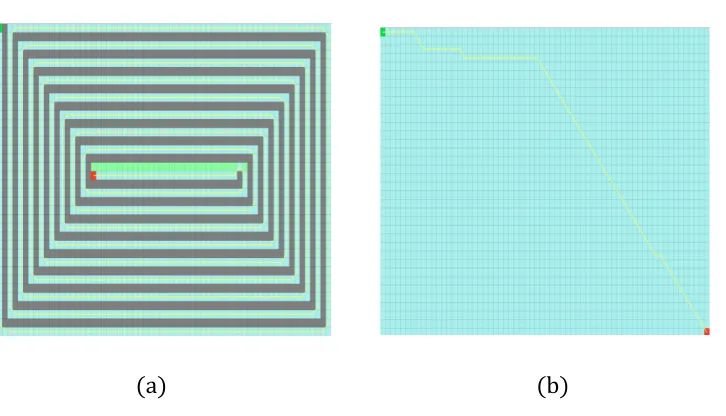
Floor effects are described as the worst-case scenario in which the algorithm’s
performance is as bad as possible whereas ceiling effects arise when algorithm
performs as best as possible. In pathfinding the ceiling effect occurs when an
algorithm expands near or same number of nodes as the path length.
(a) (b)
28
In fig 9. (a) the ceiling effect occurs because the algorithm expands nearly same
number of nodes as path length because those are the only traversable nodes in the
map. One can claim with this map that their algorithm works best as it gives the
maximum path length with almost same number of nodes expanded in high obstacle
density map. But in this scenario even the simplest pathfinding algorithm will
perform efficiently. We should not avoid these maps; we can use them because this
kind of maps will give us the ceiling value by giving the minimum number of nodes
expanded for the maximum path length. Fig 9. (b) shows the floor effect in which the
algorithm traverses the whole map means expanding all the possible nodes for the
given path length. Therefore, calculating these values help us analyzing our results
more accurately. How to use these values is explained in the later sections of this
chapter.
Next is the regression effect which is defined as getting extreme value on the first run
and lower values or near average values on later runs. For example, when we are
comparing the two heuristics Octile and Euclidean for A* algorithm, our hypothesis is
that Euclidean takes less time than octile in finding the path. In order to do that we
run our algorithm first with octile as heuristic for 10 times and record the values as
shown in table 1 (a). Then we set the criteria that we select those instances in which
the time taken is more than 1.5, because we think that these are more complex as
compared to others, and run our algorithm with Euclidean as heuristic function on
those instances again and record the values as shown in table 1 (b). Now according
to these observations, it is concluded that our heuristic is true, thus proves that
Euclidean takes less time than octile. But in general, Octile takes less time than
Euclidean. What happens here is that the values we got on those three instances are
higher because of either noise or extraneous factors and when we run the same
algorithm with octile on those instances again we get lower values as shown in table
29
A* Octile
Length Time
46 2.5
60 1.1
49 0.8
66 0.7
52 0.5
70 0.4
46 0.8
76 1.3
38 1.9
65 2.2
(a)
A* Euclidean
Length Time
46 0.9
38 0.7
65 1.4
(b)
Table 1: Example of regression effect using Octile and Euclidean heuristic.
A* Octile
Length Time T1 T2 T3 T4 T5
46 2.5 1 0.7 0.8 0.6
38 1.9 0.8 0.6 0.7 0.5
65 2.2 0.7 0.9 0.8 0.8
30
4.1.2 Control conditions:
As mentioned earlier, MRC researcher problem is a good example of control
condition. This is another pitfall in empirical studies as it is not possible to control all
the variables affecting the dependent variable. Firstly, there are basically three types
of variables which affect the dependent variable, one is obviously the independent
variable which we manipulate during the experiment, other is the extraneous variable
which we can control directly and the last one is the noise variable which we cannot
control directly. Extraneous variables are the variables that influence the results of
dependent variable along with the independent variable. Extraneous variables can be
controlled directly or indirectly, by considering them as noise variable, through
random sampling. For example, in pathfinding when we execute the algorithm to find
the path, the processor, at that time simultaneously is running other backend
applications which makes sometimes our runtimes longer than actual time required
to process it. Therefore, we can control it directly, first by recording the data with
backend applications running, then stop these applications and run our program
again and record the data. Now we have both the readings so we can compare these
values to see if it actually is influencing our results. Other possibility is to consider it
as noise variable, in this case we will run our algorithm with same start and goal node
several times and then randomly select few values to get our average running times.
4.1.3 Sampling Bias:
Sampling bias means the data collected for analysis represents certain group of
instances not all the possible ones, which results in analyzing outputs in favor of the
problem under study. This issue arises either because of control conditions or by
selecting some specific data based on some criteria like setting a threshold value. If
we cannot consider all the variables or possibilities while conducting or designing
31
zero which is sampling bias. Even if we designed our experiment sound and consider
all the scenarios, we could generate a biased sample by selecting data from certain
threshold value or based on some specific criteria which eliminates a certain type of
data to be included in analysis. A general example to understand this is given as a
survey of coffee shop in downtown to measure the number of people visiting coffee
shop in a day will be biased as majority of the people will be working in nearby offices
which does not include the people outside the downtown area. The coffee shop will
be busier than the similar coffee shops in other areas of the city. The example in
pathfinding is, if we select data from specific kind of maps such as larger size maps
randomly generated then the results will be biased because it does not include other
types of maps such as maze maps, game maps, city map and also the maps smaller in
size.
32
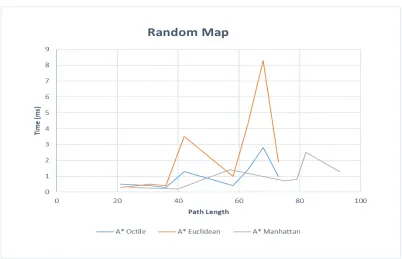
In fig 10 and 11, we can see that the results for Euclidean heuristic are more extreme
in Random Map as compared to the results obtained in terrain map. Now, collecting
or analyzing results from only Random Maps will give us biased opinion on the
performance of Euclidean Heuristic.
Figure 8: Time and path length results on terrain map size 120 X 120 with obstacle density 15%
4.2 Experimental Setup:
Our thesis is about setting guidelines to conduct empirical research in pathfinding
based on Maps. We used only 2D grid maps because most of the researchers use these
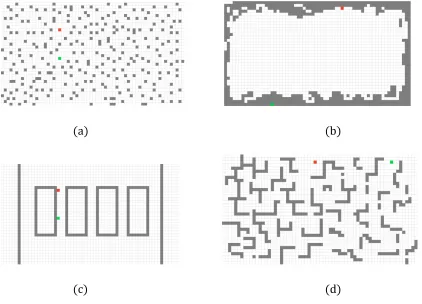
maps. We classified maps into four categories: Random Maps, maps generated
randomly, Game/Maze Maps, maps from games like Dragon Age 2, Baldurs Gate 2,
maps of various mazes, Room/ Floor maps, maps of rooms, building floor maps and
Terrain Maps, maps of real world like parks or city maps with obstacle density
ranging from 0% to 50%. The reason for choosing different categories is to include
the different distribution of obstacles on the maps which is an important factor
33
(a) (b)
(c) (d)
Figure 9: Maps of size 120 X 80 with obstacle density 15%. (a) Random Map, (b) Terrain Map, (c) Floor Plan Map, (d) Maze Map
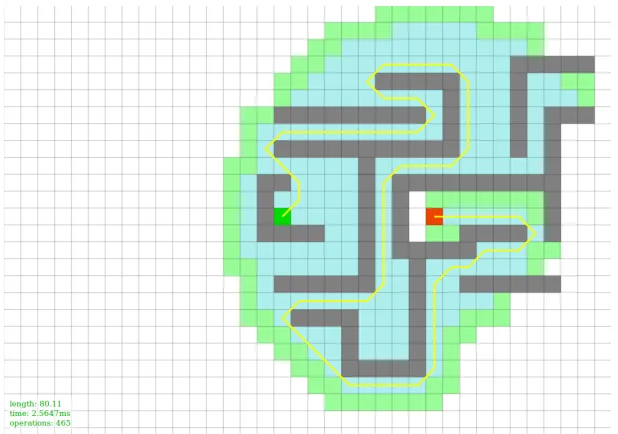
When we increase the density to 50% and the obstacles are distributed in a certain
way, we can get the maximum path length possible in the given map. In fig. 10 three
different distributions with 50% obstacle density will give maximum path length. We
cannot increase the density of the obstacles in these maps because if we do so then
path will be blocked for some start and goal positions and if we decrease the density
34
(a) (b)
Figure 10: Maps with 50% obstacle density with maximum path length.
The algorithms implemented for our thesis are Dijkstra and A* with three different
heuristics: Manhattan, Octile, and Euclidean. The data is generated and collected
based on the problem cases and pitfalls we want to study.
4.3 Solutions to Pitfalls
The pitfalls mentioned earlier will result in producing analysis reports not
representing actual performance of the algorithm. Therefore, we will suggest some
solutions and methods to handle these pitfalls through case studies of problems that
follow the suggested solutions.
4.3.1 Case 1
–
Four Spurious effects:
The four spurious effects discussed earlier, if not addressed, will conclude different
results than actual. The map used to represent the ceiling effect and maps in fig. 13
35
maximum path length with minimum number of nodes expanded. Thus, finding the
ratio of number of nodes expanded and actual path length will give us the ceiling value
(c). The ratio (R) will be given by:
𝑅 = 𝑁𝑢𝑚𝑏𝑒𝑟 𝑜𝑓 𝑛𝑜𝑑𝑒𝑠 𝑒𝑥𝑝𝑎𝑛𝑑𝑒𝑑 (𝑛) 𝐴𝑐𝑡𝑢𝑎𝑙 𝑃𝑎𝑡ℎ 𝑙𝑒𝑛𝑔𝑡ℎ (𝑙)
The ceiling value in ideal situation will be 1. In pathfinding the ceiling value is known
or we can say constant, but it is hard to find one constant or single floor value because
that depends on number of factors like map size, obstacle density and distribution of
obstacles. But, in general floor value will be exponentially high than actual path
length. In worst case, an algorithm will explore every open node in order to reach the
goal node like Dijkstra algorithm explores all the nodes before reaching the goal node
as shown in fig. 6(b). If we have map of size 10 x 10 with no obstacle, the start node
is at the upper left corner and the goal node is at lower right corner then the path
length will be the diagonal between these two nodes which is 10 and the algorithm
will explore all the nodes in the map which is 100. Thus, from this situation we can
generalize the floor value to be n (map size).
The solution to the regression effect is instead of choosing values over certain
threshold (like 1.5 as mentioned in regression problem), we should sort the data first
and then make some criteria of randomly choosing every third or fifth value from the
data to test our next algorithm, in case if we do not want to run the new algorithm on
all the instances again. This will ensure that the new algorithm will get evenly
distributed instances not just above threshold instances. Although, we recommend
36
A* Octile Average
Length 38 46 46 49 52 60 65 66 70 76
Time 1.9 2.5 0.8 0.8 0.5 1.1 2.2 0.7 0.4 1.3 1.22
Table 3: A* octile run times sorted according path length and their average
A* Euclidean
Length Time
46 0.8
60 1.9
70 1.5
Average 1.4
Table 4: A* Euclidean run times when every third instance from the octile runs is selected.
As we can see in tables 3 and 4 that when we sort the data of A* with octile heuristic
and select every third instance and run the A* with Euclidean heuristic, the average
run time of Euclidean is higher than octile.
4.3.2 Case 2
–
Control conditions:
In order to solve the problem of control condition we have to follow the general
guidelines for experimental setup because when we know our research question and
parameters used to collect data, then we can easily identify the independent and
extraneous variables. Thus, we can manipulate them or control them directly to get
37
two ways to solve the problem of control condition mentioned in earlier example, one
is stopping the backend applications and making the processor free from any other
activities and run our program to collect the data. The other possible solution is to
consider this as noise factor and run our algorithm several times with same start and
goal position, then take the average. For example, we run the octile heuristic five
times for each start and goal position and then take the average of these five runs.
When we replace the run time with these new average run times, we get lower value
of overall average run time reduced from 1.22 to 0.86 as shown in table 5.
A* Octile Average
Length 38 46 46 49 52 60 65 66 70 76
Time 0.9 1.1 0.8 0.8 0.5 1.1 1 0.7 0.4 1.3 0.86
Table 5: A* octile with new average run times for each instance.
Another factor to control in pathfinding is the distribution of obstacles in the map. So,
for this we can use the four types of maps given in fig. 12. As these maps will cover
most of the distributions we can encounter in real world or games or in random maps.
4.3.3 Case 3
–
Sampling Bias:
To reduce the effect of sampling bias we should generate different kinds of maps with
different range of size, obstacle density and path length. After that combine the data
and represent that information on chart to get the performance measure of the
38
The chart in fig. 14 combines the data from all the maps of different types and it shows
the running times along with path length for A* with three different heuristics.
Although this chart does not provide any clear picture about which heuristic takes
less time or clear lines for the time taken by each. There is another way of
representing the same data as shown in fig. 15.
Figure 11: Chart showing combined data for A* from different maps of size 120 X 120 and obstacle density is 15%.
0 1 2 3 4 5 6 7 8 9
0 20 40 60 80 100 120
Ti
me
(
ms
)
Path Length
Combined data of different maps
39
Figure 12: Average time and path length of four different types of maps, size: 120 X 120, obstacle density is 15%
In fig. 15 we calculated the average time and path length of each type of map for the
three heuristics and then projected it on chart. Now, from this chart we can easily
conclude that Euclidean takes more time on an average than other heuristics and
Manhattan takes less time but it gives longer path lengths as it can only move in
vertical and horizontal directions not diagonally as other two heuristics.
We can also use bar charts or other representations based on our data set and
parameters, but we should make sure that it represents valid results not the biased
or misrepresented results.
4.3.4 Case 4
–
Example problem from research papers:
For our thesis we critically reviewed the literature published in the field of
pathfinding. Based on that we are representing one example problem that was
mentioned in chapter two section 2.4, the research paper written by Yngvi et al [8]. 0 0.5 1 1.5 2 2.5 3
0 10 20 30 40 50 60
Ti m e ( m s) Path Length
![Figure 2: Different types of tile grids[19]](https://thumb-us.123doks.com/thumbv2/123dok_us/1497888.1183427/17.612.116.494.217.641/figure-different-types-of-tile-grids.webp)
![Figure 3: Navigation mesh[18]](https://thumb-us.123doks.com/thumbv2/123dok_us/1497888.1183427/18.612.206.447.320.474/figure-navigation-mesh.webp)
![Figure 4: Waypoints[18]](https://thumb-us.123doks.com/thumbv2/123dok_us/1497888.1183427/19.612.199.452.85.246/figure-waypoints.webp)
![Figure 5: Elements of Empirical Research[13]](https://thumb-us.123doks.com/thumbv2/123dok_us/1497888.1183427/33.612.218.414.482.650/figure-elements-of-empirical-research.webp)