Review on Amalgamation of IOT and Cloud
Computing
Sapna Tayde 1, Sachin Vyawhare 2
Assistant Professor, Department of CSE, Sanmati Engineering College, Washim, Maharashtra, India 1 Assistant Professor, Department of CSE, Sanmati Engineering College, Washim, Maharashtra, India 2
ABSTRACT: A fundamental understanding of the Internet of Things is that the data collection landscape has changed dramatically. Initially, ingested data in devices and storage caches were completely within the walls of the IT data center. At first, those walls gradually broke down as people started working from homes on their laptop and mobile devices which are connected to enterprises. Now we are seeing an explosion of devices in the field that need to connect and share data with the organizations. These devices, or things, need to share data with the same quality and performance regardless of whether they are in a remote corner of the world or in a metropolitan area. Enterprise data centres can‘t be everywhere. Thus, the Internet of Things is the primary application for cloud computing. Cloud computing and Internet of Things are two very different technologies that are both already part of our day to day life. Their adoption and use are expected to be more and more pervasive, making them important components of the Future Internet. A novel paradigm where Cloud and IoT are merged together is foreseen as disruptive and as an enabler of a large number of application scenarios. This paper provides a brief overview of IoT, importance of reference model for IoT, challenges faced by IoT and IoT and cloud convergence to resolve those challenges.
KEYWORDS: IOT, Cloud Computing.
I. INTRODUCTION
IOT is the concept of basically connecting any device with an on and off switch to the Internet (and/or to each other). This includes everything from cell phones, coffee makers, washing machines, headphones, lamps, wearable devices and almost anything else you can think of. This also applies to components of machines, for example a jet engine of an airplane or the drill of an oil rig. As I mentioned, if it has an on and off switch then chances are it can be a part of the IoT. The analyst firm Gartner says that by 2020 there will be over 26 billion connected devices... That's a lot of connections (some even estimate this number to be much higher, over 100 billion). The IoT is a giant network of connected "things" (which also includes people). The relationship will be between people-people, people-things, and things-things.
The fundamental components that make internet of things a reality are:
Hardware-Making physical objects responsive and giving them capability to retrieve data and respond to instructions
Software-Enabling the data collection, storage, processing, manipulating and instructing.
Communication Infrastructure- Most important of all is the communication infrastructure which consists of protocols and technologies which enable two physical objects to exchange data and thus communicate with each other. The Internet of Things (IoT) has not been around for very long. However, there have been visions of machines communicating with one another since the early 1800s. Machines have been providing direct communications since the
telegraph (the first landline) was developed in the 1830s and 1840s. Described as ―wireless telegraphy,ǁ the first radio
1969. In the 1980s, commercial service providers began supporting public use of ARPANET, allowing it to evolve into our modern Internet. Global Positioning Satellites (GPS) became a reality in early 1993, with the Department of Defense providing a stable, highly functional system of 24 satellites. This was quickly followed by privately owned, commercial satellites being placed in orbit. Satellites and landlines provide basic communications for much of the IoT. .
II. REFERENCE MODEL OF IOT
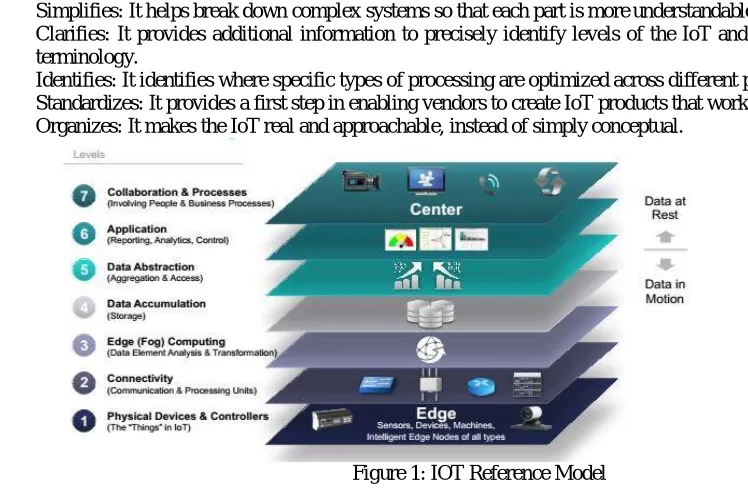
Network, compute, application, and data management architectures that are IoT-ready require a different communication and processing model. Today, there is not a standard way of understanding or describing these models for the IoT. As a result, the lines are blurred between IoT devices and systems and non-IoT devices and systems. The fact is, not every network is an IoT network. Nor does it need to be. And not every application is an IoT application. In general, when data is generated under the control of machines or equipment and sent across a network, it is probably an IoT system. But in the IoT, even generalizations may be inappropriate. There may be many, many exceptions. As a result, the reference model:
Simplifies: It helps break down complex systems so that each part is more understandable.
Clarifies: It provides additional information to precisely identify levels of the IoT and to establish common terminology.
Identifies: It identifies where specific types of processing are optimized across different parts of the system. Standardizes: It provides a first step in enabling vendors to create IoT products that work with each other. Organizes: It makes the IoT real and approachable, instead of simply conceptual.
Figure 1: IOT Reference Model
A. Physical Devices & Controller
The IoT Reference Model starts with Level 1: physical devices and controllers that might control multiple devices. These are the ―thingsǁ in the IoT, and they include a wide range of endpoint devices that send and receive information. Devices are diverse, and there are no rules about size, location, form factor, or origin. Some devices will be the size of a silicon chip. Some will be as large as vehicles. The IoT must support the entire range. Dozens or hundreds of equipment manufacturers will produce IoT devices.
B. Connectivity
This includes transmissions
Between devices (Level 1) and the network Across networks (east-west)
Between the network (Level 2) and low-level information processing occurring at Level 3. Traditional data communication networks have multiple functions, as evidenced by the International Organization for Standardization (ISO) 7-layer reference model. However, a complete IoT system contains many levels in addition to the communications network.
C. Edge (Fog) Computing
The functions of Level 3 are driven by the need to convert network data flows into information that is suitable for storage and higher level processing at Level 4 (data accumulation). This means that Level 3 activities focus on high volume data analysis and transformation. For example, a Level 1 sensor device might generate data samples multiple times per second, 24 hours a day, and 365 days a year. A basic tenet of the IoT Reference Model is that the most intelligent system initiates information processing as early and as close to the edge of the network as possible. This is sometimes referred to as fog computing. Level 3 is where this occurs. Level 3 processing can encompass many examples, such as:
Evaluation: Evaluating data for criteria as to whether it should be processed at a higher level.
Formatting: Reformatting data for consistent higher-level processing. Expanding/decoding: Handling cryptic data with additional context.
Distillation/reduction: Reducing and/or summarizing data to minimize the impact of data and traffic on the network and higher-level processing systems.
Assessment: Determining whether data represents a threshold or alert; this could include redirecting data to additional destinations.
D. Data Accumulation
Networking systems are built to reliably move data. Prior to Level 4, data is moving through the network at the rate and organization determined by the devices generating the data. The model is event driven. At Level 4, Data Accumulation, data in motion is converted to data at rest. Level 4 determines:
If data is of interest to higher levels: If so, Level 4 processing is the first level that is configured to serve the specific needs of a higher level.
If data must be persisted. The type of storage needed. If data is organized properly.
If data must be recombined or recomputed.
As Level 4 captures data and puts it at rest, it is now usable by applications on a non-real-time basis. Applications access the data when necessary. In short, Level 4 converts event-based data to query-based processing.
E. Data Abstraction
IoT systems will need to scale to a corporate or even global level and will require multiple storage systems to accommodate IoT device data and data from traditional enterprise ERP, HRMS, CRM, and other systems. The data abstraction functions of Level 5 are focused on rendering data and its storage in ways that enable developing simpler, performance-enhanced applications. With multiple devices generating data, there are many reasons why this data may not land in the same data storage:
There might be too much data to put in one place.
Devices might be geographically separated, and processing is optimized locally.
Levels 3 and 4 might separate ―continuous streams of raw dataǁ from ―data that represents an event.ǁ Data storage for streaming data may be a big data system, such as Hadoop. Storage for event data may be a
Different kinds of data processing might be required. The data abstraction level must process many different things. These include:
Reconciling multiple data formats from different sources Assuring consistent semantics of data across sources
Confirming that data is complete to the higher-level application
Consolidating data into one place or providing access to multiple data stores through data virtualization
Protecting data with appropriate authentication and authorization
Normalizing or denormalizing and indexing data to provide fast application access.
F. Application
Level 6 is the application level, where information interpretation occurs. Software at this level interacts with Level 5 and data at rest, so it does not have to operate at network speeds. The IoT Reference Model does not strictly define an application. Applications vary based on vertical markets, the nature of device data, and business needs. For example, some applications will focus on monitoring device data. Some will focus on controlling devices. Some will combine device and non-device data. Monitoring and control applications represent many different application models, programming patterns, and software stacks, leading to discussions of operating systems, mobility, application servers, hypervisors, multi-threading, multi-tenancy, etc. These topics are beyond the scope of the IoT Reference Model discussion. Suffice it to say that application complexity will vary widely.
Examples include:
● Mission-critical business applications, such as generalized ERP or specialized industry solutions
● Mobile applications that handle simple interactions
● Business intelligence reports, where the application is the BI server.
● Analytic applications that interpret data for business decisions.
G. Collaboration and Process
One of the main distinctions between the Internet of Things (IoT) and IoT is that IoT includes people and processes. This difference becomes particularly clear at Level 7: Collaboration and Processes. The IoT system, and the information it creates, is of little value unless it yields action, which often requires people and processes. Applications execute business logic to empower people. People use applications and associated data for their specific needs. Often, multiple people use the same application for a range of different purposes. So the objective is not the application—it is to empower people to do their work better.
Applications (Level 6) give business people the right data, at the right time, so they can do the right thing. But frequently, the action needed requires more than one person. People must be able to communicate and collaborate, sometimes using the traditional Internet, to make the IoT useful. Communication and collaboration often requires multiple steps. And it usually transcends multiple applications.
III. CHALLENGES OF IOT
This section discusses some of the major challenges that need to be addressed in order to build the IoT. The solutions for these issues need to be come from technological, social, legal, financial, and business backgrounds in order to receive wide acceptance by the IoT community.
1. Standards and interoperability Standards are important in creating markets for new technologies. If
come up with innovative solutions or to provide services) may dominate a market, stifling competition and creating barriers for
if consumers cannot easily transfer their data when they replace one device with another from a different manufacturer, they will in effect lose any benefit from the data they have been accumulating over time.
2. Security As the IoT connects more devices together; it provides more decentralized entry points for
malware. Less expensive devices that are in physically compromised locales are more subject to tampering. More layers of software, integration middleware, APIs, machine-to machine communication, etc. create more complexity and new security risks. Expect to see many different techniques and vendors addressing these issues with policy-driven approaches to security and provisioning.
3. Trust and Privacy With remote sensors and monitoring a core use case for the IoT, there will be
heightened sensitivity to controlling access and ownership of data. (Note that two recent high-profile security breaches at Target and Home Depot were both achieved by going through third-party vendors stolen credentials to gain access to payment systems. Partner vetting will become ever more critical.) Compliance will continue to be a major issue in medical and assisted-living applications, which could have life and death ramifications. New compliance frameworks to address the IoT‗s unique issues will evolve. Social and political concerns in this area may also hinder IoT adoption.
4. Complexity, confusion and integration issues. With multiple platforms, numerous protocols and large
numbers of APIs, IoT systems integration and testing will be a challenge to say the least. The confusion around evolving standards is almost sure to slow adoption. The rapid evolution of APIs will likely consume unanticipated development resources that will diminish project teams ‗abilities to add core new functionality. Slower adoption and
unanticipated development resource requirements will likely slip schedules and slow time to revenues, which will
require additional funding for IoT projects and longer ―runwaysǁ for stratus.
5. Evolving architectures, protocol wars and competing standards With so many players involved with the
IoT, there are bound to be ongoing turf wars as legacy companies seek to protect their proprietary systems advantages and open systems proponents try to set new standards. There may be multiple standards that evolve based on different requirements determined by device class, power requirements, capabilities and uses. This presents opportunities for platform vendors and open source advocates to contribute and influence future standards.
6. Concrete use cases and compelling value propositions. Lack of clear use cases or strong ROI examples
will slow down adoption of the IoT. Although technical specifications, theoretical uses and future concepts may suffice for some early adopters, mainstream adoption of IoT will require well-grounded, customer oriented communications and messaging around what‗s in it for me. Detailed explanations of a specific device or technical details of a
component won‗t cut it when buyers are looking for a ―whole solutionǁ or complete value added service. IoT providers will have to explain the key benefits of their services or face the proverbial so what.
IV. ROLE OF CLOUD COMPUTING IN IOT
A. Remote processing power
The Internet of Things won‘t just stay relegated to the ‗smart fridges‘ that first come to mind when anyone mentions this new wave of tech. On the contrary, everything will eventually be a smart device, putting new demands on raw processing power. And as miniaturization grows and 4G connectivity becomes even more widespread, the cloud will come to the rescue, allowing developers to offload processing to cloud computing services.
B. Lowers the entry bar for providers who lack infrastructure
Think back to some of the biggest names and trends in tech – the credit for so many of these goes to young, talented, creative upstarts who had a vision. The cloud will make it easier for such innovators to join the IoT revolution, offering a ready-made infrastructure into which they can just plug in their devices and services.
C. Analytics and monitoring
One of the central tenets of IoT is a more seamless experience. The cloud will help in this regard, giving device makers and service provider‘s access to advanced analytics and monitoring. For the developer, it‘s a step towards constant innovation, while for the consumer, holds the promise of better reliability and a more seamless experience.
D. Smoothens inter-service and inter-device communications
The IoT isn‘t just about devices talking to us – it‘s about services and devices all talking to each other. As we‘ve seen in the past, competing standards that work independently can often stifle product innovation and adoption. But with the Internet of things, the cloud as mediator and communication facilitator will banish these worries. Powerful APIs for app developers and product makers, cloud communications that are plug-and-play, seamless linking to our smartphones. The cloud will make this possible.
E. User security and privacy
A major concern around the mobility revolution has been the impact it has had on our privacy and security. Old devices and services often fall behind, putting consumers‘ data and personal privacy at risk from newly unearthed security exploits. The IoT, despite having its reach extend to every aspect of our lives, could actually sidestep this security issue, all thanks to the cloud. With devices utilizing common APIs and back-end infrastructure, vital security updates could be instantaneous and all-encompassing.
V. CONCLUSION
Paper reviews the importance of internet of things with the complete reference model and challenges of IoT. The IoT generates a vast amount of Big Data and this in turn puts a huge strain on Internet Infrastructure. Role of cloud computing in internet of things is discussed in second part of the paper. Cloud computing and the IoT both serve to increase efficiency in everyday tasks and both have a complementary relationship. The IoT generates massive amounts of data, and cloud computing provides a pathway for this data to travel.
REFERENCES
1. Keith D. Foote, ―A brief history of internet of thingsǁ, Data University.
2. Cisco, IOT Reference Model White Paper, June 2014.
3. Martin Bauer, Nicola Bui, Jourik De Loof, ―Enabling things to talkǁ, DOI 10.1007/978-3-642-40403-0_7, 2013.
4. Ms. Yogita Pundir, Ms. Nancy Sharma, ―Internet of Things (IoT) : Challenges and Future Directionsǁ, International Journal of Advanced
Research in Computer and Communication Engineering Vol. 5, Issue 3, March 2016.
5. Kailas Davadkar, Prarthana Sawant, ―Internet of Things and Integration with Cloud Computingǁ, International Journal of New Innovations in
Engineering and Technology, Volume 6 Issue 2– November 2016.