Application of Vedic Mathematics for
Computation of Basic DSP Operations
Manoj R1, Mahaveera K2
P.G Student, Department of ECE, NMAMIT, Nitte, Karnataka, India1
Assistant Professor, Department of ECE, NMAMIT, Nitte, Karnataka, India 2
ABSTRACT: In most of the Digital Signal Processing (DSP), critical operations are multiplication and accumulation.
Convolution plays a major role in various DSP applications. Multiplication is the essential component in designing DSP operations. In this regard, a study is carried out on the Urdhva-Tiryagbhyam sutra of Vedic mathematics and a multiplier is designed. DSP operations namely linear convolution, circular convolution and Multiply and Accumulate (MAC) are implemented using Vedic multiplier. The coding is developed in Verilog and it is synthesized and simulated using Xilinx ISE 13.2.The results are analysed with array multiplier in terms of computation time.
KEYWORDS: Urdhva-Tiryagbhyam, Vedic mathematics.
I. INTRODUCTION
With the advancement of VLSI technology, digital signal processing plays a crucial role in many areas of electrical engineering. The accuracy of the mathematical calculations improves by analyzing outputs of DSP operations.To perform multiplication operation in the processor it requires time to compute and the system performance is determined by the performance of the multiplier with respect to computation time.
The execution time in most DSP algorithms mainly depends upon the time required for multiplication, so there is a need of multiplier which consumes less computation time. Vedic mathematics provides the unique solution for decreasing computation time. Vedic mathematics are reproduced from Vedas by Swami Bharathi Krishna Thirtha after his eight years of research [2]. Many application areas in engineering use Vedic mathematics especially in signal processing. Vedic mathematics is primarily based on sixteen sutras.Urdhva-Tiryagbhyam sutra is one of the sixteen sutras which is used to design Vedic multiplier. The DSP operations are implemented using Vedic multiplier.
II. RELATEDWORKS
Most of the multiplication algorithms for high speed implementation are based on conventional multiplier and its modifications. The main disadvantage of the add and shift multiplication method is that it consumes more time to compute. The Vedic mathematics approach for multiplication is useful for fast computation when compared to array multiplier [1].
A method for calculating convolution sum of finite length sequences is explained in [3]. The linear convolution is implemented using Vedic multiplication based on Paravartya Yojayet (Transpose & Adjust) sutra [4].
III.VEDICMULTIPLIER
Vedic multiplier is designed based on Urdhva-Tiryagbhyam sutra. This sutra has been used for the multiplication of two decimal numbers. The similar technique is applicable to binary number system to build the proposed algorithm suitable with digital domain. Urdhva-Tiryagbhyam means “vertical and crosswise”. It is based on concept through which partial products and additions are done concurrently leading to short computation time.
Figure 1: Multiplication of Two Decimal Numbers
The result is one bit and carry is generated. The carry generated is added in next step. All results of previous carry are added, if there are more than one line present in one step. Least significant bit act as result bit in each step and rest of the bits act as carry in previous step. At the initial step carry is zero.
A. 2x2 Vedic Multiplier
Figure 2 shows the block diagram of 2x2 Vedic multiplier module.
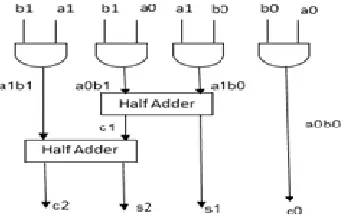
Figure 3 shows the structure of 2x2 Vedic multiplier designed using four AND gates and two half-adders. The total delay is two half-adder delays, once the product bits are generated.
Figure 2: Block Diagram of 2x2 Vedic Multiplier Module
B. 4x4 Vedic Multiplier
Figure 4 shows the structure of 4x4 Vedic multiplier using 2x2 Vedic multiplier as building block. Adders are used to add partial products [3].
C. 32x32 Vedic Multiplier
8x8 Vedic multiplier have been designed using 4x4 Vedic multiplier as building block.16x16 Vedic multiplier have been designed using 8x8 Vedic multiplier as building block. Following the same method, 32x32 Vedic multiplier is designed using the 16x16 Vedic multiplier as building block. Figure 5 shows the structure of 32x32 Vedic multiplier.
IV.DSPOPERATIONS
A. Linear Convolution
Convolution is one of the DSP operations which is the mathematical way of combining two signals x and h, to obtain a third signal y [4]. Linear Convolution of two discrete sequences is given by the equation (1).
Figure 4: Structure of 4x4 Vedic Multiplier
Linear convolution is implemented using 4x4 bit Vedic multiplier which improves its efficiency in terms of speed.
B. Circular Convolution
Circular convolution of two equal length sequences x(n) and h(n) is given by the equation (2).Circular convolution is computed using linear convolution technique.
Circular convolution is implemented using 4 bit linear convolution based on Vedic multiplier. C. Multiply and Accumulate(MAC)
Multiply and Accumulate is one of the normally used operation in various DSP applications. Speed of multiplier determines the speed of MAC. The performance of MAC can be increased by using efficient multiplier in terms of speed. Thus MAC is designed using Vedic multiplier.
Figure 6 shows the architecture of 32 bit MAC. The MAC unit comprises of a multiplier followed by an adder and an accumulator register which stores the result. The two 32 bit operand a[31:0] and b[31:0] are inputs to the MAC unit. The output from 32 bit MAC is q[63:0].32x32 bit Vedic multiplier is used to design 32 bit MAC.
Figure 6: Architecture of 32 bit MAC
V. RESULTS
Verilog code is developed for 4x4 bit and 32x32 bit Vedic multiplier and synthesized using Xilinx ISE 13.2.Synthesis is done for FPGA (Field Programmable Gate Array) Spartan3 XC3S400-TQ144.Test waveforms are generated using Xilinx software. Using Vedic multiplier, Verilog code is developed for linear convolution, circular convolution and MAC unit. Synthesis and simulation is done for the same.
Figure 7 shows the simulation result of 32x32 bit Vedic multiplier. From Figure 7, for multiplication of inputs a = FFFFFFFF(H), b = FFFFFFFF(H), product c = FFFFFFFE00000001(H).
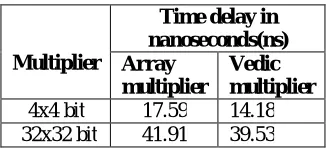
Table 1 shows the timing summary of Vedic multiplier and array multiplier. It is found that time delay for Vedic multiplier is relatively shorter than array multiplier
.
Table 1: Timing Summary of Multiplier
Figure 8 shows the simulation result of linear convolution using Vedic multiplier. From Figure 8, x(n) = (x0, x1, x2, x3) [1 2 3 4], h(n) = (h0,h1,h2,h3) = [5 6 7 8]; Output y (n) = (y0, y1, y2, y3, y4, y5, y6) = [5 16 34 60 61 52 32].
Figure 9 shows the simulation result of circular convolution using Vedic multiplier. From Figure 9, x(n)=(x0,x1,x2,x3) [1 2 3 4],h(n)=(h0,h1,h2,h3)=[5 6 7 8]; Circular convolution Output v(n)=(v0,v1,v2,v3)=[66 68 66 60].
Multiplier
Time delay in nanoseconds(ns) Array
multiplier
Vedic multiplier 4x4 bit 17.59 14.18 32x32 bit 41.91 39.53
Figure 8: Simulation Result of Linear Convolution
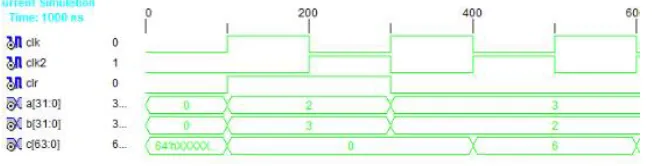
Figure 10 shows the simulation result of 32 bit MAC.
Table 2 shows timing summary of DSP operations using different multiplier techniques. With reference to Table 2, it is found that DSP operations using Vedic multiplier leads to short computation time.
VI.CONCLUSION
Multiplier is one of the vital functions in digital signal processing. It is desired to have area efficient, high speed, power efficient multiplier. In this regard, Vedic multiplication based on Urdhva-Tiryagbyham is studied and simulated. The simulations are carried out for 4x4 bit to 32x32 bit Vedic multiplier. In this technique, partial products and additions are done concurrently leading to short computation time.
DSP operations namely linear convolution and circular convolution are implemented using Vedic multiplier and simulated. 32 bit MAC unit is designed using 32x32 bit Vedic multiplier and simulated. The results are compared with array multiplier. It is found that Vedic multiplier is efficient than array multiplier with respect to computation time.
REFERENCES
[1] Partha Mehta and Dhanashri Gawali, “Conventional versus Vedic mathematical method for hardware implementation of a multiplier”, IEEE International Conference on Advances in Computing, Control and Telecommunication Technologies, pp. 641-642, 2009.
[2] Jagadguru Swami Sri Bharati Krishna Tirthji Maharaja, “Vedic Mathematics”, Motilal Banarsidas, Varanasi, India, 1986.
[3] Devika Jain, Kabiraj Sethi and Rutuparna Panda, “Vedic mathematics based Multiply Accumulate unit”, IEEE International Conference on Computational Intelligence and Communication Systems, pp. 754-757, 2011.
[4] Surabhi Jain and Sandeep Saini, “High Speed Convolution and Deconvolution based on ancient Indian Vedic Mathematics”, IEEE International Conference on Telecommunication and Information Technology, pp. 1-5, 2015.
[5] Khadeer Mohammad and Sos Agaian, “Efficient FPGA implementation of Convolution”,IEEE International Conference on Systems, Man and Cybernetics, pp. 3478-3483, 2009.
[6] Pierre and John W, “A novel method for calculating the convolution sum of two finite length sequences”, IEEE Transactions on Education, pp. 77- 80, 1996.
DSP Operations
Time delay in nanoseconds(ns)
Array Multiplier Vedic Multiplier
32 bit MAC 35.91 32.63 Linear Convolution 23.75 21.27 Circular Convolution 23.71 21.04
Figure 10: Simulation Result of 32 bit MAC