ABSTRACT
HOLLAND, LINDSAY ANNE. Initial Instruction in a Mathematics Classroom: Learning in a Contextual Setting. (Under the direction of Dr. Karen Allen Keene.)
The purpose of this research was to investigate how the order of mathematical
instruction with respect to using a context affects students’ performance in the classroom and
their attitudes towards learning. The study examined two high school Algebra I classes and
was implemented over three days. On Day 1 of the study, the experimental group received
the implementation of learning in a contextual setting while the control group learned in a
noncontextual setting. In the noncontextual setting, students learned about one and two step
equations where a lecture style lesson was implemented. On Day 2 of the study, each of the
two groups received the type of instruction the other group received on Day 1. The
experimental group received the traditional approach method where the control group learned
the mathematics in a contextual setting. The study determined that there is a difference in
students’ academic performance when they learn in a contextual setting first and then learn
the math in a traditional based approach as opposed to learning in a traditional setting first
and then learn in a contextual setting. Students’ attitudes toward learning in a contextual
setting without regards to order were more positive. Finally, the order of instruction with
respect to using a context affects lower ranked students’ levels of performance in the
Initial Instruction in a Mathematics Classroom: Learning in a
Contextual Setting
by
Lindsay Anne Holland
A thesis submitted to the Graduate Faculty of North Carolina State University
in partial fulfillment of the requirements for the Degree of
Master of Science
Mathematics Education
Raleigh, North Carolina 2008
APPROVED BY:
_____________________________ ___________________________
Dr. Ronald Fulp Dr. Hollylynne Stohl Lee
Committee Member Committee Member
_____________________________ Dr. Karen Allen Keene
DEDICATION
To my mom and dad who gave me constant and unconditional love and support
BIOGRAPHY
Lindsay Anne Holland was born February 20, 1985 in Forsyth County, North
Carolina. She is the daughter of Al and Sherry Holland and was born and raised in a small
town called High Point, North Carolina where she attended Ledford Senior High School.
Lindsay graduated high school with honors in May 2003 and began her collegiate career in
August 2003 at North Carolina State University in Raleigh North Carolina.
Lindsay began her college career as a Mathematics Education major. During her time
as an undergraduate, Lindsay was able to gain teaching experience during her student
teaching at Fuquay Varina High School. She loved this experience so much that she decided
to extend her knowledge in the educational field by attending graduate school in the summer
of 2007 after graduating with a Bachelor’s of Science degree in Mathematics Education in
May 2007. Upon completion of her Master of Science degree in Mathematics Education,
ACKNOWLEDGMENTS
I express my gratitude to my committee chair, Dr. Karen Allen Keene, for her
guidance, support, and patience. I would also like to Dr. Hollylynne Stohl Lee and Dr.
Ronald Fulp for serving on my advisory committee. Lastly, I would like to give thanks to
TABLE OF CONTENTS
LIST OF TABLES ... vii
LIST OF FIGURES ... viii
CHAPTER 1: INTRODUCTION ... 1
CHAPTER 2: LITERATURE REVIEW ... 6
Relating ... 7
Applying ... 10
Experiencing ... 12
Cooperating ... 14
Contextual Setting’s Role in Lower Ranked Students ... 16
Summary ... 17
CHAPTER 3: METHODOLOGY ... 19
Purpose ... 19
Schools, Students, and Teachers ... 19
Setting ... 23
Data Collection ... 26
Quantitative Data Analysis ... 29
Qualitative Data Analysis ... 32
CHAPTER 4: RESULTS ... 34
Qualitative Results: Observations Day 1 ... 35
Qualitative Results: Observations Day 2 ...39
Survey ... 43
Quantitative and Exploratory Data Analysis Findings ...49
CHAPTER 5: DISCUSSION and CONCLUSION ... 62
Summary ... 62
Limitations ... 65
Future Investigations ... 65
Implications for Teachers ... 66
APPENDICES ... 71
Appendix A. Contextual Lesson Plan ... 72
Appendix B. Traditional Lesson Plan ... 83
Appendix C. Pretest ... 87
Appendix D. Posttest ... 89
Appendix E. Survey ... 91
LIST OF TABLES
Table 1: Percentages of Math Classes that Students were Previously Enrolled ...20
Table 2: Average Scores on Pretest for Control and Experimental Groups ...21
Table 3: Results of t-Test for Averages on Pretests for Control and Experimental Groups ...22
Table 4: Student Rankings for Experimental Group and Control Group ... 32
Table 5: Main Observations Made with Connections to Strategies and Motives ...42
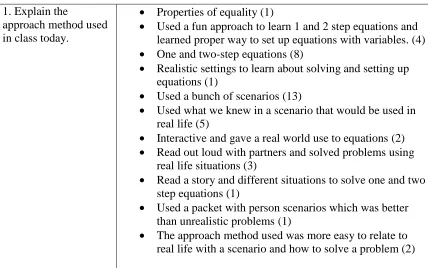
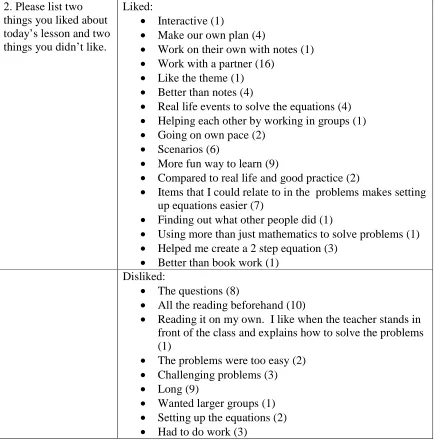
Table 6: Responses from the Survey ...44
Table 7: Summary of Key Topics from Survey ...47
Table 8: Pretest and Posttest Averages from Both Classes ... 52
Table 9: Results of t-Test using 0.05 Level of Significance ... 54
Table 10: Results of t-Test using 0.10 Level of Significance ... 55
LIST OF FIGURES
Figure 1: Model of the classroom ...24
Figure 2: Distribution of pretest scores ...31
Figure 3: Distribution of individual improvement differences for the experimental Group ...50
Figure 4: Distribution of individual improvement differences for the control group ... 51
Figure 5: Mean improvements from the pretest to posttest of experimental and control groups ...53
Figure 6: Experimental group’s improvements from pretest to posttest ...56
Figure 7: Control group’s improvements from pretest to posttest ...57
Figure 8: Mean improvements for higher ranked students ...58
Figure 9: Mean improvements for middle ranked students ...59
CHAPTER 1
INTRODUCTION
The National Council of Teachers of Mathematics (2000) promotes the instructional
strategy of placing mathematical instruction in a contextualized setting, stating that students
as early as grades 6-8 should be able to “model and solve contextualized problems using
various representations, such as graphs, tables and equations” (p. 222). The concept of
learning in a contextual setting allows students to take a math topic and relate it to a real life
situation. In a study that Alsina (2007) reported, she referred to the term “real world” as
“everything that has to do with nature, society or culture, including everyday life as well as
school and university subjects or scientific and scholarly disciplines different from
mathematics” (p. 35). Alsup and Sprigler (2003) argue that, “Prominent organizations such
as the National Council of Teachers of Mathematics and the National Research Council have
identified aspects of mathematics classroom instruction that must be changed to improve
mathematics instruction and increase student achievement” (p. 689). They contend that
stronger connections between mathematics and students’ lives outside the classroom need to
be made and teachers need to redirect their teaching focus by discarding the traditional
lecture based approach and follow a different approach where students can construct their
own knowledge (Alsup & Sprigler, 2003).
It is important that students are able to connect to the mathematics they are being
taught and can make relationships with the math with real life situations. There are several
reasons why learning in a contextual setting is being used and studied. Three, but not
(Gravemeijer & Doorman, 1999), 2) makes the math realistic (Hough and Gough 2002,
Heuvel-Panhuizen 2007) , and 3) provides ways for the math to be more meaningful to the
students (Wubbels, Korthagen, and Broekman 1997, Sullivan, Zevenbergen, and Mousley,
2003).
When students learn in a contextual setting, they become more motivated to learn
because they are able to relate more personally to the math. A constant struggle that teachers
have in their classroom is motivating students to learn. During a traditional lecture teaching
approach, students seem to become restless and disinterested in the lesson. While in this type
of instruction, students are expected to memorize procedures and facts. This type of
instruction can hinder students’ motivation towards learning the math. However, learning in
a contextual setting allows for students to use real world examples to understand different
math topics. Gravemeijer and Doorman (1999) explain that context problems are starting to
play a more central role in the curriculum because of their “presumed motivational power”
(p. 111). The realistic settings that come from the contexts promote this motivation.
Using real world examples is thought to present mathematics as a means with which
to understand reality. (Boaler, 1993). Boaler (1993) explains that setting a task in real
context can guide students to an understanding that mathematics may be used to “transform
reality” (p. 12). This perspective shows students how math is involved in the real world
which is known to motivate and engage students. When students are involved in something
that they can relate to, they are going to become more engaged in the material because they
enjoy the context the math is being placed in. Motivating students to get involved in the
consistently. Alsina (2003) explains that the classic way of delivering lectures needs to
change. She states: “Find a task that promotes students to see the reality in mathematics and
this will increase their motivation in the classroom.” (p. 35).
Learning in a contextual setting allows students to work on math problems that give
relevance to the real world. This allows students to work with realistic math situations in
which they are able to relate to outside the mathematics classroom. This type of learning is
called Realistic Mathematics Education. Hough and Gough (2007) state this curriculum
“uses imaginable contexts to help pupils to develop mathematically, with a strong emphasis
on pupils ‘making sense’ of the subject” (p. 34). When students are using this type of
curriculum, they are able to learn the math in a realistic context which allows them to
connect the mathematics to reality. When connecting the mathematics to the real world,
students are also able to imagine the mathematics. Heuvel-Panhuizen (2002) states that
Realistic Mathematics Education provides an “offering the students problem situations which
they can imagine” (p. 3). In other words when students imagine the mathematics involved,
they are able to envision something real in their minds that connect to the mathematics.
Students are able to connect to the mathematics when learning in a contextualized setting
because the math is created to be a realistic situation that they can relate to as well as
imagine.
Thirdly, when students are able to take the math and apply it to realistic situations,
they are allowing for the mathematics to take on a more meaningful role because of their
ability to connect to the mathematics. Traditionally, when students are taught mathematics,
have to memorize them. According to Wubbels, Korthagen, and Broekman (1997), the
mechanistic point of view of mathematics is about the system of rules and algorithms where
much attention is paid to “a careful stepwise approach, memorizing, and learning the
‘tricks’” (p. 1). This statement emphasizes the issue that students are too busy memorizing
math facts and are not able to see the true meaning behind the math. However, learning in a
contextual setting allows for the mathematics to be more meaningful. Mathematics teachers
are encouraged to use realistic contexts in their teaching because it makes the mathematics
more meaningful (Sullivan, Zevenbergen, & Mousley, 2003). The frequent use of using
contextual problems in the mathematics classrooms enables the math to possess a more
meaningful role to the student because of the realistic nature they promote. Sullivan,
Zevenbergen, & Mousley (2003) state that “Contexts are now used frequently in mathematics
classrooms in order to make concepts and operations more meaningful as well as to show the
usefulness of specific ideas and skills being studied (p. 107).
In this study, I examine how learning in a contextual setting affects both students’
academic performance and their attitudes. Clearly, there are good reasons to use context
when teaching mathematics. In this study, I extended the issue of context in a new way that
has not been investigated before but is embedded in the earlier research. My research
questions concern the order of the instruction. When one group of students was learning in
context, they learned the mathematics first through a realistic activity that they could relate to
and imagine experiencing on a typical Friday night. They then were instructed about the
same material in a traditional way. When the other class of students was receiving
context. Thus this research investigated a few days in the mathematical instruction of
students who were involved in two different types of instruction taught in different order and
building on the three reasons listed above: motivation, relating to the mathematics, and
making mathematics meaningful. The research questions for this study are:
1. How does the order of instruction, learning in context before or after traditional
instruction, affect students’ level of academic performance and their attitudes toward
learning?
2. How does the order of instruction, learning in context before or after traditional
instruction, affect different levels of academically ranked students’ level of academic
CHAPTER 2
LITERATURE REVIEW
One of the more common teaching styles today is a traditional teaching approach
where teachers use a lecture based setting in their classrooms. Student learning is more
focused on learning and memorizing basic math skills and concepts where little emphasis is
placed on relating these to situations outside the classroom. Some researchers say that the
instruction in our nations’ schools has been unsuccessful in promoting conceptual
understanding and application of mathematics to real-life contexts (Alsup & Sprigler, 2003).
In a traditional teaching approach, students take notes, listen to the lecture, do examples, and
at the end of the lesson they may be exposed to a couple of word problems that involve a real
life situation. These word problems are intended to help students see how the mathematics is
applied outside the classroom and how they can relate to it as well. When students are
learning math through this perspective, one might say they are doing math in a contextual
setting. Researchers define context problems as “problems of which the problem situation is
experientially real to the student” (Gravemeijer & Doorman, 1999, p. 111).
I conducted a study to determine if the order of instruction, learning in context before
or after traditional instruction, affects students’ level of academic performance and their
attitudes toward learning. In this chapter, I discuss research that supports and connects to
this study. Previously discussed were three motives for using contextual settings in the
classroom. These motives include this learning context motivates students (Gravemeijer &
Korthagen, & Broekman 1997, Sullivan, Zevenbergen, & Mousley, 2003). Crawford and
White (1999) explain four common attributes called “contextual teaching strategies,” that
focus on teaching and learning in a context (p. 35). These four contextual teaching strategies
consist of relating, experiencing, applying, and cooperating. The three reasons to use
contextual teaching styles in the classroom play a role in these four strategies. This chapter
is therefore organized around Crawford’s and White’s four contextual teaching strategies
with connections made to each of the three motives.
Relating
Gravemeijer and Doorman (1999) explain that the role of context problems are most
commonly addressed at the end of a learning sequence-“as a kind of add on” (p.111);
however, they may be play a more central role in mathematics today. This is due to the fact
that today’s emphasis is now more focused on the usefulness of what is learned, and because
of the motivational power context problems possess (see introduction chapter). The first
contextual teaching strategy discussed by Crawford and White is relating. Relating is
recognized by Crawford and White (1999) as the most powerful contextual teaching strategy
because it is used to mean “learning in the context of one’s life experiences” (p. 35.) When
teachers use the strategy of relating, they are taking a new concept and relating it to
something already familiar to the students. For example, Crawford and White (1999) explain
a situation where students are presented with the new concept of ratios. A teacher presents
the students with the idea of making fruit punch with 3 cans of water and 2 cans concentrate.
When the students are presented with the fruit punch example first, most students feel that
They are able to relate their experience of making fruit punch with a new mathematical
concept of ratios. Since they have already experienced the idea of using ratios, White and
Crawford (1999) entail that they are more likely to remember the definition of ratio because
they will be able to relate it to their fruit punch making experience.
One theory that supports the contextual teaching strategy of relating is the theory of
Realistic Mathematics Education (RME). Uzel and Uyangor, (2006) state “RME theory is a
promising direction to improve and enhance learners’ understandings in mathematics” (p.
1952). The major theory behind RME is that students will learn mathematics through the
activity of doing the mathematics. This activity consists of experiencing mathematics
through solving real life situations, often called contextual problems. Within these
contextual situations, students are able to relate everyday life situations to the mathematics
being taught. Uzel and Uyangor (2006) explain that researcher Hans Freudenthal’s view on
RME consist of mathematics as a human activity and emphasizes the actual activity of doing
mathematics. One of Freudenthal’s important points of view is that mathematics must be
connected to reality. The mathematics must be close to the students and be relevant to
everyday life situations. The context in the problems that are presented to the students can
be a real world situation where students are able to relate to the situation. For example,
Gregg and Yackel (2002) designed an instructional sequence focused on an activity which
was developed to promote the concepts of place-value numeration for second and third grade
students. In this sequence, students are presented with a scenario about a family that owns a
candy shop and are trying to figure out how many pieces of candy they should put in rolls, in
and are asked to find unknown quantities about the candies and how they are packaged.
Students start off by making different pictures of the how the candy can be packaged and
then they solve word problems where they are asked to figure out how many of a specific
type of candy is in the candy shop. This activity helps students to learn how to represent
quantities and solve for the quantities. Gregg and Yackel (2002) address the main purpose of
this activity which is to “ground students’ mathematical activity in real world imagery.”
When students are learning math through activities such as this candy shop sequence, they
are able to relate their experiences with candy and buying candy at a candy shop to learning
the math behind it. RME allows students to be presented with an everyday situation that they
can relate to and learn the math through their own life experience with the situation that is
involved.
The strategy of relating allows for the mathematics to become more meaningful to the
students. As stated previously, Crawford and White (1999) explain that students will most
likely remember the definition of ratio because of the relation it has to the fruit punch
instructions. When students are able to remember such mathematical concepts in this
approach, the math has become more meaningful to them. Verhage and Lange (1996)
explain that “meaningful mathematics has to be learned in a meaningful way” (p. 14). If
students are relating the mathematics to their own life experiences, then the mathematics has
meaning to them.
When teachers implement activities that allow for relating to occur, the realistic math
that is involved provides meaningful mathematics as well. The Candy Shop activity (2002)
stated, this activity allows students to relate to the idea of buying and selling candy. Gregg
and Yackel (2002) state
“the students’ use of symbols to record and communicate their actions in a realistic
scenario can support their development of meaning for algebraic expressions and
operations. Furthermore, it demonstrates the importance of the notion of an algebraic
expression as a quantity and translates that expression into a meaning mathematical
object for students “(p. 497).
This means that the mathematical knowledge that students develop while doing
relating activities becomes more meaningful for the students because of the realistic nature
the scenarios represent. The realistic scenarios that are embedded in activities such as the
Candy Shop activity provide students with mathematical concepts that develop more
meaning to them because of the relationship that they have with the scenarios.
Applying
Students are also able to learn in a contextual setting when they have already been
taught the math concepts. When students are taking their previously learned knowledge of a
specific mathematical concept and applying it to learning with a context situation, they are
using the strategy of applying. The strategy applying is defined by White and Crawford
(1999) as “learning by putting the concepts to use” (p. 36.) For example Pedrotti and
Chamberlain (1995) discuss the use of the program CORD Applied Mathematics. CORD is
a program that allows students to be presented with real world problem solving activities and
hands-on laboratory activities that show the applications of the concepts. With this program,
their math knowledge to activities such as these, students are able to make meaningful
connections between mathematics and application.
The contextual teaching strategy of applying is also shown through Irwin’s work.
Irwin (2001) conducted a research study to see if students’ understanding of decimals could
be improved by applying their understanding of the math concept to problem solving
activities set in everyday context. The investigation involved two groups of students where
one group solved decimal-fraction problems set in a variety of contexts while the other group
solved similar problems, but without contexts. The contexts that were selected in this study
included different sizes of soft drink bottles, monetary exchange between countries, and other
uses of metric measurement. The students that were able to solve the problems with a
context were able to apply their knowledge of decimal-fractions to these problems and find a
solution. For example, one of the contextualized problems read as follows:
“If you go on a trip and you buy 1 liter of petrol at 90.9 cents and a meal at McDonalds’ at
$4.95, how much will it cost?”
Students who were not in the group that solved contextualized problems saw this problem:
“If you add and 4.95 what will your answer be?”
The study showed a larger improvement from the pretest scores to the posttest scores
from the group of students who applied their knowledge of decimals to contextualized
problems rather than noncontextualized problems. Both groups did show improvement, but
the students who were working with contextualized problems had a larger percent increase in
improvement. Irwin (2001) explains that when students actually put the math concepts they
work. One pair of students that was involved in the contextualized problems was able to use
a clipping from the newspaper that allowed them to use this information to give meaning to
their decisions while working on the problem (Irwin, 2001). The students seemed very
intrigued in the problem and were able to apply both their knowledge of decimals and their
use of everyday knowledge to the problem to find a correct solution.
For applying mathematics, teachers can use realistic exercises in order to motivate a
need for mathematics. Crawford and White (1999) explain that when teachers are applying
the math to the students, exercises and activities that promote realistic math are important for
a math application to be motivational for the students. The contextual teaching strategy of
applying has the ability to promote realistic math to students with exercises that demonstrate
the usefulness of mathematics in a student’s life.
Experiencing
When teachers are teaching students new concepts through discovery, this allows for
students to experience the investigation of the new concept by learning by doing. Crawford
and White (1999) explain that experiencing is a contextual teaching strategy that lets students
learn new knowledge through exploration, discovery and invention. There are at least three
general categories of hands-on experiences that create meaning for students. They are
manipulatives, such as using algebra tiles to learn how to factor using completing the square,
laboratory activities where students can collect and analyze data on their own measurements,
and problem-solving activities. Heuvel-Panhuizen (2002) explains how a problem-solving
activity for first graders helped them to discover formal mathematical language. The activity
passengers are getting on and off the bus, the students were to determine the number of
passengers in the bus at each stop. With the use of a contextual situation, students were able
to experience formal mathematical language as well as discovering numerical operations and
expressing operations with pure numbers.
White and Crawford (1999) describe another example of a problem-solving activity
that goes back to the fruit punch example mentioned earlier. One teacher asked her students
“How many cans of concentrate and how many cans of water are needed to make punch for
the whole class?” (p. 35). This question makes this a problem-solving activity because there
are several different ways students can approach this problem which can lead to several
different solutions and the students may not know immediately how to do the problem. Once
students have found their own solution, the students as a class can come together and decide
on a single best solution and then actually make the fruit punch to check their answers. This
activity shows how students are experiencing ratios by figuring out how to make fruit punch
for their whole class.
The strategy of experiencing allows for students to interact in problem solving
activities that motivate student learning. When students are placed in a problem solving
environment they are motivated by the learning. According to Crawford and White (1999),
problem solving activities can be hands-on activities that “engage students’ creativity while
teaching problem solving skills, mathematical thinking, communication, and group
interaction. These characteristics create a problem solving environment. Connect to this,
Hmelo-Silver (2004) discusses a type of learning that consists of a problem solving
“Problem-based learning is an instructional method in which students learn through
facilitated problem solving” (p. 235). Problem-based learning provides students with
meaningful and experiential learning where students learn by solving problems that reflect on
their experiences (Hmelo-Silver 2004). Since the problems in this type of environment
reflect real-world problems, students become more active learners. Hmelo-Silver also
suggests that educators are interested in this type of learning environment because of its
“potential for motivating students” (p. 236).
Cooperating
Problem-solving activities can sometimes be difficult for students because of the
complexity that they possess. When students work individually, they might not make
significant progress and can become frustrated with the problem; however, when students
work in groups, several ideas all come together and students are able to learn from one
another. Cooperating is the fourth contextual teaching strategy defined by Crawford and
White (1999) as “learning in the context of sharing, responding, and communicating with
other learners” (p. 37). Pedrotti and Chamberlain (1995) explain that CORD mathematics
designs activities that encourage problem solving in small cooperative-learning groups.
When students work in cooperative-learning groups, they can share opinions and solve
problems together so that they are able to make meaningful connections between the math
and the context they are working with. When groups are finished with their activity, groups
should be able to compare and share their findings with other groups so that everyone is
interacting together. CORD mathematics suggests that “teams are encouraged to summarize
study, she asked the students to work in partners because she wanted to see a sign of
productive peer collaboration in which partners were discussing and arguing as peers which
would enable them to learn from each other. Her study also shows that using groups in a
contextual setting benefits students as well because they are able to draw ideas from their
everyday knowledge. In her study, one pair of partners who worked with contextualized
problems was able to use their ideas of currency exchange to discuss how they should
approach the problem. In a contextual setting, students who are working together are able to
use and share their everyday knowledge of different concepts and apply that knowledge to
finding a solution to the problem.
In cooperative learning, students are able to collaborate together and discuss different
ideas with one another. This contextual teaching style promotes motivation throughout the
classroom. Abrami and Chambers (1996) state “when students actively collaborate, they are
motivated to help one another and themselves to achieve” (p. 71). Cooperating helps
students to become more motivated in the learning because they are able to get help from
their peers and also give help to them as well. This type of learning in a contextual setting
allows for students share their experiences that relate to the math which also motivates the
students to learn. Abrami and Chambers (1996) suggest that cooperative learning serves to
motivate students to learn, help group members to learn and encourages group members to
learn.
I propose that the study that I conducted is strongly connected to the two strategies of
relating and applying. When students received the contextual lesson plan first, they were
situation. Conversely, the class that received the traditional lesson first, then the contextual
lesson, was using the strategy of applying, as they first learned the mathematics, and then
applied it to the context. The other two strategies, experiencing and cooperating, support the
reason why using contextual settings in the classroom is beneficial to students.
Contextual Setting’s role in Different Levels of Ranked Students
The second research question in this study involves determining if learning in a
contextual setting helps the performance level of higher, middle, and lower ranked students.
This idea compliments Irwin’s research of investigating students’ knowledge of decimals in a
contextualized setting. While only focusing on higher and lower ranked students, Irwin
(2001) found that lower ranked students who worked on contextualized problems with a
partner improved from pretest of 19% to posttest of 32%; contextualized, higher ranked
students improved from 34% to 48%; noncontextualized lower ranked students improved
from 21% to 27%; and the noncontextualized, higher ranked students improved from 45% to
52%.
In other research, Mankin, Boone, Flores, and Willyard (2001) conducted a study to
find what specific attributes in ones’ teaching style motivate students’ learning. Using
student perspectives, the study was conducted to identify detailed characteristics and
activities that motivate students to learn in the College of Agriculture at Kansas State
University. One of the objectives was what type of teaching style motivates students and the
second objective was to determine if the results differed by student grade point average. The
study concluded that both lower ranked and lower GPA students, less than a 3.0, and higher
make the subject interesting by incorporating the use of real life examples. If students are
motivated by the use of contextualized problems, then this could improve their performance
in the classroom.
More research that supports the idea that lower ranked students can learn better in a
contextual setting is from Barnes. Barnes (2005) explains how when low attaining students
are introduced to a task that makes sense, then there is a good chance they might surprise us
with what they can achieve in mathematics. In this article low attaining students refers to
students who do not meet the required standard of mathematics performance as set out by the
school. Barnes (2006) suggests that low attaining learners may learn incidentally when they
are doing an activity that promotes engagement and active participation. These activities
help lower attaining students learn because they find inconsistencies in their thinking, which
they then try to figure out. Learning in a social or cultural context allows for lower attaining
students to become a more effective learner in mathematics.
Summary
In this section, I focused on Crawford’s and White’s contextual teaching strategies for
teaching and learning mathematics in a contextual setting. Each of their discussed strategies
is used in order to help both teachers and students understand how math is related outside the
classroom. They help teachers figure out what type of lesson plans they can create so that
they can engage the students in the learning of mathematics through life experiences and they
help students see how their life experiences relate to math. The four contextual teaching
strategies, with their connections to the three motives to use contextual settings in the
Other literature provides evidence that learning with a context improves lower and
higher academically ranked students’ performance. Researchers offered a few reasons for
this phenomenon. Barnes (2005) offered the idea that low attaining students may learn
“incidentally” as they participate in the activities in context. Other researchers mentioned
that both higher and lower ranked students are more motivated by learning when they are
exposed to real life examples (Mankin, Boone, Flores, & Willyard, 2001). Overall, learning
in a contextual setting provides motivation on both higher and lower ranked students which
CHAPTER 3
METHODOLOGY
Purpose
This study was conducted to learn more about the teaching of high school
mathematics; it involved working in two Algebra I classes at a large public high school. The
purpose of the research was to investigate the implementation of two different instructional
methods. The study determined if the order of instruction, learning in context before or after
traditional instruction, affects students’ level of academic performance and their attitudes
toward learning. The study used a quasi-experimental design (Campbell & Stanley, 1963).
For the experimental group, the treatment consisted of students receiving the instruction of
learning in a contextual setting first, then learning the same material in the traditional
approach. The mathematics that was being taught during this study was learning how to
solve one and two step equations. The control group did not receive the treatment; therefore,
it received the traditional lesson on Day 1 and the contextual lesson plan on Day 2, as it
would usually occur in a high school mathematics classroom. The study also examined how
the order of instruction, with respect to a context, affects different academically performing
students’ mathematical learning. The following chapter describes the students and teachers
participating in this study, the setting, the data collection plan and how the data is analyzed.
School, Students and Teacher
Research was conducted in a large high school located in a city near Raleigh, North
Carolina with an enrollment of 2, 215 students. According to the schools mission statement,
quality instruction including creative exploration and extra-curricular activities
(http://www.wcpss.net/school-directory/316.html).
The subjects of this study consisted of 49 high school freshman who are taking
Algebra I with technology. Algebra 1 with technology is more advanced than Algebra 1
because it requires the students to use the graphing calculator for several of the mathematical
concepts taught. There were two classes involved, as mentioned above. The first period class
had a total of 22 students where there were 9 males and 13 females. The second period class
had a total of 27 students where there were 13 males and 14 females. From a survey the
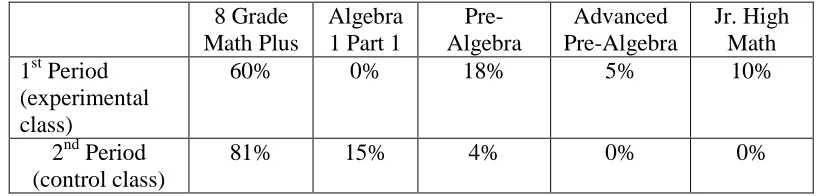
students answered (Appendix E), I obtained the following data shown in Table 1 and Table 2.
Table 1
Percentages of Math Classes that Students were Previously Enrolled
8 Grade Math Plus
Algebra 1 Part 1
Pre-Algebra Advanced Pre-Algebra Jr. High Math 1st Period
(experimental class)
60% 0% 18% 5% 10%
2nd Period (control class)
81% 15% 4% 0% 0%
From this table, one can see that no students in the experimental class had ever taken Algebra
before. The Experimental class had a lower percent of students (60%) who finished 8th
Grade Math plus. They also had higher percentage of pre-algebra students. Probably the
most important information this provides is that there are no repeat takers of Algebra 1 with
Technology in both classes, and only a small number of Algebra repeaters in the control
In order to determine if the level of academic performance in both classes was equal
before beginning the experiment, I chose to look at two measures, the results of the pretest
and the teacher’s academic ranked of the students. The pretest (Appendix C) was out of a
score of 12 points. The averages are shown in Table 2.
Table 2
Average Scores on Pretest for Control and Experimental Groups.
Control Group’s Average Score on Pretest
Experimental Group’s Average Score on Pretest
8.79 7.52
By looking at the averages only, the control group seems to have done better on the pretest
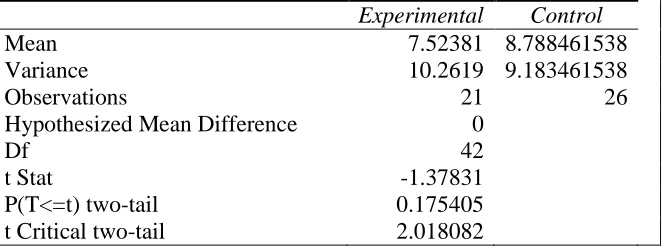
than the experimental group. Therefore, a t-Test was performed; a t-Test is a hypothesis test
about the difference between two populations. The assumptions for hypothesis tests are:
normal populations and samples were random and independently selected; we assume that
the two samples are independent random samples, and both populations are normally
Table 3
Results of t-Test for Averages on Pretests for Control and Experimental Groups
Hypothesis:
t-Test: Two-Sample Assuming Unequal Variances at alpha level .05
t-Test: Two-Sample Assuming Unequal Variances at alpha level 0.05
Experimental Control
Mean 7.52381 8.788461538
Variance 10.2619 9.183461538
Observations 21 26
Hypothesized Mean Difference 0
Df 42
t Stat -1.37831
P(T<=t) two-tail 0.175405
t Critical two-tail 2.018082
At an alpha level of .05, there is insufficient evidence to say that there is a significant
difference in the academic level of performance for the two classes. I also conducted a t-Test
at an alpha level of 0.10, and still found out that there is insufficient evidence to claim a
difference in the students’ academic performance in the two classes.
Another validation I used in showing that the two classes were approximately the
same academically was by asking the teacher to give me her opinion of the students’ ranks in
the classes. The teacher ranked the students with a letter grade that correlated to the average
the students had during that time during the semester. The experimental group consisted of
following: 12 A’s, 11 B’s, 2 D’s, 1 F. These averages show that there is clearly no evidence
that one class performs higher than the other.
The teacher involved in this study, also teaches Advanced Functions and Modeling
and taught Algebra II last year. She is a second year teacher and this is also her second year
teaching at this specific high school. She graduated from a four year university in Raleigh,
NC and obtained a Bachelors of Science degree in Mathematics Education. Along with her
degree, she also received her North Carolina Teacher’s License for grades 9-12. With her
background in computer science, she teaches afterschool at an institute that teaches children
both math and computer science skills.
Setting
Both Algebra I classes are held in the same classroom. The classroom is set up so
that half of the students sit on one side of the classroom and the other half sits on the other
side. This allows the teacher to have a large middle area where she can observe her students.
The desks area also arranged so that it is easy for the students to work in pairs. At the front
of the class, there is a small white board, but the teacher uses an overhead projector when
doing her lessons. The teacher’s desk along with one computer is in the back of the
Figure 1. Model of the classroom
The textbook and student workbook used in the class is Prentice Hall Mathematics Algebra
1. The students used both resources for in-class work and homework. When both classes
received the traditional lesson plan, the teacher used her own lesson plan that she created
with the help of the textbook (Appendix B.) The lesson plan the teacher used was created by
the Professional Learning Community (PLC) in the math department at her school last year.
Once she received this lesson, she modified the lesson. The original lesson plan was
designed for a two day lesson plan; however, in order to meet my accommodations for the
study, she revised the lesson so that it would only take one day. The contextual lesson plan
(Appendix A) consisted of an activity that I created. The first part of the contextual lesson
consisted of a page that contained a written scenario (Appendix A) where the partners had to
had to discuss with their partner all the options there are to do before and after going to a
concert and also discuss how much money they would need for certain chosen activities.
This scenario was used as an opening activity to get the students motivated for the lesson
before they started to learn the specific math topics involved. The rest of the lesson built on
this scenario and followed up with embedded instruction and exercises about one and two
step equations. The rest of the instructional activity consisted of a packet that was a scripted
lesson plan where the students worked in pairs, read and followed along, worked problems as
they read and discussed the material. The packet consisted of several different examples on
how to solve one and two step equations, followed by practice contextual problems for them
to work. In addition, once the students finished going through the examples, there were 10
context problems about the Friday night out at the end of the packet that they had to complete
with their partner
The design of the contextual lesson plan was focused around the three motives for
teaching and learning in a contextual setting mentioned in the introduction: motivates
students, makes the math realistic, and allows the math to become more meaningful. The
lesson plan was focused on spending a Friday night out on the town with $200 to spend. I
felt that this scenario would motivate the students to learn the math behind the lesson because
it is something that they are interested in. Most students enjoy going out on a Friday night
with their friends and like to spend money on exciting events such as concerts. By creating a
scenario that the students are attracted to, allows the students to become motivated to learn
the math because they are personally interested in the scenario. The nature of the lesson plan
going out on a Friday night with their friends and spending money. Since the scenario is a
situation in which students see the relevance, then the math becomes realistic to them as well.
They are able to understand that the math involved in this lesson plan can play a role outside
the classroom. The lesson plan also allows for the math to become more meaningful to the
students as it helps the students to make a clear connection to the math and the real life
situation. The following example from the contextual lesson plan, illustrates how these
previously mentioned motives work here.
Example: After dinner, you have $182 to spend. If you want to leave the concert
with $145, which concert ticket should you purchase?
This problem is able to motivate students they can relate to the situation. They have
been given an amount of money to spend on a concert ticket, but wish to leave the concert
with $145. This type of problem motivates students to figure out which concert they can see
in order to still have money left over at the end of the concert. The students are able to see
how the math is realistic because it has to do with buying concert tickets which is an
experience that most students have already experienced or might experience in the future.
The math is meaningful because they are able to see and understand the connection of the
amount of money they have to spend to which concert ticket they can purchase in order to
have a certain amount left at the end of the night. All three motives are used throughout this
lesson plan in order for students to learn successfully in a contextualized setting.
Data Collection
As stated before there were two Algebra 1 classes participating in the research which
group. On Day 1, the experimental group learned in a contextual setting by working through
the materials I had created for them to do (Appendix A.) The control group was the
teacher’s second period class. On day one of the study, the control group learned the math
through a traditional teaching approach. The classroom teacher created a lesson for the class
which consisted of the teacher lecturing to the class about the material while the students sat
down and took notes (See earlier for description). Before instruction started in both classes,
the students took a pretest.
On the second day, the instruction was reversed. In order to find out how the order of
the two types of instruction affect students learning and their attitudes towards the math, the
experimental group received the traditional based approach while the control group received
the contextual lesson plan. The lesson plans were the same for both classes, just the order
they were given was the main difference. The material was also the same from Day 1 to Day
2. Both classes were learning how to solve one and two step equations. On the third day, the
students took a posttest and filled out a survey.
The study involved collecting and analyzing both quantitative and qualitative data;
there were four kinds of data collected, including a pretest and posttest, a survey, and
observations. I chose to collect this data because I felt that this set of data would facilitate
answering my research questions. The pretest and posttest provided me with quantitative
data that aided me in determining if there was a significant difference in the initial instruction
of learning in a contextual setting compared to initial instruction of learning in a traditional
teaching style approach. This data also determined if there was a significant difference in
students. The survey and observations gave me qualitative data that allowed me to determine
how the different type of initial instruction affect students’ attitudes toward learning along
with students reactions to the initial instruction while the lesson was taking place.
The pretest (Appendix C) was a five question short answer quiz about the material the
students were going to learn in the next two day’s instruction. The purpose of this pretest
was to determine what they already knew about one and two step equations. The pretest
scores also helped me to determine that there was no significant difference in the levels of
academic performance between the experimental group and the control group as discussed in
an earlier section. The posttest (Appendix D) was a five question short answer quiz about
one and two step equations that was administered on the third day of the study. Both the
pretest and posttest were scored on a 12 point scale. For both tests, the first three problems
were worth 2 points each and consisted of equations where the students had to solve for the
variable. The last two problems were word problems and they both were worth 3 points
each. The pretest and posttest scores allowed me to determine the change in the performance
of the students from the beginning of the study to the end.
For the study, I decided to observe while the lessons were implemented. When
observing, I concentrated on how the students reacted to the lessons. As the class did the
contextual lesson plan, they were able to work in groups so I decided to focus on three small
groups for each class on how they worked together and their attitudes about learning with the
activity. I took field notes about the activity I observed when students were speaking and the
conversation that occurred. When observing the traditional based lessons in both classes, I
field notes about how they responded to the lessons, which students answered questions,
which ones were not focused on the teacher, and other behaviors that might indicate attitude
towards the lesson. In the results chapter, I report the data from these observations for each
classroom.
The survey (Appendix E) used in this study had the purpose of collecting data to
determine how the learning affected the students’ attitudes toward the learning of the math. I
was also able to find out what type of math background they had. Both classes took the
survey on the third day. The survey also asked the students questions about the type of
instruction they received on the first day of instruction and what they liked, what they did not
like, and how they might improve the lesson in terms of their own learning. In order to keep
all the data anonymous, the teacher assigned the students a class number at random that the
students put on all the data that was collected. Only the teacher knew which number
correlated with each student.
Quantitative Data Analysis
In order to determine if the order of instruction of using a contextual lesson versus a
traditional based lesson is significantly different, I first used the students’ scores on the
pretest and posttest (see Appendices C and D). Although the scores on a test do not prove
the students are learning, it is a proxy for learning that is acceptable in this situation. I found
each of the class averages of the scores on the students’ pretests, posttests, and compared the
change in these scores.
Next, in order to determine if there is a significant difference in the order of learning
then learning in a contextual setting, I compared the two groups’ mean improvement, or gain
scores, which is the average of the individual differences in pretest and posttest scores in
each class. A t-Test is most commonly used to evaluate the differences in means between
two groups (Johnson, 1996). The reason I used the t-Test is due to the small sample sizes I
used for the study. The p-level of the t-test represents the probability of error involved in
accepting the research hypothesis about the existence of a difference in the two types of
initial instruction. The outcome of the p-level will tell me to reject or fail to reject the null
hypothesis of the t-test which will give me evidence to conclude if there is or is not a
difference in the two types of initial instruction.
Additionally, I used other data analysis techniques to study the scores in more depth.
I looked at the individual improvements graphically and I analyzed spreads using dot plots
and whisker plots.
Turning to the second question, when determining the ranks of the students in both
the experimental and control group, I ranked them according to their pretest scores they
received. Figure 2 shows the distribution of pretest scores from the control and experimental
groups. While analyzing the distribution, I felt that it was necessary to break down the ranks
into three levels: higher ranked, middle ranked, and lower ranked. The higher ranked
students are those who received a score greater than a 9. The reason for this grouping is due
to the fact that the last 6 points of the pretest came from the two contextualized problems,
which were the two hardest problems. If a student received a score greater than a 9, then they
were either able to get both of the hard problems correct, or at least managed to get partial
these students were considered to be higher ranked students. A student who received a score
greater than a 5, but less than a 10, was considered to be a middle ranked student. This
meant that the student was able to get a maximum score of a 9, meaning that he or she was
unable to solve both of the harder problems and may have just received partial credit on the
two problems. If a student received a score of a 5 or less, then that student was considered to
be a lower ranked student. This meant that the student was unable to solve or obtain partial
credit from the two hardest problems and was only able to solve or receive partial credit from
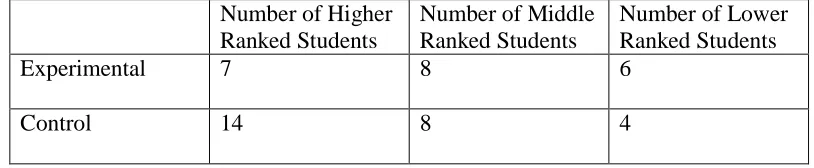
the easier three problems that were only worth 2 points each. Table 4 shows the number of
students who were a higher ranked, middle ranked, and lower ranked in both the
experimental and control group.
Table 4
Student Rankings for Experimental Group and Control Group
Number of Higher Ranked Students
Number of Middle Ranked Students
Number of Lower Ranked Students
Experimental 7 8 6
Control 14 8 4
The ranking system that I created contrasts with Irwin’s (2001) study. In her study,
she focused on two groups: higher ranked and lower ranked students. I decided to break
down the rankings into three groups because I saw a clear distinction within the distributions
and saw it appropriate to rank the students accordingly.
When determining what type of quantitative analysis I should perform when
evaluating the students in the three groups, I decided not to perform t-Tests because of low
numbers of students. I instead found the improvement in scores by calculating the averages
of the pretest and posttest and compared the increase from the pretest to the posttest in all
three of the ranked groups.
Qualitative Data Analysis
The observations that I collected were used to answer my research question on how
students’ attitudes are affected by the order of instruction of the two types of instruction. For
this piece of data, there was little data analysis involved. The observations were used
primarily to serve as a description of how the students reacted to the lessons.
The responses to the survey allowed me to investigate what students thought about
answers I received from the students from both groups and made a count of how many
students replied with that type of answer. This allowed me to see the different types of
responses about the contextual lesson and find some similar reactions as well. The responses
also allowed me to develop an idea of how the lesson affected students’ attitudes toward
learning math; I was able to find different types of positive and negative reactions. After
completing the table, I decided to make a smaller table (see Table 7) that listed the different
themes to represent a majority of the types of responses I got from both groups from the
surveys (Miles & Huberman, 1994). The themes that I found helped me to discover the key
attitudes for the students. Overall, the responses from the survey helped me to gain insight on
how the students felt about the two types of instruction and helped me to evaluate their
CHAPTER 4
RESULTS
In this chapter, I report on the results of the study. The first section is a detailed
description of the data that was collected during the observations I made on both days during
the first and second period class. The first period class was the experimental group, which
was the group that received the treatment of working on the contextual lesson on Day 1, then
the traditional based lesson on Day 2. The second period class was the control group, which
did not receive the treatment, and received the traditional based lesson on Day 1, then
worked on the contextual lesson on Day 2. During the observations, I focused my attention
on a few students to see how they reacted to the instruction. In the first section of this
chapter, I will describe the observations in the first section. The second section reports the
analysis of the survey administered on the third day. The third section describes the results
of the exploratory data and statistical analyses I did on the pretest and posttest data. The first
analysis looks at the individual improvement differences from the pretest to the posttest in
both groups. The second analysis compares the mean improvements from the pretest to the
posttest in the experimental group with the control group. The third analysis shows the
results of t-Test that was used to find out if there was a significant difference in the order of
the two types of instructions. The fourth analysis looks more closely at the individual
improvements from the pretest to posttest in both groups with the use of graphical
representations. The last data analysis evaluates the mean improvements from the pretest to
the posttest in higher, middle, and lower ranked students in the experimental group versus the
Qualitative Results
Observations: Day 1
Experimental Group. On Day one of the study, the first period class, which was the
experimental group, first took the pretest to test their knowledge of one and two step
equations. The teacher allowed the students approximately 7 minutes to complete the pretest.
After completion of the pretest, students were then assigned a partner. Once the students
moved to sit with their assigned partner, the teacher read aloud the first part of the
instructional packet. I decided to focus my observation and take notes on three main groups:
• Group 1 : one girl, one boy
• Group 2: two girls
• Group 3: two boys.
During the opening task, all three groups appeared involved and excited because they were
able to come up with their own ideas on what they wanted to do. I noticed that Group 1 was
quieter than the other groups and did not want to discuss different options. I took into
account that this is only the second week of school and the students are still getting to know
one another. I was intrigued with Group 3 during this task because they were able to be very
creative with their ideas on what they were going to spend their money on and how much
these certain items would cost. I could tell they were using their everyday knowledge of
going to a concert to enter into this activity. I heard them mention things such as VIP passes,
t-shirts and how much parking would be at this concert. This particular group was motivated
by this opening activity and kept that excitement when it was time to work on the packet of
After students had time to do the opening task, the teacher asked some of the students
to share their ideas. Some students described their options as buying t-shirts, going out to
dinner before the concert, buying a CD at the concert, paying for parking at the concert and
going to the movies. The students really got into the opening activity and were very specific
in the activities they chose to do and explained how much each option would cost. After
sharing their ideas, the teacher then handed out the second part of the instructional task,
which was the packet described above, and she read aloud the scenario. Once she was
finished reading, the students began to work on their packets in their assigned group.
While watching Group 1, I noticed that they were reading the examples in the beginning of
the packet at first, but then just skipped right to the section of the set of 10 problems.
However, I did notice that they did go back and refer to the examples that were in the
beginning of the packet because they did seem confused on how to solve the problems.
Group 1 also worked very quietly and did most of their work independently. Group 2, which
was the group with the two girls, were reading the examples aloud to one another and did
follow the examples before going straight to the set of 10 problems. When the girls did go to
the set of 10 problems they started to ask Group 3 for some help so all four students were
working together and reading the problems to each other and making sure everyone was
setting up the correct equations. This observation supports Crawford’s and White’s (2003)
contextual teaching strategy of cooperating. The group of girls seemed confused and unsure
if they were setting up the equations correctly, so they felt comfortable enough to ask another
common for students to feel less self consciousness and feel confident about asking questions
without a risk of embarrassment.
The class finished up this part of the instructional sequence in 45 minutes and for the
most part, was very quiet and there were a couple of groups that worked individually. At the
end of class, the teacher asked the students to get together with other groups and check there
answers with each other. The teacher also did problem number 7 at the end of the class so
they could see if the students did the problem correctly. The class seemed to understand the
problem and agreed with the teacher on how to solve it.
Control Group. The second period class, the control group, had a different reaction to their
lesson. The initial instruction in the control class was learning the mathematics of solving
one and two step equations in the traditional teaching approach. The teacher had a lecture
planned out for the students that consisted of several notes and examples. After the students
took the pretest, the teacher placed the notes up on the overhead and gave the students five
minutes to copy down all the notes before she went over them. I asked the teacher why she
does that and she explained to me that she feels the students learn better because they can
listen better and follow the teacher better because they aren’t busy trying to write down all
the notes.
After the students wrote down the notes, the teacher started going over the notes
which began with learning about the addition and subtraction property of equality. During
this time, I again decided to concentrate on three different people. The first person I
observed was a female. While the teacher is going over how to solve one step equations, the
She did not even write out the steps involved that the teacher was writing out in solving the
specific equation. I also noticed a male student not paying attention and was putting his head
down on his desk. The teacher did try to get the class involved several different times by
asking questions to specific students and to the whole class. When questions were asked to
the whole class, there was not any participation, which led the teacher to start asking specific
students. When students were called on, they did appear to understand what was going on
and could answer the questions correctly. Another boy I was observing was also not taking
any notes. He decided to go ahead and start working on his homework and was doing his
homework out of the workbook.
When the teacher got to the word problem examples, the students seemed to become
more interested in working out the problems by themselves and then giving input when the
teacher asked how they worked it out. The word problem that was used during this time was:
“Together you and your puppy weigh 128lbs. If you alone weigh 115 lbs, how much does
your puppy weigh?” The boy that was working on his homework earlier in the class
volunteered his way to solve the problem and said the following: “If you subtract 115 from
128, you get 13 lbs which is how much your puppy weighs” The teacher then asked for him
to give her the equation he used. He said “128 – 115 = x.” The teacher did explain that this
is correct, but also showed the students another way to work out the problem by saying “115
+ x = 128.” She explained to the class that both equations were correct and that there can
sometimes be different ways to set up equations. After the puppy example, the teacher
continued to teach the students about two step equations and the students continued to
Observations: Day 2
Experimental Group. On Day 2 of the study, the instructions were reversed as noted in the
methodology. The first period class started off the class by going over homework problems
they were assigned from the previous day. After about 5 minutes going over homework
problems, the teacher placed the notes on the overhead so students could first write them
down before she went over the material. The notes started off as the same as they did in the
control group’s lesson on Day 1, which was learning about properties and giving examples of
one step equations. As the teacher continued with her lesson, I concentrated on three
different students; all were individuals I concentrated on, on Day 1. On Day 1, I
concentrated on the following groups:
• Group 1 : one girl, one boy
• Group 2: two girls
• Group 3: two boys.
For Day 2, I focused on the boy from Group 1 (boy A), one of the girls from Group 2, and
one of the boys from Group 3 (boy B). While the teacher was asking questions to the whole
class, the class did not give any responses. Most students were busy doing other things
besides taking notes such as talking, doing homework, and laying their heads on their desks.
This type of response continued throughout the lesson. I did not get much from the three
students I observed during this time besides the fact that they did not seem to have the same
motivation that they had in the previous day’s instruction. They sat in their seats quietly, and