SHOCKLEY, DAVID RUSSELL. Learning Styles and Students’ Perceptions of Satisfaction in Community College Web-based Learning Environments. (Under the direction of Don C. Locke.)
Understanding web-based course delivery technologies in a world that demands opportunities for continuous learning, flexibility, convenience, and accessibility is
increasingly important to higher education. As a result, community colleges must evaluate and assess the effectiveness of web-based course offerings in order to identify how
technology impacts learning. This study focused on the overarching question: “What are the associations between learning styles and students’ perceptions of satisfaction among
community college students enrolled in web-based learning environments?” To address this question, the researcher used the analysis of association methodology to explore the
associations between learning styles and students’ perceptions of satisfaction in four community college web-based learning environments. While there is limited empirical research available to determine the appropriateness of measuring student learning styles, the review of literature and the results of this study support that there are differences in the learning styles among community college web-based learners.
course. However, the results of this study showed that there were limited associations between learning style preferences and students’ perceptions of satisfaction in community college web-based courses.
COMMUNITY COLLEGE WEB-BASED LEARNING ENVIRONMENTS
by
David Russell Shockley
A dissertation submitted to the Graduate Faculty of North Carolina State University in partial fulfillment of the requirements for the
Degree of Doctor of Education
ADULT AND COIMMUNITY COLLEGE EDUCATION Raleigh
2005
APPROVED BY:
___________________________________ ____________________________________
BIOGRAPHY
David Russell Shockley was born May 1, 1968, in Martinsville, Virginia, the third child of Russell Porter Shockley and Manilla Clovie Shockley. He grew up in Collinsville, Virginia where he graduated from Fieldale-Collinsville High School in 1986. While in high school, David began dating his future wife Stephanie. Today, David and Stephanie live in Granite Falls, North Carolina with their two sons, Braedan and Tristan.
In April 1986, David enlisted in the United States Marine Corp Reserves. After completing his basic training and combat engineering school, David enrolled in college at Patrick Henry Community College in Martinsville, Virginia. During his freshman year, he first discovered that learning could be pleasurable, powerful, and a means of enlightening one’s inner self and the surrounding world. As a result, he earned his Bachelor of Science in 1990 and his Master of Arts in 1991. In June 2005, David completed North Carolina State’s Adult and Community College Education Doctoral Program under the direction of
Don C. Locke.
David has learned to provide leadership to adults throughout his career first as a leader in the Marine Corp, then as a departmental director, an adjunct instructor, as a dean, and as a vice president. At the age of 37, he has served nine years on the President’s Executive Council, placing himself among the first technology positions to do so in North Carolina. In 2004, David completed the North Carolina Community College System’s Senior Administrator Institute and the North Carolina Community College System’s Future
ACKNOWLEDGEMENTS
I would like to express my gratitude to the members of my dissertation advisory committee, Dr. Don C. Locke (Chair), Dr. Ted Branoff, Dr. Jim Haynie, and Dr. Thomas E. H. Conway, Jr., for their guidance and patience throughout the stages of my dissertation. I wish to acknowledge Dr. Don C. Locke, Director of the Asheville Graduate Center, for the dedication and service that he has given his students. Personally, I am forever indebted to “Director Don” for the instruction, the honesty, and the personal challenges he provided me during the past four years. I would like to thank Dr. Robbie Pittman, faculty member at Western Carolina University, for his instruction in the computer-assisted statistics course and his assistance in completing the statistical analysis this study. Additionally, I will be forever indebted to Laurette LePrevost for her friendship and many hours of instruction in the English language.
I would like to tell my Asheville “Trihort” classmates that they will always hold a special place in my heart. I will never forget the times we spent together in Asheville and Raleigh laughing, crying, and triumphing together. To Keith Mackie, I started the doctorate degree to fulfill a dream, what I found was a neighbor and a friend for life. I will miss the conversations that occurred during our travels to the University of North Carolina at Asheville and to North Carolina State University.
Most of all, I wish to express my love and deepest appreciation for the support and dedication that my family has given me throughout the trial and tribulations of my life. Stephanie, I am so fortunate to have a wife and best friend that loves and sacrifices
and Tristan, who have sacrificed so much of their time with dad so he could complete his homework. In return, it is my desire to support both of you throughout your life and educational pursuits.
I will miss sharing this accomplishment with my father-in-law, Robert Wayne Lackey, who passed from our presence during the final revisions of this dissertation.
I am grateful to my sisters, Rene′ and Kim, for the love and support they have given no matter what I set out to accomplish.
TABLE OF CONTENTS
LIST OF TABLES ……….……….. ix
CHAPTER ONE: INTRODUCTION ……….. 1
Context of the Problem ……… 1
Statement of the Problem ………. 2
Purpose of the Study ……… 3
Research Question ……….……….. 3
Definitions ………... 4
Assumptions ……… 7
Limitations of Study...……….. 7
Significance of the Study ……… 7
CHAPTER TWO: REVIEW OF THE LITERATURE ……… 9
Introduction ……….. 9
Historical Background ……….. 9
First Generation ……… 10
Second Generation ……… 13
Third Generation ……… 18
Fourth Generation ……….. 20
Next Generation ………. 23
Distance Learning Student Demographics ……….... 25
Distance Learning Theory ………. 27
Adult Learning Theory ……….. 27
Constructivism and Self-Directed Learning ……….. 35
Theory of Interaction ………. 38
Social Presence ……….. 41
Theory of Transactional Distance ……….. 42
Computer Self-Efficacy ………. 43
Evaluation and Assessment Methods ……… 43
Current Research ………... 45
Learning Style and Distance Learning ……….. 45
Traditional Classroom versus Distance Learning ………. 47
Perceptions of Satisfaction ……… 49
Computer Efficacy ……… 50
Technical Difficulties ………... 50
Summary ……….. 51
CHAPTER THREE: METHODOLOGY ………... 52
Introduction ……….. 52
Research Design ………... 52
Research Sites ………... 53
Subjects ………. 54
Instrumentation ………. 55
Index of Learning Styles ………... 55
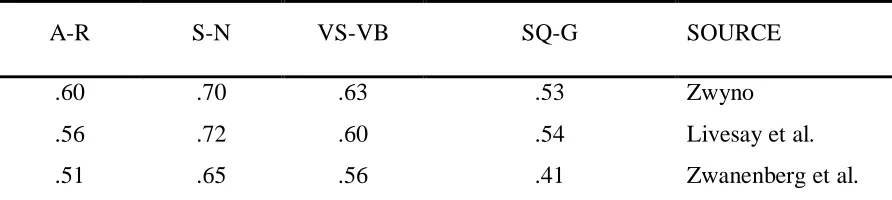
Index of Learning Styles Instrument Validity ………... 56
Perceptions of Web-based Courses Survey ………... 57
Data Collection ………. 59
Hypotheses ……….... 60
Data Analysis …... 65
CHAPTER FOUR: ANALYSIS OF DATA ………. 66
Introduction ……….. 66
Target Population ………. 67
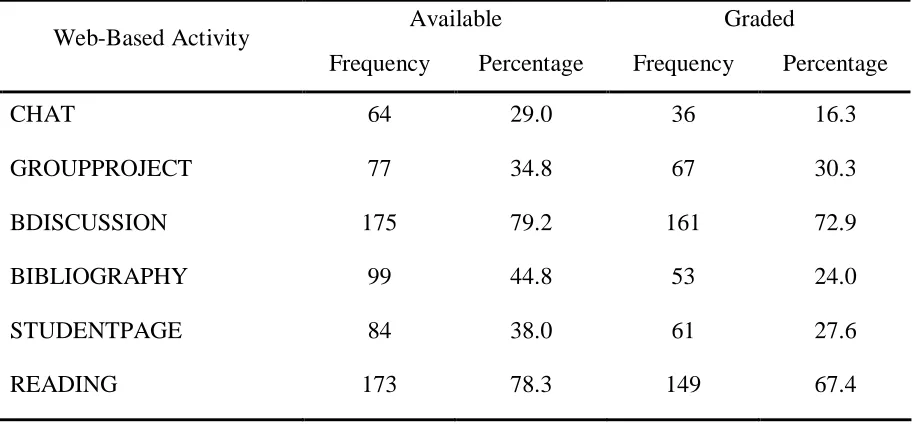
Web-based Courses ……….. 69
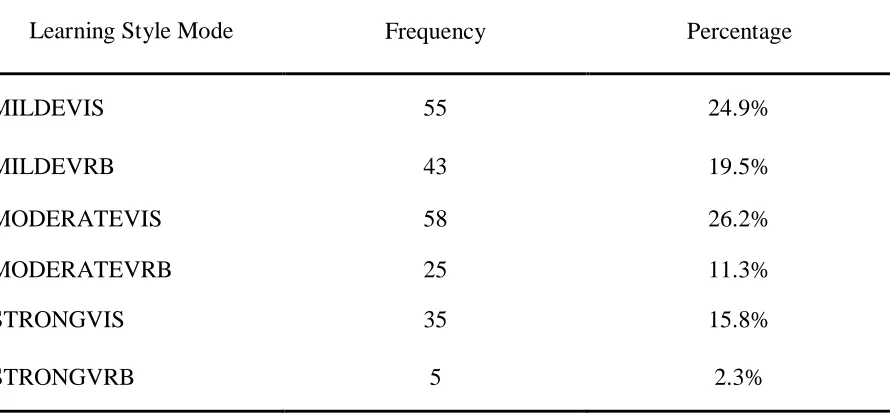
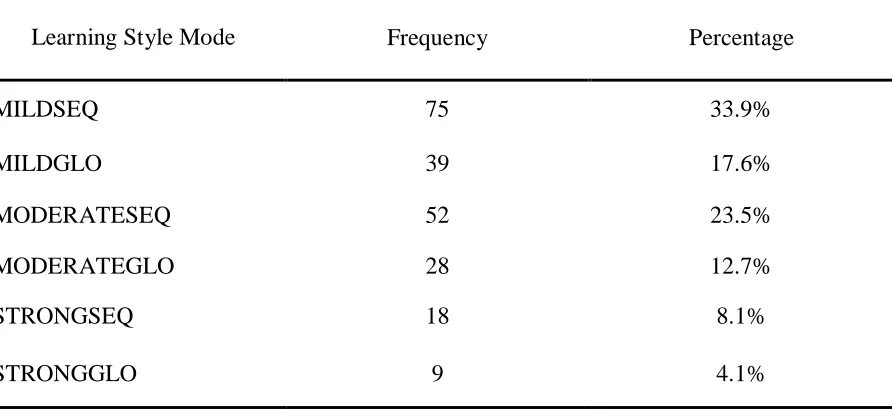
Student Learning Styles ………... 70
Students’ Perception of Satisfaction ……… 74
Computer Efficacy ………... 74
World Wide Web Efficacy ……….. 77
Social Interaction ………. 80
Instructor Feedback ………. 82
Overall Satisfaction ………. 83
Open Ended Questions ……… 84
Research Questions ………. 85
CHAPTER FIVE: SUMMARY, CONCLUSIONS, AND RECCOMENDATIONS …. 110 Introduction ……….. 110
Overview of the Study, Research Questions, and Hypotheses ……… 110
Overview of Study ....………... 110
Overview of Research Questions ………. 111
Research Question One ……… 112
Research Question Three ……….. 114
Research Question Four ………..……….. 115
Research Question Five …...……….. 116
Key Findings and Conclusions ……….. 118
Recommendations for Future Research ………. 120
Implications for Practice ……… 120
Summary ……… 122
LIST OF REFERENCES ……….. 125
APPENDIX A: SURVEY ………. 137
APPENDIX B: ILS SCORESHEET ………. 151
APPENDIX C: NULL HYPOTHESES RESEARCH QUESTIONS ..………. 154
LIST OF TABLES
Table 3.1. Web-based Students at each Community College ……… 55
Table 3.2. Conbach’s alpha values for ILS ……… 57
Table 3.3. Construct Validity of the HDLPS ………. 59
Table 3.4. Community College Response Rates ……… 60
Table 3.5. Null Hypothesis Statement Total ……….. 61
Table 4.1. Participants’ Computer and World Wide Web Experience ……….. 68
Table 4.2. Web-based Learning Activities ……… 69
Table 4.3. Frequency Statistics for Active-Reflective Learning Style Dimension … 71
Table 4.4. Frequency Statistics for Sensing-Intuitive Learning Style Dimension …. 71
Table 4.5. Frequency Statistics for Visual-Verbal Learning Styles Dimension …… 72
Table 4.6. Frequency Statistics for Sequential-Global Learning Style Dimension … 73
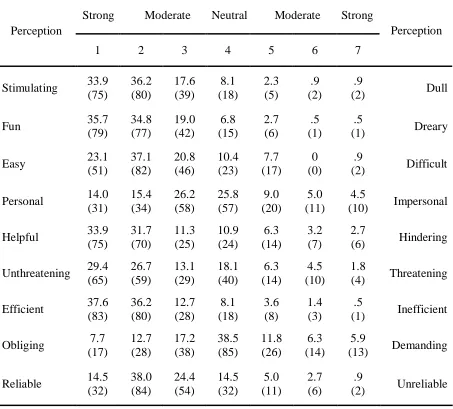
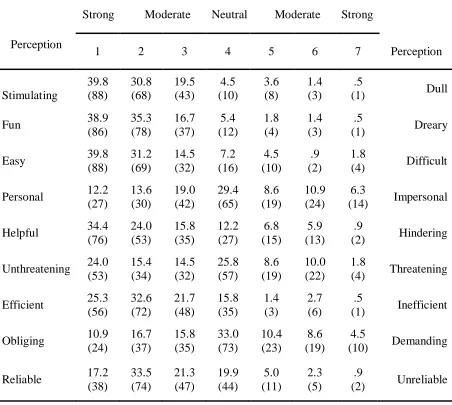
Table 4.7. Frequency Statistics for Computer Efficacy ……….. 75
Table 4.8. Frequency Statistics for World Wide Web Efficacy ………. 78
Table 4.9. Frequency Statistics for Social Interaction Variables ……… 81
Table 4.10. Frequency Statistics for Instructor Feedback Variables ……… 82
Table 4.11. Frequency Statistics for Overall Satisfaction ……… 83
Table 4.12. Association of Active-Reflective Learning Style Dimension and Computer Efficacy ………. 85
Table 4.14. Association of Sequential-Global Learning Style Dimension and
Computer Efficacy ………. 88 Table 4.15. Association of Sequential-Global Learning Style Dimension and
Computer Efficacy ……….. 89
Table 4.16. Association of Active-Reflective Learning Style Dimension and
World Wide Web Efficacy ………. 90 Table 4.17. Association of Sensing-Intuitive Learning Style Dimension and
World Wide Web Efficacy ...……….. 91 Table 4.18. Association of Association of Visual-Verbal Learning Style
Dimension and World Wide Web Efficacy ……… 92 Table 4.19. Association of Sequential-Global Learning Style Dimension and
World Wide WEB Efficacy ……… 93 Table 4.20. Association of Active-Reflective Learning Style Dimension and
Social Interaction ……… 96
Table 4.21. Association of Sensing-Intuitive Learning Style Dimension and
Social Interaction ……… 97
Table 4.22. Association of Visual-Verbal Learning Style Dimension and
Social Interaction ……… 98
Table 4.23. Association of Sequential-Global Learning Style Dimension and
Social Interaction ……… 99
Table 4.24. Association of Active-Reflective Learning Style Dimension and
Instructor Feedback ……… 100
Table 4.25. Association of Sensing-Intuitive Learning Style Dimension and
Instructor Feedback ……… 101
Table 4.26. Association of Visual-Verbal Learning Style Dimension and
Instructor Feedback ……… 102
Table 4.27. Association of Sequential-Global Learning Style Dimension and
Instructor Feedback ……… 103
Table 4.28. Association of Active-Reflective Learning Style Dimension and
Table 4.29. Association of Sensing-Intuitive Learning Style Dimension and
Overall Satisfaction ……….. 105 Table 4.30. Association of Visual-Verbal Learning Style Dimension and
Overall Satisfaction ……….. 106 Table 4.31. Association of Sequential-Global Learning Style Dimension and
CHAPTER ONE: INTRODUCTION Context of the Problem
The effectiveness of distance learning versus traditional classroom-based learning has been debated since the first generation of distance learning. As the use of technology to facilitate and deliver distance learning courses has increased, new challenges have emerged for the administration, faculty, staff and students of postsecondary institutions developing and implementing distance learning programs (Drazdowski, Holodick, & Scappaticci, 1998; Fulford & Zhang, 1993). Many instructors fear distance learning is a means whereby
administrators can justify the reduction of faculty positions to solve budget shortfalls. According to Novek (1996), many critics of distance learning fear the dehumanization and alienation of students as well as loss of critical thinking and social skills. Farrington (1999) posits that he does not accept that distant learning can be the equivalent of the face-to-face instruction. On the other hand, many other researchers have reported no significant difference between traditional classroom instruction and web-based instruction and that students feel closer to their faculty and peer students in web-based courses (Navarro & Shoemaker, 1999; Wade, 1999). Bloom and Hough (2003) postulate that a number of studies have indicated that web-based instruction decreases student learning levels. Even if there are no differences between distance learning and traditional learning environments, there is a need for additional research for the effectiveness of web-based instruction.
advantage through the training and development of students. Distance learning has become an integral part of our lives as we move towards a technology-based society where
continuous learning is required for everyone. Distance learning is not a panacea, but as web-based courses continue to evolve, their potential for broadening access to higher education and training and development programs is compelling (Pantazis, 2002). While web-based course implementation requires detailed strategic planning, time and resources, the rewards for community colleges that successfully implement distance learning strategies include empowered students, measurable learning and tangible benefits (Driscoll, 2002). Statement of the Problem
Understanding web-based course delivery technologies in a world that demands opportunities for continuous learning, flexibility, convenience, and accessibility is
Purpose of the Study
The purpose of this study is to provide empirical data that report the association between students’ learning style preferences and their perceptions of satisfaction in web-based learning environments. By providing an analysis of students’ learning styles, the study can enhance learning and expand the knowledge base of web-based learning, a delivery method characterized as a “kind of teaching method in which the teacher and students are separated from each other by place and/or time” (Offir & Lev, 1999, p. 132). In fact, an understanding of students’ learning styles may become even more important to web-based learning environments than traditional methods of learning. An analysis of web-based learning for students’ perception of satisfaction in web-based course delivery methods can potentially add to the information base about adult learners. While age, gender, and national origin are important, one cannot ignore the premise that learning styles are essential for effective teaching and learning. Therefore, the knowledge provided from the study can lead an instructor to better fulfill the responsibility of presenting information through a variety of instructional methods (Driscoll, 2002; Dunn & Dunn, 1993).
Research Question
This study examines the overarching question concerning the association between students’ learning styles and perceptions of satisfaction for those enrolled in community college web-based learning environments. The participants for the study were enrolled in one or more web-based courses at one of the following community colleges located in the
For the purpose of this study five research questions will be presented to assist in the understanding of the overarching question as follows:
1. What are the associations between learning styles and the perceptions of satisfaction with computers among community college students enrolled in web-based courses?
2. What are the associations between learning styles and the perceptions of satisfaction with the World Wide Web among community college students enrolled in web-based courses?
3. What are the associations between learning styles and the perceptions of
satisfaction with social interaction among community college students enrolled in web-based courses?
4. What are the associations between learning styles and the perceptions of
satisfaction with instructor feedback among community college students enrolled in web-based courses?
5. What are the associations between learning styles and the perceptions of overall satisfaction among community college students enrolled in web-based courses?
The Null Hypotheses for these five questions are presented in Chapter Three of this study.
Definitions
For the purposes of this study, the following definitions apply:
BlackBoard – Computer-mediated software used to develop and deliver course content using the World Wide Web.
Computer-assisted instruction – When computers are used as a self-contained
teaching machine to deliver individual lessons; without the intervention of an instructor. Computer-mediated instruction – When computers are used as the media that delivers the course content from the instructor to the student (e.g., web-based courses, e-mail, chatrooms, and videoconferencing).
Correspondence Course – A distance learning environment where the course content and communications between the instructor and the student are provided using a postal system.
Delivery Technologies – Electronic media designed to provide asynchronous and synchronous interactions for the purpose of delivering written, verbal, and visual communications.
Distance learning – A set of teaching/learning strategies to meet the learning needs of students that are separated from the traditional classroom environment and the
traditional role of faculty.
Internet – The vast collection of inter-connected networks that provide the
communication paths for networking components to route communications using a common TCP/IP language/protocol.
Learning Styles – An individual’s preferred approach to thinking, information processing, and learning (e.g., verbal, visual, reflective).
Satisfaction – An individual’s perceived comfort level and feelings regarding the effectiveness of the web-based course environments.
Synchronous Communications – Technology-based communications that provide the vehicle for which interaction between the instructors and students can occur in real time (e.g., videoconferencing, chat rooms).
Teleconferencing – A method of communication that uses telephone-based
technologies that provide the vehicle for which interaction between the instructors and students can occur in real time at multiple locations.
Telecourse – A strategy of distance learning that provides instruction to the students using television broadcasts or pre-recorded tapes.
Traditional Learning Environment – A learning environment or classroom where the instructor and the student communicate face-to-face.
Videoconferencing – Synchronous communications that allow the instructors and students to communicate in real time, from multiple locations, using computers, cameras, and sound production technologies.
Web-based Courses – Courses of study that are delivered via the World Wide Web using a web-based computer-software program such as WebCT, BlackBoard, and Campus Cruiser.
Web-based Technologies – Computer-mediated devices and software designed to connect individual to the World Wide Web (e.g., computers hardware, software, networking devices).
Assumptions of the Study
The following assumptions were used to guide this study:
1. Community colleges included in the study follow the course content guidelines established in the common course library of the North Carolina Community College System establishing general consistencies in programs and students. 2. Students will accurately and honestly respond to the learning style inventory
and the perception of satisfaction web-based survey. Limitations of Study
Participants in this study were limited to those students who enrolled in during the fall semester of 2004 at the four participating community colleges. As a result, the study
possesses the following limitations:
1. The findings from this study only apply to the four community colleges and students enrolled in one or more web-based courses at the four community colleges.
2. In measuring variables associated with students’ learning styles and student’s perceptions of satisfaction, the researcher was limited in determining if factors not measured would have higher levels of significance than those that are measured. 3. It proved difficult using the postal service to administer the surveys to students
located at the four community colleges. Significance of the Study
increasing use, community colleges are faced with utilizing technology in the education of adult learners. Although there are many challenges to consider when implementing web-based learning, they are not insurmountable. Additional research conducted for students’ learning styles, web-based course delivery methods, and web-based teaching styles is clearly needed if we are to maximize the effectiveness of web-based learning.
This research provides additional knowledge to the field of technology-enhanced learning environments thereby benefiting community colleges, academic advisors, faculty, and students as we continue to learn what enhances and hinders web-based learning.
CHAPTER TWO: LITERATURE REVIEW Introduction
The purpose of this chapter is (a) to research the past, present, and predicted future of distance learning in higher education, (b) to review the literature concerning distance
learning theory, (c) to review the evaluation and assessment methods utilized to capture and analyze students’ satisfaction in web-based learning environments, and (d) to report the current research findings that report the impact of students’ learning preferences and their perceptions of satisfaction in web-based learning environments.
Historical Background
Distance learning is not a new concept; it has been in existence for two centuries in Europe and for more than one century in the United States. During the past two hundred years, the development of new technologies has advanced the options for delivering distance learning opportunities to potential distance learners. Sloman (2002) described the periods of technological advancement as follows:
1. The first generation of distance learning in which correspondence educational
systems utilized print-based materials and a postal system to deliver distance learning courses.
2. The second generation of distance learning in which instructional radio and television were utilized to broadcast asynchronous distance learning courses.
3. The third generation of distance learning in which synchronous audio and video technologies were utilized to deliver distance learning courses between multiple locations.
4. The fourth generation of distance learning in which information-based technologies, such as satellite communications and computer-based networking systems, integrated audio and visual communications to provide synchronous and asynchronous distance learning opportunities that can be accessed any place at any time.
First Generation
time (Lau, 2000). During this era, correspondence courses relied on printed materials being delivered from the instructor to the student through a postal system, eliminating the
traditional face-to-face interaction between the instructor and the student. A typical interaction between the instructor and his/her students involved the instructor’s mailing a lesson to the student, the student’s returning the lesson to the instructor using the mail, and the student’s waiting for the instructor to return the graded assignment using the mail.
During the 1840’s, Sir Issac Pitman, creator of English shorthand, began offering correspondence courses in England by the newly established penny post mail system (Lau, 2000). In 1843, the Phonographic Correspondence Society was created in an effort to formalize the correspondence education movement (Glatter & Wedell, 1971). During the 1850s, The University of London expanded its program of studies to the inhabitants located in the British colonies of Australia, Canada, and India. These institutes were created because these countries were physically large and the citizens lived great distances from university campuses.
Meanwhile, the Chautauqua Institute in New York was founded in 1883 as the first institution in the United States to function using the postal service to deliver correspondence courses (Dede, 1990). This college was authorized by the state of New York to grant
academic degrees to students who successfully completed work during the summer at the institute and by correspondence during the academic year. Because of the success of
Pennsylvania State College began offering correspondence courses in agriculture (Matthews, 1999).
During the next twenty years, thousands of adults wished to pursue postsecondary learning opportunities; however, geographical and occupational barriers prevented many adults from accessing colleges and universities (Glatter &Wedell, 1971). Several colleges and universities within the United States began to meet this demand by creating
correspondence programs, most notably the University of Wisconsin, University of Texas, University of Columbia, Iowa State University and Chambers College. As a result, the correspondence course movement of this era exploded with enrollments nearing 200,000 students.
While the correspondence course movement opened doors to higher education for thousands of adults who otherwise would have been excluded from educational advancement opportunities, several critics began to question the effectiveness of correspondence courses (Glatter & Wedell, 1971). In fact, many elitists looked down on this form of education and argued that correspondence courses of study were inferior and designed for those
intellectually incapable of functioning within traditional university environments. For
example, William Harper, a Yale University professor of Hebrew who taught correspondence courses from 1883 to 1891, believed that even if correspondence studies could supplant oral instruction, they would always be viewed as a substitute (Matthews, 1999). In response to the criticism, many institutions began to question and assess the effectiveness of distance
has continued from the correspondence course movement to distance learning delivery methods being used today.
Second Generation
The second generation of distance learning is distinguished by the advancement of electronic communications technologies which allowed colleges and universities to deliver correspondence courses using radio and television (Sloman, 2002). Unlike the first
generation deliverers of distance learning, colleges and universities that used radio and television correspondence courses were able to create asynchronous learning environments where one-way communication between the instructor and student occurred at different points in time without the restrictions of printed materials and written communications (Glatter & Wedell, 1971). A typical interaction between an instructor and student would begin with the instructor’s delivering a lecture using radio or television broadcast. Next, the student would submit his/her assignments to the instructor using postal services. The instructor would grade the assignments and return the student’s graded assignments via the postal service. The ability of the instructor and student to interact using the transmission of non-verbal and verbal communications would ultimately come to solidify the preferred media for third and fourth generations for delivering distance learning courses (Matthews, 1999).
operate a radio transmission station to apply for a license. In 1912, Saint Joseph’s College in Philadelphia was the first college to receive a license to operate a radio transmission station. Immediately several colleges began to follow their lead.
In 1916, the University of Wisconsin was the first college in the United States to offer correspondence courses using the radio (Buckland & Dye, 1991). During the 1920s,
Pennsylvania State University and Columbia University began offering correspondence courses using radio transmission in the United States. Meanwhile, Great Britain’s
Department of Education in conjunction with the British Broadcasting Corporation started delivering correspondence courses using radio transmission to 10,000 schools. By the end of the 1930s, Turkey, India, Columbia, and Canada began to deliver instruction using the radio to offset the cost of building schools and to overcome the geographical barriers.
In the years between the World Wars (1918-1946), the United States government granted radio broadcasting licenses to 202 colleges, universities, and school boards
(Buckland & Dye, 1991). Despite the demands and popularity of instructional radio, by 1940, there was only one college-level credit course offered by radio and that course failed to attract any enrollments. Still, the concept of delivering education by radio was a major reason for development of public education television stations.
period. During the 1939 World’s Fair in New York, Franklin D. Roosevelt became the first president of the United States to appear on television. While the limited broadcast capability of this era restricted the president’s appearance to a small group of individuals who had television sets in New York, the event generated international attention.
Distance learning continued in a state of status quo until the end of World War II, a period of time when higher education enrollments exploded due to the returning veterans who desired access to higher education (Mathews, 1999). During the 1950s, television broadcasting became available to the general public. Kansas State College, Purdue
University, and Iowa University began experimenting with educational television programs that could be utilized to offer distance learning course (Buckland & Dye, 1991). The first true educational television program was Sunrise Semester, based in Chicago. From 1959 into the early Sixties, Sunrise Semester featured an instructor standing before a class with a camera shooting the actions of the instructor over the heads of the students. The Sunrise Semester program was aborted after a few years because it was not economically sustainable.
In 1969, the British Open University began offering successful distance learning programs using a blended multimedia approach to teaching (Mathews, 1999). The university designed distance learning courses using textbooks, audio and video materials, radio and television broadcasts, and supplemental audio tapes and filmstrips. The British Open
University brought a new vision of independence and respect for delivering courses through distance learning technologies. Mathews postulates that the British Open University
such as the United States, Japan, Sweden, and Canada in the large-scale integration of technology into curriculum programs for the purpose of delivering distance learning courses.
In 1970, California used the funding obtained through a Title I provision to form a task force to design distance learning courses that would be delivered using television networks (Freed, 1999). The project involved all California community colleges and the University of California. The task force developed the concept of the “telecourse,” a distance learning vehicle whereby the instructor sits before a camera in a classroom or studio and the students receive asynchronous or synchronous television transmissions. Because the
communications in this environment were one-way, provisions were developed to provide instructor and student interaction, to arrange student submission of assignments to the instructor, and to facilitate the return of graded assignments to the students.
In 1972, California created Coastline Community College, the first “virtual college,” in order to coordinate the development, distribution and licensing of telecourses (Freed, 1999). Coastline Community College contracted the best instructors to develop telecourses that were broadcasted from KOCE, a public television station, to colleges, universities and libraries located in Los Angeles. By 1976, Coastline Community College was serving 18,500 students within a 150-square-mile area of southern California.
when circumstances prevented them from attending classes in the traditional classroom. The overwhelming success of Dallas Community College in generating revenue from the
telecourses motivated Coastline Community College to begin producing and licensing pre-packaged telecourses for other colleges.
The telecourse model began to spread across the nation as many states such as Arizona, Colorado, Oklahoma, and Florida began to offer variations of video on demand telecourses (Freed, 1999). By the 1980s, the Public Broadcasting Service (PBS), a quasi-government broadcasting studio, began producing and broadcasting telecourses. However, when PBS began to experience budget shortfalls in the telcourse production market, the broadcasting company started purchasing licensed educational content and assumed the role of satellite link broadcasting the programs to local schools and colleges.
Following the lead of PBS, several cable television and satellite companies were formed in the late 1980s in effort to broadcast single educational programs to supplement existing curriculums rather than providing pre-packaged telecourses (Freed, 1999). Because of the success and journalistic integrity of these programs, there are approximately 240 consortia of public and private educational and creative enterprises in the United States that produce educational programs that are used by thousands of colleges and universities. Broadcasting and programming channels like Mind Extension University, The Discovery Channel, The Learning Channel and CNN’s Cable in the Classroom have steadily gained market shares by delivering superior video quality using satellite communication
through high school promotes a genuine commitment to public education within the cable industry. As a result, Cable in the Classroom reaches more than 90 percent of the public primary and secondary schools in the United States.
Third Generation
The third generation of distance learning began after educators began to explore the possibilities of using new technologies which would offer synchronous communications between teacher and students (Sloman, 2002). During the 1970’s, Athabasca University was established in Canada to research and provide distance learning opportunities through the combination of synchronous telephone-based communication technologies and home study techniques. As a result, colleges such as the Nova University, University of Wisconsin, Empire State College, and Oklahoma State University began to offer distance learning courses using teleconferencing technologies, a method of communication that enabled colleges to offer synchronous interaction among multiple locations using teleconferencing (Dede, 1990). The major advantage of this learning environment was that the instructor and the student could communicate audibly in real-time, therefore overcoming the asynchronous limitations that existed during the first and second generations of distance learning. While the teleconferencing learning environment provided synchronous communication capabilities between the instructor and the students, once again many educators believed that this environment was inferior to the traditional learning environment. As a result, instructional designers continued to search for a learning environment that closely emulated the intimacy of the traditional education setting.
between different campuses (Hancock, 1999). The videoconferencing learning environment allows the instructor and students to communicate in real time using cameras and sound production technologies. A typical interaction between the instructor and a student takes place in an educational environment where the instructor and the student are located in separate interactive classrooms or studios that are capable of transmitting and receiving live visual and audible communications. When the instructor or the student desires to
communicate, he/she looks into a camera and speaks into a microphone. Then the interactive technologies transmit the image and sound to the opposite site where the communication is viewed and heard using an integrated sound and television system.
Fourth Generation
The fourth generation of distance learning is distinguished as an era that produced the most significant advances in technology since the machine age, a period when mechanization revolutionized industry and homes received electricity (Sloman, 2002). The fourth generation of distance learning began when technology-based distance learning started using mainframe computers and workstations in an effort to meet the demands of companies such as IBM that required a highly skilled workforce capable of developing and supporting their computers (Whalen & Wright, 2000). Initially, large mainframe computers were expensive and difficult to maintain; therefore, large corporations, universities, and government agencies were the first institutions to purchase these systems. Computer-assisted instruction was first explored in 1959 when IBM assisted in the development of the first program to teach mathematics. In 1963, Stanford University and IBM released COURSEWRITER, a programming language specifically designed for computer-assisted instruction, a process whereby computers are used as a self-contained teaching machine to deliver individual lessons. Computer-assisted instruction provided a process of teaching and learning that delivers interactive, responsive, convenient, empowering, and outcome-oriented activities. In this method, the process of teaching and learning is designed based on asynchronous activities without limitations of time and place.
were interfaced to the university’s mainframe computer via a telephone line. This approach for mainframe computer-assisted instructional systems was developed primarily to provide college level instruction on university campuses and to provide supplemental instruction to students located at correctional institutions and basic skills centers. This methodology continued until IBM developed the first personal computer in 1981. The advent of the
personal computer promoted the widespread usage of computers in colleges and universities. Since then, distance learning delivery methods have been adapted to numerous developing computer-based technologies that include powerful operating systems, networking
technologies and compact discs.
In 1994, the development of the Internet created a new digital economy which required institutions of higher education and their faculties, staffs, and students to become flexible while continuously developing new skills to compete in a global economy (Levin, 2001). The Internet allowed colleges to deliver web-based programs and courses directly to the student workstations, residences, and mobile computers. Today, distance learning is best characterized as computer-mediated instruction delivered through web/computer based training, web/electronic performance support, web/virtual asynchronous classrooms, web/virtual synchronous classrooms, technologies for tracking and managing training, and application software for developing web-based courses (Driscoll, 2002; Sloman, 2002).
Distance learning has become an integral part of higher education as offering flexible and accessible course delivery systems enables a college to remain competitive while
substandard because they were designed from the perspective of delivering traditional instruction based largely on lecture notes, assignments and reserved readings. Accordingly, the only difference is the vehicle in that information is posted to a website rather than being delivered orally or on paper. However, private colleges such as Capella University, Cardean University, Nova Southeastern University, and the University of Phoenix design their web-based courses using a team of experts in the fields of adult learning theory, instructional design, and technology (Farrell, 2003). These web-based courses are centrally designed for the Internet in order to promote consistency in quality without depriving instructors of the flexibility necessary to modify the web-based course. As a result, these institutions deliver web-based courses that provide the student with learning opportunities that are entertaining and highly effective in transferring knowledge.
According to Silberman (1998) web-based instruction allows postsecondary institutions to provide a greater volume of courses to more students at a lower cost than traditional classroom-based instruction. The University of Phoenix, a publicly-traded, for-profit private corporation, recognized that many adult learners were restricted from enrolling in baccalaureate and master’s degree programs due to the many demands and pressures of life (Pantazis, 2002). The University of Phoenix addressed this problem by providing flexible options that allow students to complete their coursework using web-based instruction. The University of Phoenix provides an example of a new generation of
University of Phoenix is the largest and fastest growing private university in the United States with 145,000 students of which 63,500 are enrolled in distance learning programs (University of Phoenix, 2004).
Next Generation
Futurists predict that by 2010 the next generation of distance learning will provide instant and unobtrusive broadband access to interactive courses which will be cheaper and more convenient than the same course offered on college campuses (Dunn, 2000). During the next decade, distance learning will be distinguished by the broadband wireless technologies that will allow students to connect to computer-mediated distance learning programs at any place or any time. The distance learning student of the future will be able to travel anywhere and receive access to email, electronic documents and media, and audio and video clips. The student will use voice activated handheld computers to participate in interactive
How colleges and universities adapt to the changes in computer-mediated course delivery technologies may determine whether they remain competitive in the future. In 1998, 83% of governors identified the ability of students to obtain an education anytime or
anyplace as a critical characteristic for universities in the twenty-first century (Sloman, 2002). Given the demand and response, education will become a commodity, making
consumers of students and putting them in a position to shop for the best deal (Dubois, 1996; Johnstone, Ewell, Paulson, 2002).
Corporations are seeing higher education as offering an opportunity to earn big profits as the United States spends $670 billion annually for education. The for-profit education movement is predicted to increase its growth in revenue from $2.1 billion in 2002 to $33.6 billion by 2005 (Gallagher, 2003). Currently, only 4 to 5% of all higher-education students are enrolled with for-profit providers, but 33% of all web-based students are enrolled with these same providers. A survey conducted by the US Department of Education, National Center for Education Statistics predicted that college enrollment will grow 16% over the next ten years (Jones, 2003). This projected growth in student enrollment has many institutions acknowledging that within the decade there will be more students than their facilities can accommodate.
ill-prepared to deal with the education reform movements triggered by the shift in political and economic power at the state level. McGuinness reports the gap between the external and internal definitions and expectations for quality assurance is placing untenable political pressure on postsecondary institutions. Dunn (2000) projected that the number of degree-granting distance learning institutions will continue to grow, while the number of traditional campuses will decline. By 2025, half of today’s existing independent colleges will be closed, merged, or significantly altered in mission. The combination of growing markets, increased costs and increased competition will force postsecondary institutions to become market driven in order to compete with institutions such as Capella University, Cardean University, Nova Southeastern University, and the University of Phoenix.
Distance Learning Student Demographics
In the United States, adult learners aged 25 or older are the fastest growing population in higher education (Cetron & Davies, 2001). Currently, 42% of all students enrolled at postsecondary institutions are adult learners. Bishop and Spake (2003) theorize that the factors that might influence this phenomenon include “the growth of continuing education programs, economic necessity, the rapidly changing job market, changes in the economy, and the simple aging of student populations” (p. 374). Additionally, the percentage of women and minority learners is increasing in that more women (57% of all students) than men are
enrolled in higher education, a trend also reflected in the fact that more women are entering the workforce (Cetron & Davies). Furthermore, the proportions of women enrolled in higher education among minority ethnic groups are higher; 60% of Hispanic and 67% of
population projections, higher education can expect these trends to continue as the Hispanic population in the U.S. is expected to increase 63% by 2020, reaching 55 million people.
Distance learning students prefer learning environments that are self-directed, goal-oriented, and relevant to their needs (Dortch, 2003). They are motivated by professional advancement, external expectations, the need to better serve others, social relationships, escape or stimulation, and pure interest in the subject. Their demands include time and scheduling, money, and long-term commitment constraints. They also tend to feel insecure about their ability to succeed in distance learning, find instruction that matches their learning style, and have sufficient instructor contact, support services, and technology training (Diaz, 2002; Dubois, 1996).
Distance learning students enrolled in web-based programs are evolving into a subpopulation of higher education learners. According to Diaz (2002), these students are middle-aged adults that have completed more college credit hours and degrees than their traditional-aged counterparts. Bates (2003) adds that today’s distance learning students are interested in flexible educational opportunities that consist of small modules and short programs that can be completed at home and fitted around work, family, and social
Distance Learning Theory Adult Learning Theory
To successfully instruct adult learners in a distance learning environment, educators must become familiar with the concepts of andragogy, the study of the assumptions and processes used to facilitate adult learning (Wlodkowski, 1993). Merriam and Brockett (1997) define adult education as “activities intentionally designed for the purpose of bringing about learning among those whose age, social roles, or self-perception define them as adults” (p. 8). Knowles' (1980) classic learner-focused theory of andragogy suggests that much of adults' intentional learning activity is motivated by desire to move from their current level of
proficiency to a new, higher level. Knowles developed his adult learning theory of andragogy to address the inappropriateness of teaching adults using the developmental processes of pedagogy, the study of childhood learning (Knowles, Holton, & Swanson, 1989). Knowles felt that the customary characteristics of childhood learning fail to take into account the adult learner’s age, life-long experiences, physical stature, and practical approach to learning (Knowles, 1989). Adults are more self-directed, having as their specific goal the immediate application of what they have learned.
drive adults to improve their education (Wlodkowski, 1999). Wlodkowski (1993) identifies the following motivational assumptions as critical for helping adults learn:
1. Adults are always motivated to do something, whether they are motivated to learn or not to learn.
2. Adults are responsible for their own motivation. However, the educator’s role in a web-based learning environment is to influence and affect learners in positive ways. 3. All instruction/teaching should be delivered in a motivating manner.
4. There is no one best instructional method.
5. Every instructional plan should include a positive motivational plan.
experience by initiating discussion groups with peers during critical periods in a web-based course. Increased responsibility and accountability for learning are required of web-based learners (Shank & Sitze, 2004). They become active seekers and producers of information, anytime and from any location, by sharing information with or retrieving information from various resources such as instructors, other students, electronic libraries and databases, and other internal and external information resources.
Learning Styles
Felder and Silverman (1998), Kolb (1993), Saba (1999), and Shank and Sitze (2004) support accommodating student learning styles in web-based learning environments in order to increase the performance and satisfaction levels of students enrolled in web-based courses. According to Saba, distance learning requires students to take greater responsibility for their learning, which can be enhanced by identifying their learning style using a learning style inventory. Shank and Sitze believe web-based education should be student-centered rather than teacher-centered. Felder and Silverman posit that students have differing strengths and preferences in the way they process and learn new concepts. For example, Prensky (1998) suggests that learning styles change from generation to generation requiring faster speed, a more visual approach, and greater active engagement for students that grew up during the information age. When there is a mismatch between the instructors teaching style and the learning style of the student, the students will become inattentive, discouraged, and
The Institute of Learning Styles reports that there are no fewer than seven perceptual learning styles. Perceptual learning styles are characterized as the methods that individuals use to extract information from their environment (The Institute of Learning styles, 2004). The seven perceptual learning styles are print, aural, interactive, visual, haptic, kinesthetic, and olfactory. Shea-Shultz and Fogarty (2002) characterizes the seven perceptual learning styles as follows:
1. The print learning style refers to seeing printed or written characters. 2. The aural learning style refers to hearing and listening to sounds. 3. The interactive learning styles refer to verbal communications.
4. The visual learning style refers to the ability to see visual images, such as pictures and graphics.
5. The haptic learning style refers to the sense of touch.
6. The kinesthetic learning style refers to motor skills and coordinated body movements. 7. The olfactory learning style refers to an individual’s sense of smell and taste.
Kolb’s (1993) research suggests that individuals possess preferences for learning that favor some learning abilities over others. He reports that there are four basic learning modes: concrete experience, reflective observation, abstract conceptualization, and active
experimentation that describe the learning preferences of everyone. Furthermore, his research supports that the majority of people utilize only two of the four basic learning modes. Kolb (1984) describes the four learning modes as follows:
1. Concrete experience is real life experiences that are external to the learner. 2. Reflective observation is an individual’s internal reflection of the relevance of an
3. Abstract conceptualization is the process whereby an individual internalizes new ideas in the process of creating new theories.
4. Active experimentation is external to an individual as he/she puts the theories and ideas into practice.
Kolb (1984) posits that in different learning situations, individuals often use different combinations of learning modes; hence, no one learning mode clearly identifies an
individual’s learning style. The combination of learning modes are used to establish four quadrants reflecting four learning styles: Accommodator, Diverger, Assimilator, and Converger. Kolb describes the association between the learning modes and the learning styles as follows:
1. The Convergent learning style moves in cycles in which theory is moved into practice and back again.
2. The Divergent learning style focuses on action and reflection whereby the individual ponders the relevance of real life experiences.
3. The Assimilative learning style utilizes theorization and logic to convert observations into knowledge constructs.
4. The Accommodation learning style relies on practicality whereby an individual focuses on moving into action.
1. The Extroversion-Introversion dimension indicates whether an individual prefers to focus attention on their external environment or toward their internal thoughts and ideas. Extroverts prefer to participate in action oriented activities that allow them to interact with their peers. Introverts prefer to focus their energy internally and tend to be reflective thinkers.
2. The Sensing-Intuition dimension indicates whether an individual prefers to perceive the world through a reality lens or through impressions and imagination. Individuals that prefer the Sensing mode rely on their sensory inputs. These individuals are interested in the facts and solve problems using proven step-by-step instructions and solutions. Intuitive people seek out patterns and relationships among the facts they have gathered. These individuals trust their instincts and try to solve problems through creativity and imagination. Intuitive people tend to look at the big picture without worrying about the individual details.
3. The Thinking-Feeling dimension indicates whether an individual prefers to make decisions through logical analysis or through personal values. Individuals that prefer the thinking mode make decisions based on concrete analysis, logic, and principle. Feelers value harmony by focusing on human values and empathy. Individuals that prefer the feeling mode focus on human values and needs as they make decisions or arrive at judgments.
These individuals focus on completing the task, knowing the essentials, and they take action quickly. Perceptive individuals are best characterized as curious, adaptable, and spontaneous. They start many tasks, want to know everything about each task, and often find it difficult to complete a task.
Felder and Silverman (1988) developed a learning model that assembled the most prevalent learning style differences among students in effort to provide empirical evidence that supports the need for instruction that addresses the learning preferences of students. The Felder-Silverman learning style model consists of the following distinct learning style dimensions: Processing (Active-Reflective), Perception (Sensing-Intuitive), Input (Visual-Verbal), and Understanding (Sequential-Global). Felder and Silverman report that parallels exist between their four dimensions and Kolb’s (1984) Active, Reflective, Concrete, and Abstract learning modes and the Myers Briggs Type Indicator’s extravert/introvert and the Sensing-Intuitive categories. Felder and Silverman describe the dimensions of their learning style model as follows:
1. The Processing dimension focuses on the individual’s tendency to process of contextualizing new information and concepts. Active learners tend to retain and understand information through participation in activities. Reflective learners prefer to think and internalize information before taking action. Active learners prefer to work in group activities whereas reflective learners desire to work independently of others.
2. The Perception dimension focuses on the individual’s preference for
are good at memorizing facts and doing hands-on work. Intuitive learners prefer discovering the possibilities and relationships. These individuals are innovative and prefer to work with abstract concepts such as mathematical formulas.
3. The Input dimension focuses on the individual’s preference for internalizing new information or concepts through visual or verbal sensory inputs. Visual learners prefer to learn from visual images such as pictures, diagrams, flow charts, video, and demonstrations. Verbal learners prefer to learn from audible cues such as lectures, reading material that is written in textbooks or articles.
4. The Understanding dimension focuses on the individual’s thinking process preference. Sequential learners tend to gain understanding by thinking in logical and linear steps. These learners tend to follow lock and step paths to finding solutions. Global learners prefer to think holistically by take large jumps without paying attention to the details. These learners tend to randomly absorb material without seeing the individual connections before grasping the big picture.
Shank and Sitze (2004) posit that the most effective web-based courses are designed with several options that allow students to learn using their preferred perceptual learning style. For example, in a web-based course a student that prefers the print learning style could choose to read a printed text file that contains the contents of a lesson whereas a student that prefers a combination of the aural and visual learning styles would use interactive media that contain visual and audible communications. When Shea and Shultz (2002) studied the
of the students at the outset of a distance learning course will enable the instructor to gauge how the students need the content to be delivered.
In order to accommodate the different learning styles of students, adult educators must recognize their own instruction styles. According to Ebeling (2000), there is evidence that instructors typically use the teaching style that is most comfortable for them, invariably the learning style with which they are most comfortable. As a result, many learning activities fail to achieve their potential because instructors concentrate only on one stage of the
learning cycle. Taylor (1998) suggests that instructors in a web-based learning environment should be flexible in their teaching styles in order to accommodate the various learning styles of students. For example, students that are Sensing learners and Intuitive learners that operate within Felder and Silverman’s Perception dimension would benefit from the instructor using different media and activities to present the content of a web-based course. As a result, the instructor should provide abstract information to Intuitive learners who prefer to apply theory to practice and concrete information to Sensing learners who prefer to construct meaning from observations into real life experiences. Verduin & Clark’s (1991) research of learning styles within the distance education setting found that when the when the teaching styles and the learner styles match, the students report being more satisfied with the course. Additional research has shown that grade point averages, student satisfaction and student success increase whenever there is a match between instructors’ teaching style and the student’s learning style (Borg & Shapiro, 1996; Filbeck & Smith, 1996; Hayes & Allinson, 1996). Constructivism and Self-Directed Learning
web-based instruction is based on objectivism, which is the underlying theory for
behaviorism and cognitive information processing views of learning. Objectivism is a view that knowledge exists in the external environment and learning is the learner’s attempt to represent that external reality internally (Gagne´& Medsker, 1996). According to Powers and Guan, most web-based courses offered by institutions are substandard because they were adapted from the course contents of seated courses where the students read lecture notes, view web-streamed video clips, exchange assignments with the instructor via email, and take exams that are often administered at an onsite testing center. Shank and Sitze (2004) posit that distance learning courses designed using objectivism perspectives create an environment where the role of the instructor is to determine and transmit the information that is important for the student to learn, while the role of the student is to receive the information that is delivered by the instructor. When web-courses are designed in this manner, there is minimal interaction between the instructor and the student and the prior experience of the instructor and the student is discarded.
Constructivism is a philosophy of learning centered on the premise that we construct our own understanding of the world through life’s experiences. In constructivism, knowledge is the meaning that individuals create from their experiences and learning is a process of constructing a system of meanings and then using these to interpret events, ideas, or
assumes the role as a coach or guide who uncovers the content and processes behind the expertise, whereas the role of the student is to develop and apply the knowledge gained through learning activities with those who share his/her learning environment (Morphew, 2000).
According to Gagne´ and Medsker (1996), constructivism is becoming the preferred perspective for distance learning instructional designers whose goals are to simulate reality and help students develop their own sequence of learning. The challenge in constructivist design of web-based courses lies in finding the balance between interaction and
personalization and between asynchronous and synchronous learning environments. In a study of 200 undergraduate students, Powers and Guan (2000) report that students enrolled in web-based courses scored an average of 15% higher than those who enrolled in the
traditional classroom version of the same course regardless of gender, ethnicity, academic background, computer skills or academic aptitude. They note that web-based courses work well if they are designed from the ground up for web-based delivery.
environment is that students have varying degrees of control over when and where they gain the knowledge. They postulate that developing a web-based course that fosters interaction while meeting the expectations of students requires an understanding of cognitive learning and psychological and social perspectives.
Shank and Sitze (2004) recommend that instructional designers developing web-based courses use a student-centered learning assessment at the core of the designing process in order to guide decisions, set priorities and allocate resources. Active-based learning environments include activities that explore and stimulate learners’ motivations, foster and encourage participation and interaction among students, and provide considerable amounts of personal and humanist caring elements (Powers & Guan, 2000). The strength of this model is that it emphasizes the social context in which learning takes place (Merriam & Brockett, 1997).
Theory of Interaction
Interaction influences learning by causing the student to act, think and react (Shank & Sitze, 2004). At a minimum, interaction requires that a student’s effort result in some form of response. Without interaction, there would not be a means to gather feedback throughout the learning process. According to Shank and Sitze, there are four types of interaction that must occur in distance learning environments: student-content, student-instructor, student-student and student-technology. Student-content is the process through which students garner
learning environment. In Biner, Barone, Welsh, and Dean’s (1997) study of 288
undergraduates enrolled in 17 telecourses, they identified the following relationships in distance learning environments that impact the student satisfaction: instructor/instruction, technological aspects of the course, course management, support services, and out-of-class communication with the instructor. The study showed that higher levels of student
performance were positively correlated with the technological aspects of the course, the promptness of the material exchange with the instructor and overall satisfaction.
While the types of interaction that exist in distance learning environments are
important to students’ satisfaction, how these interactions take place and the degree to which there is interplay between them is important. Shank and Sitze (2004) emphasize the
importance of interactivity as an instructional activity. In a constructivist environment, interaction stimulates student motivations and promotes more effective learning as it enables students to learn quicker, retain knowledge longer, and transfer and apply the knowledge into real life situations. Offir and Lev (1999) found that increased interaction between instructor and student increased the effectiveness of distance learning. LaRose and Whitten’s (2000) study on instructor immediacy in distance learning also found that learning is increased through the interaction created from email or web-based group. Providing multiple venues for communication like email, web-based group discussions, giving prompt feedback, utilizing the beginning and end of class and breaks to meet and greet students, and creating an atmosphere of sharing can aid in helping instructors and students feel connected and result in enhanced learning (Beattie, Spooner, Jordan, Algozzine, Spooner, 2002; LaRose &
Another aspect of interaction pertains to perceptions of instructors and students in distance learning settings, specifically as it relates to nonverbal communication (Mottet, 2000; Pitcher, Davidson, Goldfinch, 2000). The inability of students to see the instructor and vice versa can be unsettling. Mottet conducted a study in which he explored “the relationship between videoconferencing instructors’ perceptions of students’ nonverbal responsiveness and the influence of those perceptions on distance teaching” (p. 146). He found that the ability to receive both visual and audible nonverbal cues increased not only the positive perceptions of students, but the distance teaching process as well. The more nonverbal responsiveness the instructor perceived while teaching resulted in positive impressions of the students, positive perceptions of his/her teaching effectiveness and satisfaction, positive perceptions of teacher-student interpersonal relationships, and preference for teaching in an interactive television setting versus a regular classroom setting. Understanding the
relationship between nonverbal responsiveness and the resulting perceptions of students and distance learning can be helpful for instructors as they consider how to create interaction in a synchronous web-based environment.
realize an internally focused causality for their learning. Essentially, learners must become self-immersed by initiating interaction and communication with faculty, fellow peers, and instructional events. Sewart stated:
It is an interesting and perhaps sometimes infuriating paradox this provision of flexibility to cater for individuals needs inevitably results in increasing complexity of administrative and organizational procedures which may present the student with problems. (p. 168)
Social Presence
Theory of Transactional Distance
The term transactional emphasizes that the distance between the instructor and student is pedagogical and not geographic (Moore & Kearsley, 1996). The theory of
transactional distance postulates that distance learning is a pedagogical phenomenon. Moore and Kearsley hypothesize that transactional distance is important to theorists and
practitioners because it explains the effect of distance on learning, the students, the
instructors, the forms of communication and interaction, the curriculum and the management of the course. Transactional distances exist between the instructor and the student in face-to-face instruction as well as in web-based learning environments; transactional distance always impacts understanding and perceptions. The transactional distance is exacerbated by geographical distance in distance learning and must be overcome by instructors and students for effective, deliberate and planned instruction to occur.