Video Forgery Detection Using Multi-Level
Subtraction Approach
Abhilasha A. Wagh
1, Sanjeevani K. Shah
2PG Student, Dept. of E & TC Engineering, STES’S Smt. KashibaiNavaleCollege of Engineering, Pune, India1 HOD E&TC, Dept. of E & TC Engineering, STES’S Smt. KashibaiNavale College of Engineering, Pune, India2
ABSTRACT:Owing to easy accessibility of video editing software, video forgery acts have been escalating in recent years. Such video editing software used by criminals to tamper the videos. Such tampered videos are shown as evidence in court and thus, innocent person may not prove himself. To obtain accurate forgery detection from forged video, a Multilevel Level Subtraction (MLS) is proposed. It is based on pixel grey value subtraction that values decide whether given video gets tampered or not. The main objective of this paper is to implement highly accurate, efficient and feasible frame insertion forgery detection for video. This method works efficiently and accurately to detect a malicious acts in original videos. The method achieves high recall rate and precision rate.
KEYWORDS:— MLS, Video forgery detection, precision rate, recall rate, BBVD.
I. INTRODUCTION
The multimedia files are used in daily life such as evidence in court, military communication, medical records in hospitals etc. Therefore, it is very crucial to authenticate digital files effectively and accurately. Video forgery is a malicious act which associated to changing or improving video contents. So, video forgery can defined as modifying the video with hostile intension and it is illegal act which destroy any crucial system.
Video can modify by replacing original frames with forged frames, changing sequence of frame, deleting frames, adding new frames, copy paste frames.
There are different types of video forgery that is classified into two categories:
i) Intra Frame forgery
ii) Inter Frame Forgery
In first type of forgery act, the individual frame gets tampered whereas in second type of forgery act, neighbouring frames are tampered. These tampered acts are as follow:
A) Adding new frames :
New frames are added or inserted into given video sequence to make fake evidence.
B) Frame Duplication :
Attacker hides the unwanted frames by using duplication of frame to unfold some evidence or information.
C) Deleting original frames:
D) Shuffling of frames:
Attacker can change the sequence or order of frames in video to get some different meaning of video.
Generally, there are two categories of forgery detection:
i) Active Detection
ii) Passive Detection
In first detection method, tampered region of video can be identified by a pre-inserted watermark in video sequence. But it suffers from some limitations such as : If attacker knows how to watermark inserted into video sequence, then he or she can easily detect watermark. Also, imminent hardware required for insertion of watermark in video. In passive detection method, without relying on pre-escaped and pre- inserted information into video forgery can detected.
The main idea of proposed method is that at the tampered region of video, consistency of the BBVD ratio will get disturbed. Thus, video forgery identified by calculating three level subtraction of pixel grey value. From this substraction ,get absolute value , which used to check whether forgery occurs or not in given video sequence. This method not only detect whether video tampered or not but also the location of frame forgery in given video sequence.
II. RELATED WORK
Various methods are implemented are as follow:
Video forgery detected by using inserting watermark information into video sequence in [1]. The watermark is invisible and fragile information which encrypted and the insert into DCT coefficient of each frame. MPEG-2 coding standard is used for watermark hardware. But this method is suffered from limitations. Owing to watermark, random values get added into each pixel thus, video become grainy. Cracker can easily know the watermark information by using reverse insertion process.
Optical flow consistency method explicated in [2] which based on consistency of optical flow of frames. The optical flow is computed by estimating motion vectors on each odd row and even row. Optical flow of frames is hundreds of times larger than others. If video gets tampered then, consistency of optical flow gets disturb. It has high complexity for computing optical flow of each pixel.
Inter frame video forgery can be identified by consistency of correlation coefficient of grey value in [3]. The main idea is that correlation coefficient of grey values of original video is consistent and its coefficient values are close to each other. If video gets tampered then, consistency will get disturb. If difference between correlation coefficient of adjacent frames is high then, conclude that video gets tampered. This method has lack of ability to detect duplication of frames of given video sequence.
Tampered point in video find using computing quantization parameters is introduced in [4]. The QP parameters of each pixel obtain by performing motion estimation. If QP values of any frame has been changed then, conclude that there may be tampered point . This technique has limitation that large number of QP values are difficult to analyse. Forged region of video is detected based on block level tampered noise correlation which is explicit in [5]. Noise residue of each frame is calculated. The noise free image is obtained using inverse wavelet transform. Then, noise residue of original frames is compared with that of forged frames. If region is forged, then correlation values of noise residue is changed. Thus, forgery can identified by segregating the tampered region from non- tampered region by analyzing properties of noise correlation.
correlation coefficient value is low at tampered point. The main limitation of this method is that , it can identified only if forgeries exist but cannot distinguish frame insertion and frame deletion.
III.PROPOSED METHODOLOGY
The principle of proposed method is based on correlation of adjacent frames. If correlation of adjacent frame is high then, conclude that original video not tampered. If some frames are deleted or inserted then, variation of brightness of frames is changed. Thus, consistency gets disturb and correlation value reduces. According to weber’s law, the ratio of Brightness variation is as follow:
R = ∆𝐵 𝐵(1)
Where R is ratio of variation in brightness versus original brightness of pixel. ∆B is Varied Brightness value of different frames. B is original pixel grey value.At the initial stage of method , there is need to perform some framework. So, that frames are enable to use for processing.
A.
Generation of sub-sequence groups
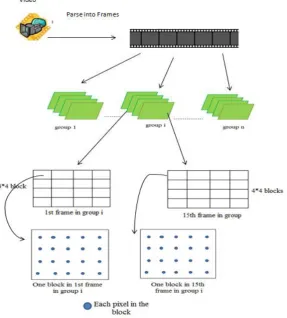
A complete video sequence is partitioned into temporal sub- sequence, it is shown as G= {g1, g2, g3,…….gn} in Fig .1. Length of each sub-sequence is 15 frames out of which 5 frames are overlapped.
Fig. 1.shows framework of given video sequence so that video is enable for further processing. Each group contains 15 frames and each frame is divided into 16 sub-blocks such as 𝐵𝑠𝑏𝑙𝑜𝑐𝑘= { b1, b2, b3,…….b16 }.The size of sub-bock is 4×4 blocks. Thus, by applying weber’s law, calculate 𝑅𝐵𝐵𝑉𝐷. The 𝑅𝐵𝐵𝑉𝐷 is ratio of variation of brightness between each sub-block in first frame and its corresponding sub-block in the last frame .It is calculated for each frame in each group then, calculate average value of all ratio of BBVD in each group.
Where 𝐵𝑓𝑖𝑗 and 𝐵𝑙𝑖𝑗 shows the grey value in each pixel of first in current block and the last frame of current block in current group respectively. M and N shows number of pixel in row and column respectively. Then, calculate average of all BBVD ratio of every 16 groups.
𝑅
𝐵𝑉𝐷=
161= ∑ (𝑅
16𝑖=1 𝑏𝑖)
(3)
Where 𝑅𝐵𝑉𝐷 is ratio of all BBVD of every 16 groups.
B. Proposed scheme –Multi Level Subtraction (MLS)
Fig. 2. Three Level Subtraction approach
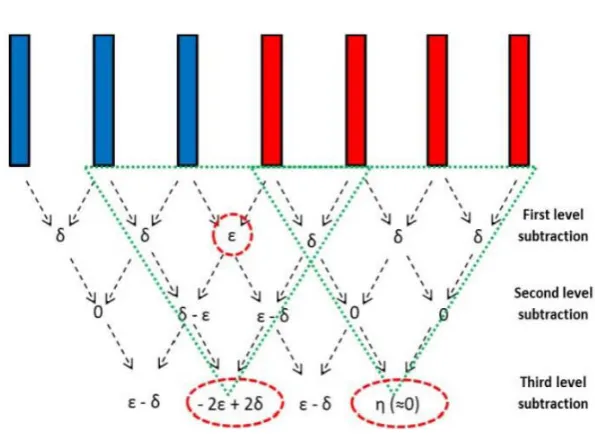
Fig. 2.Shows three level subtraction of pixel grey value. Original frames in video are shown by blue coloredframes, Forged frames are shown by red colored frames. A pair of adjacent blue colored frame of original video and a pair of adjacent red colored frames of forged video have high consistency or similarity.
In first level subtraction, adjacent frames subtraction is done. The subtraction of blue colored frames from original video is low which is shown by δ. The subtraction of adjacent red colored frames from forged video is very low which is shown by δ. But subtracted value obtain by subtraction of blue and red colored frame is high which is shown by ε, as two different frames having different pixel grey value (ε, δ).
In second level subtraction, adjacent values obtained from first subtraction are subtracted, then get two values are (δ-ε) and (ε-δ) shown in fig.2.
These values are opposite in sign but equal in magnitude.
Subtraction of similar pixel grey value gives result close to zero. These subtracted values are utilized for deciding threshold value.
Fig. 3. Forgery detection and localization
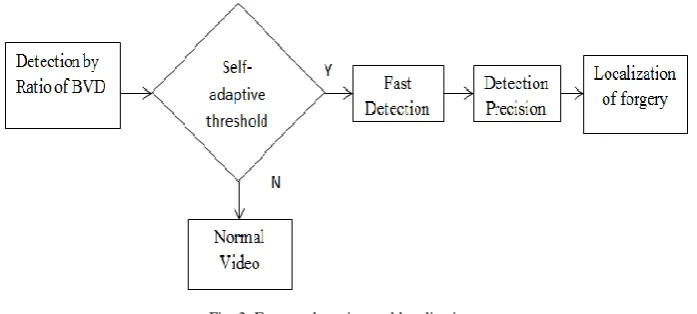
Fig. 3. Shows a forgery detection and its localization by setting threshold value. If following three conditions are satisfied then, conclude that frame insertion forgery has occurred in video.
i) If ε is more than 3σ. The probability of gross error detection is represented by 3σ. Thus, if value is more than 3σ, then it treated as the gross error.
ii) If (-2ε+2δ) is greater than ε at frame insertion boundary, then it satisfied: (ǀ2𝜀ǀ−𝑀)
𝑀 ×100≤ 𝑎 (4)
Where a is threshold value, it measures difference between ǀ2εǀ and M. iii) If (-2ε+2δ) is greater than Ƞ, then it satisfied:
ǀ Ƞ ǀ
𝑀 × 100 ≤ 𝛽 (5)
Where, β is threshold value which shows difference between ǀ Ƞ ǀ and M.
If above three conditions are satisfied then, that location is declared as frame insertion boundary in video sequence.
IV.EXPERIMENTAL RESULTS
Fig. 4. Result of MLS method
A
. Evaluation Parameters
The Efficiency of video forgery detection method can be estimated by two rates are called recall rate and precision rate. Recall rate is percentage of correctly detected video among all forged videos. Recall rate shown as follow:
𝑅𝑟= 𝑁𝑐+ 𝑁𝑁𝑐𝑚× 100 % (6)
Precision rate is percentage of correctly detected videos among all detected videos. It is shown as follow:
𝑅𝑝= 𝑁𝑐𝑁+ 𝑁𝑐 𝑓× 100 % (7)
Where, 𝑁𝑐 is number of video forgeries which correctly detected,𝑁𝑚 is number of missed video forgeries, 𝑁𝑓is number of falsely detected forgeries.
V. CONCLUSION
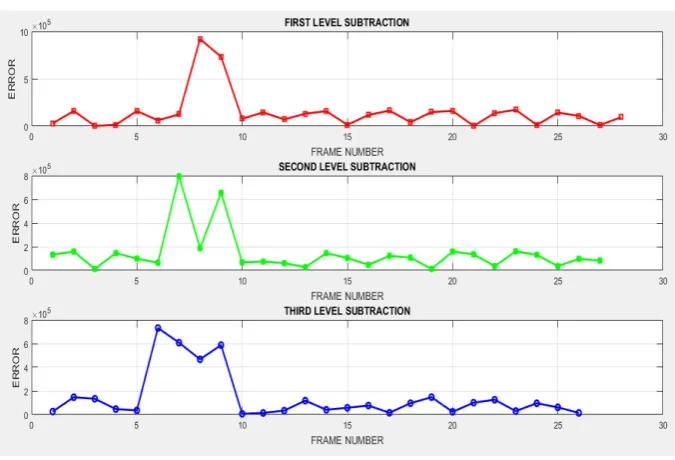
The multi-level subtraction of pixel grey value approach is efficiently detect video forgeries. From computing a subtraction of pixel grey values the threshold value is obtained. This threshold value decides whether video gets tampered or not. The given method correctly responds inserted frames from same camera recorded at same location. Therefore, it is capable of detecting video gets tampered or not also, detect insertion boundary in video sequence efficiently.
REFERENCES
[1] Sonjoy Deb Roy, Xin Li, Y. Shoshan, Alexander Fish, OrlyYadid-Pecht, “Hardware Implementation of a Digital Watermarking System for Video Authentication,” IEEE transactions on circuits and systems for video technology, vol. 23, no. 2, february 2013.
[3] Qi Wang, Zhaohong Li, Zhenzhen Zhang, QinglongMa.,K. “Video Inter-Frame Forgery Identification Based on Consistency of Correlation Coefficients of Gray Values”,Journal of Computer and Communications, vol.51-57, no.2, 2014.M.
[4] Tagliasacchi, S. Tubaro Politecnico di Milano, “Blind Estimation of The QP Parameter in H.264/AVC Decoded Video,” 11th International Workshop on Image Analysis for Multimedia Interactive Services (WIAMIS), 2010.
[5] Chih-Chung Hsu , Tzu-Yi Hung, Chia-Wen Lin , Chiou-Ting Hsu, “Video Forgery Detection Using Correlation of Noise Residue”,Conference Paper, October 2008.
[6] A.V. Subramanyam, Sabu Emmanuel,“Video Forgery Detection Using Hog Features And Compression Properties,”Conference Paper · September 2012.