A Beginning Analysis for Variable’s Risk of
Delays in the Supply of Equipment for the
Mechanical And Electrical Offshore Project
PHE - WMO Pt. X Jakarta
Krisna Widhyariana1, Manlian Ronald A Simanjuntak2
The Graduate Program of the Master of Civil Engineering Majoring in Construction Management,
Pelita Harapan University, Jakarta, Indonesia
ABSTRACT. Procurement is one of the most important departments and based on international’s journal conducted in Saudi Arabia, where the results of the survey show that Procurement is a major risk in the project and also has a negative impact on the project. Therefore, this study will analyse the problems that will be studied, such as; how the operational process of the Offshore project at PT. X Jakarta, what the risk of delays in providing equipment for WMOPHE project in Jakarta, and how the results of the analysis of delay in the provision of equipment at WMO project, by identifying risk of delays in the provision of equipment. The research methodology used was to identify the research’s problem, analysis and discussion. The research method used in the research is qualitative, namely by conducting expert tests and interviews with experts who have 20 years’ experience and S1 education, then Brain Storming is carried out. The results of the analysis show that there are 3 aspects that affect the delay in delivery of equipment, namely; the skills of the engineer are inadequate, and supplier selection is only based on the cheapest price, lack of responsibility in the work for expeditor.
KEYWORDS: identification, risk, delay, procurement, equipment
I. INTRODUCTION
The implementation of project on time is desirable for all parties and PertaminaHuluEnergi(PHE) is a company owned by countries are doing a lot of exploration in some areas in Indonesia, one of which carried the exploration is in the Madura Strait, known as West Madura Offshore (WMO) (figure 1), and in 2015, the WMO project started for EPC1 - PHE 12, PHE 24, CPP2 platforms and pipelines.
Due to a production target of the State for any company exploring for oil and gas, including the WMO then timing to complete the project is very important so that procurement department is very important because of the extremely influential in the success of the project in terms of schedule and budget of the project so that the need for special studies in the department of Procurement to be problems that occur not give adverse effects to the success of the project. There are a number of background issues per problem of this research, namely;
1. How does the Offshore project operational process at PT. X Jakarta?
2. What are the risks of delays in providing equipment for WMO Offshore PHE projects in Jakarta? 3. What is the result of the risk analysis of delays in the supply of PHE WMO project equipment?
The limit in the research by dividing the discussion into four (4) sections: the first section is composed of the background of the problem, and research. The second part is the method of research conduct a qualitative method based on supporting data from the portrait of the implementation of the Offshore project PHE - WMO. The third part is identifying the variables that affect equipment delays and analysing the variability and the fourth part is making conclusions in the results of the analysis.
II. RELATEDWORK
Based on PMBOK, "Risk management ... is the art and science of identifying, analysing and responding to risk factors throughout the life of a project and in the best interest of its objectives. (Project Management Body of Knowledge (PMBOK, 1987). While based on Quentin W Fleming, (Project Procurement Management, 2002) Risk management is a systematic process of identifying, analysing and responding to risks. That includes maximizing the possibilities and consequences of positive events. and minimize the possibility and consequences of adverse events towards the project objectives and here risk management can be reduced through three stages of the process, namely: 1. Identifying potential project risks b) evaluating the possibility of recurrence of risk c) developing a risk approach plan against all things that are harmful to every possible.
Some methods for identifying risks are a. The project work Breakdown Structure (WBSJ), b. Brainstorming, C. The Delphi Technique. D. Interviewing, E. based on the 2000 edition of PMBOK, "Project Procurement Management includes the required goods and services, to attain project scope, from outside the performing organization. (A Guide to the Project Management of the Body of Knowledge (PMBOK Guide (Year 2000 Edition) and there are several main processes including: a. Procurement of Planning, namely determining what needs to be purchased and when. B. Solicitation Planning, documenting the needs of goods and identify potential sources of sources C. Solicitation, which is getting the appropriate price quote, Source Selection, Choosing a potential seller / supplier E, Contract Administration, arranging communication with suppliers F, Contract close-out, completing contracts including how resolve issue issues that are still unfinished.
In purchasing activities, the right strategy is needed so that things that are not expected such as incompatibility of goods, inability of suppliers to produce on time, financial conditions of suppliers, lack of good cooperation, and many other things, can be reduced so as not to affect the schedule project. One strategy in gift activities, such as; decision in buying or making for project goods needs, conducting research and development of new suppliers and materials that have new specifications, conducting analysis of prices, inventory requirements, supplier search strategies, supply chain management.
The project management function involves several functions as follows; a. Planning, namely the project team must plan the implementation of the project b. Scheduling, namely; when the schedule must be done. c. Monitor, namely; to ensure the objectives and objectives of the project do not deviate. d. control, because there is no proper project process as planned. Activities for project planning and scheduling can be categorized as follows; a. Administration, b. Mobilization / Demobilization, c. Procurement, d. Construction, e. Start-up and testing. In this case, procurement is one of the most important activities in the success of a project, so that there needs to be full attention in its activities. Therefore scheduling for procurement processes must be completed at the beginning of the project.
procurement schedule activity must represent a significant amount of work. B. Every activity must have a clear time limit from the beginning of the end. C. Every stage in the procurement process for the main item d. Procurement activities that relate to significant activities carried out by other projects must be included in the procurement schedule. E. After the project schedule is complete, critical procurement activities can be identified.
III.RESEARCHPROCESS
To support the study, literature studies are needed, which are obtained from books and journals that are relevant to the research topic. After going through this literature study, the variable of research were obtained and used for data’s requirement in brain Storming which was obtained by interviewing with experts, so the analysis of data was carried out so that the conclusions could be made. The research process carried out can be observed in Figure 2.
FIGURE 2RESEARCH FLOW
IV.ANALYSIS
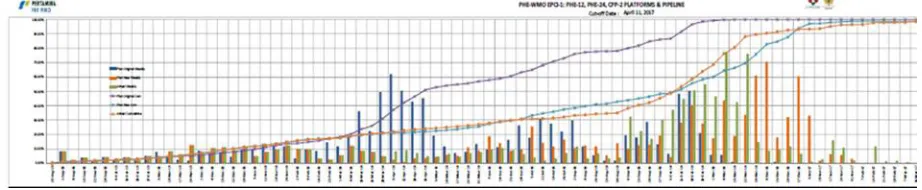
3.1 In the process of implementing an offshore operational project at PT. X Jakarta, it is not very good, where it can be seen in Figure 3. This is due to overly optimistic planning, so that procurement, fabrication and construction progress is too small. Beginning when the project started for 7 months, precisely in March 2016, there was a growing gap between actual and planning. This difference is the influence of the gap from Procurement, Fabrication and Installation.
Figure 3. Graph regarding project progress between planning and actual
Table 1. Grouping of equipment that is late that exceeds 100 days
And can be seen in the graph in Figure 4. To progress procurement that started the growing gap between actual and planning began in the 7th month after the project started. This is caused because the actual progress in procurement is not equal to the planning in procurement.
Figure 4. Graph regarding Procurement progress between planning and actual
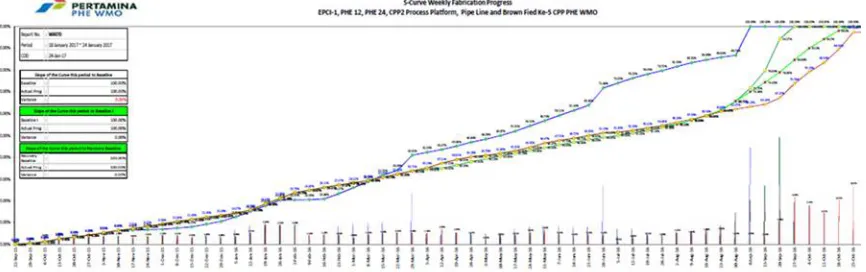
And the resignation of progress in procurement affect progress in fabrication, also increasingly widening gap between actual and planning in the fabrication’s progress and can be seen in Figure 5.
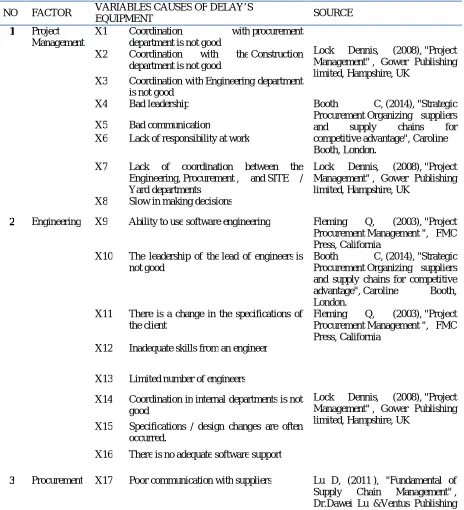
3.2 To find out how the results of risk analysis project delays in the provision of equipment WMO, the authors identify the factors and variables in the delay in the provision of equipment, the authors categorize those ones in Table 2.
Table 2. Variable factors and causes of delay’s equipment
NO FACTOR VARIABLES CAUSES OF DELAY’S
EQUIPMENT SOURCE
1 Project
Management
X1 Coordination with procurement
department is not good
Lock Dennis, (2008), "Project Management" , Gower Publishing limited, Hampshire, UK
X2 Coordination with the Construction
department is not good
X3 Coordination with Engineering department
is not good
X4 Bad leadership Booth C, (2014), "Strategic
Procurement Organizing suppliers
and supply chains for
competitive advantage", Caroline Booth, London.
X5 Bad communication
X6 Lack of responsibility at work
X7 Lack of coordination between the
Engineering, Procurement , and SITE / Yard departments
Lock Dennis, (2008), "Project Management" , Gower Publishing limited, Hampshire, UK
X8 Slow in making decisions
2 Engineering X9 Ability to use software engineering Fleming Q, (2003), "Project
Procurement Management ", FMC Press, California
X10 The leadership of the lead of engineers is not good
Booth C, (2014), "Strategic Procurement Organizing suppliers and supply chains for competitive advantage", Caroline Booth, London.
X11 There is a change in the specifications of the client
Fleming Q, (2003), "Project Procurement Management ", FMC Press, California
X12 Inadequate skills from an engineer
Lock Dennis, (2008), "Project Management" , Gower Publishing limited, Hampshire, UK
X13 Limited number of engineers
X14 Coordination in internal departments is not good
X15 Specifications / design changes are often occurred.
X16 There is no adequate software support
3 Procurement X17 Poor communication with suppliers Lu D, (2011 ), "Fundamental of
ApS, London X18 There are specifications that are not
suitable for items purchased when received
Fleming Q, (2003), "Project Procurement Management ", FMC Press, California
X19 Supplier selection is only based on the cheapest
Pazirandeh A, (2014 ), "Purchasing Power and Purchasing Strategies ", AlaPanzirandeh, Lund Sweden X20 Delay for purchase because equipment's
specifications are not clear / complete
Fleming Q, (2003 ), "Project Procurement Management ", FMC Press, California
X21 Lack of responsibility in the work for Expeditor
Fleming Q, (2003), "Project Procurement Management" , FMC Press, California
X22 There is always a change
in an equipment’s specification so that it could not immediately fabrication
Lock Dennis, (2008 ), "Project Management", Gower Publishing limited , Hampshire, UK
X23 The slowness in making the approval of the key document
X24 Lack of responsibility in the work for Buyer
X25 Delays for purchases due to specifications that do not exist
X26 Lack of knowledge about data base of suppliers
The World Bank, (2016), "Strategy
for Development
Procurement Project ", The world Bank, Washington
X27 Late to ship equipment due to logistics Lock Dennis, (2008), "Project Management" , Gower Publishing limited, Hampshire, UK
X28 Equipment’s prices above the budget Lu D, (2011 ), "Fundamental of Supply Chain Management ", Dr.Dawei Lu &Ventus Publishing ApS, London
X29 There are subjective factors in supplier selection
Fleming Q, (2003), " Project Procurement Management ", FMC Press, California
X30 Expeditor who is less proactive on duty
X31
Lack of control over vendor circulation of
documents affecting production and
purchases at Vendors.
X32 There is no deadline in making a decision to make a purchase
X33 Poor coordination in the internal
department
4 Construction X34 Lack of control over stocks stored in warehouses
Kersten, W, (2015), "Sustainability in Logistics and Supply Chain Management ", epubli GmbH, Berlin.
X35 Lack of control in and out of equipment in the warehouse
X36 Lack of knowledge of field workers / warehouses for the use of equipment
Lock Dennis, (2008), "Project Management" , Gower Publishing limited, Hampshire, UK
X37 Late arrival at Yard / SITE
X38 Not following the acceptance procedure when equipment coming to the warehouse X39 Equipment’s verification is slow by QC
X40 Security system in the warehouse so that equipment can be lost
Harrison T, (2003 ), "The Practice of Supply Chain Management: where theory and application converge ", Springer Science & Business Media Inc., New York USA
V. CONCLUSION
1. Feedback from procurement department in regard to delivery time of equipment should be highlighted; therefore the planning and project scheduling of project shall be realistic.
2. The delay delivery of equipment will affect to the progress of fabrication and installation.
3. Process of procurement should be monitored, that activities which are not effectively be eliminated and the monitor of process should be done rigorously and greatly affects the delay’s equipment for this project based on brainstorming of experts test results and interviews, such as; A. Skill of engineer inadequate (X12) B. Vendor selection based solely on the cheapest price (x19), C. less responsibility in the work for expeditor (X21).
REFERENCES
[1] Alofi, A, " The perception of the government and private sector on the procurement delivery system method in Saudi Arabia ", Procedia Engineering, Vol 145, 1394-1401,2016.
[2] Ayers J," Supply Chain Project Management ", CRC Press, Boca Raton,2010.
[3] Benton, WC, " Construction Purchasing & Supply Chain Management ", The McGraw Hill, New York,2010.
[4] Booth C, "Strategic Procurement Organizing suppliers and supply chains for competitive advantage", Caroline Booth, London,2014. [5] Calvinato, J and Kauffman, R, The Purchasing Handbook for purchasing and supply professionals ,McGraw Hill, New York,2000. [6] Duccan W," A guide to The Project Management Body of Knowledge ", Project Management Institute, New Town Square,1996. [7] Fleming Q, "Project Procurement Management ", FMC Press, California,2003.
[8] Kersten, W, " Sustainability in Logistics and Supply Chain Management ", epubli GmbH, Berlin, 2015.
[9] Harrison T, " The Practice of Supply Chain Management: where theory and application converge ", Springer Science & Business Media Inc., New York USA, 2003.