Comparative Analysis on Road Extraction
from Liss IV Near-Infrared Band Using
Genetic Algorithm and Active Contour Model
T.Ganesh Kumar
1, Dr.D.Murugan
2, Manish T.I
1Research Scholar, Dept of CSE, Manonmaniam Sundaranar University, Tirunelveli, India1 Associate Professor, Dept of CSE, Manonmaniam Sundaranar University, Tirunelveli, India2
ABSTRACT: In remote sensing energy emanating from the earth‟s surface is measured using a sensor mounted on an
aircraft or spacecraft platform. Road extraction is an important role in remote sensing applications. There are different types of satellite data available from various countries based on sensor and resolution. Liss IV is a one of the satellite data from Indian Remote Sensing P6 satellite with four different types of bands such as Green band, Red band and Near-Infrared band with 5.8 meter resolution per pixel in an each image. Above these bands, Near-infrared band is suitable for road extraction. Original this band has to improve the clarity of the pixels using gaussion homomorphic filtering techniques and then extract the road feature from filtering data using Genetic algorithm based segmentation and active contour model based segmentation. Finally detect the best segmentation algorithm is suitable for Liss IV data based on performance metrics.
KEYWORDS: Remote Sensing, Liss IV data, Near-Infrared band, gaussion homomorphic filter, segmentation
techniques.
I. INTRODUCTION
In remote sensing energy emanating from the earth‟s surface is measured using a sensor mounted on an aircraft or spacecraft platform. The energy can be reflected sunlight so that the image recorded is, in many ways, similar to the view we would have of the earth‟s surface from an aeroplane, although the wavelengths used in remote sensing are often outside the range of human vision [1]. Electromagnetic energy is generated by several mechanisms, including changes in the energy levels of electrons, acceleration of electrical charges, decay of radioactive substances, and the thermal motion of atoms and molecules. Nuclear reactions within the Sun produce a full spectrum of electromagnetic radiation, which is transmitted through space without experiencing major changes. As this radiation approaches the Earth, it passes through the atmosphere before reaching the Earth‟s surface. Some is reflected upward from the Earth‟s surface; it is this radiation that forms the basis for photographs and similar images [2]. There are different types of satellite data available such as panchromatic data (single band), multispectral data ( up to 10 bands) and hyperspectral data ( 10 to 200 and above bands).Liss IV data as if a Multispectral data with three bands such as Green band (0.52 to 0.59µm), Red band (0.62 to 0.68 µm) and Near Infrared band (0.77 to 0.86 µm) and resolution is 5 meter per digital number. Infrared red band only applied in image enhancement and segmentation techniques.
II. RELATED WORK
thinning. This is systematically evaluated the algorithm on a variety of images from IKONOS, Quick Bird, CARTOSAT-2A [5]. A direction-based cumulative voting technique is developed to evaluate reliability of each road segment. Finally, inferred road features are back projected onto depth and intensity image to test their validity. Although experimental results show a good completeness and correctness, the proposed method is limited only to linear road extraction [6]. A road damage extraction method based on object-oriented change detection method using road vector data overlaid on post-earthquake image. It is complex to identify all kinds of road damages in earthquakes. For the purpose of traffic capacity analysis, focusing on roads in good condition will simplify the problem, no matter how the roads are destroyed. The whole road line is provided by road network vector of appropriate scale [7]. The common road extraction from high-resolution imagery is based on spectral information only; it is difficult to separate road features from background completely, and a thinning algorithm always results in short spurs which reduce the smoothness of the road centerline. To overcome the aforementioned shortcomings of the common existing road centerline algorithms, this letter presents a new method to extract the road centerline from high-resolution imagery based on shape features and multivariate adaptive regression splines (MARS), in which potential road segments were obtained based on shape features and spectral feature, followed by MARS to extract road centrelines. Two experiments are performed to evaluate the accuracy of the proposed method [8]. Above works are road extracted from various satellite images except Liss IV data.
III.PROPOSED WORK
A. Study Area
Study territory is topographically found at Tamilnadu, India. This study range is secured Madurai area in Tamilnadu. Scope and longitude worth considered from above information report. Above information having diverse item unearthly data like street, building, vegetation region, mountains and water bond focused around electromagnetic range transfer speed. On the other hand, this information secured area surface just aside from ocean or sea.
B. Feature Selection
This proposed work is road just extraction from aforementioned remotely sensed information. Wellspring of the daylight and electromagnetic range phantom data road ghostly data exceedingly reflected in near-infrared band. Road offer just extricated from near-infrared band for mapping and Global Positioning System. So near-infrared band just chose from over three bands. In this way, we require not combination over these three bands. This near-infrared band must contain distinctive sorts of streets, for example, National thruways, state highways and Madurai City Street secured inside this band.
C.Input Image
Input image considered testing images selected area only cropped from near-infrared band. There are six different types area cropped as it covered with national highways, state highways, cross road, rural area road and airport also. Each image in size with 256 x 256 pixels cropped from original data without resize. These images likely cropped without loss of information and original image file format. . Already this band recorded with 5.8 meter resolution per pixel so cropped image having 256 x 256 pixels and it may be total coverage on earth surface 1.280 square kilometres. Following selected area images cropped from original data and used for road detection using existing algorithm and proposed algorithm.
Fig 1 Fig 2 Fig 3 Fig 4 Fig 5 Fig 6
D: Image Enhancement using Gaussian Homomorphic filter
An Image Processing image enhancement is broad research area and preprocessing for feature extraction from remote sensing data. There are many enhance techniques available in image processing in image processing system. There is very important domain is spatial domain and frequency domain. Noise as an unwanted component of the image and it occurs in images for many reasons. Homomorphic filtering is one of the image enhancement techniques based on frequency domain. This is a generalized technique for image processing and signed processing, involving a nonlinear mapping to a various domain in which linear filter techniques are applied, followed by mapping return to the original domain. Homomorphic filter is simultaneously normalizing the brightness an image and increase contrast. Here homomorphic filter is used to remove the Gaussian noise.
Gaussian noise
Gaussian noise is statistical noise having a probability density function equal to that of the normal distribution, which is also known as the Gaussian distribution[9][10]. Principal sources of Gaussian noise in digital images arise during acquisition. For example, these sensor noises are caused by poor illumination [11]. In digital image processing system, the Gaussian noise can be reduced using a spatial filter and frequency filter, an undesirable outcome may result in the blurring of fine-sealed image edges and also correspond to blocked high frequencies [12].Gaussian values that the noise can take on are Gaussian distributed. The probability density function name p of a Gaussian random variable z is given by
e
p
GZ
z 22
2 ) (
2
1
)
(
eq.(1)
Where z in a gray level,
the mean value and
is the standard deviation [13].This Gaussian noise applied in homomorphic filtering technique. Therefore, it is called as Gaussian noise based homomorphic filtering or Gaussian Homomorphic filter. In homomorphic filtering illumination and reflectance are made additive by taking the logarithm of the image intensity. Therefore, these components of the image can be separated linearly in the frequency domain. The high frequency components are increased and low frequency components are assumed to represent mostly the reflectance in image, the low frequency components are assumed to represent mostly the illumination in an image. The Function of the homomorphic filter is likely to decrease the low frequency and increase the high frequency. For the remote sensing images, the homomorphic filtering gives the contrast extending to the lower gray level enhancing the contrast. The high-pass filter used to suppress low frequency and amplify high frequencies in the log intensity domain [14]. The final step is to apply the exponential function to invert the log-transform and get the Gaussian based Homomorphic filtered image. Figure 5.1 to 5.6 shows the Gaussian homomorphic filter result and table 1.1 shows the PSNR value of the Gaussian Homomorphic filter.IV.COMPARATIVE ANALYSIS
There are two existing segmentation algorithms are used and compared to road extraction from liss iv data such as Genetic algorithm and active contour model based segmentation.
A.Genetic Algorithm based segmentation
Each region in a segmented image has to satisfy properties of homogeneity and connectivity. The region is considered homogeneous if all region piels satisfy homogeneity conditions defined per one or more pixel attributes, such as intensity, color, texture, etc. The region is connected if a connected path between any two pixels within the region exists. If I is a set of all image pixels and H(.) is a homogeneity predicate defined over connected pixel groups, then the image segmentation is portioning of I into connected subsets{S1,S2,...,Sn} so that
. , 1 1 j i S S and
S i j
n
i
i
eq. (2) The homogeneity predicate is
( ) . , ) ( j i j i i i S and S adjacent any f or f alse S S H S all f or true S H eq. (3)
Computation of such image partitions has a very high combinational complexity. No general solution for all segmentation cases exist.Because of a very big solution space, gentic algorithms ere adopted by several researchers . GA‟s was applied to optimize parameters of various segmentation techniques as well as to develop new techniques. One of modern segmentation techniques is a Shape description caused by energy funtion and possible shape deformation. In to detect road boundaries in infrared images road shape is described by an irregular parametric ellipsoid defined by
sin( ) cos(2 ) ...
... ) 2 cos( cos 2 2 0 1 0 1 2 1 0 y y y y x x x x eq. (4)
Shape fitting in the image is performed by minimizing energy function adopted from.
0 ) max( 255 ) ( max 1 0 ) max( ) ( 1 255 1 )] max( 1 [ ) ( j g j I g j g j I j g j Upw eq. (5)
U
Upw(j)
Us(j), eq. (6)Where Upw is energy function for posterior wall and Us is energy for septum, gmax(j) is maximum gradient in direction
to a normal of ellipsoid boundary.
Each elliptical contour is encoded as a chromosome which genes contain harmonic components of elliptic contour and two position elements. Genetic algorithm tries to minimize energy function U guiding contour to optimal segmentation of echocardiography image and extracting cardiac boundaries. Fine segmentation is achieved through the knowledge of image incorporation into optimization process through adjustable parameter ranges. Such an approach allows segmentation an image with incomplete heart boundaries as well as increases resistance to noise.Lucia Ballerini did an extensive research on snakes algorithm parameters optimization by using genetic algorithms. Cagnoni et al. use elastic contour model to segment medical images in the search for a particular anatomical structure. They use GA to optimize energy function derived from snakes algorithm, thus driving contour into an optimal position.
B. Active contour model based segmentation
The basic idea in active contour models like snakes is to evolve a curve and subject to constraints from a given image, in order to detect road or line in that image. For instance, starting with a curve around the object to be detected, the curve moves toward its interior normal and has to stop on the boundary of the object[15].
isotropic smoothing Gaussian has to be strong, which will smooth the edges too. There are different active contour model, without a stopping edge-function, i.e. a model which is not based on the gradient of the image for the stopping process. The stopping term is based on Mumford–Shah segmentation techniques. In this way, we obtain a model which can detect contours both with or without gradient, for instance objects with very smooth boundaries or even with discontinuous boundaries. In addition, our model has a level set formulation, interior contours are automatically detected, and the initial curve can be anywhere in the image. Further details about active contour model refer in [15].
V. PERFORMANCE RESULTS
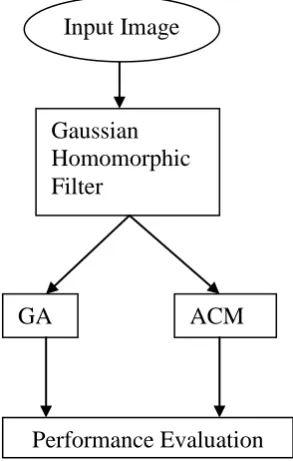
. These algorithms implemented and tested with MATLAB. Above algorithms are compared using performance metrics like Accuracy only. We considered the best road segmentation algorithm for particular data using performance metrics. Our results show that the road extraction from liss iv data based on performance metrics and identified best segmentation algorithm like Active contour model based segmentation. Fig 1.1 to Fig 11.6 shows the segmented result of Active contour model. Table 1 shows the Accuracy values of Genetic algorithm (GA) and Active contour model (ACM). Fig 1.7 shows the performance variations of GA and ACM. Fig 1.8 shows the flowchart of the work.
Fig 1.1 Fig 1.2 Fig 1.3
Fig 1.1 to Fig 1.3 shows the national highway road or four-way line in satellite image.
Fig 1.4 Fig 1.5 Fig 1.6
Fig 1.4 to Fig 1.5, Shows the national highway road and state highway road. Fig 1.6 shows the Madurai airport runway and national high way road.
The road segmentation accuracy can be defined as [16],
pixels
of
number
Total
area
segmented
for
pixels
classified
correctly
of
Number
onAccuracy
Segmentati
Image Name Accuracy GA ACM Fig 1.1 .8809 .9142 Fig 1.2 .8771 .9205 Fig 1.3 .8244 .9326 Fig 1.4 .7896 .9157 Fig 1.5 .4957 .9358 Fig 1.6 .8677 .9111
Fig 1.7 Performance Chart
Fig 1.8 Flow chart of the work
VI.CONCLUSION AND FUTURE WORK
The results shows that the comparative algorithms such as genetic algorithm based segmentation and active contour model based road segmentation from remote sensing liss iv data.. Finally, active contour model is suitable for road extraction from Liss IV data based on evaluation of performance metrics. Liss IV infrared band having 5.8 meter resolution per pixel so this is low visibility and very complicated to extraction of street roads from Liss IV data. We can use very high-resolution images like below 1 meter resolution is suitable for extraction of street roads from satellite images in future work.
REFERENCES
1. John A. Richards. Xiuping Jia, „Remote Sensing Digital Images Analysis- An Introduction 4th Edition‟, Springer Berlin Heidelberg New York,
ISBN-13 978-3-540-25128-6
2. James B.Campbell and Randolph H. Wynne, „Introduction to Remote Sensing‟, 5th Edition, The Guilford Publications, ISBN 978-1-60918-0
0.2 0.4 0.6 0.8 1
Fig 1.1 Fig 1.2 Fig 1.3 Fig 1.4 Fig 1.5 Fig 1.6
Accuracy GA
Accuracy ACM
Gaussian
Homomorphic
Filter
GA
ACM
3. Youchuan Wan, Dongliang Wang, Jianhua Xiao, Xiang Wang, Yongsheng Yu, and Jingzhong Xu, “Tracking of Vector Roads for the Determination of Seams in Aerial Image Mosaics”, IEEE Geoscience and Remote Sensing Letters, Vol. 9, No. 3, May 2012
4. Aluir P. Dal Poz, Rodrigo A. B. Gallis, João F. C. da Silva, and Érico F. O. Martins, “Object-Space Road Extraction in Rural Areas Using Stereoscopic Aerial Images”, IEEE Geoscience and Remote Sensing Letters, Vol. 9, No. 4, July 2012.
5. D. Chaudhuri, N. K. Kushwaha, and A. Samal, “Semi-Automated Road Detection From High Resolution Satellite Images by Directional Morphological Enhancement and Segmentation Techniques ”, IEEE Journal of Selected Topics in Applied Earth Observations And Remote Sensing, Vol. 5, No. 5, October 2012..
6. Jiaping Zhao, Suya You, Jing Huang, Rapid Extraction and Updating of Road Network from Airborne LiDAR Data”, IEEE 2012 7. Lixia Gong, Liqiang An, Mingzhong Liu, Jingfa Zhang, “Road Damage Detection From High-Resolution Rs Image”,IEEE 2012
8. Zelang Miao, Wenzhong Shi, Hua Zhang, and Xinxin Wang, “Road Centerline Extraction From High-Resolution Imagery Based on Shape Features and Multivariate Adaptive Regression Splines”, IEEE Geoscience and Remote Sensing Letters, Vol. 10, No. 3, May 2013
9. Tudon Barbu, “Variation image denoising approach with diffusion porous media flow”, 2013. Doi:10.1555/2013/856876. 10. Barry Truax, ed, Handbook for acoustic ecology, Cambridge street publishing, 1999.
11. philippe cattin, image restoration: introduction to signal and image processing, MIAC, University of Basel, 2013. 12. Robert fisher, Simon Perkins, Ashley walker, Erik Wolfart, “Image synthesis noise generation”.
13. T.Huang, G.Yarg, and G.Tang, “A fast two-dimensional median filtering algorithm”, IEEE trans. Acoust, speech signal processing, vol 27, no.1, pp.13-18, 1979.
14. Douglas B.williams and Vijay Madisetti, “Digital signal processing handbook”,1999.
15. Tony F. Chan, and Luminita A. Vese, “Active Contours Without Edges”, IEEE Transactions On Image Processing, Vol. 10, No. 2, February 2001.
16. Manisha Sharma and Vandana Chouhan. (2012). Objective Evaluation Parameters of Image Segmentation Algorithms. International Journal of Engineering and Advanced Technology (IJEAT) ISSN: 2249 – 8958, Volume-2, Issue-2.
BIOGRAPHY