
1 Introduction
Studying the decays of the η and η mesons provides unique information on a variety of physics topics, see [1]. Neutral decays such as the isospin-breakingη/η→3π de-cays are important tests for low-energy Quantum Chromo Dynamics (QCD) and especially Chiral Perturbation The-ory (χPT). Another test ofχPT is theη → π0γγ decay which occurs only from order O(p6) though low-energy coefficients have to be determined from other models, e.g. Vector Meson Dominance (VMD).
Another important aspect that can be studied with η and η decays are electromagnetic transition form fac-tors (TFFs) which can be studied through the η/η → e+e−γDalitz decays, see also various other contributions to this conference. The TFFs are interesting themselves as they probe the electromagnetic structure of the mesons. They may also give important input to the calculations of the hadronic light-by-light contributions to the anomalous magnetic moment of the muonaμ=(g−2)μ. The
anoma-lous magnetic moment aμ is one of the most accurately determined quantities, both from an experimental and the-oretical side within the Standard Model (SM). Currently a discrpancy of 3-4σexists between experiment and theory indicating physics beyond the SM.
Here photoproduction cross sections of the η and of the η in the threshold region measured with the Crys-tal Ball/TAPS setup at the Mainz Microtron (MAMI) are shown with unprecedented accuracy. Furthermore, studies of timelike transition form factors inηandη Dalitz de-cays, and a test ofχPT atO(p6) and other models through theη→π0γγdecay are discussed. Before summarising a short outlook on the forthcomingη/ηprogramme with the Crystal Ball/TAPS setup at MAMI will be given. Other interesting topics that can be studied withηandηdecays as the search for violation of lepton-family numbers, plac-ing limits on the masses and couplplac-ings of many proposed lepto-quark familes [2–6], and investigating violations of
ae-mail: [email protected]
C,CP, andCPT invariance [7] will not be covered by this contribution.
2 Experimental Setup
The Crystal Ball/TAPS setup was located at the Institute for Nuclear Physics at the Johannes Gutenberg-University in Mainz, Germany. There three major experiments were installed using the electron beam from the Mainz Mi-crotron (MAMI) accelerator. The results of the A2 collab-oration presented here were extracted from data taken with the Crystal Ball/TAPS setup at the Bremsstrahlung facility at MAMI. The A1-setup consisted of four high-resolution spectrometers for electron scattering experiments. The A4-experiment, a high-rate calorimetric detector for the measurement of parity violation in elastic ep-scattering, was finished in 2012. In 2013 the first steps for installing a new high-luminosity electron accelerator, Mainz Energy-Recovering Superconducting Accelerator (MESA), in the A4-halls were made. Key experiments with MESA, which was funded by the excellence initiative PRISMA [8], were a high-precision measurement of the electro-weak mixing angle in the low energy region, and the search for the Dark Photon. These two experiments and many others performed with MAMI were funded through the Collab-orative Research Center 1044 (CRC1044) [9].
MAMI was an electron accelerator consisting of three Race-Track-Microtrons (RTM) [10] and a Harmonic-Double-Sided Microtron (HDSM) [11]. The exeptionally stable beam (energy drift δE < 100 keV) could be pro-duced with a maximum energy of E0 = 1604 MeV and an energy width ofσe/E <3·10−5. The beam could be delivered with high currents of up to 110μA and high de-grees of polarisation of up to 80 %. The operation time of MAMI of about 7000 h per year shows on the one hand its high reliability, and on the other a high interest in hadron physics experiments at MAMI.
The A2 collaboration performed experiments with a real-photon beam (flux 2.5·105(sMeV)−1) derived from
Figure 1. The Glasgow-Mainz photon tagging spectrometer at MAMI. From the incoming electron beam from MAMI pho-tons are produced through Bremsstrahlung in a thin radiator foil. Post-radiation electrons are momentum analysed, and thus the photons tagged in energy.
the production of Bremsstrahlung photons during the pas-sage of the MAMI electrons through a thin rediator foil. In the Glasgow-Mainz tagging spectrometer [12–14] post-radiation electrons were momentum analysed in a mag-netic field, see fig. 1. From this the post-radiation elec-tron energies Ee− were derived. Thus, the energy of the beam-photons were tagged throughEγ=E0−Ee−with an energy resolution between 2 to 4 MeV, depending on the incident electron beam energy. Photons could be tagged in the energy range from 5 to 94 % of the incoming electron beam energy. Thus, the highest tagged photon energy for E0=1604 MeV isEγ ≈1492 MeV.
This maximum tagged photon energy allowed the mea-surement of only a small part of theηproduction range ac-cessible at MAMI. Thus, a new tagging spectrometer, End-point tagger (EPT), was constructed to cover the range from Eγ = 1425 MeV to Eγ = 1575 MeV which was almost the fullη photoproduction range at MAMI. The EPT was based on the same working principle as the main tagging spectrometer, with an energy resolution of approx-imately 1 MeV.
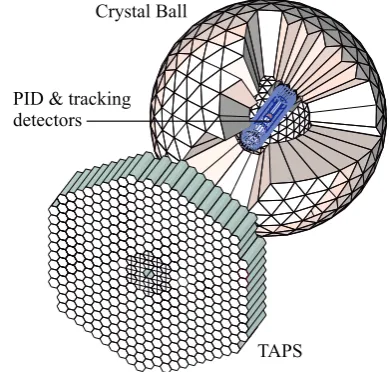
The central apparatus in the A2-setup was the Crys-tal Ball detector (CB), see fig. 2, in whose centre a liquid hydrogen target was placed forηandηproduction exper-iments. The Crystal Ball was a self-triggering spectrom-eter, highly segmented with 672 NaI(Tl) crystals. Each crystal was a 40 cm (15.7 radiation lengths) long trun-cated triangular pyramid, read out by individual photo-multipliers. The CB had an energy resolution ofΔE/E = 0.020(E[GeV])0.36, angular resolutions σ
θ of 2−3◦ and
σφofσθ/sinθfor electromagnetic showers. For charged
particle identification the target was surrounded by a bar-rel detector (PID) made of 24 scintillator strips (50 mm length, 4 mm thickness at a radius of 1 cm around the pho-ton beam line). Energies measured with the PID in
com-Figure 2. The Crystal Ball/TAPS detector setup. The spherical Crystal Ball detector can be seen with cut-away section, showing the inner detectors, and the TAPS forward wall.
bination with energies measured with the CB provided in-formation on the particle type through theΔE/Emethod.
The CB detector had a forward opening between po-lar angles<21◦. This region of the solid angle was cov-ered by the TAPS detector [15, 16]. Thus, the full detector setup, shown in figure 2, was almost hermetic. The TAPS forward wall was composed of two rings of 72 PbWO4 and several rings of BaF2 crystals. The 25 cm (12 ra-diation langths) long BaF2 crystal had a hexagonal cross section with a diameter of 59 mm. Four PbWO4 crystal formed the shape of one BaF2crystal, and had an length of 20 cm (22 radiation length). Each BaF2crystal and each block of four PbWO4 crystals had an individual 5 mm thick plastic veto scintillator in front, for charged parti-cle discrimination. The single TAPS counter resolution was 0.2 ns, and the nergy resolution can be described by ΔE/E = 0.018 +0.008/(E[GeV])0.5. The energy reso-lution of PbWO4 crystals for photons is similar to BaF2 at room temperature [17], but the higher granularity im-proves the rate capability and the angular resolution.
3
η
and
η
Cross Sections
The Crystal Ball/TAPS at MAMI setup was ideal to study the photoprodcution ofηmesons. The integrated totalη -photoproduction cross section reaches almost 100 % al-ready at photon energies ofEγ =1400 MeV. Thus, a
fur-ther increase in beam energy does not increase the statis-tical accuracy greatly. Instead new background channels complicate the analysis. Furthermore, the Crystal Ball de-tector has proven to be ideal for measuring multi-photon final states such as theη→3π0decay.
With the Crystal Ball/TAPS setup a new determina-tion of the η-photoproduction cross sections was per-formed [18]. The data obtained between the production threshold ofEγ =707 MeV andEγ =1402 MeV showed
unprecedented accuracy. Differential cross sections were
Figure 3.Total cross section forγp→ηpas a function of the c.m. energy from the Crystal Ball/TAPS experiment at MAMI-C [18] (solid circles). The hardly visible uncertainties are of statistical nature only. Other determinations shown for comparison are from MAMI-B [19] (open triangles); CLAS-g1c [20] (open circles); CLAS-g11a [21] (open diamonds); GRAAL [22] (open diamonds with crosses); LNS [23] (horizontal bars); CB-ELSA [24] (open squares); CBELSA/TAPS [25] (crosses).
extracted for the full angular range in the c.m. frame, using 3.8·106 γp → ηp → 3π0p → 6γpaccumulated events. This allowed the most precise binning in energy and angle, enabling the reaction dynamics to be studied in greater de-tail than previously possible. The Crystal Ball/TAPS data agreed very well with previous equivalent measurements, but are remarkably superior in terms of precision and en-ergy resolution [18].
These differential cross sections were integrated to de-rive the totalη-photoproduction cross section shown in fig-ure 3 in comparison to previous measfig-urements [19–25]. As can be seen clearly from the binning of the new Crys-tal Ball/TAPS at MAMI-C data the statistics are unprece-dented. These data have been included in a new SAID par-tial wave analysis [26] and the Reggeizedη-MAID partial wave analysis [27], and have proven to be a substantial contribution.
Recently, first preliminary η-photoproduction cross sections have been determined with the Crystal Ball/TAPS setup at MAMI-C. Differential cross sections for the range of Eγ = 1450 MeV to Eγ = 1570 MeV have been
ob-tained with very high accuracy fromη→ηπ0π0→6γ de-cays. This is also reflected in the totalη-photoproduction cross section shown in figure 4, where the Crystal Ball data are compared to results from CBELSA/TAPS. Though the data from Crystal/TAPS are limited in the photon-energy range they show the very high accuracy in the threshold
re-gion already achieved at MAMI-C with a first preliminary ηproduction run.
4 Timelike Transition Form Factors from
η/η
→
e
+e
−γ
Electromagentic transition form factors (TFF) of light pseudoscalar mesons are important for the understanding of the intrinsic structure of these particles (see e.g. [28] and references therein). These TFFs are crucial tests for models describing the structure, e.g. Vector Meson Domi-nance (VMD) model, and provide for theηandηmesons information on the mixing of these two particles. Further-more, it has been argued that TFFs might be related to the hadronic light-by-light contribution to the anomalous magnetic moment of the muon [29]. Thus, it is of great importance to test the TFFs at as high a precision as pos-sible.
The TFF for theηmeson can be studied in the timelike momentum transfer region through theη→γ∗γ→e+e−γ decay with the Crystal Ball/TAPS setup. A first deter-mination from the A2 collaboration based on 1.35·103 η → e+e−γ decays, extracted using kinematic cuts, was published in 2011 [30]. The result can be seen in figure 5 in comparison to earlier measurements. The SND collab-oration also used theη→ e+e−γdecay with significantly lower statistics [31] than from the Crystal Ball/TAPS measurement. The measurement of the NA60 collabora-tion [32] with 9·103 η → μ+μ−γdecays had the highest precision up to that date though this result has two major shortcomings. Due to the decay into muons the distribu-tion only starts atq=2mμ, and only the leptons were
de-tected in their setup. All results are in good agreement, and also match the theoretical calculation of Terschlüsen and Leupold [33] based on a vector-meson Lagrangian com-bined with the Wess-Zumino-Witten contact interaction.
Recently, the A2 collaboration has determined a new preliminary result for theηTFF measured with the Crys-tal Ball/TAPS setup. This new analysis was based on the kinematic fitting technique and used a bigger data set three times larger than for the previous A2 determina-tion. Also due to the kinematic fitting technique the full η-photoproduction range accessible at MAMI could be ex-plored. This resulted in 18·103analysedη →e+e−γ de-cays, more than one order of magnitude better statistics. If the detection of the outgoing proton from theγp→ηp re-action was not required the statistics could be increased to 22·103decays but with poorer signal-to-background ratio. Figure 6 shows the preliminary results of this new analysis. A fit of the usual one-pole approximation to the data points was done. Perfect agreement with the old A2 measurement [30] and the NA60 [32] results can be seen as well as comparisons to three theoretical cal-culations. The new A2 result clearly surpasses the pub-lished NA60 accuracy, although a preliminary determina-tion from NA60 [34] has been presented with 80 ·103 η → μ+μ−γdecays from a new measurement. All theo-retical calculations in figure 6 describe the A2 data points within the uncertainties. The calculation by Terschlüsen and Leupold [33], which combines the vector-meson La-grangian proposed in ref. [35], and recently extended in ref. [36], with the Wess-Zumino-Witten contact interac-tion, runs below the fit to the A2 data points. The
model-Figure 5. First result on theηTFF from the Crystal Ball/TAPS setup [30] (red full circles). Data are compared to experimental results of the SND [31] (green open circles) and NA60 [32] (blue triangles) collaborations. The dashed green line is a theoretical calculation [33] based on a vector-meson Lagrangian combined with the Wess-Zumino-Witten contact interaction.
independent method using Padé-approximants that was developed for theπ0 TFF in ref. [37] uses spacelike data to provide a model-independent prediction for the time-like TFF [38]. This calculation almost perfectly agrees with the fit. The calculation by the Jülich group estab-lishes a connection between the radiativeη→ π+π−γand the isovector contributions to theη→γ∗γTFF using dis-persion theory. The resulting curve from this calculation lies slightly above the fit to the A2 data. The inability to distinguish between these models clearly calls for higher precision measurements of theηTFF.
For the determination of theηTFF fromη →e+e−γ decays first studies were done for 20 background chan-nels [40]. Based on these results up to 80 η → e+e−γ events might be extracted from the 5-weekηproduction data taken in 2012. In summer 2014 newηdata will be taken with up to a factor 10 higher statistics. Thus far no result for theη → e+e−γdecay has been published, though other experiments, e.g. CLAS and BESIII, are ca-pable of measuring theηTFF too. The new A2 measure-ment will enable one of the most accurate determinations for theηtransition form factor.
5 Preliminary Results for
η
→
π
0γγ
The major contribution to theη →π0γγdecay amplitude stems fromO(p6) counterterms. These are needed inχPT to cancel divergences. Lower order terms do not contribute because they are forbidden or largely surpressed. Studying this decay is not a strict test ofχPT but rather of the models used to calculate the low-energy coefficients of the
Figure 6. New result on theηTFF from the Crystal Ball/TAPS setup (full squares). Data are compared in (a) to the first A2 deter-mination [30] (open circles) and in (b) to the result from the NA60 collaboration [32] (open squares). Theoretical calculations are in (a) from Terschlüsen and Leupold (TL) [33] (dashed-dotted line) and the model independent method based on Padé-approximants [38] (dashed line with error band). In (b) a calculation based on dispersion theory (DT) is shown [39] (dotted line with error band).
terterms that can not be determined withχPT itself. All calculations must describe the decay widthΓ(η → π0γγ) as well as the differential decay rate dΓ/dm2(γγ). But for the two quantities discrepancies existed between mod-els fordΓ/dm2(γγ) and between experimental results for Γ(η→π0γγ), respectively.
A new analysis of data taken with the Crystal Ball/TAPS setup using kinematic fitting yielded 1.2·103 η→ π0γγevents. The preliminary result for the diff eren-tial decay rate is shown in figure 7. Only three other exper-imental studies are known up to now. A preliminary anal-ysis of earlier Crystal Ball/TAPS data [41] yielded only around 150η→π0γγevents but the old and the new Crys-tal Ball/TAPS results agree within the uncertainties. The Crystal Ball at AGS result from 2008 [42] with roughly 500 events had much better statistics than the old Crystal Ball/TAPS measurement though with a poorer signal-to-background ratio. A third determination was carried out by the WASA at COSY collaboration [43] but was not pub-lished in a journal yet. The data show general agreement with the Crystal Ball/TAPS results and a similar accuracy, though only statistical errors are provided. Thus, the new Crystal Ball/TAPS analysis provides the most accurate re-sult with the best signal-to-background ratio to date.
In figure 7 three theoretical calculations are compared with the experimental results: a calculation based on the VMD transition amplitude [44], a revised calculation of this based on a chiral unitary approach [45], and a calcu-lation involving theoretical studies of photon fusion reac-tions based on a chiral Lagrangian with dynamical light vector mesons [46]. All three theoretical studies agree within the uncertainties with the experimental results. Thus, more detailed measurements are needed to distin-guish between the models and also to perform a Dalitz-plot analysis of theη→π0γγdecay.
Figure 7. Preliminary differential decay rate for η → π0γγ
measured with the Crystal Ball/TAPS setup. For comparison previous results from the A2 collaboration [41] (green circles), the Crystal Ball at AGS [42] (blue triangles), and the WASA at COSY collaboration [43] (red open squares) are shown. Also theoretical calculations using VMD transition amplitudes [44] (dashed line), based on a chiral unitary approach [45] (solid line with error band), and based on a chiral Lagrangian with dynami-cal light vector mesons [46] (dash-dotted line) are visible.
Crys-tal Ball/TAPS determination of the decay width is the most accurate value to date.
6 Future Programme at MAMI
The programme on η/η physics in the A2 collabora-tion will be continued in summer 2014 with the instal-lation of the End-point tagger and several weeks of η -photoproduction. Compared to the 2012 data taking the speed of the data acquisition system will be increased at least by a factor 4. It is planned to measure enough statis-tics to reach the goals of 4·105analysedη → ηπ0π0(to perform a Dalitz plot analysis) and roughly 800 analysed η →e+e−γdecays for the determination of the TFF. The statistics on theη→π0γγdecay will be improved signifi-cantly to perform a first Dalitz-plot analysis.
The long-term plans forsee the improvement of the knowledge on TFFs extracted from single and double Dalitz-decays. Also the possibility of studying the TFF in theω→ π0e+e−decay will be explored. Furthermore, Dalitz-plot analyses of theη/η→3π0and theη→ηπ0π0 decays will be carried out. In the latter decay also the cusp effect will be studied. Another possibility is to investigate radiative decays likeη→ωγandω→π0/ηγ. In the even further planning an improved tracking is planned to also measure several charged decays of the η andη mesons with high accuracy.
7 Summary
In this contribution several new results from the A2 collab-oration onηandη physics were presented. The Crystal Ball/TAPS setup has proven to be ideal for the measure-ment of many neutral and leptonic decays of theηandη mesons, producing world-leading results. Here total cross sections for η- and preliminary total cross sections for η-photoproduction were described which show unprece-dented accuracy, especially in the threshold regions. Fur-thermore, two determinations of the electromagnetic tran-sition form factor fromη → e+e−γdecays were shown. The latest A2 result is currently the most precise determi-nation. First studies of theηtransition form factor were also presented. Finally, the partial decay rate and the decay width of theη→ π0γγdecay with the world’s best preci-sion to date were demonstrated. In future results on the above mentioned determinations will be improved greatly and further neutral and leptonic decays will be studied with high accuracy.
References
[1] J. Bijnens, G. Fäldt, and B.M.K. Nefkens (Editors), Phys. Scripta T99(2002).
[2] J.L. Goity, A.M. Bernstein, and B.R. Holstein, Phys. Rev. D66, 076014 (2002).
[3] M.J. Ramsey-Musolf and M.B. Wise, Phys. Rev. Lett.
89, 041601 (2002).
[4] B.V. Martemyanov and V.S. Sopov, Phys. Rev. D71, 017501 (2005).
[5] A.G. Nicola and J.R. Pelaez, Phys. Rev. D65, 054009 (2002).
[6] P. Herczeg, Phys. Rev. D51, 136 (1995).
[7] B.M.K. Nefkens, Few–Body Syst. Suppl. 9, 193 (1995).
[8] http://www.prisma.uni-mainz.de (14th December 2013).
[9] http://sfb1044.kph.uni-mainz.de/sfb1044/ (14th De-cember 2013).
[10] H. Herminghaus et al., IEEE Trans Nucl. Sci. 30, 3274 (1983).
[11] K.-H. Kaiseret al., Nucl. Instrum. Meth. A593, 159 (2008).
[12] I. Anthony et al., Nucl. Instr. Meth. A 310, 230 (1991).
[13] S.J. Hall [et al., Nucl. Instr. Meth. A368, 698 (1996). [14] J.C. McGeorgeet al., Eur. Pyhs. J. A37, 129 (2008). [15] R. Novotny, IEEE Trans. Nucl. Sci.38, 379 (1991). [16] A.R. Gableret al., Nucl. Instrum. Meth.A346, 168
(1994).
[17] R. Novotnyet al., Nucl. Instrum. Meth. A486, 131 (2002).
[18] E.F. McNicollet al., Phys. Rev. C82, 035208 (2010). [19] B. Kruscheet al., Phys. Rev. Lett.74, 3736 (1995). [20] M. Duggeret al.(CLAS Collaboration), Phys. Rev.
Lett.89, 222002 (2002).
[21] M. Williamset al.(CLAS Collaboration), Phys. Rev. C80, 045213 (209).
[22] O. Bartalini et al. (GRAAL Collaboration), Eur. Phys. J. A33, 169 (2007).
[23] T. Nakabayashi et al., Phys. Rev. C 74, 035202 (2006).
[24] V. Crédeet al.(CB-ELSA Collaboration), Phys. Rev. Lett.94, 012004 (2005).
[25] V. Créde et al. (CB-ELSA/TAPS Collaboration), Phys. Rev. C80, 055202 (2009).
[26] W.J. Briscoe, D. Schott, I.I. Strakovsky, and R.L. Workman,http://gwdac.phys.gwu.edu.
[27] W.-T. Chiang, S.-N. Yang, L. Tiator, M. Vander-haeghen, and D. Drechsel, Phys. Rev. C 68, 045202 (2003).
[28] E. Czerwinski, S. Eidelman, C. Hanhart, B. Kubis, A. Kup´s´c, S. Leupold, P. Moskal, and S. Schadmand (Editors), Proceedings ofFirst MesonNet Workshop on Meson Transition Form Factors, 2012, Cracow, Poland, arXiv:1207.6556 [hep-ex].
[29] F. Jegerlehner and A. Nyffeler, Phys. Rep. 477, 1 (2009).
[30] H. Berghäuseret al., Phys. Lett. B701, 562 (2011). [31] M.N. Achasovet al., Phys. Lett. B504, 275 (2001). [32] R. Arnaldiet al., Phys. Lett. B677, 260 (2009). [33] C. Terschlüsen, Diploma thesis, University Gießen,
Germany, 2010.
[34] A. Uras for the NA60 collaboration, Acta Phys. Pol. B5, 465 (2012).
[35] M.F.M. Lutz and S. Leupold, Nucl. Phys. A813, 96 (2008).

![Figure 5. First result on the η TFF from the Crystal Ball/TAPSsetup [30] (red full circles)](https://thumb-us.123doks.com/thumbv2/123dok_us/8197853.1369292/4.595.310.528.82.310/figure-result-tff-crystal-ball-tapssetup-red-circles.webp)
![Figure 6. New result on themination [30] (open circles) and in (b) to the result from the NA60 collaboration [32] (open squares)](https://thumb-us.123doks.com/thumbv2/123dok_us/8197853.1369292/5.595.310.534.375.578/figure-new-result-themination-circles-result-collaboration-squares.webp)
