The study of
W
→
hH
±decay in
G
(221)
models
A Jinaru1,2, C Alexa1, I Caprini1and A Tudorache1
1Horia Hulubei National Institute of Nuclear Physics and Engineering, P.O. Box MG-6, RO - 077125, Bucharest
- M˘agurele, Romania,
2University of Bucharest, Faculty of Physics, 405, Atomi¸stilor Street, RO-077125, M˘agurele, Romania
Abstract.The existence of a heavy gauge bosonWis predicted by G(221) models, with S U(2)1 ×S U(2)2×U(1)X extended gauge groups. The doublet and bi-doublet Higgs sector ofG(221) models is assumed, and the breaking of the symmetry is produced in two stages. We studyW →hH±production in p-p collisions at √s=8 TeV. This analysis is dedicated toW →hH±decay channel, wherehis neutral andH±is charged, and we calculate the partial width forW→hH±withinG(221) model. We further consider the final state consisting of two same-sign leptons, MET and four jets, from which two are b-jets, arising from the decays ofH±andhand compare for this channel the predictions ofG(221) models with those of SUSY published by ATLAS Collaboration
1 Introduction
The recent discovery of a new boson with Higgs-like properties [1] enhanced the extended Higgs sector model building and searches. Several theories were considered, such asG(221) models [2–21]. These models add one moreS U(2) gauge group to the Standard Model (SM)S U(2)L×U(1)Ygauge structure. An important feature is the emergence of new heavyZandWgauge bosons, predicted also by other gauge extensions [22], such as the "sequential standard model"(SSM), where the couplings of theWto fermions are assumed to be identical to those of the SMW. Another feature is the existence of heavy charged HiggsH±bosons. InG(221) models the symmetry underS U(2)1×S U(2)2×U(1)Xis spontaneously broken twice, to get masses for theWandZbosons after the first symmetry breaking, and forWandZbosons after the second one. As a consequence of the two symmetry breaking stages, an interaction of the formWhHcan appear.hstands for a light boson wich can be identified with SM Higgs boson, due to the flexibility in the Yukawa sector of G(221) models.The coupling ofWwith heavy Higgs bosons it is also possible, and has been calculated in a recent paper [23].
In the present work we investigate the decay ofWinto a pairhH±in the general frame ofG(221) models. The interest in this exotic channel is that among its possible final states there are some considered to be specific to ATLAS SUSY searches [24–28]. In particular, one such state, consisting from two same-sign leptons, four jets and missing transverse energy (MET) has been investigated by ATLAS Collaboration in a search for supersymmetry (SUSY) in ppcollisions . Here we study the production of this state by an alternative channel, specific toG(221) models.
In these proceeding we present in section 2 the Higgs sector of theG(221) models. In section 3 we briefly discuss the terms in the Lagrangian of interest for the present study and derive the form of theWhH±interaction. In section 4 we calculate the width of theW → hH±rare decay, using
C
recent phenomenological constraints on theG(221) models [20]. We calculate also the cross section for the production of ahH±pair in ppcollisions at 8 TeV via this channel. Section 5 is devoted to the study of the final state with 2 same-sign leptons, 4 jets and MET. We present then our results on the total cross-section and compare them with ATLAS results. The paper ends with our conclusions concerning the possibility of detecting he rareW→hH±decay at the present collider energies.
For more details in each section, please refer to our recent paper [29]. Where applying, we specify this explicitly.
2 Higgs sector of
G
(221)
models
We consider, for the first symmetry breaking stage, a simple doublet
Φ =
φ+
φ0
, (1)
which transforms as (1,2,12) under the group action and gives masses to the heavy gauge bosonsW
andZ. For the second symmetry breaking stage we adopt a bi-doublet transforming as (2,¯2,0) of the form:
H=
h0 1 h+1
h−2 h0 2
. (2)
The doublet and bi-doublet have nonzero vacuum expectation values (vevs):
Φ= √1 2
0
u
, (3)
and
H=
k 0
0 k
, (4)
whereu,kandkare real values .
The symmetry breaking scale of the first stage is much higher than the electroweak one, therefore the parameter [20]
x≡u
2
v2 (5)
is expected to be very large.
After the symmetry breaking stages, we are left with 12 real scalars. 6 of them are physical degrees of freedom: two neutral Higgs bosons, one beeing later identified to SM Higgs, one charged Higgs boson, and 2 pseudoscalar bosons. The other 6 zero-mass modes go into the longitudinal degrees of freedom for the heavy and light gauge bosons, giving them mass.
3 Lagrangian of
G
(221)
models and
W
hH
±interaction
The kinetic and potential terms of the Lagrangian:
L ∼(DμH)†T r(DμH)
−V(H,H,Φ,Φ), (6)
where
DμH =∂μH −ig1
2 3
j=1
τjWjH+i g2
2 H
†3
j=1
is the covariant derivative that fixes the local gauge interaction,τjare the Pauli matrices, andg1,g2 are the coupling constants for the first and the second symmetry groups.
A general Higgs potential can have the form [9, 12]
V(H,H,Φ,Φ)= − μ2
1TrH†H+λ1(TrH†H)2+λ2TrH†HH†H
+ 1
2λ3(TrH†H+TrH†H) 2+1
2λ4(TrH†H − TrH†H) 2
+ λ5TrH†HH†H+12λ6
TrH†HH †H+TrH†HH†H − μ2
2Φ†Φ +ρ1(Φ†Φ)2
+ α1TrH†HΦ†Φ +α2Φ†H†HΦ +α2Φ†H†HΦ,
(8)
which it is written in terms of the fieldsH,H,ΦandΦ, whereH=τ2H∗τ2andΦ =iτ2Φ∗(H∗and
Φ∗denote the complex conjugates). Theμ
1,μ2,λ1, . . . λ6,α1,α2andα2are real parameters. By minimizing the potential :
∂V
∂u =
∂V
∂k =
∂V
∂k =0 (9)
we obtain a form of the charged sector of the Higgs mass matrix, which can be written as :
M2 += ⎛ ⎜⎜⎜⎜⎜ ⎜⎜⎜⎜⎜ ⎜⎝
Δαk2u2
2Δk2 Δ
αku
√
2
Δαk2u2
2Δk2
Δα√ku
2 ΔαΔk
2 Δα√ku 2
Δαk2u2
2Δk2 Δ
α√ku 2
Δαk2u2
2Δk2
⎞ ⎟⎟⎟⎟⎟ ⎟⎟⎟⎟⎟
⎟⎠, (10)
After diagonalization of this mass matrix in the limit ofk→0,k→ √v
2 [11, 12] the physical charged Higgs boson can be written:
H+= √ 1 u2+v2(uh
+
1 +vφ+), m2H+ = 1 2Δα(u
2+v2). (11)
whereΔα=α2−α2andΔk2 =k2−k2. Ifuv, thenH+≈h+1. In the neutral sector one can define
h01,r = √h
2, m
2 h=
(λ1+λ2)v2
2 , (12)
wherehis the SM-like Higgs boson. TheH±mass is different from thehSM mass, and little can be said about the mass of the charged Higgs, except that it is a heavy boson.
From the above kinetic part (7), after some tedious calculations, we obtain theWhH±interaction:
L ∼ −1 2ig2W
−
μ (h∂μH+−H+∂μh)+h.c. (13)
As for the Yukawa and gauge interactions, very little is said about in the global analysis [20] of
G(221) models. Nevertheless we can derive useful observations by analyzing left-right symmetric models, where the coupling of the charged Higgs boson with aqq¯pair is larger than that predicted by 2HDM [18, 19].
4 Decay width computation
Using Eq. (13) we have the tree level amplitude of the process
M= ig2 2
[GeV]
W’
m 1 1.5 2 2.5 3 3.5 4 4.5 5
) [GeV]
±
hH
→
( W’
Γ
1 10
2
10
= 300 GeV
H
m = 400 GeV
H
m = 500 GeV
H
m
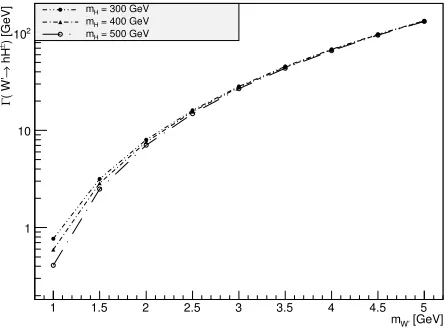
Figure 1.Partial width as a function ofWmass.
whereis theWpolarization 4-vector andp1,p2are the momenta of the two final Higgs bosons. From this, it can be shown (see [29]) that the decay rate is written as:
Γ(W± →hH±)= GF
24√2π(x+1) λ3/2(m2
W,m2H+,m2h)
m3 W
, (15)
in terms of the known kinematical functionλ.
The partial width can be calculated for various masses using the available phenomenological con-straints on the parameter x. In our estimates, we adopt the lower bound x ≥ 100 derived from recent phenomenological studies ofG(221) models [20]. From Fig. 1 it can be seen that for the most favourable case, x = 100 and mH± = 300 GeV, the branching ratio increases from 2% for mW=1000 GeV to 43% formW=5000 GeV.
5 Final state production cross sections in
G
(221)
models
In this section we discuss several final states that can arise in ppcollisions at LHC from the decay
WhH±and compare the predictions of theG(221) models with those of model independent searched. The simulation and the analysis were based on a framework [30] that chains different software packages together: Monte Carlo generators, programs for the simulation of the events through the detector and program for data analysis.
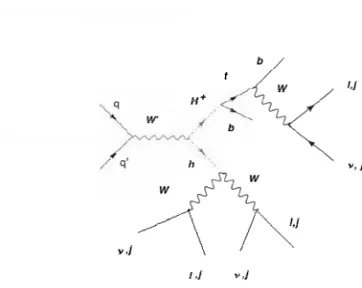
Figure 2.Production of the final state with 2 same-sign leptons, 4 jets and Emiss
T inppcollisions via theW→ hH±decay.
In PYTHIA 6.4, theWheavy gauge boson is produced according to the extended gauge model [32], where the couplings to the fermions are the same as the standard ones, and the coupling ofW
toWZis strongly supressed. As we mentioned above, theG(221) models have enough flexibility to allow for such values. The coupling ofWtohH±is set according to the calculation of Sec. 4 based onG(221) models. The decay width (15) and the branching ratio are functions of the masses and the large parameterxdefined in (5).
The default option in PYTHIA 6.4 for theH± →tb¯ decay is the 2HDM coupling with tanβ=5. One can check that this choice underestimates by a large factor the coupling expected inG(221) left-right symmetric models [18, 19]. In order to use a coupling closer to the expectations of such models, we performed the simulations in PYTHIA using 2HDM with tanβ=1. For the other decays involved in the process shown in Fig. 2, we assumed SM couplings.
[TeV]
W’
m
1 2 3 4 5
[fb]
σ
-4 10
-3 10
-2 10
-1 10
1 x = 100
x = 500 x = 1000
[TeV]
W’
m
1 2 3 4 5
[fb]
σ
-4 10
-3 10
-2 10
-1 10
x= 100 x = 500 x= 1000
Figure 3. Cross sectionσfor the production of 2 electrons, 4 jets andEmiss
We used Delphes [33] framework to perform realistic fast simulations of the ATLAS detector and to acquire reconstructed physics objects (jets,leptons,pthotons and MET). The analysis was performed with ROOT [34]. A first result can be seen in Fig. 3: the cross-section of 2 leptons, 4 jets and MET in the final state, as a function ofWmass, charged Higgs mass andxparameter.
In [29] we compared the predictions ofG(221) models with SUSY results [24–27]. There were considered events with no leptons, six jets and MET [24], one lepton, six jets and MET [25], two opposite sign leptons , four jets and MET [26], and four b-jets, one lepton and MET [27]. These states can also be produced in the context ofW → hH±G(221) models, withhdecaying to a pair ofW bosons, andH±decaying to top and bottom quarks. The presented results shows the ATLAS model independent upper limits for visible cross-sections, for SUSY searches, and the fiducialG(221) models cross-sections. Although we applied only a part of ATLAS SUSY phase space cuts, the values suggest the smallness of theG(221) predictions with respect to the ATLAS results. However, we note that theG(221) fiducial cross-sections are considerably higher than those predicted by 2HDM
pp→W →hH±decay with default PYTHIA 6.4 parameters.
6 Summary and Conclusions
The study aimed to compareWhH±decay predicted byG(221) models finalized with 2 leptons, 4 jets and MET topology with upper limits on visible cross-sections obtained by several ATLAS SUSY searches [24–27].
A two-stage symmetry breaking with the Higgs sector consisting of a Higgs doublet in the first symmetry breaking stage, and of a Higgs bi-doublet in the second one was considered [20]. The coupling between the newWboson arising in this model, the SM-like Higgs boson and a charged non-standard Higgs boson was derived, and the partial width of the rare decayWhH±was calculated. Then we obtained the cross-sections of 2 leptons, 4 jets and MET with PYTHIA 6.4 calculations, as a function ofWand charged Higgs boson masses.
By considering different final states and assuming specific kinematical cuts that were obptimized for SUSY searches, fiducial cross-sections for theG(221)W → hH±decay were computed. Com-paring them with ATLAS upper limits on visible cross-section, it can be concluded that theG(221) models are below ATLAS current sensitivity.
Acknowledgements
We would like to thank Bogdan Dobrescu for pointing us to theG(221) models and Julien Maurer for very useful discussions and suggestions. This work was supported by the Sectorial Operational Programme Human Resources Development (SOP HRD), financed from the European Social Fund and by the Romanian Government under the contract number SOP HRD/107/1.5/S/82514, and by the Romanian Ministry of Education through the ATLAS - Capacities/Module III CERN project.
References
[1] G. Aad et al. [ATLAS Collaboration] , Phys. Lett. B716 1 2012; S. Chatrchyan et al. [CMS Collaboration] , Phys. Lett. B71630 (2012)
[6] R.S.Chivukula, B.Coleppa, S.Di Chiara , E.H.Simmons , H.J.He ,M.Kurachi and M.D.Tanabashi, Phys. Rev. D74075011 (2006)
[7] V.D.Barger, W.Y.Keung and E. Ma, Phys. Rev. D22727 (1980) [8] V.D.Barger, W.Y.Keung and E. Ma , Phys. Rev. Letters441169 (1980) [9] G.Senjanovic , Nucl. Phys. B153334-64 (1979)
[10] X Li and E. Ma, Phys. Rev. Letters471788 (1981)
[11] D.Cocolicchio and G. L.Fogli, Phys. Rev. D323020 (1985)
[12] G. F.Gunion, J.Grifols, A.Mendez , B.Kayser and F.Olness, Phys. Rev. D401546 (1989) [13] H.Georgi , E.E.Jenkins and E .H.Simmons, Nucl. Phys. B331541-5 (1990)
[14] D.Cocolicchio , G.L.Fogli and J.Terron , Phys. LettersB 255599 (1991) [15] E.Malkawi ,T.P.M.Tait and C .P.Yuan , Phys. Letters B385304 (1996)
[16] X.G.He and G .Valencia , Phys. Rev. D66013004 (2002) [Erratum-ibid.D66, 079901] [17] R.N.Mohapatraet al., Rept. Prog. Phys.701757 (2007) arXiv:hep-ph/0510213 [18] J.Dong-Won and L.Kang Young , Phys. Rev. D76095016 (2007)
[19] J.Dong-Won and L.Kang Young , Phys. Rev. D D78015022 (2008)
[20] K.Hsieh , K.Schmitz , J-H.Yu , C.P.Yuan , Phys. Rev. D82035011 (2010) arXiv:1003.3482 [21] Q-H. Cao , Z.Li , J-H.Yu and C.P.Yuan , Phys. Rev. D86095010 (2012) arXiv:1205.3769 [22] J. Beringeret al.(Particle Data Group) , Phys. Rev. D86010001 (2012)
[23] B.A.Dobrescu and A.D.Peterson , Fermilab-PUB-13-549-T arXiv:1312.1999 (2013) [24] ATLAS Collaboration 2013, ATLAS-CONF-2013-047
[25] ATLAS Collaboration 2013, ATLAS-CONF-2013-062 [26] ATLAS Collaboration 2013, ATLAS-CONF-2013-025 [27] ATLAS Collaboration 2012, ATLAS-CONF-2012-104 [28] ATLAS SUSY public results:
https://twiki.cern.ch/twiki/bin/view/AtlasPublic/SupersymmetryPublicResults#2012_data_8_TeV [29] A.Jinaru , C.Alexa , I.Caprini and A.Tudorache, arXiv:1312.4268 [hep-ph]
[30] M.Cuciuc , M.Ciubancan , V.Tudorache , A.Tudorache , R.Paun , G.Stoicea and C.Alexa , Rom. Rep. Phys65122-32 (2013)
[31] T.Sjöstrand , S.Mrenna and P.Skands , JHEP 0605:026 (2006); http://PYTHIA 6.4.4.hep-forge.org/
[32] G.Altarelli , B.Mele and M.Ruiz-Altaba , Z. Phys. C45 109 (1989) [33] Delphes arXiv:0903.2225 [hep-ph]