LONGITUDINAL STUDY OF CAUSAL THINKING IN BRITISH MIDDLE SCHOOL
CHILDREN
by
Elwyn Thomas
B.Sc. (Wales) M.A. (London)
A thesis submitted for the degree of Doctor of Philosophy in the Faculty of Education of the Unive7sity of London
"Man is a cause-seeking creature; in the spiritual order he could be called the cause-seeker. Other minds perhaps think things in
otter -
to us inconceivable - categories."George Christoph Lichtenberg (1742-1799)
ABSTRACT
A multiplex view is taken of causality, and childrens' causal thinking, which is based on current scientific views, Piagetian theory, and the author's interpretation of childrens' causal explanations during the pilot studies. An instrument, devised by the author, for the categorisation and measurement of causal explanation as a means of assessing childrens' causal thinking, is a central feature of this investigation. The instrument is called the Physical Causality Test Battery (PCTB)
A sample of 112 middle school children aged
9 -
10 years were investigated in the context of two guiding statements.The first statement included research problems and hypotheses directed to a study of the nature of childrens' causal thinking and its possible relationships with other abilities. One hundred and two out of the 112 children were tested in this part of the investigation.
Application of Factor Analysis using a Varimax Rotational Solution indicated that 5 extractable factors emerged. Factor 1 reflected
childrens' appreciation of practical causal contexts. Factor 2 indicated a strong element of general achievement as measured by standardised tests. Factors
3 - 5
mainly embraced causal creativity, initial and pluralistic causal components respectively.The second guiding statement included research problems and hypotheses related to testing an aspect of causal thinking in the 112 children. Eighty of these children were tested on
3
separate occasions at7
monthly intervals. A further sub-group of 32 Ss were drawn to test for practice effects. A Two Way Anova mixed design (repeated measures), showed highly significant results for between Subjects and within Subjects sources of variation. However, this treatment did not indicate sufficiently small group or individual trends. In response to this, the author devised a descriptive technique termed,Modal Pattern Analysis (MPA), which aimed to detect and monitor change in childrens' causal explanation over time. The application of NPA in the context of a3
test longitudinal design, revealed four modal patterns, (i.e. linear, progressive, regressive and erratic) to childrens' causal explanations.Childrens' modal patterns appear to be influenced by the nature of the stimulus material, and certain experiential factors. However maturational, mnemonic and motivational processes are likely to be involved.
Case studies of causal stimulus items, and studies of individual children showing distinctive modal patterns are discussed.
ACKNOWLEDGEMENTS
The author would like to record his sincere thanks to Dr John Versey 'of the Department of Child Development, University of London, Institute
of Education for his thorough and painstaking supervision of this thesis. His suggestions for the development of the Modal Pattern Analysis technique for treating longitudinal data were particularly helpful.
Thanks must also go to Mr Tony Halil of the Department of Statistics and Computing, University of London, Institute of Education for his
valuable advice and assistance concerning the Computer programme and statistical treatments used in this thesis.
Help was also given by Mr Charlie Owen and Mr Ian Plewis both of the Thomas Coram Institute, on statistical treatments for the longitudinal data and for which gratitude is expressed.
Warm thanks must go to the staff and children of both pilot and experimental schools as well as the local education authority of Merton, for without their cooperation this thesis would not be possible.
Gratitude must also be expressed to Professor R.C. Honeybone former Head of the EDC Department, University of London, Institute of Education for his encouragement and help during the collection of data for this study.
My sincere thanks must go to my wife and children who not only gave me every support at home, but helped me in the early stages of the study. Without their help it would have been very difficult to complete this investigation.
A Factor Analytical and Longitudinal Study of Causal Thinking in British Middle School Children.
CONTENTS
Abstract
Acknowledgements Contents
PAGE
3
6
-
4
5
-
16
List of Tables
17
- 18List of Figures 19 - 20
List of Abbreviations 21
Chapter 1 INTRODUCTION 22 - 25
PART ONE:.; REVIEW OF THE PERTINENT LITERATURE Chapter 2 PHILOSOPHICAL AND SCIENTIFIC PERSPECTIVES TO
26 -
49
THE STUDY OF CAUSALITY2.1 A brief examination of the early historical development of the causal Principle
2.2 The Development of the Modern Conception of the Causal Principle
28-30
2.2.1 Issues related to a rationalistic
approach to causality. 31 - 32 2.2.2 Issues concerned with eclectic,
functional and deterministic approaches ',x) the semi-causal (or middle of the road) position
on causality.
2.2.3 Issues concerned with empirical and indeterministic approaches to the acausal position.
32 -34
2.3 A Consideration of Selected Aspects and
PAGE 38 Alternative Interpretations of the Causal
Principle with special reference to the present investigation
(a) Events of cause and effect,
39
(b) Plurality of causes - probabilisticand hierarchical cont±gencies, (c) Invariant Association of one thing
with another,
(d) Causal Ground; necessary condition, sufficient reason etc.,
(e) Contingent and Necessary Causal
40
42
43
44
Connection,(f) Causality as a relation of functional dependency,
(g) Retro-active Causality,
45
46 (h) Causal relation as action by contact
47
etc.
Chapter
3
THEORETICAL APPROACHES TO THE PSYCHOLOGICAL 50 - 78 STUDY OF CAUSALITY3.1 "Philosophico - Psychological Bridges" and 51 -
57
the Investigation of the Causal Principle3.2 The genetic - epistemological view of
57 - 59
causality - the Theory of Jean Piaget3.2.1 The Early Period
59 - 65
3.2.2
The Mid Period 65 - 683.2.3 The Third Period
(a) Causal Thinking and Memory 68 -
74
Processes(b) Causal Thinking and Operational
74 - 78
ThinkingChapter
4
REPLICATION AND FURTHER DEVELOPMENT OF GENETIC79 - 94
EPISTEMOLOGICAL THEORY IN PSYCHOLOGICAL STUDIESOF CHILDREN'S CAUSAL THINKING
4.1 Research aimed at replication, or part replication of Piaget's studies on Causal Thinking
4.2 Research extending Piaget's work on causal thinking into other psychological domains
80-88
PAGE
Chapter 5 PSYCHOLOGICAL PERSPECTIVES TO THE STUDY
95 - 115
OF CAUSALITY WITH REFERENCE TO METHODOLOGIGALISSUES
5.1 Language Factors 96 - 107
5.2 Experiential factors and the nature 107 - 109 of the Stimulus Material
5.3 Experimental and Procedural Factors 110 - 115
Brief Overview 116 - 117
PART TWO : THE PRESENT INVESTIGATION
Chapter 6 THE PILOT STUDIES AND THE RESEARCH PROBLEMS 118 - 144 AND HYPOTHESES FOR THE MAIN INVESTIGATION
6.1 Initial Aims and the Pilot Studies 119 - 134
6.1.1 Initial Aims 119
6.1.2 The Pilot Studies
A) Experimental Details - 120 - 121 School Sample Design etc.
B) General findings of the 121 - 132 Pilot Studies and Implications
for the Present Investigation
C) Aims and Scope of the Present 132 - 134 Investigation
6.2 Guiding Statements, the Research Problems 154 - 144 and Hypotheses for the Main Investigation
6.2.1 Introduction - Guiding Statements 134 - 137 and Research Problems
6.2.2 The Hypotheses, with restatement of 138 - 144 the Research Problems
Chapter 7 THE SAMPLE EXPERIMENTAL PROCEDURES AND RESEARCH DESIGNS
145 - 163
7.1 The Sample 146 - 150
(a) Method and Criteria for Selection 146
(b) Educational Background 146
c) Environment of the school 147 d) Parental Status and other socio- 147
economic factors
(e) Ethnic and Cultural Nature of the 148 Sample
Chapter 8
(g) Numbers Tested and Interview Selection
(h) Sex (i) Age
7.2 Experimental Procedures
149 150 150 150 150 151 152 152 153 154 155 155 155 156 157 158 159 162 164 - 155 - 163 - 201 (a) Setting
b) Preliminaries to Test Administra- tion
(c) Sequence of Test Instruments Contact time with Ss
e) Questioning Techniques and E-S Rapport
(f) Comments on the two year period
of
testing7.3
The Research Designs a) Research Design Ab) «1 it B
0) Dates and Duration
d) Comments on Research Design A
e) It it n it B
f) The Selection and Frequency of Treatments
(g) The Use of Controls THE INSTRUMENTATION
8.1 Instrumentation for specifically measuring 166
167
16;
173
- 195- 169
- 173
- 184
appreciation of causal situations8.1.1 The Physical Causality Test Battery (PCTB)
(a)
Nature and Background of the Test Batteryi) Rationale for the test
ii) The Initial Causal Component iii) The Pluralistic "
iv) The Probabilistic Causal Component v) Logico-causal Component
vi) Experiential Causal Component (b) Structure of the Test Battery (c) Categorisation and Scoring of
Responses for the PCTB
i)
Categorisation and Scoringof
responses for the Initial Causal Componentii) Categorisation and Scoring of responses for the Pluralistic Causal Component
PAGE iv) Categorisation and Scoring
of responses for the logico-Causal Component
v) CategorisatiOn and Scoring of responses for the Experiential Component
(d) Validity of the Physical Causality 184 Test Battery
8.1.2 Causal Demonstration - Water Level Test 184 - 185 (a) Rationale for the test
(b) Nature of the Test and Response Categorisation-Scoring
(c) Validity of the test
8.1.3 The Causal Reasoning Tests 186 - 188 E3.) Rationale for the tests
b) The Nature of the tests
(c) Categorisation and Scoring of Responses
(d) Validity of the Causal Reasoning Tests
188 - 190 8.1.4 Causal Problem Solving Test- Electric
Light Problem
(a) Rationale for the test (b) The Nature of the test
c) Categorisation and Scoring d) Validity of the test
8.1.5 The Bicycle Drawing Test ( Rationale for the test (b)The Nature of the test (c) Scoring Procedure for the
Drawing
(d) Validity of the Bicycle Drawing Test
8.1.6 A Creativity Measure for Causal Appreciation
a.) Rationale for the test b) The Nature of the test c) Scoring of the Responses d) Validity of the test
8.1.7 Use of Causal Connectives Tests a) Rationale for the test b) Nature of the test
c) Categorisation and Scoring of Responses
(d) Validity of the Causal Connectives Test
190 - 191
191 - 192
8.2 Instrumentation for Measuring Abilities 195 - 201 other than Causal but which may be related
to appreciation of Causal Situations
8.2.1 Relational Test 195 - 196
(a) Relationale for the test (b) Nature of the test
(c) Scoring of the test
(d) Validity of the Relational test
8.2.2 Judgemental/Verification Test e.) Rationale for the test b) Nature of the test (c) Scoring of the test
(d) Validity of the Judgemental/ Verification test
8.2.3 Scepticism Test
(a) Rationale for the test (b) Nature of the test
(c) Categorisation and Scoring (d) Validity of the Scepticism
Test
196 - 197
197 - 198
8.2.4 Conservational Tests
e.) Rationale for the test b) Nature of the test
i) Conservation of Substance ii) II " Weight iii) ti " Area
iv) II " Volume (c) Categorisation of Responses
i) Conservation of Substance ii) 11 " Weight iii) it " Area
iv) 11 " Volume
(d) Validity of the Conservational Test 8.2.5 The Richmond Achievement Test
Chapter
9
STATEMENT, TREATMENT AND DISCUSSION OF THE DATA FROM THE FIRST YEAR STUDIES9.1 Presentation and Discussion of the Descriptive Data from the application of the Physical Causality Test Battery (PCTB) - Descriptive Statistics
9.1.1 General Trends for the three types of stimulus material
a) Familiar Stimulus Material 204
b) Remote 206
c) Malfunctional " 206
d) Discussion of the main trends 209
198 - 200
201
202 - 250
204 - 226
9.1.2 Trends shown in the % distribution of responses to individual items comprising the three types of stimulus material a) Familiar stimulus items
b) Remote It c) Malfunctional " 11
212 - 226
212 216 221
9.2 Presentation and Discussion of Results of a 226 - 250 Factor Analytical Study of Causal Thinking
9.2.1 Relationships between individual Clausal 226 - 241 Measures and measures of other abilities
a) Relationships involving Initial Causal 226 Components
b) Relationships involving Causal 229 Pluralistic Components
c) Relationships involving Logico- 230 causal Components
d) Relationships involving Causal 230 Demonstration
e) Relationships involving Sentence 231 completion and construction using
causal connectives
f) Relationships involving Causal 234 Reasoning, Relational and Electric
Light Tests
g) Relationships involving Verification/ 236 Judgemental and Scepticism Tests
h) Relationships involving Mathematical 236 Measures
i) Relationships involving Measures of 237 Causal Creativity
j) Causal Thinking and Children's 238 appreciation of Conservational Notions
9.2.2 Group Relationships and the Application 241 - 250 of Factor Analysis
a) Principal Factor Analysis 241 b) Varimax Rotation of Factor Matrix 243
c) General Conclusion 250
Chapter 10 STATEMENT, TREATMENT AND DISCUSSION OF THE LONGITUDINAL DATA
10.1 The Structure and Nature of a three Test Longitudinal Design and Causal Thinkin
g
10.1.1 Terminology and Structure10.1.2 The Nature of Modal Patterns
251 - 322
252 - 258
253
254
a) Linear Patterns 254
b) Progressive Patterns 256
c) Regressive Patterns 256
10.2 A Global Analysis of the Longitudinal 258 - 276 Data
10.2.1 Descriptive Statistical Item 258 Analysis
a) Familiar Stimulus Material 259
b) Remote 11 It 264
c) Malfunctional " 269 10.2.2 Treatment of the Data using a Two 273
Way Anova Mixed Design
10.3 Modal Pattern Analysis (MPA) 276 - 289
10.3.1 Linear Patterns 277
10.3.2 Progressive Patterns 278 a) Progressive Gradient
b)
lag
c) “ Plateau 10.3.3 Regressive Patterns
10.3.4
Erratic10.3.5 Comparisons with Controls 10.4 Case Studies of related Items
10.4.1 Boats floating and sinking 10.4.2 The bicycle mechanism 10.4.3 The rain item
10.5 Case Studies of Individual Children
10.5.1
Individual Ss registering apreponderance of low category explanations
10.5.2 Individuals S registering a preponderance of ligh category explanations
10.5.3 Individuals Ss registering a preponderance of Linear Patterns 10.5.4 S registering a preponderance of
gradient, patterns
10.5.5 Individuals Ss registering a preponderance of Plateau type patterns
10.5.6 Individuals Ss registering a preponderance of Regressive and Erratic patterns
282 285 288
289 - 307 289
297 301
PART THREE : ASSESSMENT OF RESULTS. TailiaPIONS AND SUGGESTIONS FOR FURTHER RESEARCH
CHAPTER
11
ASSESSMENT OF RESULTS AND SUMMARY OF THE MAIN FINDINGS AND CONCLUSIONS11.1
Assessment of the findingsra to tilenature of children's causal thinking and its relationship to other abilities
11.1.1
Assessment of the findings relatingto
the nature of causal thinking in middle school childrena) Explanation of initial causal 326 components
b) Causal explanation and age norms 326 c) Causal explanation and the nature 327
of the stimulus material-initial causal components
d) Causal thinking and the nature of the stimulus material - other causal components
e) Causal Thinking, Verbal, Demonstra-tional and Psychomotor Modes
f) Causal thinking and the appreciation of other notions of causality
11.1.2
Assessment of the findings relating topelected factors affecting children's causal thinking
a) Causal thinking and incidental experiential influences
b) Causal thinking and structured 333 experiential influences
11.1.3
Assessment of the findings relating tochildren's causal thinking and other abilities
a) Causal thinking and language 335 b) Causal thinking and relational 335
thinking
c) Causal thinking and judgemental/ 336 Verificational ability
d) Causal thinking and creativity 336 e) Causal thinking and standardised 337
measures of achievement
f) Causal thinking and ability 337 groupings
11.1.4
Assessment of the findings relating tochildren's causal and operational thinking
a) Piagetian Stages of Causal 339 Thinking
b) Causal Thinking and Operational Thinking 329 330 331 332 340
323
-3.6811.2.2 Assessment of the findin•s relatin Modal Pattern Analysis
11.1.5 Summary Assessment of the Main Trends 341 arising out of a study of Guiding
Statement 1
11.2
Assessment of the findings relating to the342 - 355
longitudinal study_ of Causal Thinking bymiddle school children
11.2.1 Assessment of the findings relating to a Global Analysis of the longitudinal data
a) Descriptive Statistics
343
b) Two Way Anova Mixed Design and345
Pearson Correlation Treatments
a) Linear Patterns
348
b) Progressive Patterns 348
c) Regressive Patterns 350
d) Erratic Patterns 352
11.2.3 Summary - Assessment of the Main Trends arising out of a study of Guiding
Statement 2
353
11.3
Summar of the main findings and Conclusions355 - 368
11.3.1
Findings and conclusions relatingto the nature of children's causal thinking
11.3.2 Findings and conclusions relating to selected factors affecting children's causal thinking
11.3.3 Findings and conclusions relating to children's causal thinking and other abilities
11.3.4 Findings and conclusions relating to
children's causal and operational 361 thinking
11.3.5
Findings and conclusions relating toa Global analysis of the longitudinal 363 data
11.3.6 Findings and conclusions relating to
the Modal Pattern Analysis of the
364
longitudinal dataChapter 12 IMPLICATIONS AND SUGGESTIONS FOR FURTHER RESEARCH 369 - 372
REFERENCES
373 -
384APPENDICES (see page 16 for details) 385 - 570
355
358
APPENDICES
Appendix A Causal - Instrumentation 385 - 426 B Non-Causal - Instrumentation 427 - 436
C Recording and Scoring Sheets 437 - 448
D Results - First Year Study 449 - 469
- The Longitudinal Study 470 - 523 F Details of Statistical Programmes used in
the Investigation
524 - 525
G Description of Variables and Coding 526 - 541 Information
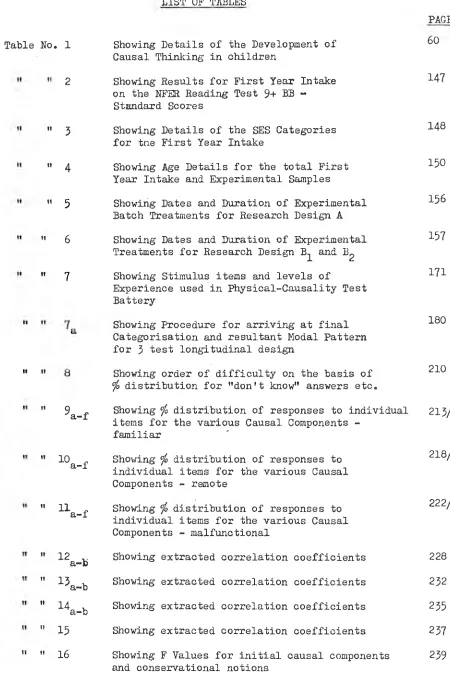
Table No. 1
PAGE Showing Details of the Development of
Causal Thinking in children
60
2 Showing Results for First Year Intake on the NFER Reading Test 9+ BB -
147
Standard Scores
It II 3 Showing Details of the SES Categories for the First Year Intake
148
It
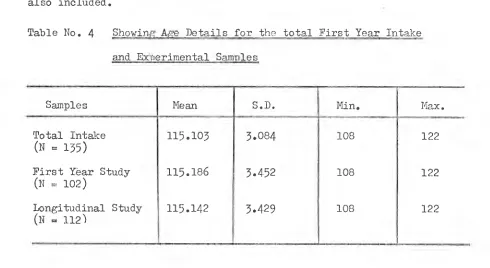
" 4 Showing Age Details for the total First 150 Year Intake and Experimental Samples
II
5
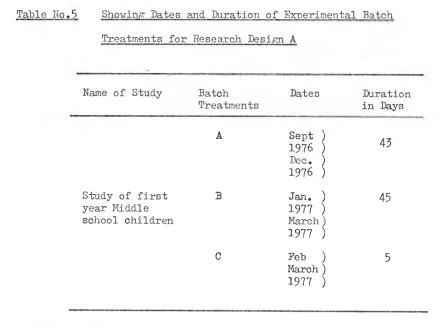
Showing Dates and Duration of Experimental 156 Batch Treatments for Research Design A6
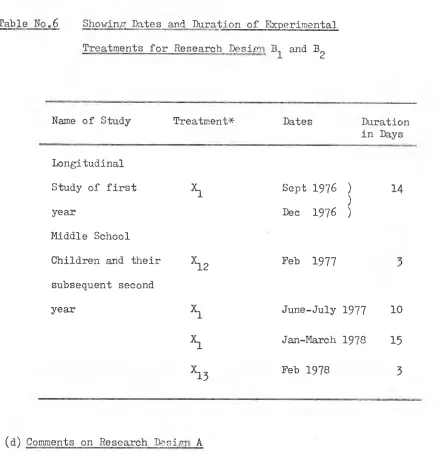
Showing Dates and Duration of Experimental 157 Treatments for Research Design B1 and B2
I/ It
7 Showing Stimulus items and levels of 171 Experience used in Physical-Causality Test
Battery II It
7
a
Showing Procedure for arriving at final Categorisation and resultant Modal Pattern for 3 test longitudinal design180
II It 8 Showing order of difficulty on the basis of 210 % distribution for "don't know" answers etc.
9
a-f Showing % distribution of responses to individual items for the various Causal Components
-familiar
213/214
" 10a-f Showing % distribution of responses to individual items for the various Causal
218/219 Components - remote
" 11a-f Showing % distribution of responses to individual items for the various Causal
222/223 Components - malfunctional
” " 12
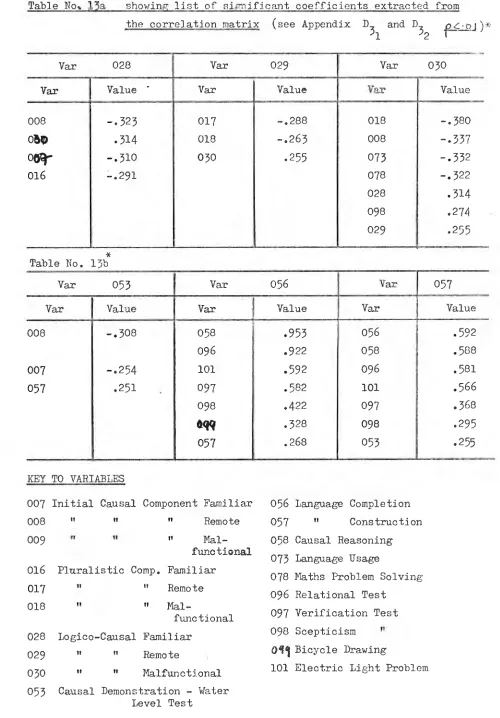
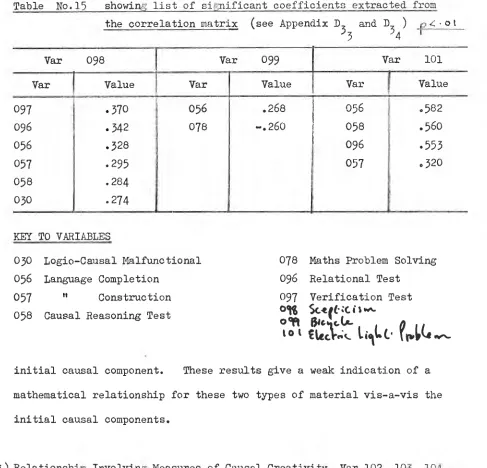
a-b Showing extracted correlation coefficients 228 " 13a_b Showing extracted correlation coefficients 232 rr " a-b Showing extracted correlation coefficients 235 11 " 15 Showing extracted correlation coefficients 237
" 16 Showing F Values for initial causal components and conservational notions
Table No.
11
"
It
11
It 11
It 11
11 11
17 18 19 19a 20 21 22 a -c 23 a -c
Showing F Values for Logico-causal Components and conservational notions
Showing Varimax Rotation of factor pattern Showing F Values 3 types of stimulus material Experimental Group
Showing F Values 3 types of stimulus material Control Group
Showing Modal Patterns for Experimental Showing
Control Group Boat Floating Item
Showing Modal Patterns for Experimental Showing
Control Group Boat Sinking Item
Showing Modal Patterns for Experimental Control Group Bicycle Mechanism
Showing Modal Patterns for Experimental Control Group Rain Item
PAGE 240
245
274
274
2
91/2
92294/295
298/299
LIST OF FIGURES
Figure No. 1 Showing Possible Conditions that could exist 41 between cause/s and effects
Showing Interpositional Perspective to Stage/
77
2 Periods in Childrpns' Development of legal,causal and operational thinking
"
3
Scheme for Research Design A - Study of first 158Year Middle School Children
u
4
Scheme for Research Design B1 - Longitudinal 160 Study of First to Second Year Middle SchoolChildren (combined cohorts)
5
Scheme for Research Design B2 - Longitudinal 161 Study of First to Second Year Middle SchoolChildren (separate cohorts)
" 6
a-c
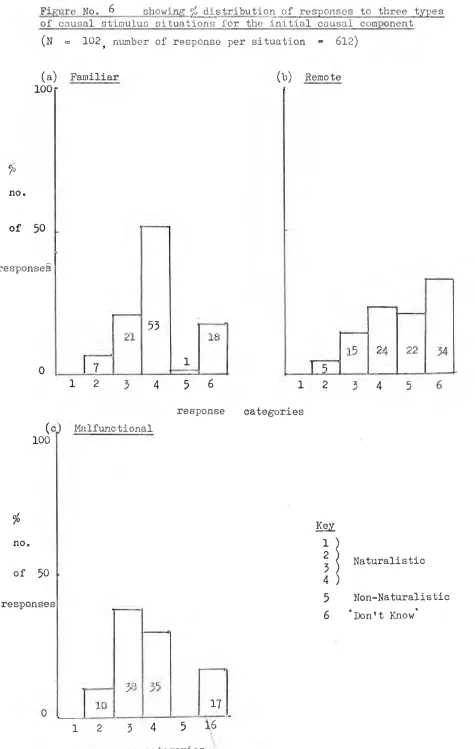
Showing % distribution of responses to three 205types of Causal Stimulus Situations for the Initial Causal Component
Showing % distributions of responses to three types of Causal Stimulus Situations for the Pluralistic Causal Component
Showing % distributions of responses to three 207 8
a
-c
types of Causal Stimulus Situations for the Probabilistic Component
Showing % distributions of responses to three types of Causal Stimulus Situations for the Logico-Causal Component
10
a-c Showing % distribution of responses to three 208 types of Causal Stimulus Situations for the
Experiential Causal Component
11 Graph showing % Variance for extracted factors 249 " 12 Showing Possible Modal Patterns for a three test 254/255
Longitudinal Dsign
"
13
Showing % No. of Ss registering modal patterns -) familiar individual items, Experimental Group" 13a
Showing % No. of Ss registering modal patterns-) familiar individual items, Control Group
" 14
Showing % No. of Ss registering modal patterns- remote individual items, Experimental Grouptt It
11
" 7
'a -0
207
11 It
It it
Q
'a-c
208260/261
Figure No. 14a Showing % No. of Ss registering modal patterns remote individual items, Control Group
" 15 Showing % No. of Ss registering modal patterns malfunctional individual items, Experimental Group
" 15a Showing % No. of Ss registering modal patterns malfunctional individual items,Control Group
PAGE
265
LIST OF ABBREVIATIONS USED IN THE THESIS
C . Cause
Ef . Effect
MPA = Modal Pattern Analysis
N . Number of Subjects
PCTB . Physical Causality Test Battery
S/s = Subject/ s
CHAPTER 1
INTRODUCTION
Psychological research into causality has had a somewhat erratic
history, since Piaget (1930) first put forward his observations on how
children explain the causes and effects of certain physical phenomena
e.g. cloud movements, the bicycle mechanism etc.. Following on from
this early work of PiagetI there were a number of studies in the mid
1930's and early 1940'so that were replicative in nature and which
either challenged Piaget's original position ffsaacs (1930) Deutsche
(193717 or supported his findings Dennis (1943)4 These early studies
concentrated mainly on young children between the ages of
3 -
8 yearsexploring pre-causal notions and explanations of causality. One
particular area being that of animistic thinking. The late 1940's and
1950's were fairly barren in any further study of causality until the
work offfaurendeau and Pinard (196217: However, their research also
concentrated on pre-causal notions, which included an elaborate emphasis
on the Piagetian stage concept,under which causality as a notion was
subsumed under the stage theory.
Even towards the end of the 1960's,the work of Berzonsky (1969)
while employing interesting factor analytic approaches,to the possible
relationships between causal thinking and other reasoning and operational
propensities, still concentrated on relatively younger children.
Mere recently) research into causal thinking has been extended to cross
cultural settings 5curia (1980), Thomas (1979), (1981ag to social
causality 2Whiteman (19762 and to more extended areas of physical
causality e.g., plurality and the role of attribution theory ffelley
(1973), Schultz and Mendelsohn (19751 Seigler (19752. Also in the
through various experiments related to memory 5iaget and Inhelder
(1970 and to operational thinking
ffiaget
(197417. Both these later areas of Piaget's work have significance for this investigation,in that causal thinking and its relationship to operational thinking and other abilities are the concern of the first part of the thesis. The second part examines changes which occur in causal explanation over a specific time, and therefore involves memory processes.The selection of the above areas for investigation,was based on the fact that the study of causal thinking is an under-researched area of cognitive development,especially in the older primary school child. Moreover,no substantial study has been carried out in British schools on causal thinking and its development,especially in the context of a
longitudinal design. Therefore, it seemed particularly apt to examine the development of causal thinking within the age range covered by the relatively recent middle school system. The idea behind the middle school was born in the early 1960's,and was seen as an essential bridge but equally important separate component of a three tier comprehensive educational system. The local authority schools in which the present research reported here was carried out, included children aged from
9 —
13 years. This system was set up in the late 1960s,and it wasstressed by the local education authority that causality among many other notions should be given a greater amount of focus by teachers in their teaching.
its share of attention to cognitive developmental research. In addition to these points an important part of this study examines
changes in the development of causal thinking in the same Ss over time, and so a much needed longitudinal perspective,has been included in this investigation.
From the standpoint of the science curriculum,the study of causal thinking is of crucial importance, as it forms an important area in the child's ability and experience to explain and answer many causal
situations encountered in and out of school. In a wider context, the
PART ONE REVIEW OF THE PERTINENT LITERATURE
CHAPTER 2
PHILOSOPHICAL AND SCIENTIFIC PERSPECTIVES
PHILOSOPHICAL AND SCIENTIFIC PERSPECTIVES TO THE STUDY OF CAUSALITY
Introduction
The long history of the causal principle shows how it has been fashioned, adapted, disguised, reinterpreted and sometimes considered by some as quite unnecessary. It is the aim of this chapter to trace briefly thehistorical development of the principlei and eventually to discuss and establish for this study its modern interpretation. As a resultj it is hoped that this study of causal thinking in children will have the benefit of a firm philosophical and scientific basis.
The chapter will be divided as follows:-
2.1 A brief examination of the early historical development of the causal principle.
2.2 The Development of the Modern conception of the causal principle.
2.3 A consideration of selected Aspects and Alternative Inter-pretations of the Causal Principle, with special reference to the present investigation.
Finally,causality may be used in the sense that it is a doctrine i.e. causalism, that which holds the universal validity of the
causal principle, to the exclusion of other principles of determination. While all three meanings will be alluded to in the discussion that follows in this and other chapters, it is the first and second meanings that will receive the most attention. The reason for this,is that in a study of causal thinking,it is necessary to know the nature of
causation and what general laws hold for the process,in order that valid research questions can be formulated,and effective instruments for
measuring causal appreciation can be constructed.
2.1 A Brief examination of the early historical development of the Causal Principle
It was Aristotle who elaborated Plato's somewhat diffuse ideas concerning the causal principle and codified it into four causes, namely,'Causa materialis - referring to material on which causes act; Causa formalis - which contributes to ideas etc.; Causa efficiens - which is a motive force or external influence and finally Causa finalis - a goal to which everything strives.
By the seventeenth century, the Aristotelian conceptions of causality were whittled down to Causa efficiens at the time modern science was beginning to develop.
29
(1)
C therefore Ef C = causeor E because C Ef = effort
"if" howeveri to make the above proposition into a lawful proposition, needs to be added thus :
(ii) if C then Ef
In order to satisfy features such as conditionalness, constancy, uniqueness, existential succession etc.; all important to any causal principle, proposition (ii) needs to be altered further, thus:
(iii) if C then (and only then) Ef always
Examination of proposition (iii) quickly suggests some form of regular association. The most fervent advocate of causality as some form of regular association was Hume who rejected totally the ontological nature of the causal principle. The Humean position is dominated by the conjunction of two events blurring any real distinction between a genetic or productive link between cause and effect,and a correlation or concomitance. In other words the Humean version of causality
emphasizes relational as opposed to a real connection between the events of cause and effect. So a further proposition avoiding the Humean version of causality would be as follows:
(iv) if C happens then (and only then) Ef is always produced by it.
Proposition (iv) shows that causation is more than a category of relationship but an actual process of production of one event by another.
simple or complex idea, while an effect is that which is produced by such an idea or ideas. However, determinism is not only a matter of causation it has other meanings such as"becoming" or a "process" both which admittedly could be considered as part of a causal situation but are not unique to it.
Therefore,summarising the historical development it can be seen that by the end of the seventeenth and early eighteenth centuries,a
polarity had developed concerning the conception of the causal principle. At one end of the spectrum,the so called classical approach of Galileo and Newton reflectingmuch of the thinking on causality by Aristotle, who saw the causal principle in very specific genetic or productive terms. At the other, end there were those like Hume who reduced the causal principle to mere external conjunction or succession of events and provided the debate on causality with the opposite of causalism namely, acausalism. The position of Locke and Descartes on causality marks the end of this period,and is a reinforcement of the classical position, but viewed by these philosophers in the strict context of determinism; a context not confined however to the causal principle.
2.2 The Development of the Modern Conception of the Causal Principle
There appeared to be three main issues surrounding the development of the modern conception of causality, these are as follows :-
2.2.1 Issues related to a rationalistic approach to causality.
approaches to the causal position. Each of the above will be discussed briefly.
2.2.1 Issues concerned with a rationalistic approach to causality Of all the most important issues surrounding the nature of the causal principle,the one related to the a priori position vis-a-vis causality has generated most debate. The issue is simply whether causality is an a priori to empirical knowledge. As far as Hume is concerned and therefore the acausal position, causality is not an
a priori to such knowledge. For the classicists like Newton and Galileo) it is seen very much as an a priori,with the emphasis on the necessary connection between things.
During Hume's time ,a striking attack was launched by him on this issue of a priorism. It was however Kant who rallied to the defence of the classicist position on causality, while at the same time he skilfully took a careful and balanced view of the Humean position. In so doing, Kant was able to conceive that parts of empirical knowledge became known to us via a priori forms e.g. space and time. Experience is often gained in an ordered situation as regards time and space,and when one is trying to trace why one event follows another, or that an object moves in the same direction under the same conditions. The a priori ordered contatict is a feature and is very pertinent to any causal analysis and ultimately to a conception of the causal principle.
Liebnitzts position on the causal principle emphasizes it as a necessity of thoughts and his so-called Denknotwendigkeit
gives a pre-supposition rather than a result of some enquiry. Anyone who assumes the Liebnitzian position vis-a-vis causality has to accept the supposition of a priorism in the form of sufficient reason. In summary theni the rationalistic approach to causality is one that is based on a priorism and although there are various shades to its
expression e.g. from Newton to Kant to Liebnitz,such an position entails the understanding of everything. In the words of Helmholtz the causal principle
"could never be refuted by any possible experience
... It is nothing but the demand of understanding everything" in Bunge (1959) p. 28.
2.2.2 Issues concerned with eclectic functional and deterministic approaches to the semi-causal position on causality
The semi-causal or hemiaitic position on causality, is concerned with several crucial issues related to eclecticism, functionality between cause and effect and finally neo-determinism.Eclectic theory recognises the validity of causality, but only in certain areas e.g. macrophysics of lawful production as in statistical or teleological cases. The main issue it appears)is whether a particular effect is
of nomic pluralism has been explored further in this studyl in the way children may recognise that causes can be related to other determinants that seem to produce an overall effect. The process of probability is also taken up in this study and both plurality and probability will be discussed in later chapters, especially chapters 8 and
9.
A second issue related to the semi-causal position on causality concerns its interactive or interdependent nature. To advocates of the functional or interactive nature of causality suchas Schelling, Pierce, etc.i the causal principle can be replaced by the notion of functional dependence. In other words thereis a functionality between cause and effect, or causes and effect etc. Such a position leaves no room for chance to account for a particular effect and
secondly,it fails to consider the decisive nature of a genetic (or productive) connection, and the uniqueness of a causal situation . A third issue
concerned with the semi-causalist positioni is the interpretation of the deterministic view in the context of causality. It appears that in examining this issuel it is necessary to mention firstly, the extreme position taken by authors such as Jordan (1944), Rey (1923) who assert the unconditionality of causality. Such an assertion is based on a fatalistic determinist philosophy. At the other extreme, is the rigid
Having mentioned the extreme positions concerned with deter-minism vis-a-vis causality,it is essential to examine the so called neo-deterministic view or as Bunge calls it General Determinism. The issue here is to what extent is causality one of several interrelated categories which result in real effects? The neo-determinist view is a position of scientists who accept the replacement of the causal
principle,by a broader principle of deterministic or lawful production. In summary, it can be said therefore,that the semi-causal position vis-a-vis the nature of the causal principle, embraces three major issues. The issue that nomic pluralism is one way of establishing the nature and validity of causality in some domains and not others Iii other words an issue of eclectism. Secondly,that functionality could be a feature between cause and effect and therefore rules out on one hand the element of chance, and on the other the substantive and unique nature of causality. Finally,semi-causal approaches to the causal principle are the concern of deterministic processes. It appears,that the issue of neo-determinism with its acceptance of a replacement of the causal principle by a broader conception of lawfulness,brings the semi-causalist position very close to the more modern conception of the causal principle.
2.2.3 Issues concerned with em irical and indeterministic a roaches to the acausal position
As has been mentioned earlier, Hume took a very reductionist view of the causal principle and is considered among othersd of his time to be the original and the strongest advocate of the empirical opposition to causalism. The empiricist position is quite clearly one that reduces causation to external conjunction,or a succession of events,or rather to a concomitance of experiences. It strongly emphasizes the
contingency of qualities of phenomena,while granting lawfulness to them. To empiricists, the nature of causation is "an episode in the history of ideas", an out-dated fetishi gradually being replaced by functional laws. *Mach (1872) and*Pearson (1911) both assertj that the causal principle is now superseded by empirically derived statistical correla- tions. Reichenbach (1951) even sees its replacement by laws of
probability and to quote Russell (1917) :
"the law of causality .... like much that passes muster among philosophers, is a relic of a bygone age surviving, like the monarchy, only because it is erroneously supposed to do no harm." (p. 171).
As to the indeterminist doctrine, this denies every lawful link among events and qualities and moreover denies the existence of causal bonds and as it cues not seem to be defended by anybody willbe left as such by the present writer! Returning to the empirical viewpoint, the main issue is that the causal principle is no longer a valid or an explanatory mechanism. While historically it has contributed much of value in
explaining many scientific phenomena; to the empiricist position especially that of Russell, there are no a priori categories involved.
The laws of causality are therefore false as a system. It involves a set or several sets of determinants often of a different kind. A less severe critic is Meyerson (1964), who views causality in terms of identity and which must be seen in terms of a temporal dimension:
"Thus the principle of causality is none other than the principle of identity applied to the existence of objects in time." (p. 43)
In other wordsj causality is the change of identity of an object or process over a period of time. However,Meyerson argues further, that the causal principle is profoundly different from that of lawfulness,as the search for a law is included in that of the cause. The cause concept is a double entity/ which includes the world of reason and the world of the will. What prevails in science, is the derivation of the causal principle from identity, this Meyerson would call scientific causality. So for Meyerson/ the issue is one of identity when it comes to interpreting the causal principle,and which he sees has a most
important use in trying to understand and explain scientific phenomena. It seems that there are several different views when one examines the causal principle. So far then, the empiricist views are either totally negative to the existence of the principle e.g. - Russell or reduce it to association and contingency dimensions e.g. Hume, or see it in terms of identity as described by Meyerson. To conclude this section,a brief analysis of the main trends concerned with the causal principle will be made leading up to the modern conception of causality and its place in present day scientific thought.
Medawar (1969), Braithwaite (1968) who seem to be in broad agreement with this central position. Wartoffsky (1962) describes causality as a
series of alternative concepts, some of which the author has used in this investigation. Other writers like Nagel (1961), emphasizes the relational and lawfulness of the causal principle,while again Medawar (1969), seems to appreciate the existence of events, presumably accepting the notions of cause and effect but at the same time emphasizing the difference between new events. Braithwaite's (1968) classic work on explanation in science emphasizes the regularity of events in causation with special reference to sequence, simultaneity and precedence.
Bohm (1957) is perhaps the most modern advocate of the classical position on causality, and sees it as a principle of being. He states:
"The causal laws that a thing satisfies constitutes a fundamental and inseparable aspect of its mode of being." p. 14 - 15.
Harre 51964, 197217 examines very closely the two main metaphysical
theories of causality namely the Generative and the Successionist Theories, and states that both theories differ in the way they treat the relation between cause and its effect. Generative theory stresses the power a causes has to generate an effect while the successionst theory looks in vain for another cause to a particular effects. Suffice to say/ that science follows the generative view/ and it may be a suitable place here to add, that the modern conce tion of causalit is that causes always act against a more or less ermanent back ound of conditions. In science one should look for possible causes rather than particular ones.
principle it seems for the rout and out' empiricist such as Russell the causal principle is obselete and has been for some time. So the issue is one of its historical value.
A less extreme and. more recent viewpoint is that taken by Meyerson who interprets causality as an identity to which changes occur over time, and which is different from the principle of lawfulness. The views of other recent philosophers of science such as Medawar, Nagel, Bunge, suggest a more cautious role for the causal principle in Scientific explanation, one which can operate alongside stable conditions.
In seeking explanations of causal situations in science the use of the causal principle should emphasize the investigation of several/ rather than one particular cause to an effect or effects.
Seen in the context of this investigation of children's causal thinking, the author has borne in mind as a basis for the research questions probed and some of the instrumentation that was constructed, the cautious note referred to in the last paragraph.
2.3 A consideration of selected As•ects and Alternative Inter-pretations of the Causal Princi le with s ecial reference to
the present investigation
called for. Both Piaget2-1930, 197217 and Wartoffsky (1962) have provided interesting observations of causality in which alternative
interpreta-tions of the notion are put forward. From pilot studies carried out by the author on children using Piagetian notions of causality and the. alternative interpretations of Wartoffsky; a more flexible frame-work of causality was developed. The Piagetian components of this framework will be discussed in the next chapter,but the analysis of
Wartoffsky will receive some discussion now, as it relates to the more philosophical and scientific interpretations of causality. Wartoffsky examines causality as follows:
(a) Events of cause and effect.
(b) Plurality of causes - probabilistic and hierarchical contingencies.
(c) Invariant Association of one thing with another.
(d) Causal ground; necessary condition, sufficient condition, necessary and sufficient condition.
(e) Contingent and necessary causal connection.
(f) Causality as a relation of functional dependency. (g) Retro-active causality.
(h) Causal relation as action by contact, at a distance, and sympathetic action.
(a) The events of cause and effect
standing scientific progress and the outcome generally for scientific knowledge. However, not only do we use the notion of cause and effect to explain everyday situations,but it is also still used in science too. Again in schools, children and teachers often find themselves trying to explain phenomena by referring to their causal origins, although such pursuits are sometimes masked by curricular objectives directed towards "finding out relationships" rather than specifically mentioning causal origins. The words cause and effect are often used in a loose manner and it might be as Wartoffsky points out that the more general use of the causal principle fails to give more accurate explana-tion of specific causal situaexplana-tions.. Therefore, there is a need to search for more precise interpretations of causality so that causal explanations will be more meaningful and helpful to our understanding of science.
(b) Plurality of Causes
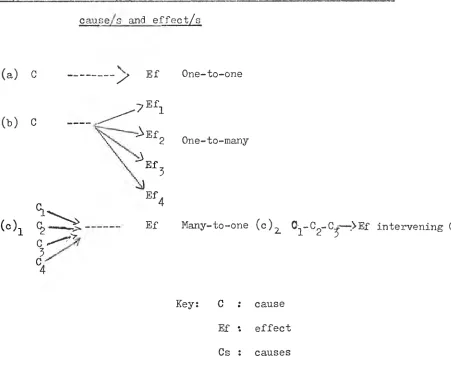
In analysing causality,a number of conditions may be considered these are the "one-to-one" "one-to-many" and "many-to-one" (see Figure No. la - c). In Figure No 1 (b) and (c)
1 (c)2 we consider the conditions as pluralistic concerning either causes or effects. In all three
conditions there are the elements or relationship, sequence and yrobabil-
.12z.
LtmLe.fnoQ:.nf.poEailagsojzL-t;i.o2s
that could exist between cause/s and effect/s(a) C
Ef One-to-one(b) C
Ef2 One-to-many Ef
3 Ef
4
Ef Many-to-one (c)
/ Ci-C2-C-7NEf intervening Cs C
3 4
Key: C : cause Ef : effect Cs : causes
When children perceive causal pluralityl it is likely that
some children might have a further appreciation as to possible inter-relationships between the various causes i.e. C
1 C2 C3 C4 etc. see Figure 1 (c). Whether indeed there is some hierarchy in the way C1 to C4 may be producing an effect)is another question the point at issue here can children appreciate the multiple nat':re of some causal situations? This in turn now brings in the element of probability,in a very skilful explanation of probability Braithwaite refers to two main "senses" in which probability can be viewed; (a) In the sense that probability can be seen within a scientific hypothesis and referred to by Carnap (1945) as relative frequency by*Kneale (1949) as chance and by Russell (1948) as mathematical probability and (b) In the sense of "reasonableness" referred
* See Braithwaite (1968) p. 120.
to by Carnap as confirmation, by Kneale as acceptability and to Russell as credibility. In this investigation i the element of probability is envisaged mostly in terms of Braithwaite's logical or scientific inter-pretation,as children are asked to express what is the most likely cause from a number, which they themselves might give and reasons for their selection. In other words a logical explanation of why a particular cause or set of causes is chosen from the possible causal sources. The questions are put in such a way that the choice if made, produces an appreciation of the likelihood or reasonableness of a particular causal system. This means that the epistemological component of probability is included but to a lesser extent, lesser becauseof the immediate impact of the question probing logicalityj giving the child no real opportunity to respond along purely epistemological lines. This was purposely engineered by the author in order (a) to keep within the narrow limits of a logical as opposed to an epistemological view of causality; (b) because this study attempts to probe what, if any relationship exists
between children's causal and other abilities especially those of a
logical disposition e.g. problem solving,their conservation of volume etc..
(c) The invariant association of one thin with another
Such a view of cause arises in "whenever" instances i.e. "whenever the rain falls we get wet". Here invariance is claimed to hold between something which happens first,and is followed by a consequence, that means, there is temporal separation or some sequence between what is taken to be a cause and what is taken to be the effect.
However in both cases the kind of events about whether such
invariance is the feature, is the recurrent nature involving not one but
a class of events. Recurrent events are related as they happen time
after time,but equally important the events recur in the same relation in each instance.
Invariance therefore in this context is seen within a lawful statement, in which an invariant association is supposed to hold. The invariant association views causality to be a matter of lawfulness and also a matter of predictability. In investigating this notion of causality with children aged nine years plus, the principal aim was to see how far they were able to detect sequence in a "lawful" context.
(d) Causal Ground: necessary condition, sufficient condition, and necessary and sufficient condition
Another interpretation of cause is seen as a source, ground or condition which gives rise to some consequence.
This type of causal situation also known as genetic cause is one
in which consequence occurs through a series of intervening events (or
causes). Associated with this conception of cause,is the generative origin, a beginning from which a late effect may be said to derive. Wartoffsky speaks of a cause "bringing into existence". This is an interpretation of causality in which every causal instance brings some-thing else into existence through some activity in time. Causal ground can be seen as a complex in itself e.g. complex states of matter giving rise to some upheaval e.g. volcanic eruption etc.;here the underlying cause is one of simultaneity providing the existence of sources for
and sufficiency when referring to antecedents and consequents, i.e. those antecedents which were present only when the consequents were also present, where consequents are only present when antecedents are present and finally, where consequences are never present without the antecedents.
However, such an interpretation of causality is very deterministic and gives no place for "chance" or spontaneous events. In other words, this view of causality says that all relations among phenomena in the universe are such that everything is a necessary and sufficient condition of everything else; causa acquat effectum i.e. cause is equal to an, effect. But it is more than a matter of equivalance,it becomes a matter of identity already referred to earlier in this chapter and a matter which Meyerson has addressed himself most adequately in his work entitled "Identity and Reality." These conceptions of causality were also explored in this studyl to find out to what extent children supposedly
exhibiting concrete modes of thinking at age nine plus are able to begin appreciating such causal subtleties or not?
(e) Contingent and NesessaryCausal Connection
A causal relation is said to be contingent when it could be otherwise than it is. In the example where "a child missed his science lesson
%
because he was ill it is conceivable that (a) he could have attended the class even if he was ill; (b) or he may not have been ill at all.
of view is an impossibility. In other words we have a case of necessar causation in an em irical instance.
In analysing such a view of cause, notions of determinism are bound to be considered. In the case of a car accident involving two causal chains i.e. either due to mechanical causality or human
causality of intention, the accident could be from either chain an accidental event.
Therefore,a distinction can be made between what might be called "fatalistic determinism" and "contingent determinism". In one way every causal situation can be seen in such termsjin which contingency is only the appearance of things underneath which is the "real" deterministic, fatalistic nature of the situation.
Now when viewing this type of causal notion, and discussing its relationship to scientific laws, one is faced with the dilemma that laws are stated in precise form for universal applicability, while our
know-ledge of necessary and sufficient tell us they are unwarranted empirically. This it seems,has engaged scientists and philosophers separating
conditional statements of laws from unconditional postulates of causality. Contingent and necessary cause was also explored in this investigation, to see if and how children appreciated such causal notions, and to see if they were able to detect or begin to detect an overlying contingency beneath a bed rock of determinism.
(f) Causality as a relation of functional deoendencr
A functional dependency relation is one in which the values of two
sufficient condition as well as contingent and necessary causal
connection. This is because they speak of originative causal grounds,
or necessity and mathematical laws formulated in this way, to answer
these conditions, and make all ontological claims about "real" and
necessary. This means,we cannot apply such a conception of causality
as we do not know enough about the other variables involved in the
relations. For instance applying causality as a relation of functional
dependency to investigating an effect when temperature increase, is
related to pressure increase, is more possible, as we know what we are
measuring and manipulating. Causality is scientifically formulable
when a causal situation is portrayed in a formulated manner e.g.
Fpm (d2 x / dt-)
However, one could agree with Russell when he states that physicists
make do with differential equations and therefore they bypass or ignore
animistic, anthropomorphic views of cause. Does this mean however,that
the physicists do not consider any metaphysical interpretation of cause?
The use of cause in this particular context was not followed up
as such in this investigation,although the relational element referred
to above was explored in several tests.
(g)Retro-active Causality
Another conception of causality,is one which introduces the feedback
element into it. There are many instances in science of such conditions,
but little if any investigation, has been carried out on childrens'
conception of this type of causality. An example of such retro-active
"the more the girl laughed the louder her voice became, the louder her voice became the more she laughed".
Her laugh is causing the voice to get louder and voice loudness presumablyi now causes more laughing.
In a way this can be interpreted as a lawful relation but one in
which there is a relation of invariant or statistically ordered succession.
A succession where antecedents and consequents are temporarily separated,
but in which a consequence becomes an antecedent,for that same class of events which was its antecedent.
Now feedback systems are usually systems with a preferred state of operation,or have some end which all the parts of the system subserve. However such an explanation usually means the awareness of a system to this preferred state or "end". In physical systems like central heating, the question of "ends in view" is lessened by self-regulating mechanisms, as so-called law ordered physical systems, in which retroactive causality is so structured that there are loopa which transmit cause and effect. However such a system requires energy as an input and one could argue this initiates the whole causal chain. In other words energy source is the initial cause. This rather difficult conception of cause for
children to appreciate is nevertheless a notion which appears in school science curricula e.g. rain cycle, central heating system etc. and ibr this reason was investigated in this study.
(h) Causal Relation as action by211t1ItaAztion at a distance and symp
a
thetic actionPerhaps one of the most common interpretations of the causal
in terms of action finds three dimensions, action by contact, action
at a distance and =pathetic action. These forms of causality are
interesting and relevant ones to consider,when studying children's
conception of cause. This is because,they are for the most part
appreciated by them during some time in their lives. These three
conceptions of causality may be explained briefly.
When a stone strikes a glass and breaks it,we have an instance of
action by contact. The effect is a direct result of an impact which
contains the elements, contact and force.
Action at a distance may be exemplified by gravitational force.
However, in classical mechanics,Newtonts space is not a medium, such a
force acts instantaneously rather than by causal transmission through
time. However,as Wartoffsky points out, the fact that we use models
in science in which we pull strings etc. underlies our unease about
causality, action and distance.
Even more primitive interpretations of this notion of cause,is met
when there is talk of dreams and spirit, which are given causal properties
and are supposed to produce effects at a distance. These
interpreta-tions extend also to magical explanainterpreta-tions, and in scoring childrenst
responses to questions of physical causality, Piaget (1930) included
such conceptions in some of his seventeen ways children appreciate
causality. Plass (1956) who explored this area further preferred to call
such responses,Non-naturalistic.
Causality as a sympathetic action is seen when a wish is expressed.
The realisation of which is effected by the force of the wish,without any
mediation. This type of causal notion has more than a "magical" ring
about it. It is perhaps here above all/ that Russell's view of replacing
models of causality are supposed to be wanting/ because they are 22ague or redundant. They are opaque in that we are unable to solve the origin of such a relationship; redundant in that causality is explained with a model. However,causal relations are seen by both children and adults in terms of action models, real connections
between things, production of effects by causes, conceptions of cause in terms of "effort" etc.
CHAPTER 3
CHAPTER
3
THEORETICAL APPROACHES TO THE PSYCHOLOGICAL STUDY OF CAUSALITY
INTRODUCTION
In the last chapter the philosophical and scientific interpreta-tions of the causal principle were examined. This was done to provide an important background to a consideration of the principle, and to give the psychological perspective with which this thesis is concerned, a more fundamental basis.
This chapter and the two that follow 9 will review the pertinent psychological literature concerned with causality,and more specifically physical causality. Through reviewing the literature, an attempt will be made to bring into the open some of the theoretical and methodological questions any psychological study concerned with causality is likely to meet,and which this investigation has explored and tried to answer.
Two areas will be discussed in this chapter.
3.1 "Philosophico - Psychological Bridges" and the investiga-tion of the Causal Principle.
3.2 The Genetic - epistemological view of causality - the Theory of Jean Piaget.
3.1 "Pili1.229 hik_.. .dges" and the Investigation of the Causal Principle
read the works of Piaget (1942), Janet (1935); Bruner et al (1966),to see the emphasis that these psychologists put on the importance of studying
relational thinking. Howeverjachotte (1963) pointed out that only problems concerning the epistemological nature and origin of functional relations have received most attention. However, this is only partly true/ for since Michotte's work on the perception of causality, Kelley (1973) and Siegler (1975) have investigated the mechanics whereby children and adults appreciate causal plurality. More of this recent work will be mentioned later in the next chapter. However/ at this point, let us consider the link or bridge that exists between the
philosophical and psychological interpretations of causality, for it is the opinion of the author,that each interpretation is crucial to the understanding of the other, and in the final analysis to causality itself. No psychological study of causality can ignore the philosophical and scientific debate, that took place in the long history of the causal principle,and its importance or otherwise to the furtherance of human understanding. Although in the 20th centuryi the causal principle has been perhaps put into its "proper context",i.e. one of many scientific principles useful but not always necessary to explain scientific phenomena, it nonetheless figures prominently in the way children and adults explain the world around them. For this reason alone,a study of an appreciation of causality is justified.
The origin of the idea of causality/ has always held an important place in philosophy, science and in psychology too. The problems concerning causality which philosophers like Hume, Kant and Malebranche probed were mainly epistemological ones. They were concerned to discover what will justify the characteristics of necessity and universality/ by
"advocating that necessity and universality could not be derived directly from ones own experience.
Hume (1748) however, went further when he asserted that in perceptual experience1 we have no direct impression of the influence exerted by one physical event or another. Causality, according to Hume is a process of regularity in the succession of events,and is based on anticipation and expectation, i.e. one event follows another.
This interpretation found favour with the associationist psychol-ogistsl and the present day behaviourists,who are fervent advocates of an analytical and objective stance in explaining human behaviour.
The interesting theory of the eighteenth century philosopher Biran, provides another interpretation of causality, in which internal experience plays a vital role in the experience of our own causality. For Biran this experience constituted the
Erimaryfaat ) providing
the foundation for all psychology and philosophy. It is a theory from which*Ach (1910), Michotte and Prim (1910) have derived useful guidelines for their work on causality. Therefore,one of the bridges we can talk of here is that "internal" experience and "external" experience, as far as causality is concerned are on the same footing.The theory of Biran was incorporated into part of contemporary psychological thought by Piaget's work on the origins of causality in children. Piaget (1930) has this to say about Biran.
"The fact the idea of force owes its existence to inner experience seems to be beyond dispute. To Maine de Biran belongs the merit for having stressed this origin". (p. 126).
Although Piaget's Theory of how children develop the appreciation of causality will be discussed later it might be worth mentioning here that
for Piaget, the world of the child is undifferentiated at first. It does not contain things and a self as separate entities as Biran states. There is little differentiation between the internal and external self.
"For everything happens as though the child began by attributing forces to all outside bodies, and as though he only ended by finding in himself the "I"
that was the cause of his own force". LTIaget (1930) p. 12.87 It is in the course of development that a separation is made in the processes of accommodation and assimilation.
force becomes gradually withdrawn from external
objects and confined within the ego". 2T_aget (1930) p. 13.27 and again Piaget (1955)
"Assimilation and accommodation are dissociated to form increasingly complex systems ... To the extent
that this occurs, the causal nucleus - personal activity - is broken into a series of centers by
the progressive objectification of causality". (p. 316)
For Piaget, a child eventually develops from a state in which it seems to him there are connections between certain events, and in which there is an awareness of efficacy i.e. with feeling a bond between the desire and the result obtained.
This view of causality,eventually fades and is replaced by a
mechanical and later a more rational conception of causality. Neverthe-lessi Biran's emphasis on internal experience as an essential part in
So far we have mentioned behaviourist and genetic - epistemological approaches to the explanation of causality. Before leaving this section mention will be made of the Gestalt view as it too has a valid contribu-tion to make to the debate.
Uhler (1929) sees the use of insight as a natural way of explaining causal phenomenal and Koffka (1935) mentions,it is conceivable that one should have a specific impression of causality. Duncker (1935)
emphasizes that where there are causal relations,the events, effect and cause, are not always so detached or separate from each other as Hume had indicated. To Duncker it seems there is a degree of
"Einsichtlichkeit" or the quality of being accessible to insight. This means that the link (if one can use this word) between cause and effect, has spatial coincidence, in which a position of a cause is marked by the position of the effect.
The link may also have temporal coincidence, of two events un-related, happening simultaneously. Furthermore thelink may be one of correspondence ,regarding form and matter, e.g. the marks made by the paws of an animal have the same shape as the object which imprints them.