102
International Journal in Management and Social Science http://ijmr.net.in, Email: [email protected] BUILDING EMPLOYEE BRAND COMMITMENT: THE ROLE OFPSYCHOLOGICAL CONTRACT ‘A Case of Higher Learning Institutions’
David Amani
Assistant Lecturer, Department of Marketing and Entrepreneurship University of Dodoma, Tanzania
Ph.D. Candidate, Mzumbe University, Tanzania
Abstract
Despite the popularity of employee brand commitment in business management studies, the influences of the same are not well documented. Therefore, this study intends to examine the influence of psychological contracts i.e. relational and transactional contracts on employee brand commitment among employees of higher learning institutions. The study collected data from 401 respondents including academic, administrative and technical staffs of the selected University by using a self-administered questionnaire. In addition, data were analyzed by using Structural Equation Modelling (SEM), and the study findings show that psychological contracts i.e. relational and transactional contracts have a significant influence on employee brand commitment. The study recommends that, branding of higher learning institutions should adopt a holistic approach that considers employees as the main engine of the Universities branding process. Finally, the study proposes further empirical studies on psychological contracts, by comparing the level of influence between relational and transactional contracts on employee brand commitment.
103
International Journal in Management and Social Science http://ijmr.net.in, Email: [email protected]1.0 Introduction
1.1 Background Information
At the global level, higher learning institutions particularly universities have recently been experiencing a very competitive academic environment. It is globally accepted that, this is the result of current major higher education sector reforms that have led to significant decrease of support from governments in the terms of funding and other vital resources (Beneke, 2011; Dholakia and Acciardo, 2014; Stephenson and Bell, 2014). In responding to this situation, higher learning institutions have automatically found themselves adopting and integrating some market-oriented or business-oriented approaches in managing their operations (Williams and Omar, 2014; Delmestri et al., 2015). Empirical evidence indicates that, the fact that boundaries that could reduce free movement of both students and staff have continuously been eliminated; universities should expect the ever-growing competitive academic environment in future (Jungblut & Vukasovic, 2013; Erdoğmuş and Ergun, 2016).
In fact, radical and constant changing of students’ and staffs’ demands as well as expectations are an indication that competition in higher academic settings is a constant phenomenon (Harsha and Shah, 2011; Jungblut & Vukasovic, 2013; Williams and Omar, 2014). Evidence shows that, both students and staff expect higher learning institutions to have significant contributions not only to the national development agenda rather to their specific demands and expectations (Judson et al., 2008; Beneke, 2011; Joseph et al., 2012; Stephenson and Bell, 2014). In that respect, in the marketing of higher learning institutions demands and expectations of key stakeholders such as students and staff should be central to the marketing strategies (Balmer et al., 2010; Dholakia and Acciardo, 2014). It should be noted that, these demands and expectations will continue to change due to the emerging use of technology, which provides a room for students, staff, and the public to access massive information about universities across the world (Opoku et al., 2006; Chapleo et al., 2011).
Furthermore, the idea that competition in academic environment will persist gains popularity given the current evidence which shows that; students, staff and other stakeholders would prefer to be affiliated or associated with the university that is credible and has good image and reputation (Bunzel, 2007; Harsha and Shah, 2011; Beneke, 2011). Further evidence confirms that, the local and international labour markets are in favour of students who accomplished their studies from universities with preferable reputations across the world (Hemsley-Brown and Goonawardana, 2007). In addition, other empirical studies reveal that it is only universities with preferable reputation which attract global projects and research funds from international agencies, which is among the primary activities of any higher learning institution (Beneke, 2011; Sataøen, 2015).
104
International Journal in Management and Social Science http://ijmr.net.in, Email: [email protected] stakeholders which is essentially important in building and sustaining the university’s image and reputation (Bock et al., 2014). It is these circumstances that necessitate the need for branding higher learning institutions particularly universities (Stephenson and Bell, 2014; Erdoğmuş and Ergun, 2016). From both theoretical and practical perspectives, branding is popularised as a preferable marketing tool that can help universities to survive in the current competitive academic settings (Curtis et al., 2009; Harsha and Shah, 2011; Drori et al., 2013).Though branding is theoretically postulated to be relevant in building and sustaining reputations of higher learning institutions, scholars continue debating on whether it is practicable to apply the same business-oriented branding approaches to academic settings (Balmer et al., 2010; Erdoğmuş and Ergun, 2016). In fact, scholars on higher education branding agree in principal that, despite of increasing importance to higher learning institutions, less attention has been invested on examining practicability of the same on academic institutions notably universities (Mourad et al., 2010; Williams, 2012; Delmestri et al., 2015). This implies that, while branding is theoretically and practically accepted to be relevant to universities, it calls for different approaches which could accommodate universities’ complexities and dynamisms (Idris and Whitfield, 2014; Delmestri et al., 2015; Sataøen, 2015).
From complexities and dynamism perspective, branding in academic settings requires integration of efforts and interests of both internal stakeholders (staff, students, and management) and external stakeholders (public, alumni, government agencies, suppliers, etc.) (Balmer and Liao, 2007; Atakan and Eker, 2007; Chapleo, 2010). Specifically, staff and students of the university seem to be the most important engine in building and maintaining credibility, image, and reputation of the university (Whisman, 2009; Beneke, 2011; Vasquez et al., 2013; Dholakia and Acciardo, 2014). This means, in the course of building positive reputation, staff and students should be considered as an important engine and hence should be central to the process (Hemsley-Brown and Goonawardana, 2007). However, this particular view has not been given the attention it deserves from both scholars and practitioners on higher education branding (Mampaey et al., 2015).
105
International Journal in Management and Social Science http://ijmr.net.in, Email: [email protected]1.2 Conceptualizing Branding and Psychological Contract
1.2.1 The Concept of Branding
There have been several divergences in defining the term brand. Despite the divergences, several definitions have been offered to describe the term brand. The most popular and frequently cited definition is by AMA (1960) which says, a brand can be a name, term, sign, symbol, or design, or a combination of them, intended to identify the goods and services of one seller or group of sellers and to differentiate them from those of competitors’. In a broader perspective, Martin and Hetrick (2006) suggested that a brand should be seen as a promise that must be made and kept in each strategic marketing operations, human resources operations, corporate decisions, and actions, as well as customer and employee interactions so as to deliver strategic value to an organization.
As a matter of fact, if a brand is perceived as a promise, it implies the use of social-contract theory in branding (McMurrian and Washburn, 2008). That means, when a brand is perceived as a promise it implies the customer-producer relationship. The relationship should be built on fulfilling customers’ expectations as the basis for meeting producer targets or goals (Willmott, 2003). On the other side, Kotler and Pfoertsch (2006) provided the following connotations regarding a brand: First, a brand is indeed a promise. Second, a brand is the sum of perceptions including all that you see, hear, read, feel, think, etc. concerning a product, service, or business.
Third, a brand occupies a distinctive position in customers’ minds as results of past or prior experiences, associations, as well as future expectations, and lastly, a brand is a short-cut of benefits, beliefs, attributes and values that differentiate, minimize complexities, and simplify the consumers’ buying decision process.
1.2.2 Branding in Higher Learning Institutions
It is widely accepted that, branding in higher education falls under corporate branding. Other scholars emphasize that, branding in higher education should be categorized as internal branding which is an integral part of corporate branding (Judson et al., 2008). In fact, the idea behind internal branding is that, branding of an organization should start from within (Berry, 2000; de Chernatony and Segal-Horn, 2003). Evidence confirms that, branding in higher education is an outcome of very stiff competition both at local and international level (Stensaker, 2007). It is suggested that, the need for integrating branding in higher learning education is the result of major transformation in the sector which motivates managements of universities to employ market-based approaches (Ferlie et al., 2008). This means, the idea of commercialization and marketization of higher learning institutions surfaced as a result of employing market-based approaches in the higher education sector (Beneke, 2011).
106
International Journal in Management and Social Science http://ijmr.net.in, Email: [email protected] programs as a means to secure a good position in global rankings and accreditations which is part of image and reputation building (Aula and Tienari, 2011).It is therefore very crucial to note that, in the branding of higher institutions, the focus should be on distinguishing the university by manifesting important features that demonstrate its ability to meet students' expectations, needs or wants (Aula et al., 2015). Furthermore, the intention should be to engender credibility and trust so as to attract qualified students and to help them to make prudent decisions concerning their enrolment (Bennett and Ali- Choudhury, 2009). However, the issue of differentiation as far as branding in higher learning institutions is concerned is debatable. For instance, while it is generally accepted that differentiation should be part of managerial and strategic decisions concerning branding of higher learning institutions, Chapleo (2010) once argued that, most of the time, university branding programs or initiatives provide very little actual outcomes in terms of differentiation.
Other scholars cemented that, branding at an organizational level such as corporate branding needs to consider the forces for similarity and forces for differentiation (Wæraas, 2015). This statement confirms the idea that, certainly there is a slight differentiation in university brand programs or initiatives. This means, when an organization tries to differentiate itself from other organizations, it must ensure that it continues to retain legitimacy and manifest membership in a field of akin organizations (King and Whetten, 2008). Thus, one could say, the question of similarity as well as differentiation forces are basically contradictory and suggest diverse behaviors (Wæraas, 2015). However, irrespective of this situation, universities should deploy different approaches in order to build and sustain the competitive edge in the higher education sector. This is necessary given the fact that, any competitive situations call the need for differentiation by promising and offering unique benefits.
As it has been previously noted, branding of higher learning institutions is very complex and dynamic process. According to Aspara et al., (2014), branding of universities should adopt a holist approach that goes extra miles to address issues concerning universities brand beyond those approaches which concentrate on designing of slogans, symbols, logos, seals, and other traditional marketing communication programs. Evidence shows that, while this approach intends to integrate branding strategies with universities policy development process, it has not been easy to achieve the same (Aspara et al., 2014). This means, branding in the context of higher learning institutions is more of an interactional process comprising of approaches that should seek to accommodate the multiplicity of interests of various stakeholders (Aspara et al., 2014). In fact, this is different from traditional standpoints of branding which emphasized on inducing brand reputations or images from producers to consumers which always lead to poor acceptance of brand (Aspara et al., 2014).
107
International Journal in Management and Social Science http://ijmr.net.in, Email: [email protected] reputation (Wæraas and Byrkjeflot, 2012; Bagautdinova et al., 2015). Actually, for this approach to be feasible and effective, basic requirements such as stakeholders’ (employees, customers, and management) commitment must be fulfilled (Jane Hemsley-Brown et al., 2016). Generally, this approach is relevant to higher learning institutions, as they possess all the basic features of organizations (see Bagautdinova et al., 2015). Regardless of great emphasis on branding in the higher education institutions, empirical studies in relation to university branding is indeed scarce, and therefore the majority of universities continue to use traditional methods of marketing (Aspara et al., 2014), which pay no attention to the complexities and dynamisms of higher education institutions (Chapleo, 2010).It is for these arguments, this study proposed a holistic approach that will examine university branding by considering employees as an integral part of the branding process. It intends to examine how employees as an important engine of university branding can be motivated to demonstrate commitment towards university brand. It has been well documented that, employees of higher learning institutions could be the most powerful representatives or ambassadors of the brand if are well motivated (Melewar and Nguyen, 2015; Jane Hemsley-Brown et al., 2016). The study used the psychological contract as a catalyst that is expected to stimulate employees’ brand commitment. In the view of Zhao et al., (2007) empirical studies are required to examine the impact of the psychological contract on areas such as organizational citizenship behaviour. In fact, under intensive scrutiny, employee brand commitment is an integral part of organizational citizenship behaviour (Kimpakorn and Tocquer, 2010).
1.2.3 The Concept of Psychological Contract
Theoretically, the construct psychological contract has been and is still very popular in various fields including organizational behaviour, human psychology, sociology, industrial relations, etc. (Koskina, 2013). It is widely accepted that, regardless of the field where the concept of psychological contract is applied, the fundamental idea remains to be relationship building. In this particular context, the focus of scholars over the past 20 years has been to examine psychological contract as a prediction of the relationship between an individual mostly an employee and an organization or an employer (Taylor and Tekleab. 2004; Zhao et al., 2007). Empirical evidence reports that, the concept has been proven to be very useful in studies related to employee-employer relationship, employees’ motivation and commitment, employees’ intentions etc. (Taylor and Tekleab. 2004; Zhao et al., 2007).
In the context of marketing, psychological contract is theoretically propagated to be relevant in theorizing various marketing phenomenon although it is empirically under-researched (Bordia
108
International Journal in Management and Social Science http://ijmr.net.in, Email: [email protected] intention to stay, positive recommendations, etc. (Mende et al., 2013). Therefore, scholars such Johnson and Selnes (2004) proposed that the psychological contract should be treated as an integral part of marketing as it shares numerous characteristics with marketing particularly the idea of exchange relationship between two parties.Therefore, the psychological contract should be viewed in the context of relationship building between two parties, of which each part should be ready to fulfil specific conditions that create favourable environments for the relationship to flourish. The fact that it is a contract, then, each part has specific obligations to perform or role to play so as to ensure the relationship is established and sustained. In addition, both parties have expectations that expect to get or achieve in the exchange relationship. Based on these arguments, Rousseau (1995) points out that, the term psychological contract refers to beliefs or perceptions that an individual person develops about a certain organization based on specific conditions or terms of a certain exchange agreement between the individual and the organization. It is generally accepted that, these perceptions or beliefs should be moulded by the organization that is, the organization is expected to be the source of the perceptions and beliefs.
Evidence shows that, an individual person expectation on what an organization has promised or supposed to fulfil is the basis for building either positive or negative beliefs or perceptions about the organization (Rousseau, 1990). In the context of the employee-employer relationship, other scholars have the opinion that, it is the organization promises that build employee expectations which in turn elicit employee specific beliefs and perceptions. Theoretically, a psychological contract is capable of prompting different forms of behavior including attitudes, perceptions, responses, as well as the roles and responsibilities of each actor in the contract. These forms of behaviours are anticipated to persuade both parties to cultivate a sense of control over the current relationship (Anderson and Schalk, 1998). In fact, employee beliefs and perceptions of what an organization is supposed or required to do play an important role in building employee commitment.
1.2.3.1 Major Types of Psychological Contract
Different scholars agree in principal that, there are two major types of psychological contract namely transactional and relational psychological contracts. According to Rousseau (2004), a transactional psychological contract is a formal contract guided by well-defined conditions and principles. It contains distinct clauses and requirements, as well as responsibilities and duties which each party in the contract has to accomplish. Given this nature, the transactional psychological contract contains elements that can be legally enforceable. In fact, transactional psychological contract possesses all basic features of being legally enforceable given the fact that agreement, requirements to be fulfilled by each party are feasible, and terms, as well as conditions of the contract, are clear and explicit (Rousseau and Tijoriwala, 1998).
109
International Journal in Management and Social Science http://ijmr.net.in, Email: [email protected] relationship which lives longer. This is the case because, the major assumptions which underline transactional psychological contact include the idea that, both actors in the contract are indeed rational and self-centred (Rousseau and McLean Parks, 1993). Therefore, when the transactional psychological contract is applied in explaining employee-organization relationship the focus is on promises in the form of extrinsic rewards that are expected to motivate employees working behavior (Rousseau, 1990). In this regard, the focus in relationship building is primarily materialistic whereby employees are working hard to acquire material things in the form of monetary benefits (Bal et al., 2013).On the other side of the coin, there are relational psychological contracts which are established within the framework of flexibility, good faith, implicit and virtual promises between a person or an employee and a certain organization (Rousseau, 1995). Although material things or benefits are still valid under this type of psychological contract, social-emotional value dominates the relationship. Therefore, the fact that relational exchange dominates the relationship, the relational psychological contract is termed as a long-term contract which seeks to build the sustainable mutual relationship between both actors i.e. employees and an organization. Evidence divulges that, any relationship that has root on the relational psychological contract has proved to be timeless and fruitful. This characteristic of being sustainable in terms of results, as well as impacts, differentiates relational psychological contracts against transactional psychological contracts (Anderson and Schalk, 1998). According to Rousseau (2004), the majority of successful organizations are the ones which has invested considerable efforts on fulfilling relational psychological contract so as to motivate employees to commit their efforts in work beyond what is specified in job descriptions.
In addition, another basic characteristic that distinguishes relational psychological contract from the transactional psychological contract is its nature of being subjective. This is the case because, the relational psychological contract is not too formal, and terms, as well as conditions that govern the contract, are implicit, or they not feasible. Thus, in the course of interpreting terms and conditions of the contract a number of contractions as well as misunderstandings may arise (Rousseau, 1995). That means, the way one party describes or perceives terms and conditions of the contract may differ significantly from the other party. This can be confirmed from different studies including the study by Bunderson (2001) which pointed out that, the moment there is a breach of relational psychological contract, its effects can be seen on individuals’ satisfaction and their level of commitment to the organization. He went on reporting that, transactional psychological contract affects both individuals’ satisfaction as well as turnover intentions.
110
International Journal in Management and Social Science http://ijmr.net.in, Email: [email protected] result, scholars such as Zhao et al., (2007) suggested further studies concerning psychological contract mainly on its influence on behavioural outcome measures such as constructive and destructive reactions, intention to switch, and organizational citizenship behaviour constituted by employee commitment and support behaviour.In a special way, employee brand commitment is among the responses which employees exhibit after being exposed to various motivational forces and has drawn the attention of various scholars in recent time. However, employee brand commitment has recently attracted the considerable attention of different scholars in internal branding, it is not clear what actually drives employee brand commitment (Terglav et al., 2016). This study, therefore, aims at examining the role of psychological contract in influencing employee brand commitment. In other words, the study intends to examine whether the psychological contract should be considered as the most influential driver of employee brand commitment in higher learning institutions.
2.0 Theoretical Base
2.1 Social Exchange TheoryGiven the nature of the study, the social exchange theory was adopted to explain the influence of psychological contract on employee brand commitment. It is well documented that, a brand as a promise implies a social contract between two parties. In fact, the social contract in the context of branding suggests that there is a mutual agreement between two parties, of which each part expects to get something of value from the other party. This is in line with the idea that the psychological contract has a root from social exchange theory (Bordia et al., 2015). The theory is popularized to be very powerful in describing how different forms of relationships can be established and maintained. In the context of the social exchange relationship, individuals are expected to exchange both social and material resources. In the view of Blau (1964), social exchange theory provides a framework that explains what kind of resources are exchanged and how the resources are exchanged (Guo et al., 2015).
Empirical perspectives suggest that, two major types of psychological contract i.e. transactional and relational psychological contracts create a good theoretical foundation to explain how both social and material resources are exchanged and their impact on relationship building. By considering its assumptions including trust, mutual agreement, promises, etc. the theory is commended in explaining the concept of psychological contract (Wang and Hsieh, 2014). In social exchange, the concept of reciprocity is very important, as there must be environments that support mutual exchange in terms of giving and taking between actors in the relationship (Rousseau 2001).
111
International Journal in Management and Social Science http://ijmr.net.in, Email: [email protected] terms stipulated in the psychological contract, employees are therefore expected to reciprocate with constructive responses in the form of brand commitment different from unfavorable responses such as negative word of mouth recommendations.3.0 Methods
3.1 Area of StudyThe study area was Dodoma Region, Tanzania. This study adopted a cross-sectional survey design given its usefulness in collecting data at one point in time as well as place and divulge a relationship between the study’s variables or an inquiry that investigates an existing phenomenon (Yin, 2009). It is convenient in evaluating practices and dogmas of a specified population in relation to a certain social, natural and health-related event in their vicinity (Yin, 2009). The surveyed data were collected from employees i.e. academic, administrative, and technical staffs at one selected university in Dodoma region, Tanzania. However, it was agreed by the university management and the researcher that, the name of the university should not be unveiled as the findings of the study might have some detrimental effects to the university.
3.2 Data Collection
The study sample was randomly drawn from the study population. In fact, the idea behind a random sample is that all potential members of a given population have equal opportunity or chance to be chosen to participate in the study. Thus, the sample for the study was randomly and carefully chosen from the list of existing employees as the population of the study by using a systematic sampling method (Zikmund, 2003). In addition, a list of University employees who met the basic criteria of the population was derived from the Directorate of Human Resources of the selected University. Thereafter, a total sum of 401 respondents who are employees of the University were randomly selected to participate in the study. Basically, the systematic sampling technique comprises of careful procedures whereby an entering point is established by using a random process and thereafter every nth number of the given list or frame is selected to form the study sample (Zikmund, 2003). In this study, every third name on the list was chosen to participate in the study.
3.3 Data Analysis
112
International Journal in Management and Social Science http://ijmr.net.in, Email: [email protected] 3.4 Operationalization and Measurement of VariablesIn measuring the study variables, specific measurement scales were adopted from previous related studies on employee branding as well as psychological contract. Specifically, both types of psychological contracts i.e. transactional and relational psychological contracts were measured by using measurement scales adopted from Bal et al., (2013). The following are some statements used to measure psychological contracts; I expect growth in this university, to me working in this university is like being a member of a family, I work only hours set out in my contract and no more, my commitment to this university is defined by my contract. Furthermore, Employee Brand Commitment was measured by using measurement items proposed by Kimpakorn and Tocquer (2010); Terglav et al., (2016). Some of the statements used to measure Employee brand commitment include: I usually tell my colleagues and friends that, this is the best office to work with; I really care about this university brand, I am willing to put in a great deal of effort beyond that I normally expected in order to help this university brand to be successful. All variables were captured by using 5 - Point Likert Scales 1 - Strong Agree and 5 - Strong Disagree.
4.1 Results and Discussion
4.1.1 Respondents’ Characteristics113
International Journal in Management and Social Science http://ijmr.net.in, Email: [email protected] Table 1: Respondents Demographic CharacteristicsRespondents’ Characteristics Frequency Percent (%)
Gender Male 197 49.1
Female 204 50.9
Total 401 100
Age 21 - 30 5 1.2
31 - 40 261 65.1
41 - 50 117 29.2
51 - 60 15 3.7
60 - above 3 0.7
Total 401 100
Maritual Status Married 309 77.1
Single 91 22.7
Divorced 1 0.2
Total 401 100
Level of Education Secondary Education 2 0.5
Diploma 14 3.5
Degree 181 45.1
Master Degree 136 33.9
PhD 68 17
Total 401 100
Occupational Status Academic Staffs 178 44.4
Administrative Staffs 165 41.1
Technical Staffs 58 14.5
Total 401 100
Source: Field Data Analysis, 2018
4.1.2 Measurement Model
It is strongly recommended that, regardless of whether the study constructs or variables have been extracted or derived from theories or intensive empirical literature reviews, to run Confirmatory Factor Analysis (CFA) is compulsory (Holtzman and Vezzu, 2011). The aim of performing CFA is to confirm whether the hypothesized model fits well the sampled data or a given set of observations. Other scholars point out that, CFA intends to establish if there is the existing relationship between the observed study variables and their specific underlying study latent or unobserved constructs (Child, 1990). Most of the time, CFA is very useful or is highly recommended in testing the extent to which the proposed measurement items precisely and accurately explain or measure a given study construct or variable (Hair et al., 2006; Holtzman and Vezzu, 2011).
114
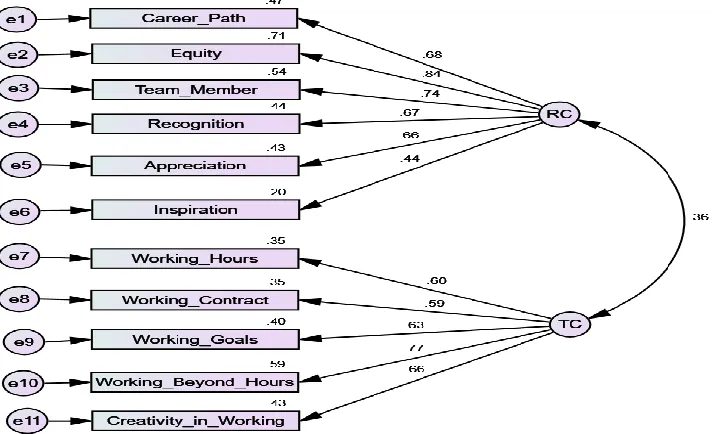
International Journal in Management and Social Science http://ijmr.net.in, Email: [email protected] Approximation (RMSEA), Goodness of Fit Index (GFI), and Adjusted Goodness of Fit Index (AGFI). The table 2 and figure 1 below show the value of model fit indices and item factor loadings respectively. Specifically, goodness of fit for measurement model indicates or shows that NFI = 0.913, IFI = 0.940, TLI = 0.923, CFI = 0.940, GFI = 0.944, AGFI = 0.914 the acceptable values is that it should be close to 1, RMSEA = 0.071 and acceptable value is 0 to 0.1, 2/df = 2.998 and recommended value is < 3.On the other side, after running CFA, two items i.e. Motivation and Working Contract were found to have factor loading less than the most recommended value for item factor loading which is 0.60. However, according to Hair et al., (1998); Kline (2005); Tabachnick and Fidell (2007) if the study sample size exceeds 350 item factor loading > 0.30 can be considered for structural model analysis. Furthermore, the Cronbach alpha coefficient for Relational Contract (RC) and Transactional Contract were 0.826 and 0.782 respectively the value which is above the recommended range i.e. > 0.70. Hence, the level of reliability that these variables measure psychological contract construct is good.
Table 2: Measurement Model Goodness of Fit Indices
Model Fit Indices
Model NFI IFI TLI CFI RMSEA GFI AGFI 2/df
Default model .913 .940 .923 .940 .071 .944 .914 2.988 Saturated model 1.000 1.000 1.000 1.000
Independence model .000 .000 .000 .000 .254 .473 .368
Acceptable ranges: NFI, IFI, TLI, CFI, RMSEA, GFI, and AGFI should be close to 1, RMSEA should be between 0 and 0.1, CMIN/DF (2/df) < 3
(Kline, 2005; Hooper et al., 2008)
115
International Journal in Management and Social Science http://ijmr.net.in, Email: [email protected] Figure 1: Psychological Contract (Relational Contract and Transactional Contract) Confirmatory Factor AnalysisSource: Field Data Analysis, 2018
4.1.3 Regression Analysis
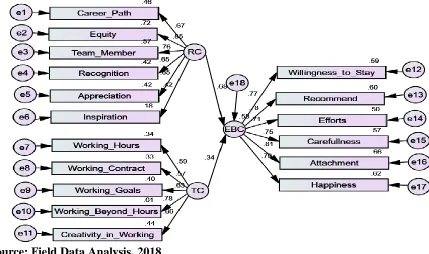
After running Confirmatory Factor Analysis (CFA) all items were confirmed to be good measures of constructs under the study, which provided the room for conducting the structural model analysis. The aim of the structural analysis was to establish cause and effect relationships between psychological contract variables i.e. relational and transactional contracts against employee brand commitment. In addition, the analysis was expected to give regression weights, as well as the level of significance between exogenous and endogenous variables. The model fit indicated that, the model fitted the sampled data well as it can be seen in table 3 below. The value shows that, CFI = 0.926, GFI = 0.904, IFI = 0.926, NFI = 0.894, and TLI = 0.914. It is recommended that the value for these indexes should be close to 1. Again, the value RMSEA = 0.071 and recommended value is that it should be between 0 and 0.1. The value for 2/df = 2.994 and threshold is 3.
This implies that, overall model fitted well the data and therefore the model was accepted. In addition, internal reliability and consistency were tested and the results show that the Cronbach Alpha coefficient for Employee Brand Commitment was 0.902, which is above the threshold of
116
International Journal in Management and Social Science http://ijmr.net.in, Email: [email protected] exceeds 350 respondents, factor loadings with the value > 0.30 is satisfactory and acceptable (See. Hair et al., 1998; Kline, 2005; Tabachnick and Fidell, 2007).Figure 2: Structural Model Shows Relationship between Psychological Contract and Employee Brand Commitment
Source: Field Data Analysis, 2018
Table 3: Structural Model Fit Goodness of Fit Indices
Model Fit Indices
Model NFI IFI TLI CFI RMSEA GFI 2
/df
Default model .894 .926 .914 .926 .071 .904 2.994 Saturated model 1.000 1.000 1.000 1.000
Independence model .000 .000 .000 .000 .241 .299 24.197
Acceptable ranges: NFI, IFI, TLI, CFI, RMSEA, GFI, and AGFI should be close to 1, RMSEA should be between 0 and 0.1, CMIN/DF (2/df) < 3
(Hooper et al., 2008; Kline, 2005)
117
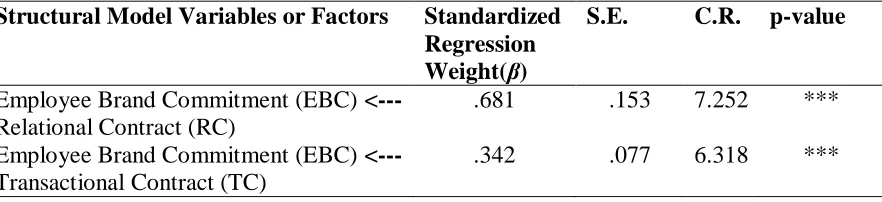
International Journal in Management and Social Science http://ijmr.net.in, Email: [email protected] 4.1.4 Regression WeightsThe results from regressed variables i.e. Relational and Transactional Contracts against employee brand commitment revealed that the relational contract has a high level of significant impact on employee brand commitment with p-value < 0.05 and β = 0.681. Likewise, transactional contract was confirmed to have a high level of significant influence on employee brand commitment with p-value < 0.05 and β = 0.342. Thus, based on the findings it can be concluded that both study variables which used to explain psychological contract which are relational and transactional contracts influence employee brand commitment significantly.
Table 4: Structural Analysis Results
Structural Model Variables or Factors Standardized
Regression
Weight(β)
S.E. C.R. p-value
Employee Brand Commitment (EBC)
<---Relational Contract (RC)
.681 .153 7.252 ***
Employee Brand Commitment (EBC) <---
Transactional Contract (TC)
.342 .077 6.318 ***
Source: Field Data Analysis, 2018
5.1 Discussion
It has been revealed by the study findings that, the psychological contract has a high level of significant influence on employee brand commitment. Basically, these findings conform with preceding empirical findings that, psychological contracts have the influence on employee organization commitment (see. Coyle-Shapiro and Kessler 2000; Flood et al., 2001; Aubé et al., 2007; Malik and Nawab, 2010; Anggraeni et al., 2017). Specifically, both relational and transactional contracts have been found to have a high level of statistical significance on employee brand commitment. In a more simplified way one could say, if employees feel/believe that an institution offers equal chances for career development, fairness, recognition, appreciation, inspiration, fellowship, etc., they are willing to reciprocate in the form of caring, efforts, positive recommendation, intention to stay, etc. Theoretically, the moment employees exhibit behaviour such as caring, positive recommendation, intention to stay, efforts, etc. it implies that they are committed to the university brand.
118
International Journal in Management and Social Science http://ijmr.net.in, Email: [email protected] universities engage employees in brand building with intention of getting a unified or an integrated brand which can easily get the support of all key stakeholders particularly employees.Specifically, in order to build employee commitment towards the university brand, employees have to be exposed to specific intrinsic factors which influence their behaviour positively. Similar to other studies in employee-employer relationships such as (Kaewsurin, 2012), in this study psychological contract dimensions confirmed to be useful in influencing employees commitment towards university brand. In addition, these intrinsic factors motivate employees to exert specific efforts in ensuring universities realize their mission and vision. These results are similar to the results by Mangold and Miles (2007); Kaewsurin (2012); Terglav et al., (2016) who found out that, employees are willing to exert remarkable support, commitment or efforts on organization success if they feel or believe that psychological contract is upheld. In a special way, the study by Schiffenbauer (2001) Judson et al., (2008); Kaewsurin (2012) reported that the value of organization brand will consistently gain credibility if employees within an organization provide required support and assistance.
On the other side, in the relation to the study findings, Rousseau (2004); Thompson and Heron (2005) reported that employees are ready to offer significant efforts with the condition that, their efforts should be equal to the rewards they perceive to get from the organization. In other words, employees expect the transactional contract to be upheld for them to reciprocate positively. Other scholars consider this as perceived distribution i.e. employees expect their efforts to be valued through getting back rewards in the form of financial considerations (Kickul, 2001). In this view, employees may reduce their contribution if their expectations have not been fulfilled (Bordia et al., 2010). This means, similar to other employees, employees of higher education are highly committed to the university brands if they perceive that there is a close association between what they commit to the university brand and what they would get from the brand. In addition, these study findings are similar to the study by Lee and Liu (2009) who revealed that psychological contract dimensions i.e. transactional and relational contracts have a significant impact on work attitude that was defined by three items i.e. organizational identification, work devotion, and work satisfaction.
6.0 Conclusion and Recommendations
119
International Journal in Management and Social Science http://ijmr.net.in, Email: [email protected] Thus, given the findings of the study, the following major recommendations are important:1. Different from the branding of products, branding of higher learning institutions calls for the need for adopting a holistic approach. Empirically, branding of organization requires aligning of stakeholders’ interests in this case employees and organization vision, values as well as culture. This means it is very important to assimilate or bring into line employees’ efforts, interests, and expectations with organization vision, values, and culture. By so doing, employees become the main engine of the process, which is very crucial in nurturing and sustaining employee brand commitment. In actual fact, if employees are committed to the university brand the likelihood of delivering brand promises which meet customers’ expectations is high.
2. Similar to other employees, employees of higher learning institutions always hold specific expectations of which the universities should fulfill. In addition, employees expect promises promised by the institutions are fulfilled. In fact, to employees when these expectations and promises are fulfilled, it is an indication that psychological contract has been upheld. According to the study findings, the feelings or beliefs that psychological contracts have been upheld or not has the influence on the level of commitment which employees are expected to offer to the brand. In addition, this determines the extent to which employees will deliver brand promises and eventually meeting customer expectations.
7.0 Limitations and Future Studies
120
International Journal in Management and Social Science http://ijmr.net.in, Email: [email protected] 8.0 References:Anderson, N., & Schalk, R. (1998). The Psychological Contract in Retrospect and Prospect.
Journal of Organizational Behaviour, 19, 637-647.
Anggraeni, A. I., Dwiatmadja, C., & Yuniawan, A. (2017). The Role of Psychological Contract on Employee Commitment and Organizational Citizenship Behaviour: A Study Of Indonesian Young Entrepreneurs in Management Action. SA Journal of Industrial Psychology, 43(1), 1-9.
Aspara, J., Aula, H. M., Tienari, J., & Tikkanen, H. (2014). Struggles in Organizational Attempts to Adopt New Branding Logics: The Case of a Marketizing University.
Consumption Markets & Culture, 17(6), 522-552.
Atakan, M. S., & Eker, T. (2007). Corporate Identity of a Socially Responsible University-A Case from the Turkish Higher Education Sector. Journal of Business Ethics, 76(1), 55-68.
Aube, C., Rousseau, V., & Morin , E. M. (2007). Perceived Organizational Support and Organization Commitment: The Moderating Effect of Locus of Control and Work Autonomy. Journal of Managerial Psychology, 22(5), 479-495.
Aula, H. M., & Tienari, J. (2011). Becoming "World-Class"? Reputation-building in a University Merger. Critical Perspectives on International Business, 7(1), 7-29.
Aula, H. M., Tienari, J., & Waeraas, A. (2015). The University Branding Game: Players, Interests, Politics. International Studies of Management & Organization, 45(2), 164-179.
Bagautdinova, N. G., Gorelova, Y. N., & Polyakova, O. V. (2015). University Management: from Successful Corporate Culture to Effective University Branding. Procedia Economics and Finance, 26(2015), 764-768.
Bal, P. M., Kooij, D. T., & De jong, S. B. (2013). How Do Developmental and Accommodative HRM enhance Employee Engagement and Commitment? The Role of Psychological Contract and SOC Strategies. Journal of Management Studies, 50(4), 545-572.
Balmer, J. M., & Liao, M. N. (2007). Student Corporate Brand Identification: An Exploratory Case Study Corporate Communications. An International Journal, 12(4), 356-375.
121
International Journal in Management and Social Science http://ijmr.net.in, Email: [email protected] Beneke, H. J. (2011). Marketing the Institution to Prospective Student-A Review ofBrand(Reputation) Management in Higher Education. International Journal of Business and Management, 6(1), 29-43.
Bennett, R., & Ali-Choudhury, R. (2009). Prospective Students' Perceptions of University Brands: An Empirical Study. Journal of Marketing for Higher Education, 19(1), 85-107.
Berry, L. L. (2000). Cultivating Service Brand Equity. Journal of the Academy of Marketing Science, 28(1), 128-137.
Blau, P. M. (1964). Exchange and Power in Social Life. New York: NY: John Wiley & Sons.
Bordia, S. E., Hobman, R., & Bordia, P. (2010). Advisor-student Relationship in Business Education Project Collaboration: A Psychological Contract Perspective. Journal of Applied Social Psychology, 40(9), 2360-86.
Bordia, S. E., Hobman, R., & Bordia, P. (2010). Advisor-Student Relationship in Business Education Project Collaboration: A Psychological Contract Perspective. Journal of Applied Social Psychology, 40(9), 2360-86.
Bordia, S., Bordia, P., & Restubog, S. (2015). Promises from Afar: A Model of International Student Psychological Contract in Business Education. Higher Education, 40(2), 212-232.
Bunderson, J. S. (2001). How Work Ideologies Shape the Psychological Contracts of Professional Employees: Doctors' Responses to Perceived Breach. Journal of Organizational Behaviour, 22, 717-741.
Bunzel, D. L. (2007). Universities Sell their Brands. Journal of Product & Brand Management, 16(2), 152-153.
Chapleo, C. (2010). What Defines "Successful" University Brands? International Journal of Public Sector Management, 23(2), 367-370.
Chapleo, C. (2011). Exploring Rationales for Branding a University: Should We Be Seeking to Measure Branding in UK Universities? Journal of Brand Management, 18(6), 411-422.
Child, D. (1990). The Essential of Factor Analysis. Cassell Educational.
122
International Journal in Management and Social Science http://ijmr.net.in, Email: [email protected] Curtis, T., Abratt, R., & Minor, W. (2009). Corporate Brand Management in Higher Education:The Case of ERAU. Journal of Product and Brand Management, 18(6), 404-413.
de Chernatony, L., & Segal-Horn, S. (2033). The Criteria for Successful Services Brands.
European Journal of Marketing, 37(7/8), 1095-1118.
Dean, D., Arroyo-Gamez, R. E., Punjaisri, K., & Pich, C. (2016). Internal Brand Co-creation: The Experiential Brand Meaning Cycle in Higher Education. Journal of Business Research, 69(8), 3041-3048.
Delmestri, G., Oberg, A., & Drori, G. S. (2015). The Unbearable Lightness of University Branding: Cross-national Patterns. International Studies of Management & Organization, 45(2), 176-186.
Dholakia , R. R., & Acciardo, L. A. (2014). Branding a State University: Doing it Right.
Journal of Marketing for Higher Education, 24(1), 144-163.
Dholakia, R. R., & Acciardo, L. A. (2014). Branding a State University: Doing it Right. Journal of Marketing for Higher Education, 24(1), 144-163.
Dora, E. B., Sonja, M. P., & Mathew, J. (2014). Does Branding Impact Student Recruitment: A Critical Evaluation. Journal of Marketing for Higher Education, 24(1), 11-21.
Drori, G. S., Delmestri, G., & Oberg, A. (2013). Branding the University: Relational Strategy of Identity Construction in a Competitive Field. Trust in Higher Education Institutions, 134-147.
Erdoğmuş,, İ., & Ergun, S. (2016). Understanding University Brand Loyalty: The Mediating Role of Attitudes Towards the Department and University. Procedia-Social and Behavioral Sciences, 229, 141-150.
Ferlie, E., Musselin, C., & Adresani, G. (2008). The Steering of Higher Education Systems: A Public Management Perspectives. Higher Education, 56(3), 325.
Flood, P. C., Turner, T., Ramamoorthy, N., & Pearson, J. (2001). Causes and Consequences of Psychological Contracts Among Knowledge Workers in the High Technology and Financial Services Industries. International Journal of Human Resource Management, 12(7), 1152-1165.
123
International Journal in Management and Social Science http://ijmr.net.in, Email: [email protected] Hair, J. F., Black, W. C., Babin, B. J., Anderso, R. E., & Taham, R. L. (2006). MultivariateData Analysis. Englewood Cliffs: Prentice Hall.
Hamsley-Brown, J., & Goonawardana, S. (2007). Brand Harmonization in the International Higher Education Market. Journal of Business Research, 60(9), 942-948.
Hamsley-Brown, J., Malewar, T. C., Nguyen, B., & Wilson, E. J. (2016). Exploring Brand Identity, Meaning, Image, and Reputation (BIMIR) in Higher Education: A Special Section. 3019-3022.
Hannah, D., Treen, E., Pitt, L., & Berthon, P. (2016). "But You Promised! Managing Consumers' Psychological Contracts. Business Horizons, 59(4), 363-368.
Harsha, P. P., & Shah, S. (2011). Creating Brand Value of Higher Education Institution. IJMT, 19(2), 152-158.
Holtzman, S., & Vezzu, S. (2011). Confirmatory Factor Analysis and Structural Equation Modelling of Noncognitive Assessment Using PROC CALIS. NorthEast SAS Users Group(NESUG), 2011 Proceedings, 11-14.
Hooper, D., Coughlan, J., & Nullen, M. R. (2008). Structural Equation Modelling: Guideline for Determining Model Fit. Electronic Journal of Business Research Methods, 6(1), 53-60.
Idris, M. Z., & Whitfield, T. A. (2014). Swayed by the Logo and Name: Does University Branding Work? Journal of Marketing for Higher Education, 24(1), 41-58.
Ivy, J. (2001). Higher Education Institution Image: A Correspondence Analysis Approach.
International Journal of Educational Management, 15(6), 276-282.
Jevons, C. (2006). Universities: A Prime Example of Branding Going Wrong. Journal of Product & Brand Management, 15(7), 466-467.
Johnson, M. D., & Selnes, F. (2004). Customer Portfolio Management: Toward a Dynamic Theory of Exchange Relationships. Journal of Marketing, 68(2), 1-17.
Joseph, M., Mullen, E. W., & Spake, D. (2012). University Branding: Understanding Students' Choice of an Educational Institution. Journal of Brand Management, 20(1), 1-12.
Judson, K. M., Aurand, T. W., Gorchels, L., & Gordon, G. L. (2008). Building a University Brand from Within: University Administrators' Perspectives of Internal Branding.
124
International Journal in Management and Social Science http://ijmr.net.in, Email: [email protected] Judson, K. M., Gorchels, L., & Aurand, T. W. (2006). Building a University Brand fromWithin: A Comparison of Coaches' Perspectives of Internal Branding. Journal of Marketing for Higher Education, 16(1), 97-114.
Jungblut, J., & Vukasovic, M. (2013). And Now for Something Completely Different? Re-examining Hybrid Steering Approaches in Higher Education. Higher Education Policy, 26(4), 447-461.
Kaewsurin, N. (2012). An Investigation into the Relationship Between Universities' Internal Branding, Employee Brand Support and the Transformational Leadership Characteristics of Immediate Leaders: A Study from the Perspective of Academic Staff in Thai Universities. Brunel University, Brunel Business School Ph.D. Thesis.
Kickul, J. (2001). When Organizations Break Their Promises: Employee Reactions to Unfair Processes and Treatment. Journal of Business Ethics, 29(4), 289-307.
Kimpakorn, N., & Tocquer, G. (2010). Service Brand Equity and Employee Brand Commitment. Journal of Services Marketing, 24(5), 378-388.
Kimpakorn, N., & Tocquer, G. (2010). Service Brand Equity and Employee Brand Commitment. Journal of Services Marketing, 24(5), 378-388.
King, B. G., & Whetten, D. A. (2008). Rethinking the Relationship Between Reputation and Legitimacy: A Social Actor Conceptualization. Corporate Reputation Review, 11(3), 192-207.
Kline, B. R. (2005). Principles and Practice of Structural Equation Modelling (4 ed.). New York: The Guilford Press.
Koskina, A. (2013). What Does the Student Psychological Contract Mean? Evidence from a UK Business School. Studies in Higher Education, 38(7), 1020-1036.
Kotler, P., & Pfoertsch, W. (2006). B2B Brand Management. Berlin: Springer Science & Business Media.
Lee, H. W., & Liu, C. H. (2009). The Relationship Among Achievement Motivation, Psychological Contract and Work Attitudes, Social Behavior and Personality. An International Journal, 37(3), 321-328.
125
International Journal in Management and Social Science http://ijmr.net.in, Email: [email protected] Mampaey, J., Huisman, J., & Seeber, M. (2015). Branding of Flemish Higher EducationInstitutions: A Strategic Balance Perspective. Higher Education Research & Development, 34(6), 1178-1191.
Mangold, W. G., & Miles, S. J. (2007). The Employee Brand: Is Yours an All-star? Business Horizons, 50(5), 423-433.
Makgosa, R., & Molefhi, B. (2012). Rebranding an Institution of Higher Education in Botswana. Business and Economic Research, 2(2), 1-13.
Martin, G., & Hetrick, S. (2006). Corporate Reputations, Branding and People Management: A Strategic Approach to HR (1 ed.). Butterworth-Heinemann, Elsevier.
McMurrian, R., & Washburn, J. H. (2008). Branding: A Social Contract Between a Business and its Customer. In Contemporary Thoughts on Corporate Branding and Corporate Identity Management (pp. 5-22). Palgrave Macmillian, London.
Mende, M., Bolton, R. N., & Bitner, M. J. (2013). Decoding Customer-firm Relationships: How Attachment Styles Help Explain Customers' Preferences for Closeness, Repurchase Intentions, and Changes in Relationship Breadth. Journal of Marketing Research, 50(1), 125-142.
Mourad, M., Ennew, C., & Kortam, W. (2011). Brand Equity in Higher Education. Marketing Intelligence and Planning, 29(4), 403-420.
Naude, P., & Ivy, J. (1999). The Marketing Strategies of Universities in the United Kingdom.
International Journal of Educational Management, 13(3), 126-136.
Nawab, S., & Bhatti, K. K. (2011). Influence of Employee Compensation on Organizational Commitment and Job Satisfaction: A Case Study of Educational Sector of Pakistan.
International Journal of Business and Social Science, 2(8).
Ngobeni, E. K., & Bezuidenhout, A. (2011). Engaging Employees for Improved Retention at a Higher Education Institution in South Africa. African Journal of Business Management, 5(23), 9961-9970.
126
International Journal in Management and Social Science http://ijmr.net.in, Email: [email protected] Palmatier, R. W., Dant, R. P., Grewel, D., & Evans, K. R. (2006). Factors Influencing theEffectiveness of Relationship Marketing: A Meta-Analysis. Journal of Marketing, 70(4), 136-153.
Rousseau, D. M. (1990). New Hire Perceptions of Their Own and Their Employer's Obligations: A Study of Psychological Contracts. Journal of Organizational Behaviour, 11, 389-400.
Rousseau, D. M. (1995). Psychological Contracts in Organizations: Understanding Written and Unwritten Agreements. Thousands Oaks, CA: SAGE Publications.
Rousseau, D. M. (2001). Schema, Promise and Mutuality: The Building Blocks of the Psychological Contract. Journal of Occupational and Organizational Psychology, 74(4), 511-541.
Rousseau, D. M. (2004). Psychological Contracts in the Workplace: Understanding the Ties that Motivate. Academy of Management Executive, 18(1), 120-127.
Rousseau, D. M., & Mclean Parks, J. (1993). The Contracts of Individuals and Organizations.
Research in Organization Behaviour, 15, 1-43.
Rousseau, D. M., & Tijoriwala, S. A. (1998). Assessing Psychological Contract: Issues, Alternatives and Measures. Journal of Organizational Behaviour, 19, 679-695.
Sataøen, H. L. (2015). Higher Education as Object for Corporate and Nation Branding: Between Equality and Flagships. Journal of Higher Education Policy and Management, 60(9), 702-717.
Schee Vander, B. A. (2011). Marketing Classroom Spaces: Is It Really Better at the Front?
Marketing Education Review, 21(3), 201-210.
Schiffenbauer, A. (2001). Study all of a Brand's Constituencies. Marketing News, 35(11), 17-17.
Shore, L. M., Coyle-Shapiro, J. A., Chen, X. P., & Tetrick, L. E. (2009). Social Exchange in Work Settings: Current, Process, and Mixed Models. Management and Organization Review, 5(3), 289-302.
127
International Journal in Management and Social Science http://ijmr.net.in, Email: [email protected] Stephenson, A. L., & Bell, N. (2014). Motivation for Alumni Donations: A Social IdentityPerspective on the Role of Branding in Higher Education. International Journal of Nonprofit and Voluntary Sector Marketing, 19(3), 176-186.
Suomi, K. (2014). Exploring the Dimensions of Brand Reputation in Higher Education - A Case Study of A Finnish Master's Degree Programme. Journal of Higher Education Policy and Management, 36(6), 646-660.
Tabachnick, B. G., & Fidell, L. S. (2007). Using Multivariate Statistics (5 ed.). New York: Allyn and Bacon.
Tanyeri, M., & Nardalli, S. (2015). Yükseköğretimde Markalaşma,. The Brand Age, 181, 54-63.
Taylor, M. S., & Tekleab, A. G. (2004). Taking Stock of Psychological Contract Research: Assessing Troublesome Issues, and Setting Research Priorities. In J. A. Coyle-shapiro, L. M. Shore, M. S. Taylor, & L. E. Tetrick, The Employment Relationship: Examining Psychological and Contextual Perspectives (pp. 253-283). Oxford: Oxford University Press.
Terglav, K., Ruzzier, M. K., & Kaše, R. (2016). Internal Branding Process: Exploring the Role of Mediators in Top Management's Leadership-commitment Relationship. International Journal of Hospitality Management, 54, 1-11.
Thomas, W. H., Ng, Daniel, C. F., & Marcus, M. B. (2014). Psychological Contract Breaches and Employee Voice Behaviour: The Moderating Effects of Changes in Social Relationships. European Journal of Work and Organizational Psychology, 23(4), 537-553.
Thompson, M., & Heron, P. (2005). The Difference a Manager Can Make: Organizational Justice and Knowledge Worker Commitment. The International Journal of Human Resource Management, 16(3), 383-404.
Vasquez, C., Sergia, V., & Cordelier, B. (2013). From Being Branded to Doing Branding: Studying Representation Practices from a Communication-centered Approach.
Scandinavian Journal of Management, 29(2), 135-146.
Waeraas, A. (2015). Making a Difference: Strategic Positioning in Municipal Reputation Building. Local Government Studies, 41(2), 280-300.
128
International Journal in Management and Social Science http://ijmr.net.in, Email: [email protected] Waeraas, A., & Solbakk, M. N. (2009). Defining the Essence of a University: Lessons fromHigher Education Branding. Higher Education, 57(4), 449.
Wang, Y. D., & Hsieh, H. H. (2014). Employees' Reactions to Psychological Contract Breach: A Moderated Mediation Analysis. Journal of Vocational Behaviour, 85(1), 57-66.
Whisman, R. (2009). Internal Branding: A University's Most Valuable Intangible Asset.
Journal of Product and Brand Management, 18(5), 367-370.
William JR, R. L., & Omar, M. (2014). How Branding Process Activities Impact Brand Equity within Higher Institutions. Journal of Marketing for Higher Education, 24(1), 1-10.
Willmott, M. (2003). Citizen Brands: Corporate Citizenship, Trust and Branding. Journal of Brand Management, 10(4-5), 362-369.
Williams, R. L. (2012). Branding Through Renaming for Strategic Alignment in Service Organizations. Doctoral Dissertation, Edinburgh Napier University.
Yin, R. K. (2009). Case Study Research: Design and Methods. Thousand Oaks, CA: SAGE.
Zhao, H. O., Wayne, S. J., Glibkowski, B. C., & Bravo, J. (2007). The Impact of Psychological Contract Breach on Work-related Outcomes: A Meta-Analysis. Personal Psychology, 60(3), 647-680.