Assay for Use in Bovine Tuberculosis Control Programs
K. E. Bass,a,bB. J. Nonnecke,bM. V. Palmer,bT. C. Thacker,bR. Hardegger,cB. Schroeder,cA. J. Raeber,cW. R. Watersb
Iowa State University, Ames, Iowa, USAa; U.S. Department of Agriculture, Agricultural Research Service, National Animal Disease Center, Ames, Iowa, USAb; Prionics AG,
Schlieren, Switzerlandc
Currently, the Bovigam assay is used as an official supplemental test within bovine tuberculosis control programs. The objec-tives of the present study were to evaluate twoMycobacterium bovis-specific peptide cocktails and purified protein derivatives (PPDs) from two sources, liquid and lyophilized antigen preparations. PPDs and peptide cocktails were also used for compari-son of a second-generation gamma interferon (IFN-␥) release assay kit with the currently licensed first-generation kit (Bovigam; Prionics AG). Three strains ofM. boviswere used for experimental challenge:M. bovis95-1315,M. bovisRavenel, andM. bovis 10-7428. Additionally, samples from a tuberculosis-affected herd (i.e., naturally infected) were evaluated. Robust responses to both peptide cocktails, HP (PC-HP) and ESAT-6/CFP10 (PC-EC), and the PPDs were elicited as early as 3 weeks after challenge. Only minor differences in responses to Commonwealth Serum Laboratories (CSL) and Lelystad PPDs were detected with sam-ples from experimentally infected animals. For instance, responses to LelystadM. avium-derived PPD (PPDa) exceeded the re-spective responses to the CSL PPDa inM. bovisRavenel-infected and control animals. However, a 1:4 dilution of stimulated plasma demonstrated greater separation of PPDb from PPDa responses (i.e., PPDb minus PPDa) with the use of Lelystad PPDs, suggesting that Lelystad PPDs provide greater diagnostic sensitivity than CSL PPDs. The responses to lyophilized and liquid an-tigen preparations did not differ. Responses detected with first- and second-generation IFN-␥release assay kits (Bovigam) did not differ throughout the study. In conclusion, antigens may be stored in a lyophilized state without loss in potency, PC-HP and PC-EC are dependable biomarkers for aiding in the detection of bovine tuberculosis, and second-generation Bovigam kits are comparable to currently used kits.
M
ycobacterium bovisis the primary causative agent of bovine tuberculosis (TB) in cattle.M. bovisis a member of the My-cobacterium tuberculosiscomplex (MTC), which also includesM. tuberculosis,M. caprae,M. microti,M. africanum,M. canettii, andM. pinnipedii(1). MTC species are similar to one another in their ability to cause tuberculosis infections; however, their host range and their virulence between hosts vary.M. bovishas the largest host range of the MTC species, infecting wildlife as well as alter-native and domestic livestock, which makes it difficult to control (2). In many developed countries, cattle herds are monitored for bovine tuberculosis using slaughterhouse surveillance and ante-mortem testing. Anteante-mortem testing is primarily based upon measures of cell-mediated immunity, such as the tuberculin skin test (e.g., caudal fold test [CFT] or single intradermal comparative cervical test [SICCT]) and gamma interferon (IFN-␥) release as-says (e.g., Bovigam; Prionics AG, Schlieren, Switzerland) (3). In regions where annual skin testing is largely absent, such as tuber-culosis-free states within the United States, most infected cattle go unnoticed until a lesioned animal is detected by slaughterhouse surveillance (4). After infection is detected, the movement history is investigated to determine other contact herds and the origin of infection (3). Affected herds may be depopulated, or a test and slaughter approach may be applied using skin tests and/or the IFN-␥release assay. Additionally, emerging serologic tests (i.e., antibody-based tests) are being evaluated for use in tuberculosis control programs. Although these tests are relatively accurate, im-provement of antemortem diagnostic methods is needed.
The IFN-␥release assay was developed to aid in the diagnosis of bovine tuberculosis and is currently used mainly as a supple-mental assay to the skin test in most TB eradication/control pro-grams. IFN-␥is produced in high quantitiesin vitroand is not
readily consumed during short-term culture (5,6), making it a good biomarker for use in tuberculosis diagnostic tests (7). The standard use of the IFN-␥assay is performed by stimulating whole blood for 16 to 24 h withM. bovispurified protein derivative (PPDb),M. aviumPPD (PPDa), medium alone (no stimulation), and a mitogen control for cell viability (6). IFN-␥produced within the stimulated samples is then measured by an enzyme-linked immunosorbent assay (ELISA). Infection status is determined by comparing differential amounts of IFN-␥produced in response to PPDb and PPDa stimulation.
Compared to the skin test, the IFN-␥assay has increased sen-sitivity and a slightly lower specificity, requires a single visit to the farm, and prevents observational variability associated with as-sessing skin test reactions (3, 8,9). With the use of PPDs, the sensitivity and specificity of the IFN-␥assay are estimated at 73 to 100% and 87.7 to 99.2%, respectively (4,9). Implementing TB-specific antigens into the IFN-␥assay may increase the accuracy of the test (10) and provide differentiation of infected from vacci-nated animals (DIVA) (11). Early secretory antigen target 6 (ESAT-6) and culture filtrate protein 10 (CFP10) are TB-specific
Received6 August 2013 Returned for modification21 September 2013
Accepted9 October 2013
Published ahead of print16 October 2013
Address correspondence to W. R. Waters, [email protected].
Supplemental material for this article may be found athttp://dx.doi.org/10.1128 /CVI.00519-13.
Copyright © 2013, American Society for Microbiology. All Rights Reserved.
doi:10.1128/CVI.00519-13
on August 17, 2020 by guest
http://cvi.asm.org/
proteins that have been extensively studied for use in the detection of bovine tuberculosis (10,12,13,14). When used as recombinant proteins or peptide cocktails, ESAT-6 and CFP10 are known to elicit immune responses, bothin vitro(13,14,15) andin vivo(16), inM. bovis-infected cattle. Aagaard and colleagues (10) demon-strated decreased sensitivity (86% versus 97%) yet increased spec-ificity (99% versus 94%) when comparing an ESAT-6 and CFP10 peptide cocktail to PPDs as antigens for use in the IFN-␥assay. This increased specificity elicited by the ESAT-6 and CFP10 pep-tide cocktail is promising; however, more research is needed to determine methods to increase sensitivity (17). For instance, use of ESAT-6 and CFP10 in combination with Rv3615 in the IFN-␥ assay has been shown to increase sensitivity without loss of spec-ificity (18).
Objectives of the current study were to compare IFN-␥ re-sponses elicited by Commonwealth Serum Laboratories (CSL) and Lelystad PPDs (Prionics AG) and two MTC-specific peptide cocktails, as well as liquid and lyophilized preparations. Studies were performed using samples from three groups of cattle, each experimentally infected with a different strain ofM. bovis, as well as samples from a tuberculosis-affected herd (i.e., natural infec-tion) within the United States. Strains for experimental infection includedM. bovisRavenel (a laboratory-adapted strain attenuated in cattle),M. bovis95-1315 (a white-tailed deer isolate), andM. bovis10-7428 (a cattle field isolate from a Colorado dairy herd). PPDs and peptide cocktails were also used to compare a second-generation Bovigam kit to the currently available kit.
MATERIALS AND METHODS
Calves, aerosol challenge, and necropsy.For the first study, 15 9-month-old Holstein castrated male cattle were housed in a biosafety level 3 (BSL-3) containment facility in Ames, IA, at the National Animal Disease Center (NADC). All animal care and use procedures were reviewed and approved by the NADC Animal Care and Use Committee. Treatment groups included cattle inoculated withM. bovis95-1315 (105CFU,n⫽5),
cattle inoculated withM. bovisRavenel (105CFU,n⫽5) (ATCC strain
35720, kind gift from John Chan, Albert Einstein College of Medicine, NY), and a noninfected control group (n⫽5). For the second study, 23 6-month-old Holstein castrated male cattle were housed as described above. Treatment groups included cattle inoculated withM. bovis95-1315 (5⫻104CFU,n⫽8), cattle inoculated withM. bovis10-7428 (5⫻104
CFU,n⫽8), and a noninfected control group (n⫽7). Strains were prepared using standard procedures (19) in Middlebrook 7H9 liquid me-dium (Becton Dickinson, Franklin Lakes, NJ) supplemented with 10% oleic acid-albumin-dextrose-catalase complex (OADC) plus 0.05% Tween 80 (0.5% glycerol was included for strain Ravenel only). Enumer-ation ofM. bovischallenge inocula, necropsy procedures (⬃3.5 months after challenges), gross and microscopic assessment of lesions, and myco-bacterial culture ofM. bovisfrom tissues were performed as described previously (15,20). The inoculation of each of the strains in both studies was via aerosol as described previously (20). Additionally, whole-blood samples were obtained from animals from a TB-affected herd in Colo-rado. Animals were categorized as infected based on positive culture ofM. bovis(infected,n⫽56).
Antigens.PPDs and peptide cocktails were provided by Prionics AG (Schlieren, Switzerland) in liquid and lyophilized forms. RPMI 1640 me-dium (Life Technologies, Grand Island, NY) was used as a negative con-trol and pokeweed mitogen (PWM; 5g/ml; Sigma-Aldrich, St. Louis, MO) was included as a positive control of cell viability. The two peptide cocktails consisted of ESAT-6 and CFP10 (PC-EC; Prionics AG) and ESAT-6, CFP10, Rv3615, and three other mycobacterium antigens (PC-HP; Prionics AG). Aliquots of liquid preparations of PC-HP and PC-EC were kept frozen at⫺20°C until the day of use. PC-HP and PC-EC were
used according to the manufacturer’s instructions. CSL PPDa and CSL PPDb were used at 20g/ml concentrations and Lelystad PPDa and Lelys-tad PPDb were used at 200 IU and 250 IU, respectively, as optimized and suggested by the manufacturers. All antigens were diluted in RPMI 1640 medium.
Whole-blood stimulation.For the first study, whole blood was col-lected in sodium-heparinized tubes 2 weeks prior to aerosol challenge and at 3, 6, 8, 11, and 12 weeks postchallenge. On the day of blood collection, 250l of blood was added to 96-well plates for each animal. Twenty-five microliters of each antigen (PPDs and peptide cocktails) and controls (e.g., RPMI 1640 and PWM) was added in duplicate to selected wells. Plates were incubated at 39°C with 5% CO2for 18 to 22 h. Plasma samples
were harvested from each stimulation for each animal and placed in indi-vidual microtubes (VWR Scientific, Radnor, PA) and stored at⫺80°C until analyzed for IFN-␥concentrations via the Bovigam assay. For the second study, blood was collected at 2 weeks prechallenge as well as 2, 3, 4, 6, 8, and 12 weeks postchallenge. Whole-blood stimulation procedures were the same as those used in the first study.
IFN-␥detection.In the first study, IFN-␥assays were performed us-ing the first-generation Bovigam kit (Prionics AG). In the second study, first- and second-generation Bovigam kits were used. All IFN-␥release assays were performed according to kit procedures. Each plasma sample and standard was tested in duplicate. Recombinant bovine IFN-␥ (Thermo Scientific, Rockford, IL) was used as a standard at 25 ng/ml, 12.5 ng/ml, 6.25 ng/ml, 5 ng/ml, 2.5 ng/ml, 1.5 ng/ml, 1.25 ng/ml, 0.625 ng/ml, and 0.3125 ng/ml, along with the positive and negative controls supplied by the manufacturer. Samples were read at a wavelength of 450 nm using a SPECTRAmax 340 microplate reader (Molecular Devices, Sunnyvale, CA) and analyzed using SOFTmax PRO software (Molecular Devices, Sunnyvale, CA) to calculate optical density (OD). Responses to the nega-tive control (RPMI 1640) for each animal were subtracted from all antigen and mitogen responses. Results were considered positive if responses to PPDb (OD at 450 mm [OD450]) minus responses to PPDa (OD450) were ⬎0.1 OD.
Tuberculin skin test procedures.Skin tests were performed as speci-fied in the circular on uniform methods and rules for the eradication of bovine tuberculosis in the United States (Animal and Plant Health Inspec-tion Service [APHIS] circular 91-45-011) (21). At 10 weeks (study 1) or 12 weeks (study 2) postchallenge, skin thickness was measured with calipers immediately before intradermal injection of PPDa and PPDb (National Veterinary Services Laboratories, Ames, IA). The skin thickness was mea-sured again after 72 h. The skin test was performed in the midcervical region (i.e., comparative cervical test). Responses were recorded on a scat-tergram for the interpretation of comparative cervical tests to determine the outcome of the tests (i.e., negative, suspect, or reactor).
Cattle pathogenesis studies: bacterial recovery and assessment of lesions.All calves were euthanized by intravenous administration of so-dium pentobarbital⬃3.5 months after challenge. Tissues were observed for gross lesions and collected and processed for microscopic analysis and isolation ofM. bovis. Tissues collected included palatine tonsil, lung, and liver and mandibular, parotid, medial retropharyngeal, mediastinal, tra-cheobronchial, hepatic, and mesenteric lymph nodes. Lymph nodes were sectioned at 0.5-cm intervals and examined. Each lung lobe was sectioned at 0.5-cm to 1.0-cm intervals and examined separately.
Tissues collected for microscopic analysis were fixed by immersion in 10% neutral buffered formalin. For microscopic examination, formalin-fixed tissues were processed by standard paraffin-embedment techniques, cut in 5-m sections, and stained with hematoxylin and eosin. Adjacent sections from samples containing caseonecrotic granulomata suggestive of tuberculosis were excised and stained by the Ziehl-Neelsen technique for identification of acid-fast bacteria.
M. bovisisolates were obtained from cattle tissues as described previ-ously (22). Briefly, tissues were macerated in phenol red nutrient broth using a blender (Oster, Shelton, CT). Homogenates were decontaminated with NaOH and then neutralized with HCl. Samples were centrifuged, Bass et al.
on August 17, 2020 by guest
http://cvi.asm.org/
supernatants were removed, and pellets were used to inoculate the media (Middlebrook 7H10, 7H11, and 7H11 with antibiotics). Plates were incu-bated at 37°C and examined weekly for growth.
Statistics.Results were analyzed using Prism software (GraphPad, La Jolla, CA). Optical densities were converted to ng/ml using the standard curve calculated from standards observed on each plate for each date. Data were analyzed using repeated measures analysis of variances with the Bonferroni multiple comparisons test and the Mann-Whitneyttest.
RESULTS
Experimental infection.Ten to 12 weeks after challenge, all cattle receivingM. bovis, regardless of strain (i.e., Ravenel, 95-1315, or 10-7428), were classified as reactors based upon standard inter-pretation of the comparative cervical skin test. Delayed-type hy-persensitivity responses were not detected (i.e., classified as nega-tive) with any of the animals within the noninfected control group. Upon necropsy, only oneM. bovisRavenel-inoculated calf had a single small granuloma in the left caudal lung lobe. In con-trast, allM. bovis95-1315- andM. bovis10-7428-inoculated cattle had granulomatous lesions in the lungs and lung-associated lymph nodes.M. boviswas isolated from 4 of the 5 cattle inocu-lated withM. bovisRavenel and all cattle receivingM. bovis 95-1315 orM. bovis10-7428.M. boviswas not isolated from cattle
within the noninfected group. These findings are consistent with the observation thatM. bovisRavenel is attenuated in cattle (W. R. Waters and M. V. Palmer, personal observations) andM. bovis
strains 95-1315 and 10-7428 are fully virulent.
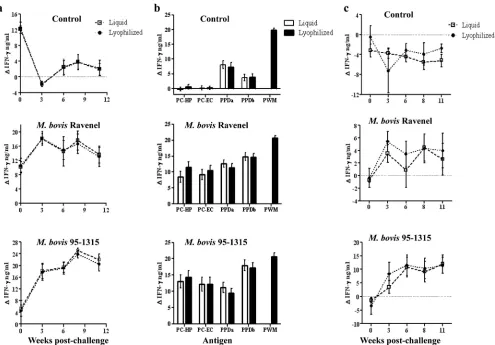
Comparison of liquid and lyophilized antigen preparations. IFN-␥responses to liquid and lyophilized preparations were de-tected inM. bovis95-1315- andM. bovisRavenel-inoculated ani-mals as early as 3 weeks after challenge (Fig. 1) (P⬍0.05). When all time points were pooled, responses to liquid and lyophilized antigen preparations (PPDb, PC-HP, and PC-EC) byM. bovis
Ravenel- andM. bovis95-1315-challenged animals exceeded (P⬍
0.05) respective responses by control animals (Fig. 1b). Significant differences were not detected between liquid and lyophilized products for any antigens within each treatment group (Fig. 1b). As utilized for official use of the Bovigam test kit, responses to PPDb minus PPDa did not differ (P⬎0.05) for liquid and lyoph-ilized antigen preparations at any time point within each treat-ment group (Fig. 1c).
IFN-␥responses to PPDa exceeded (P⬍0.01) respective re-sponses to PPDb for control animals (Fig. 1b), demonstrating prior sensitization to nontuberculous mycobacteria (NTM). Re-sponses to MTC-specific antigens (PC-HP and PC-EC) were not
FIG 1Comparison of IFN-␥responses to liquid and lyophilized antigen preparations from control (n⫽5) as well asM. bovisRavenel- (n⫽5) andM. bovis
95-1315-infected (n⫽5) animals. (a) Response kinetics: PPDb (Lelystad) minus no stimulation. For control animals, the responses to liquid and lyophilized antigens were equivalent; thus, the lines on the graphs are overlapping. Responses to PPDb detected prior to challenge in all groups (including controls) were likely due to cross-reactive responses elicited by nontuberculousMycobacteriaspp. (b) Liquid and lyophilized antigen preparations pooled over time. Responses to pokeweed mitogen (PWM) are included as a positive controls for cell viability. (c) Response kinetics: PPDb minus PPDa (Lelystad PPDs).
on August 17, 2020 by guest
http://cvi.asm.org/
detectable prior to challenge (Fig. 2a), and subtraction of PPDa responses from PPDb (PPDb minus PPDa) resulted in values of
⬍0.1⌬OD450(i.e., negative) for all animals prior to challenge (Fig. 1c). Thus, responses to PPDb detected prior to challenge in all groups (Fig. 1a) were likely due to cross-reactive responses elicited by NTM.
Evaluation of peptide cocktails for the detection of bovine tuberculosis. As early as 3 weeks after challenge, responses to PC-HP and PC-EC byM. bovisRavenel- andM. bovis 95-1315-inoculated animals exceeded (P⬍0.05) respective prechallenge responses and responses by control animals (Fig. 2a). When all time points were pooled, there was no difference (P⬎0.05) be-tween responses to PC-HP and PC-EC within treatment groups (Fig. 2b). Similar responses were detected in the second study usingM. bovis95-1315- andM. bovis10-7428-challenged animals, and responses to PC-HP and PC-EC did not differ within treat-ment groups (see Fig. S1 in the suppletreat-mental material). These findings demonstrate that responses to PC-HP and PC-EC are similar for the early detection ofM. bovisinfection in cattle.
Comparison of IFN-␥responses to Lelystad and CSL PPDs in experimentally and naturally infected animals.Lelystad and CSL PPDs are commonly used as antigens in the Bovigam assay for the detection ofM. bovisinfection in cattle (23,24); however, uses of
these antigens within IFN-␥release assays have yet to be directly compared. Experimental infection withM. bovisRavenel,M. bovis
95-1315, andM. bovis10-7428 elicited robust IFN-␥responses to both CSL and Lelystad PPDs (Fig. 3; also see Fig. S2 in the supple-mental material). When pooled over time, responses to Lelystad PPDa exceeded (P⬍0.05) responses to CSL PPDa within the control andM. bovisRavenel treatment groups (Fig. 3a). Simi-larly, responses to Lelystad PPDb exceeded (P⬍0.05) that of CSL PPDb in control animals when pooled (Fig. 3a).
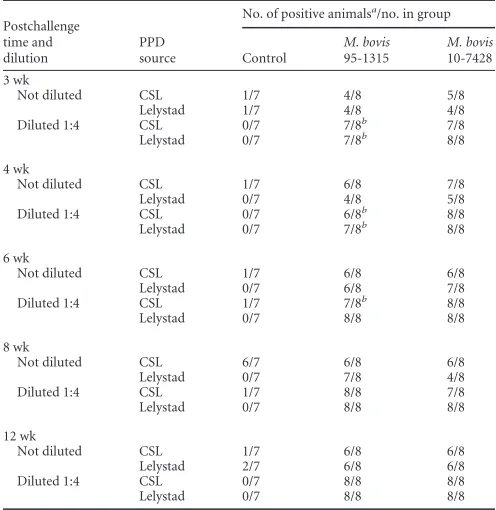
Experimental infection of cattle withM. bovisresults in robust IFN-␥responses to both PPDb and PPDa (due to cross-reactivity of antigens) that are often at the maximum detection limit of the assay, thereby limiting the comparisons of PPD potencies and diagnostic potential. Thus, several dilutions of stimulated plasma were evaluated at selected time points to further evaluate the ki-netics of the response and potency comparisons of the two PPDs (Table 1andFig. 4). When plasma from experimentally infected animals was diluted, it was determined that the majority of re-sponses after challenge to PPDa were lower than the response to PPDb, giving a difference greater than 0.1 OD450, indicating a positive test result (Table 1andFig. 4). For diluted plasma sam-ples, responses to Lelystad PPDb minus PPDa exceeded (P⬍0.05) respective responses to CSL PPDb minus PPDa (Fig. 4). In
gen-FIG 2Comparison of IFN-␥responses to PC-HP and PC-EC in control (n⫽5) andM. bovisRavenel- (n⫽5) andM. bovis95-1315-infected animals. (a) Responses over time and (b) responses pooled over time. **, responses differ between groups (P⬍0.01).
Bass et al.
on August 17, 2020 by guest
http://cvi.asm.org/
eral, diluting the plasma enabled improved accuracy for the detec-tion ofM. bovisinfection in experimentally infected animals in addition to reducing the false-positive test results within the con-trol group.
To further compare CSL and Lelystad PPDs, samples were ob-tained from a tuberculosis-affected dairy herd (Colorado,n⫽56) in the United States. All animals were deemedM. bovisinfected via mycobacterial culture. In contrast to experimental infection stud-ies, in which samples were placed in culture with antigen within 2 h of blood collection, samples from naturally infected animals were shipped overnight and set up within 20 h of blood collection. Responses to Lelystad PPDs exceeded (P⬍0.01) those to CSL PPDs, including PPDb minus PPDa (Fig. 5).
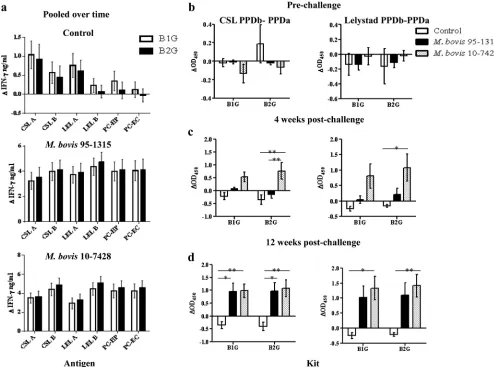
Performances of second-generation Bovigam kits compared to those of the currently licensed kits.The currently licensed Bo-vigam kits (B1G) and second-generation BoBo-vigam kits (B2G) were compared using experimentally infected animals (Fig. 6). IFN-␥ responses were not different (P⬎0.05) between the two kits when time points were pooled (Fig. 6a). B2G kits were just as effective in the differentiation of control and infected groups when calcula-tions of PPDb minus PPDa were performed throughout the course of the study (Fig. 6b,c, andd).
DISCUSSION
IFN-␥is a reliable biomarker for use in the detection ofM. bovis
infection. With the current use of the Bovigam assay, antigens are provided within the kit as a liquid preparation. In this study, ly-ophilization had no effect on antigen performance. Responses were detected as early as 3 weeks postchallenge using both liquid and lyophilized antigen preparations. These findings indicate that
TABLE 1Number of positive animals per group after challenge using CSL and Lelystad PPDs when stimulated plasma samples were either not diluted or diluted 1:4
Postchallenge time and dilution
PPD source
No. of positive animalsa/no. in group
Control
M. bovis
95-1315
M. bovis
10-7428
3 wk
Not diluted CSL 1/7 4/8 5/8
Lelystad 1/7 4/8 4/8
Diluted 1:4 CSL 0/7 7/8b
7/8
Lelystad 0/7 7/8b
8/8
4 wk
Not diluted CSL 1/7 6/8 7/8
Lelystad 0/7 4/8 5/8
Diluted 1:4 CSL 0/7 6/8b 8/8
Lelystad 0/7 7/8b
8/8
6 wk
Not diluted CSL 1/7 6/8 6/8
Lelystad 0/7 6/8 7/8
Diluted 1:4 CSL 1/7 7/8b 8/8
Lelystad 0/7 8/8 8/8
8 wk
Not diluted CSL 6/7 6/8 6/8
Lelystad 0/7 7/8 4/8
Diluted 1:4 CSL 1/7 8/8 7/8
Lelystad 0/7 8/8 8/8
12 wk
Not diluted CSL 1/7 6/8 6/8
Lelystad 2/7 6/8 6/8
Diluted 1:4 CSL 0/7 8/8 8/8
Lelystad 0/7 8/8 8/8
aAnimals were considered positive when PPDa responses were subtracted from PPDb
responses and the difference in OD450was⬎0.1.
bSome animals within the experimentally infected groups were still at the maximum
limit of detection, making it difficult to detect differences in responses to PPDb and PPDa.
FIG 3IFN-␥responses to Commonwealth Serum Laboratory (CSL) and Lelystad (LEL) PPDs in cattle upon experimental infection withM. bovis. (a) Comparison of IFN-␥responses to PPDs in control (n⫽5) as well asM. bovisRavenel- (n⫽5), andM. bovis95-1315-infected (n⫽5) animals pooled over time. (b) Comparison of IFN-␥responses to PPDs in control (n⫽7) as well asM. bovis95-1315- (n⫽8), andM. bovis10-7428-infected (n⫽8) animals pooled over time. PPDa refers toM. avium-derived PPD, PPDb refers toM. bovis-derived PPD, and B-A indicates values for PPDb minus PPDa. Asterisks indicate that responses differed (*,P⬍0.05; **,P⬍0.01).
on August 17, 2020 by guest
http://cvi.asm.org/
lyophilized preparations may be implemented into the IFN-␥ as-say without loss in potency, thereby increasing the shelf life of the test kits. Additional TB-specific antigens are needed to further increase the accuracy of the IFN-␥release assay. Interestingly, al-though both PC-HP and PC-EC were not significantly different in the responses they elicited in infected animals throughout the study, responses to PC-HP were slightly higher than responses to PC-EC, which is consistent with findings by Sidders and col-leagues (18). In experimentally infected animals, responses to PC-HP and PC-EC were detectable as early as 3 weeks postchal-lenge. PC-HP and PC-EC are commercially available products that may prove useful as antigens for bovine tuberculosis test kits, both for research and diagnostic purposes.
PPDs from differing manufacturers and lots are known to vary in potency (8). Commonwealth Serum Laboratories (CSL) has been the producer of PPDs for the Bovigam assay since the test was first approved for use in the United States. Due to manufacturing
and marketing reasons, it is possible that CSL PPDs will not be available in the near future. Thus, it is critical to validate use of different PPDs within bovine tuberculosis diagnostic tests. Whipple and colleagues performed direct comparisons between CSL PPDs and PPDs prepared in the United States (USDA, APHIS, National Veterinary Services Laboratory) using the CFT and IFN-␥assay and found that the final interpretation of the test (i.e., positive and negative animals identified by each PPD) was usually the same (25). However, U.S. PPDs elicited a higher re-sponse (25). Recently, Lelystad PPDs (Prionics AG) were adopted for use in the skin test and Bovigam assay in the United Kingdom, Republic of Ireland, and various other European Union countries. Downs and colleagues reviewed data from field surveillance re-sults of the single intradermal comparative cervical test (SICCT) using Lelystad and Weybridge (Central Veterinary Laboratory) PPDs in England, Scotland, and Wales from 2005 to 2009 (26). Due to financial reasons, Defra halted production of tuberculin at
FIG 4Comparison of PPDs using 1:4 dilutions of plasma stimulated with either Commonwealth Serum Laboratories (CSL) or Prionics (Lelystad) purified protein derivatives at select time points after challenge (left panel) and responses detected in normal (not diluted) and 1:4 diluted plasma pooled over time (right panel). (a) Control (n⫽7), (b)M. bovis95-1315-challenged animals (n⫽8), and (c)M. bovis10-7428-challenged animals. Data are presented as responses to PPDb minus PPDa. *, Responses differ (P⬍0.05).
Bass et al.
on August 17, 2020 by guest
http://cvi.asm.org/
Weybridge and their tuberculin supply was exhausted in 2009 (26). Lelystad became the sole source of tuberculin in Great Brit-ain; however, there were no data directly comparing the two sources of PPDs. Compilation and analysis of field surveillance
results determined that Lelystad PPDs were superior to Wey-bridge PPDs in confirming infection within herds and individual animals when using the SICCT (26). Lelystad has been used in IFN-␥release assays since 2007 in the United Kingdom (27);
how-FIG 5Evaluation of IFN-␥responses in samples obtained from dairy cattle within a tuberculosis-affected herd (i.e., natural infection). Comparison of CSL (Commonwealth Serum Laboratories) and Lelystad (Prionics AG)M. avium-derived PPD (PPDa) andM. bovis-derived PPD (PPDb). Responses fromM. bovis-infected (n⫽56) animals from a tuberculosis-affected dairy in Colorado. Animals were categorized as infected based on positive culture ofM. bovis
(infected,n⫽56). **, responses to Lelystad PPDs exceeded (P⬍0.01) respective responses to CSL PPDs.
FIG 6Comparison of current (B1G) and new (B2G) Bovigam (Prionics AG) kits using responses to individual antigens and PPDb minus PPDa with samples from control (n⫽7) as well asM. bovis95-1315- (n⫽8), andM. bovis10-7428-infected (n⫽8) animals. (a) IFN-␥responses pooled over time, (b) responses to prechallenge (Commonwealth Serum Laboratories) and Lelystad (Prionics AG) PPDb minus PPDa, (c) responses to 4-week-postchallenge CSL and Lelystad PPDb minus PPDa, and (d) responses to 12-week-postchallenge CSL and Lelystad PPDb minus PPDa.
on August 17, 2020 by guest
http://cvi.asm.org/
ever, direct comparisons to CSL PPDs have not been performed. In the present study, IFN-␥responses to Lelystad and CSL PPDs largely did not differ in undiluted samples from experimentally infected cattle (Fig. 3; also see Fig. S2 in the supplemental mate-rial). However, use of diluted sera (1:4) revealed greater differen-tiation of PPDb from PPDa responses with Lelystad PPDs versus CSL PPDs (i.e., PPDb minus PPDa) (Fig. 4) elicited after experi-mentalM. bovisinfection. With samples from a tuberculosis-af-fected herd, responses to Lelystad PPDs exceeded respective re-sponses to CSL PPDs.
Experimental infection of cattle resulted in IFN-␥responses to both PPDb and PPDa that reached the maximum limit of detec-tion, resulting in responses to PPDb minus PPDa of⬍0.1⌬OD (i.e., negative), even though these animals were clearly infected as evidenced by robust IFN-␥responses to MTC peptide cocktails, delayed-type hypersensitivity responses to PPDb exceeding those to PPDa, and isolation ofM. bovisfrom tissues at necropsy. Thus, differences between control and infected animals were not detect-able using the analysis of PPDb minus PPDa with undiluted stim-ulated plasma. To address this issue, dilutions of plasma were evaluated to ascertain IFN-␥concentrations detectable within as-say limits. After dilution (1:4), samples from infected animals had responses to PPDb that exceeded (P⬍0.05) respective responses to PPDa, thus enabling an accurate diagnosis using calculations of PPDb minus PPDa. Dilution of plasma may be incorporated as a means to determine differences in IFN-␥responses to PPDb and PPDa. This may be particularly useful in regions where detection of bovine tuberculosis is hindered by high levels of exposure to NTM that elicit cross-reactive responses to PPDs. Additionally, evaluation of diluted samples may be useful when evaluating re-sponses by animals with very robust rere-sponses, as seen with exper-imentally infected animals in this study. Indeed, use of diluted plasma with samples from experimentally infected cattle revealed responses to Lelystad PPDs exceeding those to CSL PPDs. These findings suggest that the use of Lelystad PPDs will provide greater diagnostic sensitivity than CSL PPDs.
In the current study, three strains ofM. boviswere used to compare IFN-␥responses to PPDs and peptide cocktails elicited after experimental infection. With the use of the IFN-␥release assay, robust responses were detected using PPDs from the two different manufacturers as well as PC-HP and PC-EC. Strains ex-amined wereM. bovis95-1315 (white-tailed deer field isolate),M. bovisRavenel (laboratory-adapted strain), andM. bovis10-7428 (cattle field isolate from a Colorado dairy).M. bovisstrain 95-1315 has been used previously in experimental infection of cattle and has been shown to elicit robust immune responses as well as gran-ulomatous lesions at necropsy (15).M. bovisstrain Ravenel was isolated in the early 1900s, and although it is virulent in mice (28), rabbits (28,29), and guinea pigs (13,28,30), it does not lead to progressive disease in cattle (W. R. Waters and M. V. Palmer, unpublished observations).M. bovisstrain 10-7428 was isolated from a Holstein cow in a dairy herd in Colorado. This strain is speculated to be highly virulent given the high rate of progression of disease in this herd (Tolani Francisco, personal communica-tion). In the first study, allM. bovis95-1315 animals had granulo-matous lesions, whereas only oneM. bovisRavenel animal had a small tuberculous lesion. In the second study, all animals in theM. bovis95-1315 andM. bovis10-7428 groups showed lesions upon necropsy as well as robust skin test responses. Thus, evaluation of IFN-␥responses to various antigen preparations in the present
study were evaluated with samples from animals inoculated with 3 strains with varied virulence levels.
PPDs and peptide cocktails were also used for comparison of two generations of Bovigam kits. The second-generation kit re-quires a decreased number of repeated washes and combines the conjugate and chromogen into one solution; however, stimula-tion and incubastimula-tion times within the test did not change. Al-though the new kit did not decrease the performance time, it did reduce the time for work labor. Present findings support the use of the second-generation Bovigam kit (B2G) for replacement of the current kit (B1G) in the detection of bovine tuberculosis.
In conclusion, lyophilized PPDs, PC-EC, and PC-HP are effec-tive replacements for liquid antigens for use in the Bovigam assay. PC-HP and PC-EC are reliable biomarkers of bovine tuberculosis, and second-generation Bovigam kits perform similarly to first-generation kits. The present findings, while not definitive, are en-couraging for replacement of CSL PPDs with Lelystad PPDs for use in the Bovigam assay to detect bovine tuberculosis in the United States. These findings, along with future evaluation of nat-urally infected animals, have the potential to increase the accuracy of current antemortem diagnostic methods in the detection of bovine tuberculosis.
ACKNOWLEDGMENTS
This research was carried out under a cooperative research and develop-ment agreedevelop-ment (no. 58-3K95-2-1551) between Prionics AG and USDA/ ARS/NADC.
We thank Jessica Pollock, Emma Frimml-Morgan, Shelly Zimmer-man, Mayara Maggioli, Molly Stafne, Allen Jensen, and Tracy Porter for their excellent technical assistance, as well as Rebecca Madison, Doug Ewing, Katie Pille, Jay Steffen, David Lubbers, Robin Zeisness, and David Panthen for the excellent care and handling of animals. We also thank Alecia L. Naugle, Kathleen A. Orloski, M. Celia Antognoli, Jeffery T. Nel-son, C. William Hench, Mark A. Schoenbaum, Tom Brignole, Tolani I. Francisco, and Robert M. Meyer for collection of samples from tubercu-losis-affected herds and assistance with these studies.
Mention of trade names or commercial products in this publication is solely for the purpose of providing specific information and does not imply recommendation or endorsement by the U.S. Department of Agri-culture.
REFERENCES
1.Cousins DV, Bastida R, Cataldi A, Quse V, Redrobe S, Dow S, Duigan P, Murray A, Dupont C, Ahmed N, Collins DM, Butler WR, Dawson D, Rodriguez D, Loureiro J, Romano MI, Alito A, Zumarraga M, Ber-nardelli A.2003. Tuberculosis in seals caused by a novel member of the
Mycobacterium tuberculosiscomplex:Mycobacterium pinnipediisp. nov. Int. J. Syst. Evol. Microbiol.53:1305–1314.
2.Good M, Duignan A.2011. Perspectives on the history of bovine TB and the role of tuberculin in bovine TB eradication. Vet. Med. Int.2011:
410470. doi:10.4061/2011/410470.
3.De la Rua-Domenech R, Goodchild AT, Vordermeier HM, Hewinso RG, Christiansen KH, Clifton-Hadley RS.2006. Ante mortem diagnosis of tuberculosis in cattle: a review of the tuberculin tests,␥-interferon assay and other ancillary diagnostic techniques. Res. Vet. Sci.81:190 –210. 4.Schiller I, Oesch B, Vordermeier HM, Palmer MV, Harris BN, Orloski
KA, Buddle BM, Thacker TC, Lyashchenko KP, Waters WR. 2010. Bovine tuberculosis: a review of current and emerging diagnostic tech-niques in view of their relevance for disease control and eradication. Transbound. Emerg. Dis.57:205–220.
5.Wood PR, Jones SL.2001. BOVIGAM: an in vitro cellular diagnostic test for bovine tuberculosis. Tuberculosis (Edinb.)81:147–155.
6.Wood PR, Corner LA, Plackett P.1990. Development of a simple, rapid in vitro cellular assay for bovine tuberculosis based on the production of gamma interferon. Res. Vet. Sci.49:46 – 49.
Bass et al.
on August 17, 2020 by guest
http://cvi.asm.org/
7.Mihret A, Bekele Y, Bobosha K, Kidd M, Aseffa A, Howe R, Walzl G.
2013. Plasma cytokines and chemokines differentiate between active dis-ease and non-active tuberculosis infection. J. Infect.66:357–365. 8.Schiller I, Vordermeier HM, Waters WR, Kyburz A, Cagiola M, Whelan
A, Palmer MV, Thacker T, Meijlis J, Carter C, Gordon S, Egnuni T, Hardegger R, Marg-Haufe B, Raeber A, Oesch B.2010. Comparison of tuberculin activity using the interferon-␥assay for the diagnosis of bovine tuberculosis. Vet. Rec.167:322–326.
9.Vordermeier HM, Whelan A, Ewer K, Goodchild T, Clifton-Hadley R, Williams J, Hewinson RG.2006. The Bovigam assay as ancillary test to the tuberculin skin test. Gov. Vet. J.16:72– 80.
10. Aagaard C, Govaerts M, Meikle V, Vallecillo AJ, Gutierrez-Pabello JA, Suarez-Güemes F, McNair J, Cataldi A, Espita C, Andersen P, Pollock JM.2006. Optimizing antigen cocktails for detection ofMycobacterium bovisin herds with different prevalences of bovine tuberculosis: ESAT6-CFP10 mixture shows optimal sensitivity and specificity. J. Clin. Micro-biol.44:4326 – 4335.
11. Vordermeier M, Jones GJ, Whelan AO.2011. DIVA reagents for bovine tuberculosis vaccines in cattle. Expert Rev. Vaccines10:1083–1091. 12. Waters WR, Palmer MV, Thacker TC, Bannantine JP, Vordermeier
HM, Hewinson RG, Greenwald R, Esfandiari J, McNair Pollock JM, Andersen P, Lyashchenko KP.2006. Early antibody responses to exper-imentalMycobacterium bovisinfection of cattle. Clin. Vaccine Immunol.
13:648 – 654.
13. Waters WR, Palmer MV, Nonnecke BJ, Thacker TC, Scherer CF, Estes DM, Hewinson RG, Vordermeier HM, Barnes SW, Federe GC, Walker JR, Glynne RJ, Hsu T, Weinrick B, Biermann K, Larsen MH, Jacobs WR, Jr. 2009. Efficacy and immunogenicity of Mycobacterium bovis
DeltaRD1 against aerosolM. bovisinfection in neonatal calves. Vaccine
27:1201–1209.
14. Vordermeier HM, Whelan A, Cockle PJ, Farrant L, Palmer N, Hewin-son RG.2001. Use of synthetic peptides derived from the antigens ESAT-6 and CFP-10 for differential diagnosis of bovine tuberculosis in cattle. Clin. Diagn. Lab. Immunol.8:571–578.
15. Waters WR, Whelan AO, Lyashchenko KP, Greenwald R, Palmer MV, Harris BN, Hewinson RG, Vordermeier HM.2010. Immune responses in cattle inoculated withMycobacterium bovis,Mycobacterium tuberculosis, orMycobacterium kansasii. Clin. Vaccine Immunol.17:247–252. 16. Whelan AO, Clifford D, Upadhyay B, Breadon EL, McNair J, Hewinson
GR, Vordermeier MH.2010. Development of a skin test for bovine tu-berculosis for differentiating infected from vaccinated animals. J. Clin. Microbiol.48:3176 –3181.
17. Vordermeier HM, Gordon SV, Hewinson RG. 2011.Mycobacterium bovisantigens for the differential diagnosis of vaccinated and infected cattle. Vet. Microbiol.15:8 –13.
18. Sidders B, Pirson C, Hogarth PJ, Hewinson RG, Stoker NG, Vorder-meier HM, Ewer K.2008. Screening of highly expressed mycobacterial genes identifies Rv3615c as a useful differential diagnostic antigen for the
Mycobacterium tuberculosiscomplex. Infect. Immun.76:3932–3939.
19. Larsen MH, Biermann K, Jacobs WR, Jr.2007. Laboratory maintenance ofMycobacterium tuberculosis. Curr. Protoc. Microbiol. Chapter 10:Unit 10A.1. doi:10.1002/9780471729259.mc10a01s6.
20. Palmer MV, Waters WR, Whipple DL.2003. Aerosol delivery of virulent
Mycobacterium bovisto cattle. Tuberculosis (Edinb.)82:275–282. 21. USDA Animal Plant and Health Inspection Service.2005. Bovine
tu-berculosis eradication uniform methods and rules (APHIS 91-45-011). U.S. Government Printing Office, Washington, DC.
22. Robbe-Austerman S, Bravo DM, Harris B. 2013. Comparison of the MGIT 960, BACTEC 460 TB and solid media for isolation of Mycobacte-rium bovisin United States veterinary specimens. BMC Vet. Res.9:74. doi:10.1186/1746-6148-9-74.
23. Schiller I, Waters WR, Vordermeier HM, Nonnecke B, Welsh M, Keck N, Whelan A, Sigafoose T, Stamm C, Palmer M, Thacker T, Hardegger R, Marg-Haufe B, Raeber A, Oesch B.2009. Optimization of a whole-blood gamma interferon assay for detection ofMycobacterium bovis -infected cattle. Clin. Vaccine Immunol.16:1196 –1202.
24. Wood PR, Corner LA, Rothel JS, Baldock C, Jones SL, Cousins DB, McCormick BS, Francis BR, Creeper J, Tweddle NE.1991. Field com-parison of the interferon-gamma assay and the intradermal tuberculin test for the diagnosis of bovine tuberculosis. Aust. Vet. J.68:286 –290. 25. Whipple DL, Bolin CA, Davis AJ, Jarnagin JL, Johnson DC, Nabors RS,
Payeur JB, Saari DA, Wilson AJ, Wolf MM.1995. Comparison of the sensitivity of the caudal fold skin test and a commercial gamma-interferon assay for diagnosis of bovine tuberculosis. Am. J. Vet. Res.56:415– 419. 26. Downs SH, Clifton-Hadley RS, Upton PA, Milne IC, Ely ER, Gopal R,
Goodchild AV, Sayers AR.2013. Tuberculin manufacturing source and breakdown incidence rate of bovine tuberculosis in British cattle, 2005– 2009. Vet. Rec.172:98. doi:10.1135/jvr.100679.
27. Denis M, Wedlock DN, McCarthy AR, Parlane NA, Cockle PJ, Vorder-meier HM, Hewinson RG, Buddle BM.2007. Enhancement of the sen-sitivity of the whole-blood gamma interferon assay for diagnosis of Myco-bacterium bovisinfections in cattle. Clin. Vaccine Immunol.14:1483– 1489.
28. Via LE, Lin PL, Ray SM, Carrillo J, Allen SS, Eum SY, Taylor K, Klein E, Manjunatha U, Gonzales J, Lee EG, Park SK, Raleigh JA, Cho SN, McMurray DN, Flynn JL, Barry CE, III.2008. Tuberculous granulomas are hypoxic in guinea pigs, rabbits, and nonhuman primates. Infect. Im-mun.76:2333–2340.
29. Converse PJ, Dannenberg AM, Shigenaga T, McMurray DN, Phalen SW, Stanford JL, Rook GAW, Koru-Sengul T, Abbey H, Estep JE, Pitt MLM.1998. Pulmonary bovine-type tuberculosis in rabbits: bacillary vir-ulence, inhaled dose effects, tuberculin sensitivity, andMycobacterium vaccaeimmunotherapy. Clin. Diagn. Lab. Immunol.5:871– 881. 30. North RJ, Ryan L, LaCource R, Mogues T, Goodrich ME.1999. Growth
rate of mycobacteria in mice as an unreliable indicator of mycobacterial virulence. Infect. Immun.67:5483–5485.