Structural Equation Modeling Between Brand Equity Elements and
Retail Store Attributes
Dr. C. Selvaraj, Department of Management
Sciences,
Velammal Engineering College Chennai, India [email protected]
Dr. G. Arasuraja, Department of Management
Sciences,
Velammal Engineering College Chennai, India [email protected]
Mr. S. Vijayakanthan, Department of Management
Sciences,
Velammal Engineering College Chennai, India [email protected]
Abstract
Brand value is the result of different promoting systems of any association which is reflected in the customers' reaction. Brand value is seen by customers as the esteem added to the item by partner it with a brand name. The Elements of brand value help to build the client base of a firm. The viability of showcasing techniques is upgraded by mark value resources. Brand value relies on the idealness of the mentalities which customers hold about a specific brand. Building positive brand value would empower an association to appreciate an upper hand. It is basic for firms to make one of a kind, solid and ideal relationship for building solid brands. Understanding the different components of brand value would help the associations to know the esteem gave by the brands to its customers. Advertisers need to choose proper brand components for making positive brand value. Retailer brands are very not quite the same as item marks that the real utilization of those marking standards differs with each other. Retailers have a tendency to make their image pictures in various courses, e.g., through interesting relationship to the nature of their administration, item go, valuing and so forth. This study created a structural equation of model of Branding Elements and Retail store attributes. It identified the relationship between brand equity and attributes of retail stores.
Key words: Brand Equity, Retail store attributes, Structural Equation Modeling
1. Introduction
Brands offer some benefit to the customers by offering different advantages and utilities. Brand names of the retailers empower the customers to imagine and separate from one store with that of the other. It is essential for an association to comprehend the components that fabricates solid brands.
With regards to store marking, retailers are considered as the essential brand. While on account of quick moving shopper merchandise, items are the essential brands. Brand building exercises of a firm enhance the piece of the overall industry and furthermore hold its client base. Brands assume a key part in building the connection between the association and the customers. Brand advancement is vital in the retail segment attributable to
the extraordinary rivalry that is common. Brands are utilized as the establishment for building trust and persisting associations with the customers. Brand building, thus ought to be founded on creating methodologies as per customers' prerequisites. Brands assume an essential part in improving the estimation of the items and administrations of an association, in this manner making an extraordinary position in the customers' psyches.
with the end goal of this exploration is examined in detail from the customers' viewpoint. The idea of brand value has been examined in different points of view by famous creators. An intensive comprehension of brand value from the customers' perspective is basic for effective brand administration. As indicated by the definition given by Srivastava and Shocker (1991) mark value comprises of two segments, mark quality and brand esteem, and keeping in mind that the previous depends on customer level estimations, the last decides the monetary advantage gave by the brand quality.
A retailer's image value is shown in customers reacting more positively to its showcasing activities than they do to contending retailers (Keller 2003). The picture of the retailers in the brains of the customers is the premise of this brand value. From this definition, it is comprehended that brand value emerges from contrasts in buyer reactions towards the showcasing techniques of a firm. This distinction in their reaction reflects in their inclinations and buys conduct. The upsides of understanding the idea of brand value from the customers. Viewpoints are that it gives supervisors to comprehend the viability of advertising projects of an association in enhancing the estimation of their brands. Positive brand value is the level of showcasing advantage a brand holds over an anonymous contender. Retail locations reinforce mark value by concentrating on unserved showcase needs of the customers and by improving the customers shopping background.
Through marking, stores can impart their thoughts, administrations, appearance, and offers to the customers. This makes mindfulness among its present and potential customers. The achievement of
store marking is reflected in good reaction among the customers, which is useful in holding its client base over the long haul. Retail locations construct solid brands through marking peculiarity, correspondence, passionate remainder with the customers and furthermore through partners their stores with trust. The brand procedure of the retailers expects to strengthen a superior administration experience to its customers.
2. Review of Literature
Farquhar (1989) broke down the importance of brand value and found that there was a general assertion at the applied level with regards to the significance of brand value which can be outlined as .the money related esteem enriched by the brand to the item. Also, the brand value is estimated by the incremental income from partner the brand with the item. The upper hand of firms that have brands with high value incorporates the open door for effective augmentations, versatility against contenders. Shopper construct viewpoint of value accentuates with respect to mental and Behavioral precepts that go into the causality of purchaser buys like brand dedication, strength and brand picture, and so forth in the wake of distinguishing the necessities of mental and behavioral perspectives in building brand value, normally a need will be made to investigate the elements and components associated with mental and behavioral principles.
He perceived the buyer parts of brand value. He recommended that the promoting analyst should move from a strategic issue solver to an educational strategist.
Aaker and Keller (1990) led an examination and investigated that specialists in this division take a gander at the connections that existed between the shopper and the brand. Consideration was given to mark properties, for example, mark name, demeanor towards the first brand, and the fit between the current and the new brand, to give some examples.
Lassar, Mittal and Sharma (1995) displayed a scale to quantify client based brand value. The client based brand value scale was created in light of the five hidden measurements of brand value: execution, esteem, social picture, dependability and duty. In experimental investigations, it was discovered that brands that scored higher on the client based brand value scale for the most part had higher costs.
Davis and Douglass (1995) contended that budgetary way to deal with characterizing brand value is to a great extent worried about doling out a quantifiable incentive to each brand an organization possesses or creates. The scientists and showcasing administrators who utilized the money related approach champion the position that a brand was a suitable resource. In this manner, esteem must be joined to it. It is important little to them that brand value depends on the possibility that a brand has an esteem more prominent than the aggregate of its unmistakable resources. Thusly, mark value by definition was an immaterial resource. This makes it vital to distinguish the substantial qualities of brand value in the wake of characterizing it as an impalpable resource.
Pappu and Quester (2006) led an examination with the target to analyze the connection between customers' fulfillment with a retailer and the value they connect with the retail mark. A review was embraced utilizing an accommodation test of shopping center customers in an Australia state capital city. Results showed that retail mark value shifts with consumer loyalty. For retail chains, every buyer based retailer value measurement fluctuated by consumer loyalty with the retailer. In any case, for strength stores, just three of the purchaser based retailer value measurements, to be specific retailer mindfulness, retailer affiliations and retailer saw quality, fluctuated by consumer loyalty level with the retailer.
Chen and Chang (2008) found that exchanging cost moderating affects the positive connection between mark value and buy purpose, while within the sight of low exchanging cost, the effect of brand value on buy aim was not positive.
Yoo and Donthu (2002) investigated the diverse generalizability of brand value creation process show. The outcomes uncovered which showcasing endeavors and brand value measurements affected brand value. In particular, mark steadfastness and saw item quality don't invariantly affect mark value, while mark mindfulness/affiliations had an equal impact. Consequently it is fundamental to assess the brand mindfulness/affiliations attributes, in light of the fact that a wonder such as this may investigate the brand steadfastness and saw quality traits.
at the significance of existing speculations of value data handling beginning. This examination tries to contribute towards the comprehension of the psychological instruments which lead buyer to contemplate the item cost not just from a basic point of the data preparing yet in addition from a formative edge recommended by hereditary brain research. Discernment can be seen at various points. Value affectability can be high, medium and low. This even relies upon the items. For specific items, customers can be more costs delicate. For specific items they can't be so value delicate. Different extremes of value affectability rely upon the items.
Mohammed Mashfiq Huq (2008) talks about investigating the connection between shopper advancement, value discernment, item quality recognitions and brand devotion in the cleanser market of Bangladesh. By and large with regards to customer advancements, general perspectives of individuals about purchaser advancement and value recognitions greatly affect item quality discernment. Value recognition demonstrates a positive connection to mark dedication. This relies upon how we see cost. Some see cost as value touchy and the other way around. With regards to mark dedication of a limited time mark, saw quality assume an essential part notwithstanding broad perspectives on customer advancement and value discernment.
3. Research Methodology
The study is based on primary data which is collected through a structured questionnaire. The population of the research includes the buyers of selected supermarkets in Chennai. A convenient sample of 210 customers was selected for
the current study. The study involved a field survey and exit interviews were conducted on different days of the week and at different times of the day. The selection of retail outlets was done in such a ways as to ensure coverage of major supermarkets in Chennai.
3.1 Tool for data analysis
Structural Equation model - It combines the techniques of regression and factor analysis. It is used to test a number of complex relationships between variables simultaneously. Structural equation modeling (SEM) has been used in this research to test the constructs and the structure of the proposed model of brand equity.
4. Data Analysis and Interpretations
SEM is performed to identify an
empirical relationship between brand
equity elements and retail store
attributes in the form of structural analysis. Structural Equation Model is a
multivariate technique which
incorporates measured (observed)
variables and latent (unobserved)
constructs explicitly specifies
measurement error. A model
(diagram) allows for specification of the relationships between variables. SEM is built upon a measurement as
well as a structural model. A
measurement model is about
measurement and data collection. While
a structural model specifies how
effectively some variables could predict other variables. When these two models are combined, they form a structural
model. SEM is defined as a
comprehensive statistical approach to
testing hypotheses about relations
SEM requires formal specification of a model to be estimated and tested. By using SEM multiple, related equations are solved simultaneously to determine
parameter estimates. The proposed
model is tested by performing SEM
using AMOS 18. The researcher
proposes a conceptual model of brand equity. The model is tested using
Confirmatory Factor analysis. This
analysis is conducted for the individual constructs separately, i.e., for brand
awareness, brand performance,
perceived quality, brand association
and brand loyalty, retail store attributes
like price, advertising, relationship
retailing, sales promotion, store
environment, store location and product assortment.
The structural model for impact of retail store attributes on brand equity and its elements, consists of a set of exogenous variables (those variables whose causes are not represented in the model) and a set of endogenous variables (those variables whose causes are specified in the model). Exogenous variables include the retail store attributes such as: Relationship retailing, Sales Promotion and Store Environment. Endogenous variables are the various brand equity elements and
brand equity itself. Variables that are observed as brand equity elements
includes: Brand association, Brand
awareness, Brand loyalty and Brand equity. Hence, the measurement of impact of retail store attributes on brand equity is a subject which attracts a great deal of interest and is explored subsequently.
SEM analysis is used to test the hypothesis ‘There is no empirical
relationship between retail store
attributes and brand equity elements’.
The present model contains the following variables:
I. Observed, endogenous variables
1.Brand Association
2.Brand Equity
3.Brand Loyalty
4.Brand Awareness
II. Observed, exogenous variables
1.Perceived quality
2.Sales promotion
3.Store environment Unobserved,
exogenous variables
e1 - error term for brand association e2 - error term for brand awareness e3 - error term for perceived quality
e4 - error term for brand loyalty e5 - error term for brand equity
Table no. 4.1 Variable counts in SEM
Number of variables in the model: 13
Number of observed variables: 8
Number of unobserved variables: 5
Number of exogenous variables: 8
Number of endogenous variables: 5
Brand
Association
Brand Awareness
18.84 Relationship retailing .1
8
1 6.2 6
e1
-2.91
.4 9 14.6
0 10.6
2
5.6 2
e 2
1
e 4
1
7.8 0
e5
18.2 9 15.3
1
.4 2
.2 9
Sales
Promotion
Brand Loyalty
.6 5
.2 3 17.0
3
10.7 5
e3
1 38.5
0
Store .38 Perceived
Quality
Environment
ON BRAND EQUITY ELEMENTS
The proposed model is tested empirically by the researcher based on the perception of the customers.
The application of SEM using AMOS 18 software derives the following findings:
Table no. 4.2 STRUCTURAL MODEL OF BRAND EQUITY OF SUPERMARKETS
Variables Value Suggested Value
Chi-Square Value 24.662
P Value .103 >0.05
GFI (Goodness Of Fit Index) .924 >0.90
Adjusted Gfi (Goodness Of Fit Index) 0.928 >0.90
CFI (Comparitive Fit Index) 0.940 >0.90
RMSEA (Root Mean Square Error of Approximation)0.0000 <0.05
(Source: Primary Data)
1
From the Table, it is found that the calculated P value is 0.103, which is greater than 0.05 which indicates perfect fit. Here GFI (Goodness of Fit Index) and AGFI (Adjusted Goodness of Fit Index) values are greater than 0.9 which represent as a good fit. The calculated CFI (Comparative Fit Index) is 0.940 which means that it is a perfect fit and also it is found that RMSEA (Root mean square error of approximation) value is
0.0, which is lesser than 0.10 which indicates that it is a perfect fit.
All these values are statistically significant to prove the emerged constructs (Factors of brand equity viz., brand awareness, brand performance, perceived quality, brand association and brand loyalty, retail store attributes like price, advertising, relationship retailing, sales promotion, store environment, store location and product assortment). It exactly proves that the proposed model of the researcher is significantly fit.
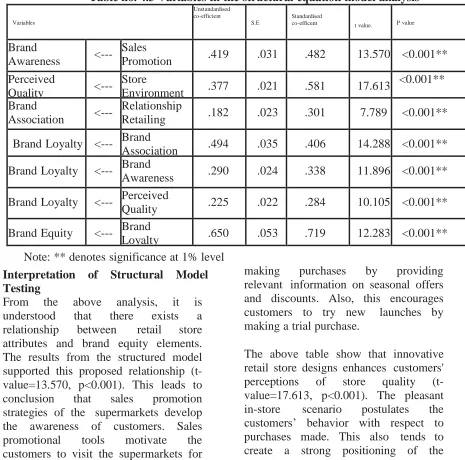
Table no. 4.3 Variables in the structural equation model analysis
Variables
Unstandardised co-efficient
S.E
Standardised
co-efficent t value. P value
Brand
Awareness
<---Sales
Promotion .419 .031 .482 13.570 <0.001**
Perceived
Quality
<---Store
Environment .377 .021 .581 17.613
<0.001**
Brand
Association
<---Relationship
Retailing .182 .023 .301 7.789 <0.001**
Brand Loyalty <--- Brand
Association .494 .035 .406 14.288 <0.001**
Brand Loyalty <--- Brand
Awareness .290 .024 .338 11.896 <0.001**
Brand Loyalty <--- Perceived
Quality .225 .022 .284 10.105 <0.001**
Brand Equity <--- Brand
Loyalty .650 .053 .719 12.283 <0.001**
Note: ** denotes significance at 1% level
Interpretation of Structural Model Testing
From the above analysis, it is
understood that there exists a
relationship between retail store
attributes and brand equity elements. The results from the structured model supported this proposed relationship (t- value=13.570, p<0.001). This leads to
conclusion that sales promotion
strategies of the supermarkets develop the awareness of customers. Sales
promotional tools motivate the
customers to visit the supermarkets for
making purchases by providing
relevant information on seasonal offers and discounts. Also, this encourages customers to try new launches by making a trial purchase.
The above table show that innovative retail store designs enhances customers'
perceptions of store quality
(t-value=17.613, p<0.001). The pleasant
in-store scenario postulates the
supermarkets among the customers. Hence, it can be considered as a major
factor influencing the customers’
judgment of store and its attributes.
The structural path between brand association and Relationship retailing
was positive and significant
(t-value=7.789, p<0.001). It is understood from the above table that Relationship retailing enhances brand association of
the customers. This implies that
customers’ favorability towards the store improves as a result of superior in-store
services. As Relationship retailing
maintained by a supermarket is unique
and cannot be reproduced by
competitive stores, this aspect helps to develop strong associations with the store.
The projected relationship among brand loyalty and brand association is well supported (t-value=14.288, p<0.001). The structural path shown in the above model depicts a strong relationship
between brand loyalty and brand
association. Brand associations create value for the customers leading to brand loyalty. Customers pay attention to unique store associations.
Positive associations with the
supermarket are influenced by
innovative retail store attributes like attractive display, colorful presentation of products, in-store music and unique store designs. This provides a reason to buy from the same supermarket more
frequently. Customers’ favorability
towards the store attributes influences their future purchase decisions in the supermarket and hence increases their
loyalty. The customer impressions
towards the stores are influenced by the associations which they hold. The shopping experiences of the customers
have an impact on their responses towards the supermarkets. As such, strong and unique store associations have a significant effect on creating brand equity.
It is inferred from the above model that brand awareness significantly leads
to brand loyalty (t-value=11.896,
p<0.001). The familiarity of
supermarkets which customer visits
produces differential responses on the customers. Greater levels of brand awareness, enhances the customers’ future intention to purchase in the
supermarkets. The strength of the
brand's existence in the customer's mind is strongly influenced by the awareness towards the supermarkets. Supermarkets communicate with the customers through various marketing strategies. This increases the level of brand recognition with the customers.
Well-known brand names of
supermarkets increase customers'
familiarity thereby creating attachment with the store. Innovative retail store
designs and packaging ensure the
highest degree of brand recall. This nurtures unique identity of the brand with the customers and acts as trigger for making frequent visits to the
supermarket. Attracting customers'
attention through brand awareness helps to invoke repeat store visits, thereby leading to loyalty.
The relationship between brand loyalty and perceived quality is supported in this structural model (t-value=10.105,
p<0.001). Perceived quality of
supermarkets builds brand loyalty.
other stores based on its products and
services delivered. Such strong
positioning creates repeat purchase
intention with the same store, thereby leading to loyalty. The right quality of products and services available in the supermarket equips the customers with zeal and satisfaction.
Customers perceived quality
expectations, when adequately met
through better store service, value pricing and promotion, increases their store loyalty. Superior product/service quality of the supermarket influences customer satisfaction which develops p o s i t i v e l o ya l t y . It i n d i c a t e s t h a t t h e q u a l i t y a n d v a l u e p e r c e p t i o n s h a v e considerable effect in building brand equity among customers. The customers’ intentions of selecting a supermarket for purchase decisions are affected by the quality of the stores’ products and services. This is because customers use these store attributes for evaluating the overall quality of the supermarkets in terms of ambience, product assortment, services offered etc.
The projected relationship of brand loyalty in building brand equity (t-value=12.283, p<0.001). The loyalty programs of the stores’ influences customer satisfaction considerably. A
satisfied customer tends to be
associated with the store for longer duration. This implies that brand loyalty is important for reducing customers’ store switching behavior. Hence brand loyalty in the long run significantly contributes to enhancing brand equity of customers.
Customer commitment with the
supermarket is reflected in their future
purchase intentions. Brand loyalty
develops a sense of affiliation in the
customers. This leads to positive
word-of-mouth communication of the
supermarkets’ offerings. Customers
prefer to make a repeat purchase in the same store and reduce the chance of store switching. Brand loyalty avoids brand shifting among customers and increases the chance of re- purchase in the same store. Hence, it is concluded that brand loyalty builds brand equity with respect to supermarkets.
5. Conclusion
The SEM model is useful to exactly
identify the opinion of unique
customers’ perceptions towards brand equity and retail store attributes. This model has its own uniqueness to sharply estimate the customer perceptions of brand equity and retail store attributes. This measurement tool, dedicated to measure brand equity in supermarkets justifies the relationship between brand equity and retail store attributes. Thus, retail store attributes are essential to be adopted by the retailers to not only increase the number of customers but to retain loyal customers and to extend incomparable positive attitude towards the supermarkets. It can be concluded that in supermarket context brand equity depends upon retail store attributes. The study revealed that retail store attributes have significant impact on creating positive brand equity in the context of supermarkets.
References
value of a brand name, New York:The Free Press.
Aaker, David. A and Kevin Lane Keller (1990), Consumer Evaluations of
Brand Extensions!, Journal of
Marketing,Vol.54, pp.27-41.
Aaker, David.A (1996),!Building
Strong Brands, The Free Press,
Simon and
Schuster Inc. Andrew J Newman, Peter Cullen, Retailing:-Environment and
operations, Vikas publishing House, Pvt Limited, 2004.
Allan D.Shocker and Richard Chay, "How marketing Researchers can Harness
the Power of Brand Equity"
(Paper presented to the NewZealand Marketing
Research Society,August 1992). lationship Spectrum: The Key to Brand
Architecture Challenge!, California Management Review, Vol.42, Part 4, pp. 8-
23.
Aaker David. A (1996), Measuring Brand Equity Across Products and
Markets!, California Management
Review, 38 (3), pp.102-20.
Baldinger,A. (1990), Defining and Applying the Brand Equity Concept:Why
the Researcher should care, Journal
of Advertising, Vol.30 (3), RC2-RC5
Baldauf, A., Cravens, K.S., & Binder, G. (2003). Performance
consequences of brand equity
Management, 12 (4), 220-236.
Barwise P.(1993), Brand Equity:
Snark or Boojum?, International
Journal of
Research Markting, Vol.10, pp.93-104.
Chen, C. and Chang, Y. (2008):
Airline Brand Equity, Brand
Preference, and
Purchase Intentions-The
Moderating Effects of Switching
Costs. Journal of Air
Transport Management, 14 (1), 40-42.
Chin, W. W., Todd, P. A. (1995).
On the Use, Usefulness, and Ease of Use of Structural Equation
Modeling in MIS Research: A Note
of Caution. In: MIS Quarterly, Vol. 19, No. 2, pp. 237 $ 246.
David R.Wheeler (1974) Brand Loyalties: Qualitative,Quantitative
Or Both.
Journal Of The Academy Of Marketing Science, Vol.2 (2), pp.651-657.
Engel, J. F., Blackwell, R. D., & Miniard, Paul W. (1995). Consumer
Behavior,
8th edition,Orlando: The Dryden Press.
Gronroos C. (1994), From marketing mix to Relationship marketing: towards a
paradigm shift in marketing,
Management Decision, Vol. 32, no.2, pp. 4-20.
Gupta S. L. (2007) Retail Management: An Indian Perspective Text and Cases, Wisdom Publications.
Jacoby, J and Kyner, D.B. (1973).
Brand Loyalty Versus Repeat
Purchasing
Behaviour!, Journal of Marketing
Research, Vol. 10, pp. 1-9.
Kevin Lane Keller (1991)
Conceptualizing, Measuring and Managing
Customer-Based Brand Equity,
Research Paper No.1140, Stanford Graduate School of Business. Luisa Andrew, Enrique B, Ruben
Retail Environment influence Consumrs" Emotional Experience
Evidence from Two Retail Settings,
The International Review of Retail, Distribution and Consumer Research, 16 (5), pp.559-578. Mahajan, V., Rao, V., Srivastava,
R., (1994), An Approach to Access the
Importance of Brand Equity in
Acquistion Decisions, Journal of
Product
Innovation Management, Vol.11, pp. 221-23
Majumdar, Aveek (2005). A Model for Customer Loyalty for Retail Stores
inside Shopping Malls $ An Indian
Perspective, Journal of Services
Research, Special Issue, December, pp 47-64.
Pokorny,G. (1995) Building Brand
Equity and Customer Loyalty,
Electric Perspectives, 20(3), pp .54-66.
Sengupta, Subrato Brand
positioning-Strategies for
competitive advantage,
TataMcGraw-Hill, NewDelhi, 1991, Page-73-75.
Sethuraman, R. (1995), A meta-analysis of national brands and store brand cross-promotional
price elasticities, Marketing Letters,
Vol. 6 No. 4, pp.275-86.
Taylor, S. & Todd, P. (1995).
Decomposition and crossover
effects in the theory of planned behavior: A study of consumer
adoption intentions. International
Journal of Research in Marketing, 12, 137-156.
Vidal, P. Mariola and Ballester, D. Elena (2005), Sales Promotion Effects on Consumer Based Brand
Equity, International Journal of
Market Research, 47-(2), 179-204. Washburn, J.H., & Plank, R.E.
(2002). Measuring brand equity: An
evaluation of a consumer- based
brand equity scale. Journal of