Analysis of Space Time Frequency
Coding in of dm Systems for Future
Wireless Communications
Vamshikrishna Chandanala & Mamillapally Kanaka Chary
1
Research scholar Department of ECE,UCE-OU Hyderabad,
2
Department of ECE, JNTU-Hyderabad,
Email:[email protected] Email: [email protected]
ABSTRACT: - This paper investigates the
different space-time codes for future wireless
transmission. The considered space-time codes
in the paper are Alamouti STBC, Golden STBC
and Silver STBC, the performance of considered
STBC’s is studied in frequency selective fading
channel with and without OFDM which provides
a real communication environment and it has
been observed that Golden STBC provides the
best result among other considered STBC’s.
Keywords: - Multiple-Input Multiple-Output
(MIMO), Orthogonal Frequency Division
Multiplexing (OFDM), Space Time Block Code
(STBC), Channel State Information (CSI),
Quasi-Orthogonal STBC (QO-STBC).
I.
INTRODUCTION
A Multiple-Input Multiple-Output (MIMO)
wireless system uses multiple transmits and
multiple receive antennas. The usage of multiple
antennas provides a substantial increase in the
capacity of the wireless system without
requiring much increase in the system
bandwidth. Nevertheless, it is anticipated that
beyond third generation communication systems
will still require large bandwidths to provide
data rates of hundreds of megabits per second.
Orthogonal Frequency Division Multiplexing
(OFDM) I a digital multi-carrier modulation
scheme, which uses a large number of
closely-spaced orthogonal sub-carriers. OFDM also has
the ability to simplify equalization dramatically
in MIMO systems. This in turn enables support
of more antennas and larger bandwidths. As
such, the combination of OFDM modulation and
MIMO technology is natural and beneficial.
MIMO-OFDM [2] system is seen as the prime
contender for the fourth generation wireless
system. Early researches on MIMO-OFDM
systems, however, are only applicable when the
propagation channel is deterministically known,
channel state information (CSI) at either the
receiving or both transmitting and receiving
ends of the communication link. Such
requirement is probably a utopia for most
wireless communication system. While perfect
CSI approach results in over optimistic design,
design requiring no CSI leads to rather
pessimistic design. More recently,
MIMO-OFDM schemes exploiting partial CSI have
been proposed, encompassing the perfect CSI
and no CSI paradigms. Partial CSI system
requires some form of channel estimation
capability. While there are already a lot of
current researches on MIMO-OFDM channel
estimation, there is very little development on
channel estimation techniques that are based on
power information.
Space-time coding [1] involves coding
across space and time and is aimed at
approaching the capacity limits of MIMO
channels. Owing to their ability to multiply
wireless capacity, mitigate slow fading, and
facilitate new adaptive communications beyond
the limits of conventional single-antenna
wireless systems, MIMO and Space Time
Coding techniques which combine coding,
modulation and signal processing designs in
systems employing multiple transmit-receive
antennas have generated much research interest
in recent years. Their adoption in cellular mobile
radio, wireless LAN and wireless MAN
standards have also marked their increasing
significance in commercial broadband wireless
systems.
An important class of space-time code is
the Orthogonal Space-Time Block Code
(O-STBC), which is attractive for its low decoding
complexity, low decoding latency, and ability to
provide full transmit diversity for mitigating
slow fading by requiring multiple antennas only
at the base stations or access points. However
O-STBC suffers from low code rate when used
with more than 2 transmit antennas and complex
modulation. This rate disadvantage can be
alleviated by a class of group-decodable STBC
design called the Quasi-Orthogonal STBC
(QO-STBC). The decoding complexity of QO-STBC
is higher than that of O-STBC, but it can be
capped by proper code design. The most
popular space time code is the Alamouti [3]
space time code. The transmissions in the
Alamouti scheme are orthogonal. This implies
that the receiver antenna „„sees‟‟ two
completely orthogonal streams. Hence, we
obtain a transmit diversity of two. The other
space time codes with full rate gain considered
in the paper are Silver [4] space time code and
Golden [5] space time code. The performance
analysis of considered STBC‟s is done with and
without OFDM.
II.
SYSTEM MODEL
In this paper the downlink communication
with two transmit antennas (MT = 2) at the base
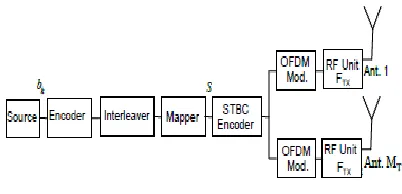
the terminal is considered. Figure 1 depicts the
transmitter modules. Information bits bk are first
channel encoded with a encoder of coding rate
R. The encoded, interleaved bits are then fed to a
phase shift keying module further complex
symbols are encoded through a space time (ST)
block code (STBC) encoder and transmitted
during T symbol durations according to the
chosen ST scheme. The ST coding rate is then
defined by L = Q/T. With MT transmitting
antennas, the output of the ST encoder is an
(MT,T) matrix X = [xi,t] where xi,t (i = 1,…,MT;
t = 1,…,T) is a function of the input symbols sq
(q = 1,…,Q) depending on STBC encoder type.
The resulting symbols are then fed to OFDM
modulator of N subcarriers.
Figure 1- Block diagram of the transmitter
After D/A conversion, the signal is transposed to
the transmitter carrier frequency FTX by the RF
unit, and transmitted through the channel. At the
receiver, it is transposed to base band with the
receiver carrier frequency FRX and sampled at
sampling frequency Fẽ = 1/Ts.
Let us now describe the transmission
link with a general model independently of the
ST coding scheme. We separate the real and
imaginary parts of the complex symbols input
vector s {sq: q = 1,…,Q}, of the outputs X of the
double layer ST encoder as well as those of the
channel matrix H, and the received signal Y. In
this work, we use an iterative receiver for
non-orthogonal schemes where the ST detector and
channel decoder exchange extrinsic information
in an iterative way until the algorithm
converges. The iterative detection and decoding
exploits the error correction capabilities of the
channel code to provide improved performance.
The estimated symbols at the first iteration are
obtained via minimum mean square error
(MMSE) filtering
III.
CONSIDERED
SPACE-TIME SCHEME
The simplest orthogonal space-time coding
scheme by Alamouti [2] is considered as a
reference with MT = 2 and MR = 2. This code is
given as
Another space-time coding scheme considered is
Silver code [4] which is full rate and full
diversity code for MT = 2 and MR = 2. The code
The other considered code is the Golden code
[5] which is designed to maximize the rate such
that the diversity gain is preserved for an
increased signal constellation size. It is also
defined for MT = 2, and MR = 2, the code is
given as
IV.
SIMULATION RESULTS
In this section, a comparative study of the
considered space-time coding schemes is done.
The performance comparison is made for a
frequency selective channel with independent
Gaussian distributed coefficients. It is computed
in terms of symbol error rate (SER) versus
signal to noise ratio (SNR) applying binary
phase shift keying (BPSK) modulation scheme.
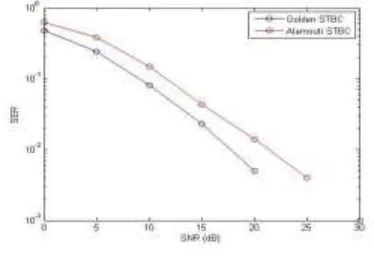
Figure 2 shows the SER performance
comparison of Golden STBC and Alamouti
STBC systems for MT = 2 transmit antennas and
MR = 2 receive antennas over frequency
selective channel. The constellation used is
BPSK. As shown in figure, the Golden STBC
outperforms the Alamouti STBC by ≈ 3 dB at a
SER of 10-1.
Figure 2- SER Performance Comparison of the Golden STBC to the Alamouti STBC
Figure 3 shows the SER performance
comparison of Silver STBC and Alamouti STBC
systems for MT = 2 transmit antennas and MR =
2 receive antennas over frequency selective
channel. The constellation used is BPSK. As
shown in figure, the Silver STBC outperforms the Alamouti STBC by ≈ 2 dB at a SER of 10-1.
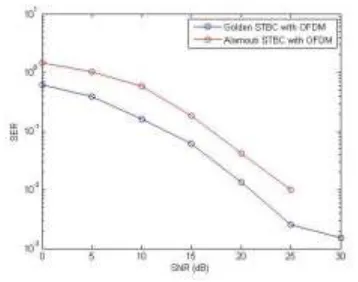
Figure 4 shows the SER performance
comparison of Golden STBC with OFDM and
Alamouti STBC system with OFDM for MT = 2
transmit antennas and MR = 2 receive antennas
over frequency selective channel. The
constellation used is BPSK. As shown in figure,
the Golden STBC outperforms the Silver STBC by ≈ 4.5 Db at a SER of 10-1.
Figure 4- SER Performance Comparison of the Golden STBC with OFDM to the Alamouti STBC with OFDM
V.
CONCLUSION
In this paper, an investigation of the
different space time codes is considered and it
has been observed that the Golden space time
code outperforms all other considered space
time codes thus providing the best results.
REFERENCES
[1] R. Prasad, Universal Wireless Personal
Communications. Norwood, MA: Artech House,
1998.
[2] G. J. Foschini, “Layered space-time
architecture for wireless communication in a
fading environment when using multi-element
antenna,” Bell Labs Tech. J., vol. 1, no. 2, pp.
41–59, 1996.
[3] S. M. Alamouti, “A simple transmit diversity
technique for wireless communications”, IEEE
J. on Selected Areas in Communications, vol. 16,
no. 8, pp. 1451-1458, Oct. 1998.
[4] C. Hollanti, J. Lahtonen, K. Ranto, R.
Vehkalahti, and E. Viterbo, “On the Algebraic
Structure of the Silver Code: A 2 × 2 Perfect
Space-time Block Code,” IEEE Information
Theory Workshop, pp. 91–94, 2008.
[5] J.-C. Belfiore, G. Rekaya, and E. Viterbo,
“The Golden code: a 2 × 2 full-rate space-time
code with non-vanishing determinants,” IEEE
Trans. In Information Theory, vol. 51, no. 4, pp.