The Age-Dependence of Personal Exposure to Electromagnetic
Fields of Wireless Communications in Indoor Environments
Enver Hamiti, Mimoza Ibrani, Luan Ahma, Doruntin¨e Berisha, Vesa Broja, and Rreze Halili
Abstract—The ever-growing usage of new information and communication technology devices by different age groups is followed with public concerns of exposure induced biological effects. The aim of this paper is to assess and compare personal exposure levels to electromagnetic fields of wireless communications for different age groups, including children, under the same exposure conditions. Assessment of personal exposure of the following age groups: 08–15, 16–20, 21–35 and 36–60 years old is conducted with sophisticated tri-axial E-field frequency selective personal exposure meters, enabling measurements of electric field strength in 14 pre-defined frequency bands in the range of 80 MHz–6 GHz. Participants are selected to be with similar social conditions and occupation, including children, students and administrative employees. The measurements were conducted in typical residential environments collecting 161 280 measurement samples. The mean value of power density of different wireless technologies is presented for each age-group, including the contribute of specific wireless technology to the total personal exposure. The highest personal exposure values per frequency band for all age groups are in GSM and Wi-Fi 2G. The results show a difference in mean power density levels between different age groups for the same exposure environment. Ultimately, all measured values were far below international safety guidelines and exposure limits.
1. INTRODUCTION
The ever-growing development and usage of wireless communications technologies, services and applications, is followed with the society concern regarding possible biological effects induced at humans as a result of exposure to radio-frequency (RF) electromagnetic fields (EMF) [1, 2]. The topic will likely remain for the foreseeable future on the scientific agenda, since radiation continue to change in characteristics and levels due to new telecommunication technologies, infrastructure deployments, smart environments and novel wireless devices [3], imposing new challenges for green communications and environments.
To address exposure safety issues many countries have set exposure limits mainly based on the widely used International Commission on Non-Ionizing Radiation Protection (ICNIRP) guidelines [4].
Few studies explored the issue whether the interaction of RF with humans is age-dependent, mainly relying on age dependence assumption of human biological tissues [5, 6], paving the way to find the more sensitive age groups to EMF, such as children. The review of policies and advice of children exposure to RF-EMF is presented in [7].
There are different methods of exposure assessment used for RF-EMF, mainly based on: 1) Spot or long-term measurements; 2) Personal exposimetry and 3) Characterization of exposure based on activities and sources [8]. Since personal exposure levels in everyday life depends from personal lifestyle including time spent in specific environment and individual behavior such as usage of wireless-enabled devices, for determination of personal exposure pattern the use of Personal Exposure Meters (PEMs)
Received 18 February 2016, Accepted 24 March 2016, Scheduled 1 April 2016 * Corresponding author: Mimoza Ibrani ([email protected]).
are recommended [9]. Evaluation of the correlation between PEMs readings and real human exposure, human body influence on measurements, the PEMs advantages and limitations are already explored and presented in [10–13].
Few exposure assessment studies to RF-EMF have been conducted using PEMs, in order to assess exposure in different scenarios, in terms of exposure duration, microenvironment and frequency bands [14–17]. The results of up-link and down-link evaluation of daily adult personal exposure induced by wireless operating networks obtained with PEMs, including the reliability of method and measurement precision, are presented in [18]. Even there is a huge variation on reported results of human exposure to RF-EMF, the summarize of exposure levels and patterns based on overview of scientific literature is given in [8].
Almost all studies conducted with PEMs used adults as target groups, without exploring the age-dependence of incident personal exposure. As stated on [19], the findings of an adult-based study do not necessarily apply to children.
Due to difficulties on measuring child personal exposure on [19, 20], as proxy for child exposures, the measurements with adults who work in close proximity to children were taken.
The results of assessment of children exposure to wireless technologies in home environment, taken by broadband in-situ measurements, are published [21]. Since different age groups have different lifestyle, it may be hypothesized that the personal exposure levels will also differ for the same exposure environment, such as residential homes.
The main objective of this study is the evaluation of the age-dependence of personal exposure to EMF of wireless communications in indoor environments, especially to explore child vs. adult incident personal exposure levels for the same exposure conditions. To reach this goal, a measurement campaign using frequency selective portable tri-axial E-field probe PEMs is conducted. After data collection and cleaning, the mean power density for each age-group exposed to different wireless technologies is presented, including the contribution of specific wireless technologies to overall personal exposure. The significant difference between the personal exposure values of different age groups, for the same exposure environment are noticed.
The study informs about typical human personal exposure levels and patterns, exposure differences between different age groups for the same exposure environment, and about exposure trends to wireless communication electromagnetic fields, since human exposure is considered as one of key requirements [22] in the process of planning and optimization of future telecommunication networks.
2. MATERIALS AND METHODS
To explore the age-dependence of personal exposure to incident EMF of new wireless technologies, the measurements campaign is conducted according to the study proprietary measurement protocol. Measurement are carried out by different age groups divided on: 8–15, 16–22, 23–35 and 36–60 years old volunteers. For each age group 8 participants were selected to perform the measurements. The measurement campaign is completed for 64 working days, within 4 months period. The participants are residing in the same living environment with very similar social, economic background and habits: comparable number of family members, similar incomes and finally similar habits in the use of wireless technologies. Participants were mainly children, students and employees with degrees in public sector. The aim was to collect more measurement samples of young groups in comparison with older ones. For each age group were captured 40 320 RF electric field strength and power density samples, resulting in total to experimental data set with 161 280 samples. All participants signed the informed consent form. For the children, in addition, the informed consent was approved by parents. During the measurements the volunteers filled an activity diary indicating the time of the measurements, usage of personal mobile devices during measurements and possible nearest base-station transmitters.
Each of participant conducted measurements for two consecutive working days. All participant were instructed to keep the measurement equipment at the same position. The measurement samples were stored and transferred via EME SPY analysis software. The in-house metadata file was built to analyze samples, map diary activities with the detected values and generate and compare results.
The participants were previously trained to use the measurement equipment, the portable EME SPY140 (Satimo, Cortaboeuf, France, http://www.satimo.fr). The PEMs were carried out in the belt when person was moving and were placed in table, near the person, at least one meter high from ground, when person was stationary. Measurement were conducted in urban areas of Kosovo.
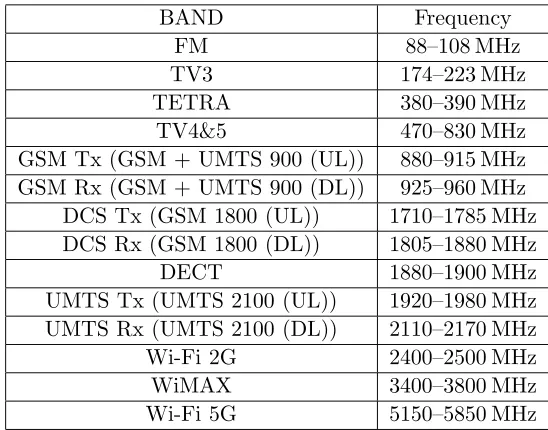
The EME SPY 140 measures electric field strength in 14 frequency bands used for wireless communication, offering possibility to differentiate up-link and down-link for cellular technologies. The measurement frequency bands of equipment used in this study are given in the Table 1.
Table 1. The measurement frequency bands of EME SPY 140.
BAND Frequency
FM 88–108 MHz
TV3 174–223 MHz
TETRA 380–390 MHz
TV4&5 470–830 MHz
GSM Tx (GSM + UMTS 900 (UL)) 880–915 MHz
GSM Rx (GSM + UMTS 900 (DL)) 925–960 MHz
DCS Tx (GSM 1800 (UL)) 1710–1785 MHz
DCS Rx (GSM 1800 (DL)) 1805–1880 MHz
DECT 1880–1900 MHz
UMTS Tx (UMTS 2100 (UL)) 1920–1980 MHz
UMTS Rx (UMTS 2100 (DL)) 2110–2170 MHz
Wi-Fi 2G 2400–2500 MHz
WiMAX 3400–3800 MHz
Wi-Fi 5G 5150–5850 MHz
EME SPY 140 lower detection limit differs from band to band (0.05 V/m for FM, 0.01 V/m for TETRA and TV4&5, 0.02 V/m for TV3, WiMAX, Wi-Fi 5G and 0.005 V/m for the rest) while the upper limit is 6 V/m. The measurement campaigns have confirmed that considered proportion of wireless technologies EMF values are below detection limit of PEMs. The common approach to treat the non-detected values is to substitute such values to the value of the detection limit. For example, the software of the EME SPY 140, in case that electric field strength is less than threshold (0.005 V/m), regardless its value, presents this measurement value as 0.004999 V/m, indicating it as a non-detected value. This way of treating the non-detects produces poor summary statistics as mean value, variance, etc., if large proportion of values are below lower detection limit. Therefore to derive more reliable EMF mean values per technology and environment the obtained measurement samples need post-processing. The postprocessing of the obtained results in the present study are based on the method described in [23]. To classify the exposure, all measurement values below the detection limit were replaced by half of the limit values before analysis (e.g., all detection values of 0.05 V/m were replaced with the value 0.025 V/m). This method is often used in the context of environmental epidemiology and the results seem plausible because all values have to be between zero and the limit of determination. The same result processing method was also used to assess the effect of RF-EMFs on the chronic well-being of young people [24].
3. RESULTS AND DISCUSSIONS
0 0.02 0.04 0.06 0.080.1 0.12 0.14 0.16 0.18 Pow e r d e n s ity (m W/m 2) 0 0.02 0.04 0.06 0.080.1 0.12 0.14 0.16 0.18 Pow e r d e n s ity (m W/m 2) 0 0.02 0.04 0.06 0.080.1 0.12 0.14 0.16 0.18 Pow e r d e n s ity (m W/m 2) 0 0.02 0.04 0.06 0.080.1 0.12 0.14 0.16 0.18 Power d e n s ity (m W/m 2) (a) (b) (c) (d)
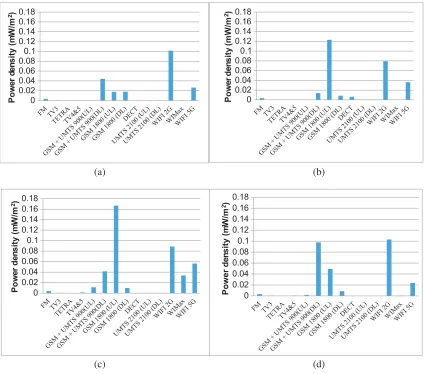
Figure 1. The mean wireless technology induced exposure levels for age groups: (a) 8–15, (b) 16–20, (c) 21–35 and (d) 36–60 years old.
Figure 1(a) shows the highest personal exposure values per frequency band for the 8–15 year old children are in the Wi-Fi 2G with a mean value of power density 0.101 mW/m2 and GSM 900 downlink with 0.044 mW/m2. Based on declared habits of participants in the measurement campaign on the use of wireless technologies, this level of exposure is a result of the use of Internet through Wi-Fi 2G network, several kinds of play stations and GSM 900 mobile phones. Also results seems to be in accordance with parents claims for the children’s behavior in regard of the use of wireless technologies.
For the 16–20 years old the dominant identified contributors were GSM 1800 uplink with mean power density value of 0.123 mW/m2 and Wi-Fi 2G with 0.079 mW/m2. Figs. 1(a) and 1(b) show comparable levels of personal exposures and use of wireless devices for age groups 8–15 and 16–20 years old, indicating trend of increased usage of smart mobile phones for the second age group.
For the 21–35 years old participants (Fig. 1(c)) the mean value of power density of GSM 1800 uplink was 0.166 mW/m2 and Wi-Fi 2G with 0.088 mW/m2. The high values of Wi-Fi 2G were caused by the popular device Playstation4 used by participants during the measurement periods. In this age is apparent domination of the use of mobile phones with GSM 1800 network to Wi-Fi network 2G and 5G. Based on the given data in personal diaries, this is related to the demand connected with daily activities such as study liabilities, commitments to work, etc..
the use of same wireless technologies, which were also the dominant against other technologies to the previous groups.
Figure 1 shows that even though all the participants conducted the measurements in similar residential environments, there is a significant difference between the personal exposure values.
Through analysis of the activity diaries, the conclusion was that the differences were caused by the different individual behaviors of the participants. From the analyses it may be concluded that children use Internet almost as much as adults, while the same hold no true for mobile phones.
Figure 2 summarizes the Mean total exposureS (mW/m2), giving trend of exposure with age.
0 0.1 0.2 0.3 0.4 0.5
8-15 16-20 21-35 36-60
Power density
(
mW/
m
2)
Age groups
Figure 2. Mean total exposure induced by wireless technologies.
Younger participants have a greater usage of wireless devices and hence the exposure levels are higher due to the presence of wireless access points. The mean total exposure is also directly related to phone calls and their duration in time.
In Fig. 3 is given the contribution of each wireless technology to the overall exposure per age-groups. Our study is focused on specific age groups in typical residential environment. The future studies should be conducted with larger number of samples and age-groups to verify differences between age cohorts’ exposure and also variance of exposure levels between participants in same cohort.
0% 10% 20% 30% 40% 50% 60% 70% 80% 90% 100%
8-15 16-20 21-35 36-60
WIFI 5G WIMax WIFI 2G UMTS 2100 (DL) UMTS 2100 (UL) DECT
GSM 1800 (DL) GSM 1800 (UL) GSM + UMTS 900 (DL) GSM + UMTS 900 (UL) TV4&5
TETRA
Figure 3. Comparison of technologies share in overall exposure.
3.1. Comparison of Measurement Data with ICNIRP Limits
0 2 4 6 8 10
Pwer density
(W/
m
)
8-15 16-20 21-35 36-60 ICNIRP
2
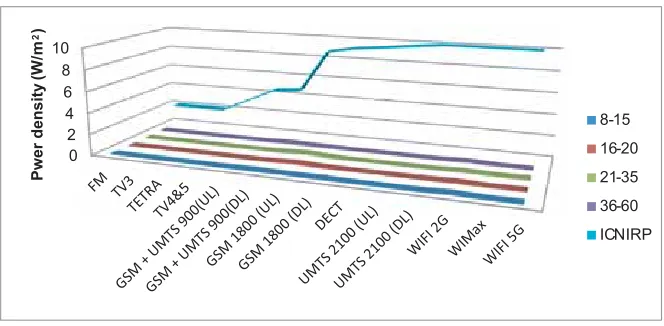
Figure 4. Comparison of measurement data with ICNIRP limits.
with ICNIRP reference levels. Almost all power density mean values in the typical exposure scenarios are approximately <0.001% of the ICNIRP reference values.
In Fig. 4 are presented the mean values of the power density S (mW/m2) for exposed age groups compared to the ICNIRP guidelines.
3.2. Comparison with Similar Measurement Campaigns
We have compared results obtained from our measurement campaign with those reported by similar studies [23, 25, 26].
Our results reveal that the exposure levels induced by operating wireless networks in Kosovo for all age groups are in close agreement with those reported on [25], the former reporting typical power densities outdoors in the range 0.01 to 1 mW/m2. Reported power density levels could be orders of magnitude higher (≥ 100 mW/m2) depending on where the measurements are taken. Base stations, radio and television transmitters can be the largest sources of radio frequency fields. This scenario is not explored in our case and should be the worst case scenario for possible future examination.
The results of in-situ measurement of mean power density of children exposure are given by [26]: 0.0215 W/m2 (0.09 V/m) for GSM base stations, 0.0321 W/m2 (0.11 V/m) for DECT and 0.0265 W/m2 (0.10 V/m) for Wi-Fi. The typical children exposure levels to RF-EMF are reported to be <0.001% of the corresponding regulatory limits. The results of our study re-confirm that personal exposure to RF-EMF for all age groups are approximately<0.001% of the ICNIRP reference levels.
While exploring the possible association between exposure to mobile telecommunication networks and well-being in children and adolescents using personal dosimetry, the study [23] reported that the median exposure to RF-EMF of children and adolescents was 0.18% and 0.19% of the ICNIRP reference level respectively, but variation in exposure are possible if the measurement location is close to a mobile phone base station.
4. CONCLUSIONS
The biggest contributor to the total exposure is a GSM 1800 uplink with 40%. Finally, for the age group of 36–60 the biggest contributor to the overall exposure was GSM 1800 uplink with 30%.
The significant difference between the exposure values of different age groups, for the same exposure environment, is mainly due to individual behavior, which is age-dependent, resulting in differences in exposure levels for different ages.
Even the differences per age-group are observed, all measured values are far below the ICNIRP reference values.
Finally, we may confirm that the values obtained in the case of Kosovo are in the same range with the values obtained in other countries. In order to have complete validated results for age-dependence of personal exposure to electromagnetic fields of wireless communications, for future studies, other measurement campaigns with a worst case scenario measurement protocol in various microenvironments, with larger measurement samples and more age groups, are recommended.
REFERENCES
1. Foster, K. R., “A world awash with wireless devices: Radio-frequency exposure issues,” IEEE Microwave Magazine, Vol. 14, No. 2, 73–84, 2013.
2. Eurobarometer, Eurobarometer 347, Wave 73.3, Electromagnetic Fields, Directorate General for Health and Consumer Affairs, Brussels, Belgium, 2010.
3. D¨urrenberger, G., J. Fr¨ohlich, M. R¨osli, and M. O. Mattsson, “EMF monitoring — Concepts, activities, gaps and options,”International Journal of Environmental Research and Public Health, Vol. 11, No. 9, 9460–9479, 2014.
4. International Commission on Non-Ionizing Radiation Protection, “Guidelines for limiting exposure to time-varying electric, magnetic, and electromagnetic fields (up to 300 GHz),” Health Physics, Vol. 74, No. 4, 494–522, 1998.
5. Ibrani, M., L. Ahma, E. Hamiti, and J. Haxhibeqiri, “Derivation of electromagnetic properties of child biological tissues at radio frequencies,”Progress In Electromagnetics Research Letters, Vol. 25, 87–100, 2011.
6. Gabriel, C., “Dielectric properties of biological tissue: variation with age,” Bioelectromagnetics, Vol. 26, No. S7, S12–S18, 2005.
7. Redmayne, M., “International policy and advisory response regarding children’s exposure to radio frequency electromagnetic fields (RF-EMF),” Electromagnetic Biology and Medicine, 1–9, 2015, ahead-of-print.
8. Gajˇsek, P., P. Ravazzani, J. Wiart, J. Grellier, T. Samaras, and G. Thur´oczy, “Electromagnetic field exposure assessment in Europe radiofrequency fields (10 MHz–6 GHz),” Journal of Exposure Science and Environmental Epidemiology, Vol. 25, No. 1, 37–44, 2015.
9. Mann, S., “Assessing personal exposures to environmental radiofrequency electromagnetic fields,”
Comptes Rendus Physique, Vol. 11, No. 9, 541–555, 2010.
10. De Miguel-Bilbao, S., J. Garc´ıa, V. Ramos, and J. Blas, “Assessment of human body influence on exposure measurements of electric field in indoor enclosures,” Bioelectromagnetics, Vol. 36, No. 2, 118–132, 2015.
11. Kwak, S. I., J. H. Kwon, and Y. J. Yoon, “Design of theE-field probe for mobile communication bands in the personal exposure meter,” The 18th IEEE International Symposium on Consumer Electronics (ISCE 2014), 1–2, IEEE, June 2014.
12. Lauer, O., H. Benedickter, G. Neubauer, M. Roosli, and J. Frohlich, “Calibration measurement setup for band-selective personal exposure meters,” 2010 Asia-Pacific Symposium on Electromagnetic Compatibility (APEMC), 381–384, IEEE, April 2010.
13. Vanveerdeghem, P., P. Van Torre, A. Thielens, J. Knockaert, W. Joseph, and H. Rogier, “Compact personal distributed wearable exposimeter,”IEEE Sensors Journal, Vol. 5, No. 8, 2014.
15. Gryz, K., J. Karpowicz, W. Leszko, and P. Zradzinski, “The frequency-selective evaluation of radiofrequency electromagnetic radiation in the public accessible indoor environment,” 2014 International Symposium on Electromagnetic Compatibility (EMC Europe), 381–384, IEEE, September 2014.
16. Thur´oczy, G., F. Moln´ar, G. J´anossy, N. Nagy, G. Kubinyi, J. Bakos, and J. Szab´o, “Personal RF exposimetry in urban area,” Annals of Telecommunications-annales des t´el´ecommunications, Vol. 63, No. 1–2, 87–96, 2008.
17. Bolte, J. F. and T. Eikelboom, “Personal radiofrequency electromagnetic field measurements in the Netherlands: Exposure level and variability for everyday activities, times of day and types of area,”Environment International, Vol. 48, 133–142, 2012.
18. Ibrani, M., E. Hamiti, L. Ahma, R. Halili, V. Shala, and D. Berisha, “Narrowband frequency-selective up-link and down-link evaluation of daily personal-exposure induced by wireless operating networks,” Wireless Networks, Advance online publication 10.1007/s11276-016-1215-1, 2016. 19. Vermeeren, G., I. Markakis, F. Goeminne, T. Samaras, L. Martens, and W. Joseph, “Spatial and
temporal RF electromagnetic field exposure of children and adults in indoor micro environments in Belgium and Greece,” Progress in Biophysics and Molecular Biology, Vol. 113, No. 2, 254–263, 2013.
20. Juh´asz, P., J. Bakos, N. Nagy, G. J´anossy, V. Finta, and G. Thur´oczy, “RF personal exposimetry on employees of elementary schools, kindergartens and day nurseries as a proxy for child exposures,”
Progress in Biophysics and Molecular Biology, Vol. 107, No. 3, 449–455, 2011.
21. Ibrani, M., L. Ahma, and E. Hamiti, “Assessment of the exposure of children to electromagnetic fields from wireless communication devices in home environments,”IET Communications, Vol. 8, No. 12, 2222–2228, 2014.
22. Liu, N., D. Plets, S. K. Goudos, L. Martens, and W. Joseph, “Multi-objective network planning optimization algorithm: Human exposure, power consumption, cost, and capacity,” Wireless Networks, Vol. 21, No. 3, 841–857, 2015.
23. Thomas, S., A. K¨uhnlein, S. Heinrich, G. Praml, R. von Kries, and K. Radon, “Exposure to mobile telecommunication networks assessed using personal dosimetry and well-being in children and adolescents: The German MobilEe-study,”Environ Health, Vol. 7, No. 1, 55, 2008.
24. Heinrich, S., S. Thomas, C. Heumann, R. von Kries, and K. Radon, “The impact of exposure to radio frequency electromagnetic fields on chronic well-being in young people — A cross-sectional study based on personal dosimetry,” Environment International, Vol. 37, No. 1, 26–30, 2011. 25. Kheifets, L., M. Repacholi, R. Saunders, and E. Van Deventer, “The sensitivity of children to
electromagnetic fields,”Pediatrics, Vol. 116, No. 2, 303–313, 2005.