Available online: https://edupediapublications.org/journals/index.php/IJR/ P a g e | 533
An Effective and Stabilization of Expansive Soils using Flyash
Syed Saba Sulthana
M.Tech, Department of Civil Engineering
ABSTRACT:Virtually 51.8 million hectares of land
discipline in India are blanketed with Expansive soil (in most casesBlack Cotton soil). The property of those expansive soils, more often than not, is that they're very toughwhen within the dry state, however, they lose all of their strength when in the wet state. In gentle of this propertyof expansive soils, these soils pose problems international that serve as a project to beatfor the Geotechnical engineers. Broad laboratory/area trials were carried out viaquite a lot of researchers and have proven promising outcome for software of such expansive soil afterstabilization with additives comparable to sand, silt, lime, fly ash, etc. As fly ash is freely on hand, fortasks within the vicinity of Thermal power crops, it can be used for stabilization of expansive soils forvarious makes use of. The gift paper describes a be taught implemented to examine the upgrades in thehouses of expansive soil with fly ash in various percentages. Both laboratory trials and field testshad been implemented and the outcome is suggested in this paper. Some of the fundamental difficulties in subjectsoftware are thorough mixing of the two substances (expansive soil and fly ash) in required proportion to form a homogeneous mass. The paper describes a method adopted for putting these materials inlayers of required thickness and working a “Disc Harrow.
KEYWORDS-Compaction, field tests, fly ash, laboratory tests, plastic clay, stabilization
I. INTRODUCTION
Expansive soils, which are also called as swell-shrink soil, have the tendency to shrink and swell with variation in moisture content. As a result of this variation in the soil, significantdistress occurs in the soil, which is subsequently followed by damage to the overlyingstructures. During periods of greater moisture, like monsoons, these soils imbibe the water, andswell; subsequently, they become soft and their water holding capacity diminishes. As opposedto this, in drier seasons, like Summers, these soils lose the moisture held in them
due toevaporation, resulting in their becoming harder. Generally found in semi-arid and arid regionsof the globe, these types of soils are regarded asa potential natural hazard – if not treated, thesecan cause extensive damage to the structures built upon them, as well causing loss of humanlife. Soils whose composition includethe presence of montmorillonite, in general, display thiskind of properties. Tallied in billions of dollars annually worldwide, these soils have causedextensive damage to civil engineering structures.Also called as Black Cotton soils or Regur soils, expansive soils in the Indian subcontinent aremainly found over the Deccan trap (Deccan lava tract), which includes Maharashtra, AndhraPradesh, Gujarat, Madhya Pradesh, and some scattered places in Odisha. These soils are alsofound in the river valley of the Narmada, Tapi, Godavari and Krishna. The depth of black cottonsoil is very large in the upper parts of the Godavari and Krishna, and the northwestern part ofDeccan Plateau. Basically, after the chemical decomposition of rocks such as basalt by variousdecomposing agents, these are the residual soils left behind at the place of such an event.Cooling of volcanic eruption (lava) and weathering another kind of rock – igneous rocks – arealso processes of formation of these types of soils. Rich in lime, alumina, magnesia, and iron,these soils, lackof nitrogen, phosphorus and organic content.
Available online: https://edupediapublications.org/journals/index.php/IJR/ P a g e | 534 waterlines, irrigation systems, sewer lines, and
slab-on-grade members.
II. RELATED WORKS
A waste material extracted from the gases emanating from coal-fired furnaces, generally of athermal power plant, is called fly ash. One of the chief usages of volcanic ashes in the ancientages was the use of it as hydraulic cement, and fly ash bears theclosest resemblance to these volcanic ashes. These ashes were believed to be one of the best pozzolans (binding agent) usedin and around the globe.
The demand for power supply has exponentially heightened these days due to increasingurbanization and industrialization phenomena. Subsequently, this growth has resulted in theincrease in the number of power supplying thermal power plants that use coal as a burning fuel toproduce electricity. The mineral residue that is left behind after the burning of coal is the flyash. The Electro Static Precipitator (ESP) of the power plants collect these fly ashes.Production of fly ash comes with two major concerns – safe disposal and management of flyash. Because of the possession of the complex characteristics of wasters which are generated fromthe industries, and their hazardous nature, these wastes pose a necessity of being disposed of in asafe and effective way, so as to not disturb the ecological system, and not causing any sort ofcatastrophe to human life and nature. Environmental pollution is imminent unless theseindustrial wastes are pre-treated before their disposal or storage.
Essentially consisting of alumina, silica, and iron, fly ashes are micro-sized particles. Fly ashparticles are generally spherical in size, and this property makes it easy for them to blend andflow, to make a suitable concoction. Both amorphous and crystalline nature of minerals is thecontent of fly ash generated. Its content varies with the change in the nature of the coal used forthe burning process, but it basically is a non-plastic silt. For waste liners, fly ash is a potentialmaterial that can be employed; and in combination with certain minerals (lime and bentonite),fly ash can be used as a barrier material. In the present scenario, the generation of this wastematerial in the picture (fly ash) is far more than its current utilization. In other words, we areproducing more of fly ash than we can spend.
III. THE PROPOSED APPROACH
Following laboratory tests have been carried out as per IS: 2720. The tests were carried out both onnatural soil and stabilized soil with fly ash collected from Ennore Thermal Power Plant.
(i) Grain Size Analysis (ii) Atterberg Limit Test (iii) Proctor Compaction Test (iv) Unconfined Compression Test (v) Permeability Tes
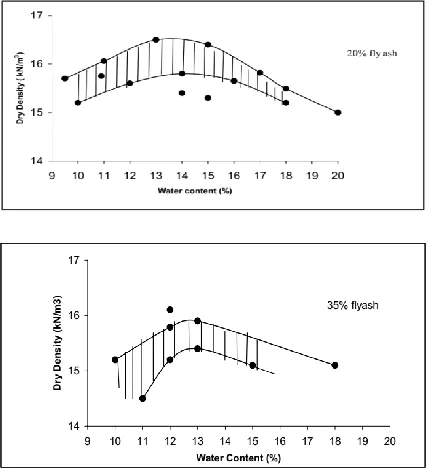
After removing impurities like vegetation, stones, etc. the soil was mixed with fly ash in varyingproportion by volume. The Mixing was thoroughly carried out manually and the tests were conductedas per standard procedures.The liquid limit and plastic limit of the soil with varying percentage of fly ash is given in Table 1. Theproctor tests carried out is summarized in Fig.1.
Fig 1. Typical relationship between dry density and water content
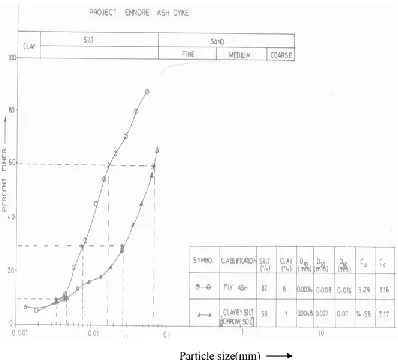
Available online: https://edupediapublications.org/journals/index.php/IJR/ P a g e | 535 Fig 2. Grain size analysis of borrow soil and fly ash
IV. EXPERIMENTAL SETUP
Field trails were carried out by constructing an embankment measuring 3 to 4m wide and 30m long.The height of the embankment was about 600mm. Each layer of 200mm loose thickness was placedwith the varying fly ash content. To achieve the desired fly ash content, the layers were placed such that the fly ash layer is sandwiched between two soil layers as per the details given in Table 4.For each trial mix, the required thickness of borrow soil was manually spread first. Above this, fly ashcollected from the ESP of the Thermal Power Plant was spread. This was again followed by a thirdlayer of soil. The layer of fly ash was sandwiched between two layers of soil to prevent it from flyingoff.
After this, a disc harrow equipment shown in Fig. 3 was used for uniform mixing of soil and fly ash.This equipment is a circular disc, which penetrates through the loosely placed layers and pulledhorizontally by a tractor. The discs rotate in such a fashion that the soil is shuffled and mixedthoroughly. It was observed at a site that after about eight passes of the disc harrow, the dry mixing ofthe two materials was quite satisfactory and with uniform colour of the mix.After this, the required quantity of water was manually sprayed over the layer to achieve the requiredmoisture content of 15%, 6 passes of disc harrow were made for uniform mixing of additional waterwith the material already mixed. After 6 passes, the mixing of moisture was found to be uniform.Though a sheep foot roller is ideally suited for compaction of plastic
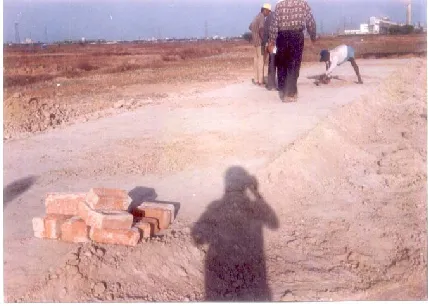
clay, after mixing with fly ash,there was considerable improvement in the workability, the compaction was therefore carried out witha 12 tonne smooth wheel roller. Each layer of mix, prepared as above was compacted with 8 passesof the roller. The material after compaction was found to be quite hard and no significant penetrationof the roller wheel was noticed during the last 2 passes. After compaction the thickness of the layer(initial loose thickness of 200mm) was found to be 120 to 130mm. Fig. 4 shows a view of a compactedlayer.To check the adequacy of compaction, following control tests was carried out on each of thecompacted layers.
(i) In-site density by core cutter
(ii) Natural moisture content
(iii) Light cone penetration test
TABLE 1: Atterberg limits of Soil–Flyash mixtures
Soil Type Liquid
Limit (%) Limit (%) Plastic Plasticity index(%)
Soil alone 30 18 12 Soil +
10% FA 28 20 8
Soil +
20% FA 29 19 10
Soil + 25% FA
30 19 11
Soil + 30% FA
30 21 9
Soil +
Available online: https://edupediapublications.org/journals/index.php/IJR/ P a g e | 536 Fig 3.Soil flyash mixing with a disc harrow
Fig.4 View of compacted surface (soil with 20% FA)
V. CONCLUSION
The ordinary soil used for construction shall be dried with the moisture content material below 7%. If the soil has extra moisture it's problematic to mix with FA. Such soil can be spread on the surface and allowed to dry before construction. Presence of dry clay lumps in the borrow soil raises the quantity of passes of disc harrow for mixing. It is, thus, crucial to do away with such soil lumps in the development. It is found that inserting of two unique materials (local soil and FA) in three layers with FA layer sandwiched between soil layers and mixing them with disc harrow is workable. It's most popular to cover the compacted soil-FA bound with a compatible soil cover of minimal 500mm thickness. For this rationale suitable borrow soil of CI variety (in limited variety) will probably be used.
REFERENCES
[1] Chen, F. H. (1988), “Foundations on expansive soils”, Chen & Associates, Elsevier Publications,U.S.A.
[2] Erdal Cokca (2001) “Use Of Class C Fly Ashes for the Stabilization – of an Expansive Soil”Journal of Geotechnical and Geoenvironmental Engineering Vol. 127, July, pp. 568-573.
[3] Pandian,N.S.,Krishna,K.C.& Leelavathamma B., (2002), Effect of Fly Ash on the CBR Behaviour ofSoils , Indian Geotechnical Conference , Allahabad , Vol.1,pp.183-186.
[4] Phanikumar B.R., & Radhey S.Sharma(2004) “Effect of flyash on Engg properties of ExpansiveSoil” Journal of Geotechnical and Geoenvironmental Engineering Vol. 130, no 7,July, pp. 764-767.
[5] Prashanth J.P., (1998)"Evaluation of the Properties of Fly Ash for its Use in GeotechnicalApplications ".Ph.D Thesis, IISC. Bangalore.
[6] Raymond N.Yong and Benno P.Warkentin (1975)" Soil Properties and BehaviourElsevier Publications, U.S.A.
[7] Radhakrishnan, G., Kumar, M.A., and Raju, G.V.R.P. (2014), “Swelling Properties ofExpansive Soils Treated with Chemicals and Fly ash”, American Journal ofEngineering Research. Vol. 3, Issue 4, pp. 245-250.
[8] Raut, J.M., Bajad, S.P., and Khadeshwar, S.P. (2014), “Stabilization of Expansive SoilsUsing Fly ash and Murrum”, International Journal of Innovative Research in Science,Engineering and Technology. Vol. 3, Issue 7.
[9] Satyanarayana P.V.V., Kumar, S.H., Praveen, P., Kumar, B.V.S. (2013), “A Study onStrength Characteristics of Expansive Soil-Fly ash Mixes at Various Moulding, WaterContents”, International Journal of Recent Technology and Engineering. Vol. 2, Issue5.
[10] Senol, A., Etminan. E., and Olgun, C. (2012), “Stabilization of Clayey Soils Using FlyAsh and Homopolymerpolypropylene”, GeoCongress, pp. 3929-3938.
Available online: https://edupediapublications.org/journals/index.php/IJR/ P a g e | 537 Syed Saba Sulthana completed M.Tech(Geotechnical